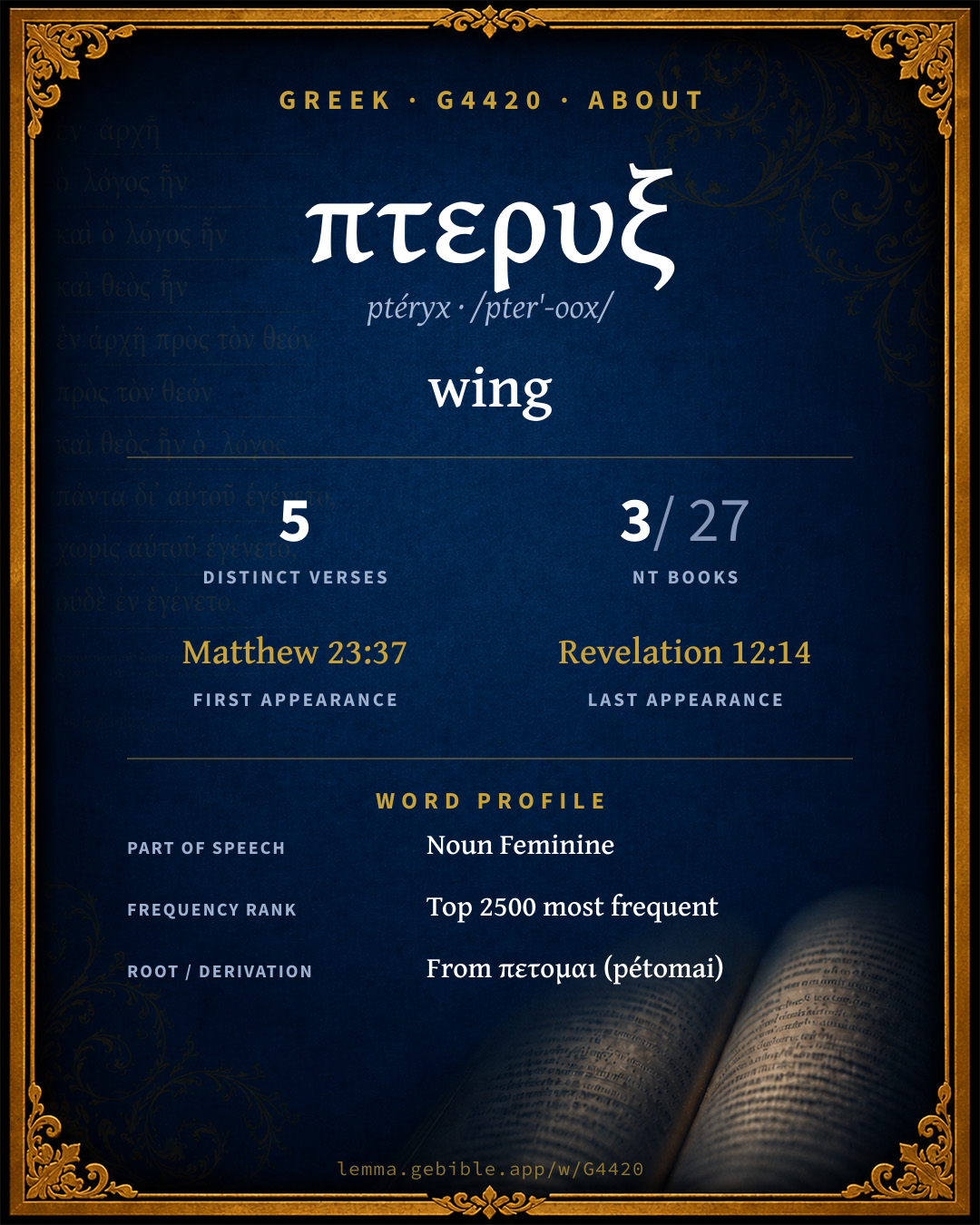
πτέρυξ
wing
Full lexicon entry — Thayer's Greek Lexicon
From Thayer's Greek Lexicon
Where this word appears
See every Accusative-case word in the Greek New Testament →
Grammar key — what these labels mean
Part of speech
- Noun
- A naming word — a person, place, thing, or idea.
Case
- Accusative
- The case of the direct object and of extent.
- Genitive
- The case of source, possession, or “of” — answers “whose / from what.”
- Nominative
- The case of the subject (and the predicate nominative).
Gender
- Feminine
- Grammatically feminine.
Number
- Plural
- More than one.
Grammatical forms
- Noun, Accusative, Plural, Feminine 3 times (60%)
- Noun, Genitive, Plural, Feminine 1 time (20%)
- Noun, Nominative, Plural, Feminine 1 time (20%)
Parsed forms decoded from the imported morphology (Robinson–Tischendorf, public domain), counted across 5 parsed occurrences — not distinct verses.
Every verse where G4420 appears — 5 distinct verses across 3 books. Click any verse to open its interlinear word-by-word view. Verse text shown in the World English Bible for context — . Each verse’s Greek form is shown with its reference; the English is not keyword-highlighted, since the data carries no word-level English alignment. Use “Compare translations” on any verse to read it across multiple English versions. This concordance covers the Greek New Testament; Septuagint (Greek Old Testament) occurrences of this word are not indexed here.
Matthew 1 verse
Luke 1 verse
Revelation 3 verses
- Revelation 4:8 πτέρυγας n acc pl fem The four living creatures, each one of them having six wings, are full of eyes around about and within. They have no rest day and night, saying, "Holy, holy, holy, holy, holy, holy, holy, holy, holy is the Lord God, the Almighty, who was and who is and who is to come!"
- Revelation 9:9 πτερύγων n gen pl fem They had breastplates, like breastplates of iron. The sound of their wings was like the sound of chariots, or of many horses rushing to war.
- Revelation 12:14 πτέρυγες n nom pl fem Two wings of the great eagle were given to the woman, that she might fly into the wilderness to her place, so that she might be nourished for a time, and times, and half a time, from the face of the serpent.
About this entry
At a glance — auto-summarized from this page’s data, not written by a person. Every figure links to its source below. This summary describes the numbers; it doesn’t interpret them.
“wing” is the headline sense of the Greek noun πτερυξ (ptéryx). With only 5 verses it sits in the long tail of Greek New Testament vocabulary. More than half of its appearances fall in Revelation. Its earliest occurrence is Matthew 23:37. Related forms include πετομαι, πετεινον and πιπτω. The sections below give every sense, occurrence, and version rendering.
Gloss history
Strong's 1890 vs modern scholarship
About this word
Strong's G4420 catalogs a Greek word from the Greek New Testament.
These counts are not copied from any lexicon or concordance. They are computed here, from the morphology-tagged Greek New Testament. What Lemma adds →
- 5
- distinct verses
- The word appears in 5 distinct verses.
- 3 / 27
- NT books
- The word appears in 3 of 27 New Testament books.
- #1,648
- by frequency
- Top 2500 most frequent Greek words (rank 1,648 of 5,347 Greek words by occurrence).
View all 5 occurrences in the concordance →
Most concentrated in
- Revelation 3 verses 60%
- Matthew 1 verse 20%
- Luke 1 verse 20%
By section of the New Testament
By traditional corpus
Conventional, traditional groupings — biblical authorship is debated, so this is a traditional corpus grouping, not an authorship claim. Some books belong to more than one corpus (Luke is in both the Gospels and the Lukan corpus, and so on), so these shares overlap and need not total 100%. Each figure is a share of the word’s 5 distinct verses.
- Johannine 3 verses · 60%
- Revelation 3 verses · 60%
- Gospels 2 verses · 40%
- Lukan (Luke–Acts) 1 verse · 20%
How translations render this word
Counts come from each version’s own published word-to-Strong’s tagging or interlinear alignment — an approximate guide to how each version renders this word, not a word-level alignment the data otherwise carries. Because each total is that version’s own tagged count, the per-version totals vary from one another and need not match the appearance or distinct-verse counts above. These counts may also differ from a printed concordance because Lemma counts each distinctly tagged rendering and does not collapse phrase taggings into a single head-word total. This is a fixed set of word-tagged versions (KJV, ASV, BSB, ULT) and does not change with the reading translation you choose elsewhere. Each version’s license is shown beside its name below (and on Sources).
- King James Version: Wings 5×
- American Standard Version: Wings 5×
- Berean Standard Bible: Wings 5×
- unfoldingWord Literal Text: Wings 5×
King James Version Public Domain
Renders G4420 across 5 tagged occurrences — most commonly:
American Standard Version Public Domain
Renders G4420 across 5 tagged occurrences — most commonly:
Berean Standard Bible Public Domain
Renders G4420 across 5 tagged occurrences — most commonly:
unfoldingWord Literal Text CC BY-SA 4.0
Renders G4420 across 6 tagged occurrences — most commonly:
Plus 1 rendering that appears only once — usually multi-word phrases or single function words the recovered tagging swept in, not distinct renderings.
Senses in Thayer's
The 1 sense Thayer's distinguishes for this word, in lexicon order (not ranked by frequency or importance). The full entry — with sub-senses — is in the Lexicon Entry tab.
- a wing: of birds
Word origin
Derived from πετομαι (pétomai) (G4072) — to fly.
From a derivative of G4072 (meaning a feather ); a wing : - wing.
— Strong’s Exhaustive Concordance (1890), public domain.
Forms in the corpus
The 3 distinct written forms G4420 takes in the Greek New Testament, most frequent first — each parse links to that case’s occurrences in the concordance.
| Form | Parsing | Example | Uses |
|---|---|---|---|
| πτέρυγας ptérygas | Noun, Accusative, Plural, Feminine | Matthew 23:37 | 3 |
| πτέρυγες ptéryges | Noun, Nominative, Plural, Feminine | Revelation 12:14 | 1 |
| πτερύγων pterýgōn | Noun, Genitive, Plural, Feminine | Revelation 9:9 | 1 |
Same root — word family
Other Thayer's entries built from the same root as G4420, grouped by Strong’s listed origin. These share a root / origin per the lexicon — not necessarily a shared meaning. Each links to that word’s own entry.
Derives from
Shares the same root
Derived from this word
Compare all same-root words → Showing 4 of 6 — not the complete family. They share a root, not necessarily a meaning.
Septuagint usage
The same Greek word πτερυξ appears 76 times in the Greek Old Testament (Septuagint), across 60 verses in 19 books.
- 76
- LXX occurrences
- Tagged occurrences of this Greek word in the Septuagint.
- 60
- verses
- Distinct Septuagint verses containing this word.
- 19 / 39
- OT books
- The word appears in 19 of the 39 Old Testament books.
Sample Septuagint occurrences
- Exodus 19:4 πτέρυξ
- Leviticus 1:17 πτέρυξ
- Deuteronomy 32:11 πτέρυξ
- Ruth 2:12 πτέρυξ
- 2 Samuel 22:11 πτέρυξ
- 1 Kings 6:27 πτέρυξ
- 1 Chronicles 28:18 πτέρυξ
- 2 Chronicles 3:11 πτέρυξ
- Job 37:3 πτέρυξ
- Psalms 16:8 πτέρυξ
- Proverbs 23:5 πτέρυξ
- Ecclesiastes 10:20 πτέρυξ
Septuagint occurrences (same lexeme)
Every verse where the same Strong’s number (G4420) appears in the Greek Septuagint — showing the first 50 of 60. Verse text shown in the World English Bible for context; the Greek form is the matched word — the English is not keyword-highlighted.
- Exodus 19:4 πτέρυξ 'You have seen what I did to the Egyptians, and how I bore you on eagles' wings, and brought you to myself.
- Exodus 25:20 πτέρυξ The cherubim shall spread out their wings upward, covering the mercy seat with their wings, with their faces toward one another. The faces of the cherubim shall be toward the mercy seat.
- Exodus 38:8 πτέρυξ He made the basin of brass, and its base of brass, out of the mirrors of the ministering women who ministered at the door of the tent of meeting.
- Leviticus 1:17 πτέρυξ He shall tear it by its wings, but shall not divide it apart. The priest shall burn it on the altar, on the wood that is on the fire. It is a burnt offering, an offering made by fire, of a sweet savor to Yahweh.
- Deuteronomy 32:11 πτέρυξ As an eagle that stirs up her nest, That flutters over her young, He spread abroad his wings, he took them, He bore them on his feathers.
- Ruth 2:12 πτέρυξ Yahweh recompense your work, and a full reward be given you of Yahweh, the God of Israel, under whose wings you are come to take refuge.
- 2 Samuel 22:11 πτέρυξ He rode on a cherub, and did fly; Yes, he was seen on the wings of the wind.
- 1 Kings 6:27 πτέρυξ He set the cherubim within the inner house; and the wings of the cherubim were stretched forth, so that the wing of the one touched the one wall, and the wing of the other cherub touched the other wall; and their wings touched one another in the midst of the house.
- 1 Kings 8:6 πτέρυξ The priests brought in the ark of the covenant of Yahweh to its place, into the oracle of the house, to the most holy place, even under the wings of the cherubim.
- 1 Kings 8:7 πτέρυξ For the cherubim spread forth their wings over the place of the ark, and the cherubim covered the ark and the poles of it above.
- 1 Chronicles 28:18 πτέρυξ and for the altar of incense refined gold by weight; and gold for the pattern of the chariot, [even] the cherubim, that spread out [their wings], and covered the ark of the covenant of Yahweh.
- 2 Chronicles 3:11 πτέρυξ The wings of the cherubim were twenty cubits long: the wing of the one [cherub] was five cubits, reaching to the wall of the house; and the other wing was [likewise] five cubits, reaching to the wing of the other cherub.
- 2 Chronicles 3:12 πτέρυξ The wing of the other cherub was five cubits, reaching to the wall of the house; and the other wing was five cubits [also], joining to the wing of the other cherub.
- 2 Chronicles 3:13 πτέρυξ The wings of these cherubim spread themselves forth twenty cubits: and they stood on their feet, and their faces were toward the house.
- 2 Chronicles 5:7 πτέρυξ The priests brought in the ark of the covenant of Yahweh to its place, into the oracle of the house, to the most holy place, even under the wings of the cherubim.
- 2 Chronicles 5:8 πτέρυξ For the cherubim spread forth their wings over the place of the ark, and the cherubim covered the ark and the poles of it above.
- Job 37:3 πτέρυξ He sends it forth under the whole sky, And his lightning to the ends of the earth.
- Job 38:13 πτέρυξ That it might take hold of the ends of the earth, And shake the wicked out of it?
- Job 39:13 πτέρυξ "The wings of the ostrich wave proudly; But are they the feathers and plumage of love?
- Job 39:26 πτέρυξ "Is it by your wisdom that the hawk soars, And stretches her wings toward the south?
- Psalms 16:8 πτέρυξ I have set Yahweh always before me. Because he is at my right hand, I shall not be moved.
- Psalms 17:11 πτέρυξ They have now surrounded us in our steps. They set their eyes to cast us down to the earth.
- Psalms 35:8 πτέρυξ Let destruction come on him unawares. Let his net that he has hidden catch himself. Let him fall into that destruction.
- Psalms 54:7 πτέρυξ For he has delivered me out of all trouble. My eye has seen triumph over my enemies.
- Psalms 56:2 πτέρυξ My enemies want to swallow me up all day long, For they are many who fight proudly against me.
- Psalms 60:5 πτέρυξ So that your beloved may be delivered, Save with your right hand, and answer us.
- Psalms 62:8 πτέρυξ Trust in him at all times, you people. Pour out your heart before him. God is a refuge for us. Selah.
- Psalms 67:14 πτέρυξ
- Psalms 90:4 πτέρυξ For a thousand years in your sight Are but as yesterday when it is past, As a watch in the night.
- Psalms 103:3 πτέρυξ Who forgives all your sins; Who heals all your diseases;
- Psalms 138:9 πτέρυξ
- Proverbs 23:5 πτέρυξ Why do you set your eyes on that which is not? For it certainly sprouts wings like an eagle and flies in the sky.
- Ecclesiastes 10:20 πτέρυξ Don't curse the king, no, not in your thoughts; And don't curse the rich in your bedchamber: For a bird of the sky may carry your voice, And that which has wings may tell the matter.
- Isaiah 6:2 πτέρυξ Above him stood the seraphim. Each one had six wings. With two he covered his face. With two he covered his feet. With two he flew.
- Isaiah 11:12 πτέρυξ He will set up an ensign for the nations, and will assemble the outcasts of Israel, and gather together the dispersed of Judah from the four corners of the earth.
- Isaiah 18:1 πτέρυξ Ah, the land of the rustling of wings, which is beyond the rivers of Ethiopia;
- Isaiah 24:16 πτέρυξ From the uttermost part of the earth have we heard songs: Glory to the righteous. But I said, I pine away, I pine away, woe is me! the treacherous have dealt treacherously; yes, the treacherous have dealt very treacherously.
- Jeremiah 30:16 πτέρυξ Therefore all those who devour you shall be devoured; and all your adversaries, everyone of them, shall go into captivity; and those who despoil you shall be a spoil, and all who prey on you will I give for a prey.
- Ezekiel 1:6 πτέρυξ Everyone had four faces, and everyone of them had four wings.
- Ezekiel 1:7 πτέρυξ Their feet were straight feet; and the sole of their feet was like the sole of a calf's foot; and they sparkled like burnished brass.
- Ezekiel 1:8 πτέρυξ They had the hands of a man under their wings on their four sides; and they four had their faces and their wings [thus]:
- Ezekiel 1:11 πτέρυξ Their faces and their wings were separate above; two [wings] of everyone were joined one to another, and two covered their bodies.
- Ezekiel 1:22 πτέρυξ Over the head of the living creature there was the likeness of an expanse, like the awesome crystal to look on, stretched forth over their heads above.
- Ezekiel 1:23 πτέρυξ Under the expanse were their wings straight, the one toward the other: everyone had two which covered on this side, and every one had two which covered on that side, their bodies.
- Ezekiel 1:24 πτέρυξ When they went, I heard the noise of their wings like the noise of great waters, like the voice of the Almighty, a noise of tumult like the noise of a host: when they stood, they let down their wings.
- Ezekiel 3:13 πτέρυξ [I heard] the noise of the wings of the living creatures as they touched one another, and the noise of the wheels beside them, even the noise of a great rushing.
- Ezekiel 7:2 πτέρυξ You, son of man, thus says the Lord Yahweh to the land of Israel, An end: the end is come on the four corners of the land.
- Ezekiel 10:5 πτέρυξ The sound of the wings of the cherubim was heard even to the outer court, as the voice of God Almighty when he speaks.
- Ezekiel 10:8 πτέρυξ There appeared in the cherubim the form of a man's hand under their wings.
- Ezekiel 10:12 πτέρυξ Their whole body, and their backs, and their hands, and their wings, and the wheels, were full of eyes round about, [even] the wheels that they four had.
These are occurrences of the same Greek lexeme (G4420) in the Septuagint — not a translation of any one Hebrew word. The store carries no word-level Hebrew↔Greek alignment, so no Hebrew original is asserted here. Counts come from the recovered LXX Strong's tagging — high-frequency vocabulary is well covered, while rare or late forms may be untagged — so they reflect tagged occurrences and may slightly undercount.