Revelation 5:14

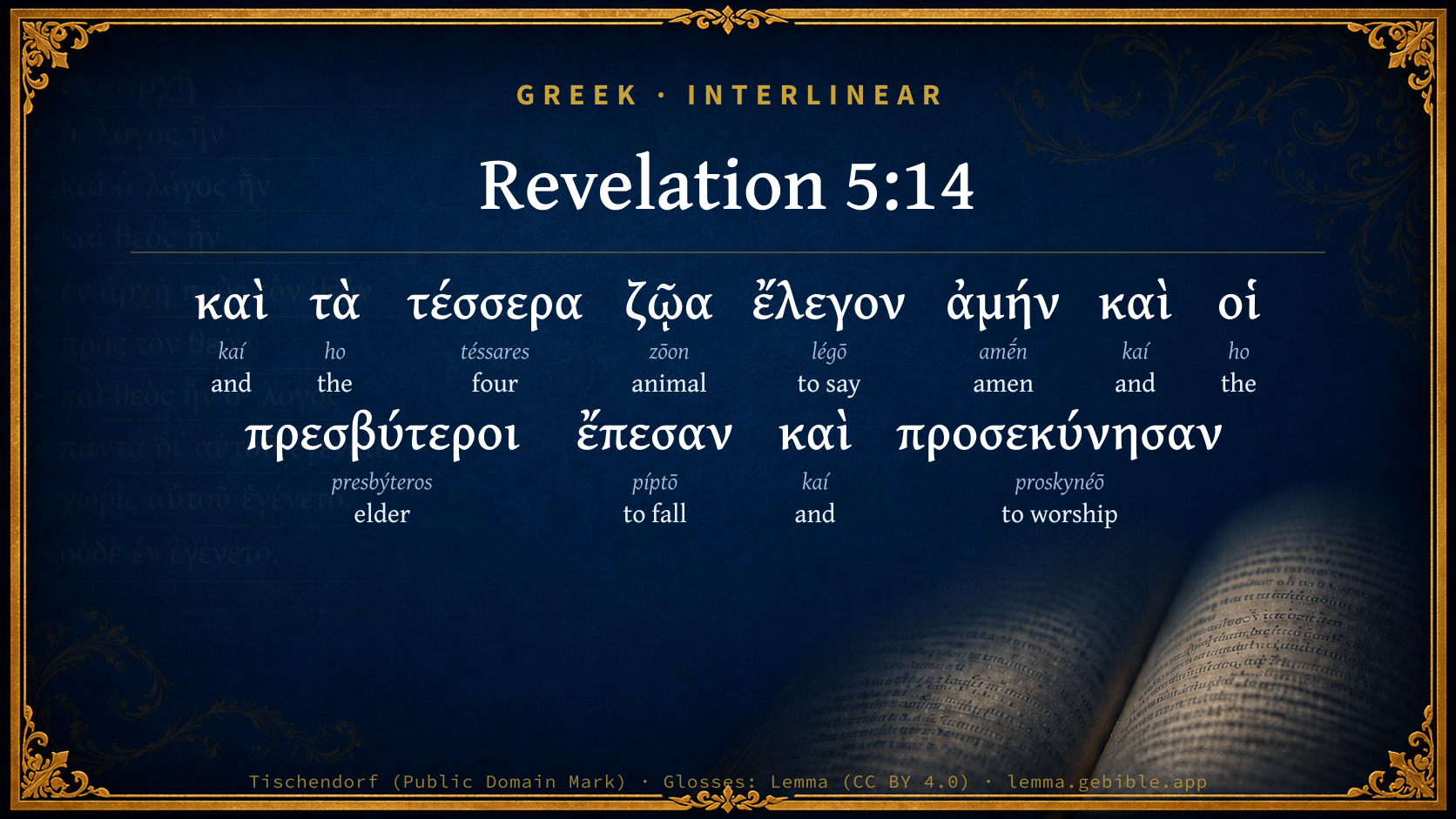
Greek (Tischendorf 8th ed.) Revelation 5:14 appears in the Greek New Testament. The text above is from the Tischendorf 8th edition. Each word links to its Strong’s number and a concise gloss. Click any word for its full Thayer’s Greek Lexicon entry.
Download image
Cite this verse

Revelation 5:14 (World English Bible). Public Domain. Lemma interlinear Bible study tool, https://lemma.gebible.app/v/revelation/5/14.

Show BibTeX & RIS
BibTeX
RIS
English Translation
The four living creatures said, "Amen!" The elders fell down and worshiped.
World English Bible · Public Domain
Download a study sheet

One document with this verse’s original text, its word-by-word gloss line, the meaning frame, cross-references with their text, attributed commentary, and full source and license credits — printable, and it pastes into notes with its structure intact.

This verse Autodidact and up

Study sheet (.html) Plain text (.txt)

A passage Seminary Student

Up to 50 verses in one chapter. A passage sheet keeps up to 6 commentary sources and 12 cross-references per verse, in the order this page ranks them, and says so on the sheet whenever that leaves anything out. Ask for a single verse and you get the Autodidact verse sheet above.

Everything on this page stays free to read, with no account — the sheet is a download of what is already on screen, not access to it.

Want to remove ads? Support Godless Engineer
Compare translations 3

The same verse in 3 English versions, stacked beneath the original-language interlinear above. Click any original word for its lexicon entry.

Each is an independent rendering of the whole verse — the interlinear is not word-aligned to these translations.

Highlighted words mark where these versions differ — a whole-verse word diff, not a word-by-word alignment.

  • World English Bible Public Domain
    The four living creatures said, "Amen!" The elders fell down and worshiped.
  • King James Version Public Domain
    And the four beasts said, Amen. And the four and twenty elders fell down and worshipped him that liveth for ever and ever.
  • unfoldingWord Literal Text CC BY-SA 4.0
    And the four living creatures said, “Amen!” and the elders fell down and worshiped.

unfoldingWord Literal Text — © unfoldingWord, licensed CC BY-SA 4.0. Word-aligned USFM3 via Door43 (git.door43.org/unfoldingWord/en_ult).

Versions to compare (up to 4)

3 of 4 selected

Show all 19 translations

Every available English version of this verse, each an independent rendering of the whole verse.

  • World English Bible Public Domain
    The four living creatures said, "Amen!" The elders fell down and worshiped.
  • Berean Standard Bible Public Domain
    And the four living creatures said, “Amen,” and the elders fell down and worshiped.
  • Majority Standard Bible Public Domain
    And the four living creatures said, “Amen,” and the elders fell down and worshiped.
  • King James Version Public Domain
    And the four beasts said, Amen. And the four and twenty elders fell down and worshipped him that liveth for ever and ever.
  • American Standard Version (1901) Public Domain
    And the four living creatures said, Amen. And the elders fell down and worshipped.
  • Revised Version (1885) Public Domain
    And the four living creatures said, Amen. And the elders fell down and worshipped.
  • Geneva Bible (1599) Public Domain
    And the foure beasts said, Amen, and the foure and twentie Elders fell downe and worshipped him that liueth for euermore.
  • Douay-Rheims (1899) Public Domain
    And the four living creatures said: Amen. And the four and twenty ancients fell down on their faces, and adored him that liveth for ever and ever.
  • Young's Literal Translation Public Domain
    and the four living creatures said, `Amen!' and the twenty-four elders fell down and they bow before Him who is living to the ages of the ages.
  • Literal Standard Version CC BY-SA 4.0
    And the four living creatures said, “Amen!” And the twenty-four elders fell down and they worship Him who is living through the ages of the ages.
  • Unlocked Literal Bible CC BY-SA 4.0
    The four living creatures said, “Amen!” and the elders fell down and worshiped.
  • unfoldingWord Literal Text CC BY-SA 4.0
    And the four living creatures said, “Amen!” and the elders fell down and worshiped.
  • Darby Bible Public Domain
    And the four living creatures said, Amen; and the elders fell down and did homage.
  • World Messianic Bible Public Domain
    The four living creatures said, “Amen!” Then the elders fell down and worshiped.
  • Webster's Bible Public Domain
    And the four living beings said, Amen. And the four and twenty elders fell down and worshiped him that liveth for ever and ever.
  • Free Bible Version CC BY-SA 4.0
    The four living creatures said, “Amen!” and the elders fell down and worshiped.
  • Bible in Basic English Public Domain
    And the four beasts said, So be it. And the rulers went down on their faces and gave worship.
  • Text-Critical English NT CC BY 4.0
    And I heard the four living creatures saying, “Amen.” And the elders fell down and worshiped.
  • Tyndale New Testament (1534) Public Domain
    And the.iiii. bestes sayd: Amen. And the.xxiiii. elders fell apon their faces and worshypped him that lyveth for ever more.

Literal Standard Version (2020), Covenant Press — licensed CC BY-SA 4.0. Text via the HelloAO Bible API (eBible.org). Unlocked Literal Bible (unfoldingWord) — licensed CC BY-SA 4.0. Text via the HelloAO Bible API (eBible.org). unfoldingWord Literal Text — © unfoldingWord, licensed CC BY-SA 4.0. Word-aligned USFM3 via Door43 (git.door43.org/unfoldingWord/en_ult). Free Bible Version, Dr. Jonathan Gallagher — licensed CC BY-SA 4.0. Text via the HelloAO Bible API (eBible.org).

Word by word

More ways to search: Search by grammar → Find every occurrence → Compare this word →

Practice this passage: Drill this verse → Learn its vocabulary →

About this verse

These counts appear in no published source. They are computed here, from the morphology-tagged text and Lemma’s own curated glosses. What Lemma adds →

12
words
9
distinct lemmas
Revelation
section

Notable vocabulary

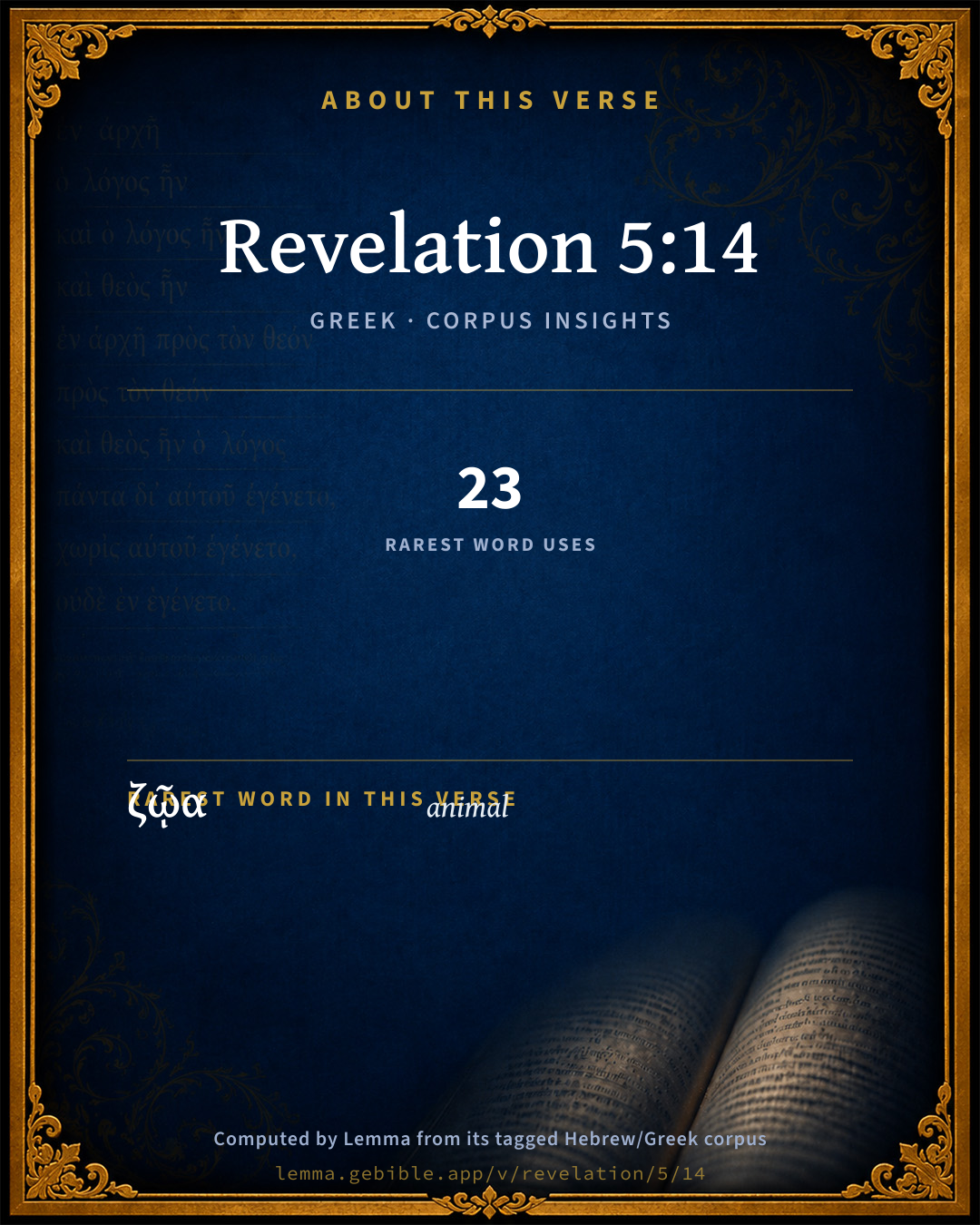
The rarest word here is ζῷα animal G2226 — appearing just 23 times in the whole Greek New Testament.

Shared distinctive vocabulary

ζῷα animal G2226 occurs in 20 verses of the Greek New Testament. Also found in:

Repetition

Words recur within this verse:

Cross-references

5

Topical passages linked to Revelation 5:14 in the Treasury of Scripture Knowledge — connected by theme and wording, ordered by reader-vote popularity; previews shown in the World English Bible.

  • Revelation 19:4 The twenty-four elders and the four living creatures fell down and worshiped God who sits on the throne, saying, "Amen! Hallelujah!"
  • Revelation 4:9–11 When the living creatures give glory, honor, and thanks to him who sits on the throne, to him who lives forever and ever,
  • Revelation 5:8 Now when he had taken the book, the four living creatures and the twenty-four elders fell down before the Lamb, each one having a harp, and golden bowls full of incense, which are the prayers of the saints.
  • Revelation 5:6 I saw in the midst of the throne and of the four living creatures, and in the midst of the elders, a Lamb standing, as though it had been slain, having seven horns, and seven eyes, which are the seven Spirits of God, sent out into all the earth.
  • Revelation 7:12 saying, "Amen! Blessing, glory, wisdom, thanksgiving, honor, power, and might, be to our God forever and ever! Amen."

Cross-references courtesy of OpenBible.info (CC BY 4.0).

Where the printed editions differ

2 variants

Places in this verse where the major printed Greek editions disagree on the wording in a way that affects the translation — a comparison of editions, not a manuscript-by-manuscript collation. The editions are the modern critical texts (Nestlé-Aland 28/27, SBL, Westcott-Hort, Tregelles, Tyndale House) and the traditional texts behind the KJV (the Textus Receptus and the Byzantine/Majority text). It is not a claim about which reading is original.

  1. Extra text
    εἴκοσιτέσσαρες

    “twenty four”

    In TR Not in NA28NA27TynSBLWHTregByz

    εἴκοσιτέσσαρες (eikositessares) 'twenty four' is only in traditional manuscripts (TR)

  2. Extra text
    ζῶντι εἰς τοὺς αἰωνας τῶν αἰώνων.

    “[the one] living into the ages of the ages.”

    In TR Not in NA28NA27TynSBLWHTregByz

    ζῶντι εἰς τοὺς αἰωνας τῶν αἰώνων.¶ (zōnti eis tous aiōnas tōn aiōnōn) '[the one] living into the ages of the ages.' is only in traditional manuscripts (TR)

Textual data: Translators Amalgamated Greek New Testament (STEPBible TAGNT) · CC BY 4.0.

Commentary

Notes on Revelation 5:14 from classic Christian and Jewish commentators (each source and its license shown beneath its notes). The classic Christian expositions comment on the surrounding passage and are grouped to its opening verse, so a note may address several verses; the Jewish commentaries on the Tanakh (Rashi and others) are per-verse, so they appear only where the commentator wrote on this verse.

Lemma curates 59 commentaries, every one of them public domain or Creative Commons licensed, each selected and text-cleaned for this edition rather than reprinted as found. About our sources →

Trapp's Complete Commentary

John Trapp

14 And the four beasts said, Amen. And the four and twenty elders fell down and worshipped him that liveth for ever and ever.

Ver. 14. And the four beasts] The saints were the precentors in this blessed choir, and now they are the succentors also, Rev 14:3. They began the song, and so conclude it, as having far greater benefit by Christ than all other creatures, and God expects a proportion, that our returns be somewhat answerable to our receipts. (Sarson.) The saints upon earth sing a new (that is, an excellent) song in the honour of Christ, Rev 5:9-10. Heaven answers as by an echo, the music upon earth in the mean time continuing, Rev 5:11-12 (where note that this song of angels putteth Christ in the third person; he took not upon him the nature of angels, he is nearer to us); all creatures come in as the chorus, Rev 5:13, and as man began, so he ends the anthem, Rev 5:14.

John Trapp, A Commentary or Exposition upon All the Books of the Old and New Testament (1647–1656) — public domain. Text from a community e-Sword module.

Tyndale Open Study Notes

Tyndale Open Resources

5:14 The dramatic introduction of the Lamb (5:1-14) closes with the living beings (4:6-9). Their Amen affirms the truth of what John had seen, as the twenty-four elders prostrate themselves in worship.

Tyndale Open Study Notes — © Tyndale Open Resources, licensed CC BY-SA 4.0. Text via the HelloAO Bible API.

Bengel's Gnomon

Johann Albrecht Bengel

Rev 5:14. Καὶ προσεκύνησαν) With this word the paragraph ends in all the copies. See App. Crit., Ed. ii., on this passage. It is the part of piety to cut out such additions, fear being laid aside.[72] The shorter reading, ΚΑῚ ΠΡΟΣΕΚΎΝΗΣΑΝ, and they worshipped, denotes the worship paid both to Him that sitteth upon the throne and unto the Lamb. Comp. Rev 5:13. Προσκυνεῖν is often put absolutely: ch. Rev 11:1; Joh 4:20; Joh 12:20.

[72] ABC “Vulg. refute the addition in Rec. Text and h, ζῶντι εἰς τοὺς αἰῶνας τῶν αἱώνων.—E.

Bengel's Gnomon of the New Testament — English translation (T&T Clark, Edinburgh, 1860) — public domain. Text from a community e-Sword module.

Meyer's Critical & Exegetical Commentary

Heinrich August Wilhelm Meyer

Rev_5:14. The Amen, the formal confirmation and conclusion of the hymn of praise,[1987] is uttered by the four beings, not because they occupy in any respect a lower position,[1988] but because the whole tenor of the hymn of praise in chs. 4 and 5, after resounding in Rev_5:13 to the farthest extent, returns to the point whence it started,[1989] and thus comes to a truly beautiful rest.[1990] But after the Amen has been uttered, nothing else remains for the elders than silent adoration, which, naturally,[1991] is directed also to the Lamb, and not alone to the One sitting on the throne.[1992]

[1987] Ewald. Cf. Deu_27:15 sqq.; Neh_5:13; Psa_41:13; 1Co_14:16.

[1988] Hengstenb.

[1989] Cf. Rev_4:8 sqq.

[1990] Cf. Beng., Ebrard.

[1991] Cf. Rev_5:13.

[1992] As Ew. i. thought, supported by the completely untenable Recepta: προσκυν. ζῶντι εἱς τοὺς αἰῶνας τῶν αἰώνων, and corresponding to the view imposed upon John, that the Messiah also is a creation (with adoration they honored Godas from him as author all things have proceeded, and the Messiah was created, Rev_4:2 sqq.)

Meyer — Critical and Exegetical Commentary on the New Testament — English translation by Peter Christie, edited by Frederick Crombie (T&T Clark, 1880) — public domain. Text from a community e-Sword module.

Expositor's Greek Testament

ed. W. Robertson Nicoll

Rev 5:14 . The prologue is brought to a splendid close by “amen” from the four ζῷα , who have the last as they had the first word (Rev 4:8 ), followed by silent adoration from the πρεσβύτεροι . As in the liturgical practice of early Christian assemblies, so in the celestial court, the solemn chant of praise to God is succeeded by the “amen” (“ad similitudinem tonitrui … amen reboat,” Jerome); [911] , Areth., etc. Alf., bring this out by reading here τὸ Ἀμήν . By prefacing the struggle on earth (Rev 5:6 f.) with a vision of the brilliant authority and awe of heaven (Rev 5:4-5 ), the prophet suggests that all the movements of men on earth, as well as the physical catastrophes which overtake them, are first fore-shadowed in heaven (the underlying principle of astrology, cf. Jeremias, 84 f.) and consequently have a providential meaning. In 4., 5. the writer takes his readers behind the scenes; the whole succeeding tide of events is shown to flow from the will of God as creator of the universe, whose executive authority is delegated to Jesus the redeemer of his people. This tide breaks in two cycles of seven waves, the seventh (Rev 8:1 ) of the first series (Rev 6:1 to Rev 7:17 ) issuing in a fresh cycle (Rev 8:2 to Rev 11:19 ) instead of forming itself (as we should expect) the climax of these preliminary catastrophes in nature and humanity, disasters which were interpreted ( R. J. 237 239) as the premonitory outbursts of an angry deity ready to visit the earth with final punishment. Observe that throughout the Apocalypse wind and fire are among God’s scourges handled by angels in order to punish the earth and the waters, according to the conception preserved in Apol. Arist. 2: “Moreover, the wind is obedient to God, and fire to the angels; the waters also to the daemons, and earth to the sons of men” ( Ante-Nicene Library , ix. 257 f.). The visitation is divinely complete, sevenfold like Ezekiel’s oracles against the nations (ver 25 32). Revelation 6-9 has, for its staple, little more than a poetic elaboration of Mar 13:8 (Mar 13:24-25 ), international complications due to the scuffling and strife of peoples, and physical disasters as a fit setting for them.

[911] An eighth century version of Codex Vaticanus

The vision of the seven seals opened (Rev 6:1 to Rev 8:2 ): Rev 6:1-2 , a Parthian invasion.

The Expositor's Greek Testament, edited by W. Robertson Nicoll (1897–1910) — public domain. Text from a community e-Sword module.

Geneva Bible (1599)

Geneva Bible translators

A confirmation of the praise beforegoing, from the contestation of the Nobles, expressed in word and signs, as once or twice before this.

Geneva Bible (1599) marginal notes — public domain. Text via Bolls.life.

Jamieson, Fausset & Brown

Robert Jamieson, A. R. Fausset & David Brown

said--So A, Vulgate, and Syriac read. But B and Coptic read, "(I heard) saying."

Amen--So A reads. But B reads, "the (accustomed) Amen." As in Rev 4:11, the four and twenty elders asserted God's worthiness to receive the glory, as having created all things, so here the four living creatures ratify by their "Amen" the whole creation's ascription of the glory to Him.

four and twenty--omitted in the oldest manuscripts: Vulgate supports it.

him that liveth for ever and ever--omitted in all the manuscripts: inserted by commentators from Rev 4:9. But there, where the thanksgiving is expressed, the words are appropriate; but here less so, as their worship is that of silent prostration. "Worshipped" (namely, God and the Lamb). So in Rev 11:1, "worship" is used absolutely.

Next: Revelation Chapter 6

Jamieson, Fausset & Brown — Commentary Critical and Explanatory on the Whole Bible (1871) — public domain (CC PDM 1.0). Text via the HelloAO Bible API.

Adam Clarke's Commentary

Verse 14. The four beasts said, Amen.] Acknowledged that what was attributed to Christ was his due.

The four and twenty elders] The word εικοσιτεσσαρες, twenty-four, is wanting in the most eminent MSS. and versions.

Fell down and worshipped] Επεσαν και προσεκυνησαν· Fell down on their knees, and then prostrated themselves before the throne. This is the eastern method of adoration: first, the person worshiping fell down on his knees; and then, bowing down touched the earth with his forehead. This latter act was prostration.

Him that liveth for ever] This clause is wanting in ABC, thirty-seven others, Syriac, Arabic, Coptic, AEthiopic, some copies of the Slavonic, Itala, and Vulgate; and in Andreas, and Arethas, ancient commentators on this book. It is also wanting in some editions, and is undoubtedly spurious. Griesbach has left this and the above twenty-four out of the text.

Now follow the least intelligible parts of this mysterious book, on which so much has been written, and so much in vain. It is natural for man to desire to be wise; and the more difficult the subject the more it is studied, and the hope of finding out something by which the world and the Church might be profited, has caused the most eminently learned men to employ their talents and consume their time on these abstruse prophecies. But of what use has all this learned and well-meant labour been to mankind? Can hypothesis explain prophecy, and conjecture find a basis on which faith can rest? And what have we better in all attempts hitherto made to explain the mysteries of this book?

Adam Clarke's Commentary on the Bible (1810–1826) — public domain. Text from a community e-Sword/MySword module.

Ellicott's Commentary for English Readers

(14) And the four beasts . . .—Better, And the four living beings said, Amen (or, the Amen). And the elders (omit “four and twenty”) fell down and worshipped. The remaining words of this verse are wanting in some of the best MSS., and they spoil thegraphic force of the description. The “Amen” rises from universal nature; the Church of Christ falls down in silent adoration. Thought and feeling assert themselves above all language. There are times when silence is the most eloquent applause; there are times when it is also the most real worship. “Let thy prayers be without words, rather than thy words, without prayer” was a wise precept of an old divine. An English and an Italian poet have given expression to the same feeling of the weakness of words. “O speech !” sang Dante, when telling his final vision—

“How feeble and how faint art thou to give

Conception birth.”

—Parad. xxxiii.

Thomson takes refuge in silence from the overwhelming thoughts of the divine glory:—

“I lose

Myself in Him, in light ineffable.

Come, then, expressive silence, muse His praise.”

Here the inspired seer describes the chorus of praise as dying into a silence born of awe and gratefulness and love.

A Bible Commentary for English Readers, edited by Charles John Ellicott (1878–1897) — public domain. Text from a community e-Sword module.

The Cambridge Bible for Schools and Colleges

gen. ed. J. J. S. Perowne

14. And the four and twenty … for ever and ever] We should read simply, “and the elders fell down and worshipped”—in silence. The brevity of the phrase, imitating their silent adoration, is really grander than the completer sentence of the A. V.

The Cambridge Bible for Schools and Colleges (gen. ed. J. J. S. Perowne; Cambridge University Press, 1878–1918) — public domain. Text from a community e-Sword module.

John Gill's Exposition

And the four beasts said, Amen,.... Giving their assent to what the angels and every creature said, and expressing their desires and wishes that so it might be, and also their faith, that so it was, and would be:

and the four and twenty elders fell down and worshipped him that liveth for ever and ever; either God the Father, who sat upon the throne, and is so described, Rev 4:9; or else the Lamb who had been slain, and was now alive, and lives for evermore; or both of them, for the Alexandrian copy, the Complutensian edition, and the Syriac and Arabic versions, omit the words "him that liveth for ever and ever"; and leave it to be understood of either of them, or both; and the Ethiopic version reads, "and the elders worshipped him"; as the four living creatures and four and twenty elders led the chorus, and begun the song, so they close it, as being the persons more immediately concerned in the death and sufferings of the Lamb, and redemption by him, and in the sealed book, and in the things contained in it; the seals of which are next opened, and an account is given of them in some following chapters.

Next: Revelation Chapter 6

John Gill's Exposition of the Whole Bible (1746–1763) — public domain (CC PDM 1.0). Text via the HelloAO Bible API.

Albert Barnes' Notes on the Bible

And the four beasts said, Amen - The voice of universal praise came to them from abroad, and they accorded with it, and ascribed honor to God.

And the four and twenty elders fell down, ... - The living creatures and the elders began the work of praise Rev 5:8, and it was proper that it should conclude with them; that is, they give the last and final response (Prof. Stuart). The whole universe, therefore, is sublimely represented as in a state of profound adoration, waiting for the developments to follow on the opening of the mysterious volume. All feel an interest in it; all feel that the secret is with God; all feel that there is but One who can open this volume; and all gather around, in the most reverential posture, awaiting the disclosure of the great mystery.

The truths taught in this chapter are the following:

(1) The knowledge of the future is with God, Rev 5:1. It is as in a book held in his hand, fully written over, yet sealed with seven seals.

(2) It is impossible for man or angel to penetrate the future, Rev 5:2-3. It seems to be a law of created being, that the ability to penetrate the future is placed beyond the reach of any of the faculties by which a creature is endowed. Of the past we have a record, and we can remember it; but no created being seems to have been formed with a power in reference to the future corresponding with that in reference to the past - with no faculty of foresight corresponding to memory.

(3) It is natural that the mind should be deeply affected by the fact that we cannot penetrate the future, Rev 5:4. John wept in view of this; and how often is the mind borne down with heaviness in view of that fact! What things there are, there must be, in that future of interest to us! What changes there may be for us to experience; what trials to pass through; what happiness to enjoy; what scenes of glory to witness! What progress may we make in knowledge; what new friendships may we form; what new displays of the divine perfections may we witness! All our great interests are in the future - in what is to us now unknown. There is to be all the happiness which we are to enjoy, all the pain that we are to suffer; all that we hope, all that we fear. All the friends that we are to have are to be there; all the sorrows that we are to experience are to be there. Yet an impenetrable veil is set up to hide all that from our view. We cannot remove it; we cannot penetrate it. There it stands to mock all our efforts, and in all our attempts to look into the future we soon come to the barrier, and are repelled and driven back. Who has not felt his heart sad that he cannot look into what is to come?

(4) The power of laying open the future to mortals has been entrusted to the Redeemer, Rev 5:5-7. It is a part of the work which was committed to him to make known to people as much as it was proper to be known. Hence, he is at once a prophet, and is the inspirer of the prophets. Hence, he came to teach people what is to be in the future pertaining to them, and hence he has caused to be recorded by the sacred writers all that is to be known of what is to come until it is slowly unfolded as events develop themselves. The Saviour alone takes the mysterious book and opens the seals; he only unrolls the volume and discloses to man what is to come.

(5) The fact that he does this is the foundation of joy and gratitude for the church, Rev 5:8-10. It is impossible that the church should contemplate what the Saviour has revealed of the future without gratitude and joy; and how often, in times of persecution and trouble, has the church joyfully turned to the developments made by the Saviour of what is to be when the gospel shall spread over the world, and when truth and righteousness shall be triumphant.

(6) This fact is of interest to the angelic beings, and for them also it lays the foundation of praise, Rev 5:11-12. This may arise from these causes:

(a)From the interest which they take in the church, and the happiness which they have from anything that increases its numbers or augments its joy:

(b)From the fact that in the disclosures of the future made by the Redeemer, there may be much that is new and of interest to them (compare notes on 1Pe 1:12); and,

(c)From the fact that they cannot but rejoice in the revelations which are made of the final triumphs of truth in the universe.

(7) The universe at large has an interest in these disclosures, and the fact that they are to be made by the Redeemer lays the foundation for universal joy, Rev 5:13-14. These events pertain to all worlds, and it is proper that all the inhabitants of the universe should join in the expressions of adoration and thanksgiving. The universe is one; and what affects one portion of it really pertains to every part of it. Angels and human beings have one and the same God and Father, and may unite in the same expressions of praise.

Albert Barnes' Notes on the Bible (1834–1885) — public domain. Text from a community e-Sword/MySword module.

Whedon's Commentary on the Bible

Daniel D. Whedon

14. The fivefold songs are ended, and it comes back to the standing fixtures; namely, the cherubic beasts and the elders, to confirm and ratify the utterances; the former by their amen, and the latter by their profound adoration of the Eternal.

On these two chapters we may note, that the theophany and the celestial rejoicing at the possibility of opening the seals imply a stupendous value in the revelations about to be made in the coming apocalypse. No book in the Bible has so magnificent an introduction, with such an assumption of the value of its own contents. However little some Christian periods or Christian thinkers may value this apocalypse, it sets a stupendous valuation upon itself. Its opening is occasion for glorious hymns to the opener. The burden of the hymns, indeed, is the great atonement by his sacrificial death; but this revelation is here a leading part of the results of that atonement. The same, indeed, is true of the entire New Testament canon—that the revelation of gospel truth results from the atonement; but this apocalypse, as crowning close of that canon, and standing prophecy for the Christian Church. This view may seem to justify the terrible warning against all mutilation or corruption in Rev_22:18-19, and may suggest how, in speaking for the apocalypse, it speaks for the whole canon. Note on Rev_22:6.

Daniel D. Whedon (gen. ed.), Commentary on the Old and New Testaments (1874–1909) — public domain. Text from a community e-Sword module.

The Pulpit Commentary

And the four beasts said, Amen. And the four and twenty elders fell down and worshipped him that liveth forever and ever. (On the signification of the four beasts as representative of creation, and the four-and-twenty elders as typical of the Church, see on Rev_4:4 and Re 6) Three stages are marked in the hymn of adoration before this concluding verse:

(1) the four living beings and the four and twenty elders worship the Lamb, and commemorate their redemption by him; they are able to sing "a new song the song of the redeemed;

(2) the angels join in the worship of the Lamb, ascribing to him the consummation of all perfection;

(3) then all created things praise God and the Lamb. In conclusion, the representatives of redeemed creation once more join in the eucharistic hymn, and prostrate themselves in worship before the Triune God.

This forms the end of one act of the heavenly drama. The opening of the seals now follows, and a description of the attendant circumstances is given.

The Pulpit Commentary (1880–1919), ed. H.D.M. Spence-Jones & Joseph S. Exell — public domain. Text from a community e-Sword module.

Scofield Reference Notes

C. I. Scofield

beasts

living creatures. (See Scofield "Eze 1:5").

The Scofield Reference Bible (1917 edition), notes by C. I. Scofield — public domain. Text from a community e-Sword module.

The People's New Testament

B. W. Johnson

14. And the four living creatures said, Amen. They, then, though they may be in sympathy with, are different from the animated creation. Four orders join in these honors to the Lamb: (1) The Living Creatures; the Cherubim; (2) the Twenty-four Elders; (3) the Angels; (4) all Animate Creation.

ADDITIONAL NOTE

The Doxologies. —The action of this chapter is wonderfully dramatic. The Being upon the throne with the sealed book in his right hand; the proclamation of the strong angel calling for some one who was worthy to open the book; the declaration that no created being of the universe could open it; the apostle weeping, in his anxiety to know concerning the future, and from disappointment that no one could open the book; the assurance of the elder that the Lion of the tribe of Judah had prevailed to open it; the appearance of the slain Lamb who prevails as the Lion, and his taking the book out of the right hand of God, are all calculated to fix the attention with breathless interest, and to strike the imagination with startling power. And the picture grows still grander as the heavenly tenants sing their doxologies in praise of the victory of the Lamb. First, the four living creatures and the elders sing a new song; then a countless number of angels, about the throne, the living creatures and the elders join in the chorus. These praises ring through the heavens, and the reverberations reach from heaven to earth, and every creature “in heaven, and on the earth, and under the earth, and such as are in the sea” join in the ascription of praise to the Lamb. To these praises the cherubim respond, Amen! and the elders fall down and worship Him that liveth forever and ever.

B. W. Johnson's The People's New Testament with Notes (1889–1891) — public domain. Electronic text from the Christian Classics Ethereal Library (CCEL) ThML edition.

Cambridge Greek Testament for Schools and Colleges

14. προσεκύνησαν. Text. Rec[219] adds ζῶντι εἰς τοὺς αἰῶνας τῶν αἰώνων with Primas[220] and late Vg[221]

[219] Rec. Textus Receptus as printed by Scrivener.

[220] Primasius, edited by Haussleiter.

[221] Vulgate.

14. καὶ οἱ πρεσβύτεροι ἔπεσαν καὶ προσεκύνησαν. The brevity of the phrase, imitating their silent adoration, is really grander than the complete sentence of the Received Text.

Cambridge Greek Testament for Schools and Colleges (Cambridge University Press, 1896; 21 vols, various authors incl. Carr, Maclear, Plummer, Farrar, Lumby, Moule, M. R. James, Simcox) — public domain. Text from a community e-Sword module.

Alford’s Greek Testament

Henry Alford

14.] The chorus of assenting praise from Creation itself. And every creature (i. e. by the very terms, animated creature: for heaven and earth and sea themselves are mentioned as the abodes of these κτίσματα) which is in the heaven (the chorus being universal, this will include the angels, previously mentioned, and the glorified saints) and on the earth and under the earth (i. e. not the devils, as even Vitringa: but as in Php 2:10, the departed spirits in Hades: see note there), and upon the sea (i. e. most probably, on the surface of the sea; meaning not those on ships, but those sea-animals which are regarded as being on the surface), and all the things in them (so in Exo 20:11. The clause added seems to serve the purpose of complete enumeration, applying here to γῆ and θάλασσα only, as ἐν τῷ οὐρανῷ has occurred already. The ἐπί and ὑποκάτω being both superficial, ἐν completes the list—in the depths of the earth and the sea: cf. ch. 8:9) I heard saying (the gender again is that of the things signified, not that of κτίσμα: see ch. 4:8), To Him that sitteth upon the throne (for the various cases after καθημ. ἐπί, see note, ch. 4:2) and to the Lamb (the Church, including Creation, gives praise to the Lamb for Redemption, vv. 9, 10: the angels praise the infinite condescension of the Son of God: the entire universe celebrates the glory of the universal Father and of the Redeemer, thence accruing) (be (or, is, belongs)) the blessing and the honour and the glory and the might (notice the fourfold arrangement where universality is set forth: and the repeated article, exhaustive of each predicate separately. It is fanciful, with Bengel, to allot the four ascriptions among the four classes of creatures above mentioned. In each case the number has the same signification: but they need not separately correspond) to the ages of the ages.

14.] The solemn assent of the celestial representatives of Creation and of the Church. And the four living-beings said Amen (as above, in ch. 4:11, the four living-beings assert the worthiness of God to receive the glory and the honour and the power on account of His having created all things, so here they say their Amen to creation’s chorus of praise: being themselves the representatives of the animated Creation). And the elders fell down and worshipped (in silent adoration of God and of the Lamb. The inference of Ewald from the rec. text (which is itself here wholly untenable), “presbyteri adoratione repetita Deum prosequuntur, ut a quo auctore omnia progressa sunt et Messias creatus est, ad eum omnis redeat honor, omnis reverentia,” would be unwarranted even were that text retained: ζῶντι, anarthrous, would apply to the whole object of praise in ver. 13).

Henry Alford, The Greek Testament (1849–1861) — public domain. Text from a community e-Sword module.

Vincent's Word Studies in the New Testament

Marvin R. Vincent

Four and twenty. Omit.

Worshipped. In silent adoration.

Him that liveth forever and ever. Omit.

Marvin R. Vincent, Word Studies in the New Testament (1887–1900) — public domain. Text from a community e-Sword/MySword module.

Lesson kit

Teaching starters — assembled from the data on this page, not authored interpretation. Every prompt links to the verse data it draws on. Edit before teaching.

Revelation, in the Revelation, opens this verse with 12 words (9 distinct Greek lemmas). Its most distinctive word is zōon (“animal”). A historical commentator’s framing appears above. Read the whole chapter for the surrounding context.

Discussion questions

  1. What does “animal” (zōon) contribute to the verse as a whole?
  2. How does Hebrews 13:11, which shares the word «animal», read alongside this verse?
  3. What does the repetition of “and” (3× in this one verse) do in this verse?
  4. These translations render this verse differently. What is at stake in choosing one wording over another?
  5. Compare how Trapp's Complete Commentary and Tyndale Open Study Notes read this verse. Where do they agree or differ?

Things to notice

  • These translations choose different wording for 9 words in this verse.
  • “and” occurs 3× in this single verse.
  • 9 distinct Greek lemmas span 12 words in this verse.

Reading settings

Reading text

Shown beneath each verse's original-language words.

Old Testament
Old Testament edition

Read the OT as the Masoretic Hebrew (MT) or the Greek Septuagint (LXX).

English shown for the Greek Septuagint (in the Hebrew ↔ Greek comparison).

Comparing translations? Open the Compare panel on any verse page to stack up to four side by side.