Revelation 11:16

Greek (Tischendorf 8th ed.) Revelation 11:16 appears in the Greek New Testament. The text above is from the Tischendorf 8th edition. Each word links to its Strong’s number and a concise gloss. Click any word for its full Thayer’s Greek Lexicon entry.
Download image
Cite this verse

Revelation 11:16 (World English Bible). Public Domain. Lemma interlinear Bible study tool, https://lemma.gebible.app/v/revelation/11/16.

Show BibTeX & RIS
BibTeX
RIS
English Translation
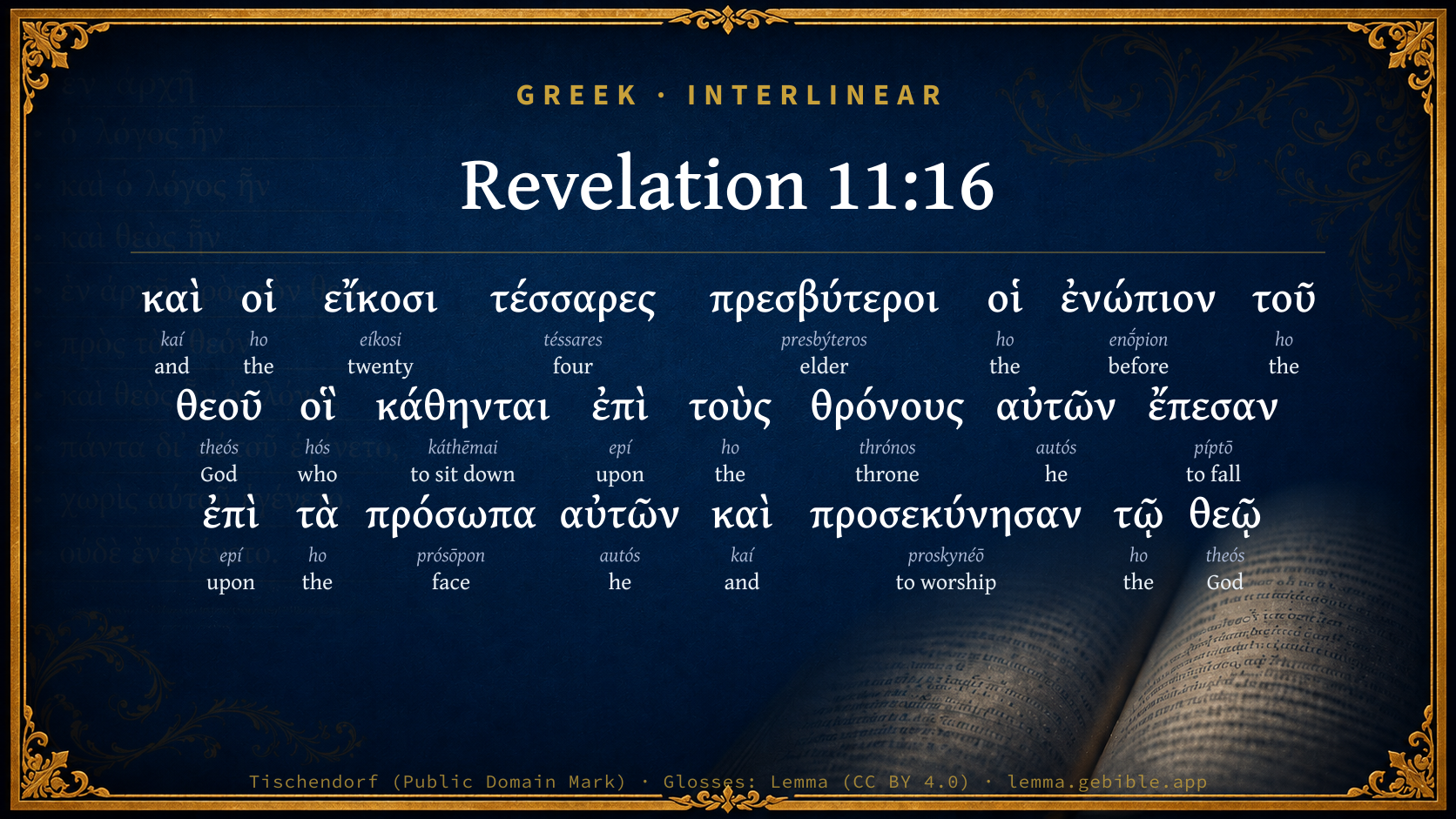
The twenty-four elders, who sit on their thrones before God's throne, fell on their faces and worshiped God,
World English Bible · Public Domain
Download a study sheet

One document with this verse’s original text, its word-by-word gloss line, the meaning frame, cross-references with their text, attributed commentary, and full source and license credits — printable, and it pastes into notes with its structure intact.

This verse Autodidact and up

Study sheet (.html) Plain text (.txt)

A passage Seminary Student

Up to 50 verses in one chapter. A passage sheet keeps up to 6 commentary sources and 12 cross-references per verse, in the order this page ranks them, and says so on the sheet whenever that leaves anything out. Ask for a single verse and you get the Autodidact verse sheet above.

Everything on this page stays free to read, with no account — the sheet is a download of what is already on screen, not access to it.

Want to remove ads? Support Godless Engineer
Compare translations 3

The same verse in 3 English versions, stacked beneath the original-language interlinear above. Click any original word for its lexicon entry.

Each is an independent rendering of the whole verse — the interlinear is not word-aligned to these translations.

Highlighted words mark where these versions differ — a whole-verse word diff, not a word-by-word alignment.

  • World English Bible Public Domain
    The twenty-four elders, who sit on their thrones before God's throne, fell on their faces and worshiped God,
  • King James Version Public Domain
    And the four and twenty elders, which sat before God on their seats, fell upon their faces, and worshipped God,
  • unfoldingWord Literal Text CC BY-SA 4.0
    And the 24 elders sitting on their thrones before God fell upon their faces and worshiped God,

unfoldingWord Literal Text — © unfoldingWord, licensed CC BY-SA 4.0. Word-aligned USFM3 via Door43 (git.door43.org/unfoldingWord/en_ult).

Versions to compare (up to 4)

3 of 4 selected

Show all 19 translations

Every available English version of this verse, each an independent rendering of the whole verse.

  • World English Bible Public Domain
    The twenty-four elders, who sit on their thrones before God's throne, fell on their faces and worshiped God,
  • Berean Standard Bible Public Domain
    And the twenty-four elders who sit on their thrones before God fell on their faces and worshiped God,
  • Majority Standard Bible Public Domain
    And the twenty-four elders who sit on their thrones before God fell on their faces and worshiped God,
  • King James Version Public Domain
    And the four and twenty elders, which sat before God on their seats, fell upon their faces, and worshipped God,
  • American Standard Version (1901) Public Domain
    And the four and twenty elders, who sit before God on their thrones, fell upon their faces and worshipped God,
  • Revised Version (1885) Public Domain
    And the four and twenty elders, which sit before God on their thrones, fell upon their faces and worshipped God,
  • Geneva Bible (1599) Public Domain
    Then the foure and twentie Elders, which sate before God on their seates, fell vpon their faces, and worshipped God,
  • Douay-Rheims (1899) Public Domain
    And the four and twenty ancients, who sit on their seats in the sight of God, fell on their faces and adored God, saying:
  • Young's Literal Translation Public Domain
    and the twenty and four elders, who before God are sitting upon their thrones, did fall upon their faces, and did bow before God,
  • Literal Standard Version CC BY-SA 4.0
    And the twenty-four elders, who are sitting on their thrones before God, fell on their faces and worshiped God,
  • Unlocked Literal Bible CC BY-SA 4.0
    Then the twenty-four elders, who sit on their thrones in the presence of God, fell upon their faces and worshiped God.
  • unfoldingWord Literal Text CC BY-SA 4.0
    And the 24 elders sitting on their thrones before God fell upon their faces and worshiped God,
  • Darby Bible Public Domain
    And the twenty-four elders, who sit on their thrones before God, fell upon their faces, and worshipped God,
  • World Messianic Bible Public Domain
    The twenty-four elders, who sit on their thrones before God’s throne, fell on their faces and worshiped God,
  • Webster's Bible Public Domain
    And the four and twenty elders, who sat before God on their seats, fell upon their faces, and worshiped God,
  • Free Bible Version CC BY-SA 4.0
    The twenty-four elders who sit on their thrones in God's presence fell down on their faces and worshiped God.
  • Bible in Basic English Public Domain
    And the four and twenty rulers, who are seated before God on their high seats, went down on their faces and gave worship to God, saying,
  • Text-Critical English NT CC BY 4.0
    And the twenty-four elders, who sit on their thrones before the throne of God, fell on their faces and worshiped God,
  • Tyndale New Testament (1534) Public Domain
    And the.xxiiii. elders which sytt before god on their seates fell apon their faces and worshipped God

Literal Standard Version (2020), Covenant Press — licensed CC BY-SA 4.0. Text via the HelloAO Bible API (eBible.org). Unlocked Literal Bible (unfoldingWord) — licensed CC BY-SA 4.0. Text via the HelloAO Bible API (eBible.org). unfoldingWord Literal Text — © unfoldingWord, licensed CC BY-SA 4.0. Word-aligned USFM3 via Door43 (git.door43.org/unfoldingWord/en_ult). Free Bible Version, Dr. Jonathan Gallagher — licensed CC BY-SA 4.0. Text via the HelloAO Bible API (eBible.org).

Word by word

More ways to search: Search by grammar → Find every occurrence → Compare this word →

Practice this passage: Drill this verse → Learn its vocabulary →

εἴκοσι
eíkosi
G1501
“twenty”
Adjective, Numeral (indeclinable)
Part of Speech
Adjective · Numeral (indeclinable)
Full Thayer's Definition

Origin: of uncertain affinity

TDNT: None

1. twenty
  1. καὶ kaí G2532 “and” Conjunction
  2. οἱ ho G3588 “the” Article, Nominative, Plural, Masculine
  3. τέσσαρες téssares G5064 “four” Adjective, Nominative, Plural, Masculine
  4. πρεσβύτεροι presbýteros G4245 “elder” Adjective, Nominative, Plural, Masculine, Comparative
  5. οἱ ho G3588 “the” Article, Nominative, Plural, Masculine
  6. ἐνώπιον enṓpion G1799 “before” Adverb
  7. τοῦ ho G3588 “the” Article, Genitive, Singular, Masculine
  8. θεοῦ theós G2316 “God” Noun, Genitive, Singular, Masculine
  9. οἳ hós G3739 “who” Relative pronoun, Nominative, Plural, Masculine
  10. κάθηνται káthēmai G2521 “to sit down” Verb, Present, Middle or Passive deponent, Indicative, 2nd person, Singular
  11. ἐπὶ epí G1909 “upon” Preposition
  12. τοὺς ho G3588 “the” Article, Accusative, Plural, Masculine
  13. θρόνους thrónos G2362 “throne” Noun, Accusative, Plural, Masculine
  14. αὐτῶν autós G846 “he” Personal pronoun, Genitive, Plural, Masculine
  15. ἔπεσαν píptō G4098 “to fall” Verb, Aorist, Active, Indicative, 3rd person, Plural
  16. ἐπὶ epí G1909 “upon” Preposition
  17. τὰ ho G3588 “the” Article, Accusative, Plural, Neuter
  18. πρόσωπα prósōpon G4383 “face” Noun, Accusative, Plural, Neuter
  19. αὐτῶν autós G846 “he” Personal pronoun, Genitive, Plural, Masculine
  20. καὶ kaí G2532 “and” Conjunction
  21. προσεκύνησαν proskynéō G4352 “to worship” Verb, Aorist, Active, Indicative, 3rd person, Plural
  22. τῷ ho G3588 “the” Article, Dative, Singular, Masculine
  23. θεῷ theós G2316 “God” Noun, Dative, Singular, Masculine

About this verse

These counts appear in no published source. They are computed here, from the morphology-tagged text and Lemma’s own curated glosses. What Lemma adds →

24
words
15
distinct lemmas
Revelation
section

Notable vocabulary

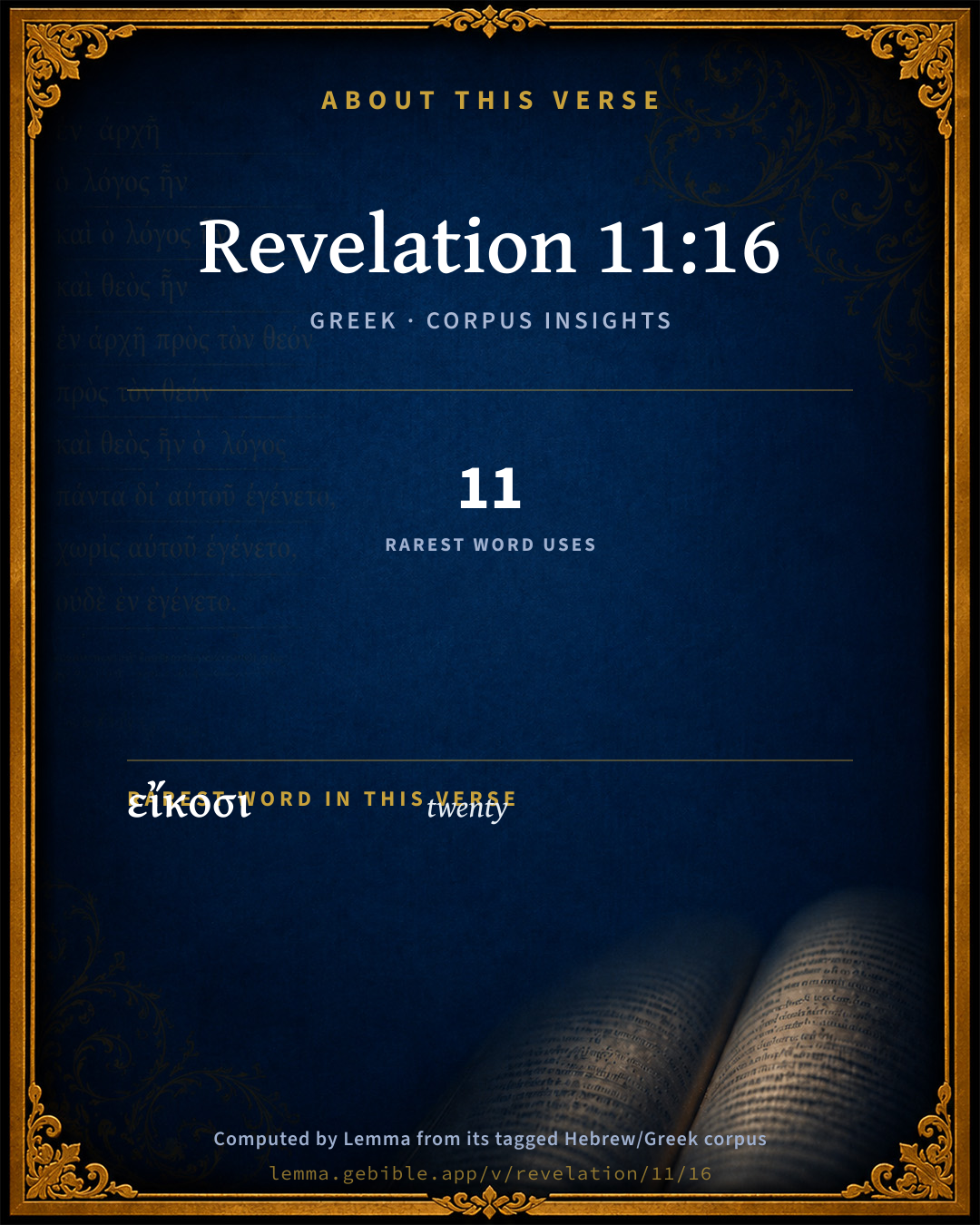
The rarest word here is εἴκοσι twenty G1501 — appearing just 11 times in the whole Greek New Testament.

Shared distinctive vocabulary

εἴκοσι twenty G1501 occurs in 10 verses of the Greek New Testament. Also found in:

Repetition

Words recur within this verse:

Cross-references

6

Topical passages linked to Revelation 11:16 in the Treasury of Scripture Knowledge — connected by theme and wording, ordered by reader-vote popularity; previews shown in the World English Bible.

  • Revelation 4:4 Around the throne were twenty-four thrones. On the thrones were twenty-four elders sitting, dressed in white garments, with crowns of gold on their heads.
  • Revelation 4:10 the twenty-four elders fall down before him who sits on the throne, and worship him who lives forever and ever, and throw their crowns before the throne, saying,
  • Revelation 7:11 All the angels were standing around the throne, the elders, and the four living creatures; and they fell on their faces before his throne, and worshiped God,
  • Revelation 5:14 The four living creatures said, "Amen!" The elders fell down and worshiped.
  • Revelation 19:4 The twenty-four elders and the four living creatures fell down and worshiped God who sits on the throne, saying, "Amen! Hallelujah!"
  • Revelation 5:5–8 One of the elders said to me, "Don't weep. Behold, the Lion who is of the tribe of Judah, the Root of David, has overcome; he who opens the book and its seven seals."

Cross-references courtesy of OpenBible.info (CC BY 4.0).

Where the printed editions differ

1 variant

Places in this verse where the major printed Greek editions disagree on the wording in a way that affects the translation — a comparison of editions, not a manuscript-by-manuscript collation. The editions are the modern critical texts (Nestlé-Aland 28/27, SBL, Westcott-Hort, Tregelles, Tyndale House) and the traditional texts behind the KJV (the Textus Receptus and the Byzantine/Majority text). It is not a claim about which reading is original.

  1. Extra text
    τοῦ θρόνου

    “the throne [of]”

    In Byz Not in NA28NA27TynSBLWHTregTR

    τοῦ θρόνου (tou thronou) 'the throne [of]' is only in a few manuscripts (Byz)

Textual data: Translators Amalgamated Greek New Testament (STEPBible TAGNT) · CC BY 4.0.

Commentary

Notes on Revelation 11:16 from classic Christian and Jewish commentators (each source and its license shown beneath its notes). The classic Christian expositions comment on the surrounding passage and are grouped to its opening verse, so a note may address several verses; the Jewish commentaries on the Tanakh (Rashi and others) are per-verse, so they appear only where the commentator wrote on this verse.

Lemma curates 59 commentaries, every one of them public domain or Creative Commons licensed, each selected and text-cleaned for this edition rather than reprinted as found. About our sources →

The Biblical Illustrator

Joseph S. Exell

Rev_11:16-19

The four-and-twenty elders … fell upon their faces and worshipped God.

The heavenly life

I. It is a life of worship.

1. The persons who are worshipping are described as twenty-four elders. They are the Universal Church, the blessed of the old covenant and of the new; and yet, as persons and representatives, are portrayed as leaders of the heavenly worship.

2. Their dignity. They are before God, i.e., in His immediate presence, and sit upon thrones. They are said also to have crowns (Rev_4:10). This is a picture in which vision, repose, kingly power, and victory each has a place.

3. Their worship. Observe, it is an act--they fell upon their faces and worshipped God. Sitting upon thrones, contemplating God, was their habitual condition; but worship was the active expression of their sense of the Divine majesty. They offer Him inward and outward adoration.

II. It is a life of thanksgiving.

1. This arises from the clear realisation of their indebtedness to God for all. Gratitude is apt to be chilled by the sorrows, the sufferings, and the uncertainties of this present life. When it exists in the soul it has to struggle with lifes burden, and its expression is like the transient rays of light which pierce the cloud that darkens the landscape. But the song of the redeemed is called forth by the sight of the Giver, and the dark problems of earth are solved in the light of heaven (Joh_13:7).

2. It arises from the possession of the gift of glory. Grace is more precious than all the gifts of nature; but glory is greater than grace, as the flower is more than the bud. The consciousness of having attained to the true end of their being elicits from the worshippers the anthem of thanksgiving with a fulness and a sweetness in the heavenly Jerusalem with which the songs by the waters of Babylon could never compare.

3. It arises from a deeper sense of unworthiness than can ever be felt on earth. What was the casting of their crowns before the feet of the Most High but a protestation that their excellence and their victories were due to the grace which He had vouchsafed to them?

4. It was a corporate oblation of thanksgiving--We give, etc. Each has his own joy, and each can enter into the joy of all.

III. What Divine perfection did they hymn? The eternity of God.

1. This perfection belongs to God alone. He alone is without beginning. This is the root-distinction between Creator and creature. He is, in the language of Daniel, the Ancient of days (Dan_7:22). He is from Himself; with Him is the well of life. None other is self-derived. He alone possesses His life without succession, unchangeably (iota simul).

2. Every creature has a beginning. The creature is from that, says St. Augustine, which is as yet not. As being is a base of all gifts, so creation is at the root of all worship. The realisation of God as the Beginning and End of our being is essential for worship. The elders grasped the difference between Creator and created. They offered Him, their God, glory, and honour, and praise. Why? Thou hast created all things, and for Thy pleasure they are, and were created. Here every one and everything we see is created and transient; the line between eternal and temporal is clearly marked where the Eternal makes Himself known and seen.

IV. Lessons.

1. The importance of worship as a preparation for the heavenly life.

2. The spirit of thanksgiving should enter more fully into our religion, which is sometimes lacking in brightness, trust, and unselfishness.

3. The contemplation of the eternity of God, Thou art from everlasting, produces many fruits. There is a certain delight in the contemplation, as in regarding some vast and magnificent object, as the heavens or the sea. Then the thought of an eternity in the future, of the endlessness of human life, must stir within us hopes and fears--hope of glory, and fear of missing it. Such a conception will always create in us a sense of the littleness of things present, in comparison with things eternal. (Canon Huchings, M. A.)

We give Thee thanks, O Lord God Almighty, which art, and wast, and art to come.--

The omnipotence of God

I. in the original production of all creatures. It is God alone who can create. Man, in the exercise of his wisdom and ingenuity, may indeed form and invent many things, but he must have the materials to work with: when God formed the world He found no materials to work with--He created the materials Himself. He called them into being with His irresistible voice: and when He surveyed the various works of His hands, we are told, they all met with His full approval: And God saw everything that He had made, and behold it was very good. All the works of God are finished works; they will bear, as they invite, the closest and most minute inspection; and unlike the works of man, when most examined they will be the most admired. We may notice also the power of God in the greatness of some of His works, and in the smallness of others. The earth which we inhabit is said to be eight thousand miles in diameter, but what is this when compared with the body of the sun, which gives us light day after day, and which is said to be a million of times larger than the earth we inhabit, and ninety millions of miles distant from it. The smallness again of many creatures is equally surprising, as is the greatness of others.

II. In the preservation and government of his creatures. He upholdeth all things by the word of His power. The planets revolve in their appointed circuits with the most unerring and minute exactness. The various seasons succeed each other in their regular and appointed order. The great and wide sea also, whose billows roar and threaten to overwhelm the earth, is kept by the power of its Maker within its proper and prescribed limits. We may again observe the same Almighty power in making such constant and abundant provision for the vast family of the universe. All the innumerable tribes of beings which inhabit the earth, the air, and the water, these all wait upon God. The moral government of God is still more wonderful to contemplate.

III. In the work of our redemption by Christ Jesus. How manifest was this in the person of our Divine Redeemer Himself! And when we come to consider the first planting of our holy religion in the world, by means so feeble and so unlikely to all human appearance, and notwithstanding obstacles so great, we shall see with what propriety the gospel is spoken of as the power of God unto salvation. The gospel also is intended to produce a great inward change. The corruption of our nature is such as to render this change absolutely needful; and it is a change so considerable and complete, that it is called in Scripture a new creation; this, of course, can only be effected by the power of God. And the apostle, as if wanting language to express the greatness of this power, says, and what is the exceeding greatness of His power to us-ward, who believe, according to the working of His mighty power, which He wrought in Christ when He raised Him from the dead, and set Him at His own right hand in the heavenly places. One exertion more of the Divine power let us dwell on. When Moses beheld a hush on fire, and yet not consumed, he turned aside to behold it with admiration. In that burning bush he beheld the emblem of Israel afflicted in Egypt, yet not destroyed; and may we not also perceive in it an emblem of the true Christian, kept by the power of God through faith unto salvation? And what but the power of God is sufficient for this purpose? Lessons:

1. That God should be held in reverence and adored.

2. Let this Almighty God be also feared.

3. Blessed are they who put their trust in Him. (J. L. F. Russell, M. A.)

The omnipotence of God

Every attribute of God is proper and useful object of our consideration, as being apt to remind us of our duty, and excite us to the practice of it, for which purposes this of omnipotence, mentioned in the text, is of much avail, and deserves serious consideration.

1. God is παντοκράτωρ, as having a just right and authority over all thing, being naturally the sovereign Lord and Emperor of the world.

2. He is also such inregard to His infinite power, as that word may signify omnipotent.

3. He is also so, because He doth actually exercise all dominion, and continually exert His power, according to His good pleasure; for the Lord hath prepared His throne in heaven, and His kingdom ruleth over all, etc.

4. God is παντοκράτωρ, as the true proprietary and just possessor of all things; the heavens, saith the Psalmist, are Thine; the earth also is Thine, etc.

5. Also as containing and comprehending all things by His immense presence and infinite capacity. I fill heaven and earth, said God in Jeremiah; and King Solomon in his prayer observes, the heaven of heavens cannot contain Thee, etc.

6. God is παντοκράτωρ, in regard that He sustains and preserves all things (Neh_9:6; Col_1:17).

I. If God be the just sovereign of all things, having a right to govern the world, and actually exercising it, then--

1. We see our condition here; that we live not in an anarch, or in perfect liberty to follow our own will, etc.

2. We understand our duty as subjects and vassals, etc.

3. We may hence discern the heinousness of every sin as committed against the crown and dignity of God.

4. We may learn what reason we have to be content in every condition, since our station is allotted to us by unquestionable right.

5. It is a matter of great consolation to reflect that we and all the world are under such a governor, who is no usurper and tyrant, but a most just, wise, and gracious sovereign.

II. The belief of Gods immense and uncontrollable power is also of great importance and influence on practice.

1. It serves to beget in us a due awe and dread of Him.

2. It consequently dissuades and deters us in a high manner from sin, nothing being more reasonable than that advice of the preacher, contend not with him that is mightier than thou.

3. Whence the consideration of this point may dispose us to weigh well our counsels.

4. It may also serve to depress confidence in ourselves, and in all other things, as to any security they can afford.

5. It may be of special efficacy to quell and mortify in us the vices of pride, arrogance, self-will.

6. Also to breed and nourish faith in God, as to the certain performance of His word and promises, which, be they never so difficult, He is so able to perform.

7. Hence also particularly it may produce and cherish faith in the sufficiency of Gods providence, and induce us entirely to rely on it.

8. It affords comfort and encouragement to us in the undertaking and prosecution of honest and prudent enterprises, giving us hope and confidence in their success.

III. That notion of the word almighty, which implies Gods being universal proprietary and possessor of all things, has also many good uses. We may thence learn--

1. That we are not our own, and therefore are obliged to submit with patience to His disposal of us.

2. We ought to be content with that share of accommodations which He allows, since all things are His, and we can claim nothing from Him.

3. To be satisfied when He withdraws that of which He has before afforded us the enjoyment.

4. To be heartily thankful for all we ever have or enjoy.

5. Carefully to manage and employ all which is put into our hands for His interest and service.

6. To be humble and sober, not to e conceited, or to glory in regard to anything we love.

IV. That sense, according to which the word signifies Gods containing all things by His immense presence, is also of most excellent use. We thereby may learn with what care, circumspection, modesty, and integrity we ought always to manage our conversation and behaviour, since we continually think and speak and act in the immediate presence of God, whose eyes are on the ways of men. Hence also we are prompted to frequent addresses of prayer, thanksgiving, and all kind of adoration.

V. The consideration that God upholds all things, and consequently ourselves, in being, may powerfully deter us from offending Him; for put the case that our life and all the comforts of living depended on the bounty and pleasure of any person, should we not be very waxy and fearful of offending such an one? (Isaac Barrow, D. D.)

The Biblical Illustrator, edited by Joseph S. Exell (c. 1880s–1900s) — public domain. Text from a community e-Sword module.

Tyndale Open Study Notes

Tyndale Open Resources

11:16-18 The twenty-four elders, representing the people of God, confirm God’s victorious enthronement (see study note on 4:4). Their worship acknowledges God’s sovereign rule as the Almighty (see 4:10-11; 5:8-10).

Tyndale Open Study Notes — © Tyndale Open Resources, licensed CC BY-SA 4.0. Text via the HelloAO Bible API.

Bengel's Gnomon

Johann Albrecht Bengel

Rev 11:16. Ἐνώπιον τοῦ θρόνου τοῦ Θεοῦ) Thus the greater part of the Manuscripts read,[119] although the more ancient omitted the words ΤΟῦ ΘΡΌΝΟΥ, leaping from the one ΤΟῦ to the other. The mention of the throne is especially suitable to this place, where the kingdom is spoken of, and where also the thrones of the elders are mentioned.[120]

[119] And the margin of Ed. ii., together with the Germ. Vers., follows that reading more confidently than the larger Edition does.—E. B.

[120] ἐπὶ τὰ πρόσωπα αὑτῶν, upon their faces) In no other place is this read respecting the elders.—V. g. ACh Vulg. Memph. omit τοῦ θρόνον. B Syr. and Rec. Text insert these words.—E.

Bengel's Gnomon of the New Testament — English translation (T&T Clark, Edinburgh, 1860) — public domain. Text from a community e-Sword module.

Meyer's Critical & Exegetical Commentary

Heinrich August Wilhelm Meyer

Rev_11:16-18. Similar ascriptions of praise on the part of the twenty-four elders. ἔπεσαν ἐπὶ τὰ πρόσωπα αὐτων, like all angels. For the deepest humiliation of adoring creatures is becoming when the highest revelation of the glory of God, as here the subduing of all enemies, stands before the eyes.[2978]

ΕὐΧΑΡΙΣΤΟῦΜΈΝ ΣΟΙ. They give thanks, not because they consider themselves partakers of the great power and government of God,[2979] which is as remote as in Rev_11:15, but because (ὍΤΙ ΕἼΛΗΦΑς, Κ.Τ.Λ.) the assumption of dominion on Gods part has brought to the oppressors of the Church, whose representatives the elders are, retributory vengeance, but to the servants of God the complete reward.[2980] The ascription of adoration, ΚΎΡΙΕ Ὁ ΘΕῸς Ὁ ΠΑΝΤΟΚΡΆΤΩΡ, Κ.Τ.Λ., in which the guaranty for the glorious result of Gods ways was previously indicated,[2981] appears now when that glorious end is beheld as already attained to be actually realized.[2982] But from the former significant designation of God, Ὁ ὪΝ ΚΑῚ Ὁ ἮΝ ΚΑῚ Ὁ ἘΡΧΌΜΕΝΟς,[2983] this last point necessarily is omitted; for the ascription of praise, even though proleptical, applies even to that which has now come, and thus the fulfilment of his mystery has been attained.[2984] Luther improperly follows the bad revision of the text, in which the ΚΑῚ Ὁ ἘΡΧ. is interpolated from Rev_1:8, Rev_4:8.

ὍΤΙ ΕἼΛΗΦΑς Τ. ΔΎΝΑΜΊΝ ΣΟΥ Τ. ΜΕΓ. ΚΑῚ ἘΒΑΣΊΛΕΥΣΑς. The assumption of great powrer[2985] is the means for entrance upon the kingdom;[2986] but as the exclamation κύριε ὁ θεὸς ὁ παντοκράτωρ properly conditions the mode of representation in the ἐβασίλευσας, the σου with the τ. δύναμ. marks also the presupposition that it was only, apparently, that the unconditioned power which he has now seized was not possessed by the eternal Ruler of all, while he allowed the antichristian powers to be exercised against himself and his Christ.

Rev_11:18. According to the fundamental thought of Rev_11:2,[2987] although the expression comes from Psa_99:1,[2988] there is a description of how the wrath of God has risen against the wrath of his enemies, to the destruction of the destroyers, in the final judgment which brings its reward to the servants of God.

The more minute description in the words ΤᾺ ἜΘΝΗ ὨΡΓΊΣΘΗΣΑΝ, Κ.Τ.Λ., of the ΕἼΛΗΦΑς Τ. ΔΎΝ., Κ.Τ.Λ., Rev_11:17,[2989] which occurs in the final judgment described here in all its parts, is subjoined by the simple ΚΑῚ. But the entire ascription of adoration proves itself to be so clearly a prolepsis of that which is not represented in details until in the visions following that extend up to Rev_22:5, and comprise the actual end, that even the expressions mostly agree with those of the succeeding chapter. The explanation of the tenor of the subject is to be derived from what follows. How the enraged Gentiles, impelled by the anger of the devil,[2990] come forth against the Lord and his servants, is, of course, to be seen already from Rev_11:9 sqq.;[2991] but the complete representation of the Gentile antichrist is given first in what follows,[2992] and it properly pertains to this, that ἨΛΘΕΝ Ἡ ὈΡΓΉ ΣΟΥ is described as actually entering, first in chs. 1618, and then Rev_19:1 sqq., is celebrated as actually occurring, just as in this passage proleptically. The expression ΤΟῪς ΔΙΑΦΘΕΊΡΟΝΤΑς Τ. ΓῆΝ is to be understood first from the entire description of Babylon, the antichristian secular power.[2993] The ΚΑΙΡῸς ΤῶΝ ΝΕΚΡῶΝ ΚΡΙΘῆΝΑΙ, which is celebrated in this passage proleptically as having already occurred (ἨΛΘΕΝ), occurs actually not until in Rev_20:11 sqq.; so also the time for giving the servants of God their reward occurs actually not until the Divine completion of the mystery of God (Rev_21:1 to Rev_22:5).

ΤΟῖς ΔΟΎΛΟΙς ΣΟΥ

ΜΕΓΆΛΟΙς. This circumstantial formula is intended to designate the entire number of all those who receive Gods reward in contrast with those condemned to judgment.[2994] The classification is not to be pressed,against Beng. and Hengstenb., who refer the Τ. ΔΟΥΛ. Σ. to Τ. ΠΡΟΦ. and Κ. Τ. ἉΓΊΟΙς, and oppose to these servants of God, in an eminent sense, the entire mass of those who fear the name of the Lord (Κ. Τ. ΦΟΒ., Κ.Τ.Λ.), in connection with which Hengstenb. wants a special emphasis recognized as resting not only upon Τ. ἉΓΊΟΙς, but immediately afterwards also upon ΤΟῖς ΜΙΚΡΟῚς, as he understands small and great not in the simplest sense.[2995] But Τ. ΔΟΎΛ. ΣΟΥ belongs[2996] only to Τ. ΠΡΟΦΉΤΑΙς, whereby all those are designated who have served God by proclaiming the Divine mysteries. Beside them stand the ἍΓΙΟΙ, as believers in general are called.[2997] The final designation Κ. Τ. ΦΟΒΟΥΜ. Τ. ὈΝ. ΣΟΥ ΤΟῖς ΜΙΚΡΟῚς ΚΑῚ Τ. ΜΕΓ., comprehends finally and summarily the entire mass of the godly, no matter whether prophets or saints absolutely,[2998] whether small or great.

[2978] Cf. Rev_4:10, Rev_5:8; Rev_5:14, Rev_19:4. Beng.

[2979] Hengstenb.

[2980] Rev_11:18. Cf. also Rev_6:9 sqq., Rev_7:14 sqq., Rev_19:1 sqq.

[2981] Rev_1:8, Rev_4:8. Cf. also Rev_10:6.

[2982] Cf. Rev_15:3, Rev_16:7; Rev_16:14, Rev_19:6; Rev_19:15, Rev_21:22.

[2983] Rev_1:8, Rev_4:8.

[2984] Cf. Rev_16:5. Beng., Hengstenb.

[2985] Cf. Zec_6:13; Psa_93:1.

[2986] Cf., on this application of the idea of βασιλεύειν, Psa_93:1; 2Sa_15:10; 2Sa_16:8, etc.

[2987] Cf. already Rev_11:15.

[2988] LXX.: ὁ κύριος ἐβασίλευσεν, ὀργιζέσθωσαν λαοί. Beng., De Wette, Hengstenb.

[2989] Cf. De Wette.

[2990] Rev_12:17. Cf. Rev_11:7.

[2991] Cf. Rev_6:10.

[2992] Cf. Rev_13:10 sqq., Rev_16:6, Rev_17:6, Rev_18:24.

[2993] Cf. Rev_19:2, where the ἔκρινε corresponds, with reference to the actually fulfilled judgment, to the διαφθεῖραι in this passage.

[2994] Cf. Rev_21:1 sqq., Rev_3:5; Rev_3:12; Rev_3:21.

[2995] Rev_13:16, Rev_19:18, Rev_20:12; Act_8:10; Act_26:22. Cf. Psa_115:13, where, of course, Hengstenb. interprets the great as priests.

[2996] Cf. Rev_10:7.

[2997] Rev_13:7; Rev_13:10, Rev_14:12, Rev_17:6, Rev_20:9, Rev_18:20.

[2998] Cf. Rev_22:9.

Meyer — Critical and Exegetical Commentary on the New Testament — English translation by Peter Christie, edited by Frederick Crombie (T&T Clark, 1880) — public domain. Text from a community e-Sword module.

Geneva Bible (1599)

Geneva Bible translators

As before, 7:11. This giving of thanks is altogether of the same content with the words going before.

Geneva Bible (1599) marginal notes — public domain. Text via Bolls.life.

Jamieson, Fausset & Brown

Robert Jamieson, A. R. Fausset & David Brown

before God--B and Syriac read, "before the throne of God." But A, C, Vulgate, and Coptic read as English Version.

seats--Greek, "thrones."

Jamieson, Fausset & Brown — Commentary Critical and Explanatory on the Whole Bible (1871) — public domain (CC PDM 1.0). Text via the HelloAO Bible API.

Adam Clarke's Commentary

Verse 16. The four and twenty elders] The representatives of the universal Church of Christ. See on Re 5:8-10.

Adam Clarke's Commentary on the Bible (1810–1826) — public domain. Text from a community e-Sword/MySword module.

Ellicott's Commentary for English Readers

(16) And the four . . .—Translate, And the four-and-twenty elders, who before God were seated upon their thrones (not “seats”), fell upon their faces, and worshipped God. The four-and-twenty elders represent the Church of God in all ages; they sit with Christ in heavenly places, even while they are toiling and sorrowing on earth; every one of the true children of the kingdom appear before God, and their angels behold the presence of their Father who is in heaven. They were seated on thrones, not “seats” (comp. Rev_4:4), as in English version; the word used is the same which is translated “throne” when it refers to our Lord. It is the same word which is rendered “seat” (Rev_2:13; Rev_16:10) when it refers to Satan; but it is better rendered throne throughout, for by this variation of translation, as “Archbishop Trench has pointed out, two great ideas which run through this book, and, indeed, we may say through the whole of the New Testament, are obliterated: the one, that the true servants of Christ are crowned with Him and share His sovereignty; the other, that the antagonism of the Prince of Darkness to the Prince of Light develops itself in the hellish parody of the heavenly kingdom” (Prof. Lightfoot, Revision of New Testament, p. 41). It is specially desirable that this thought should be kept before us in this passage, which proclaims that the kingdom and throne and power of the wicked one have passed away, and the hour has come when the victorious saints may sit down with Christ in His throne (Rev_3:21).

A Bible Commentary for English Readers, edited by Charles John Ellicott (1878–1897) — public domain. Text from a community e-Sword module.

The Cambridge Bible for Schools and Colleges

gen. ed. J. J. S. Perowne

16. which sat before God &c.] Read, which are before God, who sit upon their thrones.

The Cambridge Bible for Schools and Colleges (gen. ed. J. J. S. Perowne; Cambridge University Press, 1878–1918) — public domain. Text from a community e-Sword module.

John Gill's Exposition

And the four and twenty elders,.... The same with those in Rev 4:4;

which sat before God on their seats; as they are also there described; and which may be expressive of their enjoyment of the divine Presence; and also of their quiet and undisturbed situation, being restored to their former places, which they now possess without molestation and interruption; for as these are the representatives of Gospel churches in all ages, they were with the church in the wilderness during the 1260 days, or years: hence we hear nothing of them from the time of the sealing of the hundred and forty and four thousand, and during the sounding of the trumpets; but now they are restored to their former seats, and upon this wonderful change of things in the world, they

fell upon their faces and worshipped God; in a very humble and reverential posture, and in a way of praise and thanksgiving.

John Gill's Exposition of the Whole Bible (1746–1763) — public domain (CC PDM 1.0). Text via the HelloAO Bible API.

Trapp's Complete Commentary

John Trapp

16 And the four and twenty elders, which sat before God on their seats, fell upon their faces, and worshipped God,

Ver. 16. And the four and twenty elders] {See Trapp on "Rev 4:9"}

John Trapp, A Commentary or Exposition upon All the Books of the Old and New Testament (1647–1656) — public domain. Text from a community e-Sword module.

Albert Barnes' Notes on the Bible

And the four and twenty elders which sat ... - See the notes on Rev 4:4.

Fell upon their faces, and worshipped God - Prostrated themselves before him - the usual form of profound adoration. See the notes on Rev 5:8-14.

Albert Barnes' Notes on the Bible (1834–1885) — public domain. Text from a community e-Sword/MySword module.

Matthew Poole's English Annotations

I take this to signify no more than the triumph of the saints and angels in heaven upon this victory of the Lord over antichrist, and the promoting of Christ’s kingdom; and certainly if there be joy in heaven upon the conversion of one sinner, as we are told, Luk 15:7, we must imagine a much greater joy upon the conversion of nations and kingdams unto Christ.

Matthew Poole's English Annotations on the Holy Bible (1683–1685) — public domain. Text from a community e-Sword/MySword module.

Whedon's Commentary on the Bible

Daniel D. Whedon

16. Elders—Representatives of the universal Church in heaven and earth. Notes on Rev_6:4.

Their faces—First rising and then prostrating before God; not even lifting up the face. So profound and so one is their thanksgiving over this sure consummation. The heart of the whole Church of God feels the inexpressible joy of this grand certainty, that the dark problem of the world is solved in the final triumph of good.

Daniel D. Whedon (gen. ed.), Commentary on the Old and New Testaments (1874–1909) — public domain. Text from a community e-Sword module.

The Pulpit Commentary

And the four and twenty elders. "The elders" represent the Church; (see on Rev_4:4) they are those who were made "a kingdom"; (Rev_1:6) they therefore fitly take up the burden of praise to him who has now established his universal and everlasting kingdom. Which sat before God on their seats; which sit before God on their thrones (Revised Version). Thus they are described in Rev_4:4. Fell upon their faces, and worshipped God. (So also in Rev_4:10 Rev_5:14 Rev_19:4)

The Pulpit Commentary (1880–1919), ed. H.D.M. Spence-Jones & Joseph S. Exell — public domain. Text from a community e-Sword module.

John Wesley's Explanatory Notes

And the four and twenty elders - These shall reign over the earth, chap. v, 10. Who sit before God on their thrones - which we do not read of any angel.

John Wesley, Explanatory Notes Upon the Whole Bible (1754–1765) — public domain. Text via the GEBible commentary corpus.

Burkitt's Expository Notes on the New Testament

William Burkitt

This chapter concludes with a doxolgy and solemn thanksgiving in heaven, for the victory which Christ obtained over antichrist here on earth, that is, for the begun victory over him.

Here observe, 1. The persons rendering praises, the four and twenty elders; all the ministers of the church, say some; the whole church, say others, who are said to sit before God; denoting,

1. That they rest from their labours; they walked as pilgrims before, they sit now. Would we with Abraham, Isaac, and Jacob, sit down in the kingdom of God in heaven? we must with Abraham walk before God in uprightness here on earth, Gen 17:5.

2. It denotes the honour and dignity unto which they were now advanced; as servants they stood before, as friends they sit now: but upon this great occasion mark their humble gesture, their prostrations and adorations before God, They fell upon their faces and worshipped.

Observe, 2. The ground and occasion of it; what it is which they thus solemnly bless God for, namely, for Christ’s victory over his enemies, for assuming to himself his great power, and universal dominion; and because the kingdoms of the world were now become the kingdoms of the Lord, and of his Christ.

For if there be joy in heaven at the conversion of one sinner unto Christ, what is there, suppose we, at the conversion of nations and kingdoms unto Christ: behold here the whole host of heaven, the church triumphant in the New Jerusalem, breaking forth into the highest praises for establishing the public exercise of religion in its purity, never more to be driven into corners, as it was twice before; first by Pagans, next by Pagan Christians.

Observe, 3. The doxology or thanksgiving itself, Lord God Almighty, we give thee thanks for this begun overthrow of Antichrist, which by thy almighty power thou wilt certainly carry on, being always the same, and as able to help thy church as ever, because thou hast taken to thee thy great power, and hast reigned.

As if they had said, in the time of antichrist’s full power, when thy church was under a bitter and bloody persecution, thy power seemed to be laid aside, and thou seemedst not to reign, having thy power obscured by his tyranny; but now thou showest thyself to be a ruler over all the world, both king of saints and king of nations.

Observe, 4. The indignation and wrath which the friends of antichrist express upon this occasion, Rev 11:18. The nations were angry, that is, the idolatrous nations; they who formerly persecuted, do now fret because they are overcome; they gnash their teeth at the successful progress of the gospel; and because thy wrath, that is, the time to execute thy wrath, is come, upon all idolaters and false worshippers.

And the time of the dead, that they should be judged and rewarded: that is, the time is now come when those witnesses, which were civilly dead, and accounted as dead by the world, shall revive again; or, the time of the dead, that is, of those that have been slain by Antichrist; the time is come that their blood shall be avenged, and all thy faithful servants and sufferers recompensed and rewarded; particularly thy prophets, whose work being greater, such shall their reward be also.

And all that fear thy name, both small and great; that is, all true believers of a more private capacity, who have cleaved unto Christ’s pure and undefiled religion, how obscure soever they have been in the world, none of these shall miss of a recompence, when God’s time of rewarding is come; and then he will destroy them which destroy the earth; that is, those bloody persecutors, who destroy the inhabitants of the earth by persecutions, or false doctrines.

Observe, 5. The great blessing which follows upon the downfall of antichrist, Rev 11:19. The temple of God was opened; alluding to the frequent shutting up of the temple of Jerusalem by idolatrous princes, Ahaz, and others, when the ark, in which the law of God lay, was not seen; but Hezekiah and Josiah, those two reforming princes, opened the temple, and restored the true worship of Almighty God.

In like manner, during antichrist’s reign, the temple of God was shut up, his true worship suppressed: but now, since antichrist’s falling, the temple is opened, the ark seen, the pure word of God expounded, and a more than ordinary presence of God (of which the ark was a symbol) found in his church. Well might the church then, upon this happy occasion, triumphantly say, We give thee thanks, O Lord God Almighty, because thou hast taken to thee thy great power, and hast reigned.

William Burkitt's Expository Notes on the New Testament (1700–1703) — public domain. Text from a community e-Sword module.

The People's New Testament

B. W. Johnson

16–18. The four and twenty elders, which sat before God. These heavenly princes, in some way identified with the work of redemption, join in worship and praises. “The mystery of God has been finished in the days of the voice of the seventh angel” (10:7). The eighteenth verse will sufficiently explain why this also should be called a woe trumpet. It is the trumpet of judgment.

B. W. Johnson's The People's New Testament with Notes (1889–1891) — public domain. Electronic text from the Christian Classics Ethereal Library (CCEL) ThML edition.

unfoldingWord translationNotes

Door43 World Missions Community

twenty-four elders

"24 elders." See how you translated this in Revelation 4:4. (See: Numbers)

fell upon their faces

This is an idiom that means they lay down facing the ground. See how you translated "prostrated themselves" in Revelation 4:10. AT: "they bowed down" (See: Idiom)

you, Lord God Almighty, the one who is and who was

These phrases can be stated as sentences. AT: "you, Lord God, the ruler over all. You are the one who is, and you are the one who was" (See: Distinguishing versus Informing or Reminding)

the one who is

"the one who exists" or "the one who lives"

who was

"who has always existed" or "who has always lived"

you have taken your great power

What God did with his great power can be stated clearly. AT: "you have defeated with your power everyone who has rebelled against you" (See: Assumed Knowledge and Implicit Information)

translationWords

elder

throne

God

worship

lord

Almighty

power

reign

unfoldingWord translationNotes — © Distant Shores Media and the Door43 World Missions Community, licensed CC BY-SA 4.0. Source: git.door43.org/Door43/en_tn.

Cambridge Greek Testament for Schools and Colleges

16. οἱ ἐνώπιον. Lach[383] omits οἱ with AB2 1.

[383] Lachmann’s larger edition.

οἳ κάθηνται. Lach[384] and Text. Rec[385] read καθήμενοι with Revelation 1; and Cyp[386] enlarged text, in conspectu Dei sedentes.

[384] Lachmann’s larger edition.

[385] Rec. Textus Receptus as printed by Scrivener.

[386] St Cyprian as quoted by Haussleiter.

Cambridge Greek Testament for Schools and Colleges (Cambridge University Press, 1896; 21 vols, various authors incl. Carr, Maclear, Plummer, Farrar, Lumby, Moule, M. R. James, Simcox) — public domain. Text from a community e-Sword module.

Lesson kit

Teaching starters — assembled from the data on this page, not authored interpretation. Every prompt links to the verse data it draws on. Edit before teaching.

Revelation, in the Revelation, opens this verse with 24 words (15 distinct Greek lemmas). Its most distinctive word is eíkosi (“twenty”). A historical commentator’s framing appears above. Read the whole chapter for the surrounding context.

Discussion questions

  1. How does “twenty” (eíkosi) shape what this verse is saying?
  2. Luke 14:31 shares the word «twenty» with this verse. How do the two illuminate each other?
  3. “God” occurs 2× in this one verse. What is the effect of the repetition?
  4. These translations render this verse differently. What is at stake in choosing one wording over another?
  5. Reading how The Biblical Illustrator and Tyndale Open Study Notes read this verse, where do the two commentators agree and where do they part?

Things to notice

Reading settings

Reading text

Shown beneath each verse's original-language words.

Old Testament
Old Testament edition

Read the OT as the Masoretic Hebrew (MT) or the Greek Septuagint (LXX).

English shown for the Greek Septuagint (in the Hebrew ↔ Greek comparison).

Comparing translations? Open the Compare panel on any verse page to stack up to four side by side.