
Romans 14:4

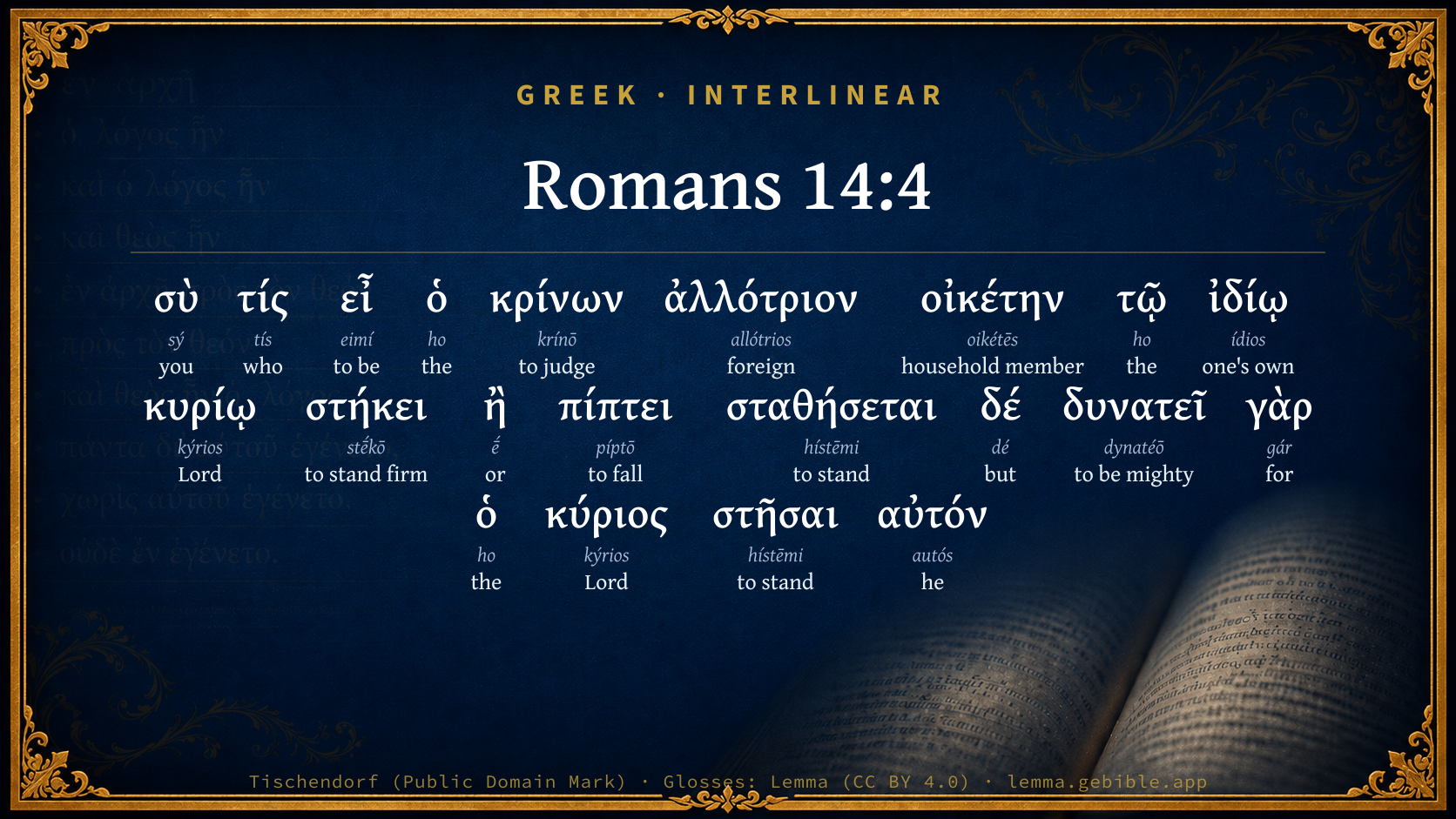
Greek (Tischendorf 8th ed.) Romans 14:4 appears in the Greek New Testament. The text above is from the Tischendorf 8th edition. Each word links to its Strong’s number and a concise gloss. Click any word for its full Thayer’s Greek Lexicon entry.
Download image
Cite this verse

Romans 14:4 (World English Bible). Public Domain. Lemma interlinear Bible study tool, https://lemma.gebible.app/v/romans/14/4.

Show BibTeX & RIS
BibTeX
RIS
English Translation
Who are you who judge another's servant? To his own lord he stands or falls. Yes, he will be made to stand, for God has power to make him stand.
World English Bible · Public Domain
Highlights
  • 1 first appearance in the Greek New Testament
Full analysis ↓
Download a study sheet

One document with this verse’s original text, its word-by-word gloss line, the meaning frame, cross-references with their text, attributed commentary, and full source and license credits — printable, and it pastes into notes with its structure intact.

This verse Autodidact and up

Study sheet (.html) Plain text (.txt)

A passage Seminary Student

Up to 50 verses in one chapter. A passage sheet keeps up to 6 commentary sources and 12 cross-references per verse, in the order this page ranks them, and says so on the sheet whenever that leaves anything out. Ask for a single verse and you get the Autodidact verse sheet above.

Everything on this page stays free to read, with no account — the sheet is a download of what is already on screen, not access to it.

Want to remove ads? Support Godless Engineer
Compare translations 3

The same verse in 3 English versions, stacked beneath the original-language interlinear above. Click any original word for its lexicon entry.

Each is an independent rendering of the whole verse — the interlinear is not word-aligned to these translations.

Highlighted words mark where these versions differ — a whole-verse word diff, not a word-by-word alignment.

  • World English Bible Public Domain
    Who are you who judge another's servant? To his own lord he stands or falls. Yes, he will be made to stand, for God has power to make him stand.
  • King James Version Public Domain
    Who art thou that judgest another man's servant? to his own master he standeth or falleth. Yea, he shall be holden up: for God is able to make him stand.
  • unfoldingWord Literal Text CC BY-SA 4.0
    Who are you, the one judging a household slave belonging to another? To his own master he stands or falls. But he will be made to stand, for the Lord is able to make him stand.

unfoldingWord Literal Text — © unfoldingWord, licensed CC BY-SA 4.0. Word-aligned USFM3 via Door43 (git.door43.org/unfoldingWord/en_ult).

Versions to compare (up to 4)

3 of 4 selected

Show all 19 translations

Every available English version of this verse, each an independent rendering of the whole verse.

  • World English Bible Public Domain
    Who are you who judge another's servant? To his own lord he stands or falls. Yes, he will be made to stand, for God has power to make him stand.
  • Berean Standard Bible Public Domain
    Who are you to judge someone else’s servant? To his own master he stands or falls. And he will stand, for the Lord is able to make him stand.
  • Majority Standard Bible Public Domain
    Who are you to judge someone else’s servant? To his own master he stands or falls. And he will stand, for God is able to make him stand.
  • King James Version Public Domain
    Who art thou that judgest another man's servant? to his own master he standeth or falleth. Yea, he shall be holden up: for God is able to make him stand.
  • American Standard Version (1901) Public Domain
    Who art thou that judgest the servant of another? to his own lord he standeth or falleth. Yea, he shall be made to stand; for the Lord hath power to make him stand.
  • Revised Version (1885) Public Domain
    Who art thou that judgest the servant of another? to his own lord he standeth or falleth. Yea, he shall be made to stand; for the Lord hath power to make him stand.
  • Geneva Bible (1599) Public Domain
    Who art thou that condemnest another mans seruant? hee standeth or falleth to his owne master: yea, he shalbe established: for God is able to make him stand.
  • Douay-Rheims (1899) Public Domain
    Who art thou that judgest another man's servant? To his own lord he standeth or falleth. And he shall stand: for God is able to make him stand.
  • Young's Literal Translation Public Domain
    Thou -- who art thou that art judging another's domestic? to his own master he doth stand or fall; and he shall be made to stand, for God is able to make him stand.
  • Literal Standard Version CC BY-SA 4.0
    You—who are you that are judging another’s domestic [affairs]? To his own master he stands or falls; and he will be made to stand, for God is able to make him stand.
  • Unlocked Literal Bible CC BY-SA 4.0
    Who are you, you who judge a servant belonging to someone else? It is before his own master that he stands or falls. But he will be made to stand, for the Lord is able to make him stand.
  • unfoldingWord Literal Text CC BY-SA 4.0
    Who are you, the one judging a household slave belonging to another? To his own master he stands or falls. But he will be made to stand, for the Lord is able to make him stand.
  • Darby Bible Public Domain
    Who art *thou* that judgest the servant of another? to his own master he stands or falls. And he shall be made to stand; for the Lord is able to make him stand.
  • World Messianic Bible Public Domain
    Who are you who judge another’s servant? To his own lord he stands or falls. Yes, he will be made to stand, for God has power to make him stand.
  • Webster's Bible Public Domain
    Who art thou that judgest another man's servant? to his own master he standeth or falleth: and he shall be held up: for God is able to make him stand.
  • Free Bible Version CC BY-SA 4.0
    What right do you have to judge someone else's servant? It's their own master who decides whether they are right or wrong. With the Lord's help they will be able to take their stand for right.
  • Bible in Basic English Public Domain
    Who are you to make yourself a judge of another man's servant? it is to his master that he is responsible for good or bad. Yes, his place will be safe, because the Lord is able to keep him from falling.
  • Text-Critical English NT CC BY 4.0
    Who are yoʋ to judge the servant of another? To his own master he stands or falls. And he will be made to stand, for God is able to make him stand.
  • Tyndale New Testament (1534) Public Domain
    What arte thou that iudgest another manes servaut? Whether he stonde or faule that pertayneth vnto his master: ye he shall stonde. For God is able to make him stonde.

Literal Standard Version (2020), Covenant Press — licensed CC BY-SA 4.0. Text via the HelloAO Bible API (eBible.org). Unlocked Literal Bible (unfoldingWord) — licensed CC BY-SA 4.0. Text via the HelloAO Bible API (eBible.org). unfoldingWord Literal Text — © unfoldingWord, licensed CC BY-SA 4.0. Word-aligned USFM3 via Door43 (git.door43.org/unfoldingWord/en_ult). Free Bible Version, Dr. Jonathan Gallagher — licensed CC BY-SA 4.0. Text via the HelloAO Bible API (eBible.org).

Word by word

More ways to search: Search by grammar → Find every occurrence → Compare this word →

Practice this passage: Drill this verse → Learn its vocabulary →

δυνατεῖ
dynatéō
G1414
“to be mighty”
Verb, Present, Active, Indicative, 3rd person, Singular
Part of Speech
Verb
Tense
Present
Voice
Active
Mood
Indicative
Person
3rd person
Number
Singular
Full Thayer's Definition

Origin: from G1415

TDNT: 06:44,2

1. to be powerful or mighty 2. show one's self powerful 3. to be able, have power
  1. σὺ sý G4771 “you” Personal pronoun, 2nd person, Nominative, Singular
  2. τίς tís G5101 “who” Interrogative pronoun, Nominative, Singular, Masculine
  3. εἶ eimí G1510 “to be” Verb, Present, Active, Indicative, 2nd person, Singular
  4. ὁ ho G3588 “the” Article, Nominative, Singular, Masculine
  5. κρίνων krínō G2919 “to judge” Verb, Present, Active, Participle, Nominative, Singular, Masculine
  6. ἀλλότριον allótrios G245 “foreign” Adjective, Accusative, Singular, Masculine
  7. οἰκέτην oikétēs G3610 “household member” Noun, Accusative, Singular, Masculine
  8. τῷ ho G3588 “the” Article, Dative, Singular, Masculine
  9. ἰδίῳ ídios G2398 “one's own” Adjective, Dative, Singular, Masculine
  10. κυρίῳ kýrios G2962 “Lord” Noun, Dative, Singular, Masculine
  11. στήκει stḗkō G4739 “to stand firm” Verb, Present, Active, Indicative, 3rd person, Singular
  12. ἢ ḗ G2228 “or” Particle
  13. πίπτει píptō G4098 “to fall” Verb, Present, Active, Indicative, 3rd person, Singular
  14. σταθήσεται hístēmi G2476 “to stand” Verb, Future, Passive, Indicative, 3rd person, Singular
  15. δέ dé G1161 “but” Conjunction
  16. γὰρ gár G1063 “for” Conjunction
  17. ὁ ho G3588 “the” Article, Nominative, Singular, Masculine
  18. κύριος kýrios G2962 “Lord” Noun, Nominative, Singular, Masculine
  19. στῆσαι hístēmi G2476 “to stand” Verb, Aorist, Active, Infinitive
  20. αὐτόν autós G846 “he” Personal pronoun, Accusative, Singular, Masculine

About this verse

These counts appear in no published source. They are computed here, from the morphology-tagged text and Lemma’s own curated glosses. What Lemma adds →

21
words
17
distinct lemmas
Pauline Epistles
section

Notable vocabulary

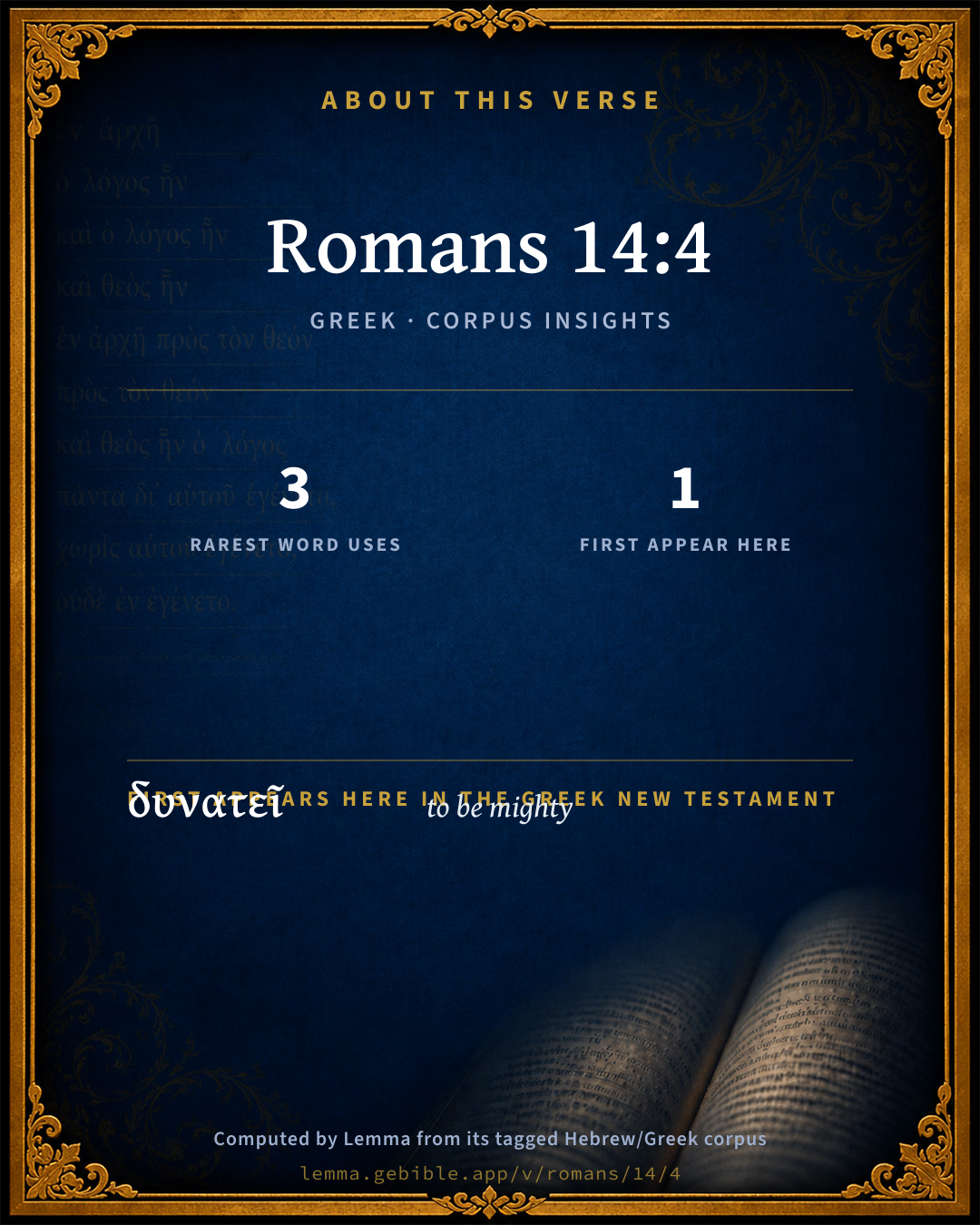
The rarest word here is δυνατεῖ to be mighty G1414 — appearing just 3 times in the whole Greek New Testament.

First appearance in Scripture

This word makes its first canonical appearance in the Greek New Testament here:

  • δυνατεῖ to be mighty G1414

Shared distinctive vocabulary

δυνατεῖ to be mighty G1414 occurs in 3 verses of the Greek New Testament. Also found in:
Repetition

Words recur within this verse:

  • κυρίῳ Lord G2962 ×2
  • σταθήσεται to stand G2476 ×2
  • ὁ the G3588 ×3

Cross-references

19

Topical passages linked to Romans 14:4 in the Treasury of Scripture Knowledge — connected by theme and wording, ordered by reader-vote popularity; previews shown in the World English Bible.

  • James 4:11–12 Don't speak against one another, brothers. He who speaks against a brother and judges his brother, speaks against the law and judges the law. But if you judge the law, you are not a doer of the law, but a judge.
  • Romans 9:20 But indeed, O man, who are you to reply against God? Will the thing formed ask him who formed it, "Why did you make me like this?"
  • Romans 8:31–39 What then shall we say about these things? If God is for us, who can be against us?
  • Jude 1:24 Now to him who is able to keep them from stumbling, and to present you faultless before the presence of his glory in great joy,
  • 1 Corinthians 4:4–5 For I know nothing against myself. Yet I am not justified by this, but he who judges me is the Lord.
  • Psalms 37:24 Though he stumble, he shall not fall, For Yahweh holds him up with his hand.
  • John 10:28–30 I give eternal life to them. They will never perish, and no one will snatch them out of my hand.
  • Romans 14:3 Don't let him who eats despise him who doesn't eat. Don't let him who doesn't eat judge him who eats, for God has received him.
  • Hebrews 7:25 Therefore he is also able to save to the uttermost those who draw near to God through him, seeing he ever lives to make intercession for them.
  • Deuteronomy 33:27–29 The eternal God is [your] dwelling-place, Underneath are the everlasting arms. He thrust out the enemy from before you, Said, Destroy.
  • Psalms 17:5 My steps have held fast to your paths, My feet have not slipped.
  • Psalms 37:28 For Yahweh loves justice, And doesn't forsake his saints. They are preserved forever, But the children of the wicked shall be cut off.
  • Isaiah 40:29 He gives power to the faint; and to him who has no might he increases strength.
  • Romans 16:25
  • Psalms 37:17 For the arms of the wicked shall be broken, But Yahweh upholds the righteous.
  • Psalms 119:116–117 Uphold me according to your word, that I may live. Let me not be ashamed of my hope.
  • Acts 11:17 If then God gave to them the same gift as us, when we believed in the Lord Jesus Christ, who was I, that I could withstand God?"
  • 1 Peter 1:5 who by the power of God are guarded through faith for a salvation ready to be revealed in the last time.
  • Romans 11:23 They also, if they don't continue in their unbelief, will be grafted in, for God is able to graft them in again.

Cross-references courtesy of OpenBible.info (CC BY 4.0).

Where the printed editions differ

1 variant

Places in this verse where the major printed Greek editions disagree on the wording in a way that affects the translation — a comparison of editions, not a manuscript-by-manuscript collation. The editions are the modern critical texts (Nestlé-Aland 28/27, SBL, Westcott-Hort, Tregelles, Tyndale House) and the traditional texts behind the KJV (the Textus Receptus and the Byzantine/Majority text). It is not a claim about which reading is original.

  1. Different wording
    κύριος

    “Lord”

    In NA28NA27TynSBLWHTreg Not in TRByz

    θεὸς (theos) 'God' occurs in traditional manuscripts (TR+Byz) instead of κύριος (kurios) 'Lord' in older manuscripts (NA28+NA27+Tyn+SBL+WH+Treg)

Textual data: Translators Amalgamated Greek New Testament (STEPBible TAGNT) · CC BY 4.0.

Commentary

Notes on Romans 14:4 from classic Christian and Jewish commentators (each source and its license shown beneath its notes). The classic Christian expositions comment on the surrounding passage and are grouped to its opening verse, so a note may address several verses; the Jewish commentaries on the Tanakh (Rashi and others) are per-verse, so they appear only where the commentator wrote on this verse.

Lemma curates 59 commentaries, every one of them public domain or Creative Commons licensed, each selected and text-cleaned for this edition rather than reprinted as found. About our sources →

Bengel's Gnomon

Johann Albrecht Bengel

Rom 14:4. Σὺ) thou, O weak man.—τὶς εἶ) who art thou, who takest so much upon thyself.—ἀλλότριον οἰκέτην, another man’s servant) He calls him in another respect thy brother, as it suits his purpose, Rom 14:10.—Κυρίῳ, [Master] Lord) Christ, Rom 14:6-7; Rom 14:9-10; Rom 14:14-15; Rom 14:18.—στήκει, he stands) although thou, O weak man, dost not think so.—σταθήσεται δὲ, yea, and he shall be holden up) if he shall fall; he will be upheld by sure knowledge.—δυνατὸς γὰρ, for He is able) In the works of Divine grace, the conclusion is often valid, when drawn from what is possible (posse) to what actually is (esse): against those especially, who judge otherwise; and in behalf of those who are weak.

Bengel's Gnomon of the New Testament — English translation (T&T Clark, Edinburgh, 1860) — public domain. Text from a community e-Sword module.

Meyer's Critical & Exegetical Commentary

Heinrich August Wilhelm Meyer

Rom_14:4 then adds what a presumptuous intermeddling such a κρίνειν is. In this the emotion rises to an animated apostrophe, addressed to the weak in faith who passes judgment, not to both parties, as Reiche and Tholuck think; for κρίνων corresponds to the κρινέτω of Rom_14:3.

σὺ τίς εἶ] comp. Rom_9:20. It discloses the presumption, without however standing in the relation of apodosis to the preceding ὁ Θεὸς αὐτὸν προσελάβετο (Hofmann), which is nowise indicated and is forbidden by the fact that the following relation of domestic slave points to Christ as Master.

ἀλλότριον οἰκέτην] who is not in thy domestic service, but in that of another. This other is Christ (see Rom_14:6), not God, who is rather distinguished from the master by δυν. γὰρ κ.τ.λ.

τῷ ἰδίῳ κυρίῳ] to his own master. The dative denotes the relation of subordination to the interest of the ἴδιος κύριος (Bernhardy, p. 85). His own master, and no other, is interested therein; whence the incompetence of the κρίνειν is obvious.

The figurative standing and falling is either explained of standing firm (Psa_1:4; Luk_21:36), and of being condemned (causa cadere) in the divine judgment (Calvin, Cornelius a Lapide, Grotius, Estius, Wolf, and others, including Reiche, Köllner, Borger, Tholuck, Philippi), or, as in 1Co_10:12, of continuance and non-continuance in the state of true Christian faith and life. So in substance, Erasmus, Beza, Vatablus, Toletus, Bengel, Semler, and others, including Flatt, de Wette, Fritzsche, Rückert, Maier, Baumgarten-Crusius, Umbreit, van Hengel, Hofmann. The use of πίπτειν would not tell against the former (Hofmann), for it would have its warrant as contrast to the σώζεσθαι in the divine judgment figuratively set forth by the standing (Soph. Trach. 84, and see Ellendt, Lex. Soph. II. p. 568); but the second explanation is to be preferred, partly because the unwarranted κρίνειν denied to the more free the possession of a right Christian frame of life, partly because of the following δυνατεῖ γὰρ κ.τ.λ. For to make to stand in the judgment, i.e. without figure, to acquit and pronounce righteous, is not the work of divine power, but of grace. But according to His power (against Reiches objection to this, see Eph_3:20) God effects an inner strengthening, so that the Christian stands in that which is good, and even he who thinks more freely does not succumb to the dangers to which the nature of his Christian faith and life is exposed by the very fact of his freer principles, but perseveres in the true Christian state. For this Paul looks to Gods power, and promises it. When Tholuck, on the ground of the reading ὁ κύριος, finds the thought, that the Judge will even find out sufficient reasons for exculpation, this is a pure importation into the text.

δυνατεῖ] See on 2Co_13:3. Comp. Clem. Hom. i. 6.

Meyer — Critical and Exegetical Commentary on the New Testament — English translation by Peter Christie, edited by Frederick Crombie (T&T Clark, 1880) — public domain. Text from a community e-Sword module.

Expositor's Greek Testament

ed. W. Robertson Nicoll

Rom 14:4 . σὺ τίς εἶ ὁ κρίνων ἀλλότριον οἱκέτην ; the sharpness of this rebuke ( cf. Rom 9:20 ) shows that Paul, with all his love and consideration for the weak, was alive to the possibility of a tyranny of the weak, and repressed it in its beginnings. It is easy to lapse from scrupulousness about one’s own conduct into Pharisaism about that of others. οἰκέτης is rare in the N.T. Paul has no other example, and may have used it here for the suggestion (which δοῦλος has not) that the person referred to belonged to the house. τῷ ἰδίῳ κυρίῳ στήκει ἢ πίπτει : for the verbs in the moral sense see 1Co 10:12 . The dative is dat [36] comm [37] It is his own Lord who is concerned it is His interest which is involved and to Him (not to you) he must answer as he stands or falls. σταθήσεται δέ : but he shall be made to stand, i.e. , shall be preserved in the integrity of his Christian character. δυνατεῖ γὰρ ὁ Κύριος στῆσαι αὐτόν : for the Lord has power to keep him upright. Paul does not contemplate the strong man falling and being set up again by Christ; but in spite of the perils which liberty brings in its train and the Apostle is as conscious of them as the most timid and scrupulous Christian could be he is confident that Christian liberty, through the grace and power of Christ, will prove a triumphant moral success.

[36] dative case.

[37] commentary, commentator.

The Expositor's Greek Testament, edited by W. Robertson Nicoll (1897–1910) — public domain. Text from a community e-Sword module.

Hodge's Commentary on Romans, Ephesians & First Corinthians

Charles Hodge

Rom_14:4

Who art thou that judgest another mans servant? to his own master he standeth or falleth. If God has not made the point in question a term of communion, we have no right to make it a ground of condemnation. We have no right to exercise the office of judge over the servant of another. This is the second reason for mutual forbearance with regard to such matters as divided the Jewish and Gentile converts. It cannot fail to be remarked how differently the apostle speaks of the same things under different circumstances. He who circumcised Timothy, who conformed in many things to the law of Moses, and to the Jews became a Jew, and who here exhorts Christians to regard their external observances as matters of indifference, resisted to the uttermost, as soon as these things were urged as matters of importance, or were insisted upon as necessary to acceptance with God. He would not allow Titus to be circumcised, nor give place even for an hour to false brethren, who had come in privily to act as spies, Gal_2:3, Gal_2:5. He warned the Galatians, that if they were circumcised, Christ would profit them nothing; that they renounced the whole method of gratuitous justification, and forfeited its blessings, if they sought acceptance on any such terms. How liberal and how faithful was the apostle! He would concede everything, and become all things to all men, where principle was not at stake; but when it was, he would concede nothing for a moment. What might be safely granted, if asked and given as a matter of indifference, became a fatal apostasy when demanded as a matter of necessity or a condition of salvation.

To his own master he standeth or falleth, i.e. it belongs to his own master to decide his case, to acquit or to condemn. These terms are often used in this judicial sense, Psa_1:5, Psa_76:7; Luk_21:36; Rev_6:17. Yea, he shall be holden up: for God is able to make him stand; i.e. he shall stand, or be accepted, for God has the right and the will to make him stand, that is, to acquit and save him. This clause seems designed to urge a further reason for forbearance and kindness towards those who differ from us on matters of indifference. However weak a mans faith may be, if he is a Christian, he should be recognized and treated as such; for his weakness is not inconsistent with his acceptance with God, and therefore is no ground or necessity for our proceeding against him with severity. The objects of discipline are the reformation of offenders and the purification of the church; but neither of these objects requires the condemnation of those brethren whom God has received. God is able to make him stand; he has not only the power, but the disposition and determination. Compare Rom_11:23, For God is able to graft them in again. The interpretation given above, according to which standing and falling are understood judicially, is the one commonly adopted. It is how ever objected, that justifying, causing to stand in judgment, is not an act of power but grace. On this ground, standing and falling are taken to refer to continuing or falling away from the Christian life. God is able, notwithstanding their weakness, to cause his feeble children to persevere. But this is against the context. The thing condemned is unrighteous judgments. The brethren are not responsible to each other, or the church, or their scruples. God is the Lord of the conscience. To him they must answer. Before him they stand or fall.

Charles Hodge — Commentary on Romans (1835), First Corinthians (1857), and Ephesians (1856) — public domain. Text from a community e-Sword module.

Geneva Bible (1599)

Geneva Bible translators

Another reason which hangeth upon the former: why the ruder and more unlearned ought not to be contemned of the more skillful, as men without hope of salvation: Because, saith the Apostle, he that is ignorant today, may be endued tomorrow with further knowledge, so that he also may stand sure: Therefore it belongeth to God, and not unto man, to pronounce the sentence of condemnation.

Geneva Bible (1599) marginal notes — public domain. Text via Bolls.life.

Jamieson, Fausset & Brown

Robert Jamieson, A. R. Fausset & David Brown

Who art thou that judges another man's--rather, "another's"

servant?--that is, CHRIST'S, as the whole context shows, especially Rom 14:8-9.

Yea, &c.--"But he shall be made to stand, for God is able to make him stand"; that is, to make good his standing, not at the day of judgment, of which the apostle treats in Rom 14:10, but in the true fellowship of the Church here, in spite of thy censures.

Jamieson, Fausset & Brown — Commentary Critical and Explanatory on the Whole Bible (1871) — public domain (CC PDM 1.0). Text via the HelloAO Bible API.

Adam Clarke's Commentary

Verse 4. Who art thou that judgest another man's servant?] Who has ever given thee the right to condemn the servant of another man, in things pertaining to his own master? To his own master he standeth or falleth. He is to judge him, not thou; thy intermeddling in this business is both rash and uncharitable.

Yea, he shall be holden up] He is sincere and upright, and God, who is able to make him stand, will uphold him; and so teach him that he shall not essentially err. And it is the will of God that such upright though scrupulous persons should be continued members of his Church.

Adam Clarke's Commentary on the Bible (1810–1826) — public domain. Text from a community e-Sword/MySword module.

John Calvin's Commentaries

4. Who art thou who judgest, etc. “As you would act uncourteously, yea, and presumptuously among men, were you to bring another man’s servant, under your own rules, and try all his acts by the rule of your own will; so you assume too much, if you condemn anything in God’s servant, because it does not please you; for it belongs not to you to prescribe to him what to do and what not to do, nor is it necessary for him to live according to your law.”

Now, though the power of judging as to the person, and also as to the deed, is taken from us, there is yet much difference between the two; for we ought to leave the man, whatever he may be, to the judgment of God; but as to his deeds we may indeed form a decisive opinion, though not according to our own views, but according to the word of God; and the judgment, derived from his word, is neither human, nor another man’s judgment. Paul then intended here to restrain us from presumption in judging; into which they fall, who dare to pronounce anything respecting the actions of men without the warrant of God’s word.

To his own Lord he stands or falls, etc. As though he said, — “It belongs rightly to the Lord, either to disapprove, or to accept what his servant doeth: hence he robs the Lord, who attempts to take to himself this authority.” And he adds, he shall indeed stand: and by so saying, he not only bids us to abstain from condemning, but also exhorts us to mercy and kindness, so as ever to hope well of him, in whom we perceive anything of God; inasmuch as the Lord has given us a hope, that he will fully confirm, and lead to perfection, those in whom he has begun the work of grace.

But by referring to the power of God, he means not simply, as though he had said, that God can do this if he will; but, after the usual manner of Scripture, he connects God’s will with his power: and yet he speaks not here of perpetuity, as though they must stand to the end whom God has once raised up; but he only reminds us, that we are to entertain a good hope, and that our judgments should lean this way; as he also teaches us in another place,

“He who began in you a good work, will perform it to the end.” (Philippians 1:6.)

In short, Paul shows to what side their judgments incline, in whom love abounds.

John Calvin's Commentaries (1540-1563) — public domain. Text from the Calvin Translation Society English edition (1840s-50s) via the Christian Classics Ethereal Library (ccel.org). Calvin's coverage is partial (roughly two-thirds of the Bible); uncommented books and verses are honest gaps, never fabricated. The 19th-century editor's footnotes and remarks are omitted so the notes are faithfully Calvin's own voice.

Ellicott's Commentary for English Readers

(4) Who art thou?—This is addressed to the weak. The Apostle indignantly challenges his right to judge. That right belongs to another tribunal, before which the conduct of the stronger Christian will not be condemned but approved and upheld.

He standeth or falleth.—It seems most in accordance with what precedes to take this of judicial condemnation or approval from the Master whom he serves—i.e., Christ.

Holden up.—The same word as that in the clause following, and similar to that in the clause preceding—“Made to stand.”

God is able to make him stand.—The true reading here is “the Lord”—i.e., Christ; the word is the same as “his Master” above. “Make him stand” seems to be still judicial. “Secure his acquittal,” but with reference to his previous course of conduct on which that acquittal is grounded. The trial is not necessarily reserved for the last day, but is rather the judgment which Christ may be supposed at any moment to pass upon His servants. If they can sustain this judgment, it is only because His grace has enabled them so to act as not to be condemned by it.

A Bible Commentary for English Readers, edited by Charles John Ellicott (1878–1897) — public domain. Text from a community e-Sword module.

The Cambridge Bible for Schools and Colleges

gen. ed. J. J. S. Perowne

4. The question has been much debated whether the observance of the Sabbath was one of the tenets of the “weak brethren,” and so whether it is here ruled by St Paul to be not of permanent moral obligation. (Cp. Col_2:16.) If by “the Sabbath” is meant the last day of the week strictly, the answer to both questions must be yes. But as to the observance of a divinely-consecrated Weekly Rest, it is evident (from Gen_2:3 and Exo_20:8-11, and cp. such passages of prophetic doctrine as Isa_58:13-14,) that the institution stands on a very different level from that of the monthly and yearly Mosaic festivals. It is antecedent to all Jewish law, and in the Decalogue of Exodus it is based on strictly universal grounds, and placed among the great elements of moral duty. No doubt it is impossible to trace the whole process of transition from the observance of the Seventh day to that of the First; but the plain fact remains that the sanctity of the primeval weekly worship-rest was of a kind most unlikely to be slightingly put aside by the Apostles; and thus in such places as this and Col_2:16 it is far more likely that the wrong opinion in question was that the whole Mosaic code of festivals was still binding in full detail; that therefore the Saturday was the only possible Sabbath; and that it was to be observed by the Rabbinic rules.

How to deal with those who might reject the Weekly Rest altogether might be a difficult question. But all we are here called on to enquire is whether it was likely that St Paul, with the O. T. before him, would treat the Sabbath (the Sabbath apart from its Rabbinic aspect) as a thing of the same quality as, for example, the new-moon feast.

4. Who art thou that judgest] The verb “judge” connects this with the “judgment” passed by the “eater of herbs” upon the Christianity of his “stronger” brother.—The word “judge” here (as in Mat_7:1) manifestly does not forbid the entertainment, nor the right expression, of opinions, but the assumption of a tone of judicial opinion: the thinking of others from a level of isolated authority and sanctity.

standeth or falleth] In the sense of acceptance or non-acceptance.

Yea, he shall be holden up] Lit. But he shall he made to stand. The “but” points out that of the two alternatives just given (“standing,” “falling,”) the former, in this case, is certain.

The Cambridge Bible for Schools and Colleges (gen. ed. J. J. S. Perowne; Cambridge University Press, 1878–1918) — public domain. Text from a community e-Sword module.

John Gill's Exposition

Who art thou that judgest another man's servant,.... This is another reason, dissuading from censoriousness and rash judgment, taken from civil things; one man has nothing to do with another man's servant; he has no power over him, nor any right to call him to an account for his actions; nor has he any business to censure or condemn him for them, or concern himself about them: so the believer supposed to be judged, does not belong to him that takes upon him to judge and condemn him; he is another's servant, he is the servant of God: he is chosen by God the Father for his service, as well as unto salvation; he is bought with the price of Christ's blood, and therefore not his own, nor another's, but Christ's, he is bought with his money; and he is also born in his house, the church; the Spirit of God in regeneration forms him for himself, for righteousness and holiness; under the influence of whose grace he voluntarily gives up himself to the service of God, and is assisted by him to keep his statutes and do them; and what has another to do with him? what power has he over him, or right to judge him?

to his own master he standeth or falleth, the meaning of which is, either if he "stands", that is, if he serves his Lord and master, of which "standing" is expressive; and continues in the service of him, whose servant he professes to be; this is to his master's advantage and profit, and not to another's: and if he "falls", that is, from his obedience to him, as such who profess to be the servants of God may; they may fall off from the doctrine of grace they have embraced; and that either totally and finally, as such do who never felt the power of it in their hearts; or partially, from some degree of steadfastness in the faith: and such also may fall from a lively exercise of the graces of faith, hope, and love, and into great sins, which is to their master's dishonour, and cause his ways and truths to be evil spoken of; and so it is to their own master they fail: or else the sense is, to their own master they are accountable, whether they stand or fall, serve or disobey him; and it is according to his judgment and not another's, that they "stand", or are and will be justified and acquitted, and will hear, well done, good and faithful servant; and according to the same they will "fall", or be condemned, and hear, take the slothful and unprofitable servant, and cast him into outer darkness: so the words "standing" and "failing" are used by the Jews in a forensic sense, for carrying or losing a cause, for justification or condemnation in a court of judicature, and particularly in the last judgment: and so they explain Psa 1:5, "the ungodly shall not stand in the judgment": the Targum paraphrases it,

"the wicked shall not be justified in the great day;''

and Jarchi upon the place says, there shall be no , "standing of the foot" of the wicked, in the day of judgment; see Luk 21:36.

Yea, ye shall be holden up; which words seem to be a sort of correction of the apostle's, as if he should say, why do I talk of falling, one that is a true servant of the Lord's shall not fall, at least not totally and finally, nor in the last judgment; for he is holden by the right hand of God, by the right hand of his righteousness, and is kept by the power of God through faith unto salvation:

for God is able to make him stand; and will make him stand: words of power oftentimes include willingness as well as ability; see Jdg 5:24. God will make such to persevere to the end, because he has loved them with an everlasting love, chosen them in Christ, made a covenant with them in him, and has put them into his hands, and made them his care and charge; Christ has redeemed them by his blood, now intercedes, and is making preparations for them in heaven; they are united to him, and are built on him, the sure foundation; and the Spirit of God has begun that good work, which shall be performed. God will make such to stand in judgment with intrepidity, and without shame, being clothed with the righteousness of his Son; and shall therefore have the crown of righteousness given them, and an abundant entrance administered into his kingdom and glory: hence they ought not to be judged by man's judgment, nor need they regard it. The Alexandrian copy reads, "the Lord is able", &c.

John Gill's Exposition of the Whole Bible (1746–1763) — public domain (CC PDM 1.0). Text via the HelloAO Bible API.

Trapp's Complete Commentary

John Trapp

4 Who art thou that judgest another man’s servant? to his own master he standeth or falleth. Yea, he shall be holden up: for God is able to make him stand.

Ver. 4. Who art thou, &c.] The wisdom from above is without censuring, without hypocrisy, saith St James, Jas 3:17. Intimating, that the greatest censurers are mostly the greatest hypocrites. And as any one is more wise, he is more sparing of his censures.

John Trapp, A Commentary or Exposition upon All the Books of the Old and New Testament (1647–1656) — public domain. Text from a community e-Sword module.

Albert Barnes' Notes on the Bible

Who art thou ... - That is, who gave you this right to sit in judgment on others; compare Luk 12:14. There is reference here particularly to the “Jew,” who on account of his ancient privileges, and because he had the Law of God, would assume the prerogative of “judging” in the case, and insist on conformity to his own views; see Acts 15. The doctrine of this Epistle is uniformly, that the Jew had no such privilege, but that in regard to salvation he was on the same level with the Gentile.

That judgest ... - compare Jam 4:12. This is a principle of common sense and common propriety. It is not ours to sit in judgment on the servant of another man. He has the control over him; and if “he” chooses to forbid his doing anything, or to allow him to do anything, it pertains to “his” affairs not ours. To attempt to control him, is to intermeddle improperly, and to become a “busy-body in other men’s matters;” 1Pe 4:15. Thus, Christians are the servants of God; they are answerable to him; and “we” have no right to usurp “his” place, and to act as if we were “lords over his heritage;” 1Pe 5:3.

To his own master - The servant is responsible to his master only. So it is with the Christian in regard to God.

He standeth or falleth - He shall be approved or condemned. If his conduct is such as pleases his master, he shall be approved; if not, he will be condemned.

Yea, he shall be holden up - This is spoken of the Christian only. In relation to the servant, he might stand or fall; he might be approved or condemned. The master had no power to keep him in a way of obedience, except by the hope of reward, or the fear of punishment. But it was not so in regard to the Christian. The Jew who was disposed to “condemn” the Gentile might say, that he admitted the general principle which the apostle had stated about the servant; that it was just what he was saying, that he might “fall,” and be condemned. But no, says the apostle, this does not follow, in relation to the Christian He shall not fall. God has power to make him stand; to hold him; to keep him from error, and from condemnation, and “he shall be holden up.” He shall not be suffered to fall into condemnation, for it is the “purpose” of God to keep him; compare Psa 1:5. This is one of the incidental but striking evidences that the apostle believed that all Christians should be kept by the power of God through faith unto salvation.

Is able - See Joh 10:29. Though a master cannot exert such an influence over a servant as to “secure” his obedience, yet “God” has this power over his people, and will preserve them in a path of obedience.

Albert Barnes' Notes on the Bible (1834–1885) — public domain. Text from a community e-Sword/MySword module.

Matthew Poole's English Annotations

Who art thou that judgest another man’s servant? to his own master he standeth or falleth: a sharp reprehension of the forementioned evil. You have the like: Jam 4:12. q.d. This phrase is repugnant not only to the law of God, but to the very law of nature, which tells us, that one man must not condemn the servant of another, over whom he hath no right or power; much less may any man condemn him that is the Lord’s servant. Every Christian hath Christ alone for his own or his proper Master; and it is his judgment by which he must abide; it is to him that he standeth or falleth, that he doth well or ill.

Yea, he shall be holden up: for God is able to make him stand: q.d. If (as thou thinkest) he be fallen or falling, he shall be upheld and supported;

for God is able, & c. But how doth this follow, because God can make him stand, therefore he shall be holden up?

Answer. It is a rule in divinity, that in all God’s promises, his power is joined with his will; so that where the latter is once revealed, there is no question of the former: now of the word of God in this matter, there was no doubt; for he had said, Rom 14:3, that God had received him. You had the like way of arguing, Rom 11:23, where the apostle proves the calling of the Jews by an argument taken from the power of God, because he is able to graft them in again: see Rom 4:21; Heb 10:23.

Matthew Poole's English Annotations on the Holy Bible (1683–1685) — public domain. Text from a community e-Sword/MySword module.

The Pulpit Commentary

Who art thou that judgest another man"s servant? (observe the emphatic position of su) to his own lord he standeth or falleth. Yea, he shall be made to stand: for the Lord (better supported than God, as in the Textus Receptus) is able (or, has power) to make him stand. The standing or falling here spoken of may be taken to mean standing firm in, or falling from, a state of grace, (cf. Rom_11:20, Rom_11:22) rather than acceptance or rejection at the last judgment. "For God is able," etc., seems to require this meaning. The non-abstainer"s freedom does not endanger his position; for God is powerful to sustain him, and to God alone he is accountable.

The Pulpit Commentary (1880–1919), ed. H.D.M. Spence-Jones & Joseph S. Exell — public domain. Text from a community e-Sword module.

Burkitt's Expository Notes on the New Testament

William Burkitt

Another reason is here produced why we should not rashly censure or judge our brother differing in judgment from us about lesser things; namely, because he is God’s servant; and it is God’s sentence and not ours, which he must stand or fall by. And if these differences shall not hinder God’s acceptance of him to salvation, why should they hinder us in accepting of him into our communion? To love, is our duty: to judge, is God’s prerogative: Let us be more in charity, and less in censure.

Learn hence, That the scripture forbids us to judge one another as having no grace, for the doing or not doing of those things which are consistent with a present state of grace.

William Burkitt's Expository Notes on the New Testament (1700–1703) — public domain. Text from a community e-Sword module.

McGarvey & Pendleton's Commentaries

J. W. McGarvey

Who art thou that judgest the servant of another? to his own lord he standeth or falleth. Yea, he shall be made to stand; for the Lord hath power to make him stand . [We must avoid the sacrilegious presumption which condemns where God hath not condemned. Whether our brother in Christ stands in favor, so that his daily life and service are accepted of God, or whether he falls from grace, so that his labors are rejected, is a matter for the Master, and does not pertain to us servants. (Comp. 1Co_10:12 ; 1Co_16:13 ; 1Th_3:8 ; Rom_8:33-34 ; Rom_11:22 ) A kindly, affectionate concern is commendable, but a censorious condemnation is forbidden. Moreover, the latter is useless and idle, for it is the duty of each disciple to please his Master, not his fellow-servant, and the Master is able to justify and will justify without consulting human accusers ( Rom_8:33 ), or paying respect to man-made technicalities about indifferent things. Christ's ability to justify extends to even positive, inexcusable sin ( Rom_3:26 ; Joh_8:11 ). If we could only learn that the consciences of others, though different, are as active and as exacting as our own, we would judge less and love more. Acting by contrary rule, if we find that any man's conscience varies from our own, we straightway conclude that he has no conscience at all, and hence is a proper subject for our condemnation, a culprit well within the bounds of our jurisdiction.]

J. W. McGarvey (with Philip Y. Pendleton), Commentaries on the New Testament (The Fourfold Gospel, 1914; Acts; and the epistles) — public domain. Text from a community e-Sword/MySword module.

The People's New Testament

B. W. Johnson

4. Who art thou that judgest another man's servant? Since God has received him, he is God's servant, and his accountability is not to you, but to God. God is able to make him stand. In spite of what some of you think is an error, he shall stand, for God is able to keep him. This conduct shall not cut him off from the grace of God in which we all stand.

B. W. Johnson's The People's New Testament with Notes (1889–1891) — public domain. Electronic text from the Christian Classics Ethereal Library (CCEL) ThML edition.

Cambridge Greek Testament for Schools and Colleges

4. σὺ τίς εἶ κ.τ.λ.: the tables are turned: in judging him as a sinner thou art committing a sin of presumption, in judging one who is not accountable to thee. For the dramatic form, cf. 1Co 4:7 f.

ἀλλότριον οἰκ. Cf. Luk 16:13. οἰκ. only here used of the relation of the Christian to the Lord, but cf. δοῦλος, and οἰκονόμοι of apostles, οἰκία of the Christian family. ἀλλ. belonging to and therefore accountable to another master.

στήκει. Cf. 1Co 11:13: a present, formed from the perf. ἕστηκα (which is used for the present) probably to allow of emphasis on the durative action (as κράζω by the side of κέκραγα (= pres.)); cf. Moulton, p. 147, 248. Blass, p. 40 f., cf[273] γρηγορεῖν, mainly found in imper.; cf. 1Co 16:13; Mar 3:31.

[273] confert

Cambridge Greek Testament for Schools and Colleges (Cambridge University Press, 1896; 21 vols, various authors incl. Carr, Maclear, Plummer, Farrar, Lumby, Moule, M. R. James, Simcox) — public domain. Text from a community e-Sword module.

Alford’s Greek Testament

Henry Alford

4.] Who art thou (see ch. 9:20) that judgest the servant of another (viz. as De W., of Christ,—for a κύριος in this passage is marked, vv. 8, 9, as being Christ,—and the Master is the same throughout. ὁ θεός before is unconnected with this verse)? to his own Master (dat. commodi or incommodi according as στ. or πίπτ. befalls: ‘it is his own master’s matter, and his alone, that’) he stands (‘remains in the place and estimation of a Christian, from which thou wouldest eject him;’ not, as Calv., Grot., Estius, Wolf, al., ‘stands hereafter in the judgment,’ which is not in question here: see 1Co 10:12) or falls (from his place, see above): but he shall be made to stand (notwithstanding thy doubts of the correctness of his practice): for the Lord (or, his Lord, in allusion to τῷ ἰδίῳ κυρίῳ above) is able to make him stand (in faith and practice. These last words are inapplicable, if standing and falling at the great day are meant). Notice, this argument is entirely directed to the weak, who uncharitably judges the strong,—not vice versâ. The weak imagines that the strong cannot be a true servant of God, nor retain his steadfastness amidst such temptation. To this the Apostle answers, (1) that such judgment belongs only to Christ, whose servant he is: (2) that the Lord’s Almighty Power is able to keep him up, and will do so.

Henry Alford, The Greek Testament (1849–1861) — public domain. Text from a community e-Sword module.

International Critical Commentary

4. σὺ τίς εἶ; St. Paul is still rebuking the ‘weak.’ The man whom he is condemning is not a household slave, but the servant of God; to God therefore he is responsible.

τῷ ἰδίῳ κυρίῳ. Dat. of reference: cf. vv. 5-8. ‘It is to his own master that he is responsible.’ He it is to whom he must show whether he has used or misused his freedom, whether he has had the strength to fulfil his work or whether he has failed. πίπτει (11:11, 11:22) of moral failure; στήκει (1Co 16:13; Php 1:27) of moral stability. In 1Co 10:12 the two are contrasted, ὥστε ὁ δοκῶν ἑστάναι βλεπέτω μὴ πέσῃ.

σταθήσεται δέ: cf. Mat 12:25. In spite of your censoriousness he will be held straight, for the same Lord who called him on conditions of freedom to His kingdom is mighty to hold him upright. The Lord will give grace and strength to those whom He has called.

For δυνατεῖ (א A B C D F G), which is an unusual word, later MSS. substituted δυνατός (P, Bas. Chrys.), or δυνατὸς ̣ ̣ ̣ ἐστιν (T R with L and later MSS.). For ὁ Κύριος (א A B C P, Sah. Boh., &c.) ὁ Θεός was introduced from ver. 3 (D E F G L, &c., Vulg., Orig.-lat. Bas. Chrys., &c.), perhaps because of the confusion with τῷ Κυρίῳ above.

International Critical Commentary — older volumes (1896–1929), various authors — public domain. Text from a community e-Sword module.

Vincent's Word Studies in the New Testament

Marvin R. Vincent

Who art thou? [συ τις ει] Thou, first in the Greek order and peculiarly emphatic. Addressing the weak brother, since judgest corresponds with judge in ver. 3.

Servant [οικετην] . Strictly, household servant. See on 1Pe 2:18. He is a servant in Christ s household. Hence not another man's, as A. V., but the servant of another, as Rev. Allotrion of another is an adjective.

He shall be holden up [σταθησεται] . Rev., shall be made to stand; better, both because the rendering is more truthful, and because it corresponds with the kindred verb stand - he standeth, make him stand.

Is able [δυνατει] . Stronger than dunatai can. The sense is, is mighty. Hence Rev., hath power.

Marvin R. Vincent, Word Studies in the New Testament (1887–1900) — public domain. Text from a community e-Sword/MySword module.

Godet's Commentaries

Frédéric Louis Godet

Vv. 4. “Who art thou that judgest another man’s servant? To his own master he standeth or falleth. Yea, he shall stand; for God is powerful to hold him up.”

The idea is: It is to the advantage or disadvantage of his master, not of his fellow-servants, that a servant fulfils or neglects his task. The terms standing and falling refer, not to the servant’s absolution or condemnation at the judgment, but to his daily faithfulness or unfaithfulness, and to the strengthening or weakening of his inward relation to Christ. What proves this, is the ground for confidence indicated in the words: “Yea, he shall stand; for God is powerful to hold him up.” There is no more need of being held up, or at least of being so by the power of God, in the judgment day. Of course the servant’s sincerity, in the line of conduct which he has adopted, is assumed, even if he were in error on a particular point. Paul affirms that the Lord will be able to hold him in communion with Himself.

Here the Lord is probably, as generally in the N. T., Christ. It is He, indeed, who is Master of the house, and for whom the servants labor (Luk 12:41-48).

There is a slight touch of irony in this reason: “Yea, he shall be held up.” It is as if Paul said to the weak: “thou mayest assure thyself about him; for, even if he is mistaken, his Master is powerful enough to avert the bad effects of a piece of flesh.” This argument applies, of course, only to things which arise exclusively on the domain of the individual conscience.

In the last proposition, the Greco-Lat. reading ὁ Θεός, God, it seems to me, ought to be preferred to that of the other documents: ὁ κύριος, the Lord; for the act in question is that of strengthening, which is naturally ascribed to God. The reading ὁ κύριος has probably arisen from the τῷ κυρίῳ which precedes.

How easily do these verses find their explanation, if we imagine the church assembled for the love-feast! The majority gives an affectionate welcome to the minority. They sit down altogether for the feast; then immediately the difference breaks out between neighbors. It is the moment for watching: “Well!” says the apostle, “no perverse debates on this occasion; but let each beware of the danger which threatens him at this instant, the one of despising, the other of judging.

Frédéric Louis Godet — Commentaries on Luke, John, Romans, and 1 Corinthians — English translation (T&T Clark, Edinburgh, 1870s–1890s) — public domain. Text from a community e-Sword module.

Lesson kit

Teaching starters — assembled from the data on this page, not authored interpretation. Every prompt links to the verse data it draws on. Edit before teaching.

Romans, in the Pauline Epistles, opens this verse with 21 words (17 distinct Greek lemmas). Its most distinctive word is dynatéō (“to be mighty”). A historical commentator’s framing appears above. Read the whole chapter for the surrounding context.

Discussion questions

  1. How does “to be mighty” (dynatéō) shape what this verse is saying?
  2. This is the first place “to be mighty” appears in Scripture (first appears here). What does its debut here establish?
  3. How does 2 Corinthians 9:8, which shares the word «to be mighty», read alongside this verse?
  4. What does the repetition of “Lord” (2× in this one verse) do in this verse?
  5. The translations on this page render this verse differently — a whole-verse word diff, not a word-by-word alignment. What might account for the different wordings?
  6. Compare how Bengel's Gnomon and Meyer's Critical & Exegetical Commentary read this verse. Where do they agree or differ?

Things to notice

  • 1 word makes its first canonical appearance in Scripture here.
  • These translations choose different wording for 29 words in this verse.
  • “Lord” occurs 2× in this single verse.
  • 17 distinct Greek lemmas span 21 words in this verse.

Reading settings

Reading text

Shown beneath each verse's original-language words.

Old Testament
Old Testament edition

Read the OT as the Masoretic Hebrew (MT) or the Greek Septuagint (LXX).

English shown for the Greek Septuagint (in the Hebrew ↔ Greek comparison).

Comparing translations? Open the Compare panel on any verse page to stack up to four side by side.