
Revelation 18:2

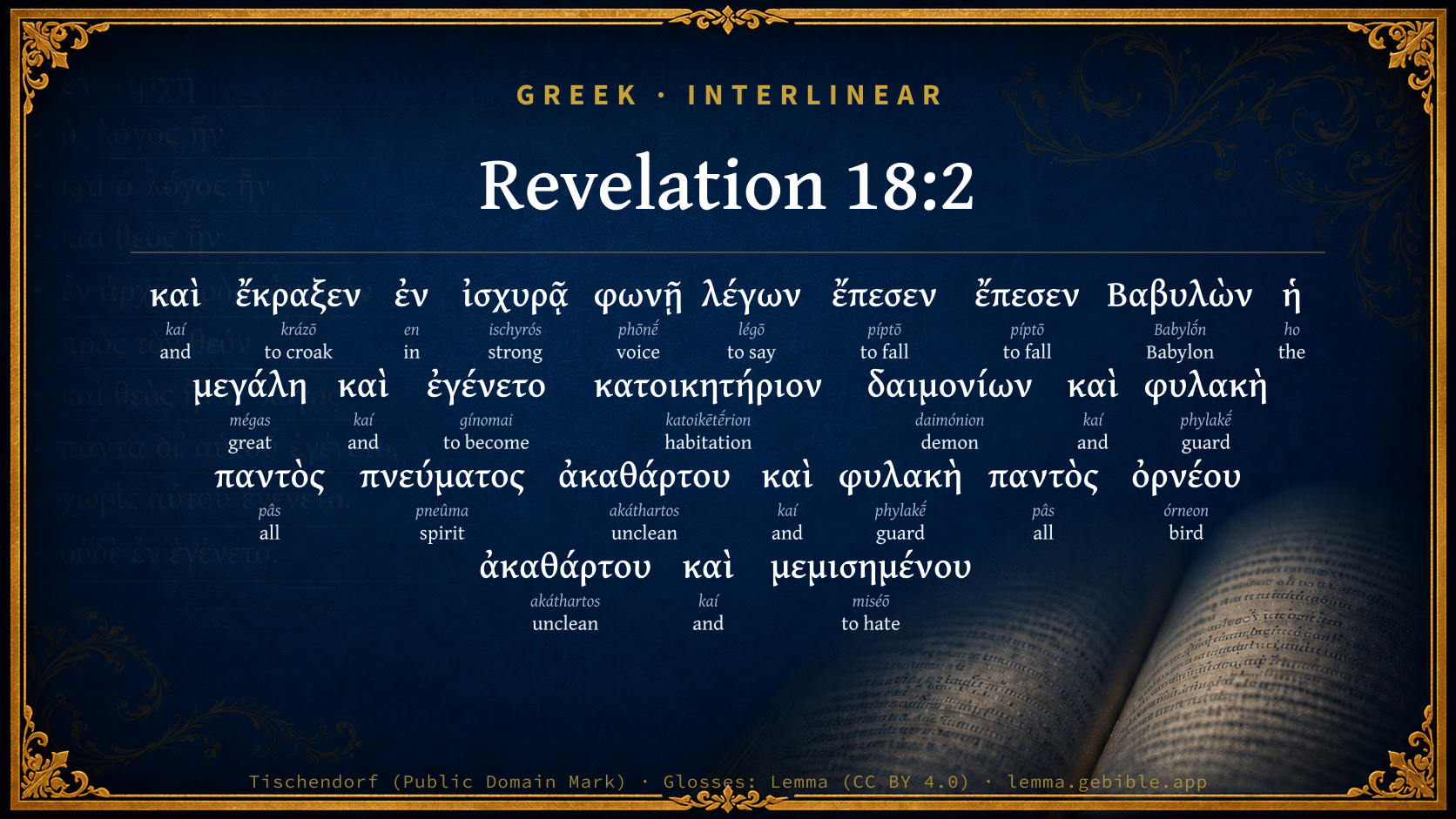
Greek (Tischendorf 8th ed.) Revelation 18:2 appears in the Greek New Testament. The text above is from the Tischendorf 8th edition. Each word links to its Strong’s number and a concise gloss. Click any word for its full Thayer’s Greek Lexicon entry.
Download image
Cite this verse

Revelation 18:2 (World English Bible). Public Domain. Lemma interlinear Bible study tool, https://lemma.gebible.app/v/revelation/18/2.

Show BibTeX & RIS
BibTeX
RIS
English Translation
He cried with a mighty voice, saying, "Fallen, fallen is Babylon the great, and she has become a habitation of demons, a prison of every unclean spirit, and a prison of every unclean and hateful bird!
World English Bible · Public Domain
Highlights
  • 1 first appearance in the Greek New Testament
Full analysis ↓
Download a study sheet

One document with this verse’s original text, its word-by-word gloss line, the meaning frame, cross-references with their text, attributed commentary, and full source and license credits — printable, and it pastes into notes with its structure intact.

This verse Autodidact and up

Study sheet (.html) Plain text (.txt)

A passage Seminary Student

Up to 50 verses in one chapter. A passage sheet keeps up to 6 commentary sources and 12 cross-references per verse, in the order this page ranks them, and says so on the sheet whenever that leaves anything out. Ask for a single verse and you get the Autodidact verse sheet above.

Everything on this page stays free to read, with no account — the sheet is a download of what is already on screen, not access to it.

Want to remove ads? Support Godless Engineer
Compare translations 3

The same verse in 3 English versions, stacked beneath the original-language interlinear above. Click any original word for its lexicon entry.

Each is an independent rendering of the whole verse — the interlinear is not word-aligned to these translations.

Highlighted words mark where these versions differ — a whole-verse word diff, not a word-by-word alignment.

  • World English Bible Public Domain
    He cried with a mighty voice, saying, "Fallen, fallen is Babylon the great, and she has become a habitation of demons, a prison of every unclean spirit, and a prison of every unclean and hateful bird!
  • King James Version Public Domain
    And he cried mightily with a strong voice, saying, Babylon the great is fallen, is fallen, and is become the habitation of devils, and the hold of every foul spirit, and a cage of every unclean and hateful bird.
  • unfoldingWord Literal Text CC BY-SA 4.0
    And he cried out in a mighty voice, saying, “Babylon the Great has fallen! And she has become a habitation of demons and a hold of every unclean spirit and a hold of every unclean and detested bird.

unfoldingWord Literal Text — © unfoldingWord, licensed CC BY-SA 4.0. Word-aligned USFM3 via Door43 (git.door43.org/unfoldingWord/en_ult).

Versions to compare (up to 4)

3 of 4 selected

Show all 19 translations

Every available English version of this verse, each an independent rendering of the whole verse.

  • World English Bible Public Domain
    He cried with a mighty voice, saying, "Fallen, fallen is Babylon the great, and she has become a habitation of demons, a prison of every unclean spirit, and a prison of every unclean and hateful bird!
  • Berean Standard Bible Public Domain
    And he cried out in a mighty voice: “Fallen, fallen is Babylon the great! She has become a lair for demons and a haunt for every unclean spirit, every unclean bird, and every detestable beast.
  • Majority Standard Bible Public Domain
    And he cried out in a mighty voice: “Fallen is Babylon the great! She has become a lair for demons and a haunt for every unclean spirit and every unclean and detestable bird.
  • King James Version Public Domain
    And he cried mightily with a strong voice, saying, Babylon the great is fallen, is fallen, and is become the habitation of devils, and the hold of every foul spirit, and a cage of every unclean and hateful bird.
  • American Standard Version (1901) Public Domain
    And he cried with a mighty voice, saying, Fallen, fallen is Babylon the great, and is become a habitation of demons, and a hold of every unclean spirit, and a hold of every unclean and hateful bird.
  • Revised Version (1885) Public Domain
    And he cried with a mighty voice, saying, Fallen, fallen is Babylon the great, and is become a habitation of devils, and a hold of every unclean spirit, and a hold of every unclean and hateful bird.
  • Geneva Bible (1599) Public Domain
    And he cryed out mightily with a loud voyce, saying, It is fallen, it is fallen, Babylon that great citie, and is become the habitation of deuils, and the holde of all foule spirits, and a cage of euery vncleane and hatefull birde.
  • Douay-Rheims (1899) Public Domain
    And he cried out with a strong voice, saying: Babylon the great is fallen, is fallen; and is become the habitation of devils, and the hold of every unclean spirit, and the hold of every unclean and hateful bird:
  • Young's Literal Translation Public Domain
    and he did cry in might -- a great voice, saying, `Fall, fall did Babylon the great, and she became a habitation of demons, and a hold of every unclean spirit, and a hold of every unclean and hateful bird,
  • Literal Standard Version CC BY-SA 4.0
    and he cried in might [with] a great voice, saying, “Fallen, fallen is Babylon the great! And she became a habitation of demons, and a hold of every unclean spirit, and a hold of every unclean and hateful bird,
  • Unlocked Literal Bible CC BY-SA 4.0
    He cried out with a mighty voice, saying, “Fallen, fallen is Babylon the great! She has become a dwelling place for demons, a refuge for every unclean spirit, and a refuge for every unclean and detestable bird.
  • unfoldingWord Literal Text CC BY-SA 4.0
    And he cried out in a mighty voice, saying, “Babylon the Great has fallen! And she has become a habitation of demons and a hold of every unclean spirit and a hold of every unclean and detested bird.
  • Darby Bible Public Domain
    And he cried with a strong voice, saying, Great Babylon has fallen, has fallen, and has become the habitation of demons, and a hold of every unclean spirit, and a hold of every unclean and hated bird;
  • World Messianic Bible Public Domain
    He cried with a mighty voice, saying, “Fallen, fallen is Babylon the great, and she has become a habitation of demons, a prison of every unclean spirit, and a prison of every unclean and hated bird!
  • Webster's Bible Public Domain
    And he cried mightily with a strong voice, saying, Babylon the great is fallen, is fallen, and is become the habitation of demons, and the hold of every foul spirit, and a cage of every unclean and hateful bird.
  • Free Bible Version CC BY-SA 4.0
    He shouted out in a powerful voice, “Babylon the great has collapsed into ruins! She has become a place where demons live, the refuge of every unclean spirit, and the roost of every unclean and detestable bird.
  • Bible in Basic English Public Domain
    And he gave a loud cry, saying, Babylon the great has come down from her high place, she has come to destruction and has become a place of evil spirits, and of every unclean spirit, and a hole for every unclean and hated bird.
  • Text-Critical English NT CC BY 4.0
    He cried out with a mighty voice, “ Fallen is Babylon the great! She has become a dwelling place for demons, a haunt for every unclean spirit, and a haunt for every unclean and hated bird.
  • Tyndale New Testament (1534) Public Domain
    And he cryed myghtyly with a stronge voyce sayinge: Great Babilon is fallen ys fallen and ys become the habitation of devels and the holde of all fowle sprettes and a cage of all vnclene and hatefull byrdes

Literal Standard Version (2020), Covenant Press — licensed CC BY-SA 4.0. Text via the HelloAO Bible API (eBible.org). Unlocked Literal Bible (unfoldingWord) — licensed CC BY-SA 4.0. Text via the HelloAO Bible API (eBible.org). unfoldingWord Literal Text — © unfoldingWord, licensed CC BY-SA 4.0. Word-aligned USFM3 via Door43 (git.door43.org/unfoldingWord/en_ult). Free Bible Version, Dr. Jonathan Gallagher — licensed CC BY-SA 4.0. Text via the HelloAO Bible API (eBible.org).

Word by word

More ways to search: Search by grammar → Find every occurrence → Compare this word →

Practice this passage: Drill this verse → Learn its vocabulary →

κατοικητήριον
katoikētḗrion
G2732
“habitation”
Noun, Nominative, Singular, Neuter
Part of Speech
Noun
Case
Nominative
Number
Singular
Gender
Neuter
Full Thayer's Definition

Origin: from a derivative of G2730

TDNT: 07:35,7

1. an abode, a habitation
  1. καὶ kaí G2532 “and” Conjunction
  2. ἔκραξεν krázō G2896 “to croak” Verb, Aorist, Active, Indicative, 3rd person, Singular
  3. ἐν en G1722 “in” Preposition
  4. ἰσχυρᾷ ischyrós G2478 “strong” Adjective, Dative, Singular, Feminine
  5. φωνῇ phōnḗ G5456 “voice” Noun, Dative, Singular, Feminine
  6. λέγων légō G3004 “to say” Verb, Present, Active, Participle, Nominative, Singular, Masculine
  7. ἔπεσεν píptō G4098 “to fall” Verb, Aorist, Active, Indicative, 3rd person, Singular
  8. ἔπεσεν píptō G4098 “to fall” Verb, Aorist, Active, Indicative, 3rd person, Singular
  9. Βαβυλὼν Babylṓn G897 “Babylon” Noun, Nominative, Singular, Feminine
  10. ἡ ho G3588 “the” Article, Nominative, Singular, Feminine
  11. μεγάλη mégas G3173 “great” Adjective, Nominative, Singular, Feminine
  12. καὶ kaí G2532 “and” Conjunction
  13. ἐγένετο gínomai G1096 “to become” Verb, Aorist, Middle deponent, Indicative, 3rd person, Singular
  14. δαιμονίων daimónion G1140 “demon” Noun, Genitive, Plural, Neuter
  15. καὶ kaí G2532 “and” Conjunction
  16. φυλακὴ phylakḗ G5438 “guard” Noun, Nominative, Singular, Feminine
  17. παντὸς pâs G3956 “all” Adjective, Genitive, Singular, Neuter
  18. πνεύματος pneûma G4151 “spirit” Noun, Genitive, Singular, Neuter
  19. ἀκαθάρτου akáthartos G169 “unclean” Adjective, Genitive, Singular, Neuter
  20. καὶ kaí G2532 “and” Conjunction
  21. φυλακὴ phylakḗ G5438 “guard” Noun, Nominative, Singular, Feminine
  22. παντὸς pâs G3956 “all” Adjective, Genitive, Singular, Neuter
  23. ὀρνέου órneon G3732 “bird” Noun, Genitive, Singular, Neuter
  24. ἀκαθάρτου akáthartos G169 “unclean” Adjective, Genitive, Singular, Neuter
  25. καὶ kaí G2532 “and” Conjunction
  26. μεμισημένου miséō G3404 “to hate” Verb, Perfect, Passive, Participle, Genitive, Singular, Neuter

About this verse

These counts appear in no published source. They are computed here, from the morphology-tagged text and Lemma’s own curated glosses. What Lemma adds →

27
words
19
distinct lemmas
Revelation
section

Notable vocabulary

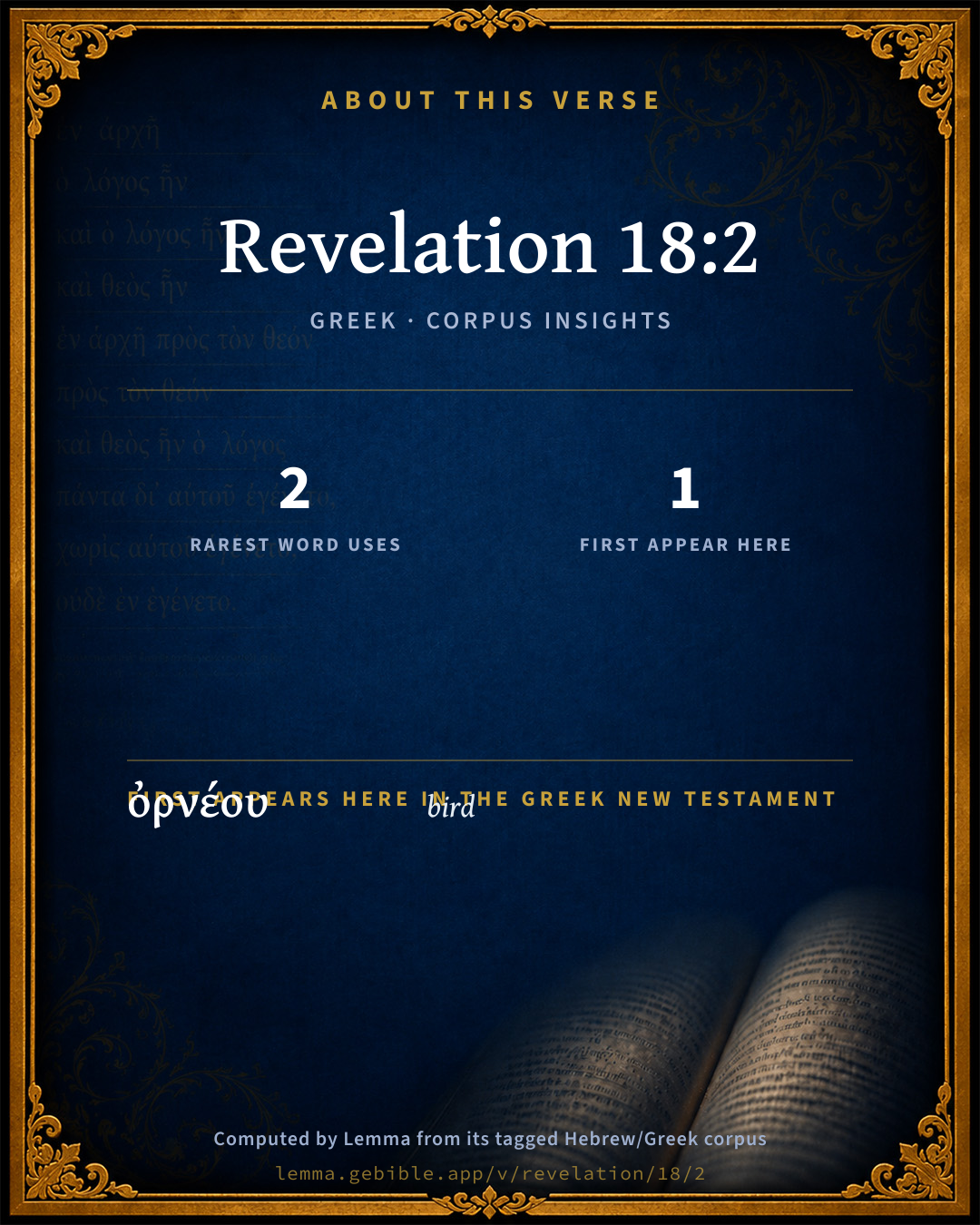
The rarest word here is κατοικητήριον habitation G2732 — appearing just 2 times in the whole Greek New Testament.

First appearance in Scripture

This word makes its first canonical appearance in the Greek New Testament here:

  • ὀρνέου bird G3732

Shared distinctive vocabulary

κατοικητήριον habitation G2732 occurs in 2 verses of the Greek New Testament. Also found in:
Repetition

Words recur within this verse:

  • ἔπεσεν to fall G4098 ×2
  • φυλακὴ guard G5438 ×2
  • παντὸς all G3956 ×2
  • ἀκαθάρτου unclean G169 ×2
  • καὶ and G2532 ×5

Cross-references

23

Topical passages linked to Revelation 18:2 in the Treasury of Scripture Knowledge — connected by theme and wording, ordered by reader-vote popularity; previews shown in the World English Bible.

  • Jeremiah 51:8 Babylon is suddenly fallen and destroyed: wail for her; take balm for her pain, if so be she may be healed.
  • Revelation 14:8 Another, a second angel, followed, saying, "Babylon the great has fallen, which has made all the nations to drink of the wine of the wrath of her sexual immorality."
  • Jeremiah 51:37 Babylon shall become heaps, a dwelling-place for jackals, an astonishment, and a hissing, without inhabitant.
  • Jeremiah 50:39–40 Therefore the wild animals of the desert with the wolves shall dwell there, and the ostriches shall dwell therein: and it shall be no more inhabited forever; neither shall it be lived in from generation to generation.
  • Jeremiah 51:60–64 Jeremiah wrote in a book all the evil that should come on Babylon, even all these words that are written concerning Babylon.
  • Isaiah 13:19–22 Babylon, the glory of kingdoms, the beauty of the Chaldeans' pride, shall be as when God overthrew Sodom and Gomorrah.
  • Isaiah 21:8–9 He cried as a lion: Lord, I stand continually on the watch-tower in the day-time, and am set in my ward whole nights;
  • Revelation 16:19 The great city was divided into three parts, and the cities of the nations fell. Babylon the great was remembered in the sight of God, to give to her the cup of the wine of the fierceness of his wrath.
  • Revelation 18:21 A mighty angel took up a stone like a great millstone and cast it into the sea, saying, "Thus with violence will Babylon, the great city, be thrown down, and will be found no more at all.
  • Revelation 17:5 And on her forehead a name was written, "MYSTERY, BABYLON THE GREAT, THE MOTHER OF THE PROSTITUTES AND OF THE ABOMINATIONS OF THE EARTH."
  • Revelation 17:18 The woman whom you saw is the great city, which reigns over the kings of the earth."
  • Revelation 18:10 standing far away for the fear of her torment, saying, 'Woe, woe, the great city, Babylon, the strong city! For your judgment has come in one hour.'
  • Leviticus 11:13–19 "'These you shall detest among the birds; they shall not be eaten, they are an abomination: the eagle, and the vulture, and the black vulture,
  • Isaiah 14:23 I will also make it a possession for the porcupine, and pools of water: and I will sweep it with the broom of destruction, says Yahweh of Hosts.
  • Isaiah 34:11–15 But the pelican and the porcupine shall possess it; and the owl and the raven shall dwell therein: and he will stretch over it the line of confusion, and the plummet of emptiness.
  • Mark 5:3–5 who had his dwelling in the tombs. Nobody could bind him any more, not even with chains,
  • Revelation 16:13 I saw coming out of the mouth of the dragon, and out of the mouth of the beast, and out of the mouth of the false prophet, three unclean spirits, something like frogs;
  • Jeremiah 25:30 Therefore prophesy you against them all these words, and tell them, Yahweh will roar from on high, and utter his voice from his holy habitation; he will mightily roar against his fold; he will give a shout, as those who tread [the grapes], against all the inhabitants of the earth.
  • Zephaniah 2:14 Herds will lie down in the midst of her, all the animals of the nations. Both the pelican and the porcupine will lodge in its capitals. Their calls will echo through the windows. Desolation will be in the thresholds, for he has laid bare the cedar beams.
  • Luke 8:27–28 When Jesus stepped ashore, a certain man out of the city who had demons for a long time met him. He wore no clothes, and didn't live in a house, but in the tombs.
  • Revelation 5:2 I saw a mighty angel proclaiming with a loud voice, "Who is worthy to open the book, and to break its seals?"
  • Revelation 10:3 He cried with a loud voice, as a lion roars. When he cried, the seven thunders uttered their voices.
  • Revelation 14:15 Another angel came out from the temple, crying with a loud voice to him who sat on the cloud, "Send forth your sickle, and reap; for the hour to reap has come; for the harvest of the earth is ripe!"

Cross-references courtesy of OpenBible.info (CC BY 4.0).

Where the printed editions differ

2 variants

Places in this verse where the major printed Greek editions disagree on the wording in a way that affects the translation — a comparison of editions, not a manuscript-by-manuscript collation. The editions are the modern critical texts (Nestlé-Aland 28/27, SBL, Westcott-Hort, Tregelles, Tyndale House) and the traditional texts behind the KJV (the Textus Receptus and the Byzantine/Majority text). It is not a claim about which reading is original.

  1. Extra text
    μεγάλη

    “loud”

    In TR Not in NA28NA27TynSBLWHTregByz

    μεγάλη (megalē) 'loud' is only in traditional manuscripts (TR)

  2. Extra text
    καὶ φυλακὴ παντὸς θηρίου ἀκαθάρτου

    “and a prison of every creature unclean”

    In NA28NA27SBL Not in TynWHTregTRByz

    καὶ φυλακὴ παντὸς θηρίου ἀκαθάρτου (kai phulakē pantos thēriou akathartou) 'and a prison of every creature unclean' is only in older manuscripts (NA28+NA27+SBL)

Textual data: Translators Amalgamated Greek New Testament (STEPBible TAGNT) · CC BY 4.0.

Commentary

Notes on Revelation 18:2 from classic Christian and Jewish commentators (each source and its license shown beneath its notes). The classic Christian expositions comment on the surrounding passage and are grouped to its opening verse, so a note may address several verses; the Jewish commentaries on the Tanakh (Rashi and others) are per-verse, so they appear only where the commentator wrote on this verse.

Lemma curates 59 commentaries, every one of them public domain or Creative Commons licensed, each selected and text-cleaned for this edition rather than reprinted as found. About our sources →

Joseph Benson's Commentary

Rev 18:2-3. And he cried mightily with a strong voice — Proclaimed aloud with triumphant joy, in the words of Isa 21:9, saying, Babylon the great is fallen, is fallen — As if he had said, What was prophesied formerly concerning the celebrated seat of the Chaldean empire, shall presently be verified in this mystical Babylon. Her fall was announced before, chap. Rev 14:8, but is now declared at large; and is become a habitation of devils, &c. — Here it is foretold, that after her fall she should be made a scene of desolation, as the ancient Babylon was, according to the predictions of the prophet respecting ancient Babylon, Isa 13:19, Babylon, the glory of kingdoms, shall be as when God overthrew Sodom and Gomorrah; it shall never be inhabited, neither shall it be dwelt in from generation to generation. Neither shall the Arabian pitch his tent there, neither shall the shepherds make their fold there; but wild beasts of the desert shall lie there, and their houses shall be full of doleful creatures, and owls shall dwell there, and satyrs shall dance there; where the word שׂעורים, which we translate satyrs, the LXX. render διαμονια, demons, or devils, who were supposed sometimes to take the shape of goats, or satyrs: and to haunt forlorn and desolate places; and it is from the translation of the LXX. that the apostle hath borrowed his images and expressions. According to this prediction, how horrid were the inhabitants of desolate Babylon to be as long as the world shall stand! Of invisible beings, devils and unclean spirits; of visible beings, every unclean beast, every filthy and hateful bird. Suppose then Babylon to mean here heathen Rome, and the fall predicted in this chapter to have been effected by Totilas, king of the Ostrogoths, as Grotius would persuade us, or by Alaric, king of the Visigoths, as the bishop of Meaux contends, how can Rome be said ever since to have been the habitation of devils, and the hold of every foul spirit, and a cage of every unclean and hateful bird, unless they will allow the popes and cardinals to merit these appellations? For all nations have drunk of the wine of her fornication, &c. — She hath not only been guilty of idolatry herself, and with great wrath persecuted the true Christian faith, worship, and practice, but hath also corrupted the princes and nations of the earth, as if she had given them a cup of poisonous composition, to disorder their reason and inflame them into rage and fury, having prevailed upon them to commit the same sins of which she was guilty, and to propagate her corruptions by ambitious views, incitements to luxury, and prospects of gain. And the merchants of the earth are waxed rich through the abundance of her delicacies — “The Romish clergy,” says Daubuz, “by trading in spiritual matters, have gotten vast wealth; these are the merchants of the earth, who by their Popish tricks and trinkets have gotten a good part of the wealth of the world into their hands. In short, Rome is a great mart; the Romish clergy are the merchants and factors; the secular, inferior clergy, the monks and friars, are the pedlers and hawkers which retail the merchandise. As for the luxury of Rome, procured by this trade, it needs no proof.

Joseph Benson's Commentary on the Old and New Testaments (1811–1818) — public domain. Text from a community e-Sword module.

Tyndale Open Study Notes

Tyndale Open Resources

18:2 Babylon is fallen: See Isa 21:9. Once a beautifully dressed woman (see Rev 17:4), Babylon (Rome) became a desolate den for demons and unclean birds such as vultures (cp. Isa 13:20-22; Jer 4:23-31; 50:39).

Tyndale Open Study Notes — © Tyndale Open Resources, licensed CC BY-SA 4.0. Text via the HelloAO Bible API.

Bengel's Gnomon

Johann Albrecht Bengel

Rev 18:2. Καὶ ἔκραξεν ἰσχύϊ φωνῇ μεγάλῃ λέγων) A noun of cognate signification is often added to a verb, for the sake of emphasis, in the Dative case, by the LXX. Ἀληθείᾳ ταπεινοῦν, βίᾳ ἀχθῆναι, βρώσει φαγεῖν, δάκρυσι κλαίειν, δεήσει λαλεῖν, θανάτῳ τελευτᾷν, θυμῷ ὀργίζεσθαι, ὀργῇ θυμοῦσθαι, μέτρῳ λαμβάνειν, σοφίᾳ ἀριθμεῖν, τόλμῃ ἐπικεῖσθαι, ὓβρει τρέχειν, ὕβρει φέρεσθαι, ὑπερόψει ὑπεριδεῖν, φόβῳ δειλιᾷν, φυγῇ πορεὑεσθαι, φωνῇ καλεῖν. See also Act 2:30; Eph 3:16; Php 1:18; 1Jn 3:18. So here κράζειν ἰσχύϊ, and Rev 18:21, ὁρμήματι βληθῆναι. Ἰσχύϊ itself is used absolutely, 2Ch 28:6, ἀνδρῶν δυνατῶν ἰσχύϊ.—ἔπεσεν ἔπεσε, is fallen, is fallen) Some MSS. and translators, ch. Rev 14:8, and here, put ἔπεσε, is fallen, once only[195]: and the one of these passages may appear to have been moulded so as to be in conformity with the other. Sometimes Epizeuxis (Append.) increases the emphasis; but Babylon is fallen, is fallen, is said in Isa 21:9, long before its fall; nay, even before its flourishing condition: Babylon is suddenly fallen, Jer 51:8, not long before its very overthrow. Therefore, if one reading is not to be followed in both passages of the Apocalypse, I would read it twice in the first passage, and once only in the second; almost in the same manner in which there are at first set forth three woes, afterwards two, and lastly one: so that, is fallen, is fallen, expresses an overthrow gradually coming on; is fallen, expresses an overthrow sudden, total, and final. For once for all [at once] is often the same as entirely: Num 20:8; 1Sa 26:8. But the copyists not unfrequently wrote once only words which ought to have been written twice: and ἔπεσεν ἔπεσε is found in many copies at ch. Rev 16:8, and ch. Rev 18:2. It is plain, that the actual overthrow is not now to be here understood, but that it is a prophecy respecting the overthrow which is certainly and quickly about to follow; for in Rev 18:4, and not until then, the people of God are commanded to go forth. But the people of God are not those whose pastor is the Roman Pontiff, as some one has wished to wrest the Apocalypse. It is said, My people, not the people of the Roman Pontiff; as Act 18:10, the Lord is said to have much people in the city of Corinth, without any particular reference to Paul or any other pastor there.[196]

[195] B and Memph. omit the second ἔπεσεν. But A Vulg. and Rec. Text retain it: so Lachm. and Tisch.—E.

[196] Κατοικητήριον the habitation) This had not yet been added, ch. Rev 14:8.—V. g.

Bengel's Gnomon of the New Testament — English translation (T&T Clark, Edinburgh, 1860) — public domain. Text from a community e-Sword module.

Geneva Bible (1599)

Geneva Bible translators

The prediction or foretelling of her ruin, containing both the fall of Babylon, in this verse, and the cause thereof uttered by way of allegory concerning her spiritual and carnal wickedness, that is, her most great impiety and injustice, in the next verse: her fall is first simply declared of the Angel: and then the greatness thereof is showed here by the events, when he saith it shall be the seat and habitation of devils, of wild beasts and of cursed souls, as of old, Isa. 13:21, and often elsewhere.

Geneva Bible (1599) marginal notes — public domain. Text via Bolls.life.

Jamieson, Fausset & Brown

Robert Jamieson, A. R. Fausset & David Brown

mightily . . . strong--not supported by manuscripts. But A, B, Vulgate, Syriac, and Coptic read, "with (literally, 'in') a mighty voice."

is fallen, is fallen--so A, Vulgate, Syriac, and ANDREAS. But B and Coptic omit the second "is fallen" (Isa 21:9; Jer 51:8). This phrase is here prophetical of her fall, still future, as Rev 18:4 proves.

devils--Greek, "demons."

the hold--a keep or prison.

Jamieson, Fausset & Brown — Commentary Critical and Explanatory on the Whole Bible (1871) — public domain (CC PDM 1.0). Text via the HelloAO Bible API.

Adam Clarke's Commentary

Verse 2. Babylon the great is fallen, is fallen] This is a quotation from Isa 21:9: And he said, Babylon is fallen, is fallen; and all the graven images of her gods he hath broken unto the ground. This is applied by some to Rome pagan; by others to Rome papal; and by others to Jerusalem.

Is become-the hold of every foul spirit] See the parallel passages in the margin. The figures here point out the most complete destruction. A city utterly sacked and ruined, never to be rebuilt.

Adam Clarke's Commentary on the Bible (1810–1826) — public domain. Text from a community e-Sword/MySword module.

Ellicott's Commentary for English Readers

(2) And he cried . . .—We must omit “mightily,” and render, And he cried in a mighty voice, saying, Fallen, fallen is Babylon the great, and is become an habitation of demons, and a prison of every unclean spirit, and a prison of every unclean and hated bird. Those who walk in darkness, and whose eyes the god of this world hath blinded through their lusts, look only on the material side, upon prosperous times, large revenues, rapidly developing resources. The great city of the world looks fair and glorious in their eyes, and even the godly are dazzled by her beauty; but when the light of heaven shines, her fall is seen to be inevitable, for she is seen to be hateful; her palaces are seen to be prisons, her highest wisdom little more than low cunning, her most exalted intelligence base-born, her sweetest songs discordant cries; the evil spirit, welcomed back, has come in seven-fold power; for the dry places afford no rest to those who still love sin and the pleasures of sin. The description in this verse is drawn largely from Isa_13:21-22; it is a picture of desolation and degradation, but it has its moral counterpart.

A Bible Commentary for English Readers, edited by Charles John Ellicott (1878–1897) — public domain. Text from a community e-Sword module.

The Cambridge Bible for Schools and Colleges

gen. ed. J. J. S. Perowne

2. mightily with a strong voice] We should read, with a mighty voice.

Babylon … is fallen] Rev_14:8; Isa_21:9.

the habitation of devils] Better, an habitation. Similar vengeance is denounced on the literal Babylon, Isa_13:21-22, and on Edom, id. Isa_34:13-15. It is not quite certain which of the words used in those passages are names of demons or goblins, and which of terrestrial birds and beasts: but there is little doubt that Isaiah, like St John, means to describe both as occupying the desolated city.

the hold] Probably a prison, not a fortress. It is the same word that is translated “cage” in the next clause, and “prison” in 1 St Peter Eph_3:19.

The Cambridge Bible for Schools and Colleges (gen. ed. J. J. S. Perowne; Cambridge University Press, 1878–1918) — public domain. Text from a community e-Sword module.

John Gill's Exposition

And he cried mightily with a strong voice,.... Which shows not only the vehemence and affection of the ministers of the word, who will publish what follows, but the greatness and importance of it; and this loud voice may be, as for the sake of the whole church in general, that all may bear, so for the sake of those of the Lord's people in particular, that will be in Babylon at this time; and it may have regard to that deep sleep and spirit of slumber that Babylon itself will be in, which, notwithstanding this loud cry, will remain insensible of its ruin till it comes upon her, as was the case of old Babylon, Jer 51:39,

saying, Babylon the great is fallen, is fallen: the whole world is not designed by Babylon, for it is distinguished from all nations in the following verse; nor Babylon in Chaldea, which was fallen long before John saw this vision, but Rome Papal; See Gill on Rev 14:8 so the woman is called in Rev 17:5 who sits on seven mountains, and is that great city, the city of Rome, that reigns over the kings of the earth, Rev 18:9 this is said to be fallen, because, in a very little time after this declaration, it will fall; for as yet it was not destroyed, since after this the Lord's people are called upon to come out of her, and are bid to reward her double; and it is declared, that her plagues, should come in one day, and she should be burnt with fire; and an angel after this throws a millstone into the sea, saying, that so should Babylon be thrown down, Rev 18:4 and it is repeated to denote the certainty and utter destruction of her: and which is more fully expressed by what follows,

and is become the habitation of devils; as old Babylon was of satyrs, Isa 13:21 demons, which appeared in a hairy form, like goats, and the word is rendered devils in Lev 17:7 and the inhabitants of Rome now are no other; the pope and his cardinals, the priests, Jesuits, monks, and friars, are the spirits of devils, and their doctrines the doctrines of devils; see Rev 16:14

and the hold of every foul spirit: devils are frequently called unclean spirits, and these appear in desert and desolate places, Mat 12:43 where they are either of choice, or rather are obliged to it; and so the word translated "hold" signifies a prison, or place of confinement; and such as are comparable to unclean spirits now haunt and abound in Rome, and its territories; see Rev 16:13

and a cage of every unclean and hateful bird; such, as vultures, kites, owls, &c. which generally reside in desolate and uninhabited places; the Alexandrian copy, the Syriac and Ethiopic versions, add, "and the hold", or "seat of every unclean and hateful beast"; and so the desolation of old Babylon is described by wild beasts and doleful creatures dwelling in it, Isa 13:21. Some consider all this as a reason of the destruction of Babylon or Rome, because it now is the residence of persons comparable to devils, foul spirits, hateful birds, and beasts of prey; but this account rather describes its state and case in which it will be after its ruin, being never more to be inhabited by men, in allusion to old Babylon, Isa 13:19.

John Gill's Exposition of the Whole Bible (1746–1763) — public domain (CC PDM 1.0). Text via the HelloAO Bible API.

Trapp's Complete Commentary

John Trapp

2 And he cried mightily with a strong voice, saying, Babylon the great is fallen, is fallen, and is become the habitation of devils, and the hold of every foul spirit, and a cage of every unclean and hateful bird.

Ver. 2. And he cried mightily] So to awaken Babylon, that slept no less securely than that old Babylon, whose king Shesach was feasting and carousing in the bowls of the sanctuary, when the city was taken the same night. The people also did so little fear it, that it was three days after the city was taken by Cyrus ere some of them heard what was befallen them. (Herodot. Arist. Pol.)

Is fallen, is fallen] Certo, cito, penitus, or, with a double fall. They have fallen culpably, and shall fall penally. This was also long since foretold by Sibylla in the eighth book of her oracles:

"Και συ θριαμβος εση κοσμω, και αοιδος απαντων".

" Tota eris in cineres quasi nunquam Roma fuisses."

Rome (during the Roman felicity) was never taken but by the Gauls; but since it became pontifical, it hath been made a prey to all barbarous nations, and never besieged by any that took it not. There yet stands, near at hand, a second Babylon (saith Petrarch), cito itidem casura, si essetis viri. This would soon be down, if you would but stand up as men.

The habitation of devils] Which, by a sweet providence of God, for the good of mankind, are banished (as likewise fierce and wild beasts are) to deserts and unpopulated places. See Mat 12:43. (It is an allusion to Isa 13:20; Isa 14:23; Jer 50:39) Yet not so, but that, by Divine permission, they haunt and pester the greatest throngs of people, yea, the holiest assemblies. Some take the words in another sense, thus, it is become a habitation of devils, that is, of idols; and this hath wrought her ruin. In the year 610, Boniface IV instituted the feast of All Saints, after that he had begged of the emperor the Pantheon of Rome, which he consecrated to the honour of All Saints, and set up the Virgin Mary in the place of Cybele, the mother of the gods. (Alsted. Chron.)

John Trapp, A Commentary or Exposition upon All the Books of the Old and New Testament (1647–1656) — public domain. Text from a community e-Sword module.

Albert Barnes' Notes on the Bible

And he cried mightily - Literally, “he cried with a strong great voice.” See Rev 10:3.

Babylon the great is fallen, is fallen - See the notes on Rev 14:8. The proclamation here is substantially the same as in that place, and no doubt the same thing is referred to.

And is become the habitation of devils - Of demons - in allusion to the common opinion that the demons inhabited abandoned cities, old ruins, and deserts. See the notes on Mat 12:43-45. The language here is taken from the description of Babylon in Isa 13:20-22; and for a full illustration of the meaning, see the notes on that passage.

And the hold of every foul spirit - φυλακὴ phulakē. A watch-post, station, haunt of such spirits - That is, they, as it were, kept guard there; were stationed there; haunted the place.

And a cage of every unclean and hateful bird - That is, they would resort there, and abide there as in a cage. The word translated “cage” is the same which is rendered “hold” - φυλακὴ phulakē. In Isa 13:21, it is said, “and owls shall dwell there”; and in Isa 14:23, it is said that it would be a “possession for the bittern.” The idea is that of utter desolation; and the meaning here is, that spiritual Babylon - papal Rome Rev 14:8 - will be reduced to a state of utter desolation resembling that of the real Babylon. It is not necessary to suppose this of the city of Rome itself - for that is not the object of the representation. It is the papacy, represented under the image of the city, and having its seat there. That is to be destroyed as utterly as was Babylon of old; that will become as odious, and loathsome, and detestable as the literal Babylon, the abode of monsters is.

Albert Barnes' Notes on the Bible (1834–1885) — public domain. Text from a community e-Sword/MySword module.

Haydock's Catholic Bible Commentary

Babylon the great is fallen, is fallen. Idolatrous Rome is fallen. That mighty seat of power and dominion is fallen. The long fixed abode of voluptuousness and luxury, for the merchants of the earth have become rich by the strength of her delicacies, and now the hand of God hath struck her. It is utterly destroyed; not a human being in it. Thus it is become an accursed place, given up for an habitation of devils and a hold of every unclean spirit, or of frightful spectres and ghosts, and a hold of every unclean and hateful bird, of owls, ravens, vultures, &c. &c. (Pastorini)

George Leo Haydock (1774–1849), Haydock's Catholic Family Bible and Commentary, 1859 edition — public domain. Excludes Psalms (Douay-Rheims chapter numbering differs from Protestant) and Deuterocanonical books (Catholic canon only).

Matthew Poole's English Annotations

And he cried mightily with a strong voice, saying, Babylon the great is fallen, is fallen: whoever was meant by the angel whom John saw, Rev 18:1, his business was to give warning to the whole world, (therefore he crieth with a strong voice, ) that Rome, the great city, the mother of spiritual harlots, should fall. This angel was a prophet, and the messenger of him who calls the things that are not as if they were; and therefore he speaks in a Divine, prophetic style: the prophets (ordinarily) speaking of things to come as past, or present, to denote the certain futurity of them, and doubling their words to assure us of it; for this, is fallen, is; expounded by shall be thrown down, Rev 18:21. We read of this angel, Rev 14:8; but it is ordinary with prophets to repeat the same things, and it is done as to the Chaldean Babylon, the type to this antitype, both Isaiah and Jeremiah declared in more than one sermon its certain approaching ruin. These words are taken from Isa 21:9, where the word fallen is doubled, as here. They are found also, Jer 51:8. God here explaineth what he had said before, Rev 14:8.

And is become the habitation of devils, &c.: the words are such as might signify a sinful fall, or apostacy; and what is here, is true of it in that sense; idols in Scripture being ordinarily called devils: but they seem rather to be understood of a penal fall, for such is that spoken of Isa 21:9, after which it should become a habitation of devils, and a cage of unclean birds. See the like spoken of literal Babylon, Isa 13:19-21; wild beasts and hateful birds usually frequenting desolate places.

Matthew Poole's English Annotations on the Holy Bible (1683–1685) — public domain. Text from a community e-Sword/MySword module.

Whedon's Commentary on the Bible

Daniel D. Whedon

2. He cried… with a strong voice—As announcing a stupendous event! The words that were prophecy in Rev_14:8, are now become history.

Devils—Demons. See note on Rev_16:14. The idea occurs more than once in Scripture—and we do not know that it was an illusion—that there are invisible as well as visible beings to whom solitudes and desolations are a congenial abode. If devils haunt human society, why may they not haunt the deserts? Perhaps the devils which seduced the living populations of Babylon still haunted the scenes after the populations were no more.

Hateful bird—Averse from the society of man, and at home amid damp and desolation.

Daniel D. Whedon (gen. ed.), Commentary on the Old and New Testaments (1874–1909) — public domain. Text from a community e-Sword module.

The Pulpit Commentary

And he cried mightily with a strong voice, saying; and he cried with a strong voice, saying. This "strong voice" is characteristic of the heavenly utterances. (cf. Rev_7:2 Rev_14:7, etc.) Babylon the great is fallen, is fallen. The event, though future, is described as past, being predetermined in the counsels of God. The words here are a reproduction of Isa_21:9. And is become the habitation of devils, and the hold of every foul spirit, and a cage of every unclean and hateful bird; a habitation... a hold of every unclean spirit, and a hold of every unclean and hated bird. "Devils" (Greek, daimonia), inferior evil spirits. The three phrases express the same idea, viz. the loathsome and hateful state to which Babylon is reduced. The language is derived from the prophets. (cf. Isa_13:21, 22 34:11-15 Jer_1:19 Jer_51:37) A hold (Greek, fulakh , "a strong place"); the natural and fitting stronghold of the devils, rather than a place to which they are involuntarily confined.

The Pulpit Commentary (1880–1919), ed. H.D.M. Spence-Jones & Joseph S. Exell — public domain. Text from a community e-Sword module.

John Wesley's Explanatory Notes

And he cried, Babylon is fallen - This fall was mentioned before, chap. xiv, 8; but is now declared at large. And is become an habitation - A free abode. Of devils, and an hold - A prison. Of every unclean spirit - Perhaps confined there where they had once practiced all uncleanness, till the judgment of the great day. How many horrid inhabitants hath desolate Babylon! of invisible beings, devils, and unclean spirits; of visible, every unclean beast, every filthy and hateful bird. Suppose, then, Babylon to mean heathen Rome; what have the Romanists gained, seeing from the time of that destruction, which they say is past, these are to be its only inhabitants forever.

John Wesley, Explanatory Notes Upon the Whole Bible (1754–1765) — public domain. Text via the GEBible commentary corpus.

Scofield Reference Notes

C. I. Scofield

Babylon

Babylon, "confusion," is repeatedly used by the prophets in a symbolic sense (See Scofield "Isa 13:2"), note 2. Two "Babylons" are to be distinguished in the Revelation: ecclesiastical babylon, which is apostate Christendom, headed up under the Papacy; and political babylon, which is the Beast’s confederated empire, the last form of Gentile world-dominion. Ecclesiastical Babylon is "the great whore" Rev 17:1 and is destroyed by political Babylon Rev 17:15-18 that the beast may be the alone object of worship.; 2Th 2:3; 2Th 2:4; Rev 13:15. The power of political Babylon is destroyed by the return of the Lord in glory. (See "Armageddon,"); Rev 16:14; Rev 19:17. The notion of a literal Babylon to be rebuilt on the site of ancient Babylon is in conflict with Isa 13:19-22. But the language of Rev 18:10; Rev 18:16; Rev 18:18 seems beyond question to identify "Babylon," the "city" of luxury and traffic, with "Babylon" the ecclesiastical centre, viz. Rome. The very kings who hate ecclesiastical Babylon deplore the destruction of commercial Babylon.

The Scofield Reference Bible (1917 edition), notes by C. I. Scofield — public domain. Text from a community e-Sword module.

The People's New Testament

B. W. Johnson

2. And he cried … Babylon the great is fallen. Compare this description with Isaiah 21:9; 14:23 and 13:21. The fall of Babylon has been already declared (16:19; 17:16) but now it is developed. This picture is intended to portray her utter desolation.

B. W. Johnson's The People's New Testament with Notes (1889–1891) — public domain. Electronic text from the Christian Classics Ethereal Library (CCEL) ThML edition.

Cambridge Greek Testament for Schools and Colleges

2. ἐν ἰσχυρᾷ φωνῇ. Vg[627] (tol[628]) Tyc[629] in fortitudine, whence Text. Rec[630] ἐν ἰσχύϊ φωνῇ μεγάλῃ.

[627] Vulgate.

[628] Codex Toletanus 10th century at Madrid.

[629] Tyconius.

[630] Rec. Textus Receptus as printed by Scrivener.

λέγων. P omits.

πν. ἀκαθάρτου. A adds καὶ μεμισημένου.

ὀρνέου. A reads θηρίου. Primas[631] refugium … omnis bestiae immundae et omnis avis immundae et odibilis. Syr[632] has et custodia omnis animalis dentis immundi et exosi at end of verse.

[631] Primasius, edited by Haussleiter.

[632] Syriac.

2. ἔπεσεν, ἔπεσεν. Rev 14:8; Isa 21:9.

κατοικητήριον, “habitation.” Similar vengeance is denounced on the literal Babylon, Isa 13:21-22, and on Edom, id. Isa 34:13-15. It is not quite certain which of the words used in those passages are names of demons or goblins, and which of terrestrial birds and beasts: but there is little doubt that Isaiah, like St John, means to describe both as occupying the desolated city.

φυλακή. “Hold” in A. V[686] is probably meant to signify a prison, not a fortress: the same word is translated “prison” Rev 2:10; Revelation 1 St Peter Rev 3:19, and again “cage” in this verse.

[686] Authorised Version.

Cambridge Greek Testament for Schools and Colleges (Cambridge University Press, 1896; 21 vols, various authors incl. Carr, Maclear, Plummer, Farrar, Lumby, Moule, M. R. James, Simcox) — public domain. Text from a community e-Sword module.

Vincent's Word Studies in the New Testament

Marvin R. Vincent

Mightily with a strong voice [εν ισχυι φωνη μεγαλη] . Lit., in strength with a great voice. Omit megalh great, and read ijscura fwnh with a mighty voice. So Rev.

Babylon - is fallen. The Rev. improves on the A. V. by placing fallen in the emphatic position of the Greek : "Fallen, fallen is Babylon." Compare Isa 21:9.

Is become [εγενετο] . Lit., became.

Devils [δαιμονων] . Properly, demons, which Rev., strangely commits to the margin. See on Mr 1:34. See Isa 13:20 - 22; Isa 34:13 - 15. Also on Luk 11:24.

Hold [φυλακη] . See on 1Pe 3:19, and Act 5:21. Rev., in margin, prison.

Cage [φυλακη] . The word rendered above hold. Rev., hold. Some, however, explain it, not as a cage where they are kept, but as a place of safety to which they resort.

Bird [ορνεου] . Only in Revelation, here, Rev 19:17, 21. Compare Jer 1:39.

Marvin R. Vincent, Word Studies in the New Testament (1887–1900) — public domain. Text from a community e-Sword/MySword module.

Lesson kit

Teaching starters — assembled from the data on this page, not authored interpretation. Every prompt links to the verse data it draws on. Edit before teaching.

Revelation, in the Revelation, opens this verse with 27 words (19 distinct Greek lemmas). Its most distinctive word is katoikētḗrion (“habitation”). A historical commentator’s framing appears above. Read the whole chapter for the surrounding context.

Discussion questions

  1. What does “habitation” (katoikētḗrion) contribute to the verse as a whole?
  2. The word “bird” first appears here in Scripture. What is being introduced at this debut?
  3. Ephesians 2:22 shares the word «habitation» with this verse. How do the two illuminate each other?
  4. “to fall” occurs 2× in this one verse. What is the effect of the repetition?
  5. These translations render this verse differently; the difference is in the English rendering, not the original. What questions does that raise?
  6. Reading how Joseph Benson's Commentary and Tyndale Open Study Notes read this verse, where do the two commentators agree and where do they part?

Things to notice

  • 1 word makes its first canonical appearance in Scripture here.
  • These translations choose different wording for 13 words in this verse.
  • “to fall” occurs 2× in this single verse.
  • 19 distinct Greek lemmas span 27 words in this verse.

Reading settings

Reading text

Shown beneath each verse's original-language words.

Old Testament
Old Testament edition

Read the OT as the Masoretic Hebrew (MT) or the Greek Septuagint (LXX).

English shown for the Greek Septuagint (in the Hebrew ↔ Greek comparison).

Comparing translations? Open the Compare panel on any verse page to stack up to four side by side.