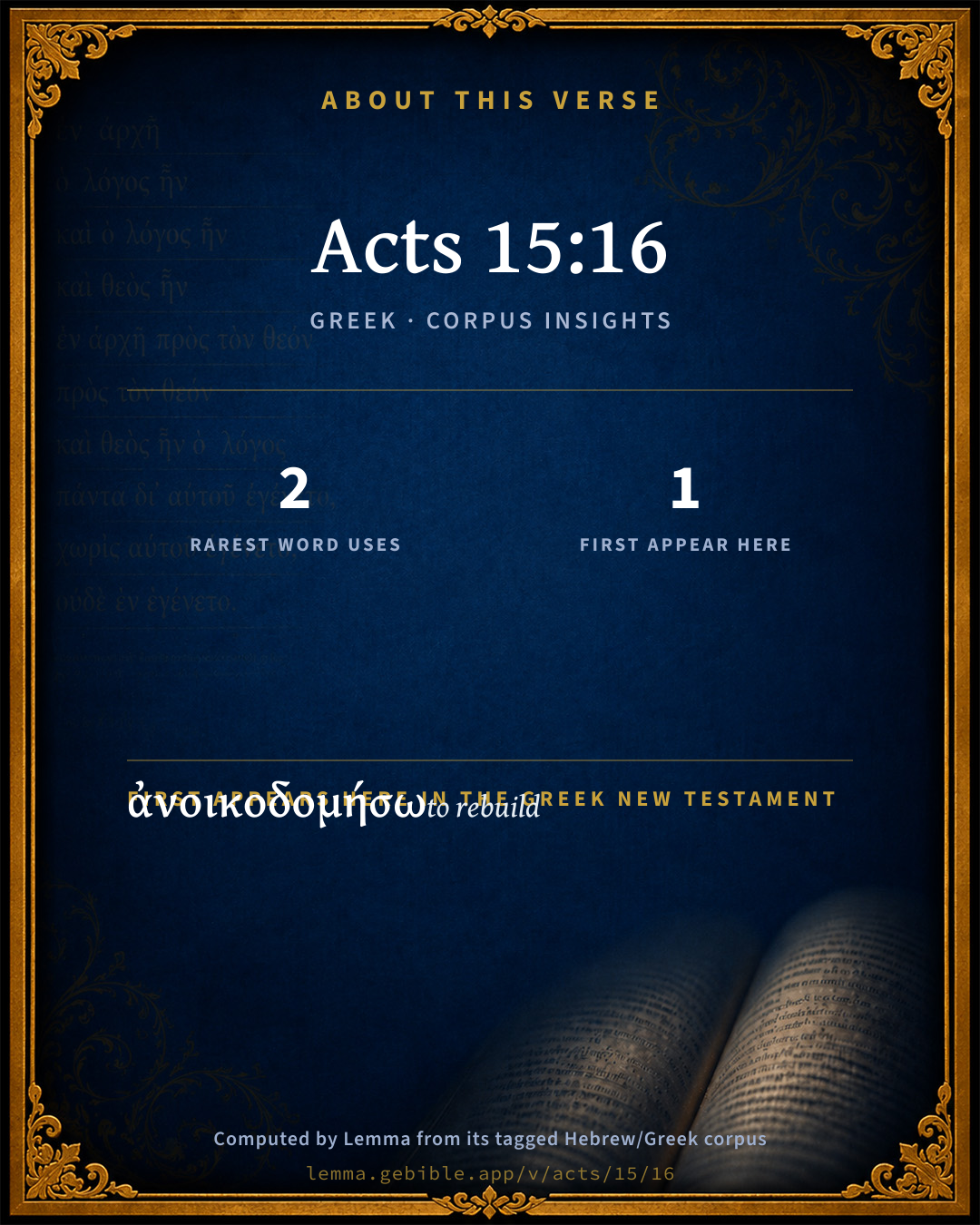
Acts 15:16

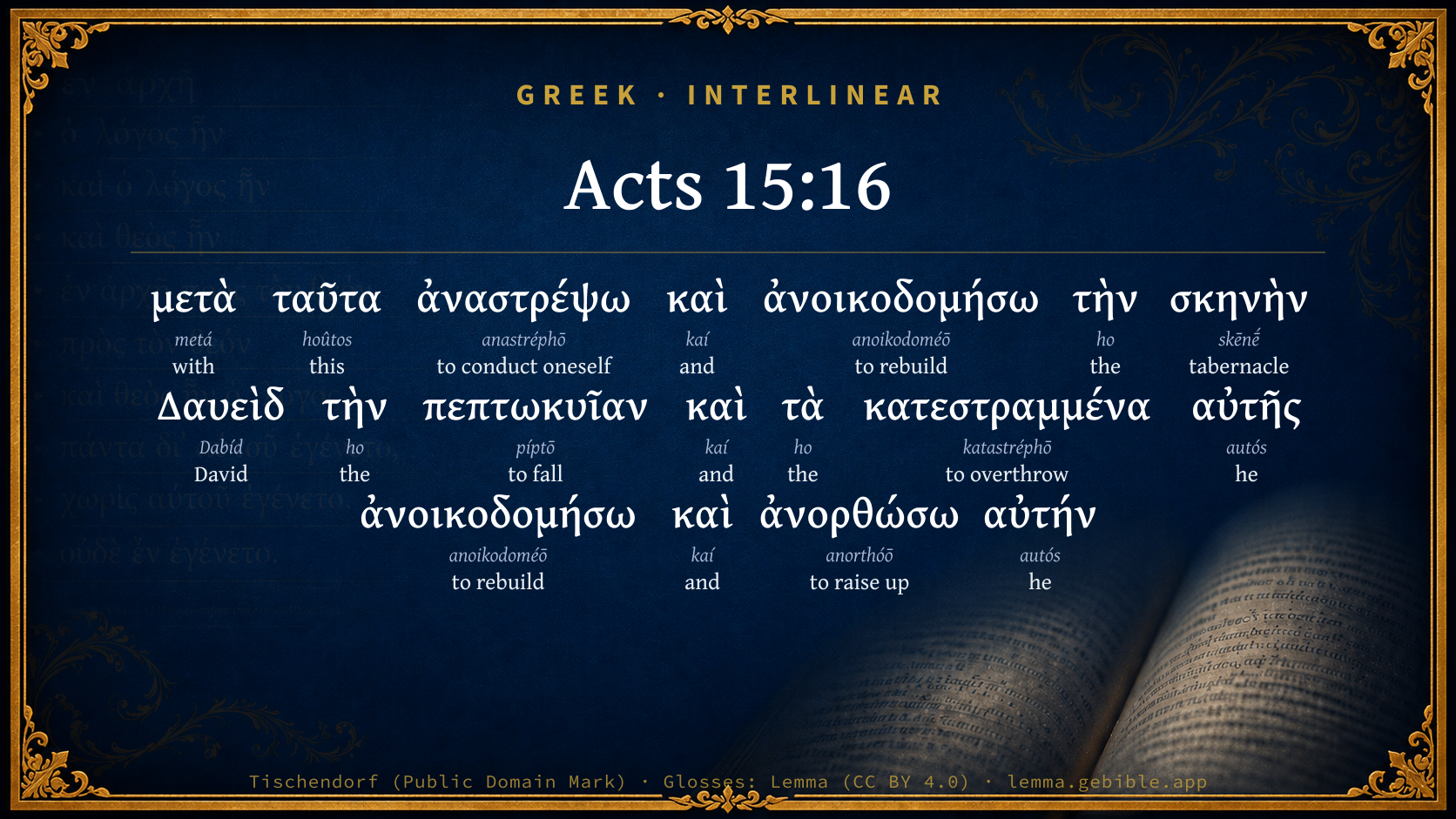
Greek (Tischendorf 8th ed.) Acts 15:16 appears in the Greek New Testament. The text above is from the Tischendorf 8th edition. Each word links to its Strong’s number and a concise gloss. Click any word for its full Thayer’s Greek Lexicon entry.
Download image
Cite this verse

Acts 15:16 (World English Bible). Public Domain. Lemma interlinear Bible study tool, https://lemma.gebible.app/v/acts/15/16.

Show BibTeX & RIS
BibTeX
RIS
English Translation
'After these things I will return. I will again build the tent of David, which has fallen. I will again build its ruins. I will set it up,
World English Bible · Public Domain
Highlights
  • 1 first appearance in the Greek New Testament
Full analysis ↓
Download a study sheet

One document with this verse’s original text, its word-by-word gloss line, the meaning frame, cross-references with their text, attributed commentary, and full source and license credits — printable, and it pastes into notes with its structure intact.

This verse Autodidact and up

Study sheet (.html) Plain text (.txt)

A passage Seminary Student

Up to 50 verses in one chapter. A passage sheet keeps up to 6 commentary sources and 12 cross-references per verse, in the order this page ranks them, and says so on the sheet whenever that leaves anything out. Ask for a single verse and you get the Autodidact verse sheet above.

Everything on this page stays free to read, with no account — the sheet is a download of what is already on screen, not access to it.

Want to remove ads? Support Godless Engineer
Compare translations 3

The same verse in 3 English versions, stacked beneath the original-language interlinear above. Click any original word for its lexicon entry.

Each is an independent rendering of the whole verse — the interlinear is not word-aligned to these translations.

Highlighted words mark where these versions differ — a whole-verse word diff, not a word-by-word alignment.

  • World English Bible Public Domain
    'After these things I will return. I will again build the tent of David, which has fallen. I will again build its ruins. I will set it up,
  • King James Version Public Domain
    After this I will return, and will build again the tabernacle of David, which is fallen down; and I will build again the ruins thereof, and I will set it up:
  • unfoldingWord Literal Text CC BY-SA 4.0
    ‘After these things I will return, and I will rebuild the fallen tent of David, and I will rebuild its ruins and restore it,

unfoldingWord Literal Text — © unfoldingWord, licensed CC BY-SA 4.0. Word-aligned USFM3 via Door43 (git.door43.org/unfoldingWord/en_ult).

Versions to compare (up to 4)

3 of 4 selected

Show all 19 translations

Every available English version of this verse, each an independent rendering of the whole verse.

  • World English Bible Public Domain
    'After these things I will return. I will again build the tent of David, which has fallen. I will again build its ruins. I will set it up,
  • Berean Standard Bible Public Domain
    ‘After this I will return and rebuild the fallen tent of David. Its ruins I will rebuild, and I will restore it,
  • Majority Standard Bible Public Domain
    ‘After this I will return and rebuild the fallen tent of David. Its ruins I will rebuild, and I will restore it,
  • King James Version Public Domain
    After this I will return, and will build again the tabernacle of David, which is fallen down; and I will build again the ruins thereof, and I will set it up:
  • American Standard Version (1901) Public Domain
    After these things I will return, And I will build again the tabernacle of David, which is fallen; And I will build again the ruins thereof, And I will set it up:
  • Revised Version (1885) Public Domain
    After these things I will return, And I will build again the tabernacle of David, which is fallen; And I will build again the ruins thereof, And I will set it up:
  • Geneva Bible (1599) Public Domain
    After this I will returne, and will builde againe the tabernacle of Dauid, which is fallen downe, and the ruines thereof will I build againe, and I will set it vp,
  • Douay-Rheims (1899) Public Domain
    After these things I will return, and will rebuild the tabernacle of David, which is fallen down; and the ruins thereof I will rebuild, and I will set it up:
  • Young's Literal Translation Public Domain
    After these things I will turn back, and I will build again the tabernacle of David, that is fallen down, and its ruins I will build again, and will set it upright --
  • Literal Standard Version CC BY-SA 4.0
    After these things I will return, || And I will rebuild the dwelling place of David that has fallen down, || And I will rebuild its ruins, || And will set it upright—
  • Unlocked Literal Bible CC BY-SA 4.0
    'After these things I will return, and I will build again the tent of David, which has fallen down; I will set up and restore its ruins again,
  • unfoldingWord Literal Text CC BY-SA 4.0
    ‘After these things I will return, and I will rebuild the fallen tent of David, and I will rebuild its ruins and restore it,
  • Darby Bible Public Domain
    After these things I will return, and will rebuild the tabernacle of David which is fallen, and will rebuild its ruins, and will set it up,
  • World Messianic Bible Public Domain
    ‘After these things I will return. I will again build the tabernacle of David, which has fallen. I will again build its ruins. I will set it up
  • Webster's Bible Public Domain
    After this I will return, and will build again the tabernacle of David which is fallen down; and I will build again the ruins of it; and I will set it up:
  • Free Bible Version CC BY-SA 4.0
    ‘In the future I will return, and I will rebuild the fallen house of David; I will rebuild its ruins and set it straight.
  • Bible in Basic English Public Domain
    After these things I will come back, and will put up the tent of David which has been broken down, building up again its broken parts and making it complete:
  • Text-Critical English NT CC BY 4.0
    ‘After this I will return and rebuild the tabernacle of David that has fallen; I will rebuild its ruins and erect it again,
  • Tyndale New Testament (1534) Public Domain
    After this I will returne and wyll bylde agayne the tabernacle of David which is fallen doune and that which is fallen in dekey of it will I bilde agayne and I will set it vp

Literal Standard Version (2020), Covenant Press — licensed CC BY-SA 4.0. Text via the HelloAO Bible API (eBible.org). Unlocked Literal Bible (unfoldingWord) — licensed CC BY-SA 4.0. Text via the HelloAO Bible API (eBible.org). unfoldingWord Literal Text — © unfoldingWord, licensed CC BY-SA 4.0. Word-aligned USFM3 via Door43 (git.door43.org/unfoldingWord/en_ult). Free Bible Version, Dr. Jonathan Gallagher — licensed CC BY-SA 4.0. Text via the HelloAO Bible API (eBible.org).

Word by word

More ways to search: Search by grammar → Find every occurrence → Compare this word →

Practice this passage: Drill this verse → Learn its vocabulary →

ἀνοικοδομήσω
anoikodoméō
G456
“to rebuild”
Verb, Future, Active, Indicative, 1st person, Singular
Part of Speech
Verb
Tense
Future
Voice
Active
Mood
Indicative
Person
1st person
Number
Singular
Full Thayer's Definition

Origin: from G303 and G3618

TDNT: None

1. to build again
  1. μετὰ metá G3326 “with” Preposition
  2. ταῦτα hoûtos G3778 “this” Demonstrative pronoun, Accusative, Plural, Neuter
  3. ἀναστρέψω anastréphō G390 “to conduct oneself” Verb, Future, Active, Indicative, 1st person, Singular
  4. καὶ kaí G2532 “and” Conjunction
  5. τὴν ho G3588 “the” Article, Accusative, Singular, Feminine
  6. σκηνὴν skēnḗ G4633 “tabernacle” Noun, Accusative, Singular, Feminine
  7. Δαυεὶδ Dabíd G1138 “David” Noun, Proper, indeclinable
  8. τὴν ho G3588 “the” Article, Accusative, Singular, Feminine
  9. πεπτωκυῖαν píptō G4098 “to fall” Verb, Perfect, Active, Participle, Accusative, Singular, Feminine
  10. καὶ kaí G2532 “and” Conjunction
  11. τὰ ho G3588 “the” Article, Accusative, Plural, Neuter
  12. κατεστραμμένα katastréphō G2690 “to overthrow” Verb, Perfect, Passive, Participle, Accusative, Plural, Neuter
  13. αὐτῆς autós G846 “he” Personal pronoun, Genitive, Singular, Feminine
  14. ἀνοικοδομήσω anoikodoméō G456 “to rebuild” Verb, Future, Active, Indicative, 1st person, Singular
  15. καὶ kaí G2532 “and” Conjunction
  16. ἀνορθώσω anorthóō G461 “to raise up” Verb, Future, Active, Indicative, 1st person, Singular
  17. αὐτήν autós G846 “he” Personal pronoun, Accusative, Singular, Feminine

About this verse

These counts appear in no published source. They are computed here, from the morphology-tagged text and Lemma’s own curated glosses. What Lemma adds →

18
words
12
distinct lemmas
Acts
section

Notable vocabulary

The rarest word here is ἀνοικοδομήσω to rebuild G456 — appearing just 2 times in the whole Greek New Testament.

First appearance in Scripture

This word makes its first canonical appearance in the Greek New Testament here:

  • ἀνοικοδομήσω to rebuild G456

Repetition

Words recur within this verse:

  • ἀνοικοδομήσω to rebuild G456 ×2
  • καὶ and G2532 ×3
  • τὴν the G3588 ×3
  • αὐτῆς he G846 ×2

Cross-references

9

Topical passages linked to Acts 15:16 in the Treasury of Scripture Knowledge — connected by theme and wording, ordered by reader-vote popularity; previews shown in the World English Bible.

  • Amos 9:11–12 In that day I will raise up the tent of David who is fallen, and close up its breaches, and I will raise up its ruins, and I will build it as in the days of old;
  • Luke 1:31–33 Behold, you will conceive in your womb, and bring forth a son, and will call his name 'Jesus.'
  • Psalms 89:35–49 Once have I sworn by my holiness, I will not lie to David.
  • Ezekiel 17:22–24 Thus says the Lord Yahweh: I will also take of the lofty top of the cedar, and will set it; I will crop off from the topmost of its young twigs a tender one, and I will plant it on a high and lofty mountain:
  • 1 Kings 12:16 When all Israel saw that the king didn't listen to them, the people answered the king, saying, What portion have we in David? neither have we inheritance in the son of Jesse: to your tents, Israel: now see to your own house, David. So Israel departed to their tents.
  • Isaiah 9:6–7 For to us a child is born, to us a son is given; and the government shall be on his shoulder: and his name shall be called Wonderful, Counselor, Mighty God, Everlasting Father, Prince of Peace.
  • Jeremiah 12:15 It shall happen, after that I have plucked them up, I will return and have compassion on them; and I will bring them again, every man to his heritage, and every man to his land.
  • Jeremiah 33:24–26 Don't you consider what this people has spoken, saying, The two families which Yahweh did choose, he has cast them off? thus do they despise my people, that they should be no more a nation before them.
  • Zechariah 13:8 It shall happen that in all the land," says Yahweh, Two parts in it will be cut off and die; But the third will be left in it.

Cross-references courtesy of OpenBible.info (CC BY 4.0).

Commentary

Notes on Acts 15:16 from classic Christian and Jewish commentators (each source and its license shown beneath its notes). The classic Christian expositions comment on the surrounding passage and are grouped to its opening verse, so a note may address several verses; the Jewish commentaries on the Tanakh (Rashi and others) are per-verse, so they appear only where the commentator wrote on this verse.

Lemma curates 59 commentaries, every one of them public domain or Creative Commons licensed, each selected and text-cleaned for this edition rather than reprinted as found. About our sources →

Bengel's Gnomon

Johann Albrecht Bengel

Act 15:16. Μετὰ ταῦτα ἀναστρέψω καὶ ἀνοικοδομήσω τὴν σκηνὴν Δαυὶδ τὴν πεπτωκυῖαν, καὶ τὰ κατεσκαμμένα αὐτῆς ἀνοικοδομήσω καὶ ἀνορθώσω αὐτήν· ὅπως ἂν ἐκζητήσωσιν οἱ κατάλοιποι τῶν ἀνθρώπων τὸν Κύριον, καὶ—τὸ ὄνομά μου ἐπʼ αὐτοὺς—ταῦτα) Amo 9:11-12, LXX., ἐν τῇ ἡμέρᾳ ἐκείνῃ ἀναστήσω τὴν σκηνὴν Δαυὶδ τὴν πεπτωκυῖαν, καὶ ἀνοικοδομήσω τὰ πεπτωκότα αὐτῆς καὶ τὰ κατεσκαμμένα αὐτῆς ἀναστήσω· καὶ ἀνοικοδομήσω αὐτὴν, καθὼς αἱ ἡμέραι τοῦ αἰῶνος· ὅπως ἐκζητήσωσί με οἱ κατάλοιποι τῶν ἀνθρώπων καὶ—τὸ ὄνομά μου, λέγει—ταῦτα.—μετὰ ταῦτα, after these things) In the Hebrew, in that day. Both expressions are to be referred to the New Testament.—ἀναστρέψω) אשוב, I will return: the verb for the adverb, “I will again build up.”—τὴν σκηνὴν Δαυὶδ, the tabernacle of David) It is otherwise (elsewhere) called the house of David, the throne of David; but here the tent of David, because his concerns had been reduced to great lowness of condition. Often the Church of the New Testament, which was to be built up even of Gentiles, is described under the allegory of architecture: Psa 102:14-16; Eph 2:20. The tabernacle of David, that is, of Christ. [The Church, in which Christ, the antitype of David, dwells and reigns.—V. g.]

Bengel's Gnomon of the New Testament — English translation (T&T Clark, Edinburgh, 1860) — public domain. Text from a community e-Sword module.

Expositor's Greek Testament

ed. W. Robertson Nicoll

Act 15:16 . Μετὰ ταῦτα : both Hebrew and LXX, ἐν τῇ ἐκει . τῇ ἡμέρᾳ , i.e. , in the Messianic times, after the predicted chastisement of Israel: the house of David is in ruins, but it is to be re-erected, and from the restoration of its prosperity the Messianic blessings will flow: “the person of the Messiah does not appear in this prophecy, but there is the generic reference to the house of David, and the people of Israel,” Briggs, Messianic Prophecy , p. 163, Delitzsch, Messianische Weissagungen , second edition, p. 94. St. James sees the spiritual fulfilment of the prophecy in the kingdom of Christ erected on the Day of Pentecost, and in the ingathering of the Gentile nations to it. On the Messianic interpretations of the passage amongst the Jews see Edersheim, Jesus the Messiah , ii., 734. ἀναστρέψω καὶ ἀνοι .: like Hebrew אשׁוב = I will return and do, i.e. , I will do again but not in LXX or Hebrew. In the latter we have simply אָקִום , and in LXX ἀναστήσω , where St. James has ἀνοικοδομήσω : the idea of restoration is fully contained in the twice repeated ἀνοι . and in ἀνορθώσω . τὴν σκ . Δ . πεπτ .: the noun is used to show how low the house of David (2Sa 7:12 ) had fallen it is no longer a palace but a hut, and that in ruins: the Hebrew word might be used for a temporary structure of the boughs of trees as at the Feast of Tabernacles. We may compare the way in which this hope of restoration asserted itself in Psalms of Solomon , Act 17:23 , where Ryle and James, p. 137, compare the words with Amo 9:11 , Jer 30:9 , etc. From the passage before us the Messiah received the name of Bar Naphli, “Son of the fallen”. κατεσκαμμένα , see critical note. In LXX [285] has κατεσκαμ ., Α κατεστρ .

[285] Codex Vaticanus (sæc. iv.), published in photographic facsimile in 1889 under the care of the Abbate Cozza-Luzi.

The Expositor's Greek Testament, edited by W. Robertson Nicoll (1897–1910) — public domain. Text from a community e-Sword module.

Adam Clarke's Commentary

Verse 16. After this I will return, and will build again, c.] These two verses, 16th and 17th, are quoted from Amo 9:11-12, nearly as they now stand in the best editions of the Septuagint, and evidently taken from that version, which differs considerably from the Hebrew text. As St. James quoted them as a prophecy of the calling of the Gentiles into the Church of God, it is evident the Jews must have understood them in that sense, otherwise they would have immediately disputed his application of them to the subject in question, and have rejected his conclusion by denying the premises. But that the words were thus understood by the ancient Jews, we have their own testimony. In Sanhedr. fol. 69, we have these remarkable words: "Rabbi Nachman said to Rabbi Isaac, 'Whence art thou taught when Bar Naphli will come?' He saith unto him, 'Who is this Bar Naphli?' The other replied, 'He is the Messiah.' 'Dost thou then call the Messiah Bar Naphli?' 'Yes,' said he, 'for it is written, In that day I will build again the tabernacle of David, הנפלת HANOPHELETH, which is falling down.'" This is evidently a quotation from Am 9:11, and a proof that the Jews understood it to be a prophecy concerning the Messiah. See Lightfoot.

Adam Clarke's Commentary on the Bible (1810–1826) — public domain. Text from a community e-Sword/MySword module.

John Calvin's Commentaries

16. After these things I will return. Because the place is not cited word for word as it is in the prophet, we must see what difference there is, though it be not necessary to examine straitly what diversity there is in the words, so it appear that the prophecy doth fitly agree with the matter which is in hand. After that God hath promised the restoring of the tabernacle of David, he saith also, that he will bring to pass that the Jews shall possess the remnants of Edom. In all that text, there appeareth nothing as yet whence the calling of the Gentiles can be fet or gathered; but that which followeth immediately after in the prophet, concerning the remnant of the Gentiles which shall call upon the name of the Lord, doth plainly show that the Jews and Gentiles shall make one Church, because that which was then proper to the Jews alone is given to both in general. For God placeth the Gentiles in like degree of honor with the Jews, when he will have them to call upon his name. Those of Idumea, and the people thereabout, were in times past under David subject to the Jews; but though they were tributaries to the people of God, yet were they nevertheless strangers from the Church. Therefore, this was news and a strange thing, in that God reckoneth them up with the holy people, that he may be called the God of them all; seeing that it is certain that they are all made equal in honor among themselves by this means. Whereby it doth plainly appear how well the testimony of the prophet agreeth with the present purpose. For God promiseth to restore the decayed tabernacle, wherein the Gentiles shall obey the kingdom of David, not only that they may pay tribute, or take [to arms] weapon at the king’s commandment, but that they may have one God, and that they may be one family to him.

Yet there may a question be moved, why he had rather cite this prophecy, than many other which contain more plentiful proof of the matter which he hath in hand, of which sort Paul citeth many? (Romans 15:9, 10, 11.) I answer, first, that the apostles were not ambitious in heaping up places of Scripture; but they did simply aim at this, which was sufficient for them, to wit, that they might prove that their doctrine was taken out of the word of God; secondly, I say that this prophecy of Amos is more plain than it is commonly taken to be. The prophet intreateth of the restoring of an house which was decayed; he describeth the miserable ruin thereof. Therefore, the promise, which is added immediately, that the seat and throne shall be set up again, from of which kings of the posterity of David shall rule over the Gentiles, doth properly appertain unto Christ. Therefore, so soon as the kingdom of Christ is set up, that must needs follow which the prophet saith also, that the Gentiles shall call upon the name of God. Now, we see that James did not unadvisedly make choice of this place; for if the kingdom of Christ cannot be otherwise established, unless God be called upon everywhere throughout the whole world, and the Gentiles grow together to be one with his holy people, it is an absurd thing that they should be driven from hope of salvation, and the middle wall must fall to the ground, wherewith the one was separate from the other under the law, (Ephesians 2:14.) The first word, I will return, is not in the prophet, but the change of the state which he denounceth is very well expressed by this means.

The tabernacle of David, which was decayed. It is not without cause that that evil-favored wasteness and ruin of the king’s house is set before our eyes by the prophet; for unless the godly should have been persuaded that Christ should notwithstanding come, though the kingdom of David were brought to nought, who should not only restore to their old order things which were decayed, but should exalt even unto the heavens the glory of his kingdom with incomparable success, they should have despaired a hundred times in a day. After they were returned from the exile wherein they lived at Babylon, they were brought by continual destructions almost unto utter destruction. Afterward that which remained was consumed by little and little with civil discord, yea, when God did relieve their miseries, that kind of help which they had was a certain matter of despair; for that rule which the Maccabees took upon them was then taken away from the tribe of Juda. For these causes the Spirit of God doth diligently beat in [inculcate] this by the prophet, that Christ shall not come until the kingdom of David shall perish, that they may not despair of salvation even amidst greatest miseries. So Isaiah saith, that there shall a branch arise out of the contemptible and base stock, (Isaiah 11:1;) and let us also remember, that God doth observe this wonderful way in restoring the Church, that he doth build it up, when it is decayed.

Furthermore, this place teachers when the Church is best ordered, and what is the true and right constitution thereof, to wit, when the throne of David is set up, and Christ alone hath the preeminence, that all may meet together in his obedience.

Though the Pope have oppressed the Church with his sacrilegious tyranny, yet doth he make boast of the title of the Church; yea, he deceiveth men under the vain title of the Church, that he may put out the clear light of sound doctrine. But if we shall come thoroughly to examine the matter, we may easily refute such a gross mock, because he alone beareth rule, having deposed Christ. He doth in word confess that he is Christ’s vicar; but in very deed after that he hath by a beautiful banishment sent Christ into the heavens, he taketh to himself all his power; for Christ reigneth by the doctrine of his gospel alone, which is wickedly trodden under foot by this abominable idol. But let us remember that this shall be the lawful estate of the Church among us, if we do all in general obey Christ, the King of kings, that there may be one sheepfold and one Shepherd, (John 10:16.)

John Calvin's Commentaries (1540-1563) — public domain. Text from the Calvin Translation Society English edition (1840s-50s) via the Christian Classics Ethereal Library (ccel.org). Calvin's coverage is partial (roughly two-thirds of the Bible); uncommented books and verses are honest gaps, never fabricated. The 19th-century editor's footnotes and remarks are omitted so the notes are faithfully Calvin's own voice.

Ellicott's Commentary for English Readers

(16) After this I will return.—It is a fact not without interest that the prophet from whom these words are taken (Amo_9:11-12) had been already quoted by Stephen (Act_7:42). Those who then listened to him had, we may believe, been led to turn to the writings of Amos, and to find in them meanings which had hitherto been latent. The fact that the inference drawn from the passage mainly turns on a clause in which the LXX. version, which St. James quotes, differs from the Hebrew, shows, beyond the shadow of a doubt, that the discussion must have been conducted in Greek, and not in Hebrew. At first this may appear strange in a council held at Jerusalem, but the trial of Stephen presents a precedent (see Note on Act_7:1); and it is obvious that in a debate which chiefly affected the interests of Greeks, and at which many of them, and of the Hellenistic Jews, were likely to be present, the use of that language, both in the debate and the decree in which it resulted, was almost a matter of necessity. Both languages were probably equally familiar to the inhabitants of Jerusalem. (See Note on Act_22:2.) The quotation suggests, perhaps implies, a fuller interpretation than is given in the summary of St. James’s speech. It assumes that the “tabernacle of David,” which to human eyes had been lying as in ruins, was being rebuilt by Christ, the Son of David, that He was doing the work which, in the prophecy, Jehovah claimed as His.

A Bible Commentary for English Readers, edited by Charles John Ellicott (1878–1897) — public domain. Text from a community e-Sword module.

The Cambridge Bible for Schools and Colleges

gen. ed. J. J. S. Perowne

16. After this] Lit. after these things, (so R. V.) It will be seen on reference to the words of Amos that the quotation here given is not made from the Hebrew, which is correctly represented by the A.V. in the book of Amos. Whether St James himself spoke at the synod in Greek, or St Luke has represented in Greek what the speaker himself uttered in Aramaic we cannot know. But the words in the text correspond very nearly with the LXX. which here (either because they read the Hebrew consonants differently or because they merely gave the sense without attempting an exact rendering), varies from the Hebrew text. Yet St Luke does not give exactly the words of the LXX. He may have quoted from memory or have modified them somewhat to adapt them to the form of his sentence. The words of the LXX. run thus, “In that day I will set up the tabernacle of David which hath fallen down, and I will build up the fallen parts thereof, and the ruins thereof I will set up, and I will build it up as the days of eternity, that the residue of men may seek (unto it) and all the Gentiles upon whom my name is called saith the Lord who doeth all these things.”

I will return, and will build] This is not the form of either the Hebrew text or the LXX., but it is a favourite Hebrew mode of expression to signify “I will do a thing again.” Cp. Ecc_4:1, “I returned and considered” = I considered once again. Also Ecc_4:7; Ecc_9:11. This favours the opinion that St James, in this specially Jewish synod, may have spoken in Aramaic.

the tabernacle of David] The word used by Amos signifies one of those booths used by the people at the Feast of Tabernacles, when they lived in frail dwellings in order to be reminded that God was their protector. This word may be applied to the estate of the Jews when the Deliverer should come, to indicate that they should be brought very low, but yet should find in him a Saviour.

The Cambridge Bible for Schools and Colleges (gen. ed. J. J. S. Perowne; Cambridge University Press, 1878–1918) — public domain. Text from a community e-Sword module.

John Gill's Exposition

After this I will return,.... That is, after the Lord had destroyed the sinful kingdom from off the face of the earth, and had sifted the house of Israel among all nations, and the sinners of his people were slain with the sword; after all this he promises to return and show favour to them: this is the sense of the prophet which James gives; for these words are not at length in Amos; there it is only said, "in that day"; upon which Jarchi's note is,

"after all these things shall have come upon them, that day shall come which is appointed for redemption;''

which well agrees with James here, and the manner in which he introduces this passage:

and will build again the tabernacle of David, that is fallen down: that is, as the Jewish (r) writers themselves interpret it, the kingdom of the house of David, though in a temporal sense, which was now in a most ruinous condition; the sceptre was departed from Judah; all; power and authority were falling off apace from the Jews, into the hands of the Romans; David's family were quite sunk, and almost gone, and had no share at all in the civil government; Jesus, who was descended from him, and was of the blood royal, and right heir to his throne, was born of a poor virgin; and his supposed father was a carpenter; and he himself the King of the Jews, was crucified by them; yet notwithstanding all this, David's tabernacle was to be rebuilt, and his kingdom to be restored by the Messiah, but in a spiritual way; for the tabernacle of David designs the spiritual kingdom or church of Christ, who is here called David, as in Eze 34:23 and of whom David was an eminent type: and the church may be called a tabernacle, being in the present state of things, as to its place, uncertain and moveable, though ere long it will be a tabernacle that will not be taken down, Isa 33:20 and Christ's tabernacle, being of his building, and where he dwells and keeps his court, as King of saints; see Isa 16:5 and which was in a fallen ruinous condition when he came on earth, through the corrupt principles of the Pharisees and Sadducees, the bigotry and superstition of the one, and the deism of the other; and through the great decay of spiritual worship and powerful godliness, and the bad lives of professors, and the small number of truly godly persons: the Jews (s) themselves refer this prophecy to the times of the Messiah, yea, one of the names by which they call the Messiah is taken from hence (t): it is asked,

"who is Bar Naphli? it is replied, the Messiah; the Messiah is called Bar Naphli (the son fallen, or of the fallen); is it not written, "in that day I will raise up the tabernacle of David that is fallen down?"''

one of their own commentators (u) on this text, has this note,

"if we interpret this of the Messiah, the matter is clear:''

but then this must be understood in a spiritual sense, for Christ's kingdom is not a worldly one; the raising up and rebuilding of this tabernacle, must design the reviving of true religion, the doctrine and practice of it, the enlargement of the church of God, by the conversion both of Jews and Gentiles:

and I will build again the ruins thereof, and I will set it up; which has been done by breaking down the middle wall of partition between Jews and Gentiles, and letting in the latter into the Gospel church with the former, whereby it grows up to be an holy temple in the Lord; see Isa 54:2 and to this sense the Jews themselves (w) interpret it;

"the holy blessed God will raise up the tabernacle of David that is fallen, as it is said, Amo 9:11 in that day I will raise up the tabernacle of David; for all the world shall be , "one bundle"; as it is said, Zep 3:9''

(r) Targum, Jarchi & Kimchi in loc. (s) Zohar in Gen. fol. 53. 2. & in Exod. fol. 4. 2. & 96. 2. (t) T. Bab. Sanhedrin, fol. 96. 2. (u) Aben Ezra in Amos ix. 11. (w) Bereshit Rabba, sect. 88. fol. 76. 4.

John Gill's Exposition of the Whole Bible (1746–1763) — public domain (CC PDM 1.0). Text via the HelloAO Bible API.

Trapp's Complete Commentary

John Trapp

16 After this I will return, and will build again the tabernacle of David, which is fallen down; and I will build again the ruins thereof, and I will set it up:

Ver. 16. Which is fallen down] Christ came when all seemed to be lost and laid on heaps. He still reserveth his holy hand for a dead lift, and delighteth to help those that are forsaken of their hopes. This Branch grew out of the roots of Jesse; when that goodly family was sunk so low, as from David the king to Joseph the carpenter, Isa 11:1.

John Trapp, A Commentary or Exposition upon All the Books of the Old and New Testament (1647–1656) — public domain. Text from a community e-Sword module.

Albert Barnes' Notes on the Bible

After this - This quotation is not made literally either from the Hebrew or the Septuagint, which differs also from the Hebrew. The 17th verse is quoted literally from the Septuagint, but in the 16th the general sense only of the passage is retained. The main point of the quotation, as made by James, was to show that, according to the prophets, it was contemplated that the Gentiles should be introduced to the privileges of the children of God; and on this point the passage has a direct bearing. The prophet Amos Amo 9:8-10 had described the calamities which would come upon the nation of the Jews by their being scattered and driven away. This implied that the city of Jerusalem, the temple, and the walls of the city would be destroyed. But after that (Heb: “on that day,” Amo 9:11, that is, the day when he should revisit them and recover them) he would restore them to their former privileges - would rebuild their temple, their city, and their walls, Amo 9:11. And not only so, not only would the blessing descend on the Jews, but it would also be extended to others. The “remnant of Edom,” “the pagan upon whom” his “name would be called” Amo 9:12, would also partake of the mercy of God, and be subject to the Jewish people, and a time of general prosperity and of permanent blessings would follow, Amo 9:13-15. James understands this as referring to the times of the Messiah, and to the introduction of the gospel to the Gentiles. And so the passage Amo 9:12 is rendered in the Septuagint. See ver. 17.

I will return - When the people of God are subjected to calamities and trials, it is often represented as if God had departed from them. His returning, therefore, is an image of their restoration to his favor and to prosperity. This is not, however, in the Hebrew, in Amo 9:11.

I will build again - In the calamities that would come upon the nation Amo 9:8, it is implied that the temple and the city would be destroyed. To build them again would be a proof of his returning favor.

The tabernacle of David - The tent of David. Here it means the house or royal residence of David and the kings of Israel. That is, he would restore them to their former glory and splendor as his people. The reference here is not to the temple, which was the work of Solomon, but to the magnificence and splendor of the dwelling-place of David; that is, to the full enjoyment of their former high privileges and blessings.

Which is fallen down - Which would be destroyed by the King of Babylon, and by the long neglect and decay resulting from their being carried to a distant land,

The ruins thereof - Heb. “close up the breaches thereof.” That is, it would be restored to its former prosperity and magnificence; an emblem of the favor of God, and of the spiritual blessings that would in future times descend on the Jewish people.

Albert Barnes' Notes on the Bible (1834–1885) — public domain. Text from a community e-Sword/MySword module.

Matthew Poole's English Annotations

After this; in the days of the Messiah.

I will return: the word may be taken in both voices. If actively, it signifies God’s returning uuto the Gentiles, from whom he had departed. If passively, it foreshows their returning unto God, whom they had forsaken.

The tabernacle; the house, expressed by a tabernacle, (as frequently in Scripture), because that anciently they dwelt only in tabernacles; and here for the throne of David, who was a type of Christ, whose kingdom is over all. God does promise less than he does perform, for he did not only restore the tabernacle of David, in Christ, but raised it to a far greater splendour and glory in its spiritual state. And though St. James here does not exactly keep unto the words of the prophet, he speaks their sense and meaning.

Matthew Poole's English Annotations on the Holy Bible (1683–1685) — public domain. Text from a community e-Sword/MySword module.

Whedon's Commentary on the Bible

Daniel D. Whedon

16. The tabernacle of David—The two verses are quoted nearly accurately from the Septuagint of Amo_9:11-12. The Jews applied it to the times of the Messiah. By David’s booth or tabernacle is meant the royal dominion of David; to which, as James, the brother of Jesus, well knew, Jesus was the lineal heir by human birth. And, as Jesus was dead, James himself was lineally king of Jerusalem!

It is a remarkable proof of the popular use of the Greek translation of the Old Testament, the Septuagint, that Judaic James should thus quote it even where it seems to vary from the ordinary Hebrew text. Yet the substance of the Hebrew prediction is conveyed in the words quoted.

The residue— Other than Jews; a depreciatory term for Gentiles.

Daniel D. Whedon (gen. ed.), Commentary on the Old and New Testaments (1874–1909) — public domain. Text from a community e-Sword module.

The Pulpit Commentary

These things for this, A.V.; I will for will, A.V.; fallen for fallen down, A.V.

The Pulpit Commentary (1880–1919), ed. H.D.M. Spence-Jones & Joseph S. Exell — public domain. Text from a community e-Sword module.

John Wesley's Explanatory Notes

After this - After the Jewish dispensation expires. I will build again the fallen tabernacle of David - By raising from his seed the Christ, who shall build on the ruins of his fallen tabernacle a spiritual and eternal kingdom. Amos ix, 11.

John Wesley, Explanatory Notes Upon the Whole Bible (1754–1765) — public domain. Text via the GEBible commentary corpus.

Scofield Reference Notes

C. I. Scofield

tabernacle of David

Kingdom (N.T.) vs. Act 15:14-17; Rev 3:21; Luk 1:31-33; 1Co 15:34.

The Scofield Reference Bible (1917 edition), notes by C. I. Scofield — public domain. Text from a community e-Sword module.

Godbey's Commentary on the New Testament

William B. Godbey

16. “After these things I will return and build again the dynasty of David which has fallen into decay, and will build again the ruins of the same and set it up” (Amo 9:11-12). James quotes this prophecy in the Jerusalem council, of course giving it full New Testament endorsement, plainly and positively stating that our Savior will return to the earth after we shall have preached the gospel to every nation, thus calling out the elect and getting the Bride ready for the return of her Divine Spouse. James here positively certifies, in harmony with the old prophets, that, after we have preached the gospel to every nation, our glorified Savior will return to the earth and restore again the temporal kingdom of David, which at that time was in dilapidation and so continues to the present day. “Tabernacle,” E. V., is skeenee in the original, and means dynasty, or the royal line of David. [See Robinson’s New Testament Greek Dictionary.] David’s kingdom was not human, but divine, i. e., the theocracy extended down on the earth, but centralized in heaven, on which our Lord was crowned when He ascended (Act 2:30), the lineal heir of David, and which He will encumber till His Father shall make all of His enemies on the earth, i. e., royal rivals, political and ecclesiastical, His “footstool” (Act 2:35). Then He will return according to these prophecies of both Testaments, restoring the interregnum of David’s kingdom on the earth and extending it throughout the inhabitable globe, Himself crowned King of kings and Lord of lords to reign forever.

William B. Godbey, Commentary on the New Testament (1896–1900) — public domain. Text from a community e-Sword module.

McGarvey & Pendleton's Commentaries

J. W. McGarvey

See notes on verse 13

J. W. McGarvey (with Philip Y. Pendleton), Commentaries on the New Testament (The Fourfold Gospel, 1914; Acts; and the epistles) — public domain. Text from a community e-Sword/MySword module.

Cambridge Greek Testament for Schools and Colleges

16. μετὰ ταῦτα, after these things. It will be seen on reference to the words of Amos that the quotation here given is not made from the Hebrew, which is correctly represented by the A.V. in the book of Amos. Whether St James himself spoke at the synod in Greek, or St Luke has represented in Greek what the speaker himself uttered in Aramaic, we cannot know. But the words in the text correspond very nearly with the LXX. which here (either because they read the Hebrew consonants differently or because they merely gave the sense without attempting an exact rendering) varies from the Hebrew text. Yet St Luke does not give exactly the words of the LXX. He may have quoted from memory or have modified them somewhat to adapt them to the form of his sentence. The words of the LXX. run thus, ἐν τῇ ἡμέρᾳ ἐκείνῃ ἀναστήσω τὴν σκηνὴν Δαυὶδ τὴν πεπτωκυῖαν, καὶ ἀνοικοδομήσω τὰ πεπτωκότα αὐτῆς, καὶ τὰ κατεσκαμμένα αὐτῆς ἀναστήσω, καὶ ἀνοικοδομήσω αὐτὴν καθὼς αἱ ἡμέραι τοῦ αἰῶνος, ὅπως ἐκζητήσωσιν οἱ κατάλοιποι τῶν ἀνθρώπων καὶ πάντα τὰ ἔθνη ἐφ’ οὔς ἐπικέκληται τὸ ὄνομά μου ἐπ’ αὐτούς, λέγει κύριος ὁ ποιῶν πάντα ταῦτα.

ἀναστρέψω καὶ ἀνοικοδομήσω, I will return and will build. This is not the form of the expression either in the Hebrew text or in the LXX., but it is a common Hebrew formula to signify ‘I will do a thing again.’ Cf. Ecc 4:1 καὶ ἐπέστρεψα ἐγὼ καὶ εἶδον, ‘I returned and considered’ = I considered once again. Similarly Ecc 4:7; Ecc 9:11. The occurrence of this formula favours the opinion that St James, in this specially Jewish synod, spoke in Aramaic of which St Luke has given us a literal translation.

τὴν σκηνὴν Δαυείδ, the tabernacle of David. The Hebrew word used in Amos signifies one of those booths used by the people at the Feast of Tabernacles, when they lived in frail dwellings in order to be reminded that God was their protector. This word may be applied to the estate of the Jews when the Deliverer should come, to indicate that they should be brought very low, but yet should find in Him a Saviour.

Cambridge Greek Testament for Schools and Colleges (Cambridge University Press, 1896; 21 vols, various authors incl. Carr, Maclear, Plummer, Farrar, Lumby, Moule, M. R. James, Simcox) — public domain. Text from a community e-Sword module.

Alford’s Greek Testament

Henry Alford

16-18.] The citation from Amos is made freely from the LXX: differing widely in the latter part from our present Hebrew text, which see in loc. E. V. In all probability the LXX had another reading before them, substituting perhaps יִדְרִשׁוּ אֹתי for יִירְשׁוּ אֶת־ and אָדָם for אֱדוֹם. The existing Hebrew mss. contain several minor variations, for which see Kennicott and De Rossi in loc. Of this we may at least be sure, that James, even if (as I believe) he spoke in Greek, and quoted as here given, would not himself (nor would the Pharisees present have allowed it) have quoted any rendering, especially where the stress of his argument lay in it, at variance with the original Hebrew.

The prophecy regards that glorious restitution of the kingdom to (the Son of) David, which should be begun by the incarnation of the Lord, and perfected by His reign over all nations. During the process of this restitution those nations, as the effect of the rebuilding, should seek the Lord,—to whomsoever the gospel should be preached. There is here neither assertion nor negation of the national restoration of the Jews. Be this as it may (and I firmly believe in the literal accomplishment of all the prophecies respecting them as a nation), it is obvious, on any deep view of prophetic interpretation, that the glorious things which shall have a fulfilment in the literal Israel, must have their complete and more worthy fulfilment in the spiritual theocracy, of which the Son of David is the Head.

Henry Alford, The Greek Testament (1849–1861) — public domain. Text from a community e-Sword module.

Lesson kit

Teaching starters — assembled from the data on this page, not authored interpretation. Every prompt links to the verse data it draws on. Edit before teaching.

Acts, in the Acts, opens this verse with 18 words (12 distinct Greek lemmas). Its most distinctive word is anoikodoméō (“to rebuild”). A historical commentator’s framing appears above. Read the whole chapter for the surrounding context.

Discussion questions

  1. What does “to rebuild” (anoikodoméō) contribute to the verse as a whole?
  2. The word “to rebuild” first appears here in Scripture. What is being introduced at this debut?
  3. Amos 9:11–12 shares this passage’s theme. How do the two illuminate each other?
  4. “to rebuild” occurs 2× in this one verse. What is the effect of the repetition?
  5. These translations render this verse differently. What is at stake in choosing one wording over another?
  6. Reading how Bengel's Gnomon and Expositor's Greek Testament read this verse, where do the two commentators agree and where do they part?

Things to notice

  • 1 word makes its first canonical appearance in Scripture here.
  • These translations choose different wording for 13 words in this verse.
  • “to rebuild” occurs 2× in this single verse.
  • 12 distinct Greek lemmas span 18 words in this verse.

Reading settings

Reading text

Shown beneath each verse's original-language words.

Old Testament
Old Testament edition

Read the OT as the Masoretic Hebrew (MT) or the Greek Septuagint (LXX).

English shown for the Greek Septuagint (in the Hebrew ↔ Greek comparison).

Comparing translations? Open the Compare panel on any verse page to stack up to four side by side.