Revelation 19:10

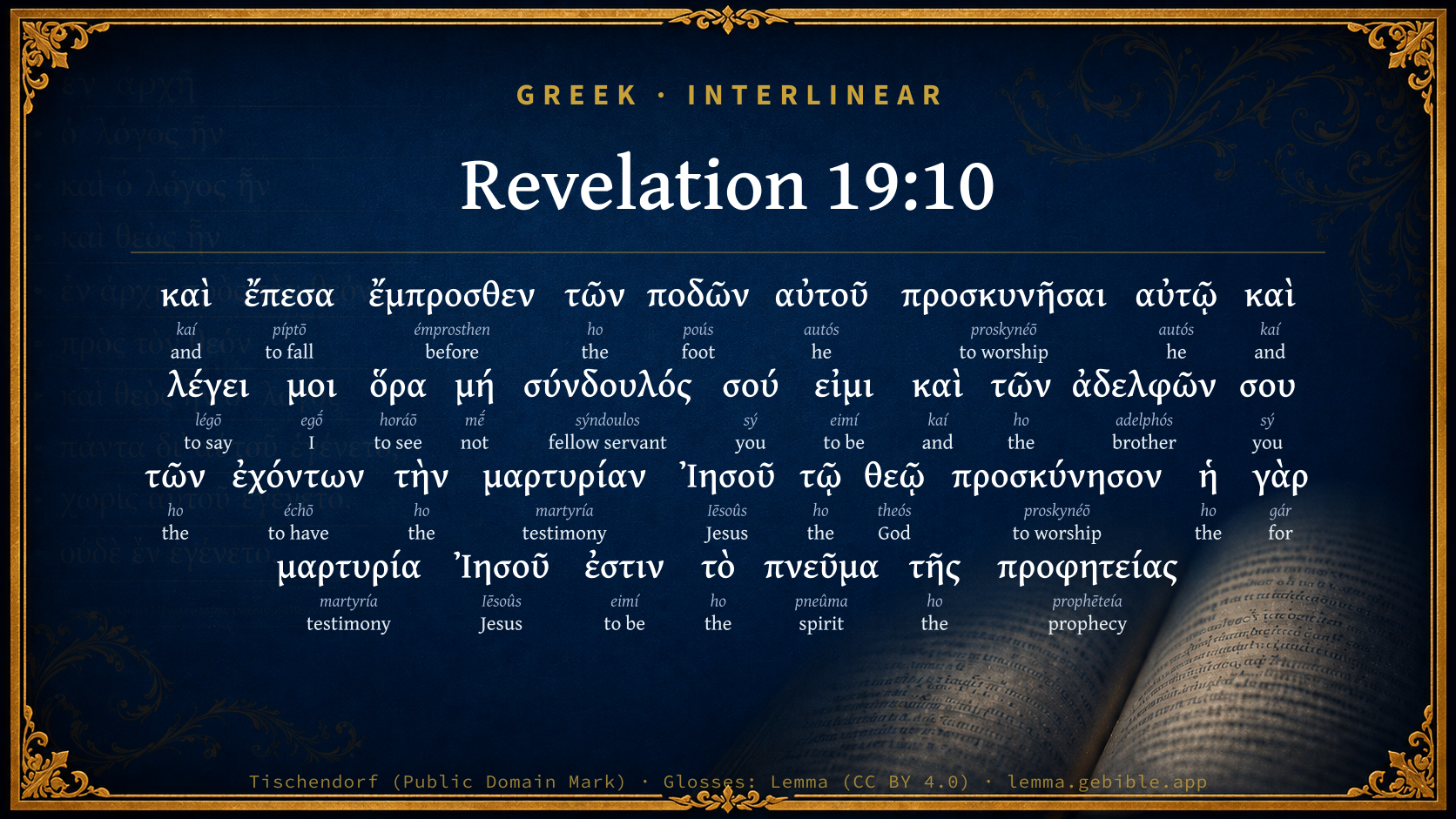
Greek (Tischendorf 8th ed.) Revelation 19:10 appears in the Greek New Testament. The text above is from the Tischendorf 8th edition. Each word links to its Strong’s number and a concise gloss. Click any word for its full Thayer’s Greek Lexicon entry.
Download image
Cite this verse

Revelation 19:10 (World English Bible). Public Domain. Lemma interlinear Bible study tool, https://lemma.gebible.app/v/revelation/19/10.

Show BibTeX & RIS
BibTeX
RIS
English Translation
I fell down before his feet to worship him. He said to me, "Look! Don't do it! I am a fellow bondservant with you and with your brothers who hold the testimony of Jesus. Worship God, for the testimony of Jesus is the Spirit of Prophecy."
World English Bible · Public Domain
Download a study sheet

One document with this verse’s original text, its word-by-word gloss line, the meaning frame, cross-references with their text, attributed commentary, and full source and license credits — printable, and it pastes into notes with its structure intact.

This verse Autodidact and up

Study sheet (.html) Plain text (.txt)

A passage Seminary Student

Up to 50 verses in one chapter. A passage sheet keeps up to 6 commentary sources and 12 cross-references per verse, in the order this page ranks them, and says so on the sheet whenever that leaves anything out. Ask for a single verse and you get the Autodidact verse sheet above.

Everything on this page stays free to read, with no account — the sheet is a download of what is already on screen, not access to it.

Want to remove ads? Support Godless Engineer
Compare translations 3

The same verse in 3 English versions, stacked beneath the original-language interlinear above. Click any original word for its lexicon entry.

Each is an independent rendering of the whole verse — the interlinear is not word-aligned to these translations.

Highlighted words mark where these versions differ — a whole-verse word diff, not a word-by-word alignment.

  • World English Bible Public Domain
    I fell down before his feet to worship him. He said to me, "Look! Don't do it! I am a fellow bondservant with you and with your brothers who hold the testimony of Jesus. Worship God, for the testimony of Jesus is the Spirit of Prophecy."
  • King James Version Public Domain
    And I fell at his feet to worship him. And he said unto me, See thou do it not: I am thy fellowservant, and of thy brethren that have the testimony of Jesus: worship God: for the testimony of Jesus is the spirit of prophecy.
  • unfoldingWord Literal Text CC BY-SA 4.0
    And I fell before his feet to worship him, but he says to me, “See not! I am a fellow servant of you and your brothers having the testimony of Jesus. Worship God! For the testimony of Jesus is the spirit of prophecy.”

unfoldingWord Literal Text — © unfoldingWord, licensed CC BY-SA 4.0. Word-aligned USFM3 via Door43 (git.door43.org/unfoldingWord/en_ult).

Versions to compare (up to 4)

3 of 4 selected

Show all 19 translations

Every available English version of this verse, each an independent rendering of the whole verse.

  • World English Bible Public Domain
    I fell down before his feet to worship him. He said to me, "Look! Don't do it! I am a fellow bondservant with you and with your brothers who hold the testimony of Jesus. Worship God, for the testimony of Jesus is the Spirit of Prophecy."
  • Berean Standard Bible Public Domain
    So I fell at his feet to worship him. But he told me, “Do not do that! I am a fellow servant with you and your brothers who rely on the testimony of Jesus. Worship God! For the testimony of Jesus is the spirit of prophecy.”
  • Majority Standard Bible Public Domain
    So I fell at his feet to worship him. But he told me, “Do not do that! I am a fellow servant with you and your brothers who rely on the testimony of Jesus. Worship God! For the testimony of Jesus is the spirit of prophecy.”
  • King James Version Public Domain
    And I fell at his feet to worship him. And he said unto me, See thou do it not: I am thy fellowservant, and of thy brethren that have the testimony of Jesus: worship God: for the testimony of Jesus is the spirit of prophecy.
  • American Standard Version (1901) Public Domain
    And I fell down before his feet to worship him. And he saith unto me, See thou do it not: I am a fellow-servant with thee and with thy brethren that hold the testimony of Jesus: worship God; for the testimony of Jesus is the spirit of prophecy.
  • Revised Version (1885) Public Domain
    And I fell down before his feet to worship him. And he saith unto me, See thou do it not: I am a fellow-servant with thee and with thy brethren that hold the testimony of Jesus: worship God: for the testimony of Jesus is the spirit of prophecy.
  • Geneva Bible (1599) Public Domain
    And I fell before his feete, to worship him: but he said vnto me, See thou doe it not: I am thy fellowe seruant, and one of thy brethren, which haue the testimonie of Iesus. Worship God: for the testimonie of Iesus is the Spirit of prophecie.
  • Douay-Rheims (1899) Public Domain
    And I fell down before his feet, to adore him. And he saith to me: See thou do it not: I am thy fellow servant, and of thy brethren, who have the testimony of Jesus. Adore God. For the testimony of Jesus is the spirit of prophecy.
  • Young's Literal Translation Public Domain
    and I fell before his feet, to bow before him, and he saith to me, `See -- not! fellow servant of thee am I, and of thy brethren, those having the testimony of Jesus; bow before God, for the testimony of Jesus is the spirit of the prophecy.'
  • Literal Standard Version CC BY-SA 4.0
    and I fell before his feet to worship him, and he says to me, “Behold—No! I am your fellow servant, and of your brothers, those having the testimony of Jesus; worship God, for the testimony of Jesus is the spirit of the prophecy.”
  • Unlocked Literal Bible CC BY-SA 4.0
    I fell down at his feet to worship him, but he said to me, “Do not do this! I am a fellow servant with you and your brothers who hold the testimony about Jesus. Worship God, for the testimony about Jesus is the spirit of prophecy.”
  • unfoldingWord Literal Text CC BY-SA 4.0
    And I fell before his feet to worship him, but he says to me, “See not! I am a fellow servant of you and your brothers having the testimony of Jesus. Worship God! For the testimony of Jesus is the spirit of prophecy.”
  • Darby Bible Public Domain
    And I fell before his feet to do him homage. And he says to me, See [thou do it] not. I am thy fellow-bondman, and [the fellow-bondman] of thy brethren who have the testimony of Jesus. Do homage to God. For the spirit of prophecy is the testimony of Jesus.
  • World Messianic Bible Public Domain
    I fell down before his feet to worship him. He said to me, “Look! Don’t do it! I am a fellow bondservant with you and with your brothers who hold the testimony of Yeshua. Worship God, for the testimony of Yeshua is the Spirit of Prophecy.”
  • Webster's Bible Public Domain
    And I fell at his feet to worship him. And he said to me, See thou do it not: I am thy fellow-servant, and of thy brethren that have the testimony of Jesus: worship God: for the testimony of Jesus is the spirit of prophecy.
  • Free Bible Version CC BY-SA 4.0
    I fell down at his feet to worship him. He told me, “Don't do that! I am one of God's servants just as you are, and those who accept Jesus' testimony. Worship God, for Jesus' testimony is the prophetic spirit.”
  • Bible in Basic English Public Domain
    And I went on my face before his feet to give him worship. And he said to me, See you do it not: I am a brother-servant with you and with your brothers who keep the witness of Jesus: give worship to God: for the witness of Jesus is the spirit of the prophet's word.
  • Text-Critical English NT CC BY 4.0
    Then I fell at his feet to worship him, but he said to me, “Do not do that! I am a fellow servant of yoʋrs and of yoʋr brothers who hold to the testimony of Jesus. Worship God.” For the testimony of Jesus is the spirit of prophecy.
  • Tyndale New Testament (1534) Public Domain
    And I fell at his fete to worshyppe him. And he sayde vnto me se thou do it not. For I am thy felowe seruaunt and one of thy brethern and of them that have the testimony of Iesus. Worshyppe God. For the testymony of Iesus ys the sprete of prophesy.

Literal Standard Version (2020), Covenant Press — licensed CC BY-SA 4.0. Text via the HelloAO Bible API (eBible.org). Unlocked Literal Bible (unfoldingWord) — licensed CC BY-SA 4.0. Text via the HelloAO Bible API (eBible.org). unfoldingWord Literal Text — © unfoldingWord, licensed CC BY-SA 4.0. Word-aligned USFM3 via Door43 (git.door43.org/unfoldingWord/en_ult). Free Bible Version, Dr. Jonathan Gallagher — licensed CC BY-SA 4.0. Text via the HelloAO Bible API (eBible.org).

Word by word

More ways to search: Search by grammar → Find every occurrence → Compare this word →

Practice this passage: Drill this verse → Learn its vocabulary →

σύνδουλός
sýndoulos
G4889
“fellow servant”
Noun, Nominative, Singular, Masculine
Part of Speech
Noun
Case
Nominative
Number
Singular
Gender
Masculine
Full Thayer's Definition

Origin: from G4862 and G1401

TDNT: 06:21,2

1. a fellow servant, one who serves the same master with another a. the associate of a servant (or slave) b. one who with others serves (ministers to) a king c. a colleague of one who is Christ's servant in publishing the gospel d. one who with others acknowledges the same Lord, Jesus, and obeys his commands e. one who with others is subject to the same divine authority in the Messianic economy 1. of angels as the fellow servants of Christians
  1. καὶ kaí G2532 “and” Conjunction
  2. ἔπεσα píptō G4098 “to fall” Verb, Aorist, Active, Indicative, 1st person, Singular
  3. ἔμπροσθεν émprosthen G1715 “before” Preposition
  4. τῶν ho G3588 “the” Article, Genitive, Plural, Masculine
  5. ποδῶν poús G4228 “foot” Noun, Genitive, Plural, Masculine
  6. αὐτοῦ autós G846 “he” Personal pronoun, Genitive, Singular, Masculine
  7. προσκυνῆσαι proskynéō G4352 “to worship” Verb, Aorist, Active, Infinitive
  8. αὐτῷ autós G846 “he” Personal pronoun, Dative, Singular, Masculine
  9. καὶ kaí G2532 “and” Conjunction
  10. λέγει légō G3004 “to say” Verb, Present, Active, Indicative, 3rd person, Singular
  11. μοι egṓ G1473 “I” Personal pronoun, 1st person, Dative, Singular
  12. ὅρα horáō G3708 “to see” Verb, Present, Active, Imperative, 2nd person, Singular
  13. μή mḗ G3361 “not” Particle, Negative
  14. σού sý G4771 “you” Personal pronoun, 2nd person, Genitive, Singular
  15. εἰμι eimí G1510 “to be” Verb, Present, Active, Indicative, 1st person, Singular
  16. καὶ kaí G2532 “and” Conjunction
  17. τῶν ho G3588 “the” Article, Genitive, Plural, Masculine
  18. ἀδελφῶν adelphós G80 “brother” Noun, Genitive, Plural, Masculine
  19. σου sý G4771 “you” Personal pronoun, 2nd person, Genitive, Singular
  20. τῶν ho G3588 “the” Article, Genitive, Plural, Masculine
  21. ἐχόντων échō G2192 “to have” Verb, Present, Active, Participle, Genitive, Plural, Masculine
  22. τὴν ho G3588 “the” Article, Accusative, Singular, Feminine
  23. μαρτυρίαν martyría G3141 “testimony” Noun, Accusative, Singular, Feminine
  24. Ἰησοῦ Iēsoûs G2424 “Jesus” Noun, Genitive, Singular, Masculine
  25. τῷ ho G3588 “the” Article, Dative, Singular, Masculine
  26. θεῷ theós G2316 “God” Noun, Dative, Singular, Masculine
  27. προσκύνησον proskynéō G4352 “to worship” Verb, Aorist, Active, Imperative, 2nd person, Singular
  28. ἡ ho G3588 “the” Article, Nominative, Singular, Feminine
  29. γὰρ gár G1063 “for” Conjunction
  30. μαρτυρία martyría G3141 “testimony” Noun, Nominative, Singular, Feminine
  31. Ἰησοῦ Iēsoûs G2424 “Jesus” Noun, Genitive, Singular, Masculine
  32. ἐστιν eimí G1510 “to be” Verb, Present, Active, Indicative, 3rd person, Singular
  33. τὸ ho G3588 “the” Article, Nominative, Singular, Neuter
  34. πνεῦμα pneûma G4151 “spirit” Noun, Nominative, Singular, Neuter
  35. τῆς ho G3588 “the” Article, Genitive, Singular, Feminine
  36. προφητείας prophēteía G4394 “prophecy” Noun, Genitive, Singular, Feminine

About this verse

These counts appear in no published source. They are computed here, from the morphology-tagged text and Lemma’s own curated glosses. What Lemma adds →

37
words
22
distinct lemmas
Revelation
section

Notable vocabulary

The rarest word here is σύνδουλός fellow servant G4889 — appearing just 10 times in the whole Greek New Testament.

Shared distinctive vocabulary

σύνδουλός fellow servant G4889 occurs in 10 verses of the Greek New Testament. Also found in:

Repetition

Words recur within this verse:

  • προσκυνῆσαι to worship G4352 ×2
  • εἰμι to be G1510 ×2
  • μαρτυρίαν testimony G3141 ×2
  • Ἰησοῦ Jesus G2424 ×2
  • τῶν the G3588 ×8
  • καὶ and G2532 ×3
  • αὐτοῦ he G846 ×2
  • σού you G4771 ×2

Cross-references

36

Topical passages linked to Revelation 19:10 in the Treasury of Scripture Knowledge — connected by theme and wording, ordered by reader-vote popularity; previews shown in the World English Bible.

  • Acts 10:25–26 When it happened that Peter entered, Cornelius met him, fell down at his feet, and worshiped him.
  • Revelation 22:8–9 Now I, John, am the one who heard and saw these things. When I heard and saw, I fell down to worship before the feet of the angel who had shown me these things.
  • John 5:39 "You search the Scriptures, because you think that in them you have eternal life; and these are they which testify about me.
  • Hebrews 1:14 Aren't they all ministering spirits, sent out to do service for the sake of those who will inherit salvation?
  • Exodus 34:14 for you shall worship no other god: for Yahweh, whose name is Jealous, is a jealous God.
  • Revelation 4:10 the twenty-four elders fall down before him who sits on the throne, and worship him who lives forever and ever, and throw their crowns before the throne, saying,
  • 2 Peter 1:19–21 We have the more sure word of prophecy; whereunto you do well that you take heed, as to a lamp shining in a dark place, until the day dawns, and the day star arises in your hearts:
  • 1 Peter 1:10–12 Concerning this salvation, the prophets sought and searched diligently, who prophesied of the grace that would come to you,
  • Revelation 12:11 They overcame him because of the Lamb's blood, and because of the word of their testimony. They didn't love their life, even to death.
  • Revelation 12:17 The dragon grew angry with the woman, and went away to make war with the rest of her seed, who keep God's commandments and hold Jesus' testimony.
  • Matthew 4:10 Then Jesus said to him, "Get behind me, Satan! For it is written, 'You shall worship the Lord your God, and him only shall you serve.'"
  • Hebrews 12:25 See that you don't refuse him who speaks. For if they didn't escape when they refused him who warned on the Earth, how much more will we not escape who turn away from him who warns from heaven,
  • 1 John 5:10 He who believes in the Son of God has the testimony in himself. He who doesn't believe God has made him a liar, because he has not believed in the testimony that God has given concerning his Son.
  • Luke 24:25–27 He said to them, "Foolish men, and slow of heart to believe in all that the prophets have spoken!
  • Acts 14:11–15 When the multitude saw what Paul had done, they lifted up their voice, saying in the language of Lycaonia, "The gods have come down to us in the likeness of men!"
  • Acts 10:43 All the prophets testify about him, that through his name everyone who believes in him will receive remission of sins."
  • Revelation 14:7 He said with a loud voice, "Fear the Lord, and give him glory; for the hour of his judgment has come. Worship him who made the heaven, the earth, the sea, and the springs of waters!"
  • 2 Kings 17:36 but Yahweh, who brought you up out of the land of Egypt with great power and with an outstretched arm, him shall you fear, and to him shall you bow yourselves, and to him shall you sacrifice:
  • Mark 5:22 Behold, one of the rulers of the synagogue, Jairus by name, came; and seeing him, he fell at his feet,
  • Revelation 15:4 Who wouldn't fear you, Lord, And glorify your name? For you only are holy. For all the nations will come and worship before you. For your righteous acts have been revealed."
  • Psalms 103:20–21 Praise Yahweh, you angels of his, Who are mighty in strength, who fulfill his word, Obeying the voice of his word.
  • Luke 1:19 The angel answered him, "I am Gabriel, who stands in the presence of God. I was sent to speak to you, and to bring you this good news.
  • Luke 24:44 He said to them, "This is what I told you, while I was still with you, that all things which are written in the law of Moses, the prophets, and the psalms, concerning me must be fulfilled."
  • Acts 3:12–18 When Peter saw it, he responded to the people, "You men of Israel, why do you marvel at this man? Why do you fasten your eyes on us, as though by our own power or godliness we had made him walk?
  • Philippians 3:3 For we are the circumcision, who worship God in the Spirit, and rejoice in Christ Jesus, and have no confidence in the flesh;
  • Revelation 1:9 I John, your brother and partner with you in oppression, Kingdom, and perseverance in Christ Jesus, was on the isle that is called Patmos because of God's Word and the testimony of Jesus Christ.
  • Psalms 45:11 So the king will desire your beauty, Honor him, for he is your lord.
  • Daniel 7:10 A fiery stream issued and came forth from before him: thousands of thousands ministered to him, and ten thousand times ten thousand stood before him: the judgment was set, and the books were opened.
  • John 4:22–24 You worship that which you don't know. We worship that which we know; for salvation is from the Jews.
  • Acts 13:27 For those who dwell in Jerusalem, and their rulers, because they didn't know him, nor the voices of the prophets which are read every Sabbath, fulfilled them by condemning him.
  • 1 John 5:21 Little children, keep yourselves from idols.
  • Mark 7:25 For a woman, whose little daughter had an unclean spirit, having heard of him, came and fell down at his feet.
  • Romans 3:21–22 But now apart from the law, a righteousness of God has been revealed, being testified by the law and the prophets;
  • 2 Corinthians 8:7 But as you abound in everything, in faith, utterance, knowledge, all earnestness, and in your love to us, see that you also abound in this grace.
  • Ephesians 5:15 Therefore watch carefully how you walk, not as unwise, but as wise;
  • 1 Thessalonians 5:15 See that no one returns evil for evil to anyone, but always follow after that which is good, for one another, and for all.

Cross-references courtesy of OpenBible.info (CC BY 4.0).

Commentary

Notes on Revelation 19:10 from classic Christian and Jewish commentators (each source and its license shown beneath its notes). The classic Christian expositions comment on the surrounding passage and are grouped to its opening verse, so a note may address several verses; the Jewish commentaries on the Tanakh (Rashi and others) are per-verse, so they appear only where the commentator wrote on this verse.

Lemma curates 59 commentaries, every one of them public domain or Creative Commons licensed, each selected and text-cleaned for this edition rather than reprinted as found. About our sources →

The Cambridge Bible for Schools and Colleges

gen. ed. J. J. S. Perowne

The Error of the Seer, Rev_19:10

10. to worship him] Perhaps understanding from the last words that the speaker was God Himself. In the O. T. God had revealed Himself to men by means of angels, and men had, by falling at the feet of angels, rightly worshipped the God Who was present in them (see esp. Hos_12:4 compared with Gen_32:30). But since a more perfect revelation of God has been given by the Incarnation, no such divine presence in an angel is to be looked for. (So Jer. Taylor, Dissuasive from Popery, Part II. 11. Rev_8:3.) We have therefore no need to suppose that the holy apostle was in intent guilty of idolatry; he meant the worship for God in the angel, but this being an angel and nothing more, it follows of course that he ought not to be honoured as God. See Rev_22:8.

I am thy fellowservant] In a sense, the angels are even servants to the elect on earth, Heb_1:14.

and of thy brethren that have, &c.] In the parallel passage, Rev_22:9, we have “thy brethren the prophets,” and the sense seems to be the same here, from the last words of the verse.

have the testimony of Jesus] Rev_1:2; Rev_1:9, Rev_6:9, and, closest of all, Rev_12:17. In all these the word rendered “testimony” comes near to the sense that became technical, of “martyrdom.”

for the testimony, &c.] Comparing Rev_22:9 with the passages last cited, it seems that the sense of the passage is, “Martyrdom like thine” (the seer was at least a confessor, Rev_1:2, perhaps, as tradition says, a proved martyr in will) “and thy brethren’s involves in it the grace of prophecy, and so places the martyrs in so close communion with God that they need no angel mediator.” But what is said to St John as a prophet is in its measure true of all Christians. All in their measure are witnesses for Christ, and all partakers of His Spirit; and therefore all are prophets in the same sense that they are all priests and kings. Thus all, if not yet “equal with the angels” (St Luk_20:36), are brought too near to God to need angels to bring Him near to them.

The Cambridge Bible for Schools and Colleges (gen. ed. J. J. S. Perowne; Cambridge University Press, 1878–1918) — public domain. Text from a community e-Sword module.

Tyndale Open Study Notes

Tyndale Open Resources

19:10 The angel issues a stern warning against misdirected worship (cp. 22:8-9).

Tyndale Open Study Notes — © Tyndale Open Resources, licensed CC BY-SA 4.0. Text via the HelloAO Bible API.

Expositor's Greek Testament

ed. W. Robertson Nicoll

Rev 19:10 . Jewish eschatology at this point has much to say of the return of the ten tribes and the general restoration of Zion’s children from foreign lands but these speculations were naturally of no interest to the religious mind of the Christian prophet. As hitherto the command to write has come from Christ, the seer perhaps thinks that this injunction also proceeds from a divine authority (Weiss), but his grateful and reverent attempt to pay divine homage to the angelus interpres ( cf. Rev 22:8 ) is severely rebuked. The author’s intention is to check any tendency to the angel-worship which (whether a Jewish practice or not, cf. Clem. Alex. Strom. vi. 5, 41; Lightfoot on Col 2:18 ; and Lueken, 4 f.) had for some time fascinated the Asiatic churches here and there. If even a prophet need not bow to an angel, how much less an ordinary Christian? A contemporary note of this polemic is heard in Asc. Isa. vii. 21 (Christians): et cecidi in faciem meam, ut eum (the angelus interpres , who conducts Isaiah through the heavens) adorarem, nec siuit me angelus, qui me instruebat, sed dixit mihi ne adores nec angelum nec thronum. In Asc. Isa 2:11 the angelic cicerone even rebukes the seer for calling him Lord: οὐκ ἐγὼ κύριος , ἀλλὰ σύν δουλός σού εἰμι . The repetition of this scene (Rev 22:8 f.), due to the Oriental love of emphasis by reduplication, is significant in a book where angels swarm ( cf. Dan 2:11 ). ἡ γὰρ κ . τ . λ ., “for the testimony or witness of ( i.e. , borne by) Jesus is ( i.e. , constitutes) the spirit of prophecy”. This prose marginal comment (see above) specifically defines the brethren who hold the testimony of Jesus as possessors of prophetic inspiration. The testimony of Jesus is practically equivalent to Jesus testifying (Rev 22:20 ). It is the self-revelation of Jesus (according to Rev 1:1 , due ultimately to God) which moves the Christian prophets. He forms at once the impulse and subject of their utterances ( cf. lgnat. Rom. viii.; Eph. vi.). The motive and materials for genuine prophecy consist in a readiness to allow the spirit of Jesus to bring the truth of God before the mind and conscience ( cf. Rev 3:14 ; Rev 3:22 ). The gloss even connects in a certain way with τῷ θεῷ προσκύνησον . Since angelic and human inspiration alike spring from the divine witness of Jesus, therefore God alone, as its ultimate source, deserves the reverence of those whom that inspiration impresses. The prestige of the prophets lies in the fact that any one of them is, as Philo called Abraham, σύνδουλος τῶν ἀγγέλων . An angel can do no more than bear witness to Jesus. Furthermore, there is an implicit definition of the spirit of prophecy (Rev 11:7 , etc.) in its final phase as a revelation of Jesus Christ. Even the O.T. prophetic books, with which the Apocalypse claims to rank, were inspired by the spirit of the pre-existent Christ (see on 1Pe 1:11 ; Barn. Rev 19:6 ). But now, by an anti-Jewish and even anti-pagan touch, no oracular or prophetic inspiration is allowed to be genuine unless it concerns Jesus who is the Christ. Such is the triumphant definition or rather manifesto of the new Christian prophecy.

The Expositor's Greek Testament, edited by W. Robertson Nicoll (1897–1910) — public domain. Text from a community e-Sword module.

Geneva Bible (1599)

Geneva Bible translators

For Jesus is the mark that all the prophecies shoot at.

The particular history of this verse is brought in by occasion, and as it were besides the purpose, that Saint John might make a public example of his own infirmity, and of the modest sanctimony of the Angel, who hath renounced for himself the divine honors, and recalled all the servants of God, unto the worship of him alone: as also Rev. 22:8.

Which are commanded to bear witness of Jesus.

Geneva Bible (1599) marginal notes — public domain. Text via Bolls.life.

Jamieson, Fausset & Brown

Robert Jamieson, A. R. Fausset & David Brown

at--Greek, "before." John's intending to worship the angel here, as in Rev 22:8, on having revealed to him the glory of the new Jerusalem, is the involuntary impulse of adoring joy at so blessed a prospect. It forms a marked contrast to the sorrowful wonder with which he had looked on the Church in her apostasy as the harlot (Rev 17:6). It exemplifies the corrupt tendencies of our fallen nature that even John, an apostle, should have all but fallen into "voluntary humility and worshipping of angels," which Paul warns us against.

and of thy brethren--that is, a fellow servant of thy brethren.

have the testimony of Jesus--(See on Rev 12:17).

the testimony of--that is, respecting Jesus.

is the spirit of prophecy--is the result of the same spirit of prophecy in you as in myself. We angels, and you apostles, all alike have the testimony of (bear testimony concerning) Jesus by the operation of one and the same Spirit, who enables me to show you these revelations and enables you to record them: wherefore we are fellow servants, not I your lord to be worshipped by you. Compare Rev 22:9, "I am fellow servant of thee and of thy brethren the prophets"; whence the "FOR the testimony," &c., here, may be explained as giving the reason for his adding "and (fellow servant) of thy brethren that have the testimony of Jesus." I mean, of the prophets; "for it is of Jesus that thy brethren, the prophets, testify by the Spirit in them." A clear condemnation of Romish invocation of saints as if they were our superiors to be adored.

Jamieson, Fausset & Brown — Commentary Critical and Explanatory on the Whole Bible (1871) — public domain (CC PDM 1.0). Text via the HelloAO Bible API.

Adam Clarke's Commentary

Verse 10. I fell at his feet to worship him.] Great as this angel was, St. John could not mistake him either for Jesus Christ, or for God the Father; nor was his prostration intended as an act of religious worship. It was merely an act of that sort of reverence which any Asiatic would pay to a superior. His mistake was, the considering that he was under obligation to the angel for the information which he had now received. This mistake the angel very properly corrects, showing him that it was from God alone this intelligence came, and that to him alone the praise was due.

I am thy fellow servant] No higher in dignity than thyself; employed by the same God, on the same errand, and with the same testimony; and therefore not entitled to thy prostration: worship God-prostrate thyself to him, and to him give thanks.

The testimony of Jesus is the spirit of prophecy.] As this is a reason given by the angel why he should not worship him, the meaning must be this: I, who have received this spirit of prophecy, am not superior to thee who hast received the testimony of Christ, to preach him among the Gentiles; for the commission containing such a testimony is equal to the gift of the spirit of prophecy. Or, the spirit of prophecy is a general testimony concerning Jesus, for he is the scope and design of the whole Scripture; to him gave all the prophets witness. Take Jesus, his grace, Spirit, and religion out of the Bible, and it has neither scope, design, object, nor end.

Adam Clarke's Commentary on the Bible (1810–1826) — public domain. Text from a community e-Sword/MySword module.

Ellicott's Commentary for English Readers

(10) And I fell at his feet . . .—The impulse to worship the messenger who had unfolded such visions was not unnatural: the immediate checking of it here and in Rev_22:8-9, on the part of the angel, supplies an indirect evidence of the genuineness of the whole book, and gives it a moral tone immeasurably superior to the vision-books of pretended revelations. And he saith to me, See (or, take heed) not (i.e., to do it); I am a fellow-servant of thee and of thy brethren who have the testimony of Jesus: worship God; for the testimony of Jesus is the spirit of prophecy. One bond of service unites angels and men: to be servants of God is the highest title they can attain; worship is for God alone. The words “worship God” are most emphatic: “to God give thy worship, and not to me, who am but thy fellow-servant.” The angel is his fellow-servant, and at that time he was emphatically so, as he and the Apostle were engaged in one common work—“the testimony of Jesus.” The Apostle’s work in the world was the testimony of Jesus (Rev_1:2; Rev_1:9), and the Spirit of prophecy which moved (2Pe_1:21) the angel was likewise the testimony of Jesus. One work and one worship belong to both. He whom Apostles worshipped unrebuked (Mat_28:9; Mat_28:17) was the one whom all the angels of God were bidden to worship (Psa_97:7; Heb_1:6). It is wonderful, with this emphatic witness to our Lord Jesus Christ, any should have undervalued this book of Revelation, as one which failed to honour Him.

A Bible Commentary for English Readers, edited by Charles John Ellicott (1878–1897) — public domain. Text from a community e-Sword module.

John Gill's Exposition

And I fell at his feet to worship him,.... Being transported with the news he brought him of the marriage, or conversion of his countrymen the Jews, and struck with reverence and awe of the glory and majesty in which the angel appeared to him; and forgetting himself, that worship was only due to God, he behaved in this manner; which is not to be excused nor justified, as appears from the angel's words:

and he said unto me, see thou do it not; the words are in the original very short and concise, and are spoken in an abrupt manner, and in great haste; as fearing he would be guilty of idolatry, before he could speak all his mind, and use the arguments that were necessary to dissuade from it:

I am thy fellow servant, and of thy brethren that have the testimony of Jesus; if this was one of the ministering spirits, he was a servant of the same Lord as John; and if he was a minister of the Gospel, he was still more literally a fellow servant of his, and of the apostles, and preachers of the Gospel; which is meant by the testimony of Jesus, that bearing testimony to the person, office, grace, obedience, sufferings, and death of Christ, and the glory following; and therefore being but a servant, and a servant in common with John and his brethren, was by no means to be worshipped; not the servant, but master; not the creature, but the Creator:

worship God and him only, even God the Father, Son, and Spirit; not the Father to the exclusion of the Son, the firstborn, whom all the angels are called upon to worship; nor of the Spirit, who is equally joined with the Father and Son in baptism, a part of religious worship, and in other parts of it also; but this excludes all creatures, angels, and men, things animate or inanimate, and images of them; the worshipping of which will now be no more, or at least will be quickly at an end.

For the testimony of Jesus is the spirit of prophecy that is, the testimony of Jesus, or the Gospel which John and his brethren had, is the very spirit, life, and soul of the prophecy of this book; for as all the prophets bore witness to Christ, so does the Spirit of God in this; or the testimony which they had, and bore to Christ, was equal to the spirit of prophecy with which this angel was endowed; so that he and they were upon an equal foot; and he was no more a proper object of divine and religious adoration than they were.

John Gill's Exposition of the Whole Bible (1746–1763) — public domain (CC PDM 1.0). Text via the HelloAO Bible API.

Trapp's Complete Commentary

John Trapp

10 And I fell at his feet to worship him. And he said unto me, See thou do it not: I am thy fellowservant, and of thy brethren that have the testimony of Jesus: worship God: for the testimony of Jesus is the spirit of prophecy.

Ver. 10. And I fell at his feet] So taken he was with the joyful tidings of his countrymen’s (the Jews’) conversion, that he fell down as Abraham did upon the good news of Isaac’s birth, Gen 17:17. And it may be he took this angel for Christ, the Angel of the covenant; but that was his error. Triste mortalitatis privilegium est, licere aliquando peccare. (Euphor.)

See thou do it not] οραμη, an elliptic and concise kind of speech in the Greek, betokening haste and displeasure at what was done. Papists will needs disdain the angels with seeming courtesies and respects; and whereas the Council of Laodicea (cap. 35) saith, it behoveth Christians, αγγελους μη ονομαζειν, not to pray to angels, Surius and Caranza make the words to be, Non oportet Christianos ad angulos congregationes facere; It is not proper for Christians to associate with angels, and the title they make De iis qui angulos colunt, in a clean contrary sense to the Council’s intention.

John Trapp, A Commentary or Exposition upon All the Books of the Old and New Testament (1647–1656) — public domain. Text from a community e-Sword module.

Albert Barnes' Notes on the Bible

And I fell at his feet to worship him - At the feet of the angel. See the notes on Rev 19:9. This is a common posture of adoration in the East. See Rosenmuller’s “Morgenland, in loco.” notes on 1Co 14:25. John was entirely overcome with the majesty of the heavenly messenger, and with the amazing truths that he had disclosed to him, and in the overflowing of his feelings he fell upon the earth in the posture of adoration. Or it may be that he mistook the rank of him who addressed him, and supposed that he was the Messiah whom he had been accustomed to worship, and who had first Rev. 1 appeared to him. If so, his error was soon corrected. He was told by the angel himself who made these communications that he had no claims to such homage, and that the praise which he offered him should be rendered to God alone. It should be observed that there is not the slightest intimation that this was the Messiah himself, and consequently this does not contain any evidence that it would be improper to worship him. The only fair conclusion from the passage is, that it is wrong to offer religious homage to an angel.

And he said unto me, See thou do it not - That is, in rendering the homage which you propose to me, you would in fact render it to a creature. This may be regarded as an admonition to be careful in our worship; not to allow our feelings to overcome us; and not to render that homage to a creature which is due to God alone. Of course, this would prohibit the worship of the Virgin Mary, and of any of the saints, and all that homage rendered to a created being which is due to God only. Nothing is more carefully guarded in the Bible than the purity and simplicity of worship; nothing is more sternly rebuked than idolatry; nothing is more contrary to the divine law than rendering in any way that homage to a creature which belongs of right to the Creator. It was necessary to guard even John, the beloved disciple, on that subject; how much more needful, therefore, is it to guard the church at large from the dangers to which it is liable.

I am thy fellow-servant - Evidently this was an angel, and yet he here speaks of himself as a “fellow-servant” of John. That is, he was engaged in the service of the same God; he was endeavoring to advance the same cause, and to honor the same Redeemer. The sentiment is, that in promoting religion in the world, we are associated with angels. It is no condescension in them to be engaged in the service of the Redeemer, though it seems to be condescension for them to be associated with us in anything; it constitutes no ground of merit in us to be engaged in the service of the Redeemer (compare Luk 17:10), though we may regard it as an honor to be associated with the angels, and it may raise us in conscious dignity to feel that we are united with them.

And of thy brethren - Of other Christians; for all are engaged in the same work.

That have the testimony of Jesus - Who are witnesses for the Saviour. It is possible that there may be here a particular reference to those who were engaged in preaching the gospel, though the language will apply to all who give their testimony to the value of the gospel by consistent lives.

Worship God - He is the only proper object of worship; he alone is to be adored.

For the testimony of Jesus - The meaning here seems to be, that this angel, and John, and their fellow-servants, were all engaged in the same work that of bearing their testimony to Jesus. Thus, in this respect, they were on a level, and one of them should not worship another, but all should unite in the common worship of God. No one in this work, though an angel, could have such a pre-eminence that it would be proper to render the homage to him which was due to God alone. There could be but one being whom it was proper to worship, and they who were engaged in simply bearing testimony to the work of the Saviour should not worship one another.

Is the spirit of prophecy - The design of prophecy is to bear testimony to Jesus. The language does not mean, of course, that this is the only design of prophecy, but that this is its great and ultimate end. The word “prophecy” here seems to be used in the large sense in which it is often employed in the New Testament - meaning to make known the divine will (see the notes on Rom 12:6), and the primary reference here would seem to be to the preachers and teachers of the New Testament. The sense is, that their grand business is to bear testimony to the Saviour. They are all - whether angels, apostles, or ordinary teachers - appointed for this, and therefore should regard themselves as “fellow-servants.” The design of the angel in this seems to have been, to state to John what was his own specific business in the communications which he made, and then to state a universal truth applicable to all ministers of the gospel, that they were engaged in the same work, and that no one of them should claim adoration from others. Thus understood, this passage has no direct reference to the prophecies of the Old Testament, and teaches nothing in regard to their design, though it is in fact undoubtedly true that their grand and leading object was to bear testimony to the future Messiah. But this passage will not justify the attempt so often made to “find Christ” everywhere in the prophecies of the Old Testament, or justify the many forced and unnatural interpretations by which the prophecies are often applied to him.

Albert Barnes' Notes on the Bible (1834–1885) — public domain. Text from a community e-Sword/MySword module.

Haydock's Catholic Bible Commentary

And I fell before his feet, to adore him. They of the pretended reformation think they have here a clear proof that no veneration is due to Angels and saints, and that papists in doing so are idolaters. In answer to this: First, they make St. John the apostle guilty of that idolatry which they lay to our charge. For they must suppose and grant that St. John, as to the dispositions of his mind and will, was just ready, or rather falling down, did pay an idolatrous worship to the Angel; and what Christian can believe this of so great an apostle, that after he had been favoured with all those extraordinary visions, he should either be so very ignorant as not to know what was idolatry, or so impious as to become guilty of it, and give divine honour to any creature? And what makes St. John altogether inexcusable, (had it been idolatry) we find him doing the very same a second time, in the last chapter of the Apocalypse; (ver. 7 and 8) that is, falling down at the Angel’s feet to adore. Secondly, as it would be extravagantly unreasonable to suspect this apostle, this evangelist, this prophet of the new law, to be guilty of it, and give divine honour due to God alone to any creature whatsoever; so in reason we cannot but conclude that he was not for giving divine honour to any Angel, knowing them all to be God’s creatures. If therefore he was about to pay divine honour, we must either say that he took him who then appeared to him to be our Saviour Christ, God and man, as some expound it; or, which seems more probable, he was only for offering an inferior honour and veneration to the Angel, such as he knew was lawful: and therefore he was for doing it afterwards a second time; though the Angel would not receive it from St. John, to make us the more convinced of the great dignity of this apostle and prophet, who should be raised in heaven to a degree of glory, not inferior to that of the Angels: and thus the Angel tells him, that he is his fellow creature, who with him must adore Almighty God, that by these prophecies they both bear testimony concerning Jesus Christ and his Church, the Angel by revealing them, and St. John by publishing them, which seems to be the sense of the following words, for the testimony of Jesus is the spirit of prophecy: or they may be expounded thus, for the testimony that we give concerning Christ and his Church, we both of us receive from the divine spirit of God, who reveals such truths to his prophets. Thirdly, Protestants are for proving us idolaters from what St. John was about to do, or rather from what he did, expressed in these words, and I fell before his feet to adore him; or, as in the Protestant translation, and I fell at his feet to worship him. Now it is certain and evident that these words neither in the Latin nor in the Greek, express that divine worship and honour which is due, and which is given to God alone, whether we consult the Hebrew or the Septuagint of the Old Testament, the very same words are many times used to signify no more than an inferior honour given to creatures. This is a thing well known, and agreed upon by every Protestant as well as Catholic, who has read the Scriptures, or who knows any thing of Latin, Greek, or Hebrew. Fourthly, it seems very strange, very unaccountable, that our adversaries will not understand the difference betwixt divine honour due to God alone, and an inferior honour, respect, or veneration given to Angels or saints, to their relics or images, which inferior honour may, in some sense, be called a religious honour, inasmuch as it is paid to persons or things that may be called sacred or holy. Is not honour or veneration certainly different, as the objects or things we pay honour to, and the intention of him that pays this honour, are different, though perhaps the exterior marks of bowing, of kneeling, of prostrating, or kissing, may be the same? We honour the king, and we also honour his courtiers, his officers, and such as are invested with dignities and authority from him: but shall any one think that we pay the same honour to all these persons or things belonging to them? though the eastern people kneel or prostrate themselves before kings or persons in dignities, they neither give nor design to give them divine honour and supreme worship to God alone? that we honour, worship, serve and adore him only as the author of all things? that we never design to pay any thing but an inferior honour to the highest Angels or saints, or their relics and images. We know, believe, and profess that there is an infinite distance betwixt God the creator, and the highest and most perfect of all created beings; so that the honour we give them is infinitely inferior, as they themselves are, to the honour that with our hearts and minds we pay to God: and must it be said that we give divine honour to creatures, and so become idolaters, when we must never design it, when we design quite the contrary? This made Mr. Thorndike, in his book of just weights and measures, tell his Protestant brethren, that the Church of Rome cannot be charged with idolatry for their reverencing images, nor on any other account; and so exhorts them not to pretend to lead the people by the nose, to make them believe suppositions which they cannot prove. See Chap. ii. and xix. (Witham) --- Fell before, &c. St. Athanasius and St. Augustine think St. John toll the Angel to be Jesus Christ, and as such was desirous of paying him the supreme homage, or Greek: latreia. (Calmet) --- St. John, in token of gratitude, offers to pay to the Angel such homage as is due to a being of his rank, which the Angel however refuses to accept, giving for reason, that his is a fellow-servant of the apostle, and of the apostle’s brethren, who bear testimony to Jesus Christ. (Pastorini) --- This speech evidently agrees with the character of [John] the Baptist, but not with that of a real Angel. --- Testimony of Jesus is the spirit of prophecy. The testimony which you give to Christ, by suffering for his holy name and the profession of his doctrine, is of equal value with the spirit of prophecy which I possess (Pastorini; Calmet)

===============================

[BIBLIOGRAPHY]

Cecidi ante pedes ejus ut adorarum illium: Greek: epeson emprosthen ton podon autou proskunesai auto, proskunein, as Mr. Legh shews out of other authors: promiscue de Dei et hominum cultu apud LXX. (the Septuagint) usurpatur, cui respondet apud Latinos, adorare, quod est quasi ad aliquem orare, says Erasmus, capite vel corpore inclinato. We have very many examples in the holy Scripture, where both Greek: proskunein and Greek: latreuein signify not only divine honour, but also the honour paid to men. When God gave the ten commandments, (Exodus xx.) he forbad his people to adore strange gods; non adorabis ea, neque coles; Greek: ou proskuneseis autois, oude me latreuseis autois. Yet the same words are used in a great many places, where it is evident no divine adoration or worship is designed, as we read of Abraham, (Genesis xxvii. 7.) adoravit populum terræ, Greek: prosekunese to lao tes ges; Genesis xlii. 6. of Joseph’s brethren, cum adorassent eum fratres sui, Greek: prosekunesan auto epi prosopon. See also 1 Kings xx. 41. where David is said to have adored Jonathan, cadens pronus in terram adoravit, Greek: epesen epi prosopon kai prosekunesen auto tris. See likewise 3 Kings i. 16. where Bethsabee [Bathsheba] is said to have adored old king David, adoravit regem, Greek: prosekunese to basilei. Though in these and many other places is meant the supreme worship due to God alone: did Bathsabee take her old, decayed, dying husband, David, to be God, or design to pay him divine honour? Nothing then is more frivolous than such arguments drawn from the like words, which have different significations.

====================

George Leo Haydock (1774–1849), Haydock's Catholic Family Bible and Commentary, 1859 edition — public domain. Excludes Psalms (Douay-Rheims chapter numbering differs from Protestant) and Deuterocanonical books (Catholic canon only).

Matthew Poole's English Annotations

And I fell at his feet to worship him: prostration, or falling at the feet of superiors, to pay them an homage in consideration of their superiority, was ordinarily used in those Eastern countries, Gen 44:14; 1Sa 25:24; 2Ki 4:37; Est 8:3. To worship him, therefore, here must be understood of prayer or praise, which are pieces of Divine adoration, which it is not probable this great apostle would have offered, had he not mistaken him, and thought him an uncreated angel.

And he said unto me, See thou do it not; but the angel doth not only refuse it, but with some indignation; Oρα μη, Have a care you do it not. From whence we may observe, what a fig leaf they have made to cover the papists’ idolatry, in worshipping the bread in the eucharist, who (to show us their great skill in divinity) think they may be excused from idolatry in it, because they think the bread is turned into the body of Christ; idolatry is not to be excused by think so’s.

I am thy fellow servant, and of thy brethren that have the testimony of Jesus: the angel gives him a reason why there was no adoration due to him, because he was his equal in office, though not in nature; he was both his and all their brethren’s fellow servant, who by preaching the gospel give a testimony to Christ. Well, therefore, Rev 2:1-3:22, may the ministers of churches be called angels.

Worship God; there is no prayer, no praise, due but to the Creator.

For the testimony of Jesus is the spirit of prophecy: there are divers senses given of the last phrase; but of all given, there are two which seem to me most probable: either:

1. The spirit of this prophecy, by which I have revealed these things to thee, is not mine, it is the testimony of Jesus; he therefore is to be adored, not I. Or:

2. Thy preaching the gospel, which is thy testimony to Christ, is as much from the Spirit of God, as my spirit of prophecy: we are therefore equals, and I am not to be worshipped more than thou art.

We have the same, Rev 22:8,9, to let us know that even good men may twice run into the same error; and to let us know, that by the mouth of these two witnesses this truth ought to have been establisled, so that papists should not after this have paid any Divine adoration to angels, much less to saints; and if invocation be no Divine adoration, nothing is. This deserveth the consideration of them, who think it so easy to excuse the popish religion from idolatry.

Matthew Poole's English Annotations on the Holy Bible (1683–1685) — public domain. Text from a community e-Sword/MySword module.

Whedon's Commentary on the Bible

Daniel D. Whedon

10. Fell… to worship him—Compare the parallel passage, Rev_22:8-9. Our seer probably supposed his apocalypse closed, and would return worship for so great a boon.

Thy fellow-servant—Fellow testifier to Jesus. He supplies the visible testimony, and John publishes it to the world.

Thy brethren—Properly, the apostles who were the chosen witnesses of Christ. Note, Luk_1:2.

Testimony of Jesus—Both Jesus’s testimony and the apostles’ testimony of Jesus. More the latter than the former.

The testimony of Jesus—Possessed and delivered by the apostles.

Is the spirit of prophecy—The same inspiration as revealed the truths of the ancient prophecy. Hence apostles and prophets are on a level, and the revealing angel was their fellow-servant.

Daniel D. Whedon (gen. ed.), Commentary on the Old and New Testaments (1874–1909) — public domain. Text from a community e-Sword module.

The Pulpit Commentary

And I fell at his feet to worship him. The same thing happens again in Rev_20:7, Rev_20:8, and this makes it improbable that St. John imagined the angel to be Christ himself, as some think. More probably (as Alford, Bengel, Vitringa, Wordsworth, and others) St. John was so overwhelmed with the tremendous character of the revelation just made to him, that in his humility he pays undue reverence to the angel who had communicated it to him. This reverence may not have been exactly of the nature of that which he would render to God; but it is evident, from the reproof of the angel, that it was more than could be becomingly and safely paid to a created being. And he said unto me, See thou do it not: I am thy fellow-servant, and of thy brethren that have the testimony of Jesus; saith... I am a fellow servant with thee and with thy brethren, etc. So the apostles styled themselves. (Rom_1:1 2Pe_1:1, etc.) (On "hold the testimony of Jesus," see Rev_1:2, 9 12:17) Worship God. Such also is the command of our Lord. (Mat_4:10) For the testimony of Jesus is the spirit of prophecy. Like the words of ver. 8, these words are probably an explanation added by St. John. To prophesy is to understand and proclaim the truth concerning God, especially in the face of prevalent ignorance or opposition; this is also what is meant by holding "the testimony of Jesus." The angel in revealing these visions, the martyrs in openly professing Christ, St. John in receiving and handing on the Apocalypse, were prophesying. Thus it was that the angel announces himself to be the fellow servant of St. John, and a fellow servant with the prophets, and with those "who keep the sayings of this book". (Rev_22:9)

Servility and humility.

"And I fell at his feet to worship him. And he said unto me, See thou do it not: I am thy fellow servant, and of thy brethren." These words may be taken as a representation of one bad thing and one good thing.

I SERVILITY THE BAD THING. John fell down before some one whom he regarded as greater than himself; not to one true God. This state of mind:

1. Bad in itself. The crawling, sycophantic, cringing spirit is one of the most detestable things in human life. It is opposed to true manhood; it spanielizes the human soul.

2. Bad in its influence. It is just that element in human life that makes heroes of the base, saints of hypocrites, lords of money grubs, and divinities of rulers. It builds up and sustains in society all manner of impostures in Church and state. It is that which has stolen nearly all true manhood from England.

II HUMILITY THE GOOD THING. He to whom this homage was rendered refused it. "See thou do it not." Worship belongs only to God. "I am thy fellow servant, and of thy brethren." How unlike is this man to the millions who are hungering for the cheers, the plaudits, the flatteries, the "praise of men"! Authors, artists, preachers, premiers, prelates most of them also love the "praise of men." A truly great man, however, despises it; he shrinks with disgust from the courtiers, and kicks with indignation the canting spaniels. D.T.

The Pulpit Commentary (1880–1919), ed. H.D.M. Spence-Jones & Joseph S. Exell — public domain. Text from a community e-Sword module.

John Wesley's Explanatory Notes

And I fell before his feet to worship him - It seems, mistaking him for the angel of the covenant. But he saith, See thou do it not - In the original, it is only, See not, with a beautiful abruptness. To pray to or worship the highest creature is flat idolatry. I am thy fellowservant and of thy brethren that have the testimony of Jesus - I am now employed as your fellowservant, to testify of the Lord Jesus, by the same Spirit which inspired the prophets of old.

John Wesley, Explanatory Notes Upon the Whole Bible (1754–1765) — public domain. Text via the GEBible commentary corpus.

The People's New Testament

B. W. Johnson

10. And I fell at his feet. In this passage and in 22:7, 8, the apostle offers worship to a fellow creature, an angel. In each place the prohibition is prompt. This episode is introduced in order to teach the sinfulness of all creature worship. It is likely that the fact that the fate of a great apostate church, in which worship is offered to its human head, is being declared, is the reason why here this symbolical act occurs. Man created in God's image is to worship only that which is divine. The testimony of Jesus. The angel declares himself of thy brethren. In 22:9, he adds, “of thy brethren, the prophets.” Here the explanation is added that the testimony of Jesus is the spirit of prophecy. In testifying of Jesus the angel became one of the prophets.

B. W. Johnson's The People's New Testament with Notes (1889–1891) — public domain. Electronic text from the Christian Classics Ethereal Library (CCEL) ThML edition.

Cambridge Greek Testament for Schools and Colleges

10. προσκυνῆσαι. P has καὶ προσεκύνησα.

τῷ θεῷ. Cyp[714] reads Jesum dominum.

[714] St Cyprian as quoted by Haussleiter.

ἡ … Ἰησοῦ. Areth[715] has τοῦ υἱοῦ for Ἰησοῦ; Primas[716] sanctificatio enim testificationis.

[715] Arethas, Archbishop of Caesarea.

[716] Primasius, edited by Haussleiter.

10. THE ERROR OF THE SEER

The last words of the angel seem fit “to seal up the vision and prophecy,” and what follows gives a certain plausibility to Völter’s suggestion that at one time (or in one recension) the Apocalypse ended here.

10. προσκυνῆσαι αὐτῷ. Perhaps understanding from the last words that the speaker was God Himself. This is more probable than Weiss’s conjecture that the Seer took him for Christ, to Whom it is possible to ascribe all the previous commands to write, Rev 1:11, Rev 14:13, as well as Rev 1:19. In Rev 1:17 the Seer falls down at His Feet, and is raised up again apparently without worshipping. In the O.T. God had revealed Himself to men by means of angels, and men had, by falling at the feet of angels, rightly worshipped the God Who was present in them (see esp. Hos 12:4 compared with Gen 32:30). But since a more perfect revelation of God has been given by the Incarnation, no such divine presence in an angel is to be looked for. (So Jer. Taylor, Dissuasive from Popery, Part II. II. viii. 3.) We have therefore no need to suppose that the holy apostle was in intent guilty of idolatry; he meant the worship for God in the angel, but this being an angel and nothing more, it follows of course that he ought not to be honoured as God. See Rev 22:8.

σύνδουλός σου εἰμί. In a sense, the angels are even servants to the elect on earth, Heb 1:14.

τῶν ἐχόντων … Ἰησοῦ. Cf. Rev 22:9, τῶν ἀδελφῶν σου τῶν προφητῶν. The last words of the verse give the reason (γὰρ) why the two phrases are equivalent. Cf. for τὴν μαρτυρίαν Ἰησοῦ Rev 1:2, Rev 6:9, and closest of all, Rev 12:17. In all these μαρτυρία comes near to the sense, that became technical, of “martyrdom.”

ἡ γὰρ μαρτυρία. Comparing Rev 22:9 with the passages last eited, it seems that the sense of the passage is, “Martyrdom like thine” (the seer was at least a confessor, Rev 1:2, perhaps, as tradition says, a proved martyr in will) “and thy brethren’s involves in it the grace of prophecy, and so places the martyrs in so close communion with God that they need no angel mediator.” But what is said to St John as a prophet is in its measure true of all Christians. All in their measure are witnesses for Christ, and all partakers of His Spirit; and therefore all are prophets in the same sense that they are all priests and kings. Thus all, if not yet “equal with the angels” (St Luk 20:36), are brought too near to God to need angels to bring Him near to them.

Cambridge Greek Testament for Schools and Colleges (Cambridge University Press, 1896; 21 vols, various authors incl. Carr, Maclear, Plummer, Farrar, Lumby, Moule, M. R. James, Simcox) — public domain. Text from a community e-Sword module.

Alford’s Greek Testament

Henry Alford

10.] The Bride in this blessed marriage being in fact the sum of the guests at its celebration, the discourse passes to their blessedness, and an assurance of the certainty of that which has been foretold respecting them. The Apostle, moved by these declarations, falls down to worship the angel, but is forbidden. And he saith (who? the only answer ready to our hand is, the angel of ch. 17:1. Some, as Ewald and Ebrard, suppose some one angel to have been constantly with St. John throughout the visions: but there seems no reason for this) to me, Write (cf. ch. 14:13) Blessed are they who are bidden (see reff.: and bear in mind, throughout, our Lord’s parables on this matter: Mat 22:1 ff., Mat 25:1 ff. Our ch. 3:20 furnishes us with a link binding on the spiritual import to the figure) to the supper of the marriage of the Lamb. And he saith to me (the solemn repetition of this formula shews that what follows it is a new and important declaration), These sayings (cf. ch. 17:17. If we understand that the speaker is the angel of ch. 17:1, then οὗτοι οἱ λόγοι will most naturally include the prophecies and revelations since then) are the true (we should hardly be justified, in a book where ἀληθινός has repeatedly occurred in a sense hardly distinguishable from ἀληθής, in pressing it here to its more proper meaning of “genuine” (as Düsterd.), which would very well suit the sense in this place) (sayings) of God (are the very truth of God, and shall veritably come to pass).

And I fell down before his feet to worship him (out of an overweening reverence for one who had imparted to him such great things: see also ch. 22:8, where the same again takes place at the end of the whole revelation, and after a similar assurance. The angel who had thus guaranteed to him, in the name of God, the certainty of these great revelations, seems to him worthy of some of that reverence which belongs to God Himself. The reason given by Düsterd., that in both cases John imagined the Lord Himself to be speaking to him, is sufficiently contradicted by the plain assertion, here in ch. 17:1, and there in ch. 22:8 itself, that it was not a divine Person, but simply an angel): and he saith to me, Take heed not (to do it): I am a fellow-servant of thine, and (a fellow-servant) of thy brethren who have the testimony of Jesus (as in reff.: on the former of which see note): worship God (both words are emphatic: let προσκύνησις be reserved for Him), for (these words following are those of the angel, not of the Apostle, as Düsterd.: ver. 8, and ch. 5:8, where the Apostle gives explanations, are no rule for this place, where the explanation of necessity comes from the speaker, whose reason for prohibiting the offered homage it renders) the testimony of Jesus (the gen. Ἰησοῦ is, as before, objective: the testimony borne to Jesus by these σύνδουλοι, men and angels) is the spirit of prophecy (there is no real difficulty in this saying: no reason for destroying its force by making Ἰησοῦ subjective, and ἡ μαρτ· Ἰης. to mean “the witness which proceeds from Jesus” (Düst.). What the angel says is this: Thou and I and our brethren are all ἔχοντες τὴν μαρτυρίαν Ἰησοῦ (= μάρτυρες Ἰησοῦ, as uniformly in this book); and the way in which we bear this witness, the substance and essence of this testimony, is, the spirit of prophecy; ἓν πνεῦμα ἐποτίσθημεν. This Spirit, given to me in that I shew thee these things, given to thee in that thou seest and art to write them, is the token that we are fellow-servants and brethren. Thus Vitringa: “Idem ille Spiritus qui loquitur agitque per eos qui prædicant testimonium Christo, quod agebant Apostoli, idem ipse est, qui per me loquitur, qui missus sum a Domino ut res venturi temporis tibi declararem. Tanta itaque tua quanta mea est dignitas, sumusque adeo conservi ad officia non disparia honoris et gradus a Domino appellati.” It does not follow that every one of those ἐχόντων τὴν μαρτυρίαν Ἰησοῦ has, in the same distinguished degree, the Spirit of prophecy: but every such one has the same Spirit, and that one Spirit, and no other, is the Spirit of prophecy).

Henry Alford, The Greek Testament (1849–1861) — public domain. Text from a community e-Sword module.

Vincent's Word Studies in the New Testament

Marvin R. Vincent

See thou do it not [ορα μη] . See not (to do it).

The testimony of Jesus [η μαρτυρια του ιησου] . Some explain as the testimony which proceeds from Jesus. Jesus, by imparting this testimony to believers imparts to them the spirit of prophecy. Others, the witness which is born to Jesus. The way of bearing this witness, the substance and essence of this testimony is the Spirit of prophecy.

Marvin R. Vincent, Word Studies in the New Testament (1887–1900) — public domain. Text from a community e-Sword/MySword module.

Lesson kit

Teaching starters — assembled from the data on this page, not authored interpretation. Every prompt links to the verse data it draws on. Edit before teaching.

Revelation, in the Revelation, opens this verse with 37 words (22 distinct Greek lemmas). Its most distinctive word is sýndoulos (“fellow servant”). A historical commentator’s framing appears above. Read the whole chapter for the surrounding context.

Discussion questions

  1. What does “fellow servant” (sýndoulos) contribute to the verse as a whole?
  2. Matthew 18:28 shares the word «fellow servant» with this verse. How do the two illuminate each other?
  3. “to worship” occurs 2× in this one verse. What is the effect of the repetition?
  4. These translations render this verse differently. What is at stake in choosing one wording over another?
  5. Reading how The Cambridge Bible for Schools and Colleges and Tyndale Open Study Notes read this verse, where do the two commentators agree and where do they part?

Things to notice

  • These translations choose different wording for 19 words in this verse.
  • “to worship” occurs 2× in this single verse.
  • 22 distinct Greek lemmas span 37 words in this verse.

Reading settings

Reading text

Shown beneath each verse's original-language words.

Old Testament
Old Testament edition

Read the OT as the Masoretic Hebrew (MT) or the Greek Septuagint (LXX).

English shown for the Greek Septuagint (in the Hebrew ↔ Greek comparison).

Comparing translations? Open the Compare panel on any verse page to stack up to four side by side.