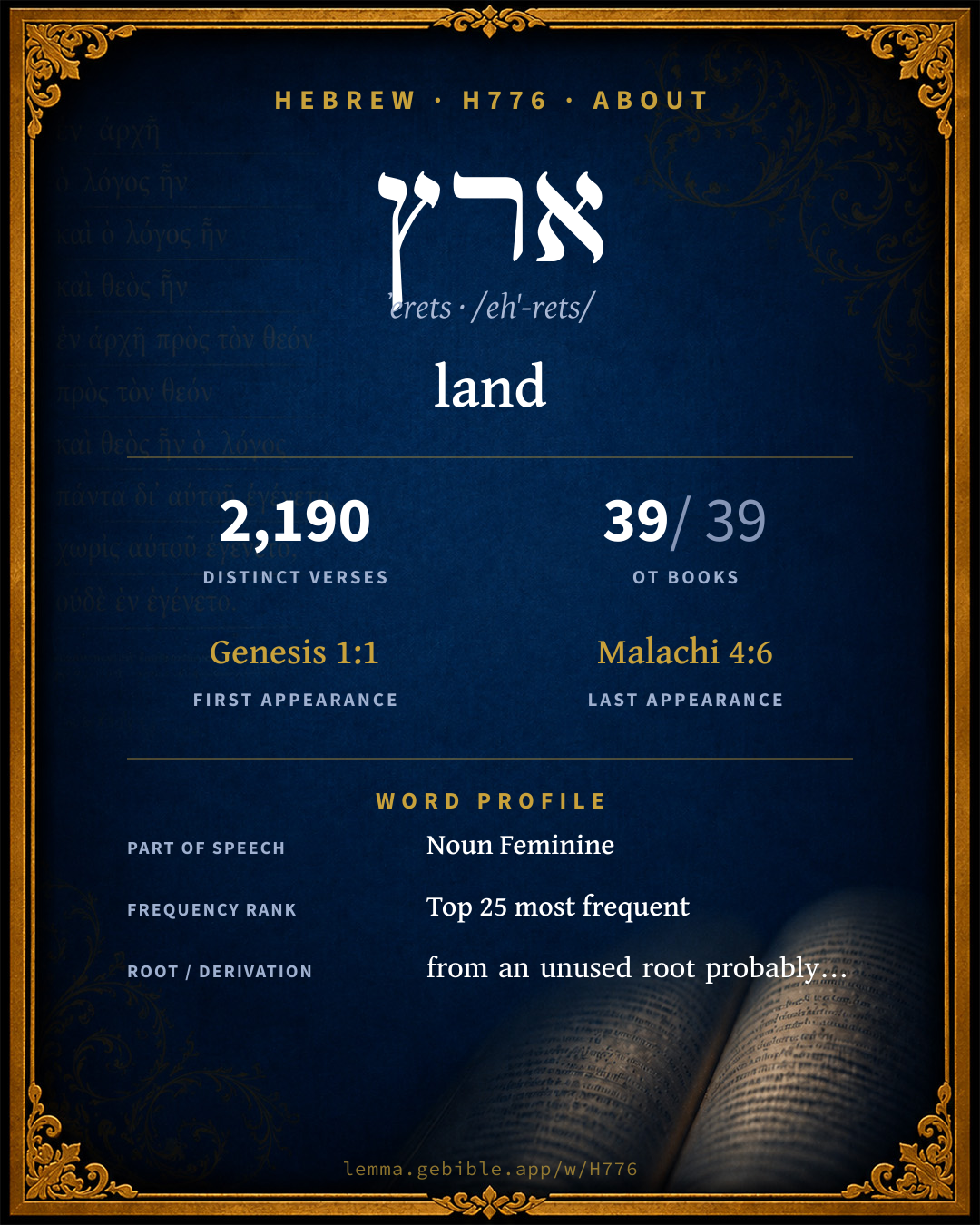
אֶ֫רֶץ
land
‘land’ is one of 4 main senses fuller range ↓
Full lexicon entry — Brown-Driver-Briggs (BDB)
From Brown-Driver-Briggs (BDB)
Where this word appears
See every Absolute-state word in the Hebrew Bible →
Grammar key — what these labels mean
Part of speech
- Noun
- A naming word — a person, place, thing, or idea.
Noun type
- Common
- A common noun — a general class of person, place, or thing (“king,” “city,” “water”), not a specific name.
State
- Absolute
- The independent form of a noun, not bound to a following word.
- Construct
- A noun bound to a following noun in a possessive / “of” relationship (the construct chain).
Gender
- Both
- Attested as both masculine and feminine.
Number
- Singular
- One.
- Plural
- More than one (in Hebrew, generally three or more).
Every verse where H776 appears in the Book of 1 Kings — 51 distinct verses. Click any verse to open its interlinear word-by-word view. Verse text shown in the World English Bible for context — . Each verse’s Hebrew form is shown with its reference; the English is not keyword-highlighted, since the data carries no word-level English alignment. Use “Compare translations” on any verse to read it across multiple English versions. This concordance covers the Hebrew Bible; Septuagint (Greek Old Testament) occurrences are not indexed here.
1 Kings
- 1 Kings 1:23 אָֽרְצָ/ה n c bs + sfx dem They told the king, saying, Behold, Nathan the prophet. When he was come in before the king, he bowed himself before the king with his face to the ground.
- 1 Kings 1:31 אֶ֔רֶץ n c bs Then Bathsheba bowed with her face to the earth, and did obeisance to the king, and said, Let my lord king David live forever.
- 1 Kings 1:40 הָ/אָ֖רֶץ ptcl def.art + n c bs All the people came up after him, and the people piped with pipes, and rejoiced with great joy, so that the earth shook with the sound of them.
- 1 Kings 1:52 אָ֑רְצָ/ה n c bs + sfx dem Solomon said, If he shall show himself a worthy man, there shall not a hair of him fall to the earth; but if wickedness be found in him, he shall die.
- 1 Kings 2:2 הָ/אָ֑רֶץ ptcl def.art + n c bs I am going the way of all the earth: be you strong therefore, and show yourself a man;
- 1 Kings 4:10 אֶ֥רֶץ n c bs cs Ben Hesed, in Arubboth (to him [pertained] Socoh, and all the land of Hepher);
- 1 Kings 4:19 בְּ/אֶ֣רֶץ אֶ֜רֶץ בָּ/אָֽרֶץ prep + n c bs cs n c bs cs prep det + n c bs Geber the son of Uri, in the land of Gilead, the country of Sihon king of the Amorites and of Og king of Bashan; and [he was] the only officer who was in the land.
- 1 Kings 4:21 אֶ֣רֶץ n c bs cs Solomon ruled over all the kingdoms from the River to the land of the Philistines, and to the border of Egypt: they brought tribute, and served Solomon all the days of his life.
- 1 Kings 4:34 הָ/אָ֔רֶץ ptcl def.art + n c bs There came of all peoples to hear the wisdom of Solomon, from all kings of the earth, who had heard of his wisdom.
- 1 Kings 6:1 מֵ/אֶֽרֶץ prep + n c bs cs It happened in the four hundred and eightieth year after the children of Israel were come out of the land of Egypt, in the fourth year of Solomon's reign over Israel, in the month Ziv, which is the second month, that he began to build the house of Yahweh.
- 1 Kings 8:9 מֵ/אֶ֥רֶץ prep + n c bs cs There was nothing in the ark save the two tables of stone which Moses put there at Horeb, when Yahweh made a covenant with the children of Israel, when they came out of the land of Egypt.
- 1 Kings 8:21 מֵ/אֶ֥רֶץ prep + n c bs cs There have I set a place for the ark, in which is the covenant of Yahweh, which he made with our fathers, when he brought them out of the land of Egypt.
- 1 Kings 8:23 הָ/אָ֖רֶץ ptcl def.art + n c bs and he said, Yahweh, the God of Israel, there is no God like you, in heaven above, or on earth beneath; who keep covenant and loving kindness with your servants, who walk before you with all their heart;
- 1 Kings 8:27 הָ/אָ֑רֶץ ptcl def.art + n c bs But will God in very deed dwell on the earth? behold, heaven and the heaven of heavens can't contain you; how much less this house that I have built!
- 1 Kings 8:36 אַרְצְ/ךָ֔ n c bs cs + sfx pers 2ms then hear in heaven, and forgive the sin of your servants, and of your people Israel, when you teach them the good way in which they should walk; and send rain on your land, which you have given to your people for an inheritance.
- 1 Kings 8:37 בָ/אָ֗רֶץ בְּ/אֶ֣רֶץ prep det + n c bs prep + n c bs cs If there be in the land famine, if there be pestilence, if there be blasting [or] mildew, locust [or] caterpillar; if their enemy besiege them in the land of their cities; whatever plague, whatever sickness there be;
- 1 Kings 8:41 מֵ/אֶ֥רֶץ prep + n c bs Moreover concerning the foreigner, who is not of your people Israel, when he shall come out of a far country for your name's sake
- 1 Kings 8:43 הָ/אָ֜רֶץ ptcl def.art + n c bs hear in heaven, your dwelling-place, and do according to all that the foreigner calls to you for; that all the peoples of the earth may know your name, to fear you, as does your people Israel, and that they may know that this house which I have built is called by my name.
- 1 Kings 8:46 אֶ֣רֶץ n c bs cs If they sin against you (for there is no man who doesn't sin), and you are angry with them, and deliver them to the enemy, so that they carry them away captive to the land of the enemy, far off or near;
- 1 Kings 8:47 בָּ/אָ֖רֶץ בְּ/אֶ֤רֶץ prep det + n c bs prep + n c bs cs yet if they shall repent themselves in the land where they are carried captive, and turn again, and make supplication to you in the land of those who carried them captive, saying, We have sinned, and have done perversely, we have dealt wickedly;
- 1 Kings 8:48 בְּ/אֶ֥רֶץ אַרְצָ/ם֙ prep + n c bs cs n c bs cs + sfx pers 3mp if they return to you with all their heart and with all their soul in the land of their enemies, who carried them captive, and pray to you toward their land, which you gave to their fathers, the city which you have chosen, and the house which I have built for your name:
- 1 Kings 8:53 הָ/אָ֑רֶץ ptcl def.art + n c bs For you did separate them from among all the peoples of the earth, to be your inheritance, as you spoke by Moses your servant, when you brought our fathers out of Egypt, Lord Yahweh.
- 1 Kings 8:60 הָ/אָ֔רֶץ ptcl def.art + n c bs that all the peoples of the earth may know that Yahweh, he is God; there is none else.
- 1 Kings 9:8 לָ/אָ֥רֶץ prep det + n c bs Though this house is so high, yet shall everyone who passes by it be astonished, and shall hiss; and they shall say, Why has Yahweh done thus to this land, and to this house?
- 1 Kings 9:9 מֵ/אֶ֣רֶץ prep + n c bs cs and they shall answer, Because they forsook Yahweh their God, who brought forth their fathers out of the land of Egypt, and laid hold on other gods, and worshiped them, and served them: therefore has Yahweh brought all this evil on them.
- 1 Kings 9:11 בְּ/אֶ֖רֶץ prep + n c bs cs (now Hiram the king of Tyre had furnished Solomon with cedar trees and fir trees, and with gold, according to all his desire), that then king Solomon gave Hiram twenty cities in the land of Galilee.
- 1 Kings 9:13 אֶ֣רֶץ n c bs cs He said, What cities are these which you have given me, my brother? He called them the land of Cabul to this day.
- 1 Kings 9:18 בָּ/אָֽרֶץ prep det + n c bs and Baalath, and Tamar in the wilderness, in the land,
- 1 Kings 9:19 אֶ֥רֶץ n c bs cs and all the store-cities that Solomon had, and the cities for his chariots, and the cities for his horsemen, and that which Solomon desired to build for his pleasure in Jerusalem, and in Lebanon, and in all the land of his dominion.
- 1 Kings 9:21 בָּ/אָ֔רֶץ prep det + n c bs their children who were left after them in the land, whom the children of Israel were not able utterly to destroy, of them did Solomon raise a levy of bondservants to this day.
- 1 Kings 9:26 בְּ/אֶ֥רֶץ prep + n c bs cs King Solomon made a navy of ships in Ezion Geber, which is beside Eloth, on the shore of the Red Sea, in the land of Edom.
- 1 Kings 10:6 בְּ/אַרְצִ֑/י prep + n c bs cs + sfx pers 1cs She said to the king, It was a true report that I heard in my own land of your acts, and of your wisdom.
- 1 Kings 10:13 לְ/אַרְצָ֖/הּ prep + n c bs cs + sfx pers 3fs King Solomon gave to the queen of Sheba all her desire, whatever she asked, besides that which Solomon gave her of his royal bounty. So she turned, and went to her own land, she and her servants.
- 1 Kings 10:15 הָ/אָֽרֶץ ptcl def.art + n c bs besides [that which] the traders [brought], and the traffic of the merchants, and of all the kings of the mixed people, and of the governors of the country.
- 1 Kings 10:23 הָ/אָ֑רֶץ ptcl def.art + n c bs So king Solomon exceeded all the kings of the earth in riches and in wisdom.
- 1 Kings 10:24 הָ/אָ֔רֶץ ptcl def.art + n c bs All the earth sought the presence of Solomon, to hear his wisdom, which God had put in his heart.
- 1 Kings 11:18 וְ/אֶ֖רֶץ conj + n c bs They arose out of Midian, and came to Paran; and they took men with them out of Paran, and they came to Egypt, to Pharaoh king of Egypt, who gave him a house, and appointed him food, and gave him land.
- 1 Kings 11:21 אַרְצִֽ/י n c bs cs + sfx pers 1cs When Hadad heard in Egypt that David slept with his fathers, and that Joab the captain of the host was dead, Hadad said to Pharaoh, Let me depart, that I may go to my own country.
- 1 Kings 11:22 אַרְצֶ֑/ךָ n c bs cs + sfx pers 2ms Then Pharaoh said to him, But what have you lacked with me, that behold, you seek to go to your own country? He answered, Nothing: however only let me depart.
- 1 Kings 12:28 מֵ/אֶ֥רֶץ prep + n c bs cs Whereupon the king took counsel, and made two calves of gold; and he said to them, It is too much for you to go up to Jerusalem: see your gods, Israel, which brought you up out of the land of Egypt.
- 1 Kings 14:24 בָ/אָ֑רֶץ prep det + n c bs and there were also sodomites in the land: they did according to all the abominations of the nations which Yahweh drove out before the children of Israel.
- 1 Kings 15:12 הָ/אָ֑רֶץ ptcl def.art + n c bs He put away the sodomites out of the land, and removed all the idols that his fathers had made.
- 1 Kings 15:20 אֶ֥רֶץ n c bs cs Ben Hadad listened to king Asa, and sent the captains of his armies against the cities of Israel, and struck Ijon, and Dan, and Abel Beth Maacah, and all Chinneroth, with all the land of Naphtali.
- 1 Kings 17:7 בָּ/אָֽרֶץ prep det + n c bs It happened after a while, that the brook dried up, because there was no rain in the land.
- 1 Kings 18:5 בָּ/אָ֨רֶץ֙ prep det + n c bs Ahab said to Obadiah, Go through the land, to all the springs of water, and to all the brooks: peradventure we may find grass and save the horses and mules alive, that we not lose all the animals.
- 1 Kings 18:6 הָ/אָ֖רֶץ ptcl def.art + n c bs So they divided the land between them to pass throughout it: Ahab went one way by himself, and Obadiah went another way by himself.
- 1 Kings 18:42 אַ֔רְצָ/ה n c bs + sfx dem So Ahab went up to eat and to drink. Elijah went up to the top of Carmel; and he bowed himself down on the earth, and put his face between his knees.
- 1 Kings 20:7 הָ/אָ֔רֶץ ptcl def.art + n c bs Then the king of Israel called all the elders of the land, and said, Please notice how this man seeks mischief: for he sent to me for my wives, and for my children, and for my silver, and for my gold; and I didn't deny him.
- 1 Kings 20:27 הָ/אָֽרֶץ ptcl def.art + n c bs The children of Israel were mustered, and were provisioned, and went against them: and the children of Israel encamped before them like two little flocks of kids; but the Syrians filled the country.
- 1 Kings 22:36 אַרְצֽ/וֹ n c bs cs + sfx pers 3ms There went a cry throughout the host about the going down of the sun, saying, Every man to his city, and every man to his country.
- 1 Kings 22:46 הָ/אָֽרֶץ ptcl def.art + n c bs The remnant of the sodomites, that remained in the days of his father Asa, he put away out of the land.
About this entry
At a glance — auto-summarized from this page’s data, not written by a person. Every figure links to its source below. This summary describes the numbers; it doesn’t interpret them.
At its core, ארץ (ʼerets) means “land.” Carrying more than one sense, it rewards its full sense range. Spanning 2,190 verses in 39 books, it ranks among the most common words of the Hebrew Bible. Scripture first uses it in Genesis 1:1. From the same root come ארע and ארצא. See the sense tree, 2,190-verse concordance, and the renderings breakdown below.
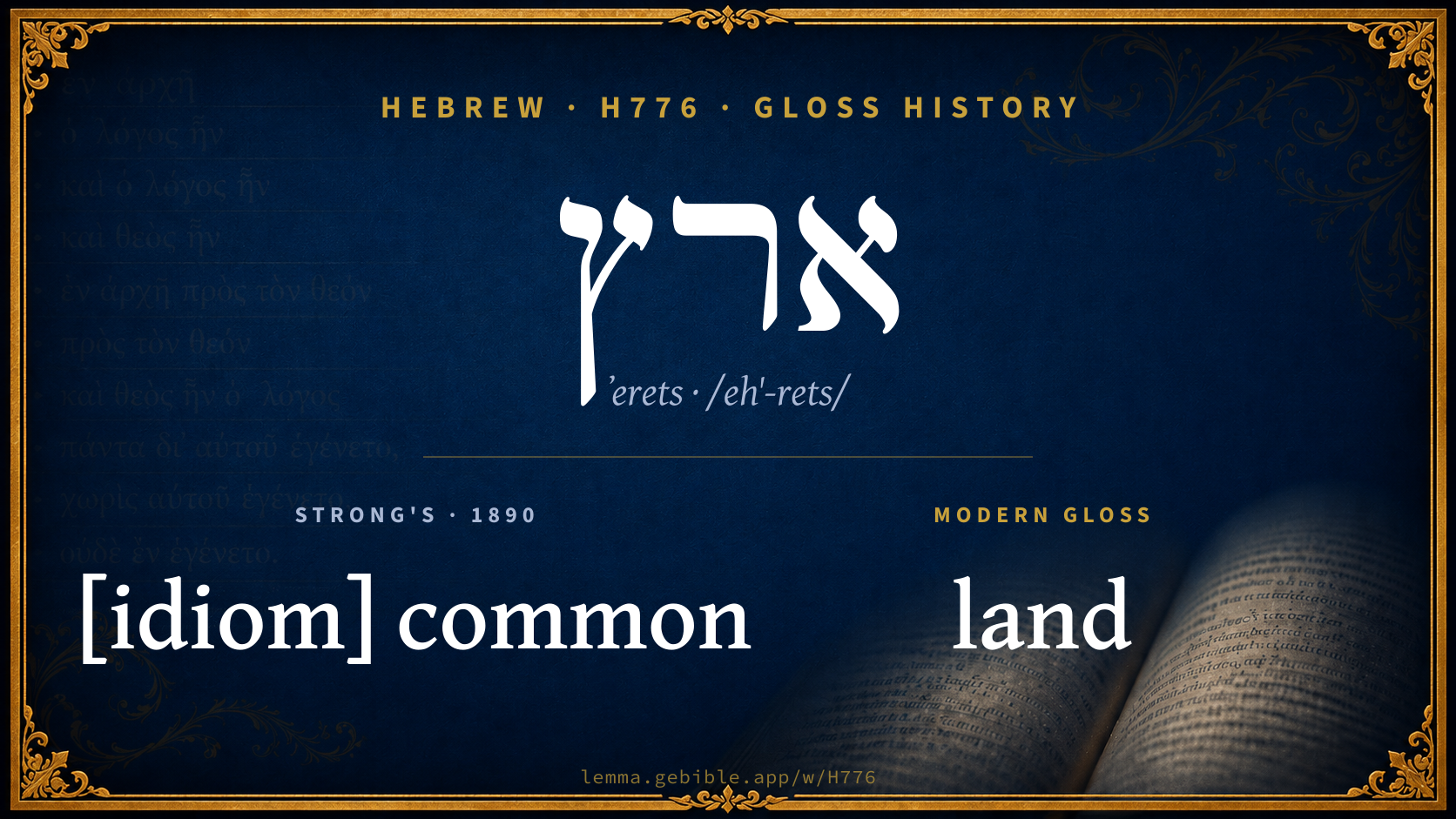
Gloss history
Strong's 1890 vs modern scholarship
About this word
Strong's H776 catalogs a Hebrew word from the Hebrew Old Testament.
These counts are not copied from any lexicon or concordance. They are computed here, from the morphology-tagged Hebrew Old Testament. What Lemma adds →
- 2,190
- distinct verses
- The word appears in 2,190 distinct verses.
- 39 / 39
- OT books
- The word appears in 39 of 39 Old Testament books.
- #17
- by frequency
- Top 25 most frequent Hebrew words (rank 17 of 8,640 Hebrew words by occurrence).
View all 2,190 occurrences in the concordance →
By section of the Old Testament
By traditional corpus
Conventional, traditional groupings — biblical authorship is debated, so this is a traditional corpus grouping, not an authorship claim. Each share is this word’s portion of its verses in that division of the Hebrew canon. Each figure is a share of the word’s 2,190 distinct verses.
- Prophets (Nevi'im) 1,038 verses · 47%
- Torah (Pentateuch) 705 verses · 32%
- Writings (Ketuvim) 447 verses · 20%
How translations render this word
Counts come from each version’s own published word-to-Strong’s tagging or interlinear alignment — an approximate guide to how each version renders this word, not a word-level alignment the data otherwise carries. Because each total is that version’s own tagged count, the per-version totals vary from one another and need not match the appearance or distinct-verse counts above. These counts may also differ from a printed concordance because Lemma counts each distinctly tagged rendering and does not collapse phrase taggings into a single head-word total. This is a fixed set of word-tagged versions (KJV, ASV, BSB, ULT) and does not change with the reading translation you choose elsewhere. Each version’s license is shown beside its name below (and on Sources).
- King James Version: Land 1,210×, Earth 543×, Ground 82×
- American Standard Version: Land 1,137×, Earth 505×, Ground 73×
- Berean Standard Bible: Land 1,415×, Earth 544×, Ground 117×
- unfoldingWord Literal Text: Land 994×, Earth 596×, Land of 491×
King James Version Public Domain
Renders H776 across 2,504 tagged occurrences — most commonly:
Plus other, less common renderings. Plus 180 renderings that appear only once — usually multi-word phrases or single function words the recovered tagging swept in, not distinct renderings.
American Standard Version Public Domain
Renders H776 across 2,502 tagged occurrences — most commonly:
Plus other, less common renderings. Plus 304 renderings that appear only once — usually multi-word phrases or single function words the recovered tagging swept in, not distinct renderings.
Berean Standard Bible Public Domain
Renders H776 across 2,375 tagged occurrences — most commonly:
Plus other, less common renderings. Plus 82 renderings that appear only once — usually multi-word phrases or single function words the recovered tagging swept in, not distinct renderings. Not rendered by a distinct English word in 108 further occurrences.
unfoldingWord Literal Text CC BY-SA 4.0
Renders H776 across 2,463 tagged occurrences — most commonly:
Plus other, less common renderings. Plus 60 renderings that appear only once — usually multi-word phrases or single function words the recovered tagging swept in, not distinct renderings.
18 senses and sub-senses in the full BDB
What do BDB’s symbols mean?
BDB uses these scholarly abbreviations:
| Symbol | Meaning |
|---|---|
| 𝔊 | the Septuagint (the ancient Greek translation, LXX) |
| 𝔙 | the Vulgate (the Latin translation) |
| 𝔖 | the Syriac version (the Peshitta) |
| 𝔗 | the Targum (the Aramaic translation) |
| ψ | the Psalms |
| √ | root (the underlying root or stem) |
| ‖ | parallel passage (a synonymous or contrasted parallel) |
| † | the dagger: every passage where the word occurs is cited |
The 18 senses and sub-senses the full Brown-Driver-Briggs lexicon distinguishes for this word, in lexicon order (not ranked by frequency), with BDB’s own verbatim wording and sub-sense lettering. Shown in Hebrew script with BDB’s own scholarly abbreviations. The condensed entry is in the Lexicon Entry tab. See also the Forms in the corpus table below.
- 1.
- a. earth, whole earth (opp. to a part) Gn 18:18, 25; 22:18 (= הָאֲדָמָה 12:3) Je 25:26, 29, 30; 26:6 Is 37:16, 20 = 2 K 19:15, 19 Zc 4:10, 14 +. e.g. Genesis 18:18
- b. earth, opp. to heaven, sky Gn 1:2 Ex 20:4 Dt 5:8; 30:19 Ju 5:4 La 2:1 Is 37:16 = 2 K 19:15 ψ 146:6 1 Ch 21:16; 29:11 2 Ch 2:11 +; as permanent Ec 1:4; built on foundations, or pillars 1 S 2:8 ψ 104:5 Jb 38:4 Is 48:13; 51:13, 16 cf. also Is 24:18 ψ 82:5; firm, so that its shaking is something terrible, & token of terrible power 1 S 14:5 2 S 22:8 = ψ 18:8 Jb 9:6 cf. ψ 46:3 & v 7; so also Am 8:8 Is 2:19, 21; 24:18, 19, 20 ψ 60:4; 77:19; 99:1; 114:7; as hung on nothing Jb 26:7; with waters under it Ex 20:4 = Dt 5:8 cf. Gn 7:11; personified, especially as addressed, called to witness, etc. Dt 32:1 Je 6:19; 22:29 Is 1:2 Mi 1:2 Jb 16:18. e.g. Genesis 1:2
- c. earth = inhabitants of earth Gn 6:11; 11:1 1 K 2:2; 10:24 ψ 33:8; 66:4 + cf. תֵּבֵל א׳ Pr 8:31 Jb 37:12. e.g. Genesis 6:11
- 2. land =
- a. country, territory, א׳ שִׁנְעָר Gn 10:10, א׳ מִצְרַיִם 21:21; cf. also 10:11; 11:28, 31; 13:10; 47:6, 27; 50:8 Is 7:18; 23:1, 13; 27:13 ψ 78:12 Je 25:20 1 Ch 1:43; personif. Is 62:4 Ec 10:16, 17. e.g. Genesis 10:10
- b. district, region Gn 19:28; 22:2 Jos 11:3 ψ 42:7. e.g. Genesis 19:28
- c. tribal territory Dt 34:2 Ju 21:21 1 S 9:4, 16; 13:7 1 K 15:20 Is 8:23; and still smaller territories 1 S 9:4, 5. e.g. Deuteronomy 34:2
- d. piece of ground Gn 23:15. e.g. Genesis 23:15
- e. specif. land of Canaan, or Israel Gn 11:31; 12:1, 5, 6, 7; 31:3 Lv 14:34 Dt 17:14; 18:9 2 K 5:2, 4 +; especially obj. of יָרַשׁ possess Dt 3:20 + often Dt ψ al.; so after נָחַל Jos 19:49 +; נָתַן Dt 1:21 +. f. = inhabitants of land Lv 19:29 Ez 14:13 + cf. Dt 24:4 Zc 12:12 etc. g. used even of Sheʾôl Jb 10:21, 22 (cf. Assyrian irṣit la târat, land without return, in Descent of Ishtar, v. Jr 10.65); v. also ψ 139:15 Is 44:23. e.g. Genesis 11:31
- 3.
- a. ground, surface of ground = אֲדָמָה q.v. Gn 1:26, 30; 18:2; 33:3; 38:9 Ex 4:3; 16:14 Ru 2:10 1 S 5:4 + very often in S. e.g. Genesis 1:26
- b. soil, as productive = אֲדָמָה Gn 1:11, 12 Lv 19:9; 25:19; 26:4 cf. Nu 14:7, 8 Is 36:17 = 2 K 18:32 ψ 72:6, 16; 107:34, 35 Ezr 9:12 Ne 9:35. e.g. Genesis 1:11
- 4. אֶרֶץ in phrases:
- a. people of the land עַם־הָא׳ of non-Israelites Gn 23:7, 12, 13 (P) Nu 14:9 (JE); as well as Isr. Lv 20:4 (H) 2 K 15:5; 16:15; 21:24(×2); especially common people, opp. officials, princes Lv 4:27 (P) Ez 7:27 2 K 11:18, 19. e.g. Genesis 23:7
- b. in measurements of distance, כִּבְרַת הָא׳ the space or distance of country (v. כּברה) Gn 35:16, so כִּבְרַת א׳ some distance Gn 48:7 2 K 5:19. e.g. Genesis 35:16
- c. אֶרֶץ הַמִּישׁוֹר the country of the plain, level or plain country Dt 4:33 Je 48:21; א׳ מִישׁוֹר fig. ψ 143:10 (but read אֹרַח 𝔖 Bi Gr Che, cf. ψ 27:11). e.g. Deuteronomy 4:33
- d. א׳חַיִּים land of the living ψ 27:13; א׳ הַחַיִּים ψ 142:6 +. e.g. Psalms 27:13
- e. קְצֵה הָא׳ end(s) of the earth Is 42:10; 43:6 (‖ רָחוֹק) ψ 135:7 Pr 17:24, so אַפְסֵי א׳ Pr 30:4 +; קְצוֹת הָא׳ Is 40:28; 41:5, 9. e.g. Isaiah 42:10
- 5. pl. אֲרָצוֹת is almost wholly late, Je 16:15 + 6 times Je; 23 times Ez; Is 36:20; 37:11 = 2 K 18:35; 19:11 (Is 37:18 read הַגּוֹיִם v. Che Di & cf. 2 K 19:17); 22 times Chr; Dn 9:7; 11:40, 42; ψ 105:44; 106:27; 107:3; 116:9; besides these only P Gn 10:5, 20, 31 Lv 26:36, 39, except Gn 26:3, 4 (JR) 41:54 (JE); it denotes lands, countries, often in contrast to Canaan, lands of the nations, etc., v. especially abs. Ez 20:32; 22:4; = the various petty divisions of Canaan afterward united under Israel’s control Gn 26:3, 4, cf. 1 Ch 13:2 אַרְצוֹת יִשְׂרָאֵל, 2 Ch 11:23 אַרְצוֹת יְהוּדָה. e.g. Jeremiah 16:15
Senses from the full Brown-Driver-Briggs lexicon (Brown, Driver, Briggs; Oxford 1906 — public domain), digitized via Sefaria, supplemented by the OpenScriptures HebrewLexicon (CC BY 4.0). Full attribution on Sources.
Word origin
n.f. Gn 10:11 & (seld.) m. Ez 21:24 earth, land (Ph. MI ארץ, Assyrian irṣitu COTGloss, Arabic أَرْضٌ, Sab. ארץֿ e.g. Os 9 DHMZMG 1875, 594, 614; Sem. Sprachf. 12, cf. PräBAS i. 374 n., Aramaic אֲרַע, ܐܰܪܥܳܐ )—א׳ abs. Gn 1:24 +; cstr. 2:11 +; אָ֑רֶץ 1:10 +; c. art. always הָאָ֫רֶץ 1:11 +; c. ה—ָloc. אַ֫רְצָה 11:31 +, (poet. = אָרֶץ Jb 34:13; cf. 1 S 25:23 1 K 1:31); sf. אַרְצִי 20:15 + אַרְצְךָ (אַרְצֶ֑ךָ) 12:1 +, etc.; pl. אֲרָצוֹת Je 28:8 + 65 times; cstr. אַרְצוֹת Ez 39:27 + 6 times; sf. אַרְצֹתָם Gn 10:5 + 2 times;—
— Brown-Driver-Briggs (Oxford 1906, public domain), digitized via Sefaria, supplemented by the OpenScriptures HebrewLexicon (CC BY 4.0). See Sources.
Origin: from an unused root probably meaning to be firm
Jastrow Dictionary
A second Hebrew/Aramaic lexicon for comparison, covering Aramaic and post-biblical (Talmudic, Targumic, Midrashic) usage that the biblical-Hebrew BDB does not. Matched by lemma rather than by Strong’s number, so a lemma may carry more than one Jastrow headword (shown separately below), and the entries cover usage well beyond the Bible.
אֶרֶץ
- רצץ; Ch. a. oth. dial. ארע fr. רעע to press together, stamp—from the rugged appearance of the surface after the subsidence of the waters) earth, dry land; country, land, field (opp. to town). Ex. R. s. 13 … threw dust upon the waters ונעשה א׳ and earth (crust) was formed.—א׳ ישראל (abbr. א"י) Palestine, opp. חוצה לָאָ׳, or מדינת הים foreign countries, or distant countries. Gitt. I, 2. Ib. 6ᵃ; a. fr.—הָאָרֶץ Palestine, Ḥull. 16ᵇ משנכנסו לא׳ since entering Palestine (under Joshua); a. fr.—עם הָאָ׳ (abbr. ע"ה) country people, hence illiterate, coarse, unrefined (often applied to an individual); pl. עַמֵּי הא׳, opp. תלמיד חכם. Sabb. 63ᵃ. Ḥull. 92ᵃ; a. v. fr.—Esp. ע"ה those not observing certain religious customs regarding tithes, levitical cleanness &c., opp. חָבֵר q. v. Dem. I, 2; a. fr.—Pl. אֲרָצוֹת. Shebi. IX, 2 שלש א׳ וכ׳ Palestine is divided into three countries with reference to the laws of the Sabbath year. Keth. 111ᵃ; a. e., v. עִיסָה; a. fr.
A Dictionary of the Targumim, the Talmud Babli and Yerushalmi, and the Midrashic Literature (Marcus Jastrow; London, Luzac, 1903) — Public Domain. Digitized via Sefaria. Digitized via Sefaria. Full attribution on Sources.
Forms in the corpus
The 297 distinct written forms H776 takes in the Hebrew Bible, most frequent first — each parse links to that state’s occurrences in the concordance. Hebrew forms include their vowel points and cantillation, so a single lemma takes many written forms.
The 60 most common forms are shown; 237 rarer forms follow in the full concordance.
Same root — word family
Other BDB entries built from the same root as H776, grouped by Strong’s listed origin. These share a root / origin per the lexicon — not necessarily a shared meaning. Each links to that word’s own entry.
Derived from this word
Proper names from this root
People and places named from this root — a name, not an additional meaning of the word.
Compare all same-root words → 1 of the same-root words is a proper name (a person or place). They share a root, not necessarily a meaning.
Septuagint verse parallels
This word appears in 2,063 verses that also exist in the Greek Old Testament (Septuagint), out of the 2,190 Hebrew verses it occurs in. You can read those verses in Greek by switching the Old Testament edition to the Septuagint.
Read these verses in the Septuagint
- Genesis 1:1
- Exodus 1:7
- Leviticus 4:27
- Numbers 1:1
- Deuteronomy 1:5
- Joshua 1:2
- Judges 1:2
- Ruth 1:1
- 1 Samuel 2:8
- 2 Samuel 1:2
- 1 Kings 1:23
- 2 Kings 2:15
This is a verse-level parallel only — the same verses exist in both the Hebrew and Greek Old Testaments. No word-level Hebrew↔Greek correspondence is claimed: the data carries no such alignment, so no Greek word is shown as this Hebrew word’s translation. Coverage is not total — the Septuagint omits the deuterocanon and renumbers the Psalms, so some Hebrew verses have no direct Greek parallel.