

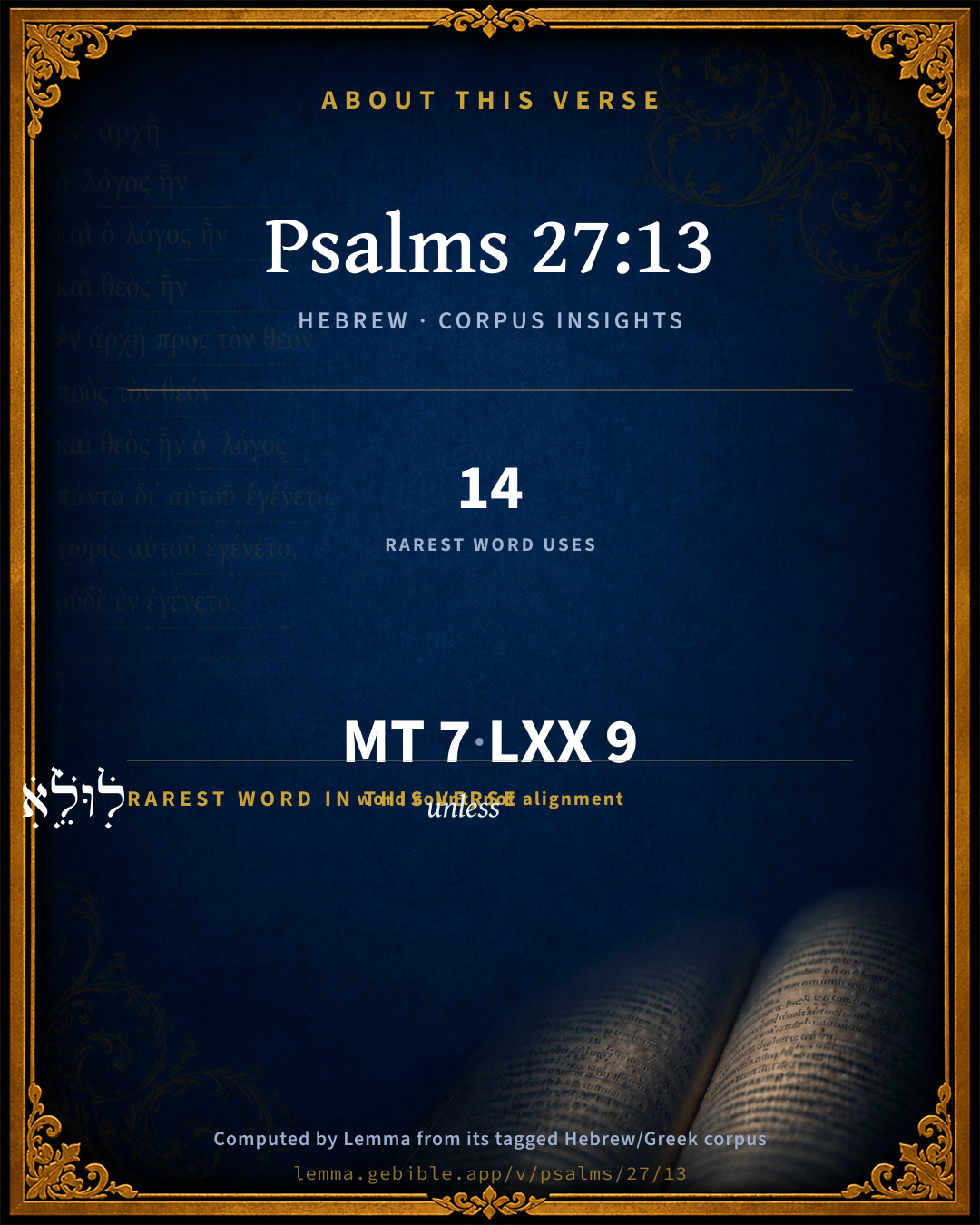
Psalms 27:13

Hebrew (Westminster Leningrad Codex) Psalms 27:13 appears in the Hebrew Old Testament. The text above is from the Westminster Leningrad Codex. Each word links to its Strong’s number, a concise gloss, and parsing drawn from the Open Scriptures Hebrew Bible morphology. Click any word for its full Brown-Driver-Briggs (BDB) entry.
Download image
Cite this verse

Psalms 27:13 (World English Bible). Public Domain. Lemma interlinear Bible study tool, https://lemma.gebible.app/v/psalms/27/13.

Show BibTeX & RIS
BibTeX
RIS
English Translation
I am still confident of this: I will see the goodness of Yahweh in the land of the living.
World English Bible · Public Domain
Download a study sheet

One document with this verse’s original text, its word-by-word gloss line, the meaning frame, cross-references with their text, attributed commentary, and full source and license credits — printable, and it pastes into notes with its structure intact.

This verse Autodidact and up

Study sheet (.html) Plain text (.txt)

A passage Seminary Student

Up to 50 verses in one chapter. A passage sheet keeps up to 6 commentary sources and 12 cross-references per verse, in the order this page ranks them, and says so on the sheet whenever that leaves anything out. Ask for a single verse and you get the Autodidact verse sheet above.

Everything on this page stays free to read, with no account — the sheet is a download of what is already on screen, not access to it.

Want to remove ads? Support Godless Engineer
Compare translations 3

The same verse in 3 English versions, stacked beneath the original-language interlinear above. Click any original word for its lexicon entry.

Each is an independent rendering of the whole verse — the interlinear is not word-aligned to these translations.

Highlighted words mark where these versions differ — a whole-verse word diff, not a word-by-word alignment.

  • World English Bible Public Domain
    I am still confident of this: I will see the goodness of Yahweh in the land of the living.
  • King James Version Public Domain
    I had fainted, unless I had believed to see the goodness of the LORD in the land of the living.
  • unfoldingWord Literal Text CC BY-SA 4.0
    Unless I had believed that I would look on the goodness of Yahweh in the land of the living.

unfoldingWord Literal Text — © unfoldingWord, licensed CC BY-SA 4.0. Word-aligned USFM3 via Door43 (git.door43.org/unfoldingWord/en_ult).

Versions to compare (up to 4)

3 of 4 selected

Show all 18 translations

Every available English version of this verse, each an independent rendering of the whole verse.

  • World English Bible Public Domain
    I am still confident of this: I will see the goodness of Yahweh in the land of the living.
  • Berean Standard Bible Public Domain
    Still I am certain to see the goodness of the LORD in the land of the living.
  • Majority Standard Bible Public Domain
    Still I am certain to see the goodness of the LORD in the land of the living.
  • King James Version Public Domain
    I had fainted, unless I had believed to see the goodness of the LORD in the land of the living.
  • American Standard Version (1901) Public Domain
    `I had fainted', unless I had believed to see the goodness of Jehovah In the land of the living.
  • Revised Version (1885) Public Domain
    I had fainted, unless I had believed to see the goodness of the LORD in the land of the living.
  • Geneva Bible (1599) Public Domain
    I should haue fainted, except I had beleeued to see the goodnes of the Lord in the land of the liuing.
  • Douay-Rheims (1899) Public Domain
    I believe to see the good things of the Lord in the land of the living.
  • Young's Literal Translation Public Domain
    I had not believed to look on the goodness of Jehovah In the land of the living!
  • Literal Standard Version CC BY-SA 4.0
    I had not believed to look on the goodness of YHWH || In the land of the living!
  • Unlocked Literal Bible CC BY-SA 4.0
    What would have happened to me if I had not believed that I would see the goodness of Yahweh in the land of the living?
  • unfoldingWord Literal Text CC BY-SA 4.0
    Unless I had believed that I would look on the goodness of Yahweh in the land of the living.
  • Darby Bible Public Domain
    Unless I had believed to see the goodness of Jehovah in the land of the living...!
  • World Messianic Bible Public Domain
    I am still confident of this: I will see the goodness of the LORD in the land of the living.
  • Webster's Bible Public Domain
    I had fainted, unless I had believed to see the goodness of the LORD in the land of the living.
  • Free Bible Version CC BY-SA 4.0
    However, I'm absolutely sure that I will see the Lord's goodness even in this life.
  • Bible in Basic English Public Domain
    I had almost given up my hope of seeing the blessing of the Lord in the land of the living.
  • JPS Tanakh (1917) Public Domain
    If I had not believed to look upon the goodness of the LORD in the land of the living! —

Literal Standard Version (2020), Covenant Press — licensed CC BY-SA 4.0. Text via the HelloAO Bible API (eBible.org). Unlocked Literal Bible (unfoldingWord) — licensed CC BY-SA 4.0. Text via the HelloAO Bible API (eBible.org). unfoldingWord Literal Text — © unfoldingWord, licensed CC BY-SA 4.0. Word-aligned USFM3 via Door43 (git.door43.org/unfoldingWord/en_ult). Free Bible Version, Dr. Jonathan Gallagher — licensed CC BY-SA 4.0. Text via the HelloAO Bible API (eBible.org).

Word by word

More ways to search: Search by grammar → Find every occurrence → Compare this word →

Practice this passage: Drill this verse → Learn its vocabulary →

About this verse

These counts appear in no published source. They are computed here, from the morphology-tagged text and Lemma’s own curated glosses. What Lemma adds →

7
words
7
distinct lemmas
Wisdom
section

Notable vocabulary

The rarest word here is לׅׄוּלֵׅׄ֗אׅׄ unless H3884 — appearing just 14 times in the whole Hebrew Bible.

Shared distinctive vocabulary

לׅׄוּלֵׅׄ֗אׅׄ unless H3884 occurs in 14 verses of the Hebrew Bible. Also found in:

Grammatical profile

  • 2 verbs
  • 3 nouns
  • 1 adjective
  • 1 conjunction

Verb forms

  • הֶ֭אֱמַנְתִּי Hiphil · Perfect
  • לִרְא֥וֹת Qal · Infinitive Construct

Hebrew & Septuagint length

In English translation the verse runs 19 words from the Hebrew and 17 from the Septuagint (LXX English) — closely comparable.

A rough comparison of the two English renderings, which tokenize alike — not a word-level alignment.

Word counts can differ between the Hebrew and the Greek without any difference in meaning — e.g. the Hebrew direct-object marker אֵת has no separate Greek word, and Greek often adds the article ὁ.

In the original languages it is 7 Hebrew tokens and 9 Greek tokens — but the two are counted differently (Hebrew bundles its prefixes and suffixes into one token; the Greek is in lemma form), so that isn’t a like-for-like length.

Cross-references

17

Topical passages linked to Psalms 27:13 in the Treasury of Scripture Knowledge — connected by theme and wording, ordered by reader-vote popularity; previews shown in the World English Bible.

  • 2 Corinthians 4:16 Therefore we don't faint, but though our outward man is decaying, yet our inward man is renewed day by day.
  • Psalms 142:5 I cried to you, Yahweh. I said, "You are my refuge, My portion in the land of the living."
  • Psalms 56:3 When I am afraid, I will put my trust in you.
  • 2 Corinthians 4:8–14 We are pressed on every side, yet not crushed; perplexed, yet not to despair;
  • Psalms 31:19 Oh how great is your goodness, Which you have laid up for those who fear you, Which you have worked for those who take refuge in you, Before the sons of men!
  • Psalms 56:13 For you have delivered my soul from death, And prevented my feet from falling, That I may walk before God in the light of the living.
  • Psalms 42:5 Why are you in despair, my soul? Why are you disturbed within me? Hope in God! For I shall still praise him for the saving help of his presence.
  • Psalms 116:9–11 I will walk before Yahweh in the land of the living.
  • Job 28:13 Man doesn't know its price; Neither is it found in the land of the living.
  • 2 Corinthians 4:1 Therefore seeing we have this ministry, even as we obtained mercy, we don't faint.
  • Ephesians 2:8 for by grace you have been saved through faith, and that not of yourselves; it is the gift of God,
  • Jeremiah 11:19 But I was like a gentle lamb that is led to the slaughter; and I didn't know that they had devised devices against me, [saying], Let us destroy the tree with the fruit of it, and let us cut him off from the land of the living, that his name may be no more remembered.
  • Isaiah 38:19 The living, the living, he shall praise you, as I do this day: The father to the children shall make known your truth.
  • Ezekiel 26:20 then will I bring you down with those who descend into the pit, to the people of old time, and will make you to dwell in the lower parts of the earth, in the places that are desolate of old, with those who go down to the pit, that you be not inhabited; and I will set glory in the land of the living:
  • Job 33:30 To bring back his soul from the pit, That he may be enlightened with the light of the living.
  • Isaiah 38:11 I said, I shall not see Yah, Yah in the land of the living: I shall see man no more with the inhabitants of the world.
  • Psalms 52:5 God will likewise destroy you forever. He will take you up, and pluck you out of your tent, And root you out of the land of the living. Selah.

Cross-references courtesy of OpenBible.info (CC BY 4.0).

Hebrew and Greek witnesses Masoretic Hebrew ↔ Greek Septuagint

The same verse in the two great witnesses to the Old Testament, shown verse-for-verse.

You’re reading Greek Psalm 26 (Hebrew Psalm 27). The Septuagint counts the superscription, so verse numbers can differ from the Hebrew — chapter-level alignment, not verse-by-verse. Numbering follows Rahlfs.

These are two independent witnesses, not word-aligned to each other, and the Septuagint is shown in lemma (dictionary) form.

Hebrew Psalms 27:13 Masoretic · Westminster Leningrad Codex

לׅׄוּלֵׅׄ֗אׅׄ הֶ֭אֱמַנְתִּי לִרְא֥וֹת בְּֽטוּב יְהוָ֗ה בְּאֶ֣רֶץ חַיִּֽים

I am still confident of this: I will see the goodness of Yahweh in the land of the living.

World English Bible · Public Domain

Greek LXX Greek Psalm 26:13 Septuagint · lemma form

πιστεύω ὁ ὁράω ὁ ἀγαθός κύριος ἐν γῆ ζάω

I believe that I shall see the goodness of the Lord in the land of the living.

LXX2012 (modern English Septuagint) · Public Domain

On this verse, Keil & Delitzsch discusses the Septuagint’s reading. Read the note in Commentary ↓

Hebrew: Westminster Leningrad Codex (CC BY 4.0). Greek: Septuagint (public domain); English from LXX2012 (modern English Septuagint) (Public Domain). How the Septuagint differs from the Hebrew →

Commentary

Notes on Psalms 27:13 from classic Christian and Jewish commentators (each source and its license shown beneath its notes). The classic Christian expositions comment on the surrounding passage and are grouped to its opening verse, so a note may address several verses; the Jewish commentaries on the Tanakh (Rashi and others) are per-verse, so they appear only where the commentator wrote on this verse.

Lemma curates 59 commentaries, every one of them public domain or Creative Commons licensed, each selected and text-cleaned for this edition rather than reprinted as found. About our sources →

Trapp's Complete Commentary

John Trapp

Psa 27:13 [I had fainted], unless I had believed to see the goodness of the LORD in the land of the living.

Ver. 13. I had fainted, unless I had believed] Saved he was then by his faith, which drank to him as it were in a cup of Nepenthes, and fetched him again when ready to swoon and sink. See Psa 119:92. The word rendered unless here is (as the Masorites note) one of the fifteen Scripture words, that were extraordinarily pointed by the men of the great synagogue ( Lule habet puncta supra and infra). {Hebrew Text Note} The reason whereof given by Kimchi and others (as if David doubted of his salvation) is not satisfactory nor sound.

To see the goodness of the Lord] That is, to taste; one sense usually put for another; the soul also hath her senses; and these must be habitually exercised to discern good and evil, Heb 5:14.

In the land of the living] That is, here on earth, Psa 116:9 Isa 38:11, where men live; and I myself have not only a portion of life with them, but a promise of many good things besides. To blame, therefore, was good David, when he said in his haste, All men are liars, prophets, and all who had promised him the kingdom, Psa 116:10. But the best have their passions; which they daily outgrow, and add to their faith patience, 2Pe 1:5-6. And albeit as Calvin here noteth, every one’s case is not like David’s, who had particular promises concerning this life, beyond many other faithful persons; yet, because according to every man’s faith it shall be unto him, let us all likewise trust in God, as we are all hereupon exhorted in the next words.

John Trapp, A Commentary or Exposition upon All the Books of the Old and New Testament (1647–1656) — public domain. Text from a community e-Sword module.

The Biblical Illustrator

Joseph S. Exell

Psa_27:13

I had fainted unless I had believed to see the goodness of the Lord in the land of the living.

The goodness of God in the land of the living

The words I had fainted are not in the original. The sentence is a broken one, such as one utters under strong emotion, suggesting possibilities, but leaving the hearer or reader to supply them for himself. O had I not believed to see the goodness of Jehovah in the land of the living--and then he breaks off, and we are left to imagine what dreadful thing would have happened.

I. Gods goodness is often a matter of faith rather than of sight. A good purpose of His often takes time to ripen. Sometimes it is long before it even appears above ground. Meanwhile there is the bleak, dreary field. In Nature we know what to expect, so that the harvest is hardly a matter of faith. Still, our Lord teaches that the attitude of the farmer, while he waits for the harvest, should be that of His disciples in regard to the Kingdom of God. Faith in God implies faith in good. The word God is good. God is not God except He be good. But it is easier to believe this as an abstract fact than in its practical applications; for there are times when we cannot see the goodness of the Lord.

II. we faint because we do not see it. This brought out more strongly by the added words, in the land of the living. It is here where we want to see it, here in this scene of strife, rebellion, cruelty, extortion, and all manner of evil. We are not troubled about Gods goodness in the next world. The believer takes it for granted, indeed, that there every cloud will be dispelled and every hard question settled. It is Gods goodness in the land of the living which sometimes puzzles him. It might be comparatively easy, as I have said, to frame an abstract conception of a perfect being, and to write under it Supremely Good, but goodness is not an abstract thing. Goodness takes shape and consistency only by contact with objects. As a mere abstract quality it has no practical significance. You may as well affirm it of a statue. It has meaning only as it is exercised. But if God be infinitely good, how can sin and evil be? This is the knotty point. Neither the Epicurean, by getting rid of God in human life; nor the Deist, nor the Pantheist, give any real help. Given the existence of a personal God, and the existence and work of evil is not an easy matter to resolve. The question is summed up in a passage of that favourite book of our childhood, Robinson Crusoe, where the poor heathen Friday asks in all simplicity why God, being all-powerful, did not kill the devil. Many of us have asked the same question. And yet the fact of such goodness visible in the world and in human life is assumed by the psalmist. He has faith in it. He believed to see it in the land of the living. Can we see as much?

1. God does not throw us entirely upon testimony as to this, for His goodness can be seen, both here and now. However hard we may find it to reconcile this fact with other facts, it is true that the world and human life furnish multiplied evidences of Gods goodness which appeal to the ordinary sense. The provisions of Nature are illustrations of this. It was something more than mere ingenious artifice which made the bread-fruit grow in the tropics and not in the northern latitudes. Similarly this goodness is seen in a thousand things in the social and domestic life of men. There is the setting of the solitary in families, and the blessed ties which unite husband and wife and parent and child. There are these things and many more like them. And each one of us if we had our sorrows, we have had our joys. Life has brought blows, but it has also brought balsams: calamities, but also mitigations. Labour has been offset with rest; tears with smiles. No life has been utterly bleak and barren. And for many of the worst of our calamities we have had only ourselves to blame. They have come through our refusing the goodness of God. Now all these appeal to our senses, and God would have us reason from the seen to the unseen, from that we can comprehend to that which we cannot. If we look at the state of society alone and affirm the evidence of a beneficent will, we must often confess what seems as if the contrary were true.

2. But we must hold to what we know of Gods goodness and trust where we cannot know. The popular proverb says, Seeing is believing; but the Scripture reverses that proverb; believing is seeing. We shall faint if we do not believe. Because there is an earthquake shall I cease to believe in gravitation? I remember a land-locked bay, which, from some peculiarity or other, the tide used to leave two-thirds bare when it ebbed. It was one of the loveliest spots I ever saw at high water, but one of the most ghastly when the tide was out. I might stand by the shore and look out over the dismal expanse of mud, and say, The place is ruined: it never will be beautiful any more. I look down into the stagnant pools, and they are glassy and motionless under the hot sun, and I say, The tide is gone, the joy and life of the ocean come hither no more. Fool that I am. Out yonder in the ocean depths, even while I mourn, the sea is rallying, and gathering itself up to move upon the land. By and by the stagnant pools will begin to stir, and the little eddies to whirl, and pool to reach over to pool and to run into one, until soon the bay will be brimming again, and the mud-banks hidden and the fresh, living tide enfolding the rocks. There are periods of slack-water in the history of individuals, of churches, and of nations; periods of mud and stagnation; days and years without a ripple. And when the ripple begins to come, and the stagnation begins to be stirred, that which is the presage of better things often makes the prospect look uglier than before. It takes-strong souls to go through such periods; believing souls, which have settled faith in the laws of Gods tides, and which believe in the force when they do not see the ripple or the wave. Breaking-up is a not uncommon fact in the lives of good men and women. Occasionally they are thrown out of their tight, comfortable ships, and see the strips go to pieces, and have to cling to fragments or make rafts. It is hard to see goodness in such wreck as that; and yet when a ship goes down at sea, the man who has a life-preserver or a timber thinks himself happy. The question is whether we can bring ourselves to think that God is good when He transfers us from the ship to the timber: whether we can stretch the word goodness to cover timbers and rafts, and life-preservers as well as ships. If we have taken it for granted that Gods goodness means only a sound ship and a voyage compassed the whole way with its protections and comforts, then the wreck and the raft will come to us as terrible surprises. If, on the other hand, we believe in the fact of the goodness of the Lord, any way, ship or raft, storm or sunshine, sailing into port or washed ashore, we shall be strong-hearted and hopeful on the raft no less than on the ship. Only it is well that we take care how we build our ship to begin with. If it is to go to pieces, it is well that the pieces be strong; well that we provide something that will float when the wreck breaks up. If a mans life is put together with selfishness, greed, pride, vanity, he stands a poor chance when the structure is broken up. If he puts out to sea with only his money or his cunning or his social repute or his political or professional or business-standing under him, he will find that such timbers will not float him. They will break with the breaking of the ship. But faith, hope and love are buoyant. If a man has in his ship this triple plank of faith, nothing can send him to the bottom. Lifes currents will bear him to land alive. (M. R. Vincent, D. D.)

A sure cure for pessimism

I. faith expects to see enrapturing visions.

1. What? The goodness of the Lord. The forces of God are adequate to overcome the forces of evil. The eternal right must prosper. God will do more than hold His own. No good reason is there to be hopeless about a world that has God in it and over 2:2. Where? In the land of the living. That the goodness of the Lord will be seen in the land of the dead no one doubts; what we sometimes forget is that we are to look for increasing revelations of His goodness in the present. Godliness hath the promise of the life that now is. The meek shall inherit the earth. Surely goodness and mercy shall follow me all the days of my life.

II. faith awakens fortitude. It gives strength of heart and hope; inspires courage; lights the eye; nerves the impotent arm; plucks victory from defeat.

III. faith leads to fidelity. Those who are full of faith are characterized by faithfulness; they can be depended upon to do their duty, for they have an abiding principle of obedience within their hearts. So long as we are in the world we must needs battle against adverse circumstances, but let us see to it that over against every evil we put the Heaven-provided antidote; that over against worldly trouble we put Divine comfort; that over against painful discipline we put the Divine purpose; that over against the worlds sin we put the worlds Saviour. (J. M. Campbell.)

Pessimism, an untenable theory of the Universe

Yet, though the creed of despair it throws its dark shadow over thousands both in Germany and England. It argues thus:--Seeing the evil and misery that exist and have existed from the beginning, how is it possible to believe in a Being who is omnipotent and omniscient? If He knew of all this, He could have prevented it; and if He did not do so, how can I believe in His goodness? Now, none of us can fully despair of the difficulty, but yet there are considerations which may help our faith; as,

I. great as is the misery of the world, it is not so great as it sometimes seems. Anguish, suffering, sorrow, are not the prevailing notes in the music of earth. Calamities are the exception, not the rule.

II. Much of the misery we deplore is not so great to those who bear it as it appears to us. Use is second nature, and what we are used to does not make us unhappy as it otherwise would.

III. the capacity for sorrow is essential to the capacity for joy. A sorrowless world would be a joyless one.

IV. with much of mans misery God is not chargeable at all. It is the result of mans sin. (W. Garrett Herder.)

Believing to see

I have taken the whole verse, but the words at which I catch are these: Unless I had believed to see. Most people see to believe; but here is the true Gospel order. Oh that some now may believe to see I Note--

I. A doctrine stated. Salvation is by faith. That is the great act by which man is saved. If he believes he is saved.

II. difficulties of the awakened soul.

1. Want of feeling.

2. Sense of ill-desert.

3. Cannot see evidences in ourselves. But these will come if you believe first. They are the product, and not the cause, of faith.

4. Repentance not deep enough.

5. No great joy.

6. Sanctification and likeness to Christ so slight.

III. directions to more advanced believers. The whole course of the Christian life must be believing to see. In our enterprises for God in our inward conflicts. In doctrinal perplexities. In times of prosperity our only safeguard is to believe beforehand. In our journey to heaven. (C. H. Spurgeon.)

The souls faith in the goodness of God

I. the condition of saints in this present world, as to the trials they are subjected to. We are born sinners into a world that lies in wickedness; and hence are brought forth to sorrow, as the sparks fly upward. We are cast on a climate where Satan rules. And those who are new-born, are the peculiar objects of his hatred and rage: whom he will, by policy or power, seek to deceive and destroy. It were hence easy to show, that the trials of saints in the present life are neither light nor few.

II. the souls faith in the goodness of God in the land of the living. That is, the felicity of the better world. Now, this faith is

1. Of a very earnest kind.

2. It causes the soul to prefer this goodness of the Lord above all things else.

3. It is accompanied with a well-grounded hope of the happiness to be enjoyed above.

4. It works the heart to a patient waiting for it.

5. It excites to most serious diligence that they do not come short.

III. in what manner this faith keeps the soul from fainting,

1. Because of the transcendent excellency the believing soul discerns in what God has promised.

2. Because such souls see in their sufferings that which will prepare them for the heavenly felicity (1Co_4:17).

3. Because they anticipate what awaits them there.

4. Because it arms them against all present temptation and murmuring of the flesh, and endues them with courage to hold on their way.

IV. application.

1. It is vain to expect peace on earth.

2. Hence be assured there is an after-state where God will distinguish between the good and the evil.

3. Consider how great our privilege in the Gospel.

4. Make sure that you be born again for a better world. (D. Wilcox.)

The fainting relieved by faith

What are the lessons which our text teaches?

I. It teaches that submission to the will of God flows from the word of God as the means. In the Word there are many clearly established principles, designed and calculated to quiet the mind under trials.

1. God admonishes us to this effect. The Word of God is the inspired commentary on the book of Providence. Compare the events of your life. Providence illustrates the Scriptures, and they explain Providence. If you look only at Providence, you cannot see the love of God to His people in those dispensations which are dark and afflictive. You would think that your heavenly Father trod forgotten you. But the Word of God answers us that it is not so.

2. For they show us that all events are appointed or permitted by God. Nothing is by chance.

3. And that all temporal things are subservient to what is spiritual (Rom_8:28; Psa_25:10; 2Co_4:17).

4. That death does not terminate our existence. Look to the future state in the light of Divine revelation: that unravels the whole mystery. All that was dark in the ways of Providence is there illuminated; all that appeared disorderly is there arranged; all that seemed evil is there felt and acknowledged to be good.

II. submission flows from faith as from the instrument. Many have read the discoveries of Divine revelation, and have been strangers to unfeigned submission, because they do not fully and firmly believe these discoveries. That the exercise of faith is necessary in order to maintain this state of mind, appears from the following considerations:--

1. Those truths contained in the Scriptures, designed and calculated to produce submission, relate to things unseen and eternal (2Co_4:1-18.).

2. Faith prevents hasty and unwarranted conclusions respecting the doings of God. It is a common error, when a trial befalls us, to conclude at once that it is against us; and this error results from unbelief of the faithfulness of God to His promises. This was the conclusion of David, who said in his heart, I shall now perish one day by the hand of Saul. But Blessed are all they that wait for Him. It is good that a man should both hope, and quietly wait for the salvation of the Lord (Heb_2:3-4).

3. Faith has respect to the time past, as well as the time to come: to what is recorded of the doings of the Lord, as well as to what is promised.

4. All the treasures of grace are communicated through Christ, and by Him to His people; and of His fulness they all receive. (Robert Cranston.)

The Biblical Illustrator, edited by Joseph S. Exell (c. 1880s–1900s) — public domain. Text from a community e-Sword module.

Joseph Benson's Commentary

Psa 27:13. I had fainted — These words are not in the original, but are added to complete the sense. For the speech is abrupt and imperfect, as is very usual, not only with the inspired penmen, but many other authors, in all vehement passions or commotions of mind, such as David was in at this time. Having declared what perfidious and cruel enemies assaulted and encompassed him, he now subjoins what impression the thoughts thereof made upon him, and speaks like one that wanted words to express how sad and desperate his condition would have been, if he had not been supported by faith in God’s promises. Even the best saints are subject to faint when their troubles become grievous and tedious; their spirits are overwhelmed, and their flesh and heart fail; but then faith is a sovereign cordial: it keeps them from desponding under their burdens; it keeps them hoping, and praying, and waiting; it maintains in them honourable thoughts of God, and an expectation of relief in due time. But what was it, the belief of which kept David from fainting? That he should see the goodness of the Lord in the land of the living — By which he means, not only a continuance of the mercy and grace of God to his soul which he already possessed, and which supported him under his trials, but that he should outlive his troubles, and see or enjoy in this life that deliverance from them, and from all his enemies, implied in the promise of the kingdom which God had given him. For, by the land of the living, he means this world, which is often so called in Scripture, and is opposed to the grave, which is the place of the dead. And David was thus earnestly desirous of this mercy in this life, not because he placed his portion in these things, but because the truth and glory of God were highly concerned in making good the promise of the kingdom to him. Heaven, however, is still more properly termed the land of the living; where there is no more death; this earth being rather the land of the dying. And nothing is so effectual to keep the soul from fainting under the calamities of this present time as the believing hope of seeing the goodness of the Lord in that world, with foresights of those glories, and foretastes of those pleasures, which are for evermore.

Joseph Benson's Commentary on the Old and New Testaments (1811–1818) — public domain. Text from a community e-Sword module.

Keil & Delitzsch

C. F. Keil & F. Delitzsch

Self-encouragement to firmer confidence of faith. Joined to Psa 27:12 (Aben-Ezra, Kimchi), Psa 27:13 trails badly after it. We must, with Geier, Dachselt, and others, suppose that the apodosis is wanting to the protasis with its לוּלא pointed with three points above,

(Note: The ו has not any point above it, because it might be easily mistaken for a Cholem, vid., Baer's Psalterium p. 130.)

and four below, according to the Masora (cf. B. Berachoth 4a), but a word which is indispensably necessary, and is even attested by the lxx (ἑαυτῇ) and the Targum (although not by any other of the ancient versions); cf. the protasis with לוּ, which has no apodosis, in Gen 50:15, and the apodoses with כּי after לוּלי in Gen 31:42; Gen 43:10; 1 Sam. 35:34; Sa2 2:27 (also Num 22:33, where אוּלי = אם לא = לוּלי), which are likewise to be explained per aposiopesin. The perfect after לוּלא (לוּלי) has sometimes the sense of a plusquamperfectum (as in Gen 43:10, nisi cunctati essemus), and sometimes the sense of an imperfect, as in the present passage (cf. Deu 32:29, si saperent). The poet does not speak of a faith that he once had, a past faith, but, in regard to the danger that is even now abiding and present, of the faith he now has, a present faith. The apodosis ought to run something like this (Psa 119:92; Psa 94:17): did I not believe, were not confidence preserved to me...then (אז( ne or כּי אז) I should perish; or: then I had suddenly perished. But he has such faith, and he accordingly in Psa 27:14 encourages himself to go on cheerfully waiting and hoping; he speaks to himself, it is, as it were, the believing half of his soul addressing the despondent and weaker half. Instead of ואמץ (Deu 31:7) the expression is, as in Ps 31:25, ויאמץ לבּך, let thy heart be strong, let it give proof of strength. The rendering "May He (Jahve) strengthen thy heart" would require יאמּץ; but האמיץ, as e.g., הרחיב Psa 25:17, belongs to the transitive denominatives applying to the mind or spirit, in which the Hebrew is by no means poor, and in which the Arabic is especially rich.

Keil & Delitzsch — Biblical Commentary on the Old Testament (1861–1891) — public domain (CC PDM 1.0). Text via the HelloAO Bible API. (Old Testament only.)

J. A. Alexander on Psalms

Joseph Addison Alexander

13. (Psa 27:13) Unless I believed (or fully expected) to look upon the goodness of Jehovah in the land of life. This is an instance of the figure called aposiopesis, in which the conclusion of the sentence is suppressed, either from excitement and hurried feeling, or because of some unwillingness to utter what is necessary to complete it. Thus in this case the apodosis would probably have been, I would despair, or I must have perished. (Compare Psa 119:92.) Of the other cases usually cited, that in Gen 31:42 especially resembles this, because the sentence opens with a similar conditional expression.—To look upon, not merely to behold, but to gaze at with delight. See above on Psa 22:18 (17).—The land of life, as opposed to that of darkness and the shadow of death (Job 10:21), seems to be a more correct translation than the common one, land of the living.

Joseph Addison Alexander, The Psalms Translated and Explained (1850) — public domain. Text from a community e-Sword module.

Tyndale Open Study Notes

Tyndale Open Resources

27:13-14 The psalmist expresses confidence and hope in the Lord’s presence. To live in faith means to wait patiently in recognition of the Lord’s goodness. Such a life is not always pleasant for the godly (42:2-3; 43:5), but their future is secure (37:9; 130:7; see 9:18).

Tyndale Open Study Notes — © Tyndale Open Resources, licensed CC BY-SA 4.0. Text via the HelloAO Bible API.

Geneva Bible (1599)

Geneva Bible translators

In this present life before I die, as Isa. 38:11.

Geneva Bible (1599) marginal notes — public domain. Text via Bolls.life.

Jamieson, Fausset & Brown

Robert Jamieson, A. R. Fausset & David Brown

The strong emotion is indicated by the incomplete sentence, for which the English Version supplies a proper clause; or, omitting that, and rendering, "yet I believed," &c., the contrast of his faith and his danger is expressed.

to see--is to experience (Psa 22:17).

Jamieson, Fausset & Brown — Commentary Critical and Explanatory on the Whole Bible (1871) — public domain (CC PDM 1.0). Text via the HelloAO Bible API.

Adam Clarke's Commentary

Verse 13. I had fainted, unless I had believed] The words in italics are supplied by our translators; but, far from being necessary, they injure the sense. Throw out the words I had fainted, and leave a break after the verse, and the elegant figure of the psalmist will be preserved: "Unless I had believed to see the goodness of the Lord in the land of the living" ----What! what, alas! should have become of me!

Dr. Hammond has observed that there is a remarkable elegance in the original, which, by the use of the beautiful figure aposiopesis, makes an abrupt breaking off in the midst of a speech. He compares it to the speech of Neptune to the winds that had raised the tempest to drown the fleet of AEneas.-AEneid. lib. i., ver. 131.

Eurum ad se zephyrumque vocat: dehinc talia fatur;

Tantane vos generis tenuit fiducia vestri?

Jam coelum terramque, meo sine numine, venti,

Miscere, et tantas audetis tollere moles?

Quos ego-sed motos praestat componere fluctus.

To Eurus and the western blast he cried,

Does your high birth inspire this boundless pride?

Audacious winds! without a power from me,

To raise at will such mountains on the sea?

Thus to confound heaven, earth, the air, and main;

Whom I------but, first, I'll calm the waves again.

PITTS.

Adam Clarke's Commentary on the Bible (1810–1826) — public domain. Text from a community e-Sword/MySword module.

John Calvin's Commentaries

13. Unless I had believed to see the goodness of Jehovah. It is generally agreed among interpreters, that this sentence is incomplete. Some, however, are of opinion, that the Hebrew particle לולא lulë, is used for the purpose of affirmation, as if it were a species of oath; the Hebrews being accustomed to swear elliptically; for breaking off in the middle of the discourse and leaving it imperfect, they supplied an imprecation, namely, that God would punish them in case they perjured themselves. But the greater number give a different interpretation, namely, that David intimates that he was supported solely by faith, otherwise he had perished a hundred times. The meaning which they elicit, accordingly, is, Had I not relied on the promise of God, and been assuredly persuaded that he would safely preserve me, and had I not continued firm in this persuasion, I had utterly perished: There was no other remedy. Some understand by the land of the living, the heavenly inheritance; but this interpretation is forced, and disagrees with the usual style of Scripture. When Hezekiah laments in his song recorded in Isaiah 38:11, that he had no hope of seeing God “in the land of the living,” he means, without all doubt, the present life, as he immediately adds, “I shall behold man no more with the inhabitants of the world.” A similar form of speech occurs also in another place, (Jeremiah 11:19.) David then believed that he would still enjoy the goodness of God in this world, although he was now deprived of all experience of his favor, and could see no spark of light. From the darkness of death, therefore, he promises himself a view of the divine favor, and by this persuasion his life is sustained, although, according to the judgment of carnal reason, it was past recovery and lost. It is to be observed, however, that David does not rashly go beyond the divine promise. It is true that “godliness is profitable unto all things, having promise of the life that now is, and of that which is to come,” (1 Timothy 4:8;) but he would have never dared to entertain this persuasion had he not been informed by a special revelation, and assuredly promised a successor, who should always sit upon his throne, (Psalm 132:11, 12.) He was, therefore, justly persuaded that he would not die till this promise was fulfilled. Lest any man, therefore, by an unwarranted imitation of his example, should overleap the boundaries of faith, it is necessary to understand what was peculiar to him, and did not belong to us. In general, however, we ought all to hope that, although God may not openly work deliverance for us, or show us his favor in a visible manner, he will, nevertheless, be always merciful to us, even in the present life.

John Calvin's Commentaries (1540-1563) — public domain. Text from the Calvin Translation Society English edition (1840s-50s) via the Christian Classics Ethereal Library (ccel.org). Calvin's coverage is partial (roughly two-thirds of the Bible); uncommented books and verses are honest gaps, never fabricated. The 19th-century editor's footnotes and remarks are omitted so the notes are faithfully Calvin's own voice.

The Cambridge Bible for Schools and Colleges

gen. ed. J. J. S. Perowne

13. The word for unless is marked with dots in the Massoretic text as probably spurious. Omitting it, we may render;

I believe that I shall see &c.

If it is retained, the construction is an aposiopesis:

O! had I not believed &c.;

or an apodosis may be supplied, as in A.V.

to see] The construction of the Heb. verb implies the sense, to see and enjoy.

in the land of the living] Here, as in Psa_3:5; Psa_116:9; Psa_142:5; Isa_38:11; Isa_53:8; &c, this life on earth in contrast to Sheol, the land of death: not, as in the natural Christian application of the words and as the Targum already paraphrases, ‘the land of everlasting life’.

The Cambridge Bible for Schools and Colleges (gen. ed. J. J. S. Perowne; Cambridge University Press, 1878–1918) — public domain. Text from a community e-Sword module.

John Gill's Exposition

I had fainted,.... When false witnesses rose up against him, and threatened to take away his life, and the life of his friends, in the most barbarous and cruel manner: the people of God are subject to faintings, in the present state of things; by reason of afflictions; because of the nature, number, and continuance of them; and especially when they apprehend them to be in wrath and sore displeasure: and on account of their sins, and the corruptions of their hearts; fearing lest there should be no pardon for them; or that the true work of grace is not in them; or that they shall fall, to the dishonour of the name of God, and to the reproach of his, cause and interest; or that they shall perish eternally: likewise, by reason of Satan's temptations, which are sometimes so grievous, that if Christ did not pray for them, their faith would fail; and also on account of the hidings of God's face, which they cannot bear: they are sometimes ready to faint in the way of their duty, in the course of their profession, because of the difficulties and discouragements, reproaches and persecutions, they meet with; and sometimes in the expectation of blessings; and of the fulfilment of promises, and of answers of prayer, which have been long deferred. This clause is not in the original text, but is a supplement of our translators; and it is generally agreed there is a defect of expression, which must be supplied in some way or other: the Jewish interpreters generally refer it to the preceding words; one supplies thus (m), "those false witnesses would have rose up against me, and consumed me"; another (n) after this manner, "mine enemies had almost got the dominion over me"; a third (o), "I had almost perished at their sayings": and a fourth (p), "and they would have destroyed me". Perhaps it may be as well supplied from Psa 119:92; "I should then have perished in mine affliction"; it follows,

unless I had believed to see the goodness of the Lord in the land of the living: both the providential goodness of the Lord, in supplying him with the, necessaries of life, and in delivering him out of the hands of his enemies; and his special goodness, which he has laid up in his covenant, and in his son; even all spiritual blessings in Christ, in whom he causes all his goodness to pass before his people. The psalmist believed that he should "see"; that is, enjoy all these, or whatever was needful for him; all the good things of life, all special favours; as supports under afflictions, views of pardoning grace under a sense of sin, strength against Satan's temptations, and deliverance out of them; the discoveries of the love of God, and the light of his countenance, after desertions, and divine refreshments in his house, from his word and ordinances; and at last all the glories of the other world; and faith in these things is the best antidote against faintings. By "the land of the living" may be meant either the land of Canaan, where the living God was worshipped, and living saints dwelt, in opposition to other lands, the habitations of men dead in sins; and at a distance from which David now might be; or else the world in general, in opposition to the place and state of the dead; or, as some think, heaven, or he life of the world to come, as Kimchi expresses it; and so Apollinarius paraphrases it,

"I shall see the blessed God with my eyes in the land of the blessed.''

The word rendered "unless", is one of the fifteen words which are extraordinarily pointed in the Hebrew Bible.

(m) Jarchi. (n) Aben Ezra. (o) Kimchi. (p) Abendana, Not. in Miclol Yophi in loc.

John Gill's Exposition of the Whole Bible (1746–1763) — public domain (CC PDM 1.0). Text via the HelloAO Bible API.

Albert Barnes' Notes on the Bible

I had fainted, unless I had believed - The words “I had fainted” are supplied by the translators, but they undoubtedly express the true sense of the passage. The psalmist refers to the state of mind produced by the efforts of his enemies to destroy him, as mentioned in Psa 27:12. So numerous, mighty, and formidable were they, that he says his only support was his faith in God; his belief that he would yet be permitted to see the goodness of God upon the earth. In this time of perplexity and trial he had confidence in God, and believed that He would uphold him, and would permit him to see the evidences of His goodness and mercy while yet on the earth. What was the ground of this confidence he does not say, but he had the fullest belief that this would be so. He may have had some special assurance of it, or he may have had a deep internal conviction of it, sufficient to calm his mind; but whatever was the source of this confidence it was that which sustained him. A similar state of feeling is indicated in the remarkable passage in Job, Job 19:25-27. See the notes at that passage.

To see the goodness of the Lord in the land of the living - That is, that I should “live,” and yet see and enjoy the tokens of the divine favor here upon the earth.

Albert Barnes' Notes on the Bible (1834–1885) — public domain. Text from a community e-Sword/MySword module.

Matthew Poole's English Annotations

I had fainted: these words are added to complete the sense; for the speech is abrupt and imperfect, as is very usual, not only in the Holy Scripture, but in many other authors, in all vehement passions or commotions of mind, such as David was in at this time. Having declared what perfidious and cruel enemies did now assault and encompass him, he now subjoins what impression the thoughts thereof made upon him, and speaks like one that wanted words to express how sad and desperate his condition would have been, if he had not been supported by faith in God’s promises.

To see the goodness of the Lord; to enjoy (which is oft expressed by seeing) the mercy which God hath promised me.

In the land of the living, i.e. in this world, which is oft so called, as Job 28:13; Psa 52:5; 116:9; 142:5; Isa 38:11; 53:8; Jer 11:9; Eze 32:32, and is opposed to the grave, which is the place of the dead. And David was thus earnestly desirous of this mercy in this life, not because he placed his portion in these things, which he so solemnly disclaims, Psa 17:14, but because the truth and glory of God were highly concerned in making good the promise of the kingdom made to him.

Matthew Poole's English Annotations on the Holy Bible (1683–1685) — public domain. Text from a community e-Sword/MySword module.

The Treasury of David

Charles H. Spurgeon

Ver. 13. Faintness of heart is a common infirmity; even he who slew Goliath was subject to its attacks. Faith puts its bottle of cordial to the lip of the soul, and so prevents fainting. Hope is heaven's balm for present sorrow. In this land of the dying, it is our blessedness to be looking and longing for our fair portion in the land of the living, whence the goodness of God has banished the wickedness of man, and where holy spirits charm with their society those persecuted saints who were vilified and despised among men. We must believe to see, not see to believe; we must wait the appointed time, and stay our soul's hunger with foretastes of the Lord's eternal goodness which shall soon be our feast and our song.

Ver. 13. I had fainted, etc. Study much the all sufficiency, the power, the goodness, the unchangeableness of God. 1. The all sufficiency of God. What fulness there is in him to make up all you can lose for him; what refreshments there are in him to sweeten all you can suffer for him. What fulness! You may as well doubt that all the waters of the ocean cannot fill a spoon, as that the divine fulness cannot be enough to you, if you should have nothing left in this world; for all the waters that cover the sea are not so much as a spoonful, compared with the boundless and infinite fulness of all sufficiency. What refreshments in him! One drop of divine sweetness is enough to make one in the very agony of the cruellest death to cry out with joy, "The bitterness of death is past." Now in him there are not only drops, but rivers; not a scanty sprinkling, but an infinite fulness. 2. Eye much the power of God, how it can support under the cross, what it can bring to pass for you by the cross. No cross so sharp and grievous, but he can make it sweet and comfortable. No cross so heavy and intolerable, but he can make light and easy. No cross so ignominious and reproachful, but he can turn it to your honour. No cross so fastened to you, but he can easily remove it. 3. His goodness. His all sufficiency and power make him able, his goodness makes him willing to do for his people under the cross what his all sufficiency and almighty power can afford. His goodness sets his mighty power to work for his suffering saints. His goodness sets his all sufficiency, his fulness, abroach for them, so that it runs freely upon them; and never more freely than when they are under the cross. I had fainted unless I had believed to see the goodness of the Lord, &c. What is it that makes you ready to faint under the cross, or thoughts and foresight of it? Look to the goodness of God, there is support. Condensed from David Clarkson.

Ver. 13. I had fainted. The words in italics are supplied by our translators; but, far from being necessary, they injure the sense. Throw out the words, I had fainted, and leave a break after the verse, and the elegant figure of the psalmist will be preserved: "Unless I had believed to see the goodness of the Lord in the land of the living" what! what, alas! should have become of me! Adam Clarke.

Ver. 13. Unless I had believed to see the goodness of the Lord in the land of the living. In the Hebrew this verse is elliptical, as Calvin here translates it. In the French version he supplies the ellipsis, by adding to the end of the verse the words, "C'estoit fait de moy, ""I had perished." In our English version the words, "I had fainted, "are introduced as a supplement in the beginning of the verse. Both the supplement of Calvin, and that of our English version, which are substantially the same, doubtless explain the meaning of the passage; but they destroy the elegant abrupt form of the expression employed by the psalmist, who breaks off in the middle of his discourse without completing the sentence, although what he meant to say is very evident. Editorial note to Calvin, in loc.

Ver. 13. Under sore trouble and distress, labour to exercise a strong and lively faith. It was a noble and heroic resolution in that holy man Job, under his singular trials Job 13:15: "Though he slay me, yet will I trust in him; "as if he had said, Let my strokes be never so sore and heavy, yet I will not let go my grips of his word and promises, I will not raze these foundations of my hope. It was the way the psalmist kept himself from sinking under his heavy burdens: I had fainted, unless I had believed to see the goodness of the Lord in the land of the living....Faith brings new strength and auxiliary supplies of grace from heaven, when the former supply is exhausted and spent; whereof David had the sweet experience here. As God doth plant and actuate grace in the soul, so he is pleased to come in with seasonable supplies and reinforcements to the weak and decayed graces of his people, answerable to their present exigencies and pressures; and thus he doth from time to time feed the believer's lamp with fresh oil, give in more faith, more love, more hope, and more desires; and hereby he gives power to the faint, and strengthens the things which remain when ready to die. John Willison.

Ver. 13. Unless I had believed to see the goodness of the Lord in the land of the living: a cordial made up of three sovereign ingredientsa hope to see; and to see the goodness of God; and the goodness of God in the land of the living. Sir Richard Baker.

Ver. 13. The land of the living. Alas! what a land of the living is this, in which there are more dead than living, more under ground than above it; where the earth is fuller of graves than houses; where life lies trembling under the hand of death; and where death hath power to tyrannize over life! No, my soul, there only is the land of the living where there are none but the living; where there is a church, not militant, but triumphant; a church indeed, but no churchyard, because none dead, nor none that can die; where life is not passive, nor death active; where life sits crowned, and where death is swallowed up in victory. Sir Richard Baker.

Ver. 13. Faith, its precedence of sight, its objects, its sustaining power.

Ver. 13. Believing to see. See Spurgeon's Sermons. No. 766.

Psalms 27:14*

Charles H. Spurgeon's The Treasury of David (1869–1885) — public domain. Psalms only. Text from a community e-Sword/MySword module.

Whedon's Commentary on the Bible

Daniel D. Whedon

13. Unless I had believed—Faith in God saved him, and this is the testimony of every godly man in affliction. The original is abrupt and emphatic, omitting the consequence (by aposiopesis) that had followed had he not trusted in God, to be supplied by the imagination. Our English text supplies the omission by the words “I had fainted,” but, as “the land of the living” is the place where he had believed to see the goodness of the Lord, and as this is to be contrasted with sheol, or the place of the dead, we should rather read “I had perished, unless I had believed,” etc.

Daniel D. Whedon (gen. ed.), Commentary on the Old and New Testaments (1874–1909) — public domain. Text from a community e-Sword module.

The Pulpit Commentary

I had fainted, unless I had believed to see the goodness of the Lord in the land of the living. In the original, by the figure aposiopesis, the apodosis is omitted, "had I not believed that I should see the goodness of Jehovah in the land of the living i.e. in this present world, then..." He shrinks from stating the consequences, He would have fainted, or despaired, or lost all faith in religion (compare, for similar uses of the figure aposiopesis, Gen_3:22 Gen_31:41 Gen_1:15 Exo_32:32 Dan_3:15 Zec_6:15 Luk_13:9). By an effort of faith, the psalmist saved himself from the despair which threatened to seize upon him, and assured himself that he would yet experience "the goodness of the Lord" in some merciful interposition and deliverance, while he still remained on earth, before he "went whence he should not return to the land of darkness and the shadow of death, a land of darkness as darkness itself, and of the shadow of death, without any order, and where the light is as darkness". (Job_10:21, Job_10:22)

Vers. 13, 14. How to become strong.

Translation, "Oh, if I had not believed to see the goodness of the Lord in the land of the living!" Wait on the Lord; be strong, and let thine heart take courage; yea, wait on the Lord." The psalmist is speaking to.himself, to encourage himself in firmer confidence in God, the believing half of his soul addressing the despondent or weaker half. "I had fainted," or "had perished," is necessary to complete the sense of ver. 13. The passage teaches us how to become strong to meet the dangers, difficulties, temptations, and afflictions of life.

I FAITH IN THE GOODNESS OF GOD. (Ver. 13) The psalmist has a firm assurance that God will make his goodness manifest to us in our personal history. He is good to all, and his tender mercy is over all his works." That he will be good to us rests on the assurance that he will be good to all, and not because we have any superior or peculiar claim. For goodness is kindness or benevolence to those who have not merited or deserved it by their character or conduct. If we cannot see the manifest proofs that God has been as good to all as he has been to us, we must believe that the evidence will come some time; or, if we cannot see the proofs that he will be good to us delivering and redeeming us according to our need we must believe that he is doing all that can be done for us, in seen and unseen ways beyond our power of interpretation.

II WAITING UPON GOD. This may mean one or both of two things.

1. Service to God. There is nothing so strengthening to our whole nature nothing that so nerves us to meet danger and difficulties as the doing all that we know to be the will of God doing all known duty. An educating, developing power, in obedience to duty, which nothing can take the place of.

2. Waiting for God; or, hope in him. God has his own time and method of doing things. "If we hope for that we see not, then do we with patience wait for it;" "We are saved by hope.

III BY CULTIVATING COURAGE. Moral courage. As a habit of the mind, and not only upon occasions; gathering up those considerations that foster and nourish a courageous heart.

1. Our past successes should help us to this, and even some of our failures, when we see how they might have been avoided.

2. God is on our side, and will help with the direct aid of his Spirit all who are aiming at the right.

3. Things are possible to courageous minds which are impossible to weak, cowardly hearts. "Let thine heart be strong." "To him that believeth all things are possible believeth in God and believeth in himself. S.

The Pulpit Commentary (1880–1919), ed. H.D.M. Spence-Jones & Joseph S. Exell — public domain. Text from a community e-Sword module.

John Wesley's Explanatory Notes

The living - David was thus earnestly desirous of this mercy in this life, not because he placed his portion in these things; but because the truth and glory of God, were highly concerned in making good the promise of the kingdom to him.

John Wesley, Explanatory Notes Upon the Whole Bible (1754–1765) — public domain. Text via the GEBible commentary corpus.

unfoldingWord translationNotes

Door43 World Missions Community

What would have happened to me

This rhetorical question can be stated positively. AT: "Something bad would have happened to me" (See: Rhetorical Question)

the goodness of Yahweh

The abstract noun "goodness" can be stated as an adjective. AT: "the good things that Yahweh does" (See: Abstract Nouns)

in the land of the living

This refers to being alive. AT: "while I am alive" (See: Idiom)

Wait for Yahweh ... Wait for Yahweh!

This verse may be 1) the writer speaking to himself or 2) the writer speaking to others or 3) someone speaking to the writer.

let your heart be courageous

Here "heart" represents the whole person. AT: "be courageous" (See: Synecdoche)

Wait for Yahweh!

This line is repeated at the end of the psalm as a way of ending the psalm.

translationWords

believe

life

heart

unfoldingWord translationNotes — © Distant Shores Media and the Door43 World Missions Community, licensed CC BY-SA 4.0. Source: git.door43.org/Door43/en_tn.

Rashi

Rabbi Shlomo Yitzchaki (Rashi)

Had I not believed in seeing, etc. If I had not believed in the Holy One, blessed be He, those false witnesses would have already risen against me and destroyed me. [The word] לולא is punctuated for the homily which our Sages expounded (Ber. 4a): I know that You give reward to the righteous in the world to come, but I do not know whether I have a share with them or not.

Rashi on the Tanakh — English translations: “The Judaica Press complete Tanach with Rashi, translated by A. J. Rosenberg” (CC BY 4.0); “Pentateuch with Rashi's commentary by M. Rosenbaum and A.M. Silbermann, 1929-1934” (public domain); “The Metsudah Tanach series, Lakewood, N.J” (CC BY 4.0); and “The Book of Joshua, Metsudah Publications, 1997” (CC BY 4.0). Text via Sefaria.

Lesson kit

Teaching starters — assembled from the data on this page, not authored interpretation. Every prompt links to the verse data it draws on. Edit before teaching.

Psalms, in the Wisdom, opens this verse with 7 words (7 distinct Hebrew lemmas). Its most distinctive word is lûwlêʼ (“unless”). A historical commentator’s framing appears above. Read the whole chapter for the surrounding context.

Discussion questions

  1. What does “unless” (lûwlêʼ) contribute to the verse as a whole?
  2. How does Genesis 31:42, which shares the word «unless», read alongside this verse?
  3. These translations render this verse differently. What is at stake in choosing one wording over another?
  4. «הֶ֭אֱמַנְתִּי» is a Hiphil Perfect verb. How does that grammatical form shape the action described?
  5. Compare how Trapp's Complete Commentary and The Biblical Illustrator read this verse. Where do they agree or differ?

Things to notice

Reading settings

Reading text

Shown beneath each verse's original-language words.

Old Testament
Old Testament edition

Read the OT as the Masoretic Hebrew (MT) or the Greek Septuagint (LXX).

English shown for the Greek Septuagint (in the Hebrew ↔ Greek comparison).

Comparing translations? Open the Compare panel on any verse page to stack up to four side by side.