
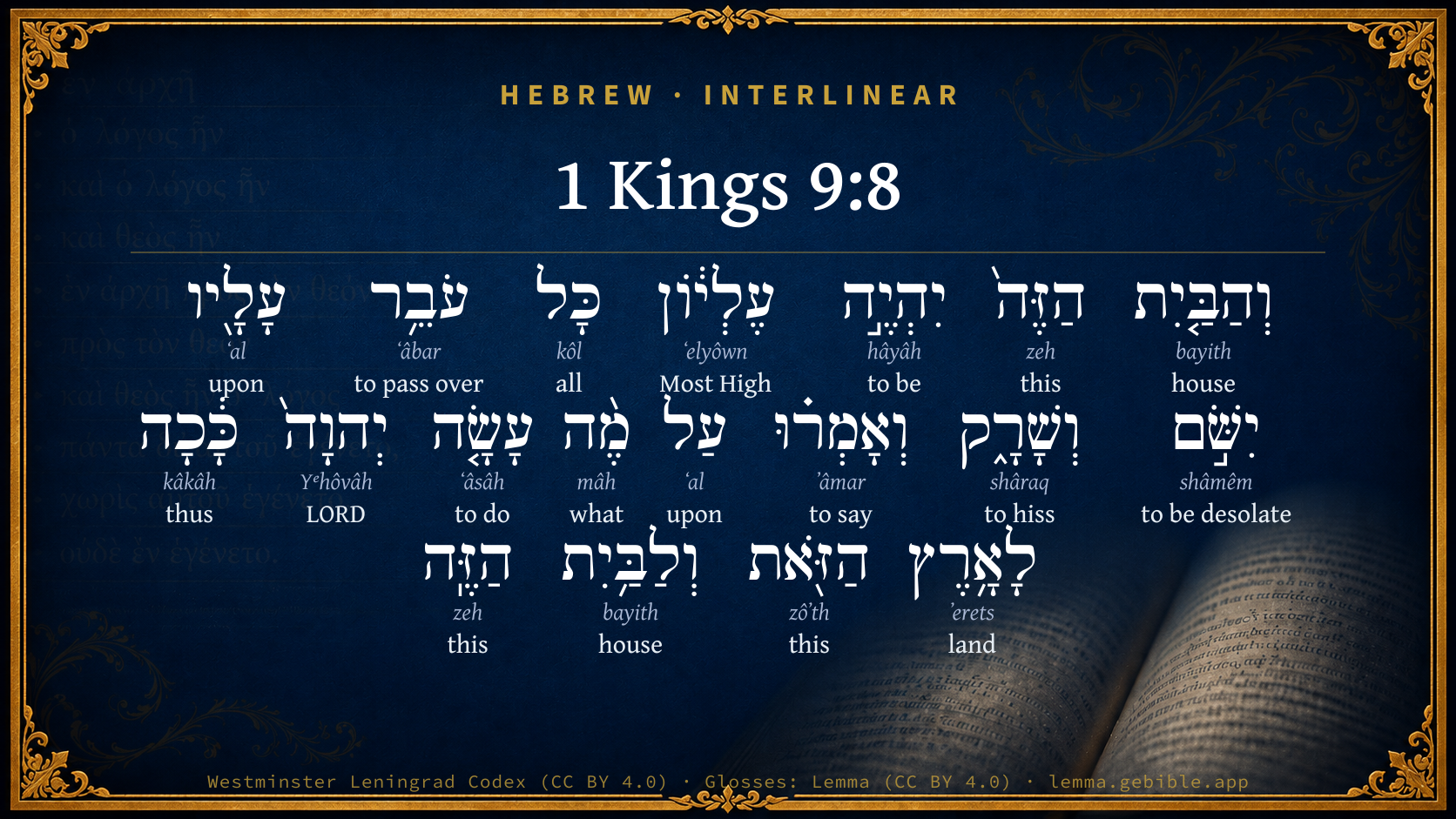
1 Kings 9:8

Hebrew (Westminster Leningrad Codex) 1 Kings 9:8 appears in the Hebrew Old Testament. The text above is from the Westminster Leningrad Codex. Each word links to its Strong’s number, a concise gloss, and parsing drawn from the Open Scriptures Hebrew Bible morphology. Click any word for its full Brown-Driver-Briggs (BDB) entry.
Download image
Cite this verse

1 Kings 9:8 (World English Bible). Public Domain. Lemma interlinear Bible study tool, https://lemma.gebible.app/v/1-kings/9/8.

Show BibTeX & RIS
BibTeX
RIS
English Translation
Though this house is so high, yet shall everyone who passes by it be astonished, and shall hiss; and they shall say, Why has Yahweh done thus to this land, and to this house?
World English Bible · Public Domain
Highlights
  • 1 first appearance in the Hebrew Bible
Full analysis ↓
Download a study sheet

One document with this verse’s original text, its word-by-word gloss line, the meaning frame, cross-references with their text, attributed commentary, and full source and license credits — printable, and it pastes into notes with its structure intact.

This verse Autodidact and up

Study sheet (.html) Plain text (.txt)

A passage Seminary Student

Up to 50 verses in one chapter. A passage sheet keeps up to 6 commentary sources and 12 cross-references per verse, in the order this page ranks them, and says so on the sheet whenever that leaves anything out. Ask for a single verse and you get the Autodidact verse sheet above.

Everything on this page stays free to read, with no account — the sheet is a download of what is already on screen, not access to it.

Want to remove ads? Support Godless Engineer
Compare translations 3

The same verse in 3 English versions, stacked beneath the original-language interlinear above. Click any original word for its lexicon entry.

Each is an independent rendering of the whole verse — the interlinear is not word-aligned to these translations.

Highlighted words mark where these versions differ — a whole-verse word diff, not a word-by-word alignment.

  • World English Bible Public Domain
    Though this house is so high, yet shall everyone who passes by it be astonished, and shall hiss; and they shall say, Why has Yahweh done thus to this land, and to this house?
  • King James Version Public Domain
    And at this house, which is high, every one that passeth by it shall be astonished, and shall hiss; and they shall say, Why hath the LORD done thus unto this land, and to this house?
  • unfoldingWord Literal Text CC BY-SA 4.0
    And this house is exalted, everyone passing by it will be astonished and will hiss. And they will say, ‘Why did Yahweh do thus to this land and to this house?’

unfoldingWord Literal Text — © unfoldingWord, licensed CC BY-SA 4.0. Word-aligned USFM3 via Door43 (git.door43.org/unfoldingWord/en_ult).

Versions to compare (up to 4)

3 of 4 selected

Show all 18 translations

Every available English version of this verse, each an independent rendering of the whole verse.

  • World English Bible Public Domain
    Though this house is so high, yet shall everyone who passes by it be astonished, and shall hiss; and they shall say, Why has Yahweh done thus to this land, and to this house?
  • Berean Standard Bible Public Domain
    And when this temple has become a heap of rubble, all who pass by it will be appalled and will hiss and say, ‘Why has the LORD done such a thing to this land and to this temple?’
  • Majority Standard Bible Public Domain
    And when this temple has become a heap of rubble, all who pass by it will be appalled and will hiss and say, ‘Why has the LORD done such a thing to this land and to this temple?’
  • King James Version Public Domain
    And at this house, which is high, every one that passeth by it shall be astonished, and shall hiss; and they shall say, Why hath the LORD done thus unto this land, and to this house?
  • American Standard Version (1901) Public Domain
    And though this house is so high, yet shall every one that passeth by it be astonished, and shall hiss; and they shall say, Why hath Jehovah done thus unto this land, and to this house?
  • Revised Version (1885) Public Domain
    And though this house be so high, yet shall every one that passeth by be astonished, and shall hiss; and they shall say, Why hath the LORD done thus unto this land, and to this house?
  • Geneva Bible (1599) Public Domain
    Euen this hie house shall bee so: euery one that passeth by it, shalbe astonied, and shall hisse, and they shall say, Why hath the Lord done thus vnto this land and to this house?
  • Douay-Rheims (1899) Public Domain
    And this house shall be made an example of: every one that shall pass by it, shall be astonished, and shall hiss, and say: Why hath the Lord done thus to this land, and to this house:
  • Young's Literal Translation Public Domain
    as to this house, `that' is high, every one passing by it is astonished, and hath hissed, and they have said, Wherefore hath Jehovah done thus to this land and to this house?
  • Literal Standard Version CC BY-SA 4.0
    as for this house [that] is high, everyone passing by it is astonished, and has hissed, and they have said, Why has YHWH done this to this land and to this house?
  • Unlocked Literal Bible CC BY-SA 4.0
    This temple will become a heap of ruins, and everyone who passes by it will be shocked and will hiss. They will ask, 'Why has Yahweh done this to this land and to this house?'
  • unfoldingWord Literal Text CC BY-SA 4.0
    And this house is exalted, everyone passing by it will be astonished and will hiss. And they will say, ‘Why did Yahweh do thus to this land and to this house?’
  • Darby Bible Public Domain
    and this house, [which] is high, every one that passes by it shall be astonished at, and shall hiss, and they shall say, Why has Jehovah done thus to this land and to this house?
  • World Messianic Bible Public Domain
    Though this house is so high, yet everyone who passes by it will be astonished and hiss; and they will say, ‘Why has the LORD done this to this land and to this house?’
  • Webster's Bible Public Domain
    And at this house which is high, every one that passeth by it shall be astonished, and shall hiss; and they shall say, Why hath the LORD done thus to this land, and to this house?
  • Free Bible Version CC BY-SA 4.0
    This Temple will become a pile of rubble. All who pass by it will be appalled and will hiss, saying, ‘Why has the Lord acted in such a way to this land and this Temple?’
  • Bible in Basic English Public Domain
    And this house will become a mass of broken walls, and everyone who goes by will be overcome with wonder at it and make whistling sounds; and they will say, Why has the Lord done so to this land and to this house?
  • JPS Tanakh (1917) Public Domain
    and this house which is so high shall become desolate, and every one that passeth by it shall be astonished, and shall hiss; and when they shall say: Why hath the LORD done thus unto this land, and to this house?

Literal Standard Version (2020), Covenant Press — licensed CC BY-SA 4.0. Text via the HelloAO Bible API (eBible.org). Unlocked Literal Bible (unfoldingWord) — licensed CC BY-SA 4.0. Text via the HelloAO Bible API (eBible.org). unfoldingWord Literal Text — © unfoldingWord, licensed CC BY-SA 4.0. Word-aligned USFM3 via Door43 (git.door43.org/unfoldingWord/en_ult). Free Bible Version, Dr. Jonathan Gallagher — licensed CC BY-SA 4.0. Text via the HelloAO Bible API (eBible.org).

Word by word

More ways to search: Search by grammar → Find every occurrence → Compare this word →

Practice this passage: Drill this verse → Learn its vocabulary →

וְשָׁרָ֑ק
shâraq
H8319
“and · to hiss”
Conjunction + Verb, Qal, Perfect, 3rd Person, Masculine, Singular
Part of Speech
Conjunction + Verb
Stem
Qal
Form
Perfect
Person
3rd Person
Gender
Masculine
Number
Singular
Full BDB Definition

Origin: a primitive root

TWOT: 2468

to hiss, whistle, pipe - (Qal) to hiss (as a signal)
  1. וְהַבַּ֤יִת bayith H1004 “and · the · house” Conjunction + Particle, Definite Article + Noun, Common, Masculine, Singular, Absolute
  2. הַזֶּה֙ zeh H2088 “the · this” Particle, Definite Article + Pronoun, Demonstrative, Masculine, Singular
  3. יִהְיֶ֣ה hâyâh H1961 “to be” Verb, Qal, Imperfect, 3rd Person, Masculine, Singular
  4. עֶלְי֔וֹן ʻelyôwn H5945 “Most High” Adjective, Adjective, Masculine, Singular, Absolute
  5. כָּל kôl H3605 “all of” Noun, Common, Masculine, Singular, Construct
  6. עֹבֵ֥ר ʻâbar H5674 “passing over” Verb, Qal, Participle Active, Masculine, Singular, Absolute
  7. עָלָ֖יו ʻal H5921 “upon · him” Preposition + Suffix, Personal, 3rd Person, Masculine, Singular
  8. יִשֹּׁ֣ם shâmêm H8074 “to be desolate” Verb, Qal, Imperfect, 3rd Person, Masculine, Singular
  9. וְאָמְר֗וּ ʼâmar H559 “and · to say” Conjunction + Verb, Qal, Perfect, 3rd Person, Common, Plural
  10. עַל ʻal H5921 “upon” Preposition
  11. מֶ֨ה mâh H4100 “what” Particle, Interrogative
  12. עָשָׂ֤ה ʻâsâh H6213 “to do” Verb, Qal, Perfect, 3rd Person, Masculine, Singular
  13. יְהוָה֙ Yᵉhôvâh H3068 “LORD” Noun, Proper
  14. כָּ֔כָה kâkâh H3602 “thus” Adverb
  15. לָאָ֥רֶץ ʼerets H776 “to/for the · land” Preposition, Determined + Noun, Common, Both, Singular, Absolute
  16. הַזֹּ֖את zôʼth H2063 “the · this” Particle, Definite Article + Pronoun, Demonstrative, Feminine, Singular
  17. וְלַבַּ֥יִת bayith H1004 “and · to/for the · house” Conjunction + Preposition, Determined + Noun, Common, Masculine, Singular, Absolute
  18. הַזֶּֽה zeh H2088 “the · this” Particle, Definite Article + Pronoun, Demonstrative, Masculine, Singular

About this verse

These counts appear in no published source. They are computed here, from the morphology-tagged text and Lemma’s own curated glosses. What Lemma adds →

19
words
16
distinct lemmas
Historical
section

Notable vocabulary

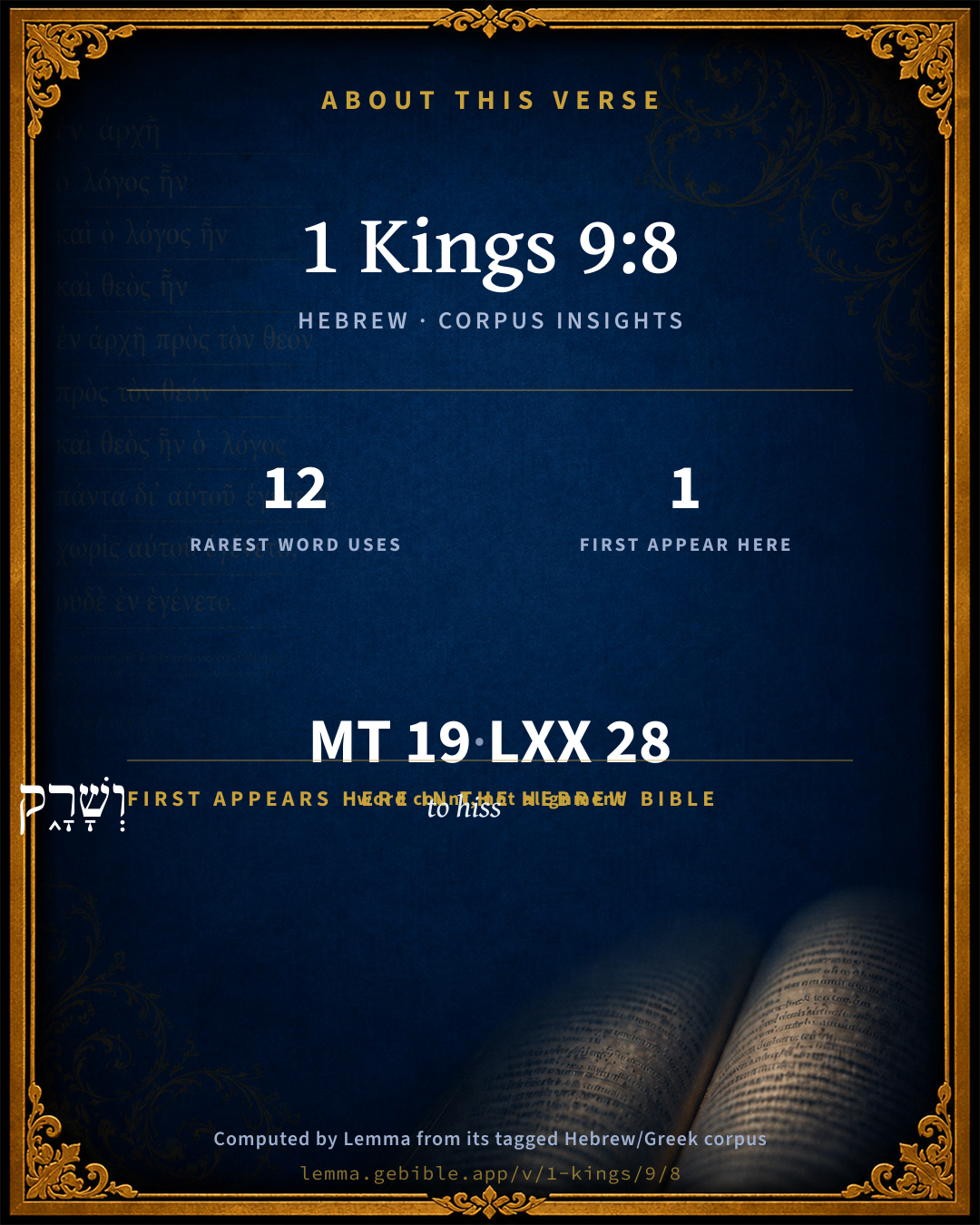
The rarest word here is וְשָׁרָ֑ק to hiss H8319 — appearing just 12 times in the whole Hebrew Bible.

First appearance in Scripture

This word makes its first canonical appearance in the Hebrew Bible here:

  • וְשָׁרָ֑ק to hiss H8319

Shared distinctive vocabulary

וְשָׁרָ֑ק to hiss H8319 occurs in 12 verses of the Hebrew Bible. Also found in:

Grammatical profile

  • 6 verbs
  • 5 nouns
  • 1 adjective
  • 3 pronouns
  • 2 prepositions
  • 1 adverb
  • 1 particle

Verb forms

  • יִהְיֶ֣ה Qal · Imperfect
  • עֹבֵ֥ר Qal · Participle Active
  • יִשֹּׁ֣ם Qal · Imperfect
  • וְשָׁרָ֑ק Qal · Perfect
  • וְאָמְר֗וּ Qal · Perfect
  • עָשָׂ֤ה Qal · Perfect

Repetition

Words recur within this verse — often emphatic in Hebrew:

  • וְהַבַּ֤יִת house H1004 ×2
  • עָלָ֖יו upon H5921 ×2
  • הַזֶּה֙ this H2088 ×2

Hebrew & Septuagint length

In English translation the verse runs 34 words from the Hebrew and 39 from the Septuagint (LXX English) — closely comparable.

A rough comparison of the two English renderings, which tokenize alike — not a word-level alignment.

Word counts can differ between the Hebrew and the Greek without any difference in meaning — e.g. the Hebrew direct-object marker אֵת has no separate Greek word, and Greek often adds the article ὁ.

In the original languages it is 19 Hebrew tokens and 28 Greek tokens — but the two are counted differently (Hebrew bundles its prefixes and suffixes into one token; the Greek is in lemma form), so that isn’t a like-for-like length.

Cross-references

9

Topical passages linked to 1 Kings 9:8 in the Treasury of Scripture Knowledge — connected by theme and wording, ordered by reader-vote popularity; previews shown in the World English Bible.

  • Deuteronomy 29:24–26 even all the nations shall say, Why has Yahweh done thus to this land? what means the heat of this great anger?
  • Jeremiah 22:8–9 Many nations shall pass by this city, and they shall say every man to his neighbor, Why has Yahweh done thus to this great city?
  • 2 Chronicles 7:21 This house, which is so high, everyone who passes by it shall be astonished, and shall say, Why has Yahweh done thus to this land, and to this house?
  • Jeremiah 19:8 I will make this city an astonishment, and a hissing; everyone who passes thereby shall be astonished and hiss because of all the plagues of it.
  • Jeremiah 22:28 Is this man Coniah a despised broken vessel? is he a vessel in which none delights? why are they cast out, he and his seed, and are cast into the land which they don't know?
  • Isaiah 64:11 Our holy and our beautiful house, where our fathers praised you, is burned with fire; and all our pleasant places are laid waste.
  • Jeremiah 49:17 Edom shall become an astonishment: everyone who passes by it shall be astonished, and shall hiss at all the plagues of it.
  • Jeremiah 50:13 Because of the wrath of Yahweh she shall not be inhabited, but she shall be wholly desolate: everyone who goes by Babylon shall be astonished, and hiss at all her plagues.
  • Daniel 9:12 He has confirmed his words, which he spoke against us, and against our judges who judged us, by bringing on us a great evil; for under the whole sky has not been done as has been done on Jerusalem.

Cross-references courtesy of OpenBible.info (CC BY 4.0).

Hebrew and Greek witnesses Masoretic Hebrew ↔ Greek Septuagint

The same verse in the two great witnesses to the Old Testament, shown verse-for-verse.

These are two independent witnesses, not word-aligned to each other, and the Septuagint is shown in lemma (dictionary) form.

Hebrew 1 Kings 9:8 Masoretic · Westminster Leningrad Codex

וְהַבַּ֤יִת הַזֶּה֙ יִהְיֶ֣ה עֶלְי֔וֹן כָּל עֹבֵ֥ר עָלָ֖יו יִשֹּׁ֣ם וְשָׁרָ֑ק וְאָמְר֗וּ עַל מֶ֨ה עָשָׂ֤ה יְהוָה֙ כָּ֔כָה לָאָ֥רֶץ הַזֹּ֖את וְלַבַּ֥יִת הַזֶּֽה

Though this house is so high, yet shall everyone who passes by it be astonished, and shall hiss; and they shall say, Why has Yahweh done thus to this land, and to this house?

World English Bible · Public Domain

Greek LXX 1 Kings 9:8 Septuagint · lemma form

καί ὁ οἶκος οὗτος ὁ ὑψηλός πᾶς ὁ διαπορεύομαι διά αὐτός ἐκἵστημι καί συρίζω καί εἶπον ἕνεκα τίς ποιέω κύριος οὕτως ὁ γῆ οὗτος καί ὁ οἶκος οὗτος

And this house, which is high, shall be so that every one that passes by it shall be amazed, and shall hiss; and they shall say, Therefore has the Lord done thus to this land, and to this house?

LXX2012 (modern English Septuagint) · Public Domain

On this verse, Ellicott's Commentary for English Readers discusses the Septuagint’s reading. Read the note in Commentary ↓

Hebrew: Westminster Leningrad Codex (CC BY 4.0). Greek: Septuagint (public domain); English from LXX2012 (modern English Septuagint) (Public Domain). How the Septuagint differs from the Hebrew →

Targum (Aramaic paraphrase)

1

The Targum is the ancient Jewish Aramaic paraphrase of the Hebrew Scriptures — an interpretive translation, not the Hebrew text itself. Onkelos (literal) and Pseudo-Jonathan (expansive) render the Torah, and Jonathan the Prophets. Coverage is partial: where no permissively-licensed English translation exists for a verse, only the Aramaic is shown. This is verse-level text, not a word-by-word alignment to the Hebrew.

  1. Targum Jonathan Prophets (Joshua–Malachi)
    וּבֵיתָא הָדֵין דַהֲוָה עִילָאֵי יְהֵי חֲרִיב כָּל דְיֶעֶבַּר עֲלוֹהִי יַכְלֵי וְיָנוּד וְיֵימְרוּן עַל מָה עֲבַד יְיָ כְּדֵין לְאַרְעָא הָדָא וּלְבֵיתָא הָדֵין:

    (no public-domain English translation for this verse)

    Targum Jonathan — Aramaic: “Mikraot Gedolot” (public domain). English: “Sefaria Community Translation” (CC0 1.0 (public-domain dedication)); “London "Chaldee Paraphrase," 1871” (public domain). Text via Sefaria.

Commentary

Notes on 1 Kings 9:8 from classic Christian and Jewish commentators (each source and its license shown beneath its notes). The classic Christian expositions comment on the surrounding passage and are grouped to its opening verse, so a note may address several verses; the Jewish commentaries on the Tanakh (Rashi and others) are per-verse, so they appear only where the commentator wrote on this verse.

Lemma curates 59 commentaries, every one of them public domain or Creative Commons licensed, each selected and text-cleaned for this edition rather than reprinted as found. About our sources →

Trapp's Complete Commentary

John Trapp

1Ki 9:8 And at this house, [which] is high, every one that passeth by it shall be astonished, and shall hiss; and they shall say, Why hath the LORD done thus unto this land, and to this house?

Ver. 8. And shall hiss.] In scorn and horror.

John Trapp, A Commentary or Exposition upon All the Books of the Old and New Testament (1647–1656) — public domain. Text from a community e-Sword module.

Joseph Benson's Commentary

1Ki 9:8-9. And at this house, which is high — Exalted in its privileges, and renowned for its riches and splendour, and the great resort of people to it. They gloried in the stateliness and magnificence of the structure; but God here lets them know it was not so high as to be out of the reach of his judgments, which should assuredly fall upon it and them, if they vilified it so as to exchange it for groves and idol-temples, and yet, at the same time, most inconsistently and absurdly magnified it, so as to suppose it would secure the favour of God to them, although they ever so much corrupted themselves. Every one that passeth by it shall be astonished — At its unexpected and wonderful ruin. As they who now pass by it are astonished at the bulk and beauty, the richness, contrivance, and workmanship of it, and call it a stupendous fabric; so, if you forsake God, its height will make its fall the more amazing, and they that pass by will be as much astonished at its ruins. And shall hiss — By way of contempt and derision; and shall say, Why hath the Lord, &c. — What is the reason that this famous place, which boasted so much of the favour and protection of God, is thus laid in ruins? And they shall answer, Because they forsook, &c. — The guilty, self-convicted, self-condemned Israelites will be forced to acknowledge with shame, that they themselves were the ruin of it. See Deu 29:24. Their sin will be read in their punishment. They deserted the temple, and therefore God deserted it; they profaned it with their sins, and laid it common; and therefore God profaned it with his judgments, and laid it waste. Of this God thus gave Solomon fair warning, now he had newly built and dedicated it, that he and his people might not be high-minded, but fear.

Joseph Benson's Commentary on the Old and New Testaments (1811–1818) — public domain. Text from a community e-Sword module.

Jamieson, Fausset & Brown

Robert Jamieson, A. R. Fausset & David Brown

this house, which is high--"high," either in point of situation, for it was built on a hill, and therefore conspicuous to every beholder; or "high" in respect to privilege, honor, and renown; or this "house of the Most High," notwithstanding all its beauty and magnificence, shall be destroyed, and remain in such a state of ruin and degradation as to be a striking monument of the just judgment of God. The record of this second vision, in which were rehearsed the conditions of God's covenant with Solomon and the consequences of breaking them, is inserted here as a proper introduction to the narrative about to be given of this king's commercial enterprises and ambitious desire for worldly glory; for this king, by encouraging an influx of foreign people and a taste for foreign luxuries, rapidly corrupted his own mind and that of this subjects, so that they turned from following God, they and their children (Kg1 9:6).

Jamieson, Fausset & Brown — Commentary Critical and Explanatory on the Whole Bible (1871) — public domain (CC PDM 1.0). Text via the HelloAO Bible API.

Ellicott's Commentary for English Readers

(8) At this house, which is high.—The word “which” is not in the original Hebrew here (although found in the present Hebrew text of 2Ch_7:21). The true meaning is certainly “This house shall be high;” which is the reading of the LXX., while the Vulg. has a good explanatory gloss, “This house shall be for an example.” Various corrections have been proposed, but there seems no necessity for them. There is evidently an allusion to the lofty position of the Temple. Generally the exaltation of “the mountain of the Lord” is made a type of its glory (as in Mic_4:1-2; Psa_68:15-16, &c.); here of its destruction. Its magnificence and its ruin are equally conspicuous: for “a city set on a hill cannot be hid.”

A Bible Commentary for English Readers, edited by Charles John Ellicott (1878–1897) — public domain. Text from a community e-Sword module.

The Cambridge Bible for Schools and Colleges

gen. ed. J. J. S. Perowne

8. And at this house which is high] The connexion of these words is very difficult. The Hebrew text, standing alone, must be rendered ‘And this house shall be high.’ But in 2 Chron. the relative is expressed, and there can be little doubt that the text here is somehow faulty. The passage in 2 Chron. (1Ki_7:21) reads ‘And this house which is high shall be an astonishment.’ To come as near to this sense as possible, while introducing no relative, R.V. gives ‘And though this house be high.’ Yet that rendering is somewhat doubtful. The text of the LXX. shows that they had our Hebrew before them: καὶ ὁ οἶκος οὖτος ἔσται ὁ ὑψηλός, πᾶς ὁ διαπορευόμενος κ.τ.λ.

The Cambridge Bible for Schools and Colleges (gen. ed. J. J. S. Perowne; Cambridge University Press, 1878–1918) — public domain. Text from a community e-Sword module.

John Gill's Exposition

And at this house which is high,.... The house of the most High, as some render it, and in high esteem, fame, and glory, as well as it was built on an high hill, and was itself one hundred and twenty cubits high, Ch2 3:4, the Targum is,

"and this house which was high shall be destroyed:''

everyone that passeth by it shall be astonished; at the ruins of the temple, and of the city of Jerusalem, which had been so magnificent:

and shall hiss; in scorn and derision of the people of Israel, rejoicing in their ruin:

and they shall say, why hath the Lord done thus unto this land, and to this house? or suffered it to be done, to lie thus in waste and ruins; a land in which it had been said he delighted, and looked unto from one end of the year to the other, and a house he had taken up his dwelling in; surely something more than ordinary, they suggest, must be the cause of all this.

John Gill's Exposition of the Whole Bible (1746–1763) — public domain (CC PDM 1.0). Text via the HelloAO Bible API.

Albert Barnes' Notes on the Bible

The Hebrew text runs - “And this house shall be high: every one,” etc. The meaning appears to be, “This house shall be high” (i. e., conspicuous) “in its ruin as in its glory.”

And shall hiss - In contempt. This expression first appears in the time of Hezekiah 2Ch 29:8; Mic 6:16. It is especially familiar to Jeremiah (Jer 18:16; Jer 19:8, etc.).

Albert Barnes' Notes on the Bible (1834–1885) — public domain. Text from a community e-Sword/MySword module.

Haydock's Catholic Bible Commentary

Example. Hebrew, "at this house, on high," (or dedicated "to the most high;" Paralipomenon) "every," &c. (Haydock) --- It shall be treated with no more regard than the high places of idols. (Calmet) --- Though at present so much exalted, it shall be reduced to a heap of ruins, (Vatable) and destroyed. (Challoner)

George Leo Haydock (1774–1849), Haydock's Catholic Family Bible and Commentary, 1859 edition — public domain. Excludes Psalms (Douay-Rheims chapter numbering differs from Protestant) and Deuterocanonical books (Catholic canon only).

Matthew Poole's English Annotations

Which is high, i.e. exalted in its privileges, glorious, and renowned. The particle which is oft understood, and is here fitly supplied out of 2Ch 7:21, where it is expressed.

Shall be astonished at its unexpected and wonderful ruin.

Shall hiss, by way of contempt and derision. See Jer 19:8; 49:17; 50:13.

Matthew Poole's English Annotations on the Holy Bible (1683–1685) — public domain. Text from a community e-Sword/MySword module.

Whedon's Commentary on the Bible

Daniel D. Whedon

8. This house, which is high — This rendering is an attempt to emend the text by the aid of 2Ch_7:21, but is altogether unnecessary and erroneous. The Hebrew reads: This house shall be high; that is, shall be a conspicuous example of Divine judgment on a chosen people for their sins. “It will be exposed aloft, on its high hill, as a laughingstock to the scorn of passers-by, who will be astonished at it.” — Wordsworth.

Daniel D. Whedon (gen. ed.), Commentary on the Old and New Testaments (1874–1909) — public domain. Text from a community e-Sword module.

The Pulpit Commentary

And at this house, which is high Heb., And this house shall be high, hyhyi wOyl. Our translators were probably influenced by (2Ch_7:21) the text of which is wOyl hyh rva which would seem to be an emendation, designed to clear up the difficulty rather than an accidental variation of the text. But here the literal rendering is probably the truer, the meaning being "this house shall be conspicuous, as an example so the Vulg. domus haec erit in exemplum. The LXX accords with the Hebrew text, oJ oikov outov estai oJ ujyhlov, but the Syriac and Arabic read, "this house shall be destroyed." Keil sees in the words an allusion implicite to Deu_26:19 Deu_28:1, where God promises to make Israel wOyl, and says "the blessing will be turned into a curse." The temple should indeed be "high," should be what Israel would have been, but it shall be as a warning, etc.; but this connexion is somewhat far fetched and artificial. Thenius would read for, wOyl yYii. "ruins," after Mic_3:12; Jer_26:18; Psa_79:1; but it is hardly right to resort to conjectures, unsupported by a single version or MS., so long as any sufficient meaning can be extracted from the words as they stand, and no one can deny that "high" may surely signify "conspicuous." Cf., Mat_11:23 every one that passeth by it shall be astonished. primarily means to be dumb with astonishment, Gesen., Thessalonians 3. p. 1435 and shall hiss qrv like "hiss," is an onomatopoetic word. It does not denote the hissing of terror (Bahr) but of derision; of. Jer_19:8 Jer_49:17; Job_27:23; Lam_2:15, Lam_2:16. Rawlinson aptly remarks, as bearing on the authorship of the Kings, that this is a familiar word in Jeremiah, (see 1Ki_18:16 1Ki 25:9 1Ki 29:18 1Ki 50:13 1Ki 51:37) in addition to the passages cited above) and that the other prophets rarely use it. The fact that much of this charge is in Jeremiah"s style, confirms the view taken above (note on ver. 4), that the ipsissima verba of the dream are not preserved to us. The author indeed could hardly do more than preserve its leading ideas, which he would naturally present in his own dress; and they shall say, Why hath the Lord done thus unto this land and to this house? Similar words Deu_29:24, Deu_29:25; Jer_22:8.

The Pulpit Commentary (1880–1919), ed. H.D.M. Spence-Jones & Joseph S. Exell — public domain. Text from a community e-Sword module.

John Wesley's Explanatory Notes

High - Glorious and renowned. Astonished - At its unexpected and wonderful ruin. Hiss - By way of contempt and derision.

John Wesley, Explanatory Notes Upon the Whole Bible (1754–1765) — public domain. Text via the GEBible commentary corpus.

unfoldingWord translationNotes

Door43 World Missions Community

This temple will become a heap of ruins

"This temple will be destroyed and its remains will be piled into a high mound"

will be shocked and will hiss

This can be stated in active form. AT: "will express amazement and make a sound of disrespect" (See: Active or Passive)

bowed down to them and worshiped them

These two phrases mean the same thing. The phrase "bowed down to them" describes the posture that people used in worship. (See: Parallelism)

translationWords

temple

Yahweh

forsake

God

Egypt

false god

unfoldingWord translationNotes — © Distant Shores Media and the Door43 World Missions Community, licensed CC BY-SA 4.0. Source: git.door43.org/Door43/en_tn.

Rashi

Rabbi Shlomo Yitzchaki (Rashi)

And this Beis Hamikdosh will be most high. So long as you have not sinned; but once you sin, every passerby will be astounded and will hiss. And similarly it is written in Divrei Hayomim, “And this Beis [Hamikdosh] that was exalted, all who pass by it, etc.,” and this is its interpretation, “and this house that was exalted and revered even by the gentiles,” as is stated above, “And even to the stranger who is not of Your people, etc.,” But, now in its destruction, everyone who passes by it, even the gentiles, will be astounded and hiss, and will say that the Jews’ sins were the cause.

Will be astounded. [ישם means] “will wonder,” as in, “and your enemies will be astonished [ושממו] about it,” [and as in,] “Concerning his day, the later ones will wonder [נשמו].”

And whistle. Siffler, in O.F. The habit of anyone who suddenly sees desolation, is to hiss.

Rashi on the Tanakh — English translations: “The Judaica Press complete Tanach with Rashi, translated by A. J. Rosenberg” (CC BY 4.0); “Pentateuch with Rashi's commentary by M. Rosenbaum and A.M. Silbermann, 1929-1934” (public domain); “The Metsudah Tanach series, Lakewood, N.J” (CC BY 4.0); and “The Book of Joshua, Metsudah Publications, 1997” (CC BY 4.0). Text via Sefaria.

Lesson kit

Teaching starters — assembled from the data on this page, not authored interpretation. Every prompt links to the verse data it draws on. Edit before teaching.

1 Kings, in the Historical, opens this verse with 19 words (16 distinct Hebrew lemmas). Its most distinctive word is shâraq (“to hiss”). A historical commentator’s framing appears above. Read the whole chapter for the surrounding context.

Discussion questions

  1. What does “to hiss” (shâraq) contribute to the verse as a whole?
  2. The word “to hiss” first appears here in Scripture. What is being introduced at this debut?
  3. Job 27:23 shares the word «to hiss» with this verse. How do the two illuminate each other?
  4. “house” occurs 2× in this one verse. What is the effect of the repetition?
  5. These translations render this verse differently; the difference is in the English rendering, not the original. What questions does that raise?
  6. The verb «יִהְיֶ֣ה» is Qal Imperfect. How does its form color the action?
  7. Reading how Trapp's Complete Commentary and Joseph Benson's Commentary read this verse, where do the two commentators agree and where do they part?

Things to notice

Reading settings

Reading text

Shown beneath each verse's original-language words.

Old Testament
Old Testament edition

Read the OT as the Masoretic Hebrew (MT) or the Greek Septuagint (LXX).

English shown for the Greek Septuagint (in the Hebrew ↔ Greek comparison).

Comparing translations? Open the Compare panel on any verse page to stack up to four side by side.