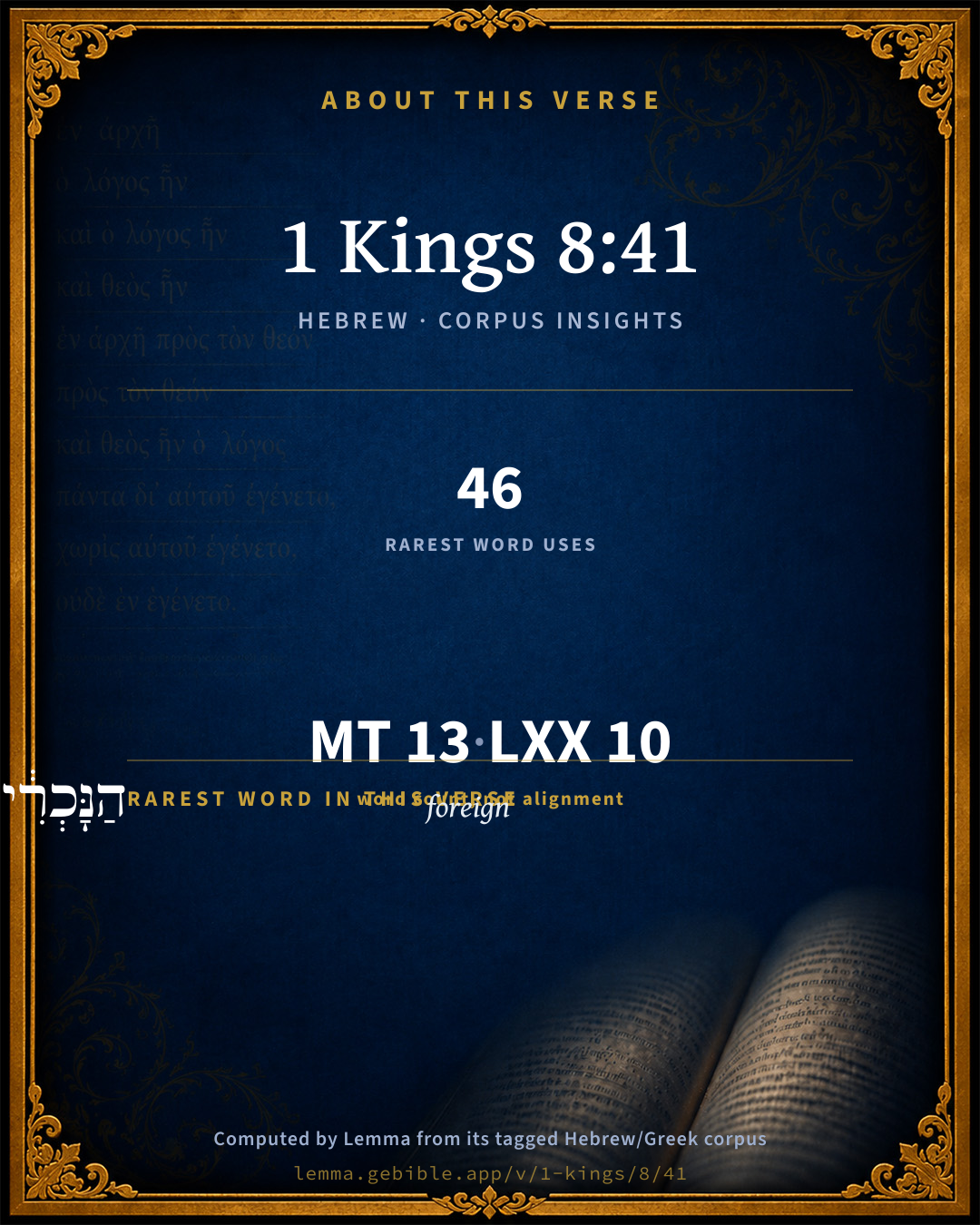
1 Kings 8:41

Hebrew (Westminster Leningrad Codex) 1 Kings 8:41 appears in the Hebrew Old Testament. The text above is from the Westminster Leningrad Codex. Each word links to its Strong’s number, a concise gloss, and parsing drawn from the Open Scriptures Hebrew Bible morphology. Click any word for its full Brown-Driver-Briggs (BDB) entry.
Download image
Cite this verse

1 Kings 8:41 (World English Bible). Public Domain. Lemma interlinear Bible study tool, https://lemma.gebible.app/v/1-kings/8/41.

Show BibTeX & RIS
BibTeX
RIS
English Translation
Moreover concerning the foreigner, who is not of your people Israel, when he shall come out of a far country for your name's sake
World English Bible · Public Domain
Download a study sheet

One document with this verse’s original text, its word-by-word gloss line, the meaning frame, cross-references with their text, attributed commentary, and full source and license credits — printable, and it pastes into notes with its structure intact.

This verse Autodidact and up

Study sheet (.html) Plain text (.txt)

A passage Seminary Student

Up to 50 verses in one chapter. A passage sheet keeps up to 6 commentary sources and 12 cross-references per verse, in the order this page ranks them, and says so on the sheet whenever that leaves anything out. Ask for a single verse and you get the Autodidact verse sheet above.

Everything on this page stays free to read, with no account — the sheet is a download of what is already on screen, not access to it.

Want to remove ads? Support Godless Engineer
Compare translations 3

The same verse in 3 English versions, stacked beneath the original-language interlinear above. Click any original word for its lexicon entry.

Each is an independent rendering of the whole verse — the interlinear is not word-aligned to these translations.

Highlighted words mark where these versions differ — a whole-verse word diff, not a word-by-word alignment.

  • World English Bible Public Domain
    Moreover concerning the foreigner, who is not of your people Israel, when he shall come out of a far country for your name's sake
  • King James Version Public Domain
    Moreover concerning a stranger, that is not of thy people Israel, but cometh out of a far country for thy name's sake;
  • unfoldingWord Literal Text CC BY-SA 4.0
    And also, concerning the foreigner, he who not from your people Israel, and he comes from a distant land because of your name,

unfoldingWord Literal Text — © unfoldingWord, licensed CC BY-SA 4.0. Word-aligned USFM3 via Door43 (git.door43.org/unfoldingWord/en_ult).

Versions to compare (up to 4)

3 of 4 selected

Show all 18 translations

Every available English version of this verse, each an independent rendering of the whole verse.

  • World English Bible Public Domain
    Moreover concerning the foreigner, who is not of your people Israel, when he shall come out of a far country for your name's sake
  • Berean Standard Bible Public Domain
    And as for the foreigner who is not of Your people Israel but has come from a distant land because of Your name—
  • Majority Standard Bible Public Domain
    And as for the foreigner who is not of Your people Israel but has come from a distant land because of Your name—
  • King James Version Public Domain
    Moreover concerning a stranger, that is not of thy people Israel, but cometh out of a far country for thy name's sake;
  • American Standard Version (1901) Public Domain
    Moreover concerning the foreigner, that is not of thy people Israel, when he shall come out of a far country for thy name's sake;
  • Revised Version (1885) Public Domain
    Moreover concerning the stranger, that is not of thy people Israel, when he shall come out of a far country for thy name’s sake;
  • Geneva Bible (1599) Public Domain
    Moreouer as touching the stranger that is not of thy people Israel, who shall come out of a farre countrey for thy Names sake,
  • Douay-Rheims (1899) Public Domain
    Moreover also the stranger, who is not of thy people Israel, when he shall come out of a far country for thy name's sake, (for they shall hear every where of thy great name and thy mighty hand,
  • Young's Literal Translation Public Domain
    `And also, unto the stranger who is not of Thy people Israel, and hath come from a land afar off for Thy name's sake --
  • Literal Standard Version CC BY-SA 4.0
    And also, to the stranger who is not of Your people Israel, and has come from a far-off land for Your Name’s sake—
  • Unlocked Literal Bible CC BY-SA 4.0
    In addition, concerning the foreigner who does not belong to your people Israel: When he comes from a distant country because of your name—
  • unfoldingWord Literal Text CC BY-SA 4.0
    And also, concerning the foreigner, he who not from your people Israel, and he comes from a distant land because of your name,
  • Darby Bible Public Domain
    And as to the stranger also, who is not of thy people Israel, but cometh out of a far country for thy name's sake
  • World Messianic Bible Public Domain
    “Moreover, concerning the foreigner, who is not of your people Israel, when he comes out of a far country for your name’s sake
  • Webster's Bible Public Domain
    Moreover, concerning a stranger, that is not of thy people Israel, but cometh out of a far country for thy name's sake;
  • Free Bible Version CC BY-SA 4.0
    As for the foreigners who do not belong to your people Israel but who come from a distant land,
  • Bible in Basic English Public Domain
    And as for the man from a strange land, who is not of your people Israel; when he comes from a far country because of the glory of your name:
  • JPS Tanakh (1917) Public Domain
    Moreover concerning the stranger that is not of Thy people Israel, when he shall come out of a far country for Thy name's sake—

Literal Standard Version (2020), Covenant Press — licensed CC BY-SA 4.0. Text via the HelloAO Bible API (eBible.org). Unlocked Literal Bible (unfoldingWord) — licensed CC BY-SA 4.0. Text via the HelloAO Bible API (eBible.org). unfoldingWord Literal Text — © unfoldingWord, licensed CC BY-SA 4.0. Word-aligned USFM3 via Door43 (git.door43.org/unfoldingWord/en_ult). Free Bible Version, Dr. Jonathan Gallagher — licensed CC BY-SA 4.0. Text via the HelloAO Bible API (eBible.org).

Word by word

More ways to search: Search by grammar → Find every occurrence → Compare this word →

Practice this passage: Drill this verse → Learn its vocabulary →

הַנָּכְרִ֔י
nokrîy
H5237
“the · foreign”
Particle, Definite Article + Adjective, Adjective, Masculine, Singular, Absolute
Part of Speech
Particle + Adjective
Type
Adjective
Gender
Masculine
Number
Singular
State
Absolute
Full BDB Definition

Origin: from H5235 (second form)

TWOT: 1368c

foreign, alien - foreign - foreigner (substantive) - foreign woman, harlot - unknown, unfamiliar (figuratively)
  1. וְגַם֙ gam H1571 “and · also” Conjunction + Particle, Accusative
  2. אֶל ʼêl H413 “to” Preposition
  3. אֲשֶׁ֛ר ʼăsher H834 “which” Particle, Relative
  4. לֹא lôʼ H3808 “not” Particle, Negative
  5. מֵעַמְּךָ֥ ʻam H5971 “from · people · your” Preposition + Noun, Common, Masculine, Singular, Construct + Suffix, Personal, 2nd Person, Masculine, Singular
  6. יִשְׂרָאֵ֖ל Yisrâʼêl H3478 “Israel” Noun, Proper
  7. ה֑וּא hûwʼ H1931 “he” Pronoun, Personal, 3rd Person, Masculine, Singular
  8. וּבָ֛א bôwʼ H935 “and · to enter” Conjunction + Verb, Qal, Sequential Perfect, 3rd Person, Masculine, Singular
  9. מֵאֶ֥רֶץ ʼerets H776 “from · land” Preposition + Noun, Common, Both, Singular, Absolute
  10. רְחוֹקָ֖ה râchôwq H7350 “far” Adjective, Adjective, Feminine, Singular, Absolute
  11. לְמַ֥עַן maʻan H4616 “for the sake of” Preposition
  12. שְׁמֶֽךָ shêm H8034 “name · your” Noun, Common, Masculine, Singular, Construct + Suffix, Personal, 2nd Person, Masculine, Singular

About this verse

These counts appear in no published source. They are computed here, from the morphology-tagged text and Lemma’s own curated glosses. What Lemma adds →

13
words
13
distinct lemmas
Historical
section

Shared distinctive vocabulary

הַנָּכְרִ֔י foreign H5237 occurs in 45 verses of the Hebrew Bible. Also found in:

Grammatical profile

  • 1 verb
  • 4 nouns
  • 2 adjectives
  • 1 pronoun
  • 2 prepositions
  • 3 particles

Verb forms

  • וּבָ֛א Qal · Sequential Perfect

Hebrew & Septuagint length

In English translation the verse runs 24 words from the Hebrew and 10 from the Septuagint (LXX English) — the Septuagint runs noticeably shorter here. See the side-by-side →

A rough comparison of the two English renderings, which tokenize alike — not a word-level alignment.

Word counts can differ between the Hebrew and the Greek without any difference in meaning — e.g. the Hebrew direct-object marker אֵת has no separate Greek word, and Greek often adds the article ὁ.

In the original languages it is 13 Hebrew tokens and 10 Greek tokens — but the two are counted differently (Hebrew bundles its prefixes and suffixes into one token; the Greek is in lemma form), so that isn’t a like-for-like length.

Cross-references

18

Topical passages linked to 1 Kings 8:41 in the Treasury of Scripture Knowledge — connected by theme and wording, ordered by reader-vote popularity; previews shown in the World English Bible.

  • 1 Kings 10:1–2 When the queen of Sheba heard of the fame of Solomon concerning the name of Yahweh, she came to prove him with hard questions.
  • Exodus 18:8–12 Moses told his father-in-law all that Yahweh had done to Pharaoh and to the Egyptians for Israel's sake, all the hardships that had come on them on the way, and how Yahweh delivered them.
  • Isaiah 56:3–7 Neither let the foreigner, who has joined himself to Yahweh, speak, saying, Yahweh will surely separate me from his people; neither let the eunuch say, Behold, I am a dry tree.
  • Acts 8:27–40 He arose and went; and behold, there was a man of Ethiopia, a eunuch of great authority under Candace, queen of the Ethiopians, who was over all her treasure, who had come to Jerusalem to worship.
  • Ruth 1:16 Ruth said, "Don't entreat me to leave you, and to return from following after you, for where you go, I will go; and where you lodge, I will lodge; your people shall be my people, and your God my God;
  • Ruth 2:11 Boaz answered her, It has fully been shown me, all that you have done to your mother-in-law since the death of your husband; and how you have left your father and your mother, and the land of your birth, and have come to a people that you didn't know before.
  • 2 Kings 5:1–7 Now Naaman, captain of the host of the king of Syria, was a great man with his master, and honorable, because by him Yahweh had given victory to Syria: he was also a mighty man of valor, [but he was] a leper.
  • 2 Kings 5:16–17 But he said, As Yahweh lives, before whom I stand, I will receive none. He urged him to take it; but he refused.
  • 2 Chronicles 6:32 Moreover concerning the foreigner, who is not of your people Israel, when he shall come from a far country for your great name's sake, and your mighty hand, and your outstretched arm; when they shall come and pray toward this house:
  • Isaiah 60:1–10 Arise, shine; for your light is come, and the glory of Yahweh is risen on you.
  • Matthew 2:1 Now when Jesus was born in Bethlehem of Judea in the days of Herod the king, behold, wise men from the east came to Jerusalem, saying,
  • Matthew 8:5 When he came into Capernaum, a centurion came to him, asking him,
  • Matthew 8:10–11 When Jesus heard it, he marveled, and said to those who followed, "Most assuredly I tell you, I haven't found so great a faith, not even in Israel.
  • Matthew 12:42 The queen of the south will rise up in the judgment with this generation, and will condemn it, for she came from the ends of the earth to hear the wisdom of Solomon; and behold, someone greater than Solomon is here.
  • Matthew 15:22–28 Behold, a Canaanite woman came out from those borders, and cried, saying, "Have mercy on me, Lord, you son of David! My daughter is severely demonized!"
  • Luke 17:18 Were there none found who returned to give glory to God, except this stranger?"
  • John 12:20 Now there were certain Greeks among those that went up to worship at the feast.
  • Acts 10:1–4 Now there was a certain man in Caesarea, Cornelius by name, a centurion of what was called the Italian Regiment,

Cross-references courtesy of OpenBible.info (CC BY 4.0).

Hebrew and Greek witnesses Masoretic Hebrew ↔ Greek Septuagint

The same verse in the two great witnesses to the Old Testament, shown verse-for-verse.

Here the Septuagint runs noticeably shorter than the Hebrew — LXX2012 (modern English Septuagint) 10 words vs World English Bible 24. A rough length comparison of the two English translations, not a word-level alignment — read both below.

These are two independent witnesses, not word-aligned to each other, and the Septuagint is shown in lemma (dictionary) form.

Hebrew 1 Kings 8:41 Masoretic · Westminster Leningrad Codex

וְגַם֙ אֶל הַנָּכְרִ֔י אֲשֶׁ֛ר לֹא מֵעַמְּךָ֥ יִשְׂרָאֵ֖ל ה֑וּא וּבָ֛א מֵאֶ֥רֶץ רְחוֹקָ֖ה לְמַ֥עַן שְׁמֶֽךָ

Moreover concerning the foreigner, who is not of your people Israel, when he shall come out of a far country for your name's sake

World English Bible · Public Domain

Greek LXX 1 Kings 8:41 Septuagint · lemma form

καί ὁ ἀλλότριος ὅς οὐ εἰμί ἀπό λαός σύ οὗτος

And for the stranger who is not of your people,

LXX2012 (modern English Septuagint) · Public Domain

Hebrew: Westminster Leningrad Codex (CC BY 4.0). Greek: Septuagint (public domain); English from LXX2012 (modern English Septuagint) (Public Domain). How the Septuagint differs from the Hebrew →

Targum (Aramaic paraphrase)

1

The Targum is the ancient Jewish Aramaic paraphrase of the Hebrew Scriptures — an interpretive translation, not the Hebrew text itself. Onkelos (literal) and Pseudo-Jonathan (expansive) render the Torah, and Jonathan the Prophets. Coverage is partial: where no permissively-licensed English translation exists for a verse, only the Aramaic is shown. This is verse-level text, not a word-by-word alignment to the Hebrew.

  1. Targum Jonathan Prophets (Joshua–Malachi)
    וְאַף מִן בַּר עַמְמִין דְלָא מֵעַמָךְ יִשְׂרָאֵל הוּא וְיֵתֵי מֵאַרְעָא רְחִיקָא בְּדִיל שְׁמָךְ:

    (no public-domain English translation for this verse)

    Targum Jonathan — Aramaic: “Mikraot Gedolot” (public domain). English: “Sefaria Community Translation” (CC0 1.0 (public-domain dedication)); “London "Chaldee Paraphrase," 1871” (public domain). Text via Sefaria.

Commentary

Notes on 1 Kings 8:41 from classic Christian and Jewish commentators (each source and its license shown beneath its notes). The classic Christian expositions comment on the surrounding passage and are grouped to its opening verse, so a note may address several verses; the Jewish commentaries on the Tanakh (Rashi and others) are per-verse, so they appear only where the commentator wrote on this verse.

Lemma curates 59 commentaries, every one of them public domain or Creative Commons licensed, each selected and text-cleaned for this edition rather than reprinted as found. About our sources →

Trapp's Complete Commentary

John Trapp

1Ki 8:41 Moreover concerning a stranger, that [is] not of thy people Israel, but cometh out of a far country for thy name’s sake;

Ver. 41. Moreover, concerning a stranger.] A proselyte, such as was the eunuch, {Act 8:27} Cornelius. {Act 10:1}

John Trapp, A Commentary or Exposition upon All the Books of the Old and New Testament (1647–1656) — public domain. Text from a community e-Sword module.

Joseph Benson's Commentary

1Ki 8:41-42. Moreover, concerning a stranger — The case of an alien, who is not an Israelite is next mentioned; a proselyte that might come to the temple to pray to the God of Israel, being convinced of the folly and wickedness of worshipping the gods of his country. He supposes there would be many such; that the fame of God’s great works which he had wrought for Israel; by which he had proved himself to be above all gods, nay, to be God alone, would reach distant countries. They shall hear of thy great name, and of thy strong hand — And this will bring such as are thinking and considerate among them to pray toward this house, that they may obtain the favour of a God that is able to confer on them real blessings.

Joseph Benson's Commentary on the Old and New Testaments (1811–1818) — public domain. Text from a community e-Sword module.

Tyndale Open Study Notes

Tyndale Open Resources

8:41-43 Solomon asked that non-Israelites would learn to fear the Lord and live in relationship with him. Solomon realized that Israel must properly represent the Lord to those outside the covenant (see Gen 12:7; Ps 102:15; Hab 2:14; Matt 28:19).

Tyndale Open Study Notes — © Tyndale Open Resources, licensed CC BY-SA 4.0. Text via the HelloAO Bible API.

Geneva Bible (1599)

Geneva Bible translators

He meaneth such as should be turned from their idolatry to serve the true God.

Geneva Bible (1599) marginal notes — public domain. Text via Bolls.life.

Adam Clarke's Commentary

Verse 41. Moreover, concerning a stranger] The FIFTH case relates to heathens coming from other countries with the design to become proselytes to the true religion; that they might be received, blessed, and protected as the true Israelites, that the name of Jehovah might be known over the face of the earth.

Adam Clarke's Commentary on the Bible (1810–1826) — public domain. Text from a community e-Sword/MySword module.

Ellicott's Commentary for English Readers

(41-43) Moreover, concerning a stranger.—These verses in a striking digression (perhaps suggested by the general acknowledgment in the previous verse of God’s knowledge of every human heart), interpose in the series of references to Israel a prayer for the acceptance of the prayer of the “stranger” who should come from afar to confess the Lord Jehovah, and to “pray toward this house.” Such recognition of the stranger, not as an enemy or even a complete alien, but as in some sense capable of communion with the true God, was especially natural in Solomon; first, because in his days many strangers came from afar, drawn by the fame of his wisdom and magnificence, so that the old exclusiveness of the Israelites must have been greatly broken down; and next, because the character of the thought and writing of his age, searching (as in the books of Job, Proverbs, and Ecclesiastes) into the great religious problems which belong to man as man, naturally led to that wider view of the kingdom of God over all nations, which is worked out so strikingly in the writings of the prophets. That the case contemplated is probably not imaginary, is shown by the examples of King Hiram and the Queen of Sheba. Admiration of the glory of Israel would lead inevitably to some belief in, and “fear” of, the God of Israel; and it might well go on to the further result, here contemplated, of a fuller acknowledgment of the Lord Jehovah, and of the sacredness of the worship of His appointed Temple, which would tell silently on all the religions of the East. It was expressly provided for in the Law (Num_15:14-16): and in spite of the greater exclusiveness of the ages after the Captivity, heathen princes were often allowed to offer in the Temple. This recognition of the stranger from afar is different from the frequent recognition of the resident “stranger within their gates,” as being under the protection of God, and to be “loved” by those who had been “strangers in the land of Egypt” (Deu_10:18-19). But, like it, it nobly distinguished the Law of Israel from most ancient codes; it stood out as a striking, though often unheeded, protest against the hard exclusiveness of the Jewish temper; it was a tacit anticipation of the future gathering in of all nations to enjoy the blessing which was from the beginning expressly destined for “all families of the earth.”

A Bible Commentary for English Readers, edited by Charles John Ellicott (1878–1897) — public domain. Text from a community e-Sword module.

The Cambridge Bible for Schools and Colleges

gen. ed. J. J. S. Perowne

41. Moreover concerning a stranger] Consideration for the stranger was a marked feature of the Jewish legislation. Cf. Exo_22:21; Exo_23:9; Exo_23:12, &c. So he is not to be excluded from spiritual privileges. Josephus makes Solomon enlarge on this characteristic thus: “And I do not ask from Thee this help for the Hebrews alone when they offend; but even if any come from the ends of the earth, or from any land whatever and wish in this place to make petition unto Thee, hearken and grant their request. For thus it will be known to all men that Thou hast wished this house to be built for Thee by us, and that we are not unnatural nor hostile to strangers, but gladly desire that Thy help and the advantage of Thy blessings should be shared by all.” The last sentence tells of the opinion, which in the days of Josephus prevailed among the heathen, that the Jews were haters of the rest of mankind. For this sentiment cf. Juvenal XIV. 103, 104. Tac. Hist. 1Ki_5:5.

for thy name’s sake] i.e. Having heard of Thy wondrous works performed for Israel.

The Cambridge Bible for Schools and Colleges (gen. ed. J. J. S. Perowne; Cambridge University Press, 1878–1918) — public domain. Text from a community e-Sword module.

John Gill's Exposition

Moreover, concerning a stranger that is not of thy people Israel,.... One of another country, not belonging to any of the tribes of Israel, yet having some knowledge of, and disposition to, the true worship of God:

but cometh out of a far country for thy name's sake; as the Ethiopian eunuch did, to pray to him, worship him, and offer such sacrifices as were allowed a Gentile to do, Lev 22:18 led thereunto by the fame of him, as follows.

John Gill's Exposition of the Whole Bible (1746–1763) — public domain (CC PDM 1.0). Text via the HelloAO Bible API.

Albert Barnes' Notes on the Bible

Nothing is more remarkable in the Mosaic Law than its liberality with regard to strangers, both in general Exo 22:21; Lev 25:35; Deu 10:19 and in religious matters Num 15:14-16; Deu 31:12. It is quite in the spirit of these enactments that Solomon, having first prayed to God on behalf of his fellow-countrymen, should next go on to intercede for the strangers, and to ask for their prayers the same acceptance which he had previously begged for the prayers of faithful Israelites.

For thy name’s sake - i. e. “to visit the place where Thou hast set Thy name” (Compare Deu 12:5, Deu 12:11, etc.).

Albert Barnes' Notes on the Bible (1834–1885) — public domain. Text from a community e-Sword/MySword module.

Haydock's Catholic Bible Commentary

Stranger. God watches over all mankind; and oblations were received from all sorts of people, even from idolaters. The kings of Persia and Egypt, the Roman emperors, &c., made great presents, 1 Esdras iii. 7., and vii. 21. (Josephus, [Antiquities?] xi., and xii. 2.) It seems the court of the Gentiles was only made after the captivity. Some of these adored the true God, like Cornelius, &c., Acts viii. 27., and x. 1. Some were drawn by curiosity; others desired to be converted. To thee, kings shall offer presents, Psalm lxxi. 10. (Calmet) --- Unbelievers are still invited to attend the chapels of the true God, that they may receive information, and deserve to obtain the blessing of faith. (Haydock)

George Leo Haydock (1774–1849), Haydock's Catholic Family Bible and Commentary, 1859 edition — public domain. Excludes Psalms (Douay-Rheims chapter numbering differs from Protestant) and Deuterocanonical books (Catholic canon only).

Matthew Poole's English Annotations

This may note either,

1. The end of his coming, that he may worship and glorify thy name; or rather,

2. The motive or occasion of his coming, which was the fame of God’s greatness, and power, and kindness to his people; as the following words explain it.

Matthew Poole's English Annotations on the Holy Bible (1683–1685) — public domain. Text from a community e-Sword/MySword module.

Whedon's Commentary on the Bible

Daniel D. Whedon

41. Concerning a stranger — Moses had made provision for the pious Gentiles to worship and sacrifice at the tabernacle, (Num_15:14-16,) and Solomon presumes that strangers will of course learn of the God of Israel, and come to worship at his temple. That strangers did thus come we not only infer from such provisions being made for them in the Old Testament, but also know from the facts recorded Joh_12:20; Act_8:27.

Daniel D. Whedon (gen. ed.), Commentary on the Old and New Testaments (1874–1909) — public domain. Text from a community e-Sword module.

The Pulpit Commentary

Moreover concerning a stranger, that is not of thy people Israel, but cometh out of a far country for thy name"s sake; Solomon takes it for granted that such will come, and not without good reason, for the house was "exceeding magnifical" and destined to be "of fame and glory throughout all countries". (1Ch_22:5) And we can hardly doubt that in the visit of the Queen of Sheba we are to see one fulfilment of this anticipation. (Note the expression of ch. 10:1 "concerning the name of the Lord.") One who blessed God, as she did (ver. 9), would certainly pray towards the house. In the time of the second temple there were several instances of strangers (e.g., Alexander the Great, Ptolemy Philadelphus, and Seleucus; see Keil in loc.) worshipping the God of Jacob in Jerusalem.

HOMILIES BY J. WAITE Vers. 41-43.

The Stranger"s Interest in the Temple.

Kindly human sympathy is one of the most marked characteristics of this prayer of Solomon. This is seen in the way in which he enters into various supposed conditions of need and suffering among his people; takes the burden and the "plague" upon himself as if it were his own; a true intercessor on their behalf. His royalty assumes here the aspect of fatherhood. The model king is one in heart and interest with those over whom he rules. We are reminded, too, that before the "mercy seat" of God all human distinctions are lost. All suppliants stand on one common level, subject to the same dangers and necessities. All true prayer, therefore, is thus broad in its sympathies. But in this passage the king"s supplications take a wider range than the needs of his own people. He pleads for the "stranger," the foreigner from a "far country." This is strictly in harmony with the Divine economy of the time, however much it may seem to be otherwise. It is remarkable how much there was in the Mosaic law that was expressly intended to enforce on the people a generous regard for those who were beyond their pale. They were commanded not to "vex a stranger", (Exo_22:21) to relieve his poverty, (Lev_25:35) even to "love" him as "God loveth him in giving him iced and raiment", (Deu_10:18, Deu_10:19) and all this in memory of the fact that they themselves were once "strangers in the land of Egypt." Strangers, moreover were to be permitted to hear the solemn reading of the law in the "year of release", (Deu_31:12) and to offer sacrifices on the same conditions as themselves. "One law and one manner shall be for you and for the stranger that sojourneth with you". (Num_15:16) So that Solomon gave expression to the spirit of the dispensation to which he belonged when he thus prayed. Certain broad truths underlie this prayer

I JEHOVAH"S UNIVERSAL SOVEREIGNTY. He is the "God of the whole earth," and not merely of any particular portion of it. (Isa_54:5) "Is he the God of the Jews only and not of the Gentries?" (Rom_3:29) "The God of the spirits of all flesh". (Num_16:22) The whole Mosaic economy was built on the grand truth of the unity and absolute worldwide supremacy of Jehovah. The heathen according to their principle of local deities, might acknowledge the God of the Hebrews as having authority over his own, but a Hebrew who should in any way recognize the gods of other nations and think of Jehovah merely as a national deity could be a traitor to the commonwealth. The only living and true God can have no rival. The gods of the nations are idols, and "an idol is nothing in the world lying vanity," a vile "abomination." "The things which the Gentiles sacrifice they sacrifice to demons and not to 1Co_8:4, 5 10:20. To "know God," to have "him whom they ignorantly worship" declared to them, is "eternal life" to men. The absence of this knowledge is death. The curse and misery of the world is that it "knows not its God." Solomon here dimly recognizes this truth; and the case he contemplates is that of some child of the Universal Father in whom the sense of need has been awakened, "coming from a far country" to "seek the Lord, if haply he may feel after him and find him". (Act_17:27, Act_17:28)

II THE REPRESENTATIVE CHARACTER OF ISRAEL. They were a representative people in two respects.

1. Inasmuch as they were called to bear witness to the glory of the "great name" of Jehovah. His name is the symbol of His personality, the attributes of His being and character spirituality, purity, righteousness, love, etc. Their mission was to make known to mankind the God who had revealed Himself in wondrous forms to them. How they failed to rise to the height of this mission their national history only too sadly tells. The utterances of the psalmists and prophets are full of the spirit of it, but all this was far above the comprehension of the great mass of the people. They utterly mistook the meaning of the distinction conferred upon them, and God taught them by the discipline of subjection and captivity the lesson that in the day of their national glory they failed to learn. In this mission as a witness Israel was a type of the Christian Church. Christ declared the Father"s name to His disciples and He sent them forth on an errand like His. (Joh_17:18-26) How grand a vocation, to reflect the glory of His "great name" on the world"s darkness, to say to the nations, "Behold your God!

2. They were a representative people also in the sense that in their history God illustrated the general method and the uniform laws of His moral government. The "strong hand and the stretched out arm" here suggests the marvellous manifestation of Divine power that marked the career of the people from the beginning, the whole course of providential training and moral discipline through which they passed. But the principles on which God deals with one nation are the principles on which He deals with all. He is no "respecter of persons." The history of the "chosen people" unfolds His universal purpose and plan, illustrates unvarying laws, the conditions of all personal, social, and national life. And so it comes to pass that after every review of Israel"s experiences we may say, "Now all these things happened unto them for ensamples," etc. (1Co_10:11)

III THE ATTRACTION OF THE TEMPLE FOR ALL LONGING HUMAN HEARTS AS THE SCENE OF GRACIOUS DIVINE MANIFESTATION. That which made it the centre of interest to pious Jews made it so also to earnest souls of other lands. The truth and mercy symbolized and enshrined there promises, atoning sacrifices, benedictions answered to universal needs of humanity. Solomon supposes a case in which the vague sense of this should lead the "stranger in a far off land" to look with longing eyes, or to bend his steps, towards "the house over which God"s name is called." We have no historical record of strangers actually worshipping in the first temple as they did in that built after the captivity; but God said, "My house shall be called a house of prayer for all people"; (Isa_56:6, 7 Mar_11:17) and there may have been many who, with a far reaching hand of faith, "took hold of His covenant" as established there.

IV THE RESPONSE GOD GAVE TO EVERY TRUE SUPPLIANT, WHOEVER HE MIGHT BE. "Hear thou in heaven thy dwelling place," etc. This intercessory prayer, we may be sure, was answered. God does not awaken holy yearnings in any soul that He will not satisfy. "In every nation, he that feareth him," etc. The sovereignty that reigns over all lands is that of Almighty Love. There is room in the infinite Father"s heart for all, even the far. off "stranger," and "the same Lord over all is rich unto all that call upon him. W.

The Pulpit Commentary (1880–1919), ed. H.D.M. Spence-Jones & Joseph S. Exell — public domain. Text from a community e-Sword module.

John Wesley's Explanatory Notes

A stranger - A proselyte. But cometh - That he may worship, and glorify thy name.

John Wesley, Explanatory Notes Upon the Whole Bible (1754–1765) — public domain. Text via the GEBible commentary corpus.

unfoldingWord translationNotes

Door43 World Missions Community

your mighty hand, and your raised arm

These two phrases mean basically the same thing and refer to God's power. (See: Doublet and Metonymy)

this house I have built is called by your name

The phrase "is called by your name" shows that God possesses and owns the house. This can be stated in active form. AT: "you own this house that I have built" (See: Active or Passive)

translationWords

alien

name

might

hand

temple

people group

fear

house

call

unfoldingWord translationNotes — © Distant Shores Media and the Door43 World Missions Community, licensed CC BY-SA 4.0. Source: git.door43.org/Door43/en_tn.

Lesson kit

Teaching starters — assembled from the data on this page, not authored interpretation. Every prompt links to the verse data it draws on. Edit before teaching.

1 Kings, in the Historical, opens this verse with 13 words (13 distinct Hebrew lemmas). Its most distinctive word is nokrîy (“foreign”). The Greek Septuagint runs shorter here. A historical commentator’s framing appears above. Read the whole chapter for the surrounding context.

Discussion questions

  1. How does “foreign” (nokrîy) shape what this verse is saying?
  2. Genesis 31:15 shares the word «foreign» with this verse. How do the two illuminate each other?
  3. Compared with the Hebrew, the Septuagint runs shorter here. What questions does that raise?
  4. The translations on this page render this verse differently — a whole-verse word diff, not a word-by-word alignment. What might account for the different wordings?
  5. The verb «וּבָ֛א» is Qal Sequential Perfect. How does its form color the action?
  6. Reading how Trapp's Complete Commentary and Joseph Benson's Commentary read this verse, where do the two commentators agree and where do they part?

Things to notice

Reading settings

Reading text

Shown beneath each verse's original-language words.

Old Testament
Old Testament edition

Read the OT as the Masoretic Hebrew (MT) or the Greek Septuagint (LXX).

English shown for the Greek Septuagint (in the Hebrew ↔ Greek comparison).

Comparing translations? Open the Compare panel on any verse page to stack up to four side by side.