Isaiah 42:10

Hebrew (Westminster Leningrad Codex) Isaiah 42:10 appears in the Hebrew Old Testament. The text above is from the Westminster Leningrad Codex. Each word links to its Strong’s number, a concise gloss, and parsing drawn from the Open Scriptures Hebrew Bible morphology. Click any word for its full Brown-Driver-Briggs (BDB) entry.
Download image
Cite this verse

Isaiah 42:10 (World English Bible). Public Domain. Lemma interlinear Bible study tool, https://lemma.gebible.app/v/isaiah/42/10.

Show BibTeX & RIS
BibTeX
RIS
English Translation
Sing to Yahweh a new song, and his praise from the end of the earth; you who go down to the sea, and all that is therein, the isles, and the inhabitants of it.
World English Bible · Public Domain
Download a study sheet

One document with this verse’s original text, its word-by-word gloss line, the meaning frame, cross-references with their text, attributed commentary, and full source and license credits — printable, and it pastes into notes with its structure intact.

This verse Autodidact and up

Study sheet (.html) Plain text (.txt)

A passage Seminary Student

Up to 50 verses in one chapter. A passage sheet keeps up to 6 commentary sources and 12 cross-references per verse, in the order this page ranks them, and says so on the sheet whenever that leaves anything out. Ask for a single verse and you get the Autodidact verse sheet above.

Everything on this page stays free to read, with no account — the sheet is a download of what is already on screen, not access to it.

Want to remove ads? Support Godless Engineer
Compare translations 3

The same verse in 3 English versions, stacked beneath the original-language interlinear above. Click any original word for its lexicon entry.

Each is an independent rendering of the whole verse — the interlinear is not word-aligned to these translations.

Highlighted words mark where these versions differ — a whole-verse word diff, not a word-by-word alignment.

  • World English Bible Public Domain
    Sing to Yahweh a new song, and his praise from the end of the earth; you who go down to the sea, and all that is therein, the isles, and the inhabitants of it.
  • King James Version Public Domain
    Sing unto the LORD a new song, and his praise from the end of the earth, ye that go down to the sea, and all that is therein; the isles, and the inhabitants thereof.
  • unfoldingWord Literal Text CC BY-SA 4.0
    Sing to Yahweh a new song, his praise from the end of the earth; the ones going down the sea and its fullness, the coastlands and their dwellers.

unfoldingWord Literal Text — © unfoldingWord, licensed CC BY-SA 4.0. Word-aligned USFM3 via Door43 (git.door43.org/unfoldingWord/en_ult).

Versions to compare (up to 4)

3 of 4 selected

Show all 18 translations

Every available English version of this verse, each an independent rendering of the whole verse.

  • World English Bible Public Domain
    Sing to Yahweh a new song, and his praise from the end of the earth; you who go down to the sea, and all that is therein, the isles, and the inhabitants of it.
  • Berean Standard Bible Public Domain
    Sing to the LORD a new song—His praise from the ends of the earth—you who go down to the sea, and all that is in it, you islands, and all who dwell in them.
  • Majority Standard Bible Public Domain
    Sing to the LORD a new song—His praise from the ends of the earth—you who go down to the sea, and all that is in it, you islands, and all who dwell in them.
  • King James Version Public Domain
    Sing unto the LORD a new song, and his praise from the end of the earth, ye that go down to the sea, and all that is therein; the isles, and the inhabitants thereof.
  • American Standard Version (1901) Public Domain
    Sing unto Jehovah a new song, and his praise from the end of the earth; ye that go down to the sea, and all that is therein, the isles, and the inhabitants thereof.
  • Revised Version (1885) Public Domain
    Sing unto the LORD a new song, and his praise from the end of the earth; ye that go down to the sea, and all that is therein, the isles, and the inhabitants thereof.
  • Geneva Bible (1599) Public Domain
    Sing vnto the Lord a newe song, and his praise from the ende of the earth: yee that goe downe to the sea, and all that is therein: the yles and the inhabitants thereof.
  • Douay-Rheims (1899) Public Domain
    Sing ye to the Lora a new song, his praise is from the ends of the earth: you that go down to the sea, and all that are therein: ye islands, and ye inhabitants of them.
  • Young's Literal Translation Public Domain
    Sing to Jehovah a new song, His praise from the end of the earth, Ye who are going down to the sea, and its fulness, Isles, and their inhabitants.
  • Literal Standard Version CC BY-SA 4.0
    Sing a new song to YHWH, || His praise from the end of the earth, || You who are going down to the sea, and its fullness, || Islands, and their inhabitants.
  • Unlocked Literal Bible CC BY-SA 4.0
    Sing to Yahweh a new song, and his praise from the end of the earth; you who go down to the sea, and all that is in it, the coastlands, and those who live there.
  • unfoldingWord Literal Text CC BY-SA 4.0
    Sing to Yahweh a new song, his praise from the end of the earth; the ones going down the sea and its fullness, the coastlands and their dwellers.
  • Darby Bible Public Domain
    Sing unto Jehovah a new song, his praise from the end of the earth, ye that go down to the sea, and all that is therein, the isles and their inhabitants.
  • World Messianic Bible Public Domain
    Sing to the LORD a new song, and his praise from the end of the earth, you who go down to the sea, and all that is therein, the islands and their inhabitants.
  • Webster's Bible Public Domain
    Sing to the LORD a new song, and his praise from the end of the earth, ye that go down to the sea, and all that is in it; the isles, and their inhabitants.
  • Free Bible Version CC BY-SA 4.0
    Sing a new song to the Lord! Sing praise from everywhere on earth, you who sail on the sea and everything in it, you islands and everyone who lives in them.
  • Bible in Basic English Public Domain
    Make a new song to the Lord, and let his praise be sounded from the end of the earth; you who go down to the sea, and everything in it, the sea-lands and their people.
  • JPS Tanakh (1917) Public Domain
    Sing unto the LORD a new song, and His praise from the end of the earth; ye that go down to the sea, and all that is therein, the isles, and the inhabitants thereof.

Literal Standard Version (2020), Covenant Press — licensed CC BY-SA 4.0. Text via the HelloAO Bible API (eBible.org). Unlocked Literal Bible (unfoldingWord) — licensed CC BY-SA 4.0. Text via the HelloAO Bible API (eBible.org). unfoldingWord Literal Text — © unfoldingWord, licensed CC BY-SA 4.0. Word-aligned USFM3 via Door43 (git.door43.org/unfoldingWord/en_ult). Free Bible Version, Dr. Jonathan Gallagher — licensed CC BY-SA 4.0. Text via the HelloAO Bible API (eBible.org).

Word by word

More ways to search: Search by grammar → Find every occurrence → Compare this word →

Practice this passage: Drill this verse → Learn its vocabulary →

אִיִּ֖ים
ʼîy
H339
“islands”
Noun, Common, Masculine, Plural, Absolute
Part of Speech
Noun
Type
Common
Gender
Masculine
Number
Plural
State
Absolute
Full BDB Definition

Origin: from H183

TWOT: 39a

coast, island, shore, region
  1. שִׁ֤ירוּ shîyr H7891 “sing” Verb, Qal, Imperative, 2nd Person, Masculine, Plural
  2. לַֽיהוָה֙ Yᵉhôvâh H3068 “to/for · LORD” Preposition + Noun, Proper
  3. שִׁ֣יר shîyr H7892 “song” Noun, Common, Both, Singular, Absolute
  4. חָדָ֔שׁ châdâsh H2319 “new” Adjective, Adjective, Masculine, Singular, Absolute
  5. תְּהִלָּת֖וֹ tᵉhillâh H8416 “praise · his” Noun, Common, Feminine, Singular, Construct + Suffix, Personal, 3rd Person, Masculine, Singular
  6. מִקְצֵ֣ה qâtseh H7097 “from · end of” Preposition + Noun, Common, Both, Singular, Construct
  7. הָאָ֑רֶץ ʼerets H776 “the · land” Particle, Definite Article + Noun, Common, Both, Singular, Absolute
  8. יוֹרְדֵ֤י yârad H3381 “going down” Verb, Qal, Participle Active, Masculine, Plural, Construct
  9. הַיָּם֙ yâm H3220 “the · sea” Particle, Definite Article + Noun, Common, Masculine, Singular, Absolute
  10. וּמְלֹא֔וֹ mᵉlôʼ H4393 “and · fulness · his” Conjunction + Noun, Common, Masculine, Singular, Construct + Suffix, Personal, 3rd Person, Masculine, Singular
  11. וְיֹשְׁבֵיהֶֽם yâshab H3427 “and · dwelling · them” Conjunction + Verb, Qal, Participle Active, Masculine, Plural, Construct + Suffix, Personal, 3rd Person, Masculine, Plural

About this verse

These counts appear in no published source. They are computed here, from the morphology-tagged text and Lemma’s own curated glosses. What Lemma adds →

12
words
12
distinct lemmas
Prophets
section

Shared distinctive vocabulary

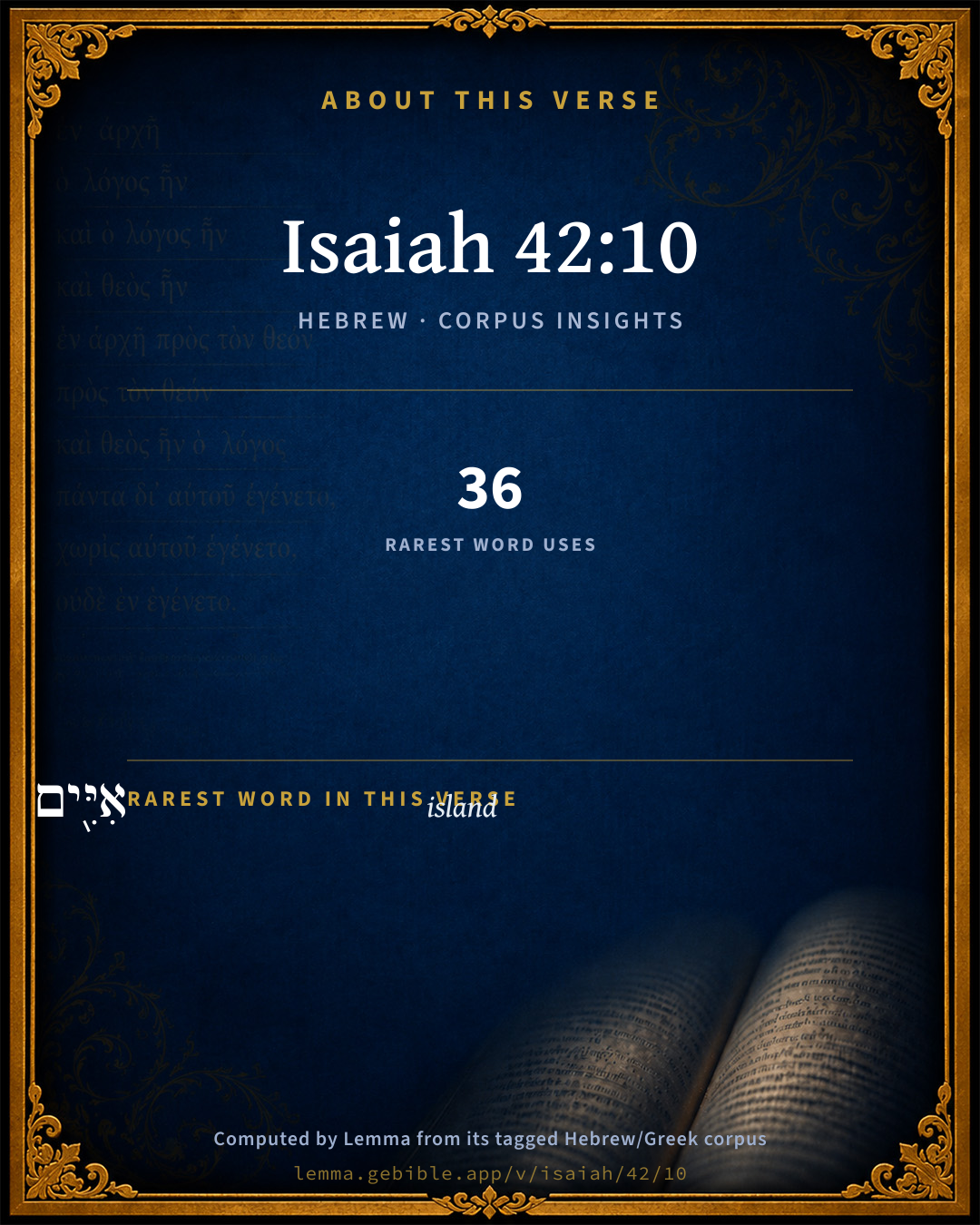
אִיִּ֖ים island H339 occurs in 35 verses of the Hebrew Bible. Also found in:

Grammatical profile

  • 3 verbs
  • 8 nouns
  • 1 adjective

Verb forms

  • שִׁ֤ירוּ Qal · Imperative
  • יוֹרְדֵ֤י Qal · Participle Active
  • וְיֹשְׁבֵיהֶֽם Qal · Participle Active

Hebrew & Septuagint length

In English translation the verse runs 34 words from the Hebrew and 40 from the Septuagint (LXX English) — closely comparable.

A rough comparison of the two English renderings, which tokenize alike — not a word-level alignment.

Word counts can differ between the Hebrew and the Greek without any difference in meaning — e.g. the Hebrew direct-object marker אֵת has no separate Greek word, and Greek often adds the article ὁ.

Cross-references

23

Topical passages linked to Isaiah 42:10 in the Treasury of Scripture Knowledge — connected by theme and wording, ordered by reader-vote popularity; previews shown in the World English Bible.

  • Psalms 33:3 Sing to him a new song. Play skillfully with a shout of joy!
  • Psalms 40:3 He has put a new song in my mouth, even praise to our God. Many shall see it, and fear, and shall trust in Yahweh.
  • Isaiah 42:4 He will not fail nor be discouraged, until he have set justice in the earth; and the isles shall wait for his law.
  • Romans 15:9–11 and that the Gentiles might glorify God for his mercy. As it is written, "Therefore will I give praise to you among the Gentiles, And sing to your name."
  • Psalms 98:1–4 Sing to Yahweh a new song, For he has done marvelous things! His right hand, and his holy arm, have worked salvation for him.
  • Isaiah 49:13 Sing, heavens; and be joyful, earth; and break forth into singing, mountains: for Yahweh has comforted his people, and will have compassion on his afflicted.
  • Revelation 5:9 They sang a new song, saying, "You are worthy to take the book, And to open its seals: For you were killed, And bought us for God with your blood, Out of every tribe, language, people, and nation,
  • 1 Chronicles 16:32 Let the sea roar, and the fullness of it; Let the field exult, and all that is therein;
  • Psalms 96:1–3 Sing to Yahweh a new song! Sing to Yahweh, all the earth.
  • Psalms 96:11 Let the heavens be glad, and let the earth rejoice. Let the sea roar, and it's fullness!
  • Psalms 97:1 Yahweh reigns! Let the earth rejoice! Let the multitude of islands be glad!
  • Psalms 107:23–32 Those who go down to the sea in ships, Who do business in great waters;
  • Psalms 117:1–2 Praise Yahweh, all you nations! Extol him, all you peoples!
  • Psalms 148:1–14 Praise Yah! Praise Yahweh from the heavens! Praise him in the heights!
  • Psalms 150:6 Let everything that has breath praise Yah! Praise Yah!
  • Isaiah 24:14–16 These shall lift up their voice, they shall shout; for the majesty of Yahweh they cry aloud from the sea.
  • Isaiah 44:23 Sing, you heavens, for Yahweh has done it; shout, you lower parts of the earth; break forth into singing, you mountains, O forest, and every tree therein: for Yahweh has redeemed Jacob, and will glorify himself in Israel.
  • Isaiah 49:6 yes, he says, It is too light a thing that you should be my servant to raise up the tribes of Jacob, and to restore the preserved of Israel: I will also give you for a light to the Gentiles, that you may be my salvation to the end of the earth.
  • Isaiah 51:5 My righteousness is near, my salvation is gone forth, and my arms shall judge the peoples; the isles shall wait for me, and on my arm shall they trust.
  • Isaiah 60:9 Surely the isles shall wait for me, and the ships of Tarshish first, to bring your sons from far, their silver and their gold with them, for the name of Yahweh your God, and for the Holy One of Israel, because he has glorified you.
  • Isaiah 65:14 behold, my servants shall sing for joy of heart, but you shall cry for sorrow of heart, and shall wail for vexation of spirit.
  • Zephaniah 2:11 Yahweh will be awesome to them, for he will famish all the gods of the land. Men will worship him, everyone from his place, even all the shores of the nations.
  • Revelation 14:3 They sing a new song before the throne, and before the four living creatures and the elders. No one could learn the song except the one hundred forty-four thousand, those who had been redeemed out of the earth.

Cross-references courtesy of OpenBible.info (CC BY 4.0).

Hebrew and Greek witnesses Masoretic Hebrew ↔ Greek Septuagint

The same verse in the two great witnesses to the Old Testament, shown verse-for-verse.

These are two independent witnesses, not word-aligned to each other, and the Septuagint is shown in lemma (dictionary) form.

Hebrew Isaiah 42:10 Masoretic · Westminster Leningrad Codex

שִׁ֤ירוּ לַֽיהוָה֙ שִׁ֣יר חָדָ֔שׁ תְּהִלָּת֖וֹ מִקְצֵ֣ה הָאָ֑רֶץ יוֹרְדֵ֤י הַיָּם֙ וּמְלֹא֔וֹ אִיִּ֖ים וְיֹשְׁבֵיהֶֽם

Sing to Yahweh a new song, and his praise from the end of the earth; you who go down to the sea, and all that is therein, the isles, and the inhabitants of it.

World English Bible · Public Domain

Greek LXX Isaiah 42:10 Septuagint · lemma form

ὑμνέω ὁ κύριος ὕμνος καινός ὁ ἀρχή αὐτός δοξάζω ὁ ὄνομα αὐτός ἀπό ἄκρος ὁ γῆ ὁ καταβαίνω εἰς ὁ θάλασσα καί πλέω αὐτός ὁ νήσος καί ὁ καταοἰκέω αὐτός

Sing a new hymn to the Lord: you⌃ who are his dominion, glorify his name from the end of the earth: you⌃ that go down to the sea, and sail upon it; the islands, and they that dwell in them.

LXX2012 (modern English Septuagint) · Public Domain

Hebrew: Westminster Leningrad Codex (CC BY 4.0). Greek: Septuagint (public domain); English from LXX2012 (modern English Septuagint) (Public Domain). How the Septuagint differs from the Hebrew →

Targum (Aramaic paraphrase)

1

The Targum is the ancient Jewish Aramaic paraphrase of the Hebrew Scriptures — an interpretive translation, not the Hebrew text itself. Onkelos (literal) and Pseudo-Jonathan (expansive) render the Torah, and Jonathan the Prophets. Coverage is partial: where no permissively-licensed English translation exists for a verse, only the Aramaic is shown. This is verse-level text, not a word-by-word alignment to the Hebrew.

  1. Targum Jonathan Prophets (Joshua–Malachi)
    שַׁבָּחוּ קֳדָם יְיָ תּוּשְׁבַּחְתָּא חַדְתָּא אֱמָרוּ תּוּשְׁבַּחְתֵּהּ מִסְיָפֵי אַרְעָא נַחֲתֵי יַמָא וּמְלָאָהּ נַגְוָן וְיָתְבֵיהוֹן:

    Sing unto the Lord a new song, proclaim His praise from the ends of the earth, ye that go down to the sea, and its fulness; the isles, and the inhabitants thereof.

    Targum Jonathan — Aramaic: “Mikraot Gedolot” (public domain). English: “Sefaria Community Translation” (CC0 1.0 (public-domain dedication)); “London "Chaldee Paraphrase," 1871” (public domain). Text via Sefaria.

Commentary

Notes on Isaiah 42:10 from classic Christian and Jewish commentators (each source and its license shown beneath its notes). The classic Christian expositions comment on the surrounding passage and are grouped to its opening verse, so a note may address several verses; the Jewish commentaries on the Tanakh (Rashi and others) are per-verse, so they appear only where the commentator wrote on this verse.

Lemma curates 59 commentaries, every one of them public domain or Creative Commons licensed, each selected and text-cleaned for this edition rather than reprinted as found. About our sources →

Trapp's Complete Commentary

John Trapp

Isa 42:10 Sing unto the LORD a new song, [and] his praise from the end of the earth, ye that go down to the sea, and all that is therein; the isles, and the inhabitants thereof.

Ver. 10. Sing unto the Lord a new song.] The disputation being ended, and God having clearly got the better, the prophet singeth this gratulatory song, and calleth upon others to bear a part with him therein, and especially for Christ and his benefits before mentioned.

Ye that go down to the sea,] i.e., That dwell toward the west of Judea.

John Trapp, A Commentary or Exposition upon All the Books of the Old and New Testament (1647–1656) — public domain. Text from a community e-Sword module.

The Biblical Illustrator

Joseph S. Exell

Isa_42:10

Sing unto the Lord a new song

New things and a new song

The new things become the impulse and matter of a new song, such as was never yet heard in the heathen world.

(F. Delitzsch, D. D.)

Joy among the heathen

Reduced to ordinary prose style, it is a prediction that changes are to take place joyfully affecting the condition of the whole world. (J. A. Alexander.)

The Biblical Illustrator, edited by Joseph S. Exell (c. 1880s–1900s) — public domain. Text from a community e-Sword module.

Joseph Benson's Commentary

Isa 42:10; Isa 42:12. Sing unto the Lord a new song — Upon this new and great occasion, the salvation of the world by Christ. It is with peculiar propriety and elegance that the nations are here called upon and exhorted to praise and extol Jehovah, for the singular blessing conferred upon them by the gospel. And his praise from the end of the earth — All nations, from one end of the earth to another. Ye that go down to the sea — You that go by sea, carry these glad tidings from Judea, where Christ was born, and lived, and died, and published the gospel, unto the remotest parts of the earth. Let the wilderness, &c. — Those parts of the world which are now desolate and forsaken of God, and barren of all good fruits. The villages that Kedar doth inhabit — The Arabians, who were a heathen and barbarous people, and are put for all nations. Let them shout from the top of the mountains — Whose inhabitants are commonly more savage and ignorant than others. Let them declare his praise in the islands — In the remotest parts of the world, as well as in Arabia, which was near to them.

Joseph Benson's Commentary on the Old and New Testaments (1811–1818) — public domain. Text from a community e-Sword module.

Whedon's Commentary on the Bible

Daniel D. Whedon

10-13. Sing… a new song — On this marvellous unseen religious development which is to fill the whole earth, God calls for jubilation. The “new things” furnish the impulse for a “new song.” This means not only fresh praise but a fresh occasion for it. The whole world of the heathen are summoned to join in it.

Standing on some Palestinian eminence, the prophet’s eye sweeps the circle of the earth — lands to the far east, and waters to the west and south.

Ye that go down to the sea — The Red Sea on the south, and the Mediterranean on the west.

The isles, and the inhabitants thereof — These take in all the populous western shores; the beautiful shephelah, or plains stretching in length from Carmel to the South Land, and in width to the foot hills of the Palestinian range.

The wilderness and the cities thereof — These are the vast steppes eastward, yet to be ideally more blooming, (Isa_35:1,) and to become hospitable tracts for towns and cities, like oases and great river valleys.

Kedar — This includes the wild Ishmaelites, and their peaceful civilization is implied.

All these are summoned to lift, with grand good will, their voices in praise of the forthcoming renovation of mankind. The strong imagery of Isa_42:10 indicates that the things predicted are the ultimate sure triumphs of the Gospel in all the earth. God, in his almightiness, pledges it. Time is never noted, but all shall come to pass in his own time. Non-infringement of the free human will is the divine principle of action, and this necessitates time on and for the human side. The promise as to extent of renovation has no limit, either in amplitude or completeness.

Daniel D. Whedon (gen. ed.), Commentary on the Old and New Testaments (1874–1909) — public domain. Text from a community e-Sword module.

Tyndale Open Study Notes

Tyndale Open Resources

42:10-11 The various geographical regions represent the extremes of human habitation. The whole earth is called to praise God for his commitment to redeem humanity. • Kedar and Sela (42:11; see also 16:1; 21:16-17) were representative desert sites.

Tyndale Open Study Notes — © Tyndale Open Resources, licensed CC BY-SA 4.0. Text via the HelloAO Bible API.

Jamieson, Fausset & Brown

Robert Jamieson, A. R. Fausset & David Brown

new song--such as has never before been sung, called for by a new manifestation of God's grace, to express which no hymn for former mercies would be appropriate. The new song shall be sung when the Lord shall reign in Jerusalem, and all "nations shall flow unto it" (Isa 2:2; Isa 26:1; Rev 5:9; Rev 14:3).

ye that go down to the sea--whose conversion will be the means of diffusing the Gospel to distant lands.

all . . . therein--all the living creatures that fill the sea (Psa 96:11) [MAURER]. Or, all sailors and voyagers [GESENIUS]. But these were already mentioned in the previous clause: there he called on all who go upon the sea; in this clause all animals in the sea; so in Isa 42:11, he calls on the inanimate wilderness to lift up its voice. External nature shall be so renovated as to be in unison with the moral renovation.

Jamieson, Fausset & Brown — Commentary Critical and Explanatory on the Whole Bible (1871) — public domain (CC PDM 1.0). Text via the HelloAO Bible API.

Adam Clarke's Commentary

Verse 10. Ye that go down to the sea] This seems not to belong to this place; it does not well consist with what follows, "and the fulness thereof." They that go down upon the sea means navigators, sailors, traders, such as do business in great waters; an idea much too confined for the prophet, who means the sea in general, as it is used by the Hebrews, for the distant nations, the islands, the dwellers on the sea-coasts all over the world. I suspect that some transcriber had the 23d verse of Psalm cvii. Ps 107:23 running in his head, יורדי הים באניות yoredey haiyam booniyoth, and wrote in this place יורדי הים yoredey haiyam instead of ירעם הים yiram haiyam, or יריע yari, or ירן yaran; "let the sea roar, or shout, or exult." But as this is so different in appearance from the present reading, I do not take the liberty of introducing it into the translation. Conjeceram legendum יגידו yegidu, ut Isa 42:12; sed non favent Versiones. "I would propose to read יגידו yegidu, as in Isa 42:12; but this is not supported by the Versions." -Secker.

Adam Clarke's Commentary on the Bible (1810–1826) — public domain. Text from a community e-Sword/MySword module.

Ellicott's Commentary for English Readers

(10) Sing unto the Lord a new song.—The words are familiar in the Psalms (Psa_33:3; Psa_40:3; Psa_98:1) and are probably quoted from them. The only touch of definite localisation is found in the mention of Kedar. (See Note on Isa_21:16.) Starting from this, the other terms gain a more defined significance. The proclamation seems to be addressed to the nations of the Eastern, not the Western world, as if to the ships that sailed from Elath or Ezion-geber down the Elanitic Gulf. The rock, or Sela (see Isa_16:1), is the Petra of Roman Idumæa; the ships are those that trade to Ophir or the land of Sinim. The cities and the nomad tribes are all invited to join in the hymn of praise, and it is to be echoed in the far-off “islands,” or coasts, of the Indian Ocean.

A Bible Commentary for English Readers, edited by Charles John Ellicott (1878–1897) — public domain. Text from a community e-Sword module.

The Cambridge Bible for Schools and Colleges

gen. ed. J. J. S. Perowne

10–13. The mention of “new things” in Isa_42:9 suggests this “new song,” in which the creation is called to celebrate Jehovah’s redemption of His people. The expression is common in the Psalms (Psa_33:3 Psa_40:3, Psa_96:1, Psa_98:1, Psa_144:9, Psa_149:1; cf. Rev_14:3). These Psalmists probably borrowed the term from our prophet, whose use of it bears the stamp of originality. It is a song “such as has never been heard in the heathen world” (Delitzsch). see ch. Isa_24:14-16.

from the end of the earth] means (as in Gen_19:4; Jer_51:31) “from end to end.”

ye that go down to the sea] seafarers, cf. Psa_107:23. There is some awkwardness in the following words: and all that is therein (lit. “and the fulness thereof”), which are naturally parallel to “the sea” and not to “those who go down to it.” The harshness is removed by a plausible emendation of Lowth, who reads the whole clause in accordance with Psa_96:11; Psa_98:7 let the sea roar and the fulness thereof (יִרְעם for יו̇רְדֵי).

the isles] see on ch. Isa_40:15. The mention of the sea and its coasts before the land is one indication of the prominence which the western lands have in the mind of this prophet.

The Cambridge Bible for Schools and Colleges (gen. ed. J. J. S. Perowne; Cambridge University Press, 1878–1918) — public domain. Text from a community e-Sword module.

John Gill's Exposition

Sing unto the Lord a new song,.... On account of the new things before prophesied of, and now done; on account of redemption and salvation by Christ, and the conversion of the Gentiles through the light of the Gospel brought among them; the song of redeeming love, and for the Gospel, and regenerating grace; and not the Jews only, but the Gentiles also, are called upon to sing this song, as having a special share in the blessings, the subject of it: hence it follows,

and his praise from the end of the earth; thither the Gospel being sent, and there made effectual to the conversion of many, these are exhorted to sing and show forth the praises of him who had called them out of Heathenish blindness and darkness into the marvellous light of the Gospel and grace of God:

ye that go down into the sea; in ships, that trade by sea; such as the Phoenicians, Tyrians, and Sidonians, to whom the Gospel came, and where it was preached with success, to the conversion of many of them, and therefore had reason to join in this new song; see Act 11:19 or such that went by sea to distant parts, on purpose to publish the Gospel, as Paul, Barnabas, Silas, and Timothy; and who, succeeding in their work, had reason to rejoice; see Act 13:4,

and all that is therein: or "the fulness of it" (s); meaning not the fishes in it, but the islands of it, as next explained:

the isles, and the inhabitants thereof; as Cyprus, Crete, and other isles, which heard the joyful sound of the Gospel, and embraced it, Act 13:4, and, as the sea often denotes the western part of the world from Judea, this may design the European parts of it, and the islands in it, particularly ours of Great Britain and Ireland, whither the Gospel came very early.

(s) "et plenitudo ejus", Munster, Pagainus, Montanus.

John Gill's Exposition of the Whole Bible (1746–1763) — public domain (CC PDM 1.0). Text via the HelloAO Bible API.

Albert Barnes' Notes on the Bible

Sing unto the Lord a new song - It is common, as we have seen, to celebrate the goodness of God in a hymn of praise on the manifestation of any special act of mercy (see the notes at Isa 12:1-6; Isa 25:1-12; 26) Here the prophet calls upon all people to celebrate the divine mercy in a song of praise in view of his goodness in providing a Redeemer. The sentiment is, that God’s goodness in providing a Saviour demands the thanksgiving of all the world.

A new song - A song hitherto unsung; one that shall be expressive of the goodness of God in this new manifestation of his mercy. None of the hymns of praise that had been employed to express his former acts of goodness would appropriately express this. The mercy was so great that it demanded a song expressly made for the occasion.

And his praise frown the end of the earth - From all parts of the earth. Let the most distant nations who are to be interested in this great

Ye that go down to the sea - That is, traders, navigators, merchants, seamen; such as do business in the great waters. The sense is, that they would be interested in the plan of mercy through a Redeemer; and hence, they are called on to celebrate the goodness of God (compare the notes at Isa 60:5). This is referred to by the prophet, first, because of the great multitude who thus go down to the sea; and, secondly, because their conversion will have so important an influence in diffusing the true religion to distant nations.

And all that is therein - Margin, as Hebrew, ‘The fullness thereof.’ All that fill it; that is, either in ships, or by dwelling on the islands and coasts. The meaning is, that all who were upon the sea - the completeness, the wholeness of the maritime population, being equally interested with all others in the great salvation, should join in celebrating the goodness of God.

The isles - A large portion of the inhabitants of the world are dwellers upon islands. In modern times, some of the most signal displays of the divine mercy, and some of the most remarkable conversions to Christianity, have been there. In the Sandwich Islands, and in Ceylon, God has poured out his Spirit, and their inhabitants have been among the first in the pagan world to embrace the gospel.

Albert Barnes' Notes on the Bible (1834–1885) — public domain. Text from a community e-Sword/MySword module.

Haydock's Catholic Bible Commentary

All. Literally, "its fullness," (Haydock) sailors, (Calmet) and fishes. (Haydock) --- He concludes with a canticle.

George Leo Haydock (1774–1849), Haydock's Catholic Family Bible and Commentary, 1859 edition — public domain. Excludes Psalms (Douay-Rheims chapter numbering differs from Protestant) and Deuterocanonical books (Catholic canon only).

Matthew Poole's English Annotations

Sing unto the Lord a new song, upon this new and great occasion, the calling and salvation of the world by Christ.

From the end of the earth; all nations, from one end of the earth. to another, who shall be sharers in this mercy.

Ye that go down to the sea, & c.; you that go by sea, carry these glad tidings from Judea, where Christ was born, and lived, and died, and published the gospel, unto the remotest parts of the earth, that they may join with you in singing forth God’s praises for his marvellous kindness and grace to them.

Matthew Poole's English Annotations on the Holy Bible (1683–1685) — public domain. Text from a community e-Sword/MySword module.

The Pulpit Commentary

Sing unto the Lord a new song. The call for a "new song" is based upon the ground that the mercy vouchsafed was a "new" one (see ver. 9). The expression is frequent in the Psalms. (Psa_33:3 Psa_96:1 Psa_98:1 Psa_144:9 Psa_149:1) His praise from the end of the earth; i.e. "let his praise be sung by all the inhabitants of the earth to its remotest bounds." The sea. Sea and land are called upon equally to proclaim God"s praise; the sea, "and its fulness" (margin) those who frequent it in ships, and those who dwell on its shores and islands. The last clause, "the isles and the inhabitants thereof," is exegetical of the preceding one all that is therein.

Vers. 10-12. The duty of sympathizing with the joys of others.

Compassion for those who suffer is a strong and powerful feeling, well developed in human nature, and widely spread among all classes and conditions of men. A real feeling of glad sympathy with those who are exceptionally prosperous is a far rarer emotion, and seldom attains any great intensity. Yet, in the nature of things, the two duties would seem to be co-ordinate and to balance each other. "Rejoice with them that do rejoice, and weep with them that weep". (Rom_12:15) In the present passage of Isaiah the whole world seems to be called upon to sympathize with Israel"s deliverance from captivity, and its consequences, which were the re-establishment of a visible Church of God upon the earth a Church which would be a perpetual witness for him, and out of which, in a certain sense, would be developed that "Church of Christ," against which the gates of hell would not prevail, and which would continue "even to the end of the world." No doubt the whole world was interested in these results, and might thus be regarded as having reason to rejoice for their own sake; but the call made upon them is not rested on any such grounds. It bases itself simply on the general duty of good will which men owe to their fellows. Here we may note two forms of the duty.

I AS INDIVIDUALS, WE SHOULD REJOICE IN THE JOY AND PROSPERITY OF OUR NEIGHBOURS. Condolence is common; congratulation is less frequent. Our neighbours" successes and triumphs too often raise in us a certain feeling of jealousy and discontent, which prevents us from offering congratulations, or makes those that we offer insincere. "Why are they so much more favoured than ourselves? What have they done to deserve their advancement?" All such thoughts ought to be put aside. "It is God that ruleth in Jacob, and unto the ends of the earth." All prosperity is from God-at the least, allowed by him. We are bound, by the love that we ought to bear to our fellow-men, to be glad when good befalls them to put ourselves and our own claims and deservings out of sight, and simply to rejoice in their joy.

II AS MEMBERS OF A NATION, WE SHOULD REJOICE IN THE JOY AND PROSPERITY OF NEIGHBOURING NATIONS. The indifferent Beni-Kedar, the hostile Idumaeans, are required by God to sing a song of praise for Israel"s restoration to their own country. The isles and maritime tracts of the West are to do the same. Nations are, all of them, members of the one human family, intimately connected one with another, and bound to have friendly feelings one towards another. Petty quarrels and differences, such as crop up between near relations, and still more between neighbouring peoples, should not be allowed to overpower the general sentiment of good will, or to prevent the exhibition of sympathy when occasion arises. National enmities would be greatly softened if nations generally would show satisfaction in each other"s successes and prosperity, even if such an exhibition of satisfaction were limited to cases where the success gained by the one in no way interfered with the interests of the other.

Vers. 10-25. A new song to Jehovah.

Caught up in his ecstasy to a high place of vision, the prophet sees all the nations of mankind deriving blessing from the ministry of Israel, and calls upon them to join in a song of praise. God"s goodness in providing a Redeemer demands the thanksgiving of all the world.

I THE SONG AND THE SINGERS. The new song is named in the Psalter, (Psa_96:1 Psa_98:1) meaning a song inspired by the sense of new mercies. All parts of the earth are to join in the chorus: the sailors, and even all the finny inhabitants of the deep; (Psa_34:1) the nomads and the dwellers in cities and among the rocks, shall join to swell the volume of his mighty song.

II THE GREAT DEEDS OF THE ALMIGHTY. It is a great and terrible day of Jehovah. He, breaking his long silence and reserve, will march forth like a mighty hero, with a loud battle-shout, and put forth all his prowess. (For similar pictures of the God of war, see Isa_28:21 Isa_31:4 Isa_59:16 Zec_9:13, 14 14:3) The whole imagery bespeaks the most intense emotion. God may be silent, may seem to disregard the prayers of his people; but he is not dead, nor is he sleeping, like a Baal. He is waiting; he is ripening his purposes. He is looking for his opportunity. When he comes forth his progress will be marked by judgment and by redemption. These are the two sides, the dark and the bright, of his work. As Judge and Avenger. he will devastate the mountains and hills the high places of heathendom; and the fertile vineyards on their slopes, and all the temples, fanes, and altars, will be demolished. Under the figures is expressed the coming of a great spiritual revolution. The old corrupt order and custom of the world must first give way before the new and holy can come in. And then, amidst the dismay of the false worshippers, light will at the same time appear to the righteous. "I will lead the blind by a way which they knew not; through paths they have not known I will make them to go: I will turn darkness into light before them, and rough places into a table-land. Those things I will surely do, and I will not let them slip." By the "blind" appears to be meant, not so much the spiritually ignorant as the perplexed, distressed, desponding those who "walk in obscurity". (Isa_59:9, Isa_59:10) It is the language of tenderness, and the language of strong assurance, founded on superior knowledge. What more common than the experience of the Christian, "Darkness is about me; my way is hedged in; there is no outlook, no prospect"? Yet suddenly it may be while he is on his knees, it may be in some moment of refreshing sleep a change comes. The clouds lift; the hosts of the enemy fall back; the: "large place" is reached. Then he sees how blind, how "faint-hearted, incredulous, and undiscerning" he has been. Let us tread the path of duty, which is the path of faith; it will surely lead, before our journey closes, out to those "shining table-lands to which our God himself is Sun and Moon." And let us lay the reproach of the "blind and deaf servant" to heart. We are among the fainthearted and the incredulous despite all our experience of God"s goodness whom he here addresses. We are like "the man of mature years and experience, by which he has failed to profit." And thus we are reduced to that mood of humility in which there is every hope. Why this contrast between the design of God to exalt his law of righteousness by means of Israel, and Israel"s despoiled and captive estate? Clearly it is because of Israel"s sins because, though chosen of God, they would not walk in God"s ways. So let every argument end between ourselves and God "that thou mightest be justified when thou speakest, and be clear when thou judgest." Let us return unto him and be saved. J.

The Pulpit Commentary (1880–1919), ed. H.D.M. Spence-Jones & Joseph S. Exell — public domain. Text from a community e-Sword module.

John Wesley's Explanatory Notes

Sing - Upon this new and great occasion, the salvation of the world by Christ. From the end - All nations from one end of the earth to another. Ye - You that go by sea carry these glad tidings from Judea, where Christ was born, and lived, and died, and published the gospel, unto the remotest parts of the earth.

John Wesley, Explanatory Notes Upon the Whole Bible (1754–1765) — public domain. Text via the GEBible commentary corpus.

Keil & Delitzsch

C. F. Keil & F. Delitzsch

The prediction of these "new things," which now follows, looks away from all human mediation. They are manifestly the work of Jehovah Himself, and consist primarily in the subjugation of His enemies, who are holding His people in captivity. "Sing ye to Jehovah a new song, His praise from the end of the earth, ye navigators of the sea, and its fulness; ye islands, and their inhabitants. Let the desert and the cities thereof strike up, the villages that Kedar doth inhabit; the inhabitants of the rock-city may rejoice, shout from the summits of the mountains. Let them give glory to Jehovah, and proclaim His praise in the islands. Jehovah, like a hero will He go forth, kindle jealousy like a man of war; He will breath forth into a war-cry, a yelling war-cry, prove Himself a hero upon His enemies." The "new things" furnish the impulse and materials of "a new song," such as had never been heard in the heathen world before. This whole group of vv. is like a variation of Isa 24:14-15. The standing-place, whence the summons is uttered, is apparently Ezion-geber, at the head of the Elanitic Gulf, that seaport town from which in the time of the kings the news of the nations reached the Holy Land through the extensive commerce of Israel. From this point the eye stretches to the utmost circle of the earth, and then returns from the point where it meets with those who "go down to the sea," i.e., who navigate the ocean which lies lower than the solid ground. These are to sing, and everything that lives and moves in the sea is to join in the sailors' song. The islands and coast lands, that are washed by the sea, are likewise to sing together with their inhabitants. After the summons has drawn these into the net of the song of praise, it moves into the heart of the land. The desert and its cities are to lift up (viz., "their voice"), the villages which Kedar inhabits. The reference to Sela', the rock-city of Edomitish Nabataea, which is also mentioned in Isa 16:1 (the Wadi Musa, which is still celebrated for its splendid ruins), shows by way of example what cities are intended. Their inhabitants are to ascend the steep mountains by which the city is surrounded, and to raise a joyful cry (yitsvâchū, to cry out with a loud noise; cf., Isa 24:11). Along with the inhabitants of cities, the stationary Arabs, who are still called Hadariye in distinction from Wabariye, the Arabs of the tents, are also summoned; hadar (châtsēr) is a fixed abode, in contrast to bedû, the steppe, where the tents are pitched for a short time, now in one place and now in another. In Isa 42:12 the summons becomes more general. The subject is the heathen universally and in every place; they are to give Jehovah the glory (Psa 56:2), and declare His praise upon the islands, i.e., to the remotest ends of the whole world of nations. In Isa 42:13 there follows the reason for this summons, and the theme of the new song in honour of the God of Israel, viz., His victory over His enemies, the enemies of His people. The description is anthropomorphically dazzling and bold, such as the self-assurance and vividness of the Israelitish idea of God permitted, without any danger of misunderstanding. Jehovah goes out into the conflict like a hero; and like a "man of war," i.e., like one who has already fought many battles, and is therefore ready for war, and well versed in warfare, He stirs up jealousy (see at Isa 9:6). His jealousy has slumbered as it were for a long time, as if smouldering under the ashes; but now He stirs it up, i.e., makes it burn up into a bright flame. Going forward to the attack, יריע, "He breaks out into a cry," אף־יצריח, "yea, a yelling cry" (kal Zep 1:14, to cry with a yell; hiphil, to utter a yelling cry). In the words, "He will show Himself as a hero upon His enemies," we see Him already engaged in the battle itself, in which He proves Himself to possess the strength and boldness of a hero (hithgabbar only occurs again in the book of Job). The overthrow which heathenism here suffers at the hand of Jehovah is, according to our prophet's view, the final and decisive one. The redemption of Israel, which is thus about to appear, is redemption from the punishment of captivity, and at the same time from all the troubles that arise from sin. The period following the captivity and the New Testament times here flow into one.

Keil & Delitzsch — Biblical Commentary on the Old Testament (1861–1891) — public domain (CC PDM 1.0). Text via the HelloAO Bible API. (Old Testament only.)

J. A. Alexander on Isaiah

Joseph Addison Alexander

“Sing to Jehovah a new song, His praise from the end of the earth, (ye) going down to the sea and its fullness, isles and their inhabitants!” To sing a new song, according to Old Testament usage, is to praise God for some new manifestation of His power and goodness. It implies, therefore, not only fresh praise, but a fresh occasion for it. Reduced to ordinary prose style, it is a prediction that changes are to take place, joyfully affecting the condition of the whole world. That this is a hyperbole, relating to the restoration of the Jews from Babylon, is too gratuitous and forced a supposition. Its fullness may either be connected with the sea, and both made dependent on go down (to the sea and its fullness), or regarded as a distinct object of address. In the latter case, the marine animals would seem to be intended; in the former, the whole mass of water with its contents; the last is more poetical and natural. The antithesis is then between the sea with its frequenters on the one hand and the isles with their inhabitants on the other.

Joseph Addison Alexander, The Prophecies of Isaiah (1846–1847; New York: Scribner, 1870–1878) — public domain. Text from a community e-Sword module.

Kretzmann's Popular Commentary

Paul E. Kretzmann

The Joy Over the Judgment of Condemnation upon the Ungodly

v. 10. Sing unto the Lord a new song, Psa 33:3; Psa 40:3, a hymn of praise in honor of the new things promised, a psalm lauding His mercy in the Savior, and His praise from the end of the earth, so that the whole earth resounds with it, ye that go down to the sea, the seafaring inhabitants of the isles and coasts of the Mediterranean Sea, and all that is therein, all the marine animals being called upon to join in this praise of the Lord; the isles and the inhabitants thereof, that is, all the people of the earth.

v. 11. Let the wilderness and the cities thereof, the great Arabian Desert with its commercial centers, lift up their voice, the villages, the fortified camps, that Kedar doth inhabit, the second son of Ishmael, Gen 25:13, being named as representative of the nomad tribes of the East; let the inhabitants of the rock, of mountainous Idumea, sing; let them shout from the top of the mountains, with a voice which carries far and wide.

v. 12. Let them give glory unto the Lord and declare His praise in the islands, the entire exhortation being summarized here.

v. 13. The Lord, in carrying out His counsel of salvation, shall go forth as a mighty man, like a hero; He shall stir up jealousy, the indignation and fury in His own heart, like a man of war, an invincible warrior; He shall cry, yea, roar, with a fearful battle-cry; He shall prevail against His enemies, boasting of His victory over all His enemies. The entire section is built up so that there can he no question of Jehovah’s final triumph. The Lord now takes up His proclamation in person once more.

v. 14. I have long time holden My peace, not interfering with the ways of men; I have been still and refrained Myself, purposely holding Himself back; now, when patience and forbearance could no longer be practiced, will I cry like a travailing woman, I will destroy and devour at once, groan, pant, and gasp.

v. 15. I will make waste mountains and hills, thereby destroying the enemies, and dry up all their herbs, as a preliminary act of the final annihilation; and I will make the rivers islands, and I will dry up the pools, thereby making their land uninhabitable. The final Judgment of the world is always included in prophecies like that here given, where one act of the preliminary punishment is sketched. But while the enemies feel the wrath of the Lord, the believers feel the riches of His blessing.

v. 16. And I will bring the blind, those who realize the condition of blindness with which they are suffering, by a way that they knew not, which they never would and could find on account of the natural perverseness of their hearts, Joh 9:39-41; I will lead them in paths that they have not known, Psa 32:8; I will make darkness light before them, so that they will not stumble and fall, and crooked things straight, removing all obstructions and making level paths everywhere, all this proclaiming the sure deliverance of the children of God. These things will I do unto them and not forsake them, for the Lord is ever by the side of those who believe in Him. By way of contrast He now refers to the unhappy condition of the idolaters, of the ungodly.

v. 17. They shall be turned back, reeling in a stupor of disappointment, they shall be greatly ashamed, heaped with disgrace, that trust in graven images, that say to the molten images, Ye are our gods. That is ever the lot of the idolaters, no matter whether their idolatry is openly practiced or held in secret only. The religion of Jesus Christ is the only true, the absolute religion.

Paul E. Kretzmann, Popular Commentary of the Bible (1921–1924) — public domain. Text from a community e-Sword module.

unfoldingWord translationNotes

Door43 World Missions Community

General Information:

Yahweh continues speaking.

the sea, and all that is in it, the coastlands, and those who live there

"and all the creatures that live in the sea, and all those who live on the coastlands"

Let the desert and the cities cry out

This refers to the people who live in the desert and the cities. (See: Metonymy)

Kedar

This is a city north of Arabia. See how this was translated in Isaiah 21:16

Sela

a city in Edom (See: How to Translate Names)

translationWords

Yahweh

praise

earth

desert

joy

unfoldingWord translationNotes — © Distant Shores Media and the Door43 World Missions Community, licensed CC BY-SA 4.0. Source: git.door43.org/Door43/en_tn.

Rashi

Rabbi Shlomo Yitzchaki (Rashi)

His praise from the end of the earth Perforce, when they see My mighty deeds for Israel, all the heathens (nations [Parshandatha, K’li Paz]) will admit that I am God.

those who go down to the sea Those who embark in ships.

and those therein Those whose permanent residence is in the sea and not in the islands, but in the midst of the water, they spill earth, each one of them, enough for a house, and go from house to house by boat, like the city of Venice. [As in Warsaw ed. and Parshandatha.]

Rashi on the Tanakh — English translations: “The Judaica Press complete Tanach with Rashi, translated by A. J. Rosenberg” (CC BY 4.0); “Pentateuch with Rashi's commentary by M. Rosenbaum and A.M. Silbermann, 1929-1934” (public domain); “The Metsudah Tanach series, Lakewood, N.J” (CC BY 4.0); and “The Book of Joshua, Metsudah Publications, 1997” (CC BY 4.0). Text via Sefaria.

Ibn Ezra

Rabbi Abraham ibn Ezra

Sing unto the Lord, etc. The prophet addresses the people in these words. They that go down to the sea, etc. For all the people of the earth will praise God at the return of Israel from the Babylonian exile (Kedar is therefore mentioned together with the inhabitants of the isles, and those that go down to the sea ), when they hear of this extraordinary event.

Ibn Ezra on the Tanakh — English translations: “Sefaria Community Translation” (CC0 1.0 (public-domain dedication)); “Yalkut, Sifsei Chachomim Chumash, Metsudah Publications, 2009” (CC BY 4.0); and “Commentary of Ibn Ezra on Isaiah - trans. by M. Friedlander, 1873” (public domain). Text via Sefaria.

Lesson kit

Teaching starters — assembled from the data on this page, not authored interpretation. Every prompt links to the verse data it draws on. Edit before teaching.

Isaiah, in the Prophets, opens this verse with 12 words (12 distinct Hebrew lemmas). Its most distinctive word is ʼîy (“island”). A historical commentator’s framing appears above. Read the whole chapter for the surrounding context.

Discussion questions

  1. How does “island” (ʼîy) shape what this verse is saying?
  2. Genesis 10:5 shares the word «island» with this verse. How do the two illuminate each other?
  3. The translations on this page render this verse differently — a whole-verse word diff, not a word-by-word alignment. What might account for the different wordings?
  4. The verb «שִׁ֤ירוּ» is Qal Imperative. How does its form color the action?
  5. Reading how Trapp's Complete Commentary and The Biblical Illustrator read this verse, where do the two commentators agree and where do they part?

Things to notice

Reading settings

Reading text

Shown beneath each verse's original-language words.

Old Testament
Old Testament edition

Read the OT as the Masoretic Hebrew (MT) or the Greek Septuagint (LXX).

English shown for the Greek Septuagint (in the Hebrew ↔ Greek comparison).

Comparing translations? Open the Compare panel on any verse page to stack up to four side by side.