
Ezekiel 19:13

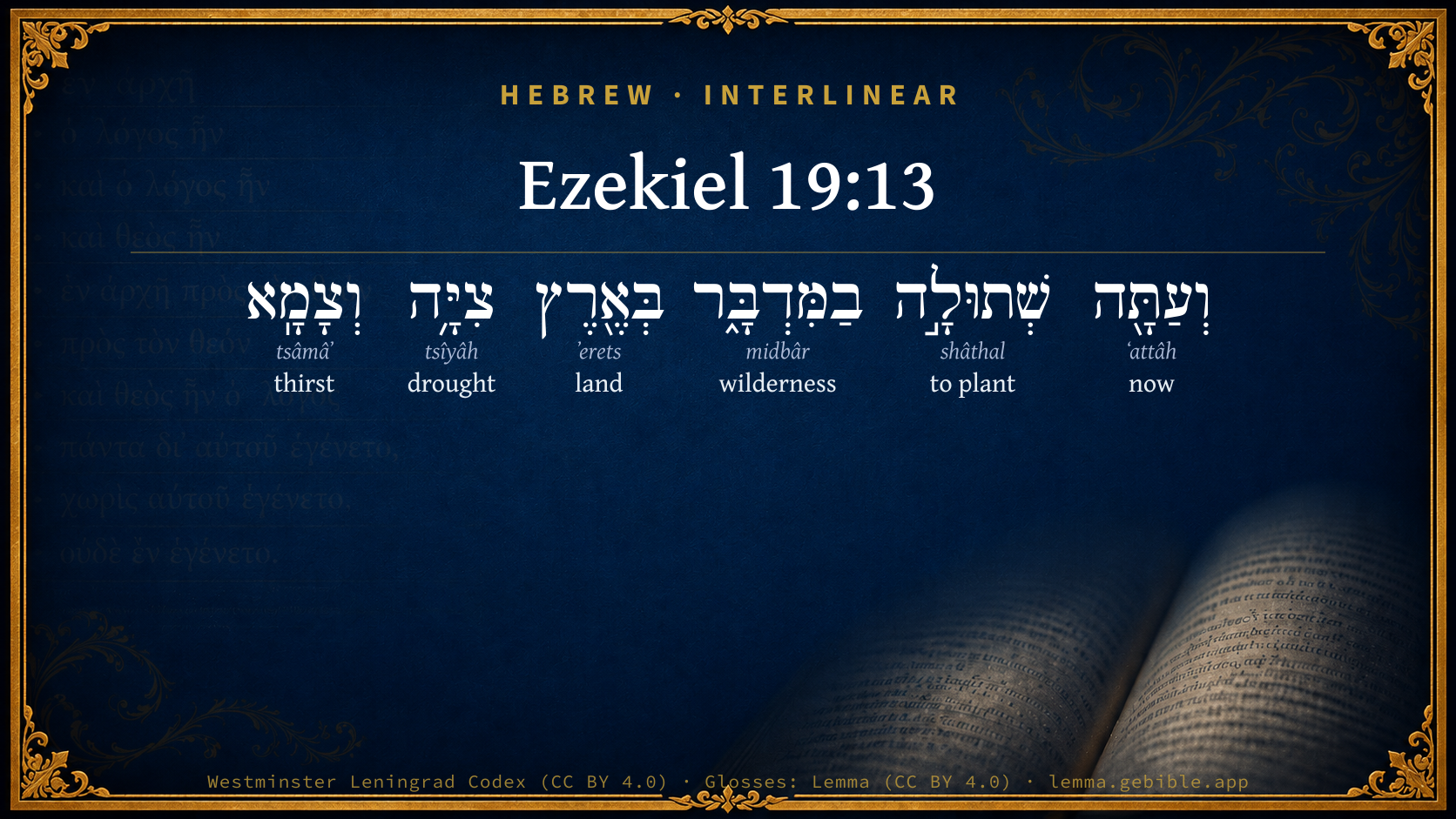
Hebrew (Westminster Leningrad Codex) Ezekiel 19:13 appears in the Hebrew Old Testament. The text above is from the Westminster Leningrad Codex. Each word links to its Strong’s number, a concise gloss, and parsing drawn from the Open Scriptures Hebrew Bible morphology. Click any word for its full Brown-Driver-Briggs (BDB) entry.
Download image
Cite this verse

Ezekiel 19:13 (World English Bible). Public Domain. Lemma interlinear Bible study tool, https://lemma.gebible.app/v/ezekiel/19/13.

Show BibTeX & RIS
BibTeX
RIS
English Translation
Now it is planted in the wilderness, in a dry and thirsty land.
World English Bible · Public Domain
Download a study sheet

One document with this verse’s original text, its word-by-word gloss line, the meaning frame, cross-references with their text, attributed commentary, and full source and license credits — printable, and it pastes into notes with its structure intact.

This verse Autodidact and up

Study sheet (.html) Plain text (.txt)

A passage Seminary Student

Up to 50 verses in one chapter. A passage sheet keeps up to 6 commentary sources and 12 cross-references per verse, in the order this page ranks them, and says so on the sheet whenever that leaves anything out. Ask for a single verse and you get the Autodidact verse sheet above.

Everything on this page stays free to read, with no account — the sheet is a download of what is already on screen, not access to it.

Want to remove ads? Support Godless Engineer
Compare translations 3

The same verse in 3 English versions, stacked beneath the original-language interlinear above. Click any original word for its lexicon entry.

Each is an independent rendering of the whole verse — the interlinear is not word-aligned to these translations.

Highlighted words mark where these versions differ — a whole-verse word diff, not a word-by-word alignment.

  • World English Bible Public Domain
    Now it is planted in the wilderness, in a dry and thirsty land.
  • King James Version Public Domain
    And now she is planted in the wilderness, in a dry and thirsty ground.
  • unfoldingWord Literal Text CC BY-SA 4.0
    So now it is planted in the wilderness, in a land of drought and thirst.

unfoldingWord Literal Text — © unfoldingWord, licensed CC BY-SA 4.0. Word-aligned USFM3 via Door43 (git.door43.org/unfoldingWord/en_ult).

Versions to compare (up to 4)

3 of 4 selected

Show all 18 translations

Every available English version of this verse, each an independent rendering of the whole verse.

  • World English Bible Public Domain
    Now it is planted in the wilderness, in a dry and thirsty land.
  • Berean Standard Bible Public Domain
    Now it is planted in the wilderness, in a dry and thirsty land.
  • Majority Standard Bible Public Domain
    Now it is planted in the wilderness, in a dry and thirsty land.
  • King James Version Public Domain
    And now she is planted in the wilderness, in a dry and thirsty ground.
  • American Standard Version (1901) Public Domain
    And now it is planted in the wilderness, in a dry and thirsty land.
  • Revised Version (1885) Public Domain
    And now she is planted in the wilderness, in a dry and thirsty land.
  • Geneva Bible (1599) Public Domain
    And now she is planted in the wildernes in a drie and thirstie ground.
  • Douay-Rheims (1899) Public Domain
    And now she is transplanted into the desert, in a land not passable, and dry.
  • Young's Literal Translation Public Domain
    And now -- it is planted in a wilderness, In a land dry and thirsty.
  • Literal Standard Version CC BY-SA 4.0
    And now she is planted in a wilderness, || In a dry and thirsty land.
  • Unlocked Literal Bible CC BY-SA 4.0
    So now it is planted in the wilderness, in a land of drought and thirst.
  • unfoldingWord Literal Text CC BY-SA 4.0
    So now it is planted in the wilderness, in a land of drought and thirst.
  • Darby Bible Public Domain
    And now it is planted in the wilderness, in a dry and thirsty ground:
  • World Messianic Bible Public Domain
    Now it is planted in the wilderness, in a dry and thirsty land.
  • Webster's Bible Public Domain
    And now she is planted in the wilderness, in a dry and thirsty ground.
  • Free Bible Version CC BY-SA 4.0
    Now the vine has been replanted in the desert, in a dry and waterless land.
  • Bible in Basic English Public Domain
    And now she is planted in the waste land, in a dry and unwatered country.
  • JPS Tanakh (1917) Public Domain
    And now she is planted in the wilderness, in a dry and thirsty ground.

Literal Standard Version (2020), Covenant Press — licensed CC BY-SA 4.0. Text via the HelloAO Bible API (eBible.org). Unlocked Literal Bible (unfoldingWord) — licensed CC BY-SA 4.0. Text via the HelloAO Bible API (eBible.org). unfoldingWord Literal Text — © unfoldingWord, licensed CC BY-SA 4.0. Word-aligned USFM3 via Door43 (git.door43.org/unfoldingWord/en_ult). Free Bible Version, Dr. Jonathan Gallagher — licensed CC BY-SA 4.0. Text via the HelloAO Bible API (eBible.org).

Word by word

More ways to search: Search by grammar → Find every occurrence → Compare this word →

Practice this passage: Drill this verse → Learn its vocabulary →

About this verse

These counts appear in no published source. They are computed here, from the morphology-tagged text and Lemma’s own curated glosses. What Lemma adds →

6
words
6
distinct lemmas
Prophets
section

Notable vocabulary

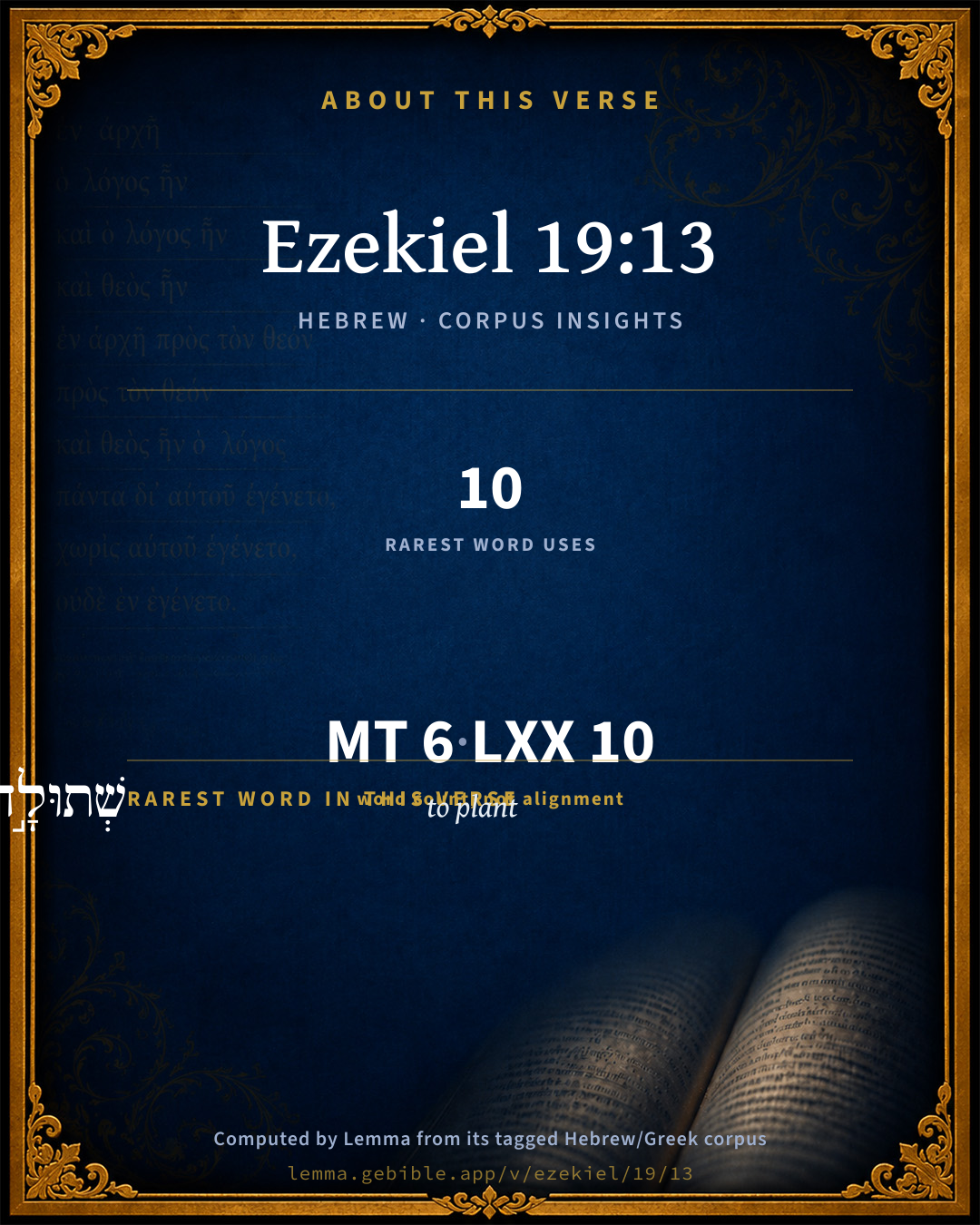
The rarest word here is שְׁתוּלָ֣ה to plant H8362 — appearing just 10 times in the whole Hebrew Bible.

Shared distinctive vocabulary

שְׁתוּלָ֣ה to plant H8362 occurs in 10 verses of the Hebrew Bible. Also found in:

Grammatical profile

  • 1 verb
  • 4 nouns
  • 1 adverb

Verb forms

  • שְׁתוּלָ֣ה Qal · Participle Passive

Hebrew & Septuagint length

In English translation the verse runs 13 words from the Hebrew and 13 from the Septuagint (LXX English) — the same length.

A rough comparison of the two English renderings, which tokenize alike — not a word-level alignment.

Word counts can differ between the Hebrew and the Greek without any difference in meaning — e.g. the Hebrew direct-object marker אֵת has no separate Greek word, and Greek often adds the article ὁ.

In the original languages it is 6 Hebrew tokens and 10 Greek tokens — but the two are counted differently (Hebrew bundles its prefixes and suffixes into one token; the Greek is in lemma form), so that isn’t a like-for-like length.

Cross-references

8

Topical passages linked to Ezekiel 19:13 in the Treasury of Scripture Knowledge — connected by theme and wording, ordered by reader-vote popularity; previews shown in the World English Bible.

  • Hosea 2:3 Lest I strip her naked, And make her bare as in the day that she was born, And make her like a wilderness, And set her like a dry land, And kill her with thirst.
  • Ezekiel 19:10 Your mother was like a vine, in your blood, planted by the waters: it was fruitful and full of branches by reason of many waters.
  • 2 Kings 24:12–16 and Jehoiachin the king of Judah went out to the king of Babylon, he, and his mother, and his servants, and his princes, and his officers: and the king of Babylon took him in the eighth year of his reign.
  • Psalms 63:1 God, you are my God. I will earnestly seek you. My soul thirsts for you, My flesh longs for you, In a dry and weary land, where there is no water.
  • Psalms 68:6 God sets the lonely in families. He brings out the prisoners with singing, But the rebellious dwell in a sun-scorched land.
  • Jeremiah 52:27–31 The king of Babylon struck them, and put them to death at Riblah in the land of Hamath. So Judah was carried away captive out of his land.
  • Ezekiel 20:35 and I will bring you into the wilderness of the peoples, and there will I enter into judgment with you face to face.
  • Deuteronomy 28:47–48 Because you didn't serve Yahweh your God with joyfulness, and with gladness of heart, by reason of the abundance of all things;

Cross-references courtesy of OpenBible.info (CC BY 4.0).

Hebrew and Greek witnesses Masoretic Hebrew ↔ Greek Septuagint

The same verse in the two great witnesses to the Old Testament, shown verse-for-verse.

These are two independent witnesses, not word-aligned to each other, and the Septuagint is shown in lemma (dictionary) form.

Hebrew Ezekiel 19:13 Masoretic · Westminster Leningrad Codex

וְעַתָּ֖ה שְׁתוּלָ֣ה בַמִּדְבָּ֑ר בְּאֶ֖רֶץ צִיָּ֥ה וְצָמָֽא

Now it is planted in the wilderness, in a dry and thirsty land.

World English Bible · Public Domain

Greek LXX Ezekiel 19:13 Septuagint · lemma form

καί νῦν φυτεύω αὐτός ἐν ὁ ἔρημος ἐν γῆ ἄνυδρος

And now they have planted her in the wilderness, in a dry land.

LXX2012 (modern English Septuagint) · Public Domain

Hebrew: Westminster Leningrad Codex (CC BY 4.0). Greek: Septuagint (public domain); English from LXX2012 (modern English Septuagint) (Public Domain). How the Septuagint differs from the Hebrew →

Targum (Aramaic paraphrase)

1

The Targum is the ancient Jewish Aramaic paraphrase of the Hebrew Scriptures — an interpretive translation, not the Hebrew text itself. Onkelos (literal) and Pseudo-Jonathan (expansive) render the Torah, and Jonathan the Prophets. Coverage is partial: where no permissively-licensed English translation exists for a verse, only the Aramaic is shown. This is verse-level text, not a word-by-word alignment to the Hebrew.

  1. Targum Jonathan Prophets (Joshua–Malachi)
    וּכְעַן דַמְיָא לְגוּפַן דִשְׁתִילָא בִּמַדְבְּרָא בְּאַרְעָא צַדְיָא וַחֲרֵיבָא:

    (no public-domain English translation for this verse)

    Targum Jonathan — Aramaic: “Mikraot Gedolot” (public domain). English: “Sefaria Community Translation” (CC0 1.0 (public-domain dedication)); “London "Chaldee Paraphrase," 1871” (public domain). Text via Sefaria.

Commentary

Notes on Ezekiel 19:13 from classic Christian and Jewish commentators (each source and its license shown beneath its notes). The classic Christian expositions comment on the surrounding passage and are grouped to its opening verse, so a note may address several verses; the Jewish commentaries on the Tanakh (Rashi and others) are per-verse, so they appear only where the commentator wrote on this verse.

Lemma curates 59 commentaries, every one of them public domain or Creative Commons licensed, each selected and text-cleaned for this edition rather than reprinted as found. About our sources →

Trapp's Complete Commentary

John Trapp

Eze 19:13 And now she [is] planted in the wilderness, in a dry and thirsty ground.

Ver. 13. And now she is planted in a wilderness.] Babylon was no wilderness, but fruitful beyond credulity, {a} But the poor captive Jews had little joy from it, for some time at least.

In a dry and thirsty ground.] In terra sicca et sitioulosa. So it was to them, though never so well watered, because they wanted there the waters of the sanctuary, and many other comforts of their own country. See Psa 137:1-6

{a} Herodot., lib. i. cap. 193; Plin., lib. vi. cap. 26.

John Trapp, A Commentary or Exposition upon All the Books of the Old and New Testament (1647–1656) — public domain. Text from a community e-Sword module.

Tyndale Open Study Notes

Tyndale Open Resources

19:13-14 The fire (probably Zedekiah) that came from the vine’s own branches consumed the fruit (the land and people). After this destruction, there was no branch left that was strong enough to be a ruler’s scepter. Zedekiah would have no immediate successor.

Tyndale Open Study Notes — © Tyndale Open Resources, licensed CC BY-SA 4.0. Text via the HelloAO Bible API.

Jamieson, Fausset & Brown

Robert Jamieson, A. R. Fausset & David Brown

planted--that is, transplanted. Though already "dried up" in regard to the nation generally, the vine is said to be "transplanted" as regards God's mercy to the remnant in Babylon.

dry . . . ground--Chaldea was well-watered and fertile; but it is the condition of the captive people, not that of the land, which is referred to.

Jamieson, Fausset & Brown — Commentary Critical and Explanatory on the Whole Bible (1871) — public domain (CC PDM 1.0). Text via the HelloAO Bible API.

Adam Clarke's Commentary

Verse 13. And now she is planted in the wilderness] In the land of Chaldea, whither the people have been carried captives; and which, compared with their own land, was to them a dreary wilderness.

Adam Clarke's Commentary on the Bible (1810–1826) — public domain. Text from a community e-Sword/MySword module.

John Calvin's Commentaries

The Prophet seems here inconsistent with himself, since these two clauses are openly at variance, that the vine was not, only withered, but burnt up, and yet planted in a desert place; for if it was withered, it could not take root again; but the burning removed the slightest hope; for when the twigs were reduced to ashes, who ever saw a vine spring up and grow from its ashes? But when the Prophet says that the vine was withered and burnt up, he refers to the conclusion which men must arrive at by their own senses when the city was utterly ruined; for that was in truth a horrible spectacle, when the people were made tributary after their king was taken, the temple, plundered, the city ruined, and their safety dependent on the lust of their conqueror. Since, therefore, neither the royal name and dignity, nor freedom and security, remained, and especially when they were led to the slaughter-house, was not their ruin very like a burning? Now, therefore, we see why the Prophet said that the vine was torn and burnt up, for that most severe destruction took away all hope of restoration for a short time. Hence he spoke according to common sense: then he kept in view that form of horrible ruin, or rather deformity, which was like a burning and a final destruction of the people. But now, when he says that the vine was planted again, he commends the mercy of God, who wished some seed to remain for the production of young plants; as it is said in the first chapter of Isaiah, Lest you should be in like Sodom and Gomorrah, some small seed has been wonderfully preserved. Although, therefore, the people were burnt up after being violently plucked up, and all their lives subjected to the will of the proudest, of conquerors, yet God took some twigs or vine branches, which he planted, that he might propagate a new nation, which was done at the people’s return.

But he says that those vine branches were planted in the desert in the dry and thirsty land, since God preserves the religion of his people even in death. Hence he compares their exile to a desert and a wilderness. It may seem absurd at first sight that, Chaldaea should be likened to a desert, since that district we know to be remarkable for its fertility and other advantages; we know, too, that it was well watered, though called dry. But the Prophet here does not, consider the material character of the country, but the condition of the people in it. Although Chaldaea was most lovely, and full of all kinds of fruits, yet, since the people were cruelly oppressed and contemptuously treated, hence the land was called a desert. We say that no prison is beautiful, so that their exile could not be agreeable to the children of Israel; for they were ashamed of their life, and did not dare to raise their eyes upwards. Since, then, they were drowned in a deep abyss of evils, the land was to them a desert; hence there was no splendor, dignity, or opulence; and liberty, the most precious of all boons, was wrested from them. Now we see the sense of the words. It follows at length —

John Calvin's Commentaries (1540-1563) — public domain. Text from the Calvin Translation Society English edition (1840s-50s) via the Christian Classics Ethereal Library (ccel.org). Calvin's coverage is partial (roughly two-thirds of the Bible); uncommented books and verses are honest gaps, never fabricated. The 19th-century editor's footnotes and remarks are omitted so the notes are faithfully Calvin's own voice.

Ellicott's Commentary for English Readers

(13) In a dry and thirsty ground.—Such was Babylon to Israel in its national relations, and even after the return from the exile the Jews never rose again to much importance among the nations of the earth; but meantime they were being disciplined, that at least a few of them might be prepared for the planting among them of that kingdom not of this world, spoken of at the close of Ezekiel 16, which should fill the whole earth.

A Bible Commentary for English Readers, edited by Charles John Ellicott (1878–1897) — public domain. Text from a community e-Sword module.

The Cambridge Bible for Schools and Colleges

gen. ed. J. J. S. Perowne

13. The deportation of the people from their own land into conditions where national life cannot thrive.

The Cambridge Bible for Schools and Colleges (gen. ed. J. J. S. Perowne; Cambridge University Press, 1878–1918) — public domain. Text from a community e-Sword module.

John Gill's Exposition

And now she is planted in the wilderness,.... In the land of Babylon, which though a very fruitful country, yet, because of the hardships and miseries which the Jews were exposed unto in it, was a wilderness to them:

in a dry and thirsty ground; which is a periphrasis or description of a wilderness, Psa 63:1; and designs the same place as before; where the Jews were deprived of their liberties, and had not the opportunities of divine worship, the word and ordinances; and were destitute of the comforts both of civil and religious life. Unless this is to be understood of the land of Judea, which by the devastation made in it by the king of Babylon, and the multitudes that were carried captive by him out of it, it became like a desert, a dry and thirsty land; and so the vine planted in it signifies the remainder of the people left in it, alter this great destruction; when it looked like a vine plucked up, and thrown down, and left on the ground, dried up with the east wind, and burnt with fire; and thus it fared with the remnant in a little time after, as the next words show.

John Gill's Exposition of the Whole Bible (1746–1763) — public domain (CC PDM 1.0). Text via the HelloAO Bible API.

Haydock's Catholic Bible Commentary

Dry; unfit for vine-trees. He speaks of the prison of Babylon. (Calmet) --- The country was naturally wet. (Haydock)

George Leo Haydock (1774–1849), Haydock's Catholic Family Bible and Commentary, 1859 edition — public domain. Excludes Psalms (Douay-Rheims chapter numbering differs from Protestant) and Deuterocanonical books (Catholic canon only).

Matthew Poole's English Annotations

And now; at this present time.

She is planted; but, alas! how unlike what she was! a brand pulled out of the burnings, a few of the branches of the last pruning, or a few smaller roots taken up by the provident hand of the Lord of the vineyard, a remnant that might be a nursery, a seedplot; but the much greater part of the vine is, as said, destroyed. It is not said who planted them, but it is easy to conjecture Nebuchadnezzar planted them in policy and for his advantage, they planted themselves out of necessity, and God planted them there in just correcting mercy, and will give them root, and make them thrive, and transplant them after seventy years, and set them on the mountains of Israel again.

In the wilderness; so it was to the Jews, a forlorn, dangerous, and necessitous state: though Babylon was in a very fruitful place, yet the savage cruelty and the insulting pride of the Babylonians made it to the Jews as terrible as a wilderness; besides, there were some barren places of this kingdom, to which some of the Jews might be carried and confined.

Dry: this and the other expression are a description of the nature of a wilderness, and illustrate what the prophet had spoken, or may be paraphrased by that of David, Psa 63:1; it was dry and thirsty, where no one stream ran from that river which made glad the city of God, Psa 46:4.

Matthew Poole's English Annotations on the Holy Bible (1683–1685) — public domain. Text from a community e-Sword/MySword module.

John Wesley's Explanatory Notes

She - A few of the branches of the last pruning. In the wilderness - Tho' Babylon was in a very fruitful place, yet the cruelty of the Babylonians, made it to the Jews as terrible as a wilderness.

John Wesley, Explanatory Notes Upon the Whole Bible (1754–1765) — public domain. Text via the GEBible commentary corpus.

Lesson kit

Teaching starters — assembled from the data on this page, not authored interpretation. Every prompt links to the verse data it draws on. Edit before teaching.

Ezekiel, in the Prophets, opens this verse with 6 words (6 distinct Hebrew lemmas). Its most distinctive word is shâthal (“to plant”). A historical commentator’s framing appears above. Read the whole chapter for the surrounding context.

Discussion questions

  1. The word shâthal carries the sense “to plant.” How does it shape the verse?
  2. How does Psalms 1:3, which shares the word «to plant», read alongside this verse?
  3. These translations render this verse differently; the difference is in the English rendering, not the original. What questions does that raise?
  4. «שְׁתוּלָ֣ה» is a Qal Participle Passive verb. How does that grammatical form shape the action described?
  5. Compare how Trapp's Complete Commentary and Tyndale Open Study Notes read this verse. Where do they agree or differ?

Things to notice

Reading settings

Reading text

Shown beneath each verse's original-language words.

Old Testament
Old Testament edition

Read the OT as the Masoretic Hebrew (MT) or the Greek Septuagint (LXX).

English shown for the Greek Septuagint (in the Hebrew ↔ Greek comparison).

Comparing translations? Open the Compare panel on any verse page to stack up to four side by side.