
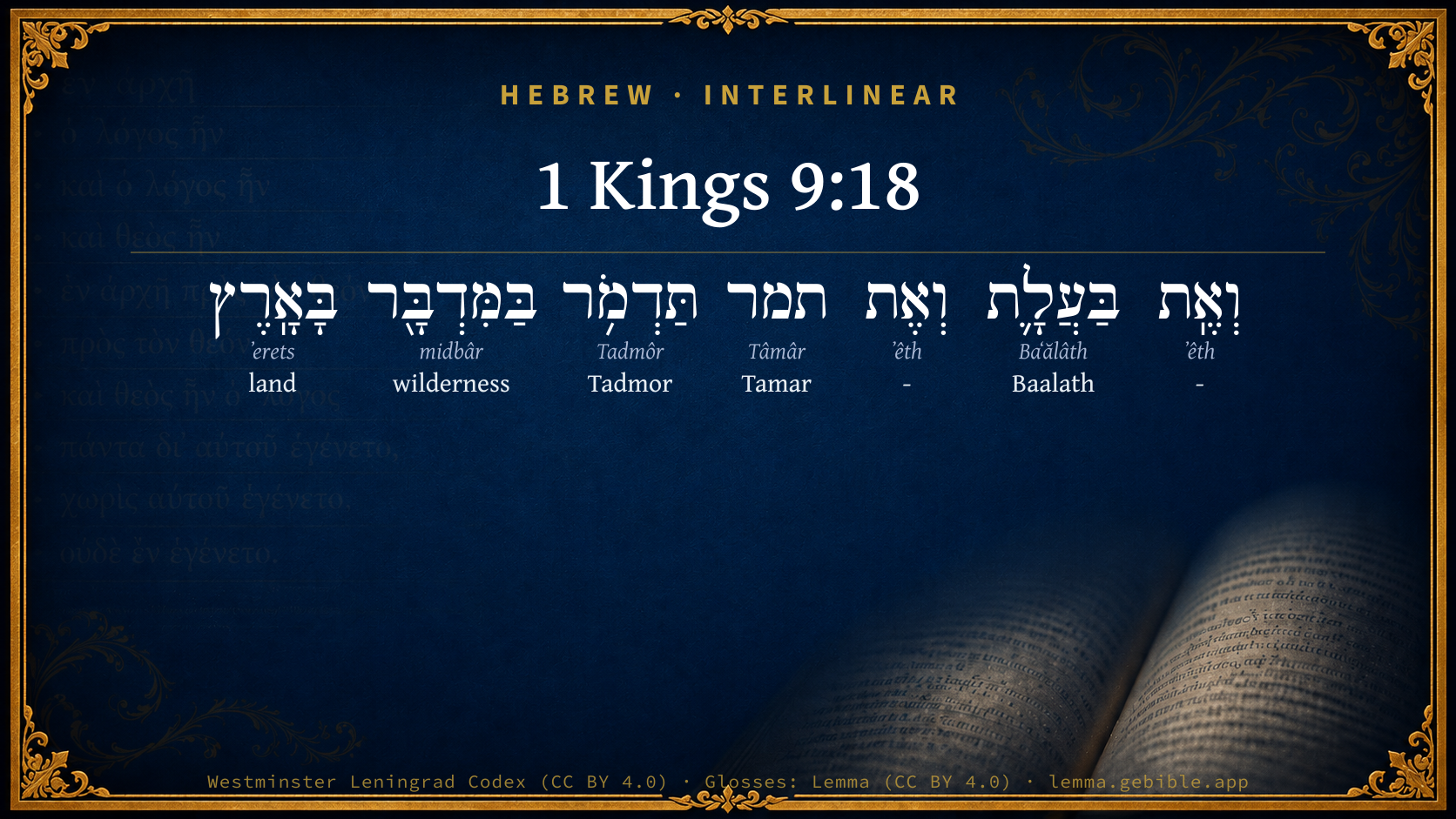
1 Kings 9:18

Hebrew (Westminster Leningrad Codex) 1 Kings 9:18 appears in the Hebrew Old Testament. The text above is from the Westminster Leningrad Codex. Each word links to its Strong’s number, a concise gloss, and parsing drawn from the Open Scriptures Hebrew Bible morphology. Click any word for its full Brown-Driver-Briggs (BDB) entry.
Download image
Cite this verse

1 Kings 9:18 (World English Bible). Public Domain. Lemma interlinear Bible study tool, https://lemma.gebible.app/v/1-kings/9/18.

Show BibTeX & RIS
BibTeX
RIS
English Translation
and Baalath, and Tamar in the wilderness, in the land,
World English Bible · Public Domain
Highlights
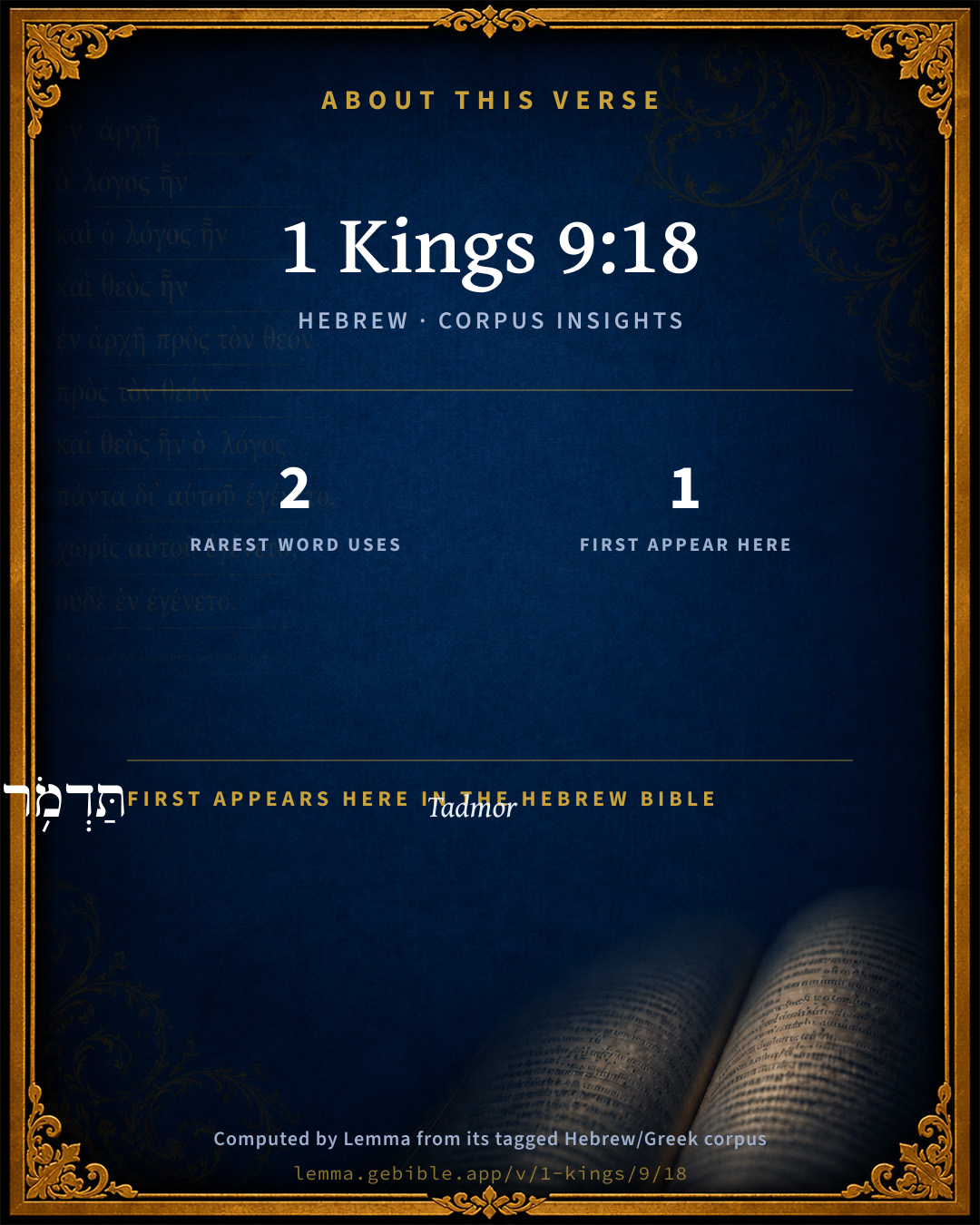
  • 1 first appearance in the Hebrew Bible
Full analysis ↓
Download a study sheet

One document with this verse’s original text, its word-by-word gloss line, the meaning frame, cross-references with their text, attributed commentary, and full source and license credits — printable, and it pastes into notes with its structure intact.

This verse Autodidact and up

Study sheet (.html) Plain text (.txt)

A passage Seminary Student

Up to 50 verses in one chapter. A passage sheet keeps up to 6 commentary sources and 12 cross-references per verse, in the order this page ranks them, and says so on the sheet whenever that leaves anything out. Ask for a single verse and you get the Autodidact verse sheet above.

Everything on this page stays free to read, with no account — the sheet is a download of what is already on screen, not access to it.

Want to remove ads? Support Godless Engineer
Compare translations 3

The same verse in 3 English versions, stacked beneath the original-language interlinear above. Click any original word for its lexicon entry.

Each is an independent rendering of the whole verse — the interlinear is not word-aligned to these translations.

Highlighted words mark where these versions differ — a whole-verse word diff, not a word-by-word alignment.

  • World English Bible Public Domain
    and Baalath, and Tamar in the wilderness, in the land,
  • King James Version Public Domain
    And Baalath, and Tadmor in the wilderness, in the land,
  • unfoldingWord Literal Text CC BY-SA 4.0
    and Baalath and Tadmor in the wilderness in the land

unfoldingWord Literal Text — © unfoldingWord, licensed CC BY-SA 4.0. Word-aligned USFM3 via Door43 (git.door43.org/unfoldingWord/en_ult).

Versions to compare (up to 4)

3 of 4 selected

Show all 18 translations

Every available English version of this verse, each an independent rendering of the whole verse.

  • World English Bible Public Domain
    and Baalath, and Tamar in the wilderness, in the land,
  • Berean Standard Bible Public Domain
    Baalath, and Tamar in the Wilderness of Judah,
  • Majority Standard Bible Public Domain
    Baalath, and Tamar in the Wilderness of Judah,
  • King James Version Public Domain
    And Baalath, and Tadmor in the wilderness, in the land,
  • American Standard Version (1901) Public Domain
    and Baalath, and Tamar in the wilderness, in the land,
  • Revised Version (1885) Public Domain
    and Baalath, and Tamar in the wilderness, in the land,
  • Geneva Bible (1599) Public Domain
    And Baalath and Tamor in the wildernes of the land,
  • Douay-Rheims (1899) Public Domain
    And Baalath, and Palmira in the land of the wilderness.
  • Young's Literal Translation Public Domain
    and Baalath, and Tadmor in the wilderness, in the land;
  • Literal Standard Version CC BY-SA 4.0
    and Ba‘alath, and Tadmor in the wilderness, in the land,
  • Unlocked Literal Bible CC BY-SA 4.0
    Baalath and Tamar in the wilderness in the land of Judah,
  • unfoldingWord Literal Text CC BY-SA 4.0
    and Baalath and Tadmor in the wilderness in the land
  • Darby Bible Public Domain
    and Baalath, and Tadmor in the wilderness, in the land,
  • World Messianic Bible Public Domain
    Baalath, Tamar in the wilderness,
  • Webster's Bible Public Domain
    And Baalath, and Tadmor in the wilderness, in the land,
  • Free Bible Version CC BY-SA 4.0
    Baalath and Tamar in the wilderness, in the land of Judah,
  • Bible in Basic English Public Domain
    And Baalath and Tamar in the waste land, in that land;
  • JPS Tanakh (1917) Public Domain
    and Baalath, and Tadmor in the wilderness, in the land,

Literal Standard Version (2020), Covenant Press — licensed CC BY-SA 4.0. Text via the HelloAO Bible API (eBible.org). Unlocked Literal Bible (unfoldingWord) — licensed CC BY-SA 4.0. Text via the HelloAO Bible API (eBible.org). unfoldingWord Literal Text — © unfoldingWord, licensed CC BY-SA 4.0. Word-aligned USFM3 via Door43 (git.door43.org/unfoldingWord/en_ult). Free Bible Version, Dr. Jonathan Gallagher — licensed CC BY-SA 4.0. Text via the HelloAO Bible API (eBible.org).

Word by word

More ways to search: Search by grammar → Find every occurrence → Compare this word →

Practice this passage: Drill this verse → Learn its vocabulary →

About this verse

These counts appear in no published source. They are computed here, from the morphology-tagged text and Lemma’s own curated glosses. What Lemma adds →

7
words
6
distinct lemmas
Historical
section

Notable vocabulary

The rarest word here is תַּדְמֹ֥ר Tadmor H8412 — appearing just 2 times in the whole Hebrew Bible.

First appearance in Scripture

This word makes its first canonical appearance in the Hebrew Bible here:

  • תַּדְמֹ֥ר Tadmor H8412

Shared distinctive vocabulary

תַּדְמֹ֥ר Tadmor H8412 occurs in 2 verses of the Hebrew Bible. Also found in:

Grammatical profile

  • 5 nouns
  • 2 particles

Cross-references

2

Topical passages linked to 1 Kings 9:18 in the Treasury of Scripture Knowledge — connected by theme and wording, ordered by reader-vote popularity; previews shown in the World English Bible.

  • Joshua 19:44 and Eltekeh, and Gibbethon, and Baalath,
  • 2 Chronicles 8:4 He built Tadmor in the wilderness, and all the store-cities, which he built in Hamath.

Cross-references courtesy of OpenBible.info (CC BY 4.0).

Hebrew and Greek witnesses Masoretic Hebrew ↔ Greek Septuagint

The same verse in the two great witnesses to the Old Testament, shown verse-for-verse.

These are two independent witnesses, not word-aligned to each other, and the Septuagint is shown in lemma (dictionary) form.

Hebrew 1 Kings 9:18 Masoretic · Westminster Leningrad Codex

וְאֶֽת בַּעֲלָ֛ת וְאֶת תמר תַּדְמֹ֥ר בַּמִּדְבָּ֖ר בָּאָֽרֶץ

and Baalath, and Tamar in the wilderness, in the land,

World English Bible · Public Domain

Hebrew: Westminster Leningrad Codex (CC BY 4.0). Greek: Septuagint (public domain); English from a public-domain English Septuagint. How the Septuagint differs from the Hebrew →

Targum (Aramaic paraphrase)

1

The Targum is the ancient Jewish Aramaic paraphrase of the Hebrew Scriptures — an interpretive translation, not the Hebrew text itself. Onkelos (literal) and Pseudo-Jonathan (expansive) render the Torah, and Jonathan the Prophets. Coverage is partial: where no permissively-licensed English translation exists for a verse, only the Aramaic is shown. This is verse-level text, not a word-by-word alignment to the Hebrew.

  1. Targum Jonathan Prophets (Joshua–Malachi)
    וְיַת בַּעֲלַת וְיַת תַּדְמוּר בְּמַדְבְּרָא בְּאַרְעָא:

    (no public-domain English translation for this verse)

    Targum Jonathan — Aramaic: “Mikraot Gedolot” (public domain). English: “Sefaria Community Translation” (CC0 1.0 (public-domain dedication)); “London "Chaldee Paraphrase," 1871” (public domain). Text via Sefaria.

Commentary

Notes on 1 Kings 9:18 from classic Christian and Jewish commentators (each source and its license shown beneath its notes). The classic Christian expositions comment on the surrounding passage and are grouped to its opening verse, so a note may address several verses; the Jewish commentaries on the Tanakh (Rashi and others) are per-verse, so they appear only where the commentator wrote on this verse.

Lemma curates 59 commentaries, every one of them public domain or Creative Commons licensed, each selected and text-cleaned for this edition rather than reprinted as found. About our sources →

Trapp's Complete Commentary

John Trapp

1Ki 9:18 And Baalath, and Tadmor in the wilderness, in the land,

Ver. 18. In the wilderness, in the land,] i.e., So in the wilderness, as not out of the land of Canaan. Places which were but thinly inhabited, the Jews called wildernesses.

John Trapp, A Commentary or Exposition upon All the Books of the Old and New Testament (1647–1656) — public domain. Text from a community e-Sword module.

Jamieson, Fausset & Brown

Robert Jamieson, A. R. Fausset & David Brown

Baalath--Baal-bek.

Tadmor--Palmyra, between Damascus and the Euphrates, was rebuilt and fortified as a security against invasion from northern Asia. In accomplishing these and various other works which were carried on throughout the kingdom, especially in the north, where Rezon of Damascus, his enemy, might prove dangerous, he employed vast numbers of the Canaanites as galley slaves (Ch2 2:18), treating them as prisoners of war, who were compelled to do the drudgery and hard labor, while the Israelites were only engaged in honorable employment.

Jamieson, Fausset & Brown — Commentary Critical and Explanatory on the Whole Bible (1871) — public domain (CC PDM 1.0). Text via the HelloAO Bible API.

Adam Clarke's Commentary

Verse 18. And Tadmor in the wilderness] This is almost universally allowed to be the same with the celebrated Palmyra, the ruins of which remain to the present day, and give us the highest idea of Solomon's splendour and magnificence. Palmyra stood upon a fertile plain surrounded by a barren desert, having the river Euphrates on the east. The ruins are well described by Messrs. Dawkes and Wood, of which they give fine representations. They are also well described in the ancient part of the Universal History, vol. i., p. 367-70. The description concludes thus: "The world never saw a more glorious city; the pride, it is likely, of ancient times, and the reproach of our own; a city not more remarkable for the state of her buildings and unwontedness of her situation than for the extraordinary personages who once flourished there, among whom the renowned Zenobia and the incomparable Longinus must for ever be remembered with admiration and regret."

Adam Clarke's Commentary on the Bible (1810–1826) — public domain. Text from a community e-Sword/MySword module.

Ellicott's Commentary for English Readers

(18) Baalath is said by Josephus to have been in the same neighbourhood; and this agrees with the mention of it in Jos_19:44, as lying in the region assigned to Dan, on the edge of the Philistine country. The three, Gezer, Beth-horon, and Baalath, evidently form a group of fortified places commanding the passes from the sea-coast.

Tadmor in the wilderness, in the land.—The Hebrew text here has Tamar (with, however, Tadmor as a marginal reading). From this fact, and from the peculiar expression “in the land,” which certainly seems to designate the land of Israel, and from the juxtaposition of the name in this passage with the names of places situated in the southern part of Palestine, it has been thought that the place meant is the Tamar of Eze_47:19; Eze_48:28), or, perhaps, Hazazon-Tamar, the old name of En-gedi; and that the marginal reading, and the reading of the old versions, have arisen from a mistaken identification of this place with the Tadmor of 2Ch_9:4. But, on the whole, these considerations are not sufficient to counterbalance the invariable reference of this passage, by all the ancient versions and by the narrative of Josephus, to the celebrated Tadmor, the name of which is a local variety of the Hebrew name Tamar (or “the palm-tree,”) preserved in the later name of Palmyra. If this be meant, it is indeed difficult to suppose that there is not some omission after the words “in the land.”

Tadmor, or Palmyra, is described by Josephus as “in the desert above Syria, a day’s journey from the Euphrates, and six long days’ journey from Babylon the Great.” Its foundation is described in 2Ch_9:4, as connected with a subjugation of Hamathzobah, and it may have had a military purpose. But situated on a well-watered oasis, in the midst of the desert, south-west of Tiphsah or Thapsacus on the Euphrates, also occupied by Solomon (see 1Ki_4:24), and about 120 miles from Damascus, it would be eminently fitted for trade both with Damascus and with Babylon and the north. Its importance is indicated by its long existence as a great city, and by its splendour (still traceable in its ruins), in Greek and Roman times, down to, at least, the age of Diocletian.

A Bible Commentary for English Readers, edited by Charles John Ellicott (1878–1897) — public domain. Text from a community e-Sword module.

The Cambridge Bible for Schools and Colleges

gen. ed. J. J. S. Perowne

18. and Baalath] This place is mentioned (Jos_19:44) among the places which fell to the tribe of Dan, and must therefore have been on the border of the country of the Philistines, and for that reason we may presume that it was included among the places which Solomon strengthened.

and Tadmor in the wilderness, in the land] Here the Hebrew text reads Tamar, and Tadmor is only given on the margin (Keri). The R.V. adopts the reading of the text, probably because of the words ‘in the land.’ All the places mentioned here lie in Palestine, and we know from Ezekiel (Eze_47:19, Eze_48:28) that there was a city Tamar on the south border of the Holy Land, which was towards the wilderness. It seems therefore most likely, as this place is spoken of as ‘in the land,’ that Tamar should be here preferred, and the position assigned to it in Ezekiel is that of a place which it would be most important to fortify. The marginal reading Tadmor is no doubt due to the mention of Tadmor among the cities which Solomon built in 2Ch_8:4. But there Tadmor is mentioned in connexion with Hamath-Zobah and the conquest of the northern part of the land. This reading may be correct in Chronicles, for with Solomon’s ambition to extend his dominion and foster commerce, Tadmor in the wilderness (afterwards so famous as Palmyra) would be a place much to be coveted as a step on the road to Babylon. Tadmor grew famous, and Tamar was well-nigh forgotten, hence we can see how the former name (not mentioned anywhere but in Chronicles) should be substituted on the margin in the verse before us. It may well be that Solomon occupied both places, but there is no warrant for importing the name Tadmor into Kings, especially as the place here mentioned is spoken of as being ‘in the land.’

Josephus is very minute in his account of this city, which he (as was to be expected) says was Tadmor (Ant. viii. 6, i), ‘Having invaded the desert that lies above Syria, and acquired it, he founded there a very great city, two days’ journey from upper Syria, and one from the Euphrates, and its distance from the great city of Babylon was six days. And the reason why he built this city so distant from the inhabited parts of Syria was that nowhere in the land lower down was there water, but that there alone were found fountains and wells. So having built the city and surrounded it with very strong walls, he named it Thadamora, and it is still so called by the Syrians, but the Greeks name it Palmyra.’

The Cambridge Bible for Schools and Colleges (gen. ed. J. J. S. Perowne; Cambridge University Press, 1878–1918) — public domain. Text from a community e-Sword module.

John Gill's Exposition

And all the cities of store that Solomon had,.... In which were his magazines of corn, arms, and ammunition; and these were built in Hamath, Ch2 8:4.

and cities for his chariots; chariots of war, iron chariots, which were kept in times of peace, in case of necessity, of which Solomon had 1400, Kg1 10:26,

and cities for his horsemen; of which he had 12,000, a standing cavalry:

and that which Solomon desired to build in Jerusalem; besides the temple and his own palace before mentioned; see Ecc 2:4,

and in Lebanon; the house of the forest of Lebanon, which Junius on Kg1 7:2 thinks he built after he had taken Hamathzobah, a royal city of Lebanon; see Ch2 8:3 or fortresses on Mount Lebanon, which was the northern border of his kingdom:

and in all the land of his dominions; where he might repair or fortify cities, or erect new forts for the safety of his kingdom; now for the doing of all this was the levy both of men and money raised, and of whom next follows.

John Gill's Exposition of the Whole Bible (1746–1763) — public domain (CC PDM 1.0). Text via the HelloAO Bible API.

Albert Barnes' Notes on the Bible

Tadmor - The Hebrew text here has, as written, Tamor (or Tamar), and as read, Tadmor. That the latter place, or Palmyra, was meant appears, first, from the distinct statement of Chronicles 2Ch 8:4 that Solomon built Tadmor, and the improbability that the fact would be omitted in Kings; secondly, from the strong likelihood that Solomon, with his wide views of commerce, would seize and fortify the Palmy-rene Oasis: and thirdly, from the unanimity of the old versions in rendering Tamar here by Tadmor. The probability seems to be that Tamar was the original name of the place, being the Hebrew word for “a palm,” from where it is generally agreed that the town derived its name. Tadmor was a corrupt or dialectic variety of the word, which was adopted at the city itself, and prevailed over the original appellation. No reference is found to Tadmor in the Assyrian inscriptions, or in any Classical writer before Pliny.

Albert Barnes' Notes on the Bible (1834–1885) — public domain. Text from a community e-Sword/MySword module.

Haydock's Catholic Bible Commentary

Baalath. There were several towns of this name, Josue xix. 44. (Calmet) --- Palmira. Hebrew Tamor, "a palm-tree." (Calmet) --- But the d is preserved in the margin, as well as in some manuscripts, and in the ancient versions; and is read, Tadmor, in Chronicles. (Kennicott) --- Protestants have also, "Tadmor, in the wilderness, in the land." (Haydock) --- Le Clerc adds, "of Aram," or Syria of Soba, 2 Paralipomenon viii. 3, 4. Palmira, famous for its water and fertile soil, was the boundary of the Roman and Parthian empires, (Pliny, [Natural History?] v. 25.) surrounded on all sides by vast deserts, and built by Solomon for the advantage of travellers, a day’s journey from the Euphrates. (Josephus, [Antiquities?] viii. 6.) --- Superb ruins are still to be seen, and various pagan inscriptions, in Greek. There are others in an unknown language, which might relate to the Jewish or Christian affairs. See Phil. Transac. Oct. 1695. (Brun) --- The city was destroyed by the emperor Aurelian. (Calmet)

George Leo Haydock (1774–1849), Haydock's Catholic Family Bible and Commentary, 1859 edition — public domain. Excludes Psalms (Douay-Rheims chapter numbering differs from Protestant) and Deuterocanonical books (Catholic canon only).

Matthew Poole's English Annotations

Baalath, in the tribe of Dan, Jos 19:40,44.

Tadmor; supposed to be called Tamar, Eze 47:19.

In the land: this clause may belong either, first, To all the places above mentioned, which are here declared to be in the land of Canaan. But so that clause may seem superfluous; for none would easily think that he would build much out of his own land. Or rather, secondly, To Tadmor, which otherwise being in that wilderness which was the border of the land, might have been presumed to have been out of the land.

Matthew Poole's English Annotations on the Holy Bible (1683–1685) — public domain. Text from a community e-Sword/MySword module.

Whedon's Commentary on the Bible

Daniel D. Whedon

18. Baalath — Probably identical with the town of this name in the tribe of Dan. Jos_19:44. Some have supposed it to be the same as Baalbek in Coele-Syria, whose splendid ruins are still the wonder of the modern traveller.

Tadmor — Such is the name in the margin of the Hebrew Bible, (keri,) and in 2Ch_8:4; but in the Hebrew text of this verse it is Tamar, which seems to have been the original name, and means a palm tree. The place probably received this name from the many palm trees which were planted within and around it, and hence the later Greek and Roman name Palmyra, city of palms. The site of this celebrated city was a fertile oasis in the great Syrian desert, midway between the Euphrates and Palestine, and served as a most important watering-station for the caravans which carried on commerce between the Western nations and those of the far East. Its importance to commerce was, perhaps, suggested to Solomon by Phenician merchants, and his ready practical wisdom would not be slow to secure to his own dominion the advantage of such a control over the traffic between the East and the West as this central emporium would naturally give him. It was probably at first strongly built, and so garrisoned as to give protection and security to the caravans against the tribes of lawless Arabs which then, as now, infested those deserts, and exposed all travel and commerce in great danger and inconvenience. But the city soon rose to magnificence and luxury, and became a city of merchants, who monopolized the trade between the East and the West, buying up the products of Arabia and India and selling them again to the Western traders. Tadmor, probably soon after the death of Solomon, passed from the possession of the Hebrews to that of the Assyrians. It is not mentioned again in Scripture; but from other sources we learn that it passed through various fortunes under the Eastern kings, the Roman emperors, the Mohammedan khalifs, and was at last plundered and laid waste by the Mongol conqueror, Tamerlane. Its ruins were long unknown to Europeans, but were discovered towards the close of the seventeenth century. They occupy a sandy plain, slightly elevated above the surrounding desert, and consist of “scattered groups of columns and single monumental pillars, while everywhere the ground is thickly strewn with broken shafts, and great shapeless piles of ruins, all white and glistering in the bright sunlight. Like bleached bones on a long-neglected battle-field those ruins lie, lonely and forsaken.” — PORTER, Giant Cities of Bashan.

In the wilderness — In the great Syrian desert between Palestine and the Euphrates.

In the land — The land of Solomon’s dominion. The phrase is to be construed with built in 1Ki_9:17. Solomon built in his land the cities here named.

Daniel D. Whedon (gen. ed.), Commentary on the Old and New Testaments (1874–1909) — public domain. Text from a community e-Sword module.

The Pulpit Commentary

And Baalath probably the place mentioned in Jos_19:44, and therefore a town of Daniel By some it has been identified, but on wholly insufficient grounds the mention of Tadmor immediately afterwards being the chief with Baalbek. This is one of the names which prove how ancient and widespread was the worship of Baal (Gesen., Thesaurus, 225; Dict. Bib., 1:147, 148) and Tadmor in the wilderness, in the land. Whether this is

(1) the famous Palmyra, or

(2) Tamar, an obscure town of south Judah, is a question which has been much disputed. It should be stated in the first place that the Cethib has rmt, but the Keri, after 2Ch_8:4, reads rmdt, as do all the versions; and secondly that a Tarnar is mentioned Eze_47:19 and Eze_48:28 a place which may well be identical with "Hazazon Tamar, which is Engedi". (2Ch_20:2; cf. Gen_14:7) In favour of (1) are the following considerations:

(1) the statement of the chronicler that Solomon did build Palmyra (for of the identity of "Tadmor" with Palmyra there can be no reasonable doubt; see Dict. Bib. 3:1428).

(2) The probability that Solomon, with his wide views of commerce, would seize upon and fortify the one oasis in the great Syrian desert in order to establish an entrepot there (see on ver. 19).

(3) The words "in the wilderness," which, of course, are eminently true of Palmyra.

Against it, however, may be urged

(1) that Tamar was much more likely to be changed into Tadmor than Tadmor into Tamar.

(2) That this place is distinctly described as "in the land," which, strictly, Palmyra was not. But here it is to be observed that the chronicler omits these words, and that the Syriac, Arabic, and Vulgate render, "in the land of the wilderness." Keil says our text is manifestly corrupt, and certainly the expression is a singular one. Some would, therefore, alter rab into or into tmjb. (after 2Ch_8:4) Both of the emendations, however, while undoubtedly plausible, are purely conjectural.

Wordsworth, who thinks Palmyra is meant, says it is described as "in the land" to indicate that God had fulfilled his promise to extend the land of Solomon far eastward into the wilderness. (Psa_72:9) And a Jewish historian, especially in the time of his country s decadence, might well recount how this great city had once been comprised within the boundaries of Israel.

In favour of (2) are these facts:And all the cities of store that Solomon had cities where the produce of the land was stored for the use of the troops or household, or against a season of scarcity (Gen_41:35; Exo_1:11) or possibly (Ewald) they were emporiums for the development of trade. The fact that these store cities are mentioned in the same breath with Tadmor, is an argument for the identification of that place with Palmyra, which Solomon could only have built as a means of gaining or retaining control over the caravan trade between the East and the Mediterranean. Cf. 2Ch_17:12 2Ch_32:28, and Gen_41:48. They would seem to have been chiefly on the northern frontier, 2Ch_8:4 ("in Hamath" 2Ch_16:4) speaks of "the store cities of Napthali." It should be remembered that Solomon had an adversary in Damascus and cities for his chariots, and cities for his horsemen. (Cf. 1Ki_4:26) These were not so much fortresses (vers. 15-18) as places adapted to accommodate his cavalry, etc. For horsemen we should perhaps read horses, See note on 1Ki_5:6 and that which Solomon desired to build Heb. and the desire of Solomon which he desired; cf. ver. 1.

The use of the cognate verb refutes the idea that Solomon"s "desire" isanother name for pleasure buildings or pleasaunces, as does also "desire" in ver. 11. It is certain, however, that such buildings were erected, and it is probable that they are referred to here in Jerusalem and in Lebanon It is highly probable that pleasure houses were built in Lebanon, (Son_7:4, passim) for which Solomon may well have had a strong affection, and pleasure gardens in Jerusalem. (Ecc_2:4-7) See Stanley, pp. 197-199); and we may reasonably imagine (with Ewald) that in these latter he sought to grow specimens of the plants, etc., about which he "spoke" (ch. 4:33; cf. Ecc_2:5) "It is a curious fact that in the ground hard by the "fountains of Solomon" near Bethlehem, which exhibit manifest traces of an ancient garden, and where the intimations of Josephus would lead us to suppose that Solomon had a rural retreat, are still to be found a number of plants self sown from age to age, which do not exist in any other part of the Holy Land" (Kitto, "Bib. Illus." vol. 4. p. 101). Some of Solomon"s journeys to these favourite resorts, we can hardly doubt, are referred to in Son_3:6-10 Son_4:8 Son_6:11 and in all the land of his dominion.

(1) That it is the reading of the text. It is said, however, that the ancient name of Tadmor was Tamar, and the place clearly owed its name to the Palm trees. But the name is always Tadmor in the Palmyrene inscriptions.

(2) That this place was "in the wilderness," i.e., of Judah.

(3) That it was "in the land," and

(4) that it was in close proximity to the places just mentioned. The evidence is thus so evenly balanced that it is impossible to decide positively between the two.

The Pulpit Commentary (1880–1919), ed. H.D.M. Spence-Jones & Joseph S. Exell — public domain. Text from a community e-Sword module.

Rashi

Rabbi Shlomo Yitzchaki (Rashi)

And Tadmor in the desert of the land. [I.e., it was located] near a settlement.

Rashi on the Tanakh — English translations: “The Judaica Press complete Tanach with Rashi, translated by A. J. Rosenberg” (CC BY 4.0); “Pentateuch with Rashi's commentary by M. Rosenbaum and A.M. Silbermann, 1929-1934” (public domain); “The Metsudah Tanach series, Lakewood, N.J” (CC BY 4.0); and “The Book of Joshua, Metsudah Publications, 1997” (CC BY 4.0). Text via Sefaria.

Lesson kit

Teaching starters — assembled from the data on this page, not authored interpretation. Every prompt links to the verse data it draws on. Edit before teaching.

1 Kings, in the Historical, opens this verse with 7 words (6 distinct Hebrew lemmas). Its most distinctive word is Tadmôr (“Tadmor”). A historical commentator’s framing appears above. Read the whole chapter for the surrounding context.

Discussion questions

  1. The word Tadmôr carries the sense “Tadmor.” How does it shape the verse?
  2. This is the first place “Tadmor” appears in Scripture (first appears here). What does its debut here establish?
  3. How does 2 Chronicles 8:4, which shares the word «Tadmor», read alongside this verse?
  4. The translations on this page render this verse differently — a whole-verse word diff, not a word-by-word alignment. What might account for the different wordings?
  5. Compare how Trapp's Complete Commentary and Jamieson, Fausset & Brown read this verse. Where do they agree or differ?

Things to notice

  • 1 word makes its first canonical appearance in Scripture here.
  • These translations choose different wording for 2 words in this verse.
  • 6 distinct Hebrew lemmas span 7 words in this verse.

Reading settings

Reading text

Shown beneath each verse's original-language words.

Old Testament
Old Testament edition

Read the OT as the Masoretic Hebrew (MT) or the Greek Septuagint (LXX).

English shown for the Greek Septuagint (in the Hebrew ↔ Greek comparison).

Comparing translations? Open the Compare panel on any verse page to stack up to four side by side.