
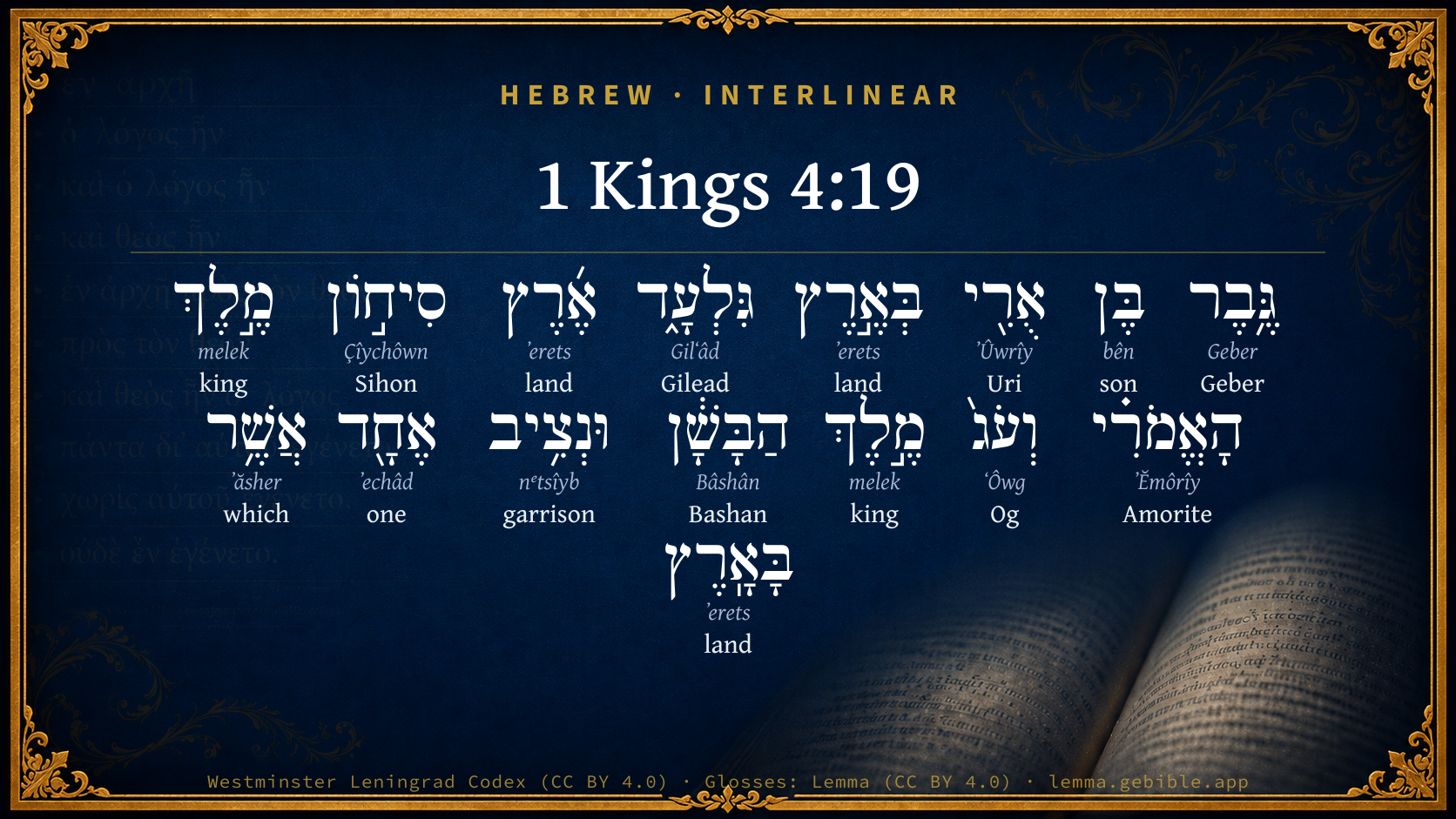
1 Kings 4:19

Hebrew (Westminster Leningrad Codex) 1 Kings 4:19 appears in the Hebrew Old Testament. The text above is from the Westminster Leningrad Codex. Each word links to its Strong’s number, a concise gloss, and parsing drawn from the Open Scriptures Hebrew Bible morphology. Click any word for its full Brown-Driver-Briggs (BDB) entry.
Download image
Cite this verse

1 Kings 4:19 (World English Bible). Public Domain. Lemma interlinear Bible study tool, https://lemma.gebible.app/v/1-kings/4/19.

Show BibTeX & RIS
BibTeX
RIS
English Translation
Geber the son of Uri, in the land of Gilead, the country of Sihon king of the Amorites and of Og king of Bashan; and [he was] the only officer who was in the land.
World English Bible · Public Domain
Highlights
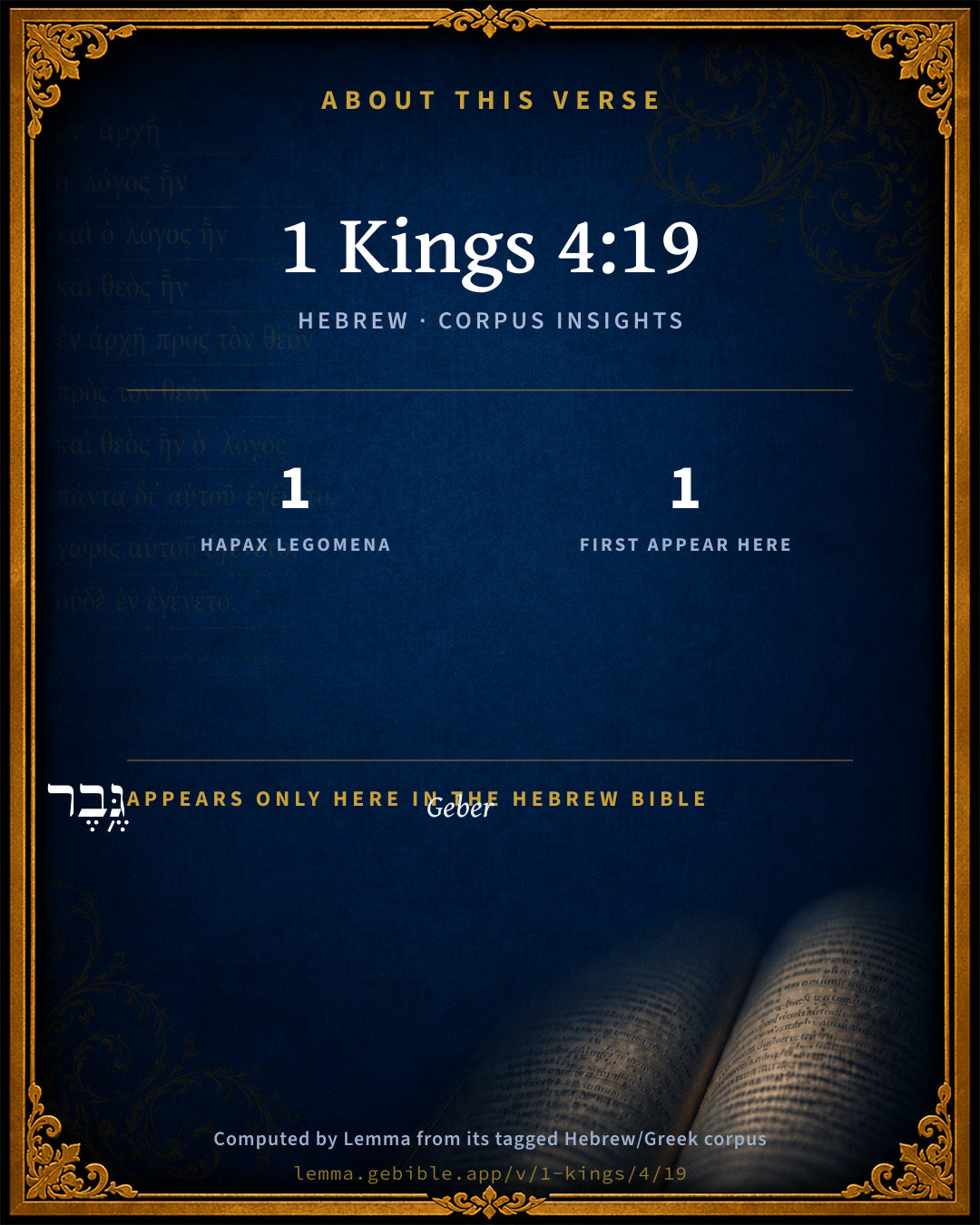
  • 1 hapax legomenon — only here in the Hebrew Bible
  • 1 first appearance in the Hebrew Bible
Full analysis ↓
Download a study sheet

One document with this verse’s original text, its word-by-word gloss line, the meaning frame, cross-references with their text, attributed commentary, and full source and license credits — printable, and it pastes into notes with its structure intact.

This verse Autodidact and up

Study sheet (.html) Plain text (.txt)

A passage Seminary Student

Up to 50 verses in one chapter. A passage sheet keeps up to 6 commentary sources and 12 cross-references per verse, in the order this page ranks them, and says so on the sheet whenever that leaves anything out. Ask for a single verse and you get the Autodidact verse sheet above.

Everything on this page stays free to read, with no account — the sheet is a download of what is already on screen, not access to it.

Want to remove ads? Support Godless Engineer
Compare translations 3

The same verse in 3 English versions, stacked beneath the original-language interlinear above. Click any original word for its lexicon entry.

Each is an independent rendering of the whole verse — the interlinear is not word-aligned to these translations.

Highlighted words mark where these versions differ — a whole-verse word diff, not a word-by-word alignment.

  • World English Bible Public Domain
    Geber the son of Uri, in the land of Gilead, the country of Sihon king of the Amorites and of Og king of Bashan; and [he was] the only officer who was in the land.
  • King James Version Public Domain
    Geber the son of Uri was in the country of Gilead, in the country of Sihon king of the Amorites, and of Og king of Bashan; and he was the only officer which was in the land.
  • unfoldingWord Literal Text CC BY-SA 4.0
    Geber, the son of Uri, in the land of Gilead, the land of Sihon, the king of the Amorite, and Og, the king of Bashan, and one deputy who in the land.

unfoldingWord Literal Text — © unfoldingWord, licensed CC BY-SA 4.0. Word-aligned USFM3 via Door43 (git.door43.org/unfoldingWord/en_ult).

Versions to compare (up to 4)

3 of 4 selected

Show all 18 translations

Every available English version of this verse, each an independent rendering of the whole verse.

  • World English Bible Public Domain
    Geber the son of Uri, in the land of Gilead, the country of Sihon king of the Amorites and of Og king of Bashan; and [he was] the only officer who was in the land.
  • Berean Standard Bible Public Domain
    Geber son of Uri in the land of Gilead, including the territories of Sihon king of the Amorites and of Og king of Bashan. There was also one governor in the land of Judah.
  • Majority Standard Bible Public Domain
    Geber son of Uri in the land of Gilead, including the territories of Sihon king of the Amorites and of Og king of Bashan. There was also one governor in the land of Judah.
  • King James Version Public Domain
    Geber the son of Uri was in the country of Gilead, in the country of Sihon king of the Amorites, and of Og king of Bashan; and he was the only officer which was in the land.
  • American Standard Version (1901) Public Domain
    Geber the son of Uri, in the land of Gilead, the country of Sihon king of the Amorites and of Og king of Bashan; and `he was' the only officer that was in the land.
  • Revised Version (1885) Public Domain
    Geber the son of Uri, in the land of Gilead, the country of Sihon king of the Amorites and of Og king of Bashan; and he was the only officer which was in the land.
  • Geneva Bible (1599) Public Domain
    Geber the sonne of Vri in the countrey of Gilead, the land of Sihon King of the Amorites, and of Og King of Bashan, and was officer alone in the land.
  • Douay-Rheims (1899) Public Domain
    Gaber the son of Uri, in the land of Galaad, in the land of Sehon the king of the Amorrhites and of Og the king of Basan, over all that were in that land.
  • Young's Literal Translation Public Domain
    Geber Ben-Uri `is' in the land of Gilead, the land of Sihon king of the Amorite, and of Og king of Bashan: and one officer who `is' in the land.
  • Literal Standard Version CC BY-SA 4.0
    Geber Ben-Uri [is] in the land of Gilead, the land of Sihon king of the Amorite, and of Og king of Bashan: and [he is] the one officer who [is] in the land.
  • Unlocked Literal Bible CC BY-SA 4.0
    and Geber son of Uri, in the land of Gilead, the country of Sihon king of the Amorites and of Og king of Bashan, and he was the only official who was in the land.
  • unfoldingWord Literal Text CC BY-SA 4.0
    Geber, the son of Uri, in the land of Gilead, the land of Sihon, the king of the Amorite, and Og, the king of Bashan, and one deputy who in the land.
  • Darby Bible Public Domain
    Geber the son of Uri, in the land of Gilead, the land of Sihon the king of the Amorites, and of Og the king of Bashan; and [he was] the only superintendent that was in the land.
  • World Messianic Bible Public Domain
    Geber the son of Uri, in the land of Gilead, the country of Sihon king of the Amorites and of Og king of Bashan; and he was the only officer who was in the land.
  • Webster's Bible Public Domain
    Geber the son of Uri was in the country of Gilead, in the country of Sihon king of the Amorites, and of Og king of Bashan; and he was the only officer who was in the land.
  • Free Bible Version CC BY-SA 4.0
    Geber son of Uri in the land of Gilead (the former country of Sihon, king of the Amorites, and of Og, king of Bashan. There was also a governor who was over the land of Judah).
  • Bible in Basic English Public Domain
    Geber, the son of Uri, in the land of Gilead, the country of Sihon, king of the Amorites, and Og, king of Bashan; and one overseer had authority over all the overseers who were in the land.
  • JPS Tanakh (1917) Public Domain
    Geber the son of Uri, in the land of Gilead, the country of Sihon king of the Amorites and of Og king of Bashan; and one officer that was over all the officers in the land.

Literal Standard Version (2020), Covenant Press — licensed CC BY-SA 4.0. Text via the HelloAO Bible API (eBible.org). Unlocked Literal Bible (unfoldingWord) — licensed CC BY-SA 4.0. Text via the HelloAO Bible API (eBible.org). unfoldingWord Literal Text — © unfoldingWord, licensed CC BY-SA 4.0. Word-aligned USFM3 via Door43 (git.door43.org/unfoldingWord/en_ult). Free Bible Version, Dr. Jonathan Gallagher — licensed CC BY-SA 4.0. Text via the HelloAO Bible API (eBible.org).

Word by word

More ways to search: Search by grammar → Find every occurrence → Compare this word →

Practice this passage: Drill this verse → Learn its vocabulary →

גֶּ֥בֶר
Geber
H1398
“Geber”
Noun, Proper
Part of Speech
Noun
Type
Proper
Full BDB Definition

Origin: the same as H1397

TWOT: None

Geber = "warrior" - the son of Uri, an officer of Solomon, overseer of Gilead
  1. בֶּן bên H1121 “son of” Noun, Common, Masculine, Singular, Construct
  2. אֻרִ֖י ʼÛwrîy H221 “Uri” Noun, Proper
  3. בְּאֶ֣רֶץ ʼerets H776 “in/at · land of” Preposition + Noun, Common, Both, Singular, Construct
  4. גִּלְעָ֑ד Gilʻâd H1568 “Gilead” Noun, Proper
  5. אֶ֜רֶץ ʼerets H776 “land of” Noun, Common, Both, Singular, Construct
  6. סִיח֣וֹן Çîychôwn H5511 “Sihon” Noun, Proper
  7. מֶ֣לֶךְ melek H4428 “king of” Noun, Common, Masculine, Singular, Construct
  8. הָאֱמֹרִ֗י ʼĔmôrîy H567 “the · Amorite” Particle, Definite Article + Noun, Gentilic, Masculine, Singular, Absolute
  9. וְעֹג֙ ʻÔwg H5747 “and · Og” Conjunction + Noun, Proper
  10. מֶ֣לֶךְ melek H4428 “king of” Noun, Common, Masculine, Singular, Construct
  11. הַבָּשָׁ֔ן Bâshân H1316 “the · Bashan” Particle, Definite Article + Noun, Proper
  12. וּנְצִ֥יב nᵉtsîyb H5333 “and · garrison” Conjunction + Noun, Common, Masculine, Singular, Absolute
  13. אֶחָ֖ד ʼechâd H259 “one” Adjective, Cardinal number, Masculine, Singular, Absolute
  14. אֲשֶׁ֥ר ʼăsher H834 “which” Particle, Relative
  15. בָּאָֽרֶץ ʼerets H776 “in/at the · land” Preposition, Determined + Noun, Common, Both, Singular, Absolute

About this verse

These counts appear in no published source. They are computed here, from the morphology-tagged text and Lemma’s own curated glosses. What Lemma adds →

16
words
13
distinct lemmas
Historical
section

Notable vocabulary

1 hapax legomenon — a word that appears only here in the entire Hebrew Bible:

  • גֶּ֥בֶר Geber H1398

First appearance in Scripture

This word makes its first canonical appearance in the Hebrew Bible here:

  • גֶּ֥בֶר Geber H1398

Shared distinctive vocabulary

אֻרִ֖י Uri H221 occurs in 7 verses of the Hebrew Bible. Also found in:

Grammatical profile

  • 14 nouns
  • 1 adjective
  • 1 particle

Repetition

Words recur within this verse — often emphatic in Hebrew:

  • בְּאֶ֣רֶץ land H776 ×3
  • מֶ֣לֶךְ king H4428 ×2

Hebrew & Septuagint length

In English translation the verse runs 35 words from the Hebrew and 30 from the Septuagint (LXX English) — closely comparable.

A rough comparison of the two English renderings, which tokenize alike — not a word-level alignment.

Word counts can differ between the Hebrew and the Greek without any difference in meaning — e.g. the Hebrew direct-object marker אֵת has no separate Greek word, and Greek often adds the article ὁ.

Cross-references

3

Topical passages linked to 1 Kings 4:19 in the Treasury of Scripture Knowledge — connected by theme and wording, ordered by reader-vote popularity; previews shown in the World English Bible.

  • Deuteronomy 2:26–3:17 I sent messengers out of the wilderness of Kedemoth to Sihon king of Heshbon with words of peace, saying,
  • Numbers 21:21–35 Israel sent messengers to Sihon king of the Amorites, saying,
  • Joshua 13:9–12 from Aroer, that is on the edge of the valley of the Arnon, and the city that is in the middle of the valley, and all the plain of Medeba to Dibon;

Cross-references courtesy of OpenBible.info (CC BY 4.0).

Hebrew and Greek witnesses Masoretic Hebrew ↔ Greek Septuagint

The same verse in the two great witnesses to the Old Testament, shown verse-for-verse.

These are two independent witnesses, not word-aligned to each other, and the Septuagint is shown in lemma (dictionary) form.

Hebrew 1 Kings 4:19 Masoretic · Westminster Leningrad Codex

גֶּ֥בֶר בֶּן אֻרִ֖י בְּאֶ֣רֶץ גִּלְעָ֑ד אֶ֜רֶץ סִיח֣וֹן מֶ֣לֶךְ הָאֱמֹרִ֗י וְעֹג֙ מֶ֣לֶךְ הַבָּשָׁ֔ן וּנְצִ֥יב אֶחָ֖ד אֲשֶׁ֥ר בָּאָֽרֶץ

Geber the son of Uri, in the land of Gilead, the country of Sihon king of the Amorites and of Og king of Bashan; and [he was] the only officer who was in the land.

World English Bible · Public Domain

Greek LXX 1 Kings 4:19 Septuagint · lemma form

ιωσαφατ υἱός φουασουδ ἐν ισσαχαρ

Gaber son of Adai in the land of Gad, the land of Seon king of Esebon, and of Og king of Basan, and one officer in the land of Juda.

LXX2012 (modern English Septuagint) · Public Domain

On this verse, Ellicott's Commentary for English Readers discusses the Septuagint’s reading. Read the note in Commentary ↓

Hebrew: Westminster Leningrad Codex (CC BY 4.0). Greek: Septuagint (public domain); English from LXX2012 (modern English Septuagint) (Public Domain). How the Septuagint differs from the Hebrew →

Targum (Aramaic paraphrase)

1

The Targum is the ancient Jewish Aramaic paraphrase of the Hebrew Scriptures — an interpretive translation, not the Hebrew text itself. Onkelos (literal) and Pseudo-Jonathan (expansive) render the Torah, and Jonathan the Prophets. Coverage is partial: where no permissively-licensed English translation exists for a verse, only the Aramaic is shown. This is verse-level text, not a word-by-word alignment to the Hebrew.

  1. Targum Jonathan Prophets (Joshua–Malachi)
    גֶבֶר בַּר אֻרִי בְּאַרְעָא גִלְעָד אַרְעָא סִיחוֹן מַלְכָּא אֱמוֹרָאָה וְעוֹג מַלְכָּא דְמַתְנָן וְאִסְטַרְטִיגָא חָד דִי מְמַנָא בְּאַרְעָא:

    (no public-domain English translation for this verse)

    Targum Jonathan — Aramaic: “Mikraot Gedolot” (public domain). English: “Sefaria Community Translation” (CC0 1.0 (public-domain dedication)); “London "Chaldee Paraphrase," 1871” (public domain). Text via Sefaria.

Commentary

Notes on 1 Kings 4:19 from classic Christian and Jewish commentators (each source and its license shown beneath its notes). The classic Christian expositions comment on the surrounding passage and are grouped to its opening verse, so a note may address several verses; the Jewish commentaries on the Tanakh (Rashi and others) are per-verse, so they appear only where the commentator wrote on this verse.

Lemma curates 59 commentaries, every one of them public domain or Creative Commons licensed, each selected and text-cleaned for this edition rather than reprinted as found. About our sources →

Ellicott's Commentary for English Readers

(19) The twelfth division was on the east of Jordan, south of the seventh, including the pastoral country of Reuben and part of Gad on the borders of Moab, probably occupied by the royal flocks and herds.

In place of the reading of the text, “and he was the only officer in the land”—which yields very little meaning, for in each of the divisions there was but one governor—the LXX. here reads, “and Naseph (or an officer), one only in the land of Judah.” The reading seems probable; for it will be noticed that in the enumeration the territory of Judah is otherwise altogether omitted. It supplies accordingly here the mention of a special governor, over and above the twelve, for the royal tribe. It has been thought that as Judah was the home province, it was under no other government than that of the king’s officers at Jerusalem; but for purposes of revenue it seems hardly likely that it should have been excepted from the general system. Possibly Azariah, who was over the officers residing at the Court, may have been its territorial governor.

In some MSS. of the Greek Version, 1Ki_4:27-28 immediately follow 1Ki_4:19, and (as 1Ki_4:20-21 are omitted) they form a link between 1Ki_4:7-19 and 1Ki_4:22-23, in a very natural order.

A Bible Commentary for English Readers, edited by Charles John Ellicott (1878–1897) — public domain. Text from a community e-Sword module.

Trapp's Complete Commentary

John Trapp

1Ki 4:19 Geber the son of Uri [was] in the country of Gilead, [in] the country of Sihon king of the Amorites, and of Og king of Bashan; and [he was] the only officer which [was] in the land.

Ver. 19. He was the only officer.] Sitarchus unus, the arch-prefect.

John Trapp, A Commentary or Exposition upon All the Books of the Old and New Testament (1647–1656) — public domain. Text from a community e-Sword module.

Joseph Benson's Commentary

1Ki 4:19. In the country of Gilead — That is, in the remaining part of that land of Gilead which was mentioned above. The only officer in the land — Or rather, in that land; namely, in all Gilead, excepting the parcels mentioned before, the only one in all the territories of Sihon and Og. These were of large extent, and yet all committed to this one man, which is here noticed as a peculiar privilege which he had above the other officers, whose jurisdictions were of narrower extent.

Joseph Benson's Commentary on the Old and New Testaments (1811–1818) — public domain. Text from a community e-Sword module.

The Cambridge Bible for Schools and Colleges

gen. ed. J. J. S. Perowne

19. in the country of Gilead] Geber had the oversight of that part of Gilead which lay south of the district assigned to Ben-Geber (1Ki_4:13). This comprised all the kingdom of Sihon and part of the kingdom of Og (Deut. chh. 2. 3), and was a very extensive province, but on account of its rugged character was probably thinly populated. The extent of it may account for the notice which follows that Geber was the only officer, though the country was so large.

The Cambridge Bible for Schools and Colleges (gen. ed. J. J. S. Perowne; Cambridge University Press, 1878–1918) — public domain. Text from a community e-Sword module.

John Gill's Exposition

And Solomon's provision for one day was thirty measures of fine flour,.... The measure here used was the "corus", or "cor", the same with the homer, which was equal to ten ephahs, and, according to Bishop Cumberland (w), held seventy five wine gallons and five pints, and somewhat more; by which may be known how many gallons of fine flour these thirty measures held, which were all consumed in one day:

and threescore measures of meal: sixty measures of a coarser sort, for the servants, not so finely dressed; the same measure is here used as before; and it is observed by some, that one cor is equivalent to six hundred forty eight Roman pounds, and allowing to one man two pounds a day for his food, there would be food enough for 29,160 men out of 90 times 648, or 58,320 pounds (x). Others exaggerate the account; Vilalpandus says it would have sufficed 48,600 persons; Seth Calvisius 54,000, and Salianus 70,000 (y); the Jews say (z) that he had 60,000 that ate at his table; that is, who were maintained at his court.

(w) Scripture Weights and Measures, ch. 3. p. 86. (x) Vid. Scheuchzer. Physic. Sacr. p. 516. (y) Vid. Witsii Miscellan. tom. 2. exercit. 10. sect. 26. (z) Shalshalet Hakabala, fol. 8. 2.

John Gill's Exposition of the Whole Bible (1746–1763) — public domain (CC PDM 1.0). Text via the HelloAO Bible API.

Albert Barnes' Notes on the Bible

The meaning of the last clause is somewhat doubtful. On the whole, our King James Version may well stand as nearly correct. The writer has assigned to Geber a wide stretch of territory; and, anticipating surprise, assures his readers ” (there was but) one officer who (purveyed) in this land.”

Albert Barnes' Notes on the Bible (1834–1885) — public domain. Text from a community e-Sword/MySword module.

Haydock's Catholic Bible Commentary

Land. Hebrew, "the only officer who was in the land," (Haydock) except in the towns of Jair, ver. 13. (Calmet) --- His province had belonged to two kings. (Menochius)

George Leo Haydock (1774–1849), Haydock's Catholic Family Bible and Commentary, 1859 edition — public domain. Excludes Psalms (Douay-Rheims chapter numbering differs from Protestant) and Deuterocanonical books (Catholic canon only).

Matthew Poole's English Annotations

In the country of Gilead, i.e. in the remaining part of that land of Gilead, which was mentioned above, 1Ki 4:13.

In the land, or rather, in that land; for the Hebrew points intimate that the emphatical article is there understood, to wit, in all Gilead, excepting the parcels mentioned before, in all the territories of Sihon and Og; which because they were of large extent, and yet all committed to this one man, it is here noted concerning him as his privilege above the rest, whose jurisdictions were of a narrower extent.

Matthew Poole's English Annotations on the Holy Bible (1683–1685) — public domain. Text from a community e-Sword/MySword module.

Whedon's Commentary on the Bible

Daniel D. Whedon

19. The country of Gilead — The vast mountainous tract east of the Jordan, and south of Bashan. Here it is spoken of as including at least a part of Bashan. See on Deu_3:13, and references. But the whole of Gilead was not under this Geber. His son and Ahinadab had their districts also in Gilead, (1Ki_4:13-14;) but with that exception, the son of Uri was the only officer in all this vast tract of country, an evidence of the profound peace throughout Solomon’s dominions.

Daniel D. Whedon (gen. ed.), Commentary on the Old and New Testaments (1874–1909) — public domain. Text from a community e-Sword module.

The Pulpit Commentary

Geber the son of Uri was in the country of Gilead i.e., he presided over the parts not already assigned to Bengeber (perhaps his son) and Ahinadab. Gilead is often used (see Deu_34:1; Jud_1:20:1) to designate all the country east of the Jordan. And so apparently here, for the country of Sihon king of, the Amorites, and of Og king of Bashan embraced the whole trans-Jordanic region, Deu_3:8; Num_21:24-35: cf.; Psa_135:11 Psa_136:19, 20 and he was the only officer which was in the land. This cannot mean "the only officer in Gilead," notwithstanding the great extent of territory the usual interpretation for that would contradict vers. 13, 14. Nor can can it mean the only officer in his district, or portion, of Gilead, for that is self-evident, and the remark would apply equally to all the other prefects. And we are hardly justified in translating dja byxin "he was the first (i.e., superior), officer" (set over those mentioned above, vers. 13, 14), as Schulze. dja, is used as an ordinal number, but it is only in connexion with days and years (Gesen. s.v.) Some, following the LXX (ei=v ejn gh jIouda) would detach Judah from ver. 20, where it must be allowed it occurs with a suspicious abruptness, and where the absence of the copula, so usual in the Hebrew, suggests a corruption of the text, and would connect it with this verse, which would then yield the sense, "and he was," (or "there was") "one officer which purveyed in the land of Judah." it is to be observed, however, that though no mention has as yet been made of Judah in any of the districts, yet the prefecture of Ben Hesed (ver. 10) appears to have extended over this tribe, and the remark consequently seems superfluous. (Can it be the object of the writer to show that the royal tribe was not favoured or exempted from contributing its share?) On the whole, the difficulty would seem still to await a solution. We can hardly, in the teeth of ver. 7, suppose with Ewald, al. that a thirteenth officer is here intended.

The Pulpit Commentary (1880–1919), ed. H.D.M. Spence-Jones & Joseph S. Exell — public domain. Text from a community e-Sword module.

John Wesley's Explanatory Notes

Country of Gilead - That is, in the remaining part of that land of Gilead, which was mentioned above. The only officer - In all Gilead, excepting the parcels mentioned before, in all the territories of Sihon and Og; which because they were of large extent, and yet all committed to this one man, it is here noted concerning him as his privilege above the rest.

John Wesley, Explanatory Notes Upon the Whole Bible (1754–1765) — public domain. Text via the GEBible commentary corpus.

Rashi

Rabbi Shlomo Yitzchaki (Rashi)

And one officer over the land. Rav and Shmuel have differing opinions, one says, one was appointed over all of them, and this was Azaryoh[u] the son of Noson, who was mentioned previously, and one says he was [appointed] for the thirteenth month.

Rashi on the Tanakh — English translations: “The Judaica Press complete Tanach with Rashi, translated by A. J. Rosenberg” (CC BY 4.0); “Pentateuch with Rashi's commentary by M. Rosenbaum and A.M. Silbermann, 1929-1934” (public domain); “The Metsudah Tanach series, Lakewood, N.J” (CC BY 4.0); and “The Book of Joshua, Metsudah Publications, 1997” (CC BY 4.0). Text via Sefaria.

Lesson kit

Teaching starters — assembled from the data on this page, not authored interpretation. Every prompt links to the verse data it draws on. Edit before teaching.

1 Kings, in the Historical, opens this verse with 16 words (13 distinct Hebrew lemmas). Its most distinctive word is Geber (“Geber”). A historical commentator’s framing appears above. Read the whole chapter for the surrounding context.

Discussion questions

  1. How does “Geber” (Geber) shape what this verse is saying?
  2. 1 word here appears nowhere else in the Hebrew Bible. Why might the author reach for such rare wording?
  3. This is the first place “Geber” appears in Scripture (first appears here). What does its debut here establish?
  4. How does Exodus 31:2, which shares the word «Uri», read alongside this verse?
  5. What does the repetition of “land” (3× in this one verse) do in this verse?
  6. The translations on this page render this verse differently — a whole-verse word diff, not a word-by-word alignment. What might account for the different wordings?
  7. Compare how Ellicott's Commentary for English Readers and Trapp's Complete Commentary read this verse. Where do they agree or differ?

Things to notice

  • 1 word in this verse appears nowhere else in the Hebrew Bible.
  • 1 word makes its first canonical appearance in Scripture here.
  • These translations choose different wording for 9 words in this verse.
  • “land” occurs 3× in this single verse.
  • 13 distinct Hebrew lemmas span 16 words in this verse.

Reading settings

Reading text

Shown beneath each verse's original-language words.

Old Testament
Old Testament edition

Read the OT as the Masoretic Hebrew (MT) or the Greek Septuagint (LXX).

English shown for the Greek Septuagint (in the Hebrew ↔ Greek comparison).

Comparing translations? Open the Compare panel on any verse page to stack up to four side by side.