
1 Kings 10:23

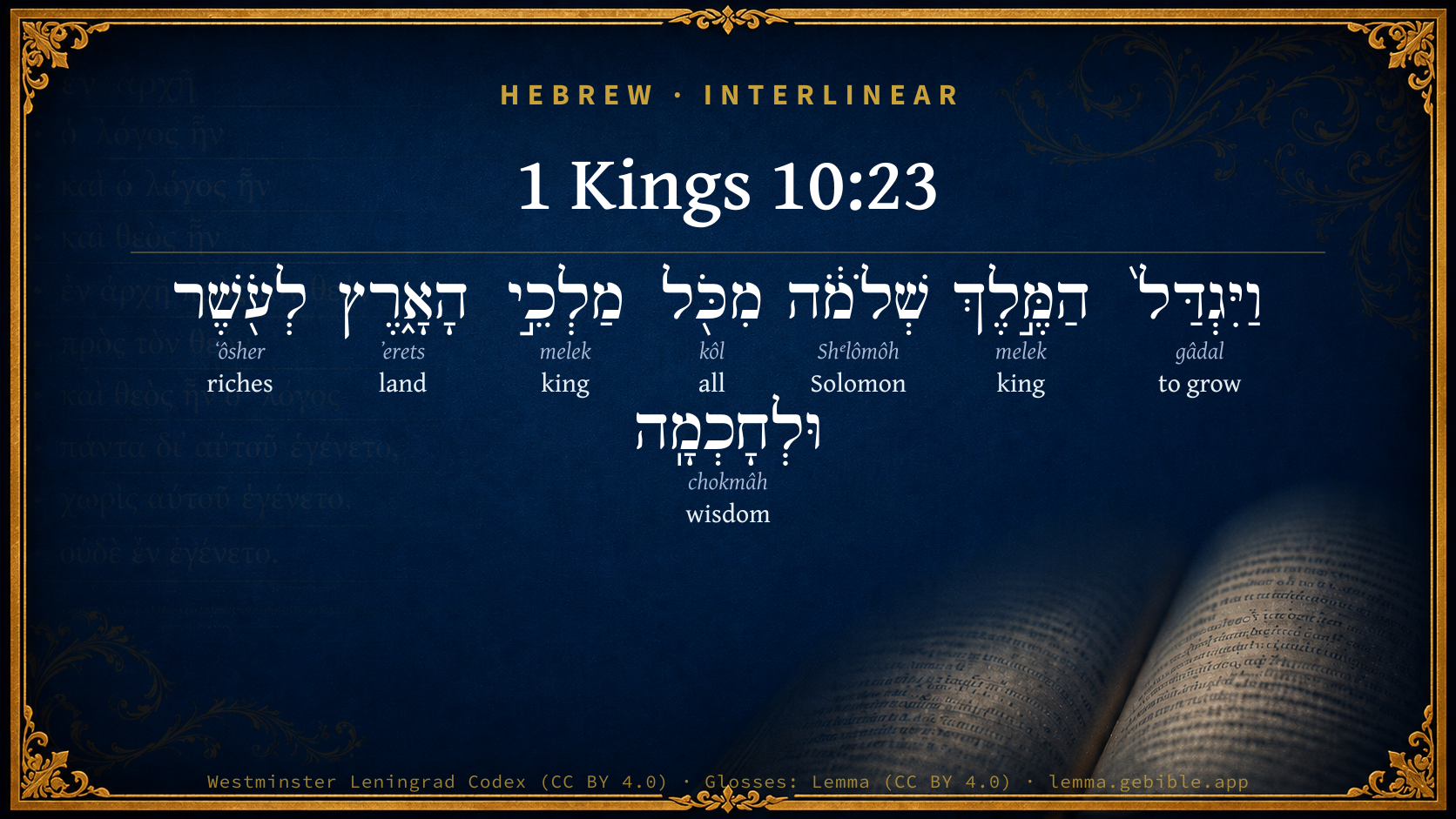
Hebrew (Westminster Leningrad Codex) 1 Kings 10:23 appears in the Hebrew Old Testament. The text above is from the Westminster Leningrad Codex. Each word links to its Strong’s number, a concise gloss, and parsing drawn from the Open Scriptures Hebrew Bible morphology. Click any word for its full Brown-Driver-Briggs (BDB) entry.
Download image
Cite this verse

1 Kings 10:23 (World English Bible). Public Domain. Lemma interlinear Bible study tool, https://lemma.gebible.app/v/1-kings/10/23.

Show BibTeX & RIS
BibTeX
RIS
English Translation
So king Solomon exceeded all the kings of the earth in riches and in wisdom.
World English Bible · Public Domain
Download a study sheet

One document with this verse’s original text, its word-by-word gloss line, the meaning frame, cross-references with their text, attributed commentary, and full source and license credits — printable, and it pastes into notes with its structure intact.

This verse Autodidact and up

Study sheet (.html) Plain text (.txt)

A passage Seminary Student

Up to 50 verses in one chapter. A passage sheet keeps up to 6 commentary sources and 12 cross-references per verse, in the order this page ranks them, and says so on the sheet whenever that leaves anything out. Ask for a single verse and you get the Autodidact verse sheet above.

Everything on this page stays free to read, with no account — the sheet is a download of what is already on screen, not access to it.

Want to remove ads? Support Godless Engineer
Compare translations 3

The same verse in 3 English versions, stacked beneath the original-language interlinear above. Click any original word for its lexicon entry.

Each is an independent rendering of the whole verse — the interlinear is not word-aligned to these translations.

Highlighted words mark where these versions differ — a whole-verse word diff, not a word-by-word alignment.

  • World English Bible Public Domain
    So king Solomon exceeded all the kings of the earth in riches and in wisdom.
  • King James Version Public Domain
    So king Solomon exceeded all the kings of the earth for riches and for wisdom.
  • unfoldingWord Literal Text CC BY-SA 4.0
    And King Solomon became greater than all of the kings of the earth in wealth and in wisdom.

unfoldingWord Literal Text — © unfoldingWord, licensed CC BY-SA 4.0. Word-aligned USFM3 via Door43 (git.door43.org/unfoldingWord/en_ult).

Versions to compare (up to 4)

3 of 4 selected

Show all 18 translations

Every available English version of this verse, each an independent rendering of the whole verse.

  • World English Bible Public Domain
    So king Solomon exceeded all the kings of the earth in riches and in wisdom.
  • Berean Standard Bible Public Domain
    So King Solomon surpassed all the kings of the earth in riches and wisdom.
  • Majority Standard Bible Public Domain
    So King Solomon surpassed all the kings of the earth in riches and wisdom.
  • King James Version Public Domain
    So king Solomon exceeded all the kings of the earth for riches and for wisdom.
  • American Standard Version (1901) Public Domain
    So king Solomon exceeded all the kings of the earth in riches and in wisdom.
  • Revised Version (1885) Public Domain
    So king Solomon exceeded all the kings of the earth in riches and in wisdom.
  • Geneva Bible (1599) Public Domain
    So King Salomon exceeded all the kings of the earth both in riches and in wisedome.
  • Douay-Rheims (1899) Public Domain
    And king Solomon exceeded all the kings of the earth in riches, and wisdom.
  • Young's Literal Translation Public Domain
    And king Solomon is greater than any of the kings of the earth for riches and for wisdom,
  • Literal Standard Version CC BY-SA 4.0
    And King Solomon is greater than any of the kings of the earth for riches and for wisdom,
  • Unlocked Literal Bible CC BY-SA 4.0
    So King Solomon exceeded all the kings of the world in riches and in wisdom.
  • unfoldingWord Literal Text CC BY-SA 4.0
    And King Solomon became greater than all of the kings of the earth in wealth and in wisdom.
  • Darby Bible Public Domain
    And king Solomon was greater than all the kings of the earth in riches and in wisdom.
  • World Messianic Bible Public Domain
    So King Solomon exceeded all the kings of the earth in riches and in wisdom.
  • Webster's Bible Public Domain
    So king Solomon exceeded all the kings of the earth for riches and for wisdom.
  • Free Bible Version CC BY-SA 4.0
    King Solomon was greater than any other king on earth in wealth and wisdom.
  • Bible in Basic English Public Domain
    And King Solomon was greater than all the kings of the earth in wealth and in wisdom.
  • JPS Tanakh (1917) Public Domain
    So king Solomon exceeded all the kings of the earth in riches and in wisdom.

Literal Standard Version (2020), Covenant Press — licensed CC BY-SA 4.0. Text via the HelloAO Bible API (eBible.org). Unlocked Literal Bible (unfoldingWord) — licensed CC BY-SA 4.0. Text via the HelloAO Bible API (eBible.org). unfoldingWord Literal Text — © unfoldingWord, licensed CC BY-SA 4.0. Word-aligned USFM3 via Door43 (git.door43.org/unfoldingWord/en_ult). Free Bible Version, Dr. Jonathan Gallagher — licensed CC BY-SA 4.0. Text via the HelloAO Bible API (eBible.org).

Word by word

More ways to search: Search by grammar → Find every occurrence → Compare this word →

Practice this passage: Drill this verse → Learn its vocabulary →

About this verse

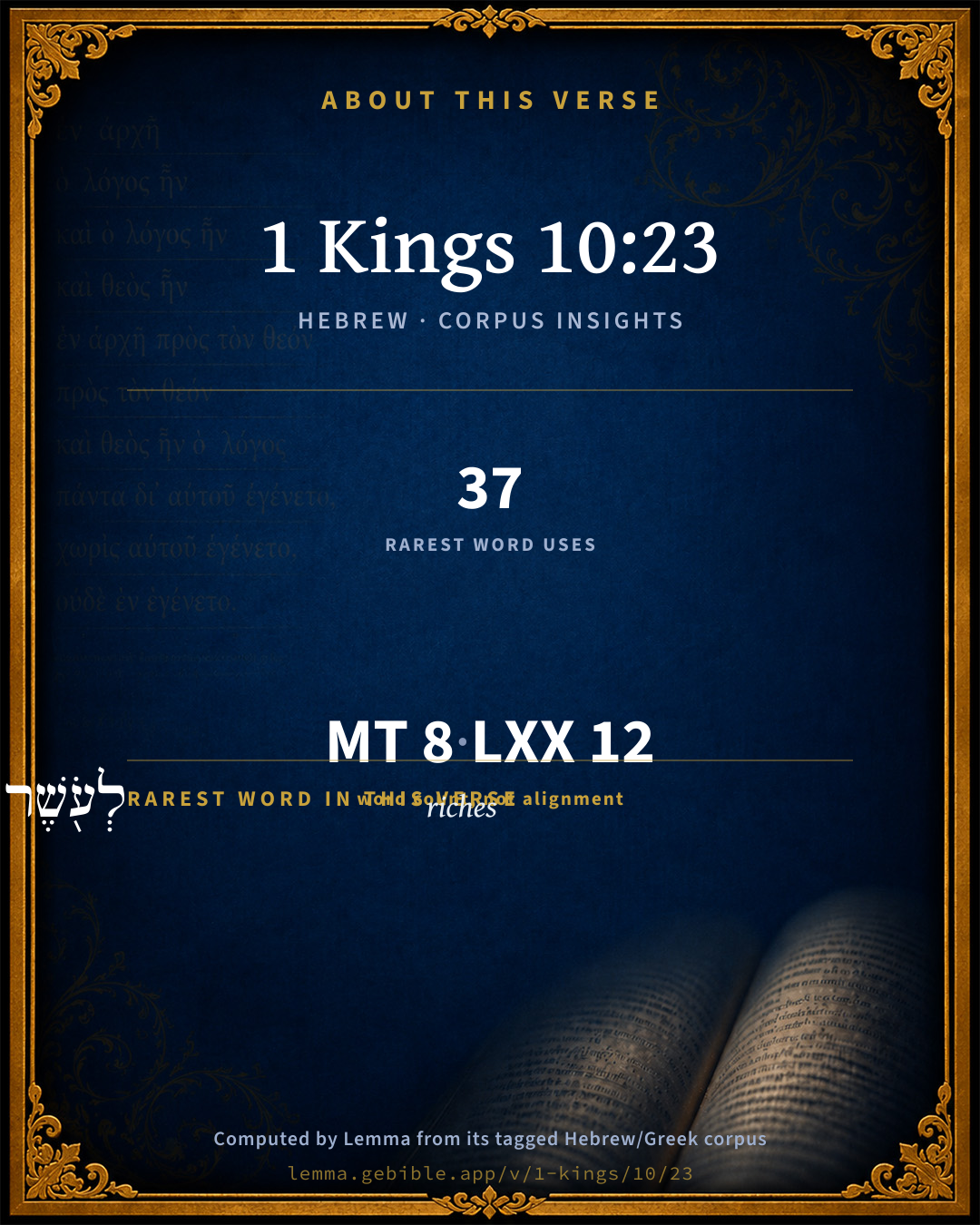
These counts appear in no published source. They are computed here, from the morphology-tagged text and Lemma’s own curated glosses. What Lemma adds →

8
words
7
distinct lemmas
Historical
section

Shared distinctive vocabulary

לְעֹ֖שֶׁר riches H6239 occurs in 36 verses of the Hebrew Bible. Also found in:

Grammatical profile

  • 1 verb
  • 7 nouns

Verb forms

  • וַיִּגְדַּל֙ Qal · Sequential Imperfect

Repetition

A word recurs within this verse — often emphatic in Hebrew:

  • הַמֶּ֣לֶךְ king H4428 ×2

Hebrew & Septuagint length

In English translation the verse runs 15 words from the Hebrew and 14 from the Septuagint (LXX English) — closely comparable.

A rough comparison of the two English renderings, which tokenize alike — not a word-level alignment.

Word counts can differ between the Hebrew and the Greek without any difference in meaning — e.g. the Hebrew direct-object marker אֵת has no separate Greek word, and Greek often adds the article ὁ.

In the original languages it is 8 Hebrew tokens and 12 Greek tokens — but the two are counted differently (Hebrew bundles its prefixes and suffixes into one token; the Greek is in lemma form), so that isn’t a like-for-like length.

Cross-references

7

Topical passages linked to 1 Kings 10:23 in the Treasury of Scripture Knowledge — connected by theme and wording, ordered by reader-vote popularity; previews shown in the World English Bible.

  • 1 Kings 3:12–13 behold, I have done according to your word: behold, I have given you a wise and an understanding heart; so that there has been none like you before you, neither after you shall any arise like you.
  • 1 Kings 4:29–34 God gave Solomon wisdom and understanding exceeding much, and very great understanding, even as the sand that is on the sea-shore.
  • 2 Chronicles 9:22–23 So king Solomon exceeded all the kings of the earth in riches and wisdom.
  • Ephesians 3:8 To me, the very least of all saints, was this grace given, to preach to the Gentiles the unsearchable riches of Christ,
  • Colossians 1:18–19 He is the head of the body, the assembly, who is the beginning, the firstborn from the dead; that in all things he might have the preeminence.
  • Colossians 2:2–3 that their hearts may be comforted, they being knit together in love, and gaining all riches of the full assurance of understanding, that they may know the mystery of God, both of the Father and of Christ,
  • Psalms 89:27 I will also appoint him my firstborn, The highest of the kings of the earth.

Cross-references courtesy of OpenBible.info (CC BY 4.0).

Hebrew and Greek witnesses Masoretic Hebrew ↔ Greek Septuagint

The same verse in the two great witnesses to the Old Testament, shown verse-for-verse.

These are two independent witnesses, not word-aligned to each other, and the Septuagint is shown in lemma (dictionary) form.

Hebrew 1 Kings 10:23 Masoretic · Westminster Leningrad Codex

וַיִּגְדַּל֙ הַמֶּ֣לֶךְ שְׁלֹמֹ֔ה מִכֹּ֖ל מַלְכֵ֣י הָאָ֑רֶץ לְעֹ֖שֶׁר וּלְחָכְמָֽה

So king Solomon exceeded all the kings of the earth in riches and in wisdom.

World English Bible · Public Domain

Greek LXX 1 Kings 10:23 Septuagint · lemma form

καί μεγαλύνω σαλωμών ὑπέρ πᾶς ὁ βασιλεύς ὁ γῆ πλοῦτος καί φρόνησις

And Solomon increased beyond all the kings of the earth in wealth and wisdom.

LXX2012 (modern English Septuagint) · Public Domain

On this verse, Keil & Delitzsch discusses the Septuagint’s reading. Read the note in Commentary ↓

Hebrew: Westminster Leningrad Codex (CC BY 4.0). Greek: Septuagint (public domain); English from LXX2012 (modern English Septuagint) (Public Domain). How the Septuagint differs from the Hebrew →

Targum (Aramaic paraphrase)

1

The Targum is the ancient Jewish Aramaic paraphrase of the Hebrew Scriptures — an interpretive translation, not the Hebrew text itself. Onkelos (literal) and Pseudo-Jonathan (expansive) render the Torah, and Jonathan the Prophets. Coverage is partial: where no permissively-licensed English translation exists for a verse, only the Aramaic is shown. This is verse-level text, not a word-by-word alignment to the Hebrew.

  1. Targum Jonathan Prophets (Joshua–Malachi)
    וּרְבָא מַלְכָּא שְׁלֹמֹה מִכָּל מַלְכֵי אַרְעָא לְעוֹתֵר וּלְחוּכְמָא:

    (no public-domain English translation for this verse)

    Targum Jonathan — Aramaic: “Mikraot Gedolot” (public domain). English: “Sefaria Community Translation” (CC0 1.0 (public-domain dedication)); “London "Chaldee Paraphrase," 1871” (public domain). Text via Sefaria.

Commentary

Notes on 1 Kings 10:23 from classic Christian and Jewish commentators (each source and its license shown beneath its notes). The classic Christian expositions comment on the surrounding passage and are grouped to its opening verse, so a note may address several verses; the Jewish commentaries on the Tanakh (Rashi and others) are per-verse, so they appear only where the commentator wrote on this verse.

Lemma curates 59 commentaries, every one of them public domain or Creative Commons licensed, each selected and text-cleaned for this edition rather than reprinted as found. About our sources →

Trapp's Complete Commentary

John Trapp

1Ki 10:23 So king Solomon exceeded all the kings of the earth for riches and for wisdom.

Ver. 23. For riches and wisdom.] Take them both together, and well he might be imparallel: for Stultitiam patiuntur opes: and Difficile est opibus non tradire mores.

John Trapp, A Commentary or Exposition upon All the Books of the Old and New Testament (1647–1656) — public domain. Text from a community e-Sword module.

Joseph Benson's Commentary

1Ki 10:23-25. For riches and for wisdom — The latter of which he asked of God, who graciously promised to add the former, and did so to a great degree. But what is here said is not to be taken in too strict a sense, but only as intending that he was richer than the kings of the earth in general were at that time. And all the earth sought to Solomon, &c. — That is, all the kings of the earth, as it is expressed 2Ch 9:23; namely, of those parts of the earth, or of the neighbouring countries, and the great men thereof. They came, as the queen of Sheba did, to be acquainted with his wisdom, which the heard was a supernatural gift, and to receive an increase of knowledge thereby. They brought every man his present — a rate year by year — By this conclusion it seems as if the persons here spoken of were tributary to him.

Joseph Benson's Commentary on the Old and New Testaments (1811–1818) — public domain. Text from a community e-Sword module.

Keil & Delitzsch

C. F. Keil & F. Delitzsch

In Kg1 10:23-29 everything that had to be stated concerning the wealth, wisdom, and revenue of Solomon is summed up as conclusion (cf. Ch2 9:22-28 and Ch2 1:14-17).

Kg1 10:23-25

Kg1 10:23, Kg1 10:24 point back to Kg1 5:9-14. ויּגדּל: Solomon became greater, not was greater, on account of the Vv consec. כּל־הארץ, all the world, corresponds to כּל־העמּים in Kg1 5:14. The foreigners out of all lands, who came on account of his wisdom, brought Solomon presents: gold and silver vessels, clothes (שׂלמות, court dresses, which are still customary presents in the East), נשׁק, armour, spices, horses and mules.

Kg1 10:26-27

Kg1 10:26 is simply a repetition of Kg1 5:6 (compare also Kg1 9:19); and Kg1 10:27 is merely a further extension of Kg1 10:21. The words of Kg1 10:27, "Solomon made silver like stones in Jerusalem, and cedars like the sycamores in the lowland for abundance," are a hyperbolical description of his collection of enormous quantities of precious metals and costly wood. שׁקמים, sycomori, mulberry fig-trees, are very rare in Palestine in its present desolate state (see Rob. Pal. iii. 27), and are only met in any abundance in Egypt; but in ancient times they abounded in the lowlands of Palestine to such an extent, that they were used as common building wood (vid., Isa 9:9, on which Theodoret observes, τούτων (συκαμίνων) ἡ Παλαιστίνη πεπλήρωται). According to Ch1 27:28, the sycamore forests in the lowland of Judah were royal domains.

Kg1 10:28-29

(cf. Ch2 1:16-17). "And (as for) the going out of horses from Egypt for Solomon, a company of king's merchants fetched (horses) for a definite price." This is the only possible explanation of the verse according to the Masoretic punctuation; but to obtain it, the first מקוה must be connected with סחרי in opposition to the accents, and the second must be pointed מקוה. This is the rendering adopted by Gesenius in his Thesaurus and Lexicon (ed. Dietr. s. v. מקוה). The meaning company or troop may certainly be justified from Gen 1:10; Exo 7:19, and Lev 11:36, where the word signifies an accumulation of water. Still there is something very strange not only in the application of the word both to a company of traders and also to a troop of horses, but also in the omission of סוּסים (horses) after the second מקוה. Hence the rendering of the lxx and Vulgate deserves attention, and may possibly be the one to be preferred (as Michaelis, Bertheau on Chron., and Movers assume). The translators of these versions have taken מקוה as the name of a place, ἐξ Ἐκουέ, or rather ἐκ Κουέ, de Coa.

(Note: That Κουέ or Κωέ is the earliest reading of the lxx, and not the ἐκ Θεκουέ of the Cod. Vat. and Alex., is very evident from the statement which we find in the Onomast. of Eusebius (ed. Larsow et Parth. p. 260), Κώδ, πλησίον Αἰγύπτου; for which Jerome has Coa, quae est juxta Aegyptum, after the Vulgate.)

According to this, the rendering would be: "And as for the going out of horses from Egypt and Koa (or Kawe) for Solomon, the king's traders fetched them from Joa (Kawe) for a fixed price." It is true that the situation of Koa cannot be more precisely defined; but there seems to be very little doubt that it was a place for the collection of customs upon the frontier of Egypt.

Kg1 10:29

"And there came up and went out a chariot from Egypt for six hundred shekels of silver, and a horse for a hundred and fifty shekels; and so (in the same manner as for Solomon) they led them out for all the kings of the Hittites and the kings of Aram through their hand." מרכּבה, like רכב in Sa2 8:4; Sa2 10:18, and Eze 39:20, denotes a chariot with the team of horses belonging to it, possibly three horses (see at Kg1 5:6), not quadriga (Clericus and others), or two draught horses and two as a reserve (Thenius). For the inference, that if a horse cost 150 shekels, a team of four would be obtained for 600, is not quite a certain one, since the chariot itself would certainly not be given in. A hundred and fifty shekels are a little more than 130 thalers (19, 10s. - Tr.), and 600 would be 525 thalers (78, 15s.). These amounts are sufficient to show how untenable the opinion of Movers is, that the sums mentioned are not the prices paid for horses and chariots, but the payment made for their exit, or the customs duty. And his other opinion is quite equally erroneous, namely that the chariots and horses were state carriages and horses of luxury intended for the king. - The merchants are called the king's traders, not because a portion of their profits went into the royal treasury as the tax upon trade (Bertheau), nor as the brokers who bought for the king (Thenius), but because they carried on their trade for the king's account. בּידם cannot be adduced as evidence to the contrary; for linguists require no proof that this cannot mean "auf ihre Hand," as Thenius assumes. Bttcher's explanation is the right one, namely, "through their hand," inasmuch as they brought the horses and chariots themselves even to those kings who lived at a greater distance, without employing intermediate agents. The kings of the חתּים, the Hittites in the wider sense (= Canaanites, as in Jos 1:4; Kg2 7:6; Eze 16:3), and of Aram, were in part Solomon's vassals, since his rule extended over all the Canaanites with the exception of the Phoenicians, and over several kingdoms of Aram.

Keil & Delitzsch — Biblical Commentary on the Old Testament (1861–1891) — public domain (CC PDM 1.0). Text via the HelloAO Bible API. (Old Testament only.)

Adam Clarke's Commentary

Verse 23. Solomon exceeded all the kings of the earth for riches] Mr. Reynolds, stating the yearly tribute of Solomon, 666 talents of gold, at about four times as much as his father left him, hence reckons that he had £4,909,371 8s. 8d. each year, £94,410 19s. 9 1/4d. per week, £13,487 5s. 8d. per day, taking each day, week, and year, one with another.

Adam Clarke's Commentary on the Bible (1810–1826) — public domain. Text from a community e-Sword/MySword module.

Ellicott's Commentary for English Readers

(23-25) All the kings.—These verses indicate the character of the empire of Solomon, as a loosely-compacted group of tributary states round the dominant kingdom of Israel, kept to their allegiance mainly by the ascendency of his personal wisdom and ability, partly by the ties of commercial intercourse and the attractions of his wealth and splendour, and to some degree (though in his case to a less extent than usual) by an imposing military force. It rose rapidly in the comparative abeyance of the great neighbouring empires of Egypt and Assyria, and fell as rapidly on the death of Solomon and the disruption of the kingdom. In the grand description of it in Psalms 72, we observe that while its wealth and prosperity are painted in bright colours, the chief stress is laid on its moral greatness, as a kingdom of righteousness and peace: “All kings shall fall down before him; all nations shall serve him. For he shall deliver the needy when he crieth . . . He shall judge thy people with righteousness, and thy poor with judgment.” Here, with the same general idea, but with a characteristic difference of expression, the chief emphasis is laid on the wisdom of Solomon, acknowledged as the gift of God (see Note on 1Ki_4:29), and being a moral and religious at least as much as an intellectual power. In this higher character it was the type of the kingdom of the true Son of David. In this, rather than in wealth and power, lay its true glory; and the falling away from this in the later days of Solomon brought at once decay and ruin.

A Bible Commentary for English Readers, edited by Charles John Ellicott (1878–1897) — public domain. Text from a community e-Sword module.

John Gill's Exposition

So King Solomon exceeded all the kings of the earth for riches and for wisdom. In which he was an eminent type of Christ; see Eph 3:8.

.

1 Kings 10:24

kg1 10:24

kg1 10:24

kg1 10:24And all the earth sought to Solomon, to hear his wisdom, which God had put in his heart. For it was all of God, a peculiar gift of his; by "all the earth" is meant the inhabitants of it, and only them, and those the more principal; who came from the several parts of it, hearing the fame of his wisdom, to know the truth of it, and to improve themselves by it.

John Gill's Exposition of the Whole Bible (1746–1763) — public domain (CC PDM 1.0). Text via the HelloAO Bible API.

Albert Barnes' Notes on the Bible

See the marginal references. By “all the earth” we are, of course, only to understand the kings or people of neighboring nations.

Albert Barnes' Notes on the Bible (1834–1885) — public domain. Text from a community e-Sword/MySword module.

The Pulpit Commentary

So King Solomon exceeded all the kings of the earth for riches and wisdom Cf. 1Ki_3:13. "There is something ominous of evil here. Riches are put before wisdom. This was not the case in the beginning of Solomon"s reign Wordsworth. (1Ki_3:11)

The Pulpit Commentary (1880–1919), ed. H.D.M. Spence-Jones & Joseph S. Exell — public domain. Text from a community e-Sword module.

unfoldingWord translationNotes

Door43 World Missions Community

All the earth

This is a generalization. AT: "People from everywhere" or "People from many different places" (See: Hyperbole and Generalization)

sought the presence of Solomon

The presence of the person is a metonym for being able to speak and listen to the person. AT: "sought an audience with Solomon" or "wanted to visit Solomon" (See: Metonymy)

to hear his wisdom, which God had put in his heart

The heart is a metonym for what a person thinks and is spoken of as if it were a container. The abstract noun "wisdom" is spoken of as if it were an object that could be put in a container and can be translated as an adjective. It can be a metonym for either the person or the words the person speaks. AT: "to hear his wisdom, which God had given him" or "to hear how wise God had enabled him to be" or "to hear him speak the wise words that God had enabled him to speak" (See: Metonymy)

translationWords

wise

earth

God

heart

tribute

armor

horse

donkey

unfoldingWord translationNotes — © Distant Shores Media and the Door43 World Missions Community, licensed CC BY-SA 4.0. Source: git.door43.org/Door43/en_tn.

Lesson kit

Teaching starters — assembled from the data on this page, not authored interpretation. Every prompt links to the verse data it draws on. Edit before teaching.

1 Kings, in the Historical, opens this verse with 8 words (7 distinct Hebrew lemmas). Its most distinctive word is ʻôsher (“riches”). A historical commentator’s framing appears above. Read the whole chapter for the surrounding context.

Discussion questions

  1. The word ʻôsher carries the sense “riches.” How does it shape the verse?
  2. How does Genesis 31:16, which shares the word «riches», read alongside this verse?
  3. What does the repetition of “king” (2× in this one verse) do in this verse?
  4. The translations on this page render this verse differently — a whole-verse word diff, not a word-by-word alignment. What might account for the different wordings?
  5. «וַיִּגְדַּל֙» is a Qal Sequential Imperfect verb. How does that grammatical form shape the action described?
  6. Compare how Trapp's Complete Commentary and Joseph Benson's Commentary read this verse. Where do they agree or differ?

Things to notice

Reading settings

Reading text

Shown beneath each verse's original-language words.

Old Testament
Old Testament edition

Read the OT as the Masoretic Hebrew (MT) or the Greek Septuagint (LXX).

English shown for the Greek Septuagint (in the Hebrew ↔ Greek comparison).

Comparing translations? Open the Compare panel on any verse page to stack up to four side by side.