
Deuteronomy 4:43

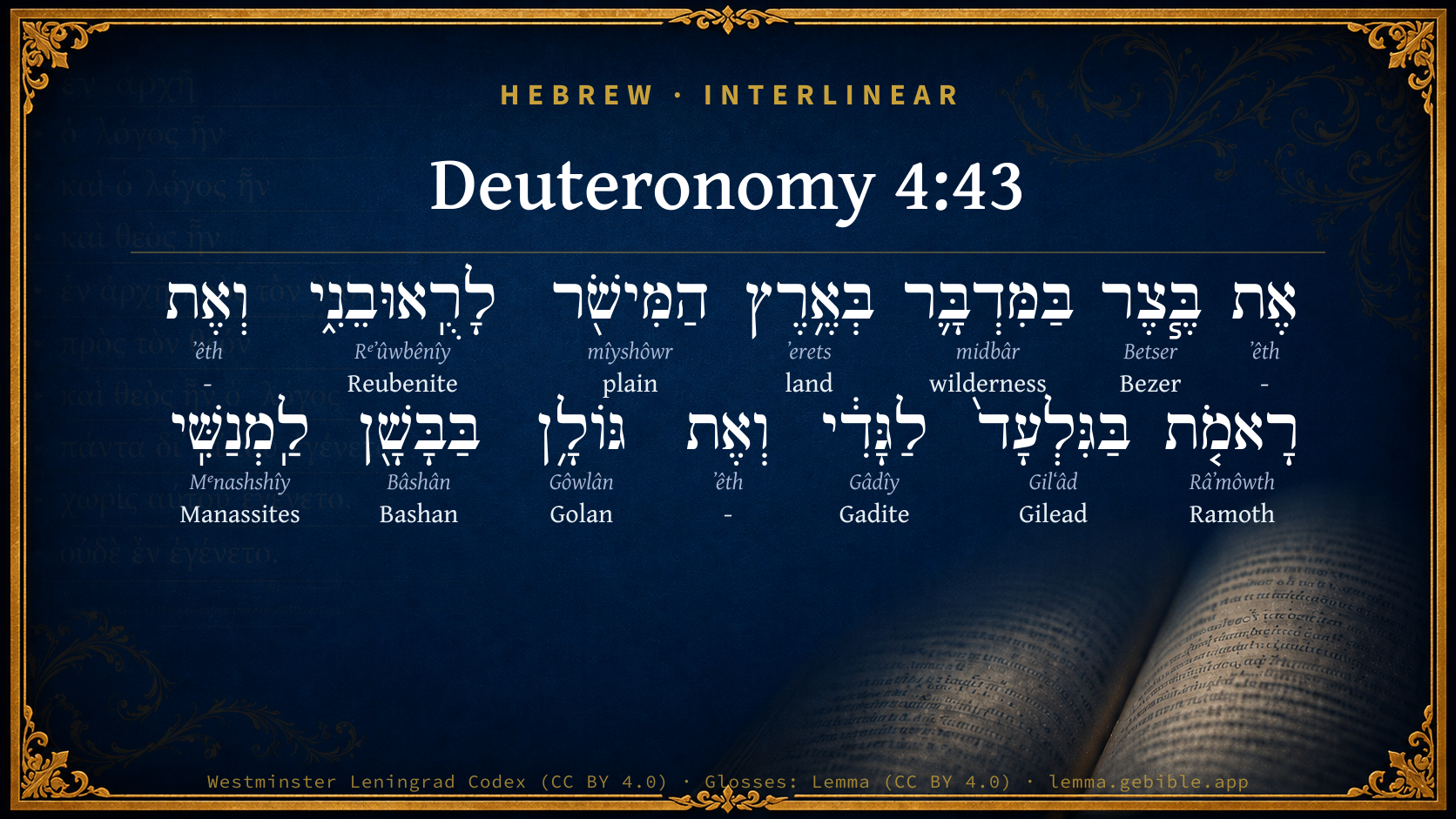
Hebrew (Westminster Leningrad Codex) Deuteronomy 4:43 appears in the Hebrew Old Testament. The text above is from the Westminster Leningrad Codex. Each word links to its Strong’s number, a concise gloss, and parsing drawn from the Open Scriptures Hebrew Bible morphology. Click any word for its full Brown-Driver-Briggs (BDB) entry.
Download image
Cite this verse

Deuteronomy 4:43 (World English Bible). Public Domain. Lemma interlinear Bible study tool, https://lemma.gebible.app/v/deuteronomy/4/43.

Show BibTeX & RIS
BibTeX
RIS
English Translation
[namely], Bezer in the wilderness, in the plain country, for the Reubenites; and Ramoth in Gilead, for the Gadites; and Golan in Bashan, for the Manassites.
World English Bible · Public Domain
Highlights
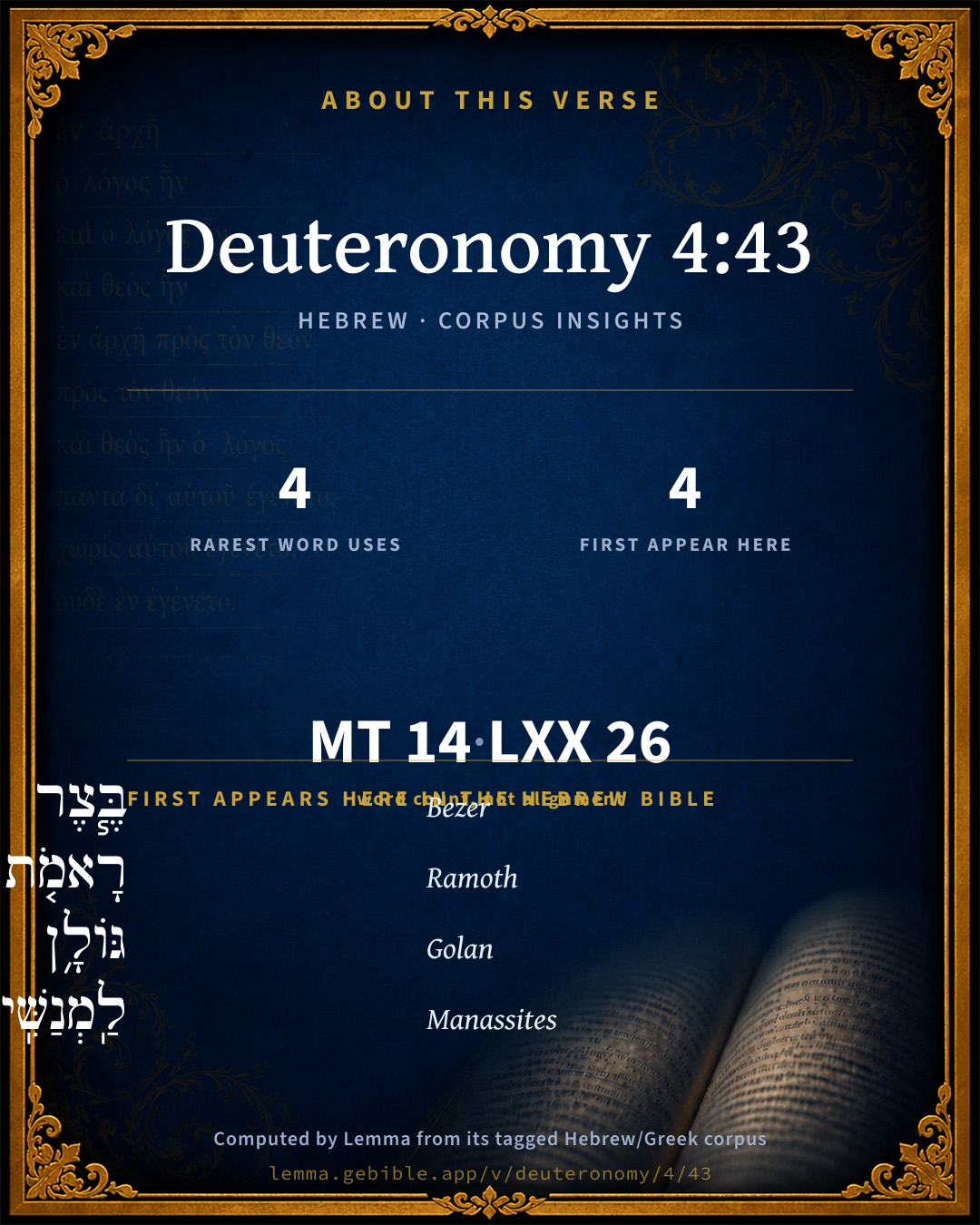
  • 4 first appearances in the Hebrew Bible
Full analysis ↓
Download a study sheet

One document with this verse’s original text, its word-by-word gloss line, the meaning frame, cross-references with their text, attributed commentary, and full source and license credits — printable, and it pastes into notes with its structure intact.

This verse Autodidact and up

Study sheet (.html) Plain text (.txt)

A passage Seminary Student

Up to 50 verses in one chapter. A passage sheet keeps up to 6 commentary sources and 12 cross-references per verse, in the order this page ranks them, and says so on the sheet whenever that leaves anything out. Ask for a single verse and you get the Autodidact verse sheet above.

Everything on this page stays free to read, with no account — the sheet is a download of what is already on screen, not access to it.

Want to remove ads? Support Godless Engineer
Compare translations 3

The same verse in 3 English versions, stacked beneath the original-language interlinear above. Click any original word for its lexicon entry.

Each is an independent rendering of the whole verse — the interlinear is not word-aligned to these translations.

Highlighted words mark where these versions differ — a whole-verse word diff, not a word-by-word alignment.

  • World English Bible Public Domain
    [namely], Bezer in the wilderness, in the plain country, for the Reubenites; and Ramoth in Gilead, for the Gadites; and Golan in Bashan, for the Manassites.
  • King James Version Public Domain
    Namely, Bezer in the wilderness, in the plain country, of the Reubenites; and Ramoth in Gilead, of the Gadites; and Golan in Bashan, of the Manassites.
  • unfoldingWord Literal Text CC BY-SA 4.0
    Bezer in the wilderness in the land of the plain for the Reubenites, and Ramoth in Gilead for the Gadites, and Golan in Bashan for the Manassites.

unfoldingWord Literal Text — © unfoldingWord, licensed CC BY-SA 4.0. Word-aligned USFM3 via Door43 (git.door43.org/unfoldingWord/en_ult).

Versions to compare (up to 4)

3 of 4 selected

Show all 18 translations

Every available English version of this verse, each an independent rendering of the whole verse.

  • World English Bible Public Domain
    [namely], Bezer in the wilderness, in the plain country, for the Reubenites; and Ramoth in Gilead, for the Gadites; and Golan in Bashan, for the Manassites.
  • Berean Standard Bible Public Domain
    Bezer in the wilderness on the plateau belonging to the Reubenites, Ramoth in Gilead belonging to the Gadites, or Golan in Bashan belonging to the Manassites.
  • Majority Standard Bible Public Domain
    Bezer in the wilderness on the plateau belonging to the Reubenites, Ramoth in Gilead belonging to the Gadites, or Golan in Bashan belonging to the Manassites.
  • King James Version Public Domain
    Namely, Bezer in the wilderness, in the plain country, of the Reubenites; and Ramoth in Gilead, of the Gadites; and Golan in Bashan, of the Manassites.
  • American Standard Version (1901) Public Domain
    `namely', Bezer in the wilderness, in the plain country, for the Reubenites; and Ramoth in Gilead, for the Gadites; and Golan in Bashan, for the Manassites.
  • Revised Version (1885) Public Domain
    namely, Bezer in the wilderness, in the plain country, for the Reubenites; and Ramoth in Gilead, for the Gadites; and Golan in Bashan, for the Manassites.
  • Geneva Bible (1599) Public Domain
    That is, Bezer in the wildernesse, in the plaine countrey of the Reubenites: and Ramoth in Gilead among the Gadites: and Golan in Bashan among them of Manasseh.
  • Douay-Rheims (1899) Public Domain
    Bosor in the wilderness, which is situate in the plains of the tribe of Ruben: and Ramoth in Galaad, which is in the tribe of Gad: and Golan in Basan, which is in the tribe of Manasses.
  • Young's Literal Translation Public Domain
    Bezer, in the wilderness, in the land of the plain, of the Reubenite; and Ramoth, in Gilead, of the Gadite; and Golan, in Bashan, of the Manassahite.
  • Literal Standard Version CC BY-SA 4.0
    Bezer in the wilderness, in the land of the plain, for the Reubenite; and Ramoth in Gilead for the Gadite; and Golan in Bashan for the Manassite.
  • Unlocked Literal Bible CC BY-SA 4.0
    They were: Bezer in the wilderness, the plain country, for the Reubenites; Ramoth in Gilead, for the Gadites; and Golan in Bashan, for the Manassites.
  • unfoldingWord Literal Text CC BY-SA 4.0
    Bezer in the wilderness in the land of the plain for the Reubenites, and Ramoth in Gilead for the Gadites, and Golan in Bashan for the Manassites.
  • Darby Bible Public Domain
    Bezer in the wilderness, in the plateau, of the Reubenites, and Ramoth in Gilead, of the Gadites, and Golan in Bashan, of the Manassites.
  • World Messianic Bible Public Domain
    Bezer in the wilderness, in the plain country, for the Reubenites; and Ramoth in Gilead for the Gadites; and Golan in Bashan for the Manassites.
  • Webster's Bible Public Domain
    Namely, Bezer in the wilderness, in the plain country, of the Reubenites; and Ramoth in Gilead, of the Gadites; and Golan in Bashan, of the Manassites.
  • Free Bible Version CC BY-SA 4.0
    Bezer in the desert plain belonging to the tribe of Reuben; Ramoth in Gilead belonging to the tribe of Gad, or Golan in Bashan belonging to the tribe of Manasseh.
  • Bible in Basic English Public Domain
    The names of the towns were Bezer in the waste land, in the table-land, for the Reubenites; and Ramoth in Gilead for the Gadites; and Golan in Bashan for Manasseh.
  • JPS Tanakh (1917) Public Domain
    Bezer in the wilderness, in the table-land, for the Reubenites; and Ramoth in Gilead, for the Gadites; and Golan in Bashan, for the Manassites.

Literal Standard Version (2020), Covenant Press — licensed CC BY-SA 4.0. Text via the HelloAO Bible API (eBible.org). Unlocked Literal Bible (unfoldingWord) — licensed CC BY-SA 4.0. Text via the HelloAO Bible API (eBible.org). unfoldingWord Literal Text — © unfoldingWord, licensed CC BY-SA 4.0. Word-aligned USFM3 via Door43 (git.door43.org/unfoldingWord/en_ult). Free Bible Version, Dr. Jonathan Gallagher — licensed CC BY-SA 4.0. Text via the HelloAO Bible API (eBible.org).

Word by word

More ways to search: Search by grammar → Find every occurrence → Compare this word →

Practice this passage: Drill this verse → Learn its vocabulary →

רָאמֹ֤ת
Râʼmôwth
H7216
“Ramoth”
Noun, Proper
Part of Speech
Noun
Type
Proper
Full BDB Definition

Origin: pl. of H7215

TWOT: None

Ramoth = "heights" - a place in Gilead; site dubious - a Levitical city in Issachar
  1. אֶת ʼêth H853 “-” Particle, Direct Object
  2. בֶּ֧צֶר Betser H1221 “Bezer” Noun, Proper
  3. בַּמִּדְבָּ֛ר midbâr H4057 “in/at the · wilderness” Preposition, Determined + Noun, Common, Masculine, Singular, Absolute
  4. בְּאֶ֥רֶץ ʼerets H776 “in/at · land of” Preposition + Noun, Common, Both, Singular, Construct
  5. הַמִּישֹׁ֖ר mîyshôwr H4334 “the · plain” Particle, Definite Article + Noun, Common, Masculine, Singular, Absolute
  6. לָרֻֽאוּבֵנִ֑י Rᵉʼûwbênîy H7206 “to/for the · Reubenite” Preposition, Determined + Noun, Gentilic, Masculine, Singular, Absolute
  7. וְאֶת ʼêth H853 “and · -” Conjunction + Particle, Direct Object
  8. בַּגִּלְעָד֙ Gilʻâd H1568 “in/at the · Gilead” Preposition, Determined + Noun, Proper
  9. לַגָּדִ֔י Gâdîy H1425 “to/for the · Gadite” Preposition, Determined + Noun, Gentilic, Masculine, Singular, Absolute
  10. וְאֶת ʼêth H853 “and · -” Conjunction + Particle, Direct Object
  11. גּוֹלָ֥ן Gôwlân H1474 “Golan” Noun, Proper
  12. בַּבָּשָׁ֖ן Bâshân H1316 “in/at the · Bashan” Preposition, Determined + Noun, Proper
  13. לַֽמְנַשִּֽׁי Mᵉnashshîy H4520 “to/for the · Manassites” Preposition, Determined + Noun, Gentilic, Masculine, Singular, Absolute

About this verse

These counts appear in no published source. They are computed here, from the morphology-tagged text and Lemma’s own curated glosses. What Lemma adds →

14
words
12
distinct lemmas
Pentateuch
section

Notable vocabulary

The rarest word here is רָאמֹ֤ת Ramoth H7216 — appearing just 4 times in the whole Hebrew Bible.

First appearance in Scripture

These words make their first canonical appearance in the Hebrew Bible here:

  • בֶּ֧צֶר Bezer H1221
  • רָאמֹ֤ת Ramoth H7216
  • גּוֹלָ֥ן Golan H1474
  • לַֽמְנַשִּֽׁי Manassites H4520

Shared distinctive vocabulary

רָאמֹ֤ת Ramoth H7216 occurs in 4 verses of the Hebrew Bible. Also found in:

Grammatical profile

  • 11 nouns
  • 3 particles

Hebrew & Septuagint length

In English translation the verse runs 26 words from the Hebrew and 24 from the Septuagint (LXX English) — closely comparable.

A rough comparison of the two English renderings, which tokenize alike — not a word-level alignment.

Word counts can differ between the Hebrew and the Greek without any difference in meaning — e.g. the Hebrew direct-object marker אֵת has no separate Greek word, and Greek often adds the article ὁ.

In the original languages it is 14 Hebrew tokens and 26 Greek tokens — but the two are counted differently (Hebrew bundles its prefixes and suffixes into one token; the Greek is in lemma form), so that isn’t a like-for-like length.

Cross-references

7

Topical passages linked to Deuteronomy 4:43 in the Treasury of Scripture Knowledge — connected by theme and wording, ordered by reader-vote popularity; previews shown in the World English Bible.

  • Joshua 20:8 Beyond the Jordan at Jericho eastward, they assigned Bezer in the wilderness in the plain out of the tribe of Reuben, and Ramoth in Gilead out of the tribe of Gad, and Golan in Bashan out of the tribe of Manasseh.
  • Joshua 21:27 To the children of Gershon, of the families of the Levites, out of the half-tribe of Manasseh [they gave] Golan in Bashan with its suburbs, the city of refuge for the manslayer, and Be-eshterah with its suburbs; two cities.
  • Joshua 21:38 Out of the tribe of Gad, Ramoth in Gilead with its suburbs, the city of refuge for the manslayer, and Mahanaim with its suburbs,
  • 1 Kings 4:13 Ben Geber, in Ramoth-gilead (to him [pertained] the towns of Jair the son of Manasseh, which are in Gilead; [even] to him [pertained] the region of Argob, which is in Bashan, sixty great cities with walls and brazen bars);
  • 1 Kings 22:3–4 The king of Israel said to his servants, "You know that Ramoth-gilead is ours, and we are still, and don't take it out of the hand of the king of Syria?"
  • 1 Chronicles 6:71 To the sons of Gershom [were given], out of the family of the half-tribe of Manasseh, Golan in Bashan with its suburbs, and Ashtaroth with its suburbs;
  • 1 Chronicles 6:80 and out of the tribe of Gad, Ramoth in Gilead with its suburbs, and Mahanaim with its suburbs,

Cross-references courtesy of OpenBible.info (CC BY 4.0).

Hebrew and Greek witnesses Masoretic Hebrew ↔ Greek Septuagint

The same verse in the two great witnesses to the Old Testament, shown verse-for-verse.

These are two independent witnesses, not word-aligned to each other, and the Septuagint is shown in lemma (dictionary) form.

Hebrew Deuteronomy 4:43 Masoretic · Westminster Leningrad Codex

אֶת בֶּ֧צֶר בַּמִּדְבָּ֛ר בְּאֶ֥רֶץ הַמִּישֹׁ֖ר לָרֻֽאוּבֵנִ֑י וְאֶת רָאמֹ֤ת בַּגִּלְעָד֙ לַגָּדִ֔י וְאֶת גּוֹלָ֥ן בַּבָּשָׁ֖ן לַֽמְנַשִּֽׁי

[namely], Bezer in the wilderness, in the plain country, for the Reubenites; and Ramoth in Gilead, for the Gadites; and Golan in Bashan, for the Manassites.

World English Bible · Public Domain

Greek LXX Deuteronomy 4:43 Septuagint · lemma form

ὁ βοσορ ἐν ὁ ἔρημος ἐν ὁ γῆ ὁ πεδεινός ὁ ρουβην καί ὁ ραμωθ ἐν γαλαάδ ὁ γαδδι καί ὁ γαυλων ἐν βασαν ὁ μανασσή

Bosor in the wilderness, in the plain country of Ruben, and Ramoth in Galaad belonging to Gad, and Gaulon in Basan belonging to Manasse.

LXX2012 (modern English Septuagint) · Public Domain

On this verse, John Gill's Exposition discusses the Septuagint’s reading. Read the note in Commentary ↓

Hebrew: Westminster Leningrad Codex (CC BY 4.0). Greek: Septuagint (public domain); English from LXX2012 (modern English Septuagint) (Public Domain). How the Septuagint differs from the Hebrew →

Targum (Aramaic paraphrase)

2

The Targum is the ancient Jewish Aramaic paraphrase of the Hebrew Scriptures — an interpretive translation, not the Hebrew text itself. Onkelos (literal) and Pseudo-Jonathan (expansive) render the Torah, and Jonathan the Prophets. Coverage is partial: where no permissively-licensed English translation exists for a verse, only the Aramaic is shown. This is verse-level text, not a word-by-word alignment to the Hebrew.

  1. Targum Onkelos Torah (Genesis–Deuteronomy)
    יָת בֶּצֶר בְּמַדְבְּרָא בְּאַרְעָא מֵישְׁרָא לְשִׁבְטָּא דִרְאוּבֵן וְיָת רָאמוֹת בַּגִלְעָד לְשִׁבְטָא דְגָד וְיָת גוֹלָן בְּמַתְנָן לְשִׁבְטָא דִמְנַשֶׁה

    (no public-domain English translation for this verse)

    Targum Onkelos — Aramaic: “Onkelos Genesis” (public domain); “Onkelos Exodus” (public domain); “Onkelos Leviticus” (public domain); “Onkelos Numbers” (public domain); “Onkelos Deuteronomy” (public domain). English: “Sefaria Community Translation” (CC0 1.0 (public-domain dedication)); “J.W. Etheridge. The Targums of Onkelos and Jonathan Ben Uzziel on the Pentateuch. London: Longmans, Green, 1862” (public domain). Text via Sefaria.

  2. Targum Pseudo-Jonathan Torah (Genesis–Deuteronomy)
    יַת כְּוָתִירִין בְּמַדְבְּרָא בְּאַרַע מִישְׁרָא לְשֵׁבֶט רְאוּבֵן וְיַת רָמָתָא בְגִלְעָד לְשֵׁבֶט גָּד וְיַת דַּבְרָא בְּמַתְנָן לְשֵׁבֶט מְנַשֶּׁה

    Kevatirin the wilderness, in the plain country, for the tribe of Reuben, and Ramatha in Gilead for the tribe of Gad, and Dabera in Mathnan for the tribe of Menasheh.

    Targum Pseudo-Jonathan — Aramaic: “Targum Jonathan on Genesis” (public domain); “Targum Jonathan on Exodus” (public domain); “Targum Jonathan on Leviticus” (public domain); “Targum Jonathan on Numbers” (public domain); “Targum Jonathan on Deuteronomy” (public domain). English: “The Targum of Jonathan ben Uzziel, trans. J. W. Etheridge, London, 1862” (public domain). Text via Sefaria.

Commentary

Notes on Deuteronomy 4:43 from classic Christian and Jewish commentators (each source and its license shown beneath its notes). The classic Christian expositions comment on the surrounding passage and are grouped to its opening verse, so a note may address several verses; the Jewish commentaries on the Tanakh (Rashi and others) are per-verse, so they appear only where the commentator wrote on this verse.

Lemma curates 59 commentaries, every one of them public domain or Creative Commons licensed, each selected and text-cleaned for this edition rather than reprinted as found. About our sources →

Tyndale Open Study Notes

Tyndale Open Resources

4:43 Bezer (probably modern Umm al-‘Amad) lay some six miles east of Heshbon. • Ramoth in Gilead was thirty-five miles east-southeast of the Sea of Galilee. • The town of Golan was about forty miles north of Ramoth in Gilead.

Tyndale Open Study Notes — © Tyndale Open Resources, licensed CC BY-SA 4.0. Text via the HelloAO Bible API.

Adam Clarke's Commentary

Verse 43. Bezer in the wilderness] As the cities of refuge are generally understood to be types of the salvation provided by Christ for sinners; so their names have been thought to express some attribute of the Redeemer of mankind. See them explained Jos 20:7-8.

I SUPPOSE the last nine verses of this chapter to have been added by either Joshua or Ezra.

Adam Clarke's Commentary on the Bible (1810–1826) — public domain. Text from a community e-Sword/MySword module.

The Cambridge Bible for Schools and Colleges

gen. ed. J. J. S. Perowne

43. Bezer] Beṣer; described, as here, in Jos_20:8; and in Jos_21:36 along with Yahaṣ, Ḳedemoth, and Mepha‘ath. The name also occurs on the Moabite stone, line 27. No modern equivalent has been recovered. The meaning of the name is the general one of wall or fence.

Ramoth in Gilead] Jos_20:8; Jos_21:38 (with Maḥanaim), Ramoth of Gilead, 1Ki_4:13, etc. It has been variously identified with Es-Salṭ (because of the military and administrative importance of this site, and the statement of Eusebius and Jerome that Ramoth Gilead lay 15 Roman miles W. of Philadelphia = Rabbath-‘Ammon), and with the ruins called el-Jal‘ûd, 6 miles N. of es-Salṭ. The Biblical data, however, imply a site N. of the Jabboḳ. Some have fixed on Jerash, but a site still further N. seems necessary. There Gadara (because it must always have been a fortress of importance, debateable between Israel and Aram, and because it is not otherwise mentioned in the O.T.) and Remtheh (both because of its position and its name) seem most suitable. Salḥad has been suggested, but it lies too far E., and its own name was too well known. See further HGHL 587 f., G. A. Cooke in Driver’s Deuteronomy (3rd ed.), Add. p. xx; Cheyne, E. B. 4014 ff.

Golan] Jos_20:8; Jos_21:27. The Γαυλάνη of Josephus (XIII. Ant. xv. 3; 1 B.J. iv. 4, 8) was in Eusebius’ time ‘a very large village in Batanea.’ To-day the name Jaulân corresponds to the Γαυλανῖτις of the Greek period, E. of the Lake of Galilee and between the Yarmûk and Ḥermon. Schumacher identifies the town with the modern Saḥem-el-Jaulan, 17 miles E. of the Lake. See HGHL 444 n. 2, 536, 553.

The Cambridge Bible for Schools and Colleges (gen. ed. J. J. S. Perowne; Cambridge University Press, 1878–1918) — public domain. Text from a community e-Sword module.

John Gill's Exposition

Namely, Bezer in the wilderness,.... In Jos 20:8, it is added "upon the plain"; this perhaps was the wilderness of Moab, in the plains of it, the same with Bozrah, see Jer 48:24 and in the Apocrypha:"Hereupon Judas and his host turned suddenly by the way of the wilderness unto Bosora; and when he had won the city, he slew all the males with the edge of the sword, and took all their spoils, and burned the city with fire,'' (1 Maccabees 5:28)it was in the

plain country of the Reubenites, or lay in that part of the country which was allotted to them, and which they gave to the Levites, Ch1 6:78,

and Ramoth in Gilead of the Gadites; it lay in that part of Mount Gilead, and among the cities of it, which fell to the share of the tribe of Gad, and was by them given to the Levites, Ch1 6:80, this city is frequently in Scripture called Ramothgilead; see Kg1 4:13.

and Golan in Bashan, of the Manassites, or "Gaulon", as the Septuagint, and from hence the country round about was called Gaulanitis; all Bashan, the kingdom of Og, was given to the half tribe of Manasseh, and out of it this city was given by them to the Levites, Ch1 6:71, and appointed a city of refuge: now as these cities were typical of Christ, there may be something observed in the names of them as agreeing with him. "Bezer" signifies "a fortified place"; Christ is the fortress, mountain, and place of defence for his people, and strong hold to which the prisoners of hope turn, the strong tower whither the righteous run and are safe. "Ramoth" signifies "exaltations"; which may point both at the exaltation of Christ in human nature at the right hand of God, and the exaltation of his people by him, who are raised by him from a low estate to sit among princes, and to inherit the throne of glory, and by whom he is exalted in his person, office, and grace. "Golan" signifies "revealed" or" manifested": so Christ has been manifest in the flesh, and is revealed to sinners, when they are called by his grace; to whom they flee for refuge, and lay hold on him, the hope set before them.

John Gill's Exposition of the Whole Bible (1746–1763) — public domain (CC PDM 1.0). Text via the HelloAO Bible API.

Haydock's Catholic Bible Commentary

Wilderness, or plains of Moab, at the mouth of the Jordan. It is sometimes called Besor, and is very different from Bozra of Idumea, (Isaias lxiii. 1,) a very famous city, known to profane authors by the name of Bostra. --- Ramoth, one of the strongest towns of Galaad, 15 miles west of Philadelphia, (Eusebius) where Achab, king of Israel, received a mortal wound, 3 Kings xxii. 3. --- Golon, or Gaulan, gave its name to Gaulanitis, a part of Batanea, lying on the southern parts of the division of Gad, though the city belonged to Manasses. The lower Gaulanitis lay towards the lake of Genezareth, and had Gamala for its capital. (Cellarius) (Calmet)

George Leo Haydock (1774–1849), Haydock's Catholic Family Bible and Commentary, 1859 edition — public domain. Excludes Psalms (Douay-Rheims chapter numbering differs from Protestant) and Deuterocanonical books (Catholic canon only).

Whedon's Commentary on the Bible

Daniel D. Whedon

43. Bezer — This city is mentioned in Jos_20:8; Jos_21:36, and 1Ch_6:63. By some it is thought to be the same as Bosor. 1Ma_5:36. It may possibly be the modern Berza of Robinson.

Ramoth in Gilead — By some writers considered the same as Ramath-mizpeh. Comp. Jos_20:8, with Deut 13:26. It was situated fifteen Roman miles west of Rabbath-Ammon.

Golan in Bashan — According to Eusebius it was a large village in Batanaea even in his day. The district received its name Gaulonitis from Golan.

Daniel D. Whedon (gen. ed.), Commentary on the Old and New Testaments (1874–1909) — public domain. Text from a community e-Sword module.

The Pulpit Commentary

Names of the cities set apart. Bezer; LXX bosor; one of the cities of the plain or table-land of the Amorites, on the east of Jordan (Deu_3:10; Jos_20:8) afterwards a Levitical city in the tribe of Reuben. (Jos_21:36) It is probably the Bosor of RAPC 1Ma 5:36; it has not been identified with any existing locality, but the ruined heaps of Burazin to the east of Hesban, or those of Berza in the same district, may mark its site. Ramoth in Gilead; probably the same as Ramoth-mizpeh; (Jos_13:26) it lay to the northwest of Philadelphia (Rabba or Rabbath-Ammon, hod. Amman), on the Jabbok (Onom.," s.v." Rammoth" and Remmoth"); a Levitical city in the tribe of Gad, (Jos_21:38) hod. Es Salt, six hours from Amman (Von Raumer, Porter). Golan in Bashan. Eusebius identifies this with Gaulon, a very large village in Batanaea, from which the surrounding region had its name, viz. Gaulonitis, hod. Jolan ("Onom.," s.v. Gau-lon"); it was a Levitical city in the tribe of Manasseh (Jos_21:27; 1Ch_6:71) it has not been identified.

The Pulpit Commentary (1880–1919), ed. H.D.M. Spence-Jones & Joseph S. Exell — public domain. Text from a community e-Sword module.

Lesson kit

Teaching starters — assembled from the data on this page, not authored interpretation. Every prompt links to the verse data it draws on. Edit before teaching.

Deuteronomy, in the Pentateuch, opens this verse with 14 words (12 distinct Hebrew lemmas). Its most distinctive word is Râʼmôwth (“Ramoth”). A historical commentator’s framing appears above. Read the whole chapter for the surrounding context.

Discussion questions

  1. What does “Ramoth” (Râʼmôwth) contribute to the verse as a whole?
  2. 4 words here appear for the first time in Scripture. What is being introduced at this debut?
  3. Joshua 20:8 shares the word «Ramoth» with this verse. How do the two illuminate each other?
  4. These translations render this verse differently. What is at stake in choosing one wording over another?
  5. Reading how Tyndale Open Study Notes and Adam Clarke's Commentary read this verse, where do the two commentators agree and where do they part?

Things to notice

Reading settings

Reading text

Shown beneath each verse's original-language words.

Old Testament
Old Testament edition

Read the OT as the Masoretic Hebrew (MT) or the Greek Septuagint (LXX).

English shown for the Greek Septuagint (in the Hebrew ↔ Greek comparison).

Comparing translations? Open the Compare panel on any verse page to stack up to four side by side.