
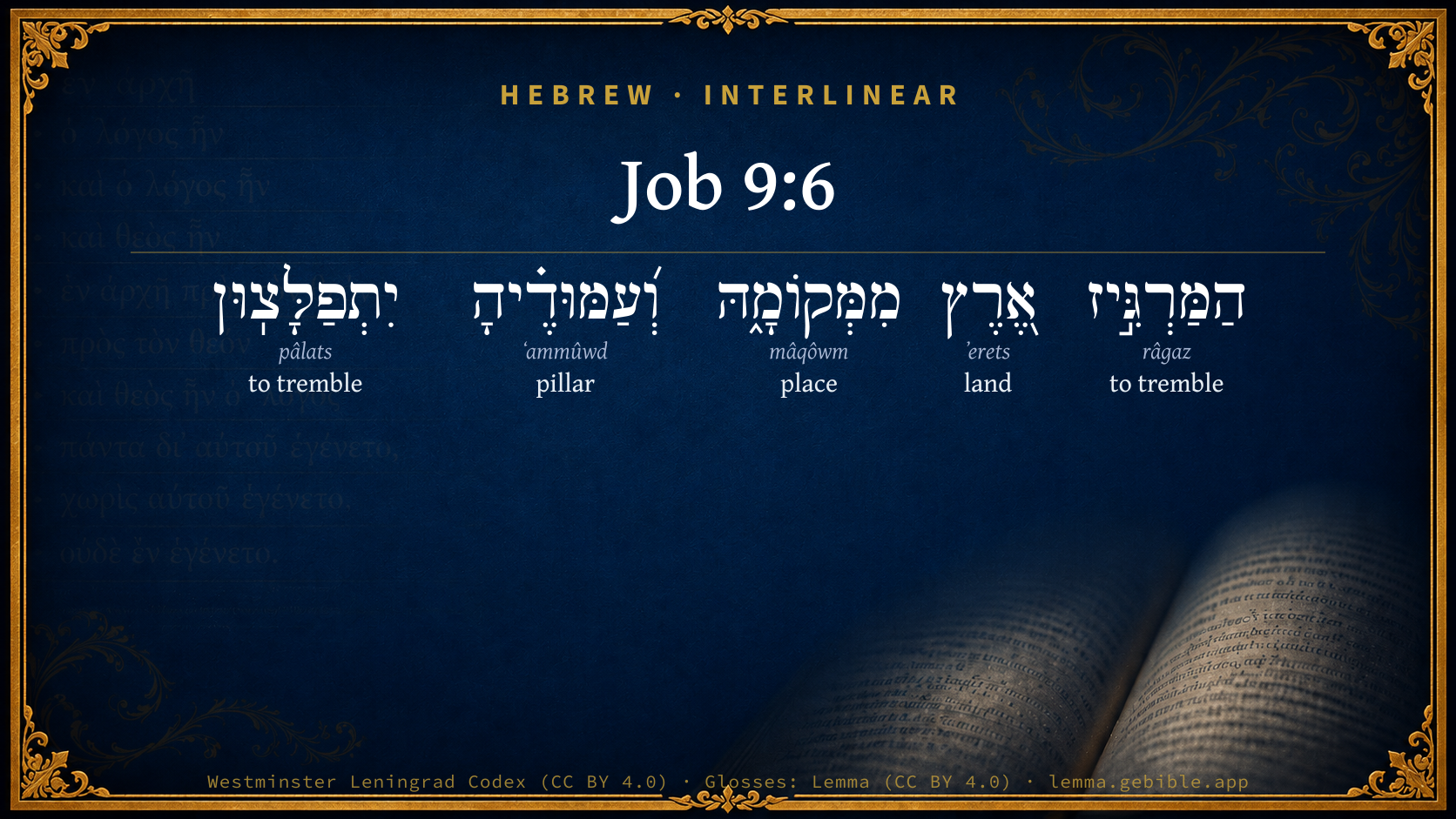
Job 9:6

Hebrew (Westminster Leningrad Codex) Job 9:6 appears in the Hebrew Old Testament. The text above is from the Westminster Leningrad Codex. Each word links to its Strong’s number, a concise gloss, and parsing drawn from the Open Scriptures Hebrew Bible morphology. Click any word for its full Brown-Driver-Briggs (BDB) entry.
Download image
Cite this verse

Job 9:6 (World English Bible). Public Domain. Lemma interlinear Bible study tool, https://lemma.gebible.app/v/job/9/6.

Show BibTeX & RIS
BibTeX
RIS
English Translation
Who shakes the earth out of its place; The pillars of it tremble;
World English Bible · Public Domain
Highlights
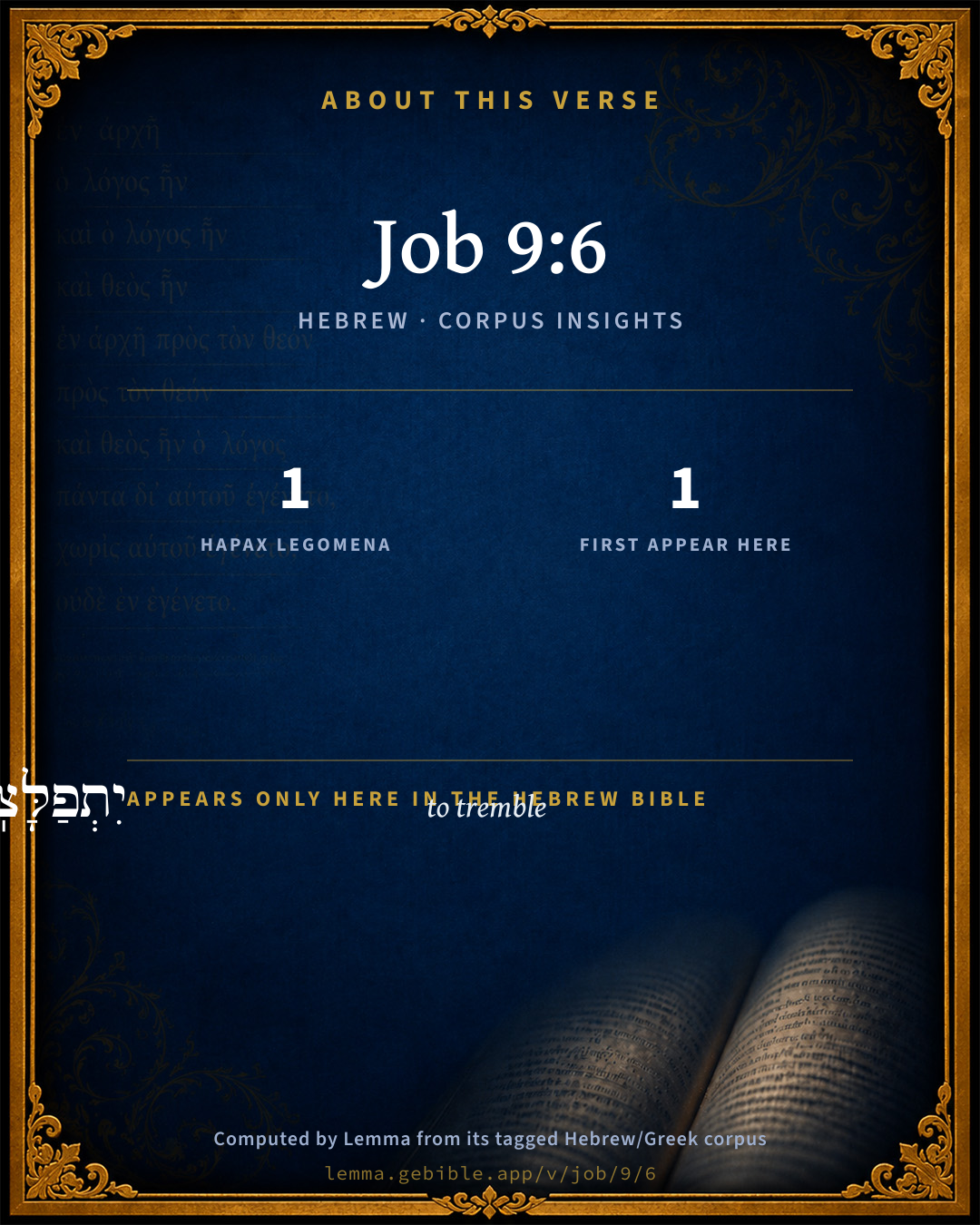
  • 1 hapax legomenon — only here in the Hebrew Bible
  • 1 first appearance in the Hebrew Bible
Full analysis ↓
Download a study sheet

One document with this verse’s original text, its word-by-word gloss line, the meaning frame, cross-references with their text, attributed commentary, and full source and license credits — printable, and it pastes into notes with its structure intact.

This verse Autodidact and up

Study sheet (.html) Plain text (.txt)

A passage Seminary Student

Up to 50 verses in one chapter. A passage sheet keeps up to 6 commentary sources and 12 cross-references per verse, in the order this page ranks them, and says so on the sheet whenever that leaves anything out. Ask for a single verse and you get the Autodidact verse sheet above.

Everything on this page stays free to read, with no account — the sheet is a download of what is already on screen, not access to it.

Want to remove ads? Support Godless Engineer
Compare translations 3

The same verse in 3 English versions, stacked beneath the original-language interlinear above. Click any original word for its lexicon entry.

Each is an independent rendering of the whole verse — the interlinear is not word-aligned to these translations.

Highlighted words mark where these versions differ — a whole-verse word diff, not a word-by-word alignment.

  • World English Bible Public Domain
    Who shakes the earth out of its place; The pillars of it tremble;
  • King James Version Public Domain
    Which shaketh the earth out of her place, and the pillars thereof tremble.
  • unfoldingWord Literal Text CC BY-SA 4.0
    the one shaking the earth from its place and causing its pillars to tremble;

unfoldingWord Literal Text — © unfoldingWord, licensed CC BY-SA 4.0. Word-aligned USFM3 via Door43 (git.door43.org/unfoldingWord/en_ult).

Versions to compare (up to 4)

3 of 4 selected

Show all 18 translations

Every available English version of this verse, each an independent rendering of the whole verse.

  • World English Bible Public Domain
    Who shakes the earth out of its place; The pillars of it tremble;
  • Berean Standard Bible Public Domain
    He shakes the earth from its place, so that its foundations tremble.
  • Majority Standard Bible Public Domain
    He shakes the earth from its place, so that its foundations tremble.
  • King James Version Public Domain
    Which shaketh the earth out of her place, and the pillars thereof tremble.
  • American Standard Version (1901) Public Domain
    That shaketh the earth out of its place, And the pillars thereof tremble;
  • Revised Version (1885) Public Domain
    Which shaketh the earth out of her place, and the pillars thereof tremble.
  • Geneva Bible (1599) Public Domain
    Hee remooueth the earth out of her place, that the pillars thereof doe shake.
  • Douay-Rheims (1899) Public Domain
    Who shaketh the earth out of her place, and the pillars thereof tremble.
  • Young's Literal Translation Public Domain
    Who is shaking earth from its place, And its pillars move themselves.
  • Literal Standard Version CC BY-SA 4.0
    Who is shaking earth from its place, || And its pillars move themselves.
  • Unlocked Literal Bible CC BY-SA 4.0
    he who shakes the earth out of its place and sets its supports trembling.
  • unfoldingWord Literal Text CC BY-SA 4.0
    the one shaking the earth from its place and causing its pillars to tremble;
  • Darby Bible Public Domain
    Who shaketh the earth out of its place, and the pillars thereof tremble;
  • World Messianic Bible Public Domain
    He shakes the earth out of its place. Its pillars tremble.
  • Webster's Bible Public Domain
    Who shaketh the earth out of her place, and its pillars tremble.
  • Free Bible Version CC BY-SA 4.0
    He shakes the earth, making its foundations quake.
  • Bible in Basic English Public Domain
    Who is moving the earth out of its place, so that its pillars are shaking:
  • JPS Tanakh (1917) Public Domain
    Who shaketh the earth out of her place, and the pillars thereof tremble.

Literal Standard Version (2020), Covenant Press — licensed CC BY-SA 4.0. Text via the HelloAO Bible API (eBible.org). Unlocked Literal Bible (unfoldingWord) — licensed CC BY-SA 4.0. Text via the HelloAO Bible API (eBible.org). unfoldingWord Literal Text — © unfoldingWord, licensed CC BY-SA 4.0. Word-aligned USFM3 via Door43 (git.door43.org/unfoldingWord/en_ult). Free Bible Version, Dr. Jonathan Gallagher — licensed CC BY-SA 4.0. Text via the HelloAO Bible API (eBible.org).

Word by word

More ways to search: Search by grammar → Find every occurrence → Compare this word →

Practice this passage: Drill this verse → Learn its vocabulary →

About this verse

These counts appear in no published source. They are computed here, from the morphology-tagged text and Lemma’s own curated glosses. What Lemma adds →

5
words
5
distinct lemmas
Wisdom
section

Notable vocabulary

1 hapax legomenon — a word that appears only here in the entire Hebrew Bible:

  • יִתְפַלָּצֽוּן to tremble H6426

First appearance in Scripture

This word makes its first canonical appearance in the Hebrew Bible here:

  • יִתְפַלָּצֽוּן to tremble H6426

Shared distinctive vocabulary

הַמַּרְגִּ֣יז to tremble H7264 occurs in 40 verses of the Hebrew Bible. Also found in:

Grammatical profile

  • 2 verbs
  • 3 nouns

Verb forms

  • הַמַּרְגִּ֣יז Hiphil · Participle Active
  • יִתְפַלָּצֽוּן Hithpael · Imperfect

Hebrew & Septuagint length

In English translation the verse runs 13 words from the Hebrew and 13 from the Septuagint (LXX English) — the same length.

A rough comparison of the two English renderings, which tokenize alike — not a word-level alignment.

Word counts can differ between the Hebrew and the Greek without any difference in meaning — e.g. the Hebrew direct-object marker אֵת has no separate Greek word, and Greek often adds the article ὁ.

Cross-references

16

Topical passages linked to Job 9:6 in the Treasury of Scripture Knowledge — connected by theme and wording, ordered by reader-vote popularity; previews shown in the World English Bible.

  • Psalms 75:3 The earth and all its inhabitants quake. I firmly hold its pillars. Selah.
  • Haggai 2:6 For this is what Yahweh of Hosts says: 'Yet once, it is a little while, and I will shake the heavens, the earth, the sea, and the dry land;
  • Hebrews 12:26 whose voice shook the earth, then, but now he has promised, saying, "Yet once more I will shake not only the earth, but also the heavens."
  • Job 26:11 The pillars of heaven tremble And are astonished at his rebuke.
  • Job 38:4–7 "Where were you when I laid the foundations of the earth? Declare, if you have understanding.
  • Isaiah 2:21 To go into the caverns of the rocks, And into the clefts of the ragged rocks, From before the terror of Yahweh, And from the glory of his majesty, When he arises to shake the earth mightily.
  • Isaiah 2:19 Men shall go into the caves of the rocks, And into the holes of the earth, From before the terror of Yahweh, And from the glory of his majesty, When he arises to shake the earth mightily.
  • Psalms 114:7 Tremble, you earth, at the presence of the Lord, At the presence of the God of Jacob,
  • Isaiah 13:13–14 Therefore I will make the heavens to tremble, and the earth shall be shaken out of its place, in the wrath of Yahweh of hosts, and in the day of his fierce anger.
  • Haggai 2:21 "Speak to Zerubbabel, governor of Judah, saying, 'I will shake the heavens and the earth.
  • 1 Samuel 2:8 He raises up the poor out of the dust, He lifts up the needy from the dunghill, To make them sit with princes, Inherit the throne of glory: For the pillars of the earth are Yahweh's, He has set the world on them.
  • Isaiah 24:1 Behold, Yahweh makes the earth empty, and makes it waste, and turns it upside down, and scatters abroad the inhabitants of it.
  • Isaiah 24:19–20 The earth is utterly broken, the earth is torn apart, the earth is shaken violently.
  • Jeremiah 4:24 I saw the mountains, and, behold, they trembled, and all the hills moved back and forth.
  • Joel 2:10 The earth quakes before them. The heavens tremble. The sun and the moon are darkened, And the stars withdraw their shining.
  • Revelation 20:11 I saw a great white throne, and him who sat on it, from whose face the earth and the heaven fled away. There was found no place for them.

Cross-references courtesy of OpenBible.info (CC BY 4.0).

Hebrew and Greek witnesses Masoretic Hebrew ↔ Greek Septuagint

The same verse in the two great witnesses to the Old Testament, shown verse-for-verse.

These are two independent witnesses, not word-aligned to each other, and the Septuagint is shown in lemma (dictionary) form.

Hebrew Job 9:6 Masoretic · Westminster Leningrad Codex

הַמַּרְגִּ֣יז אֶ֭רֶץ מִמְּקוֹמָ֑הּ וְ֝עַמּוּדֶ֗יהָ יִתְפַלָּצֽוּן

Who shakes the earth out of its place; The pillars of it tremble;

World English Bible · Public Domain

Greek LXX Job 9:6 Septuagint · lemma form

ὁ σείω ὁ ὑπό οὐρανός ἐκ θεμέλιον ὁ δέ στῦλος αὐτός σαλεύω

Who shakes the earth under heaven from its foundations, and its pillars totter.

LXX2012 (modern English Septuagint) · Public Domain

On this verse, Albert Barnes' Notes on the Bible discusses the Septuagint’s reading. Read the note in Commentary ↓

Hebrew: Westminster Leningrad Codex (CC BY 4.0). Greek: Septuagint (public domain); English from LXX2012 (modern English Septuagint) (Public Domain). How the Septuagint differs from the Hebrew →

Commentary

Notes on Job 9:6 from classic Christian and Jewish commentators (each source and its license shown beneath its notes). The classic Christian expositions comment on the surrounding passage and are grouped to its opening verse, so a note may address several verses; the Jewish commentaries on the Tanakh (Rashi and others) are per-verse, so they appear only where the commentator wrote on this verse.

Lemma curates 59 commentaries, every one of them public domain or Creative Commons licensed, each selected and text-cleaned for this edition rather than reprinted as found. About our sources →

Trapp's Complete Commentary

John Trapp

Job 9:6 Which shaketh the earth out of her place, and the pillars thereof tremble.

Ver. 6. Which shaketh the earth out of her place] By mighty earthquakes, dislocating the earth, some part of it; for the whole was never removed, though God can take up the whole globe as a man would do a ball, tossing the very centre itself whereon it is established, 2Sa 22:8, &c. There is a twofold power of God; 1. Absolute. 2. Actual. By the former he can do more than he doth: by the latter, whatsoever he willeth, that without impediment he effecteth. As for the earth, as God upholdeth it by the word of his power, Heb 1:3, so he hath poised it merely by its own weight, that it should not be removed for ever, Psa 104:5. For if you imagine that the earth could be removed out of its natural place, which way soever it be removed, it shall move towards heaven, and so shall naturally ascend; but to do so is utterly repugnant to the nature of the earth, which is to bear downward. All which, notwithstanding, the God of nature, as he is in the heaven, so he doth whatsoever he will in heaven and earth.

John Trapp, A Commentary or Exposition upon All the Books of the Old and New Testament (1647–1656) — public domain. Text from a community e-Sword module.

Geneva Bible (1599)

Geneva Bible translators

He declareth what is the infirmity of man, by the mighty and incomprehensible power that is in God, showing what he could do if he would set forth his power.

Geneva Bible (1599) marginal notes — public domain. Text via Bolls.life.

Jamieson, Fausset & Brown

Robert Jamieson, A. R. Fausset & David Brown

The earth is regarded, poetically, as resting on pillars, which tremble in an earthquake (Psa 75:3; Isa 24:20). The literal truth as to the earth is given (Job 26:7).

Jamieson, Fausset & Brown — Commentary Critical and Explanatory on the Whole Bible (1871) — public domain (CC PDM 1.0). Text via the HelloAO Bible API.

Adam Clarke's Commentary

Verse 6. The pillars thereof tremble.] This also refers to an earthquake, and to that tremulous motion which sometimes gives warning of the approaching catastrophe, and from which this violent convulsion of nature has received its name. Earthquakes, in Scripture language, signify also violent commotions and disturbances in states; mountains often signify rulers; sun, empires; stars, petty states. But it is most likely that the expressions here are to be understood literally.

Adam Clarke's Commentary on the Bible (1810–1826) — public domain. Text from a community e-Sword/MySword module.

The Cambridge Bible for Schools and Colleges

gen. ed. J. J. S. Perowne

6. The reference is probably to earthquakes. The earth is conceived as a structure supported on pillars, ch. Job_38:6; Psa_75:3. The conception was poetical; if the pillars were supposed anything actual, they were probably the roots of the great mountains which extended downwards and bore up the earth, as the part of them above the earth supported the heavens.

The Cambridge Bible for Schools and Colleges (gen. ed. J. J. S. Perowne; Cambridge University Press, 1878–1918) — public domain. Text from a community e-Sword module.

John Gill's Exposition

Which commandeth the sun, and it riseth not,.... Either he could do it if he would, by a word speaking, as he ordered it to stand still in the times of Joshua, Jos 10:13, and caused the shadow to return ten degrees it had gone back in the dial of Ahaz, in the times of Hezekiah, Kg2 20:11; or else the sense is, it rises not at any other time and place but when and where he commands it; or he commands it not to rise in the same place at one time of the year as at another, and it rises not; or this may be understood of eclipses, or of its being covered with clouds in tempestuous weather for a considerable time together, when it seems as if it was not risen: some think this respects the three days' darkness in Egypt, when the Israelites were there, Exo 10:22, which was a little before, or about the time of Job; or rather it refers to the general flood, in the times of Noah, when it rained forty days and forty nights, Gen 7:12, during which time the sun appeared not, and so seemed as if it was not risen; see Amo 8:9; Herodotus (b) relates, from the memoirs of the Egyptians, that the sun rose four times out of its usual course; twice it rose where it now sets, and twice it set where it now rises:

and sealeth up the stars: either by the light of the sun in the daytime, which hides them that they are not visible, or by dark clouds and tempestuous weather in the night; such a season as that was in which the Apostle Paul and the mariners with him were, when neither sun nor stars appeared for many days, Act 27:20, and so the Targum paraphrases it, and"sealeth up the stars with clouds;''this may also refer to the time of the flood, during the rain of forty days and nights, Gen 7:4; or to the annual motion of the sun through the ecliptic, which makes the point of the sun's rising and setting vary, and is the reason why some stars appear in summer and are sealed up in winter, and others that are seen in winter are not visible in summer; and so Cocceius interprets it.

(b) Euterpe, sive, l. 2. c. 149.

John Gill's Exposition of the Whole Bible (1746–1763) — public domain (CC PDM 1.0). Text via the HelloAO Bible API.

Albert Barnes' Notes on the Bible

Which shaketh the earth out of her place - This evidently refers to violent convulsions of nature, as if the earth were to be taken away. Objects on the earth’s surface become displaced, and convulsion seems to seize the world. The Septuagint renders this, “who shaketh that which is under the heavens from its foundations” - ἐκ Θεμελίων ek themeliōn. The change in the Hebrew would be very slight to authorize this rendering.

And the pillars thereof tremble - In this place the earth is represented as sustained like a building by pillars or columns. Whether this is a mere poetic representation, or whether it describes the actual belief of the speaker in regard to the structure of the earth, it is not easy to determine. I am inclined to think it is the former, because in another place where he is speaking of the earth, he presents his views in another form, and more in acoordance with the truth (see the notes at Job 26:7): and because here the illustration is evidently taken from the obvious and perceived effects of an earthquake. It would convulse and agitate the pillars of the most substantial edifice, and so it seemed to shake the earth, as if its very supports would fall.

Albert Barnes' Notes on the Bible (1834–1885) — public domain. Text from a community e-Sword/MySword module.

Haydock's Catholic Bible Commentary

Pillars. These are represented as fixed in the waters, Proverbs viii. 29., and Psalm xxvii. 16., &c.

George Leo Haydock (1774–1849), Haydock's Catholic Family Bible and Commentary, 1859 edition — public domain. Excludes Psalms (Douay-Rheims chapter numbering differs from Protestant) and Deuterocanonical books (Catholic canon only).

Matthew Poole's English Annotations

The earth, i.e. great portions of it, by earthquakes, or by removing islands, which sometimes hath been done.

The pillars thereof, i.e. the strength or the strongest parts of it, the mountains, yea, the deep and inward parts of it, which, like pillars, supported those parts which appear to our view, and yet have been discovered and overturned by earthquakes.

Matthew Poole's English Annotations on the Holy Bible (1683–1685) — public domain. Text from a community e-Sword/MySword module.

Whedon's Commentary on the Bible

Daniel D. Whedon

6. Pillars thereof — Job speaks after the popular notion of the day, of the earth as resting on pillars, as we still speak of the rising of the sun. That he had a correct knowledge of the spherical form of the earth, is evident from Job_26:7, where see note. Dillmann explains the pillars, by the roots of the mountains, which sustained the earth as their summits did the heavens: Jerome, that they figuratively represent its stability.

Daniel D. Whedon (gen. ed.), Commentary on the Old and New Testaments (1874–1909) — public domain. Text from a community e-Sword module.

The Pulpit Commentary

Which shaketh the earth out of her place. This is a still more startling figure of speech; but comp. Psa_46:2 Psa_68:16 Psa_114:4, Psa_114:6. And the pillars thereof tremble. The earth is conceived of, poetically, as a huge edifice, supported on pillars, (comp. Psa_75:3) which in an earthquake are shaken, and impart their motion to the entire building. Rosenmuller"s quotation of Seneca, "Nat. Quaest.," 6:20 ex aliqua parle terra veluti columnis quibusdam et pills sustinetur, quibus vitiatis et recedentibus tremit pondus impositum is apposite.

The Pulpit Commentary (1880–1919), ed. H.D.M. Spence-Jones & Joseph S. Exell — public domain. Text from a community e-Sword module.

John Wesley's Explanatory Notes

The earth - Great portions of it, by earthquakes, or by removing islands. Pillars - The deep and inward parts of it, which like pillars supported those parts that appear to our view.

John Wesley, Explanatory Notes Upon the Whole Bible (1754–1765) — public domain. Text via the GEBible commentary corpus.

Rashi

Rabbi Shlomo Yitzchaki (Rashi)

He Who causes the earth to quake when He looks at it, and it trembles.

Rashi on the Tanakh — English translations: “The Judaica Press complete Tanach with Rashi, translated by A. J. Rosenberg” (CC BY 4.0); “Pentateuch with Rashi's commentary by M. Rosenbaum and A.M. Silbermann, 1929-1934” (public domain); “The Metsudah Tanach series, Lakewood, N.J” (CC BY 4.0); and “The Book of Joshua, Metsudah Publications, 1997” (CC BY 4.0). Text via Sefaria.

Lesson kit

Teaching starters — assembled from the data on this page, not authored interpretation. Every prompt links to the verse data it draws on. Edit before teaching.

Job, in the Wisdom, opens this verse with 5 words (5 distinct Hebrew lemmas). Its most distinctive word is pâlats (“to tremble”). A historical commentator’s framing appears above. Read the whole chapter for the surrounding context.

Discussion questions

  1. The word pâlats carries the sense “to tremble.” How does it shape the verse?
  2. This verse holds 1 word here found nowhere else in the Hebrew Bible. What might the rare word draw attention to?
  3. The word “to tremble” first appears here in Scripture. What is being introduced at this debut?
  4. Genesis 45:24 shares the word «to tremble» with this verse. How do the two illuminate each other?
  5. The translations on this page render this verse differently — a whole-verse word diff, not a word-by-word alignment. What might account for the different wordings?
  6. The verb «הַמַּרְגִּ֣יז» is Hiphil Participle Active. How does its form color the action?
  7. Reading how Trapp's Complete Commentary and Geneva Bible (1599) read this verse, where do the two commentators agree and where do they part?

Things to notice

  • 1 word in this verse appears nowhere else in the Hebrew Bible.
  • 1 word makes its first canonical appearance in Scripture here.
  • These translations choose different wording for 9 words in this verse.
  • 5 distinct Hebrew lemmas span 5 words in this verse.

Reading settings

Reading text

Shown beneath each verse's original-language words.

Old Testament
Old Testament edition

Read the OT as the Masoretic Hebrew (MT) or the Greek Septuagint (LXX).

English shown for the Greek Septuagint (in the Hebrew ↔ Greek comparison).

Comparing translations? Open the Compare panel on any verse page to stack up to four side by side.