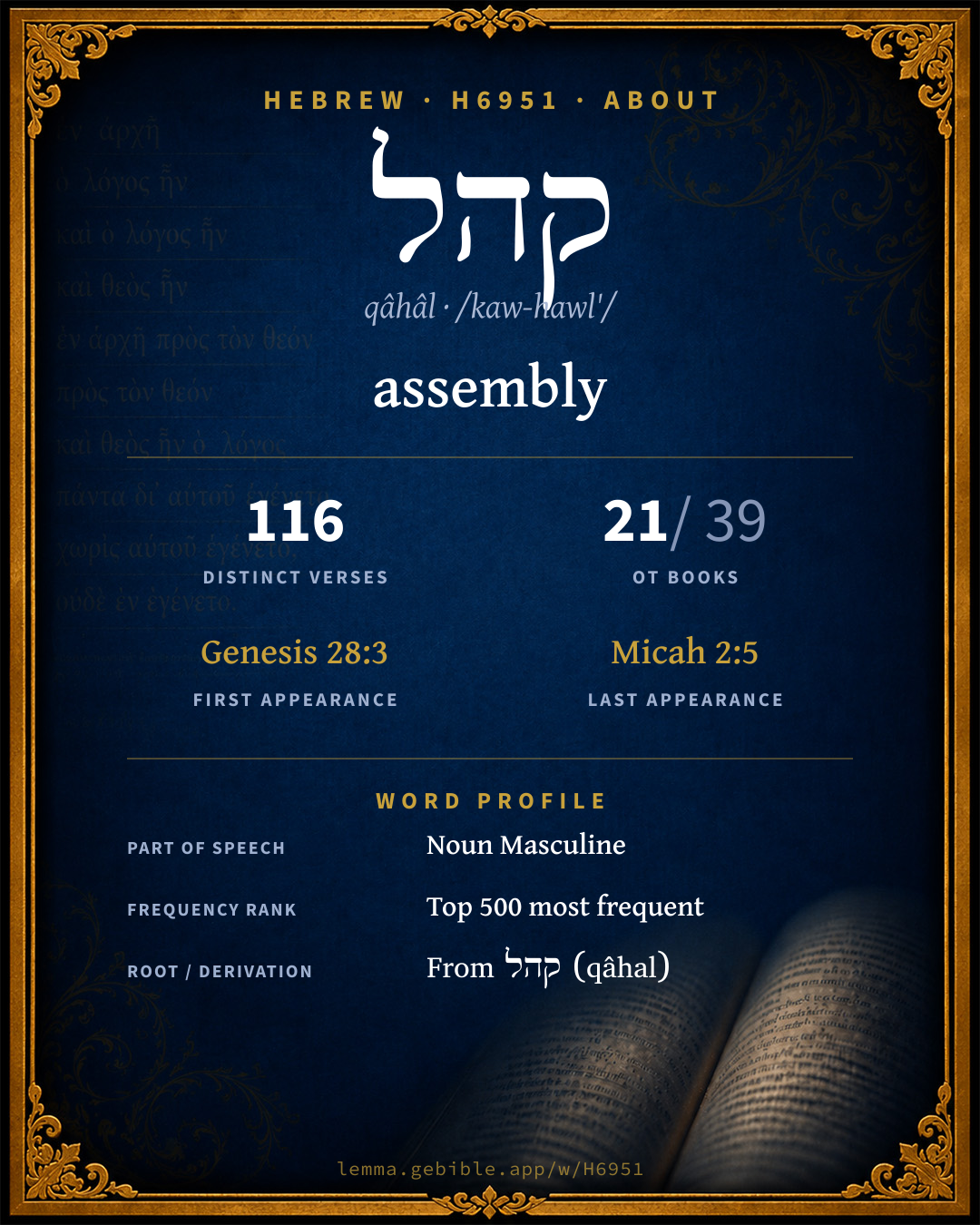
קָהָל
assembly
also: company, congregation, convocation fuller range ↓
Full lexicon entry — Brown-Driver-Briggs (BDB)
From Brown-Driver-Briggs (BDB)
Where this word appears
See every Absolute-state word in the Hebrew Bible →
Grammar key — what these labels mean
Part of speech
- Noun
- A naming word — a person, place, thing, or idea.
Noun type
- Common
- A common noun — a general class of person, place, or thing (“king,” “city,” “water”), not a specific name.
State
- Absolute
- The independent form of a noun, not bound to a following word.
- Construct
- A noun bound to a following noun in a possessive / “of” relationship (the construct chain).
Gender
- Masculine
- Grammatically masculine.
Number
- Singular
- One.
Grammatical forms
- Noun, Common, Masculine, Singular, Absolute 73 times (59%)
- Noun, Common, Masculine, Singular, Construct 50 times (41%)
Parsed forms decoded from the imported morphology (morphhb / Westminster Leningrad Codex — WLC text public domain, morphhb tagging CC BY 4.0), counted across 123 parsed occurrences — not distinct verses.
Every verse where H6951 appears — 116 distinct verses across 21 books. Click any verse to open its interlinear word-by-word view. Verse text shown in the World English Bible for context — . Each verse’s Hebrew form is shown with its reference; the English is not keyword-highlighted, since the data carries no word-level English alignment. Use “Compare translations” on any verse to read it across multiple English versions. This concordance covers the Hebrew Bible; Septuagint (Greek Old Testament) occurrences are not indexed here.
Genesis 4 verses
- Genesis 28:3 לִ/קְהַ֥ל prep + n c ms cs May God Almighty bless you, and make you fruitful, and multiply you, that you may be a company of peoples,
- Genesis 35:11 וּ/קְהַ֥ל conj + n c ms cs God said to him, "I am God Almighty. Be fruitful and multiply. A nation and a company of nations will be from you, and kings will come out of your loins.
- Genesis 48:4 לִ/קְהַ֣ל prep + n c ms cs and said to me, 'Behold, I will make you fruitful, and multiply you, and I will make of you a company of peoples, and will give this land to your seed after you for an everlasting possession.'
- Genesis 49:6 בִּ/קְהָלָ֖/ם prep + n c ms cs + sfx pers 3mp My soul, don't come into their council; My glory, don't be united to their assembly; For in their anger they killed a man, In their self-will they hamstrung an ox.
Exodus 2 verses
- Exodus 12:6 קְהַ֥ל n c ms cs and you shall keep it until the fourteenth day of the same month; and the whole assembly of the congregation of Israel shall kill it at evening.
- Exodus 16:3 הַ/קָּהָ֥ל ptcl def.art + n c ms and the children of Israel said to them, "We wish that we had died by the hand of Yahweh in the land of Egypt, when we sat by the flesh-pots, when we ate our fill of bread, for you have brought us out into this wilderness, to kill this whole assembly with hunger."
Leviticus 5 verses
- Leviticus 4:13 הַ/קָּהָ֑ל ptcl def.art + n c ms "'If the whole congregation of Israel sins, and the thing is hidden from the eyes of the assembly, and they have done any of the things which Yahweh has commanded not to be done, and are guilty;
- Leviticus 4:14 הַ/קָּהָ֜ל ptcl def.art + n c ms when the sin in which they have sinned is known, then the assembly shall offer a young bull for a sin offering, and bring it before the Tent of Meeting.
- Leviticus 4:21 הַ/קָּהָ֖ל ptcl def.art + n c ms He shall carry forth the bull outside the camp, and burn it as he burned the first bull. It is the sin offering for the assembly.
- Leviticus 16:17 קְהַ֥ל n c ms cs There shall be no one in the Tent of Meeting when he enters to make atonement in the Holy Place, until he comes out, and has made atonement for himself and for his household, and for all the assembly of Israel.
- Leviticus 16:33 הַ/קָּהָ֖ל ptcl def.art + n c ms Then he shall make atonement for the Holy Sanctuary; and he shall make atonement for the Tent of Meeting and for the altar; and he shall make atonement for the priests and for all the people of the assembly.
Numbers 12 verses
- Numbers 10:7 הַ/קָּהָ֑ל ptcl def.art + n c ms But when the assembly is to be gathered together, you shall blow, but you shall not sound an alarm.
- Numbers 14:5 קְהַ֥ל n c ms cs Then Moses and Aaron fell on their faces before all the assembly of the congregation of the children of Israel.
- Numbers 15:15 הַ/קָּהָ֕ל ptcl def.art + n c ms For the assembly, there shall be one statute for you, and for the stranger who lives as a foreigner [with you], a statute forever throughout your generations: as you are, so shall the foreigner be before Yahweh.
- Numbers 16:3 קְהַ֥ל n c ms cs and they assembled themselves together against Moses and against Aaron, and said to them, You take too much on you, seeing all the congregation are holy, everyone of them, and Yahweh is among them: why then lift yourselves up above the assembly of Yahweh?
- Numbers 16:33 הַ/קָּהָֽל ptcl def.art + n c ms So they, and all that appertained to them, went down alive into Sheol: and the earth closed on them, and they perished from among the assembly.
- Numbers 16:47 הַ/קָּהָ֔ל ptcl def.art + n c ms Aaron took as Moses spoke, and ran into the midst of the assembly; and, behold, the plague was begun among the people: and he put on the incense, and made atonement for the people.
- Numbers 19:20 הַ/קָּהָ֑ל ptcl def.art + n c ms But the man who shall be unclean, and shall not purify himself, that soul shall be cut off from the midst of the assembly, because he has defiled the sanctuary of Yahweh: the water for impurity has not been sprinkled on him; he is unclean.
- Numbers 20:4 קְהַ֣ל n c ms cs Why have you brought the assembly of Yahweh into this wilderness, that we should die there, we and our animals?
- Numbers 20:6 הַ/קָּהָ֗ל ptcl def.art + n c ms Moses and Aaron went from the presence of the assembly to the door of the tent of meeting, and fell on their faces: and the glory of Yahweh appeared to them.
- Numbers 20:10 הַ/קָּהָ֖ל ptcl def.art + n c ms Moses and Aaron gathered the assembly together before the rock, and he said to them, Hear now, you rebels; shall we bring you forth water out of this rock?
- Numbers 20:12 הַ/קָּהָ֣ל ptcl def.art + n c ms Yahweh said to Moses and Aaron, Because you didn't believe in me, to sanctify me in the eyes of the children of Israel, therefore you shall not bring this assembly into the land which I have given them.
- Numbers 22:4 הַ/קָּהָל֙ ptcl def.art + n c ms Moab said to the elders of Midian, Now will this multitude lick up all that is round about us, as the ox licks up the grass of the field. Balak the son of Zippor was king of Moab at that time.
Deuteronomy 9 verses
- Deuteronomy 5:22 קְהַלְ/כֶ֜ם n c ms cs + sfx pers 2mp These words Yahweh spoke to all your assembly on the mountain out of the midst of the fire, of the cloud, and of the thick darkness, with a great voice: and he added no more. He wrote them on two tables of stone, and gave them to me.
- Deuteronomy 9:10 הַ/קָּהָֽל ptcl def.art + n c ms Yahweh delivered to me the two tables of stone written with the finger of God; and on them [was written] according to all the words, which Yahweh spoke with you on the mountain out of the midst of the fire in the day of the assembly.
- Deuteronomy 10:4 הַ/קָּהָ֑ל ptcl def.art + n c ms He wrote on the tables, according to the first writing, the ten commandments, which Yahweh spoke to you on the mountain out of the midst of the fire in the day of the assembly: and Yahweh gave them to me.
- Deuteronomy 18:16 הַ/קָּהָ֖ל ptcl def.art + n c ms according to all that you desired of Yahweh your God in Horeb in the day of the assembly, saying, Let me not hear again the voice of Yahweh my God, neither let me see this great fire any more, that I not die.
- Deuteronomy 23:1 בִּ/קְהַ֥ל prep + n c ms cs He who is wounded in the stones, or has his privy member cut off, shall not enter into the assembly of Yahweh.
- Deuteronomy 23:2 בִּ/קְהַ֣ל בִּ/קְהַ֥ל prep + n c ms cs prep + n c ms cs A bastard shall not enter into the assembly of Yahweh; even to the tenth generation shall none of his enter into the assembly of Yahweh.
- Deuteronomy 23:3 בִּ/קְהַ֣ל בִּ/קְהַ֥ל prep + n c ms cs prep + n c ms cs An Ammonite or a Moabite shall not enter into the assembly of Yahweh; even to the tenth generation shall none belonging to them enter into the assembly of Yahweh forever:
- Deuteronomy 23:8 בִּ/קְהַ֥ל prep + n c ms cs The children of the third generation who are born to them shall enter into the assembly of Yahweh.
- Deuteronomy 31:30 קְהַ֣ל n c ms cs Moses spoke in the ears of all the assembly of Israel the words of this song, until they were finished.
Joshua 1 verse
Judges 3 verses
- Judges 20:2 בִּ/קְהַ֖ל prep + n c ms cs The chiefs of all the people, even of all the tribes of Israel, presented themselves in the assembly of the people of God, four hundred thousand footmen who drew sword.
- Judges 21:5 בַ/קָּהָ֛ל prep det + n c ms The children of Israel said, Who is there among all the tribes of Israel who didn't come up in the assembly to Yahweh? For they had made a great oath concerning him who didn't come up to Yahweh to Mizpah, saying, He shall surely be put to death.
- Judges 21:8 הַ/קָּהָֽל ptcl def.art + n c ms They said, What one is there of the tribes of Israel who didn't come up to Yahweh to Mizpah? Behold, there came none to the camp from Jabesh Gilead to the assembly.
1 Samuel 1 verse
1 Kings 5 verses
- 1 Kings 8:14 קְהַ֣ל קְהַ֥ל n c ms cs n c ms cs The king turned his face about, and blessed all the assembly of Israel: and all the assembly of Israel stood.
- 1 Kings 8:22 קְהַ֣ל n c ms cs Solomon stood before the altar of Yahweh in the presence of all the assembly of Israel, and spread forth his hands toward heaven;
- 1 Kings 8:55 קְהַ֣ל n c ms cs He stood, and blessed all the assembly of Israel with a loud voice, saying,
- 1 Kings 8:65 קָהָ֨ל n c ms So Solomon held the feast at that time, and all Israel with him, a great assembly, from the entrance of Hamath to the brook of Egypt, before Yahweh our God, seven days and seven days, even fourteen days.
- 1 Kings 12:3 קְהַ֣ל n c ms cs and they sent and called him), that Jeroboam and all the assembly of Israel came, and spoke to Rehoboam, saying,
1 Chronicles 6 verses
- 1 Chronicles 13:2 קְהַ֣ל n c ms cs David said to all the assembly of Israel, If it seem good to you, and if it be of Yahweh our God, let us send abroad everywhere to our brothers who are left in all the land of Israel, with whom the priests and Levites are in their cities that have suburbs, that they may gather themselves to us;
- 1 Chronicles 13:4 הַ/קָּהָ֖ל ptcl def.art + n c ms All the assembly said that they would do so; for the thing was right in the eyes of all the people.
- 1 Chronicles 28:8 קְהַל n c ms cs Now therefore, in the sight of all Israel, the assembly of Yahweh, and in the audience of our God, observe and seek out all the commandments of Yahweh your God; that you may possess this good land, and leave it for an inheritance to your children after you forever.
- 1 Chronicles 29:1 הַ/קָּהָ֔ל ptcl def.art + n c ms David the king said to all the assembly, Solomon my son, whom alone God has chosen, is yet young and tender, and the work is great; for the palace is not for man, but for Yahweh God.
- 1 Chronicles 29:10 הַ/קָּהָ֑ל ptcl def.art + n c ms Therefore David blessed Yahweh before all the assembly; and David said, You are blessed, Yahweh, the God of Israel our father, forever and ever.
- 1 Chronicles 29:20 הַ/קָּהָ֔ל הַ/קָּהָ֗ל ptcl def.art + n c ms ptcl def.art + n c ms David said to all the assembly, Now bless Yahweh your God. All the assembly blessed Yahweh, the God of their fathers, and bowed down their heads, and worshiped Yahweh, and the king.
2 Chronicles 23 verses
- 2 Chronicles 1:3 הַ/קָּהָ֣ל ptcl def.art + n c ms So Solomon, and all the assembly with him, went to the high place that was at Gibeon; for there was the tent of meeting of God, which Moses the servant of Yahweh had made in the wilderness.
- 2 Chronicles 1:5 וְ/הַ/קָּהָֽל conj + ptcl def.art + n c ms Moreover the brazen altar, that Bezalel the son of Uri, the son of Hur, had made, was there before the tent of Yahweh: and Solomon and the assembly sought to it.
- 2 Chronicles 6:3 קְהַ֣ל קְהַ֥ל n c ms cs n c ms cs The king turned his face, and blessed all the assembly of Israel: and all the assembly of Israel stood.
- 2 Chronicles 6:12 קְהַ֣ל n c ms cs He stood before the altar of Yahweh in the presence of all the assembly of Israel, and spread forth his hands
- 2 Chronicles 6:13 קְהַ֣ל n c ms cs (for Solomon had made a brazen scaffold, five cubits long, and five cubits broad, and three cubits high, and had set it in the midst of the court; and on it he stood, and kneeled down on his knees before all the assembly of Israel, and spread forth his hands toward heaven;)
- 2 Chronicles 7:8 קָהָ֖ל n c ms So Solomon held the feast at that time seven days, and all Israel with him, a very great assembly, from the entrance of Hamath to the brook of Egypt.
- 2 Chronicles 20:5 בִּ/קְהַ֧ל prep + n c ms cs Jehoshaphat stood in the assembly of Judah and Jerusalem, in the house of Yahweh, before the new court;
- 2 Chronicles 20:14 הַ/קָּהָֽל ptcl def.art + n c ms Then on Jahaziel the son of Zechariah, the son of Benaiah, the son of Jeiel, the son of Mattaniah, the Levite, of the sons of Asaph, came the Spirit of Yahweh in the midst of the assembly;
- 2 Chronicles 23:3 הַ/קָּהָ֥ל ptcl def.art + n c ms All the assembly made a covenant with the king in the house of God. He said to them, Behold, the king's son shall reign, as Yahweh has spoken concerning the sons of David.
- 2 Chronicles 24:6 וְ/הַ/קָּהָ֖ל conj + ptcl def.art + n c ms The king called for Jehoiada the chief, and said to him, Why haven't you required of the Levites to bring in out of Judah and out of Jerusalem the tax of Moses the servant of Yahweh, and of the assembly of Israel, for the tent of the testimony?
- 2 Chronicles 28:14 הַ/קָּהָֽל ptcl def.art + n c ms So the armed men left the captives and the spoil before the princes and all the assembly.
- 2 Chronicles 29:23 וְ/הַ/קָּהָ֑ל conj + ptcl def.art + n c ms They brought near the male goats for the sin-offering before the king and the assembly; and they laid their hands on them:
- 2 Chronicles 29:28 הַ/קָּהָל֙ ptcl def.art + n c ms All the assembly worshiped, and the singers sang, and the trumpeters sounded; all this [continued] until the burnt offering was finished.
- 2 Chronicles 29:31 הַ/קָּהָל֙ ptcl def.art + n c ms Then Hezekiah answered, Now you have consecrated yourselves to Yahweh; come near and bring sacrifices and thank-offerings into the house of Yahweh. The assembly brought in sacrifices and thank-offerings; and as many as were of a willing heart [brought] burnt offerings.
- 2 Chronicles 29:32 הַ/קָּהָל֒ ptcl def.art + n c ms The number of the burnt offerings which the assembly brought was seventy bulls, one hundred rams, and two hundred lambs: all these were for a burnt offering to Yahweh.
- 2 Chronicles 30:2 הַ/קָּהָ֖ל ptcl def.art + n c ms For the king had taken counsel, and his princes, and all the assembly in Jerusalem, to keep the Passover in the second month.
- 2 Chronicles 30:4 הַ/קָּהָֽל ptcl def.art + n c ms The thing was right in the eyes of the king and of all the assembly.
- 2 Chronicles 30:13 קָהָ֖ל n c ms There assembled at Jerusalem much people to keep the feast of unleavened bread in the second month, a very great assembly.
- 2 Chronicles 30:17 בַּ/קָּהָ֖ל prep det + n c ms For there were many in the assembly who had not sanctified themselves: therefore the Levites had the charge of killing the Passovers for everyone who was not clean, to sanctify them to Yahweh.
- 2 Chronicles 30:23 הַ/קָּהָ֔ל ptcl def.art + n c ms The whole assembly took counsel to keep other seven days; and they kept [other] seven days with gladness.
- 2 Chronicles 30:24 לַ/קָּהָ֜ל לַ/קָּהָל֙ prep det + n c ms prep det + n c ms For Hezekiah king of Judah did give to the assembly for offerings one thousand bulls and seven thousand sheep; and the princes gave to the assembly a thousand bulls and ten thousand sheep: and a great number of priests sanctified themselves.
- 2 Chronicles 30:25 קְהַ֣ל הַ/קָּהָ֖ל n c ms cs ptcl def.art + n c ms All the assembly of Judah, with the priests and the Levites, and all the assembly who came out of Israel, and the foreigners who came out of the land of Israel, and who lived in Judah, rejoiced.
- 2 Chronicles 31:18 קָהָ֑ל n c ms and those who were reckoned by genealogy of all their little ones, their wives, and their sons, and their daughters, through all the congregation: for in their office of trust they sanctified themselves in holiness.
Ezra 5 verses
- Ezra 2:64 הַ/קָּהָ֖ל ptcl def.art + n c ms The whole assembly together was forty-two thousand three hundred sixty,
- Ezra 10:1 קָהָ֣ל n c ms Now while Ezra prayed and made confession, weeping and casting himself down before the house of God, there was gathered together to him out of Israel a very great assembly of men and women and children; for the people wept very sore.
- Ezra 10:8 מִ/קְּהַ֥ל prep + n c ms cs and that whoever didn't come within three days, according to the counsel of the princes and the elders, all his substance should be forfeited, and himself separated from the assembly of the captivity.
- Ezra 10:12 הַ/קָּהָ֛ל ptcl def.art + n c ms Then all the assembly answered with a loud voice, As you have said concerning us, so must we do.
- Ezra 10:14 הַ/קָּהָ֞ל ptcl def.art + n c ms Let now our princes be appointed for all the assembly, and let all those who are in our cities who have married foreign women come at appointed times, and with them the elders of every city, and the judges of it, until the fierce wrath of our God be turned from us, until this matter be dispatched.
Nehemiah 5 verses
- Nehemiah 5:13 הַ/קָּהָ֜ל ptcl def.art + n c ms Also I shook out my lap, and said, So God shake out every man from his house, and from his labor, that doesn't perform this promise; even thus be he shaken out, and emptied. All the assembly said, Amen, and praised Yahweh. The people did according to this promise.
- Nehemiah 7:66 הַ/קָּהָ֖ל ptcl def.art + n c ms The whole assembly together was forty-two thousand three hundred sixty,
- Nehemiah 8:2 הַ/קָּהָל֙ ptcl def.art + n c ms Ezra the priest brought the law before the assembly, both men and women, and all who could hear with understanding, on the first day of the seventh month.
- Nehemiah 8:17 הַ֠/קָּהָל ptcl def.art + n c ms All the assembly of those who were come again out of the captivity made booths, and lived in the booths; for since the days of Jeshua the son of Nun to that day the children of Israel had not done so. There was very great gladness.
- Nehemiah 13:1 בִּ/קְהַ֥ל prep + n c ms cs On that day they read in the book of Moses in the audience of the people; and therein was found written, that an Ammonite and a Moabite should not enter into the assembly of God forever,
Job 1 verse
Psalms 9 verses
- Psalms 22:22 קָהָ֣ל n c ms I will declare your name to my brothers. In the midst of the assembly, I will praise you.
- Psalms 22:25 בְּ/קָהָ֥ל prep + n c ms Of you comes my praise in the great assembly. I will pay my vows before those who fear him.
- Psalms 26:5 קְהַ֣ל n c ms cs I hate the assembly of evil-doers, And will not sit with the wicked.
- Psalms 35:18 בְּ/קָהָ֣ל prep + n c ms I will give you thanks in the great assembly. I will praise you among many people.
- Psalms 40:9 בְּ/קָ֘הָ֤ל prep + n c ms I have proclaimed glad news of righteousness in the great assembly. Behold, I will not seal my lips, Yahweh, you know.
- Psalms 40:10 לְ/קָהָ֥ל prep + n c ms I have not hidden your righteousness within my heart. I have declared your faithfulness and your salvation. I have not concealed your loving kindness and your truth from the great assembly.
- Psalms 89:5 בִּ/קְהַ֥ל prep + n c ms cs The heavens will praise your wonders, Yahweh; Your faithfulness also in the assembly of the holy ones.
- Psalms 107:32 בִּ/קְהַל prep + n c ms cs Let them exalt him also in the assembly of the people, And praise him in the seat of the elders.
- Psalms 149:1 בִּ/קְהַ֥ל prep + n c ms cs Praise Yahweh! Sing to Yahweh a new song, His praise in the assembly of the saints.
Proverbs 3 verses
- Proverbs 5:14 קָהָ֣ל n c ms I have come to the brink of utter ruin, In the midst of the gathered assembly."
- Proverbs 21:16 בִּ/קְהַ֖ל prep + n c ms cs The man who wanders out of the way of understanding Shall rest in the assembly of the dead.
- Proverbs 26:26 בְ/קָהָֽל prep + n c ms His malice may be concealed by deception, But his wickedness will be exposed in the assembly.
Jeremiah 4 verses
- Jeremiah 26:17 קְהַ֥ל n c ms cs Then rose up certain of the elders of the land, and spoke to all the assembly of the people, saying,
- Jeremiah 31:8 קָהָ֥ל n c ms Behold, I will bring them from the north country, and gather them from the uttermost parts of the earth, [and] with them the blind and the lame, the woman with child and her who travails with child together: a great company shall they return here.
- Jeremiah 44:15 קָהָ֣ל n c ms Then all the men who knew that their wives burned incense to other gods, and all the women who stood by, a great assembly, even all the people who lived in the land of Egypt, in Pathros, answered Jeremiah, saying,
- Jeremiah 50:9 קְהַל n c ms cs For, behold, I will stir up and cause to come up against Babylon a company of great nations from the north country; and they shall set themselves in array against her; from there she shall be taken: their arrows shall be as of an expert mighty man; none shall return in vain.
Lamentations 1 verse
Ezekiel 15 verses
- Ezekiel 16:40 קָהָ֔ל n c ms They shall also bring up a company against you, and they shall stone you with stones, and thrust you through with their swords.
- Ezekiel 17:17 וּ/בְ/קָהָ֣ל conj + prep + n c ms Neither shall Pharaoh with his mighty army and great company help him in the war, when they cast up mounds and build forts, to cut off many persons.
- Ezekiel 23:24 וּ/בִ/קְהַ֣ל conj + prep + n c ms cs They shall come against you with weapons, chariots, and wagons, and with a company of peoples; they shall set themselves against you with buckler and shield and helmet round about; and I will commit the judgment to them, and they shall judge you according to their judgments.
- Ezekiel 23:46 קָהָ֔ל n c ms For thus says the Lord Yahweh: I will bring up a company against them, and will give them to be tossed back and forth and robbed.
- Ezekiel 23:47 קָהָ֔ל n c ms The company shall stone them with stones, and dispatch them with their swords; they shall kill their sons and their daughters, and burn up their houses with fire.
- Ezekiel 26:7 וְ/קָהָ֥ל conj + n c ms For thus says the Lord Yahweh: Behold, I will bring on Tyre Nebuchadrezzar king of Babylon, king of kings, from the north, with horses, and with chariots, and with horsemen, and a company, and much people.
- Ezekiel 27:27 קְהָלֵ/ךְ֙ n c ms cs + sfx pers 2fs Your riches, and your wares, your merchandise, your mariners, and your pilots, your repairers of ship seams, and the dealers in your merchandise, and all your men of war, who are in you, with all your company which is in the midst of you, shall fall into the heart of the seas in the day of your ruin.
- Ezekiel 27:34 קְהָלֵ֖/ךְ n c ms cs + sfx pers 2fs In the time that you were broken by the seas in the depths of the waters, your merchandise and all your company did fall in the midst of you.
- Ezekiel 32:3 בִּ/קְהַ֖ל prep + n c ms cs Thus says the Lord Yahweh: I will spread out my net on you with a company of many peoples; and they shall bring you up in my net.
- Ezekiel 32:22 קְהָלָ֔/הּ n c ms cs + sfx pers 3fs Asshur is there and all her company; her graves are round about her; all of them slain, fallen by the sword;
- Ezekiel 32:23 קְהָלָ֔/הּ n c ms cs + sfx pers 3fs whose graves are set in the uttermost parts of the pit, and her company is round about her grave; all of them slain, fallen by the sword, who caused terror in the land of the living.
- Ezekiel 38:4 קָהָ֥ל n c ms and I will turn you about, and put hooks into your jaws, and I will bring you forth, and all your army, horses and horsemen, all of them clothed in full armor, a great company with buckler and shield, all of them handling swords;
- Ezekiel 38:7 קְהָלֶ֖/ךָ n c ms cs + sfx pers 2ms Be prepared, yes, prepare yourself, you, and all your companies who are assembled to you, and be a guard to them.
- Ezekiel 38:13 קְהָלֶ֑/ךָ n c ms cs + sfx pers 2ms Sheba, and Dedan, and the merchants of Tarshish, with all the young lions of it, shall tell you, Are you come to take the spoil? have you assembled your company to take the prey? to carry away silver and gold, to take away cattle and goods, to take great spoil?
- Ezekiel 38:15 קָהָ֥ל n c ms You shall come from your place out of the uttermost parts of the north, you, and many peoples with you, all of them riding on horses, a great company and a mighty army;
Joel 1 verse
Micah 1 verse
About this entry
At a glance — auto-summarized from this page’s data, not written by a person. Every figure links to its source below. This summary describes the numbers; it doesn’t interpret them.
“assembly” is the headline sense of the Hebrew noun קהל (qâhâl). Where the King James Version says “congregation,” newer translations reach for “assembly” (Berean Standard Bible); the renderings breakdown has the detail. The Hebrew Bible uses it across 116 verses — common. First canonically at Genesis 28:3, it enters the text early. Not a single-sense word: its full sense range also takes in “company”, “congregation”, and “convocation”. The sections below give every sense, occurrence, and version rendering.
Gloss history
Strong's 1890 vs modern scholarship
About this word
Strong's H6951 catalogs a Hebrew word from the Hebrew Old Testament.
These counts are not copied from any lexicon or concordance. They are computed here, from the morphology-tagged Hebrew Old Testament. What Lemma adds →
- 116
- distinct verses
- The word appears in 116 distinct verses.
- 21 / 39
- OT books
- The word appears in 21 of 39 Old Testament books.
- #356
- by frequency
- Top 500 most frequent Hebrew words (rank 356 of 8,640 Hebrew words by occurrence).
View all 116 occurrences in the concordance →
Most concentrated in
- 2 Chronicles 23 verses 20%
- Ezekiel 15 verses 13%
- Numbers 12 verses 10%
By section of the Old Testament
By traditional corpus
Conventional, traditional groupings — biblical authorship is debated, so this is a traditional corpus grouping, not an authorship claim. Each share is this word’s portion of its verses in that division of the Hebrew canon. Each figure is a share of the word’s 116 distinct verses.
- Writings (Ketuvim) 53 verses · 46%
- Torah (Pentateuch) 32 verses · 28%
- Prophets (Nevi'im) 31 verses · 27%
How translations render this word
Counts come from each version’s own published word-to-Strong’s tagging or interlinear alignment — an approximate guide to how each version renders this word, not a word-level alignment the data otherwise carries. Because each total is that version’s own tagged count, the per-version totals vary from one another and need not match the appearance or distinct-verse counts above. These counts may also differ from a printed concordance because Lemma counts each distinctly tagged rendering and does not collapse phrase taggings into a single head-word total. This is a fixed set of word-tagged versions (KJV, ASV, BSB, ULT) and does not change with the reading translation you choose elsewhere. Each version’s license is shown beside its name below (and on Sources).
- King James Version: Congregation 49×, All the congregation 26×, Assembly 10×
- American Standard Version: Assembly 57×, All the assembly 27×, Company 12×
- Berean Standard Bible: Assembly 94×, Company 8×, Horde 3×
- unfoldingWord Literal Text: Assembly 66×, Assembly of 34×, Company 4×
King James Version Public Domain
Renders H6951 across 123 tagged occurrences — most commonly:
Plus 19 renderings that appear only once — usually multi-word phrases or single function words the recovered tagging swept in, not distinct renderings.
American Standard Version Public Domain
Renders H6951 across 123 tagged occurrences — most commonly:
Plus 21 renderings that appear only once — usually multi-word phrases or single function words the recovered tagging swept in, not distinct renderings.
Berean Standard Bible Public Domain
Renders H6951 across 119 tagged occurrences — most commonly:
Plus 9 renderings that appear only once — usually multi-word phrases or single function words the recovered tagging swept in, not distinct renderings. Not rendered by a distinct English word in 4 further occurrences.
unfoldingWord Literal Text CC BY-SA 4.0
Renders H6951 across 127 tagged occurrences — most commonly:
Plus 15 renderings that appear only once — usually multi-word phrases or single function words the recovered tagging swept in, not distinct renderings.
10 senses and sub-senses in the full BDB
What do BDB’s symbols mean?
BDB uses these scholarly abbreviations:
| Symbol | Meaning |
|---|---|
| 𝔊 | the Septuagint (the ancient Greek translation, LXX) |
| 𝔙 | the Vulgate (the Latin translation) |
| 𝔖 | the Syriac version (the Peshitta) |
| 𝔗 | the Targum (the Aramaic translation) |
| ψ | the Psalms |
| √ | root (the underlying root or stem) |
| ‖ | parallel passage (a synonymous or contrasted parallel) |
| † | the dagger: every passage where the word occurs is cited |
The 10 senses and sub-senses the full Brown-Driver-Briggs lexicon distinguishes for this word, in lexicon order (not ranked by frequency), with BDB’s own verbatim wording and sub-sense lettering. Shown in Hebrew script with BDB’s own scholarly abbreviations. The condensed entry is in the Lexicon Entry tab. See also the Forms in the corpus table below.
- 1. assembly specially convoked:
- a. for evil counsel, ‖ סוד Gn 49:6 (poem); ק׳ מרעים ψ 26:5; for civil affairs 1 K 12:3 Pr 5:14; 26:26 Jb 30:28 (Di publice). e.g. Genesis 49:6
- b. for war or invasion, Nu 22:4 (E), Ju 20:2; 21:5, 8 1 S 17:47 Ez 16:40; 38:7 (pl. only here), + 8 times Ez; ק׳ גדול (‖ חיל רב) Ez 38:15; ק׳ רב (‖ חיל גדול) 17:17; 38:4; ק׳ נוים Je 50:9; ק׳ עמים Ez 23:24; 32:3. e.g. Numbers 22:4
- c. company of returning exiles, Je 31:8 Ezr 2:64 = Ne 7:66. e.g. Jeremiah 31:8
- d. for religious purposes, to hear words of י׳ at Horeb Dt 5:19, ביום הק׳ Dt 9:10; 10:4 (gloss, not in 𝔊), 18:16; word of Jer. Je 26:17; 44:15; for feasts, fasts and worship 2 Ch 20:5; 30:25(×2) Ne 5:13; Jo 2:16 ψ 107:32; ק׳ רב 22:26 + 4 times; וַיֵּאָֽסְפוּ … ק׳ לרב מְאֹד 2 Ch 30:13; ק׳ גדול 1 K 8:65 = 2 Ch 7:8; בתוך (ה)ק׳ 2 Ch 20:14 ψ 22:23. e.g. Deuteronomy 5:17
- 2. congregation, as organized body:
- a. of Isr.: ק׳ יהוה Mi 2:5; Nu 16:3; 20:4 (P), 1 Ch 28:8; (י׳) בא בק׳ Dt 23:2, 3(×2), 4(×2), 9 Ne 13:1; La 1:10; כל ק׳ ישׂראל Dt 31:30; Jos 8:35 (D) Lv 16:17 (P); 1 K 8:14(×2), 22, 55 = 2 Ch 6:3(×2), 12, 13; 1 K 12:3; 1 Ch 13:2; כל ק׳ עדת ישׂראל Ex 12:6 (𝔊 reads בני before יִשׂ׳), Nu 14:5 (P; 𝔊 συναγωγή; MT prob. conflation); כל עם הק׳ Lv 16:33; כל הק׳ Ex 16:3 (P) 1 Ch 13:4 + 12 times Ch; הק׳ Lv 4:13, 14, 21 + 8 times Nu (P), 8 times 2 Ch. e.g. Micah 2:5
- b. restored community in Jerus. Ezr 10:12, 14; Ne 8:2, 17; ק׳ הַגּוֹלָה Ezr 10:8; later the better part of it, ק׳ חסידים ψ 149:1. e.g. Ezra 10:12
- c. of angels, ק׳ קדש֯ים ψ 89:6. e.g. Psalms 89:6
- d. more gen.: company, assembled multitude, ק׳ גוים Gn 35:11 (P), עמים ק׳ Gn 28:3; 48:4 (P), Nu 22:4 (E), ק׳ רפאים Pr 21:16. e.g. Genesis 35:11
Senses from the full Brown-Driver-Briggs lexicon (Brown, Driver, Briggs; Oxford 1906 — public domain), digitized via Sefaria, supplemented by the OpenScriptures HebrewLexicon (CC BY 4.0). Full attribution on Sources.
Word origin
n.m. Ez 38:15 assembly, convocation, congregation;—abs. ק׳ Je 31:8 +; cstr. קְהַל Ex 12:6 +; sf. קְהָלֶ֑ךָ Ez 38:13, etc.; pl. sf. קְהָלֶיךָ Ez 38:7;—
— Brown-Driver-Briggs (Oxford 1906, public domain), digitized via Sefaria, supplemented by the OpenScriptures HebrewLexicon (CC BY 4.0). See Sources.
Derived from קהל (qâhal) (H6950) — to assemble.
Jastrow Dictionary
A second Hebrew/Aramaic lexicon for comparison, covering Aramaic and post-biblical (Talmudic, Targumic, Midrashic) usage that the biblical-Hebrew BDB does not. Matched by lemma rather than by Strong’s number, so a lemma may carry more than one Jastrow headword (shown separately below), and the entries cover usage well beyond the Bible.
קָהַל
- to call.
- to assemble. Ber. 61ᵇ; Ab. Zar. 18ᵃ מַקְהִיל קהילות ברבים called public assemblies (to teach). Gen. R. s. 99 כשיַקְהִיל קרח וכ׳ (some ed. כשיַקְהֵל) when Korah will gather his followers for strife, my (Jacob’s) name shall not be joined with them. Yalk. Ex. 408 כדי שילמדו … להַקְהִיל וכ׳ that coming generations may learn from thee to assemble congregations every Sabbath; a. e.
- to be assembled. Gen. R. s. 98 בשעה שהן נִקְהָלִין על וכ׳ when they will be assembled against Moses in the party of Korah &c. Lev. R. s. 24 פרשה … בהִקָּהֵל וכ׳ this section (Lev. XIX) was proclaimed in full assembly (v. ib. 2), because &c. Koh. R. to I, 1, v. קֹהֶלֶת.
- same. Gen. R. s. 99 (ref. to יקהת, Gen. XLIX, 10) מי … מִתְקָהֲלִין עליו he around whom the nations will group themselves.—[Num. R. s. 12 מתקהלא, v. קָהָה.] e.g. Genesis 49:10
קָהָל
- preced.) gathering, congregation. Y. Hor. I, 46ᵃ bot. (ref. to Num. XV, 24, העדה) כל השבטים קרויין ק׳ all tribes together are called ḳahal; כל שבט … ק׳ every tribe for itself is called ḳ.; Bab. Hor. 3ᵃ כגון … רובו של ק׳ וכ׳ when six tribes have sinned, and they form the majority of the congregation (the entire people) &c. Ib. הני הוא דאיקרו ק׳ only they (the entire people) are called ḳ.—Kidd. 73ᵃ קְהַל ודאי a community of Israelites of undoubted legitimacy; קְ׳ ספק of doubtful legitimacy; Y. Yeb. VIII, 9ᵇ bot. קָ׳ ברור; קְ׳ ספק. Ib. [read:] ארבע קְהִילּוֹת אינון קְ׳ יי׳ קְ׳ כהנים וכ׳ four communities are meant by ‘the congregation of the Lord’ (Deut. XXIII, 2; 3; 4; 9): the community of priests, of Levites, of Israelites, and of proselytes. Mish. ib. VIII, 2 ואינן … אלא מלבא בק׳ and they are forbidden only to enter the congregation (to intermarry with Israelites); a. fr.—Pl., v. קְהִלָּה e.g. Numbers 15:24
קָהָל ²
- Targ. Num. XVI, 3. Ib. XX, 4; a. fr.—Kidd. 73ᵃ מחד קהל נפקו ed. (Rashi קהלא) the (laws concerning priests and Levites) are derived from one of the verses (Deut. XXIII, 3; 4; 9) in which ḳahal occurs.—Pl. קַהֲלֵי. Ib. הנהו נמי תרי ק׳ נינהו these (priests and Levites) are also two communities (requiring two verses with the word ḳahal in them); a. e. e.g. Deuteronomy 23:3
A Dictionary of the Targumim, the Talmud Babli and Yerushalmi, and the Midrashic Literature (Marcus Jastrow; London, Luzac, 1903) — Public Domain. Digitized via Sefaria. Digitized via Sefaria. Full attribution on Sources.
Forms in the corpus
The 58 distinct written forms H6951 takes in the Hebrew Bible, most frequent first — each parse links to that state’s occurrences in the concordance. Hebrew forms include their vowel points and cantillation, so a single lemma takes many written forms.
Same root — word family
Other BDB entries built from the same root as H6951, grouped by Strong’s listed origin. These share a root / origin per the lexicon — not necessarily a shared meaning. Each links to that word’s own entry.
Derives from
Shares the same root
- מקהל maqhêl H4721 assembly
- קהלה qᵉhillâh H6952 congregation
- קהלת qôheleth H6953 preacher
- קלה qâlahh H7035 to assemble
Proper names from this root
People and places named from this root — a name, not an additional meaning of the word.
Compare all same-root words → Showing 4 of 7 — not the complete family. 1 of the same-root words is a proper name (a person or place). They share a root, not necessarily a meaning.
Septuagint verse parallels
This word appears in 104 verses that also exist in the Greek Old Testament (Septuagint), out of the 116 Hebrew verses it occurs in. You can read those verses in Greek by switching the Old Testament edition to the Septuagint.
Read these verses in the Septuagint
- Genesis 28:3
- Exodus 12:6
- Leviticus 4:13
- Numbers 10:7
- Deuteronomy 5:22
- Judges 20:2
- 1 Kings 8:14
- 1 Chronicles 13:2
- 2 Chronicles 1:3
- Ezra 2:64
- Job 30:28
- Psalms 26:5
This is a verse-level parallel only — the same verses exist in both the Hebrew and Greek Old Testaments. No word-level Hebrew↔Greek correspondence is claimed: the data carries no such alignment, so no Greek word is shown as this Hebrew word’s translation. Coverage is not total — the Septuagint omits the deuterocanon and renumbers the Psalms, so some Hebrew verses have no direct Greek parallel.