
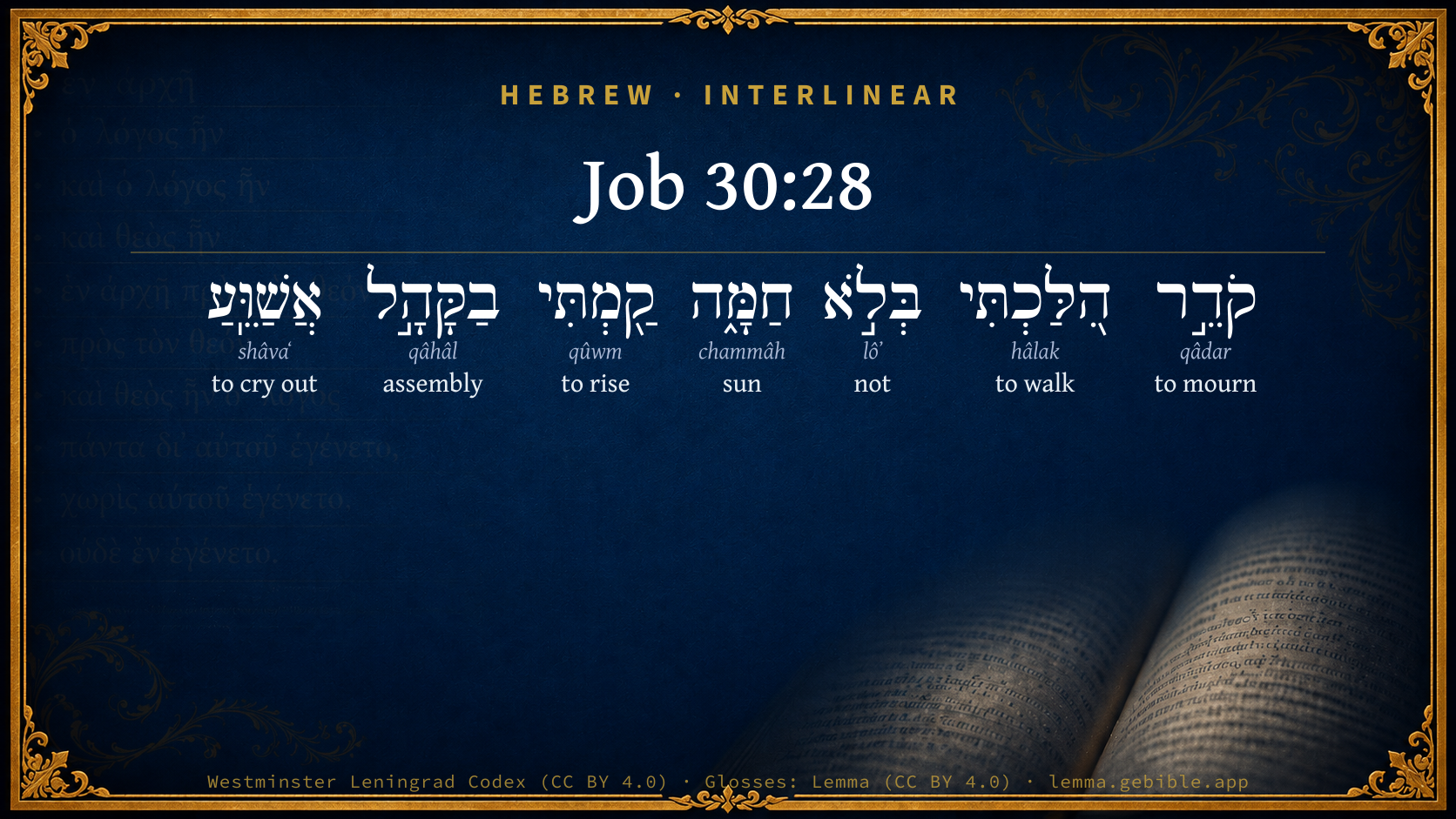
Job 30:28

Hebrew (Westminster Leningrad Codex) Job 30:28 appears in the Hebrew Old Testament. The text above is from the Westminster Leningrad Codex. Each word links to its Strong’s number, a concise gloss, and parsing drawn from the Open Scriptures Hebrew Bible morphology. Click any word for its full Brown-Driver-Briggs (BDB) entry.
Download image
Cite this verse

Job 30:28 (World English Bible). Public Domain. Lemma interlinear Bible study tool, https://lemma.gebible.app/v/job/30/28.

Show BibTeX & RIS
BibTeX
RIS
English Translation
I go mourning without the sun. I stand up in the assembly, and cry for help.
World English Bible · Public Domain
Highlights
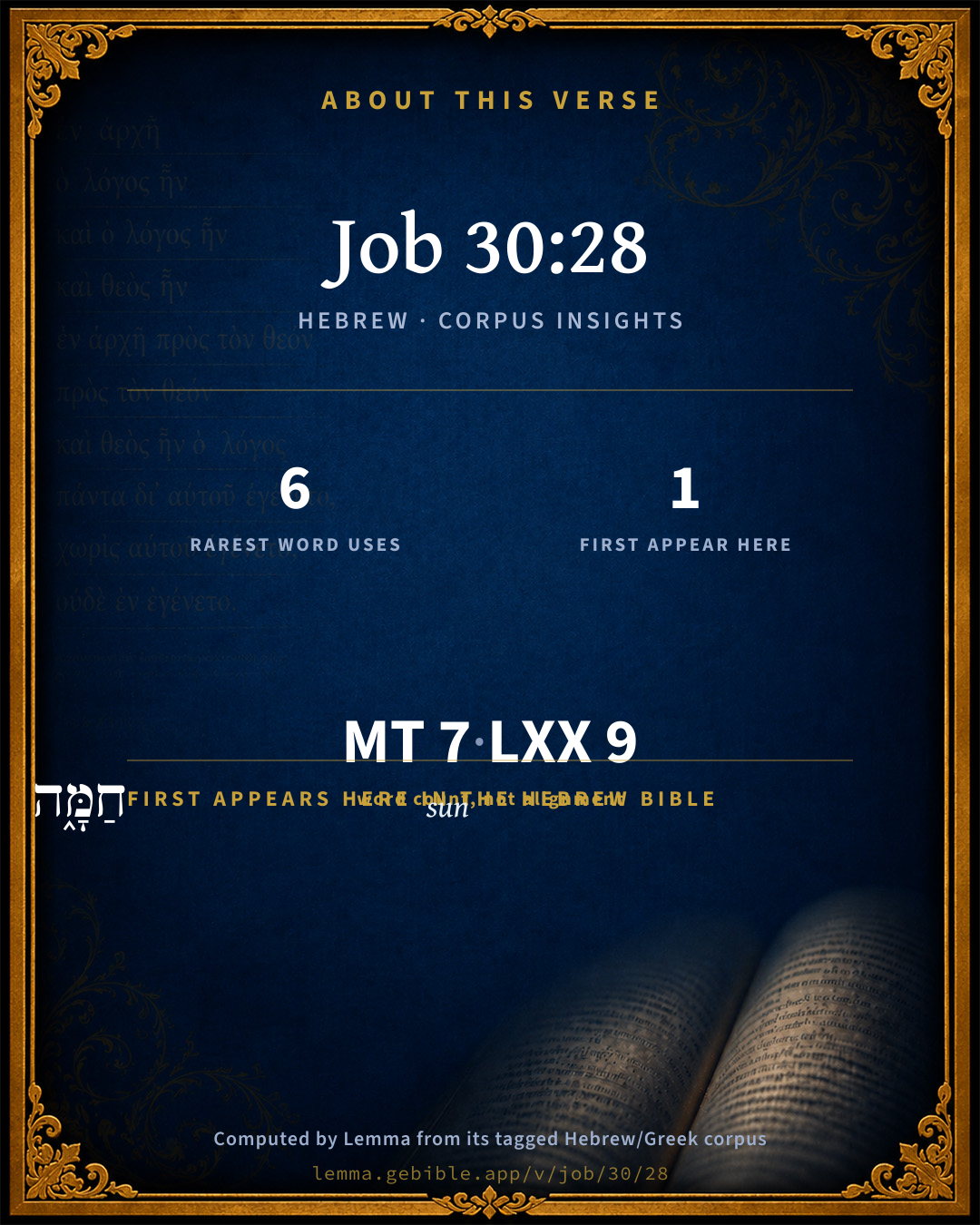
  • 1 first appearance in the Hebrew Bible
Full analysis ↓
Download a study sheet

One document with this verse’s original text, its word-by-word gloss line, the meaning frame, cross-references with their text, attributed commentary, and full source and license credits — printable, and it pastes into notes with its structure intact.

This verse Autodidact and up

Study sheet (.html) Plain text (.txt)

A passage Seminary Student

Up to 50 verses in one chapter. A passage sheet keeps up to 6 commentary sources and 12 cross-references per verse, in the order this page ranks them, and says so on the sheet whenever that leaves anything out. Ask for a single verse and you get the Autodidact verse sheet above.

Everything on this page stays free to read, with no account — the sheet is a download of what is already on screen, not access to it.

Want to remove ads? Support Godless Engineer
Compare translations 3

The same verse in 3 English versions, stacked beneath the original-language interlinear above. Click any original word for its lexicon entry.

Each is an independent rendering of the whole verse — the interlinear is not word-aligned to these translations.

Highlighted words mark where these versions differ — a whole-verse word diff, not a word-by-word alignment.

  • World English Bible Public Domain
    I go mourning without the sun. I stand up in the assembly, and cry for help.
  • King James Version Public Domain
    I went mourning without the sun: I stood up, and I cried in the congregation.
  • unfoldingWord Literal Text CC BY-SA 4.0
    I go about being dark not by the sun; I stand up in the assembly and cry out.

unfoldingWord Literal Text — © unfoldingWord, licensed CC BY-SA 4.0. Word-aligned USFM3 via Door43 (git.door43.org/unfoldingWord/en_ult).

Versions to compare (up to 4)

3 of 4 selected

Show all 18 translations

Every available English version of this verse, each an independent rendering of the whole verse.

  • World English Bible Public Domain
    I go mourning without the sun. I stand up in the assembly, and cry for help.
  • Berean Standard Bible Public Domain
    I go about blackened, but not by the sun. I stand up in the assembly and cry for help.
  • Majority Standard Bible Public Domain
    I go about blackened, but not by the sun. I stand up in the assembly and cry for help.
  • King James Version Public Domain
    I went mourning without the sun: I stood up, and I cried in the congregation.
  • American Standard Version (1901) Public Domain
    I go mourning without the sun: I stand up in the assembly, and cry for help.
  • Revised Version (1885) Public Domain
    I go mourning without the sun: I stand up in the assembly, and cry for help.
  • Geneva Bible (1599) Public Domain
    I went mourning without sunne: I stood vp in the congregation and cryed.
  • Douay-Rheims (1899) Public Domain
    I went mourning without indignation; I rose up, and cried in the crowd.
  • Young's Literal Translation Public Domain
    Mourning I have gone without the sun, I have risen, in an assembly I cry.
  • Literal Standard Version CC BY-SA 4.0
    I have gone mourning without the sun, || I have risen, I cry in an assembly.
  • Unlocked Literal Bible CC BY-SA 4.0
    I have gone about like one who was living in the dark, but not because of the sun; I stand up in the assembly and cry for help.
  • unfoldingWord Literal Text CC BY-SA 4.0
    I go about being dark not by the sun; I stand up in the assembly and cry out.
  • Darby Bible Public Domain
    I go about blackened, but not by the sun; I stand up, I cry in the congregation.
  • World Messianic Bible Public Domain
    I go mourning without the sun. I stand up in the assembly, and cry for help.
  • Webster's Bible Public Domain
    I went mourning without the sun: I stood up, and I cried in the congregation.
  • Free Bible Version CC BY-SA 4.0
    I am so depressed; seeing the sun doesn't help. I stand up in the assembly and cry for help.
  • Bible in Basic English Public Domain
    I go about in dark clothing, uncomforted; I get up in the public place, crying out for help.
  • JPS Tanakh (1917) Public Domain
    I go mourning without the sun; I stand up in the assembly, and cry for help.

Literal Standard Version (2020), Covenant Press — licensed CC BY-SA 4.0. Text via the HelloAO Bible API (eBible.org). Unlocked Literal Bible (unfoldingWord) — licensed CC BY-SA 4.0. Text via the HelloAO Bible API (eBible.org). unfoldingWord Literal Text — © unfoldingWord, licensed CC BY-SA 4.0. Word-aligned USFM3 via Door43 (git.door43.org/unfoldingWord/en_ult). Free Bible Version, Dr. Jonathan Gallagher — licensed CC BY-SA 4.0. Text via the HelloAO Bible API (eBible.org).

Word by word

More ways to search: Search by grammar → Find every occurrence → Compare this word →

Practice this passage: Drill this verse → Learn its vocabulary →

About this verse

These counts appear in no published source. They are computed here, from the morphology-tagged text and Lemma’s own curated glosses. What Lemma adds →

7
words
7
distinct lemmas
Wisdom
section

Notable vocabulary

The rarest word here is חַמָּ֑ה sun H2535 — appearing just 6 times in the whole Hebrew Bible.

First appearance in Scripture

This word makes its first canonical appearance in the Hebrew Bible here:

  • חַמָּ֑ה sun H2535

Shared distinctive vocabulary

חַמָּ֑ה sun H2535 occurs in 5 verses of the Hebrew Bible. Also found in:

Grammatical profile

  • 4 verbs
  • 2 nouns
  • 1 particle

Verb forms

  • קֹדֵ֣ר Qal · Participle Active
  • הִ֭לַּכְתִּי Piel · Perfect
  • קַ֖מְתִּי Qal · Perfect
  • אֲשַׁוֵּֽעַ Piel · Imperfect

Hebrew & Septuagint length

In English translation the verse runs 16 words from the Hebrew and 15 from the Septuagint (LXX English) — closely comparable.

A rough comparison of the two English renderings, which tokenize alike — not a word-level alignment.

Word counts can differ between the Hebrew and the Greek without any difference in meaning — e.g. the Hebrew direct-object marker אֵת has no separate Greek word, and Greek often adds the article ὁ.

In the original languages it is 7 Hebrew tokens and 9 Greek tokens — but the two are counted differently (Hebrew bundles its prefixes and suffixes into one token; the Greek is in lemma form), so that isn’t a like-for-like length.

Cross-references

6

Topical passages linked to Job 30:28 in the Treasury of Scripture Knowledge — connected by theme and wording, ordered by reader-vote popularity; previews shown in the World English Bible.

  • Psalms 38:6 I am pained and bowed down greatly. I go mourning all day long.
  • Psalms 42:9 I will ask God, my rock, "Why have you forgotten me? Why do I go mourning because of the oppression of the enemy?"
  • Psalms 43:2 For you are the God of my strength. Why have you rejected me? Why do I go mourning because of the oppression of the enemy?
  • Job 19:7 "Behold, I cry out of wrong, but I am not heard: I cry for help, but there is no justice.
  • Isaiah 53:3–4 He was despised, and rejected by men; a man of suffering, and acquainted with disease: and as one from whom men hide their face he was despised; and we didn't respect him.
  • Lamentations 3:1–3 I am the man that has seen affliction by the rod of his wrath.

Cross-references courtesy of OpenBible.info (CC BY 4.0).

Hebrew and Greek witnesses Masoretic Hebrew ↔ Greek Septuagint

The same verse in the two great witnesses to the Old Testament, shown verse-for-verse.

These are two independent witnesses, not word-aligned to each other, and the Septuagint is shown in lemma (dictionary) form.

Hebrew Job 30:28 Masoretic · Westminster Leningrad Codex

קֹדֵ֣ר הִ֭לַּכְתִּי בְּלֹ֣א חַמָּ֑ה קַ֖מְתִּי בַקָּהָ֣ל אֲשַׁוֵּֽעַ

I go mourning without the sun. I stand up in the assembly, and cry for help.

World English Bible · Public Domain

Greek LXX Job 30:28 Septuagint · lemma form

στένω πορεύομαι ἄνευ φιμός ἵστημι δέ ἐν ἐκκλησία κράζω

I went mourning without restraint: and I have stood and cried out in the assembly.

LXX2012 (modern English Septuagint) · Public Domain

On this verse, Keil & Delitzsch discusses the Septuagint’s reading. Read the note in Commentary ↓

Hebrew: Westminster Leningrad Codex (CC BY 4.0). Greek: Septuagint (public domain); English from LXX2012 (modern English Septuagint) (Public Domain). How the Septuagint differs from the Hebrew →

Commentary

Notes on Job 30:28 from classic Christian and Jewish commentators (each source and its license shown beneath its notes). The classic Christian expositions comment on the surrounding passage and are grouped to its opening verse, so a note may address several verses; the Jewish commentaries on the Tanakh (Rashi and others) are per-verse, so they appear only where the commentator wrote on this verse.

Lemma curates 59 commentaries, every one of them public domain or Creative Commons licensed, each selected and text-cleaned for this edition rather than reprinted as found. About our sources →

Trapp's Complete Commentary

John Trapp

Job 30:28 I went mourning without the sun: I stood up, [and] I cried in the congregation.

Ver. 28. I went mourning without the sun] Ater ambulo, sed non ob solem; I am not sun burnt, but heart burnt; black and discoloured without, because parched and dried up within by the force of my disease and my grief, wherewith I am pained, pined, and even perished.

I stood up and cried in the congregation] Which was not very handsome, but I could not hold. Rise I did, and roar I must amidst the press of people, whatever they should think of me. So Mordecai went out into the midst of the city, and cried with a loud and a bitter cry; and came even before the king’s gate, &c., Est 4:1-2. In extreme heaviness men care not to keep decorums.

John Trapp, A Commentary or Exposition upon All the Books of the Old and New Testament (1647–1656) — public domain. Text from a community e-Sword module.

Keil & Delitzsch

C. F. Keil & F. Delitzsch

28 I wandered about in mourning without the sun;

I rose in the assembly, I gave free course to my complaint.

29 I am become a brother of the jackals

And a companion of ostriches.

30 My skin having become black, peels off from me,

And my bones are parched with dryness.

31 My harp was turned to mourning,

And my pipe to tones of sorrow.

Several expositors (Umbr., Vaih., Hlgst.) understand קדר of the dirty-black skin of the leper, but contrary to the usage of the language, according to which, in similar utterances (Psa 35:14; Psa 38:7; Psa 42:10; Psa 43:2, comp. supra, Job 5:11), it rather denotes the dirty-black dress of mourners (comp. Arab. qḏḏr, conspurcare vestem); to understand it of the dirty-black skin as quasi sordida veste (Welte) is inadmissible, since this distortion of the skin which Job bewails in Job 30:30 would hardly be spoken of thus tautologically. קדר therefore means in the black of the שׂק, or mourning-linen, Job 16:15, by which, however, also the interpretation of בּלא חמּה, "without sunburn" (Ew., Hirz.), which has gained ground since Raschi's day (לא שׁשׁזפתני השׁמשׁ), is disposed of; for "one can perhaps say of the blackness of the skin that it does not proceed from the sun, but not of the blackness of mourning attire" (Hahn). קדר also refutes the reading בלא חמה in lxx Complut. (ἄνευ θυμοῦ),

(Note: Whereas Codd. Alex., Vat., and Sinait., ἄνευ φιμοῦ, which is correctly explained by κημοῦ in Zwingli's Aldine, but gives no sense.)

Syr., Jer. (sine furore), which ought to be understood of the deposition of the gall-pigment on the skin, and therefore of jaundice, which turns it (especially in tropical regions) not merely yellow, but a dark-brown. Hahn and a few others render בלא חמה correctly in the sense of בחשׁך, "without the sun having shone on him." Bereft of all his possessions, and finally also of his children, he wanders about in mourning (הלּך as Job 24:10; Psa 38:7), and even the sun had clothed itself in black to him (which is what קדר השׁמשׁ means, Joe 2:10 and freq.); the celestial light, which otherwise brightened his path, Job 29:3, was become invisible. We must not forget that Job here reviews the whole chain of afflictions which have come upon him, so that by Job 30:28 we have not to think exclusively, and also not prominently, of the leprosy, since הלכתי indeed represents him as still able to move about freely.

In Job 30:28 the accentuation wavers between Dech, Munach, Silluk, according to which בּקּהל אשׁוּע belong together, which is favoured by the Dagesh in the Beth, and Tarcha, Munach, Silluk, according to which (because Munach, according to Psalter ii. 503, 2, is a transformation of Rebia mugrasch) קמתּי בּקּהל belong together. The latter mode of accentuation, according to which בקהל must be written without the Dag. instead of בּקהל (vid., Norzi), is the only correct one (because Dech cannot come in the last member of the sentence before Silluk), and is also more pleasing as to matter: I rose (and stood) in the assembly, crying for help, or more generally: wailing. The assembly is not to be thought of as an assembly of the people, or even tribunal (Ew.: "before the tribunal seeking a judge, with lamentations"), but as the public; for the thought that Job sought help against his unmerited sufferings before a human tribunal is absurd; and, moreover, the thought that he cried for help before an assembly of the people called together to take counsel and pronounce decisions is equally absurd. Welte, however, who interprets: I was as one who, before an assembled tribunal, etc., introduces a quasi of which there is no trace in the text. בּקּהל must therefore, without pressing it further, be taken in the sense of publice, before all the world (Hirz.: comp. בקהל, ἐν φανερῷ, Pro 26:26); אשׁוּע, however, is a circumstantial clause declaring the purpose (Ew. 337, b; comp. De Sacy, Gramm. Arabe ii. 357), as is frequently the case after קום, Job 16:8; Psa 88:11; Psa 102:14 : surrexi in publico ut lamentarer, or lamentaturus, or lamentando. In this lament, extorted by the most intense pain, which he cannot hold back, however many may surround him, he is become a brother of those תּנּים, jackals (canes aurei), whose dolorous howling produces dejection and shuddering in all who hear it, and a companion of בּנות יענה, whose shrill cry is varied by wailing tones of deep melancholy.

(Note: It is worth while to cite a passage from Shaw's Travels in Barbary, ii. 348 (transl.), here: "When the ostriches are running and fighting, they sometimes make a wild, hideous, hissing noise with their throats distended and beaks open; at another time, if they meet with a slight opposition, they have a clucking or cackling voice like our domestic fowls: they seem to rejoice and laugh at the terror of their adversary. During the loneliness of the night however, as if their voice had a totally different tone, they often set up a dolorous, hideous moan, which at one time resembles the roar of the lion, and at another is more like the hoarser voice of other quadrupeds, especially the bull and cow. I have often heard them groan as if they were in the greatest agonies." In General Doumas' book on the Horse of the Sahara, I have read that the male ostrich (delı̂m), when it is killed, especially if its young ones are near, sends forth a dolorous note, wile the female (remda), on the other hand, does not utter a sound; and so, when the ostrich digs out its nest, one hears a languishing and dolorous tone all day long, and when it has laid its egg, its usual cry is again heard, only about three o'clock in the afternoon.)

The point of comparison is not the insensibility of the hearers (Sforno), but the fellowship of wailing and howling together with the accompanying idea of the desert in which it is heard, which is connected with the idea itself (comp. Mic 1:8).

Job 30:30

Now for the first time he speaks of his disfigurement by leprosy in particular: my skin (עורי, masc., as it is also used in Job 19:26, only apparently as fem.) is become black (nigruit) from me, i.e., being become black, has peeled from me, and my bones (עצמי, construed as fem. like Job 19:20; Psa 102:6) are consumed, or put in a glow (חרה, Milel, from חרר, as Eze 24:11) by a parching heat. Thus, then, his harp became mournful, and his pipe (ועגבי with ג raphatum) the cry of the weepers; the cheerful music (comp. Job 21:12) has been turned into gloomy weeping and sobbing (comp. Lam 5:15). Thus the second part of the monologue closes. It is somewhat lengthened and tedious; it is Job's last sorrowful lament before the catastrophe. What a delicate touch of the poet is it that he makes this lament, Job 30:31, die away so melodiously! One hears the prolonged vibration of its elegiac strains. The festive and joyous music is hushed; the only tones are tones of sadness and lament, mesto, flebile.

Keil & Delitzsch — Biblical Commentary on the Old Testament (1861–1891) — public domain (CC PDM 1.0). Text via the HelloAO Bible API. (Old Testament only.)

Tyndale Open Study Notes

Tyndale Open Resources

30:28 Before his testing began, Job had been respected in the public square (29:7-10, 21-25); he helped others who were in need (29:11-17).

Tyndale Open Study Notes — © Tyndale Open Resources, licensed CC BY-SA 4.0. Text via the HelloAO Bible API.

Geneva Bible (1599)

Geneva Bible translators

Not delighting in any worldly thing, no not so much as in the use of the Sun.

Lamenting them that were in affliction, and moving others to pity them.

Geneva Bible (1599) marginal notes — public domain. Text via Bolls.life.

Jamieson, Fausset & Brown

Robert Jamieson, A. R. Fausset & David Brown

mourning--rather, I move about blackened, though not by the sun; that is, whereas many are blackened by the sun, I am, by the heat of God's wrath (so "boiled," Job 30:27); the elephantiasis covering me with blackness of skin (Job 30:30), as with the garb of mourning (Jer 14:2). This striking enigmatic form of Hebrew expression occurs, Isa 29:9.

stood up--as an innocent man crying for justice in an assembled court (Job 30:20).

Jamieson, Fausset & Brown — Commentary Critical and Explanatory on the Whole Bible (1871) — public domain (CC PDM 1.0). Text via the HelloAO Bible API.

Adam Clarke's Commentary

Verse 28. I went mourning without the sun] חמה chammah, which we here translate the sun, comes from a root of the same letters, which signifies to hide, protect, c., and may be translated, I went mourning without a protector or guardian or, the word may be derived from חם cham, to be hot, and here it may signify fury, rage, anger; and thus it was understood by the Vulgate: Maerens incedebam, sine furore, I went mourning without anger; or, as Calmet translates, Je marchois tout triste, mais sans me laisser aller a l'emportement; "I walked in deep sadness, but did not give way to an angry spirit." The Syriac and Arabic understood it in the same way.

Adam Clarke's Commentary on the Bible (1810–1826) — public domain. Text from a community e-Sword/MySword module.

Ellicott's Commentary for English Readers

(28) I went mourning without the sun.—Rather, I go mourning without the sun; or, according to some, “blackened, but not by the sun.” We give the preference to the other.

I stood up, and I cried in the congregation—i.e., not merely in secret, but in the face of all men.

A Bible Commentary for English Readers, edited by Charles John Ellicott (1878–1897) — public domain. Text from a community e-Sword module.

The Cambridge Bible for Schools and Colleges

gen. ed. J. J. S. Perowne

28. I went mourning] Better perhaps, I go blackened, not by the sun. The reference is to his appearance from his disease: he is black, but his blackness is not due to the sun, comp. Son_1:6.

The Cambridge Bible for Schools and Colleges (gen. ed. J. J. S. Perowne; Cambridge University Press, 1878–1918) — public domain. Text from a community e-Sword module.

John Gill's Exposition

I went mourning without the sun,.... So overwhelmed with grief, that he refused to have any comfort from, or any advantage by the sun; hence Mr. Broughton renders it, "out of the sun"; he did not choose to walk in the sunshine, but out of it, to indulge his grief and sorrow the more; or he went in black attire, and wrapped and covered himself with it, that he might not see the sun, or receive any relief by it: or "I go black, but not by the sun" (q); his face and his skin were black, but not through the sun looking upon him and discolouring him, as in Sol 1:6; but through the force of his disease, which had changed his complexion, and made him as black as a Kedarene, or those that dwell in the tents of Kedar, Sol 1:5; and he also walked without the sun of righteousness arising on him, with healing in his wings, which was worst of all:

I stood up, and I cried in the congregation: either in the congregation of the saints met together for religious worship, where he cried unto God for help and deliverance, and for the light of his countenance, Job 30:20; or such was the extreme anguish of his soul, that when a multitude of people got about him to see him in his distressed condition, he could not contain himself, but burst out before them in crying and tears, though he knew it was unbecoming a man of his age and character; or he could not content himself to stay within doors and soothe his grief, but must go abroad and in public, and there expressed with strong cries and tears his miserable condition.

(q) "non propter solem", Vatablus; "non a sole", Junius & Tremellius, Drusius, Mercerus; "non ob solem", Piscator.

John Gill's Exposition of the Whole Bible (1746–1763) — public domain (CC PDM 1.0). Text via the HelloAO Bible API.

Albert Barnes' Notes on the Bible

I went mourning - Or rather, “I go,” in the present tense, for he is now referring to his present calamities, and not to what was past. The word rendered “mourning,” however (קדר qâdar), means here rather to be dark, dingy, tanned. It literally means to be foul or turbid, like a torrent, Job 6:16; then to go about in filthy garments, as they do who mourn, Job 5:11; Jer 14:2; then to be dusky, or of a dark color, or to become dark. Thus, it is applied to the sun and moon becoming dark in an eclipse, or when covered with clouds, Jer 4:28; Joe 2:10; Joe 3:15; Mic 3:6. Here it refers to the fact that, by the mere force of his disease, his skin had become dark and swarthy, though he had not been exposed to the burning rays of the sun. The wrath of God had burned upon him, and he had become black under it. Jerome, however, renders it moerens, mourning. The Septuagint, “I go groaning (στένων stenōn) without restraint, or limit” - ἄνευ φιμοῦ aneu fimou. The Chaldee translates it אוכם, “black.”

Without the sun - Without being exposed to the sun; or without the agency of the sun. Though not exposed, he had become as dark as if he had been a day-laborer exposed to a burning sun.

I stood up - Or, I stand up.

And cried in the congregation - I utter my cries in the congregation, or when surrounded by the assembled people. Once I stood up to counsel them, and they hung upon my lips for advice; now I stand up only to weep over my accumulated calamities. This indicates the great change which had come upon him, and the depth of his sorrows. A man will weep readily in private; but he will be slow to do it, if he can avoid it, when surrounded by a multitude.

Albert Barnes' Notes on the Bible (1834–1885) — public domain. Text from a community e-Sword/MySword module.

Haydock's Catholic Bible Commentary

Mourning. Hebrew, "blackened without the sun." (Haydock) --- Bile has disfigured my countenance, through excessive sorrow, ver. 30. The dark olive complexions of the Jews and Arabs would be more susceptible of these effects. (Calmet) --- Indignation. I have not given way to passion, though I allowed full scope to my groans. (Septuagint) (Haydock)

George Leo Haydock (1774–1849), Haydock's Catholic Family Bible and Commentary, 1859 edition — public domain. Excludes Psalms (Douay-Rheims chapter numbering differs from Protestant) and Deuterocanonical books (Catholic canon only).

Matthew Poole's English Annotations

I went, or, I walked hither and thither as I could. Or, I converse or appear among others.

Mourning without the sun; spending my days in mourning, without any sun-light or comfort; or so oppressed with sadness, that I did not care nor desire to see the light of the sun. Heb. black not by the sun. My very countenance is changed and become black, but not by the sun, which makes many other persons black, Son 1:5,6; but by the force of my disease and deep melancholy, which ofttimes makes a man’s visage black and dismal. See Psa 119:83; Lam 5:10. And this he repeats in plainer terms, Job 30:30, as an eminent token of his excessive grief and misery.

I stood up; either because my disease and pain made me weary of other postures; or that others might take notice of me, and be moved with pity towards me.

I cried with a loud and direful clamour, through great and sudden anguish.

In the congregation; where prudence and modesty taught me to forbear it, if extreme necessity and misery had not forced me to it.

Matthew Poole's English Annotations on the Holy Bible (1683–1685) — public domain. Text from a community e-Sword/MySword module.

Whedon's Commentary on the Bible

Daniel D. Whedon

28. Mourning without the sun — I go blackened, but not by the heat of the sun. The blackness of his skin is due, not to the sun, but to his disease. Elephantiasis passes current as “the black leprosy.”

Congregation — Probably the indiscriminate assemblage of the people, naturally drawn together at first by the tidings of his misfortunes. This seems to have been previous to the seven days of mourning; the utter breaking down of Job is painfully indicated by this cry of despair.

Daniel D. Whedon (gen. ed.), Commentary on the Old and New Testaments (1874–1909) — public domain. Text from a community e-Sword module.

The Pulpit Commentary

Vers. 28, 29. I went mourning without the sun; rather, I go about blackened, but not by the sun. Grief and suffering, according to Oriental notions, blackened the face. (see Lam_4:8 Lam_5:10 Psa_119:83; and below, ver. 30) I stood up, and I cried in the congregation; rather, I stand up in the assembly" and cry for help (see the Revised Version). Job feels this as the most pitiable feature in his ease. He is broken down; he can no longer endure. At first he could sit in silence for seven days; (Job_2:13) now he is reduced to uttering complaints and lamentations. He is a brother, not to dragons, but to jackals. His laments are like the long melancholy cries that those animals emit during the silence of the night, so well known to Eastern travellers. He adds further that he is a companion, not to owls, but to ostriches; which, like jackals, have a melancholy cry. (see Mic_1:8; and comp. Dr. Hooker"s article in Smith"s "Dict. of the Bible," vol. 2. p. 650)

The Pulpit Commentary (1880–1919), ed. H.D.M. Spence-Jones & Joseph S. Exell — public domain. Text from a community e-Sword module.

John Wesley's Explanatory Notes

Without the sun - Hebrew. black, not by the sun. My very countenance became black, tho' not by the sun, but by the force of my disease.

John Wesley, Explanatory Notes Upon the Whole Bible (1754–1765) — public domain. Text via the GEBible commentary corpus.

Rashi

Rabbi Shlomo Yitzchaki (Rashi)

without the sun The sun did not gaze upon me, yet I am blackened.

Rashi on the Tanakh — English translations: “The Judaica Press complete Tanach with Rashi, translated by A. J. Rosenberg” (CC BY 4.0); “Pentateuch with Rashi's commentary by M. Rosenbaum and A.M. Silbermann, 1929-1934” (public domain); “The Metsudah Tanach series, Lakewood, N.J” (CC BY 4.0); and “The Book of Joshua, Metsudah Publications, 1997” (CC BY 4.0). Text via Sefaria.

Lesson kit

Teaching starters — assembled from the data on this page, not authored interpretation. Every prompt links to the verse data it draws on. Edit before teaching.

Job, in the Wisdom, opens this verse with 7 words (7 distinct Hebrew lemmas). Its most distinctive word is chammâh (“sun”). A historical commentator’s framing appears above. Read the whole chapter for the surrounding context.

Discussion questions

  1. The word chammâh carries the sense “sun.” How does it shape the verse?
  2. The word “sun” first appears here in Scripture. What is being introduced at this debut?
  3. Psalms 19:6 shares the word «sun» with this verse. How do the two illuminate each other?
  4. These translations render this verse differently; the difference is in the English rendering, not the original. What questions does that raise?
  5. The verb «קֹדֵ֣ר» is Qal Participle Active. How does its form color the action?
  6. Reading how Trapp's Complete Commentary and Keil & Delitzsch read this verse, where do the two commentators agree and where do they part?

Things to notice

Reading settings

Reading text

Shown beneath each verse's original-language words.

Old Testament
Old Testament edition

Read the OT as the Masoretic Hebrew (MT) or the Greek Septuagint (LXX).

English shown for the Greek Septuagint (in the Hebrew ↔ Greek comparison).

Comparing translations? Open the Compare panel on any verse page to stack up to four side by side.