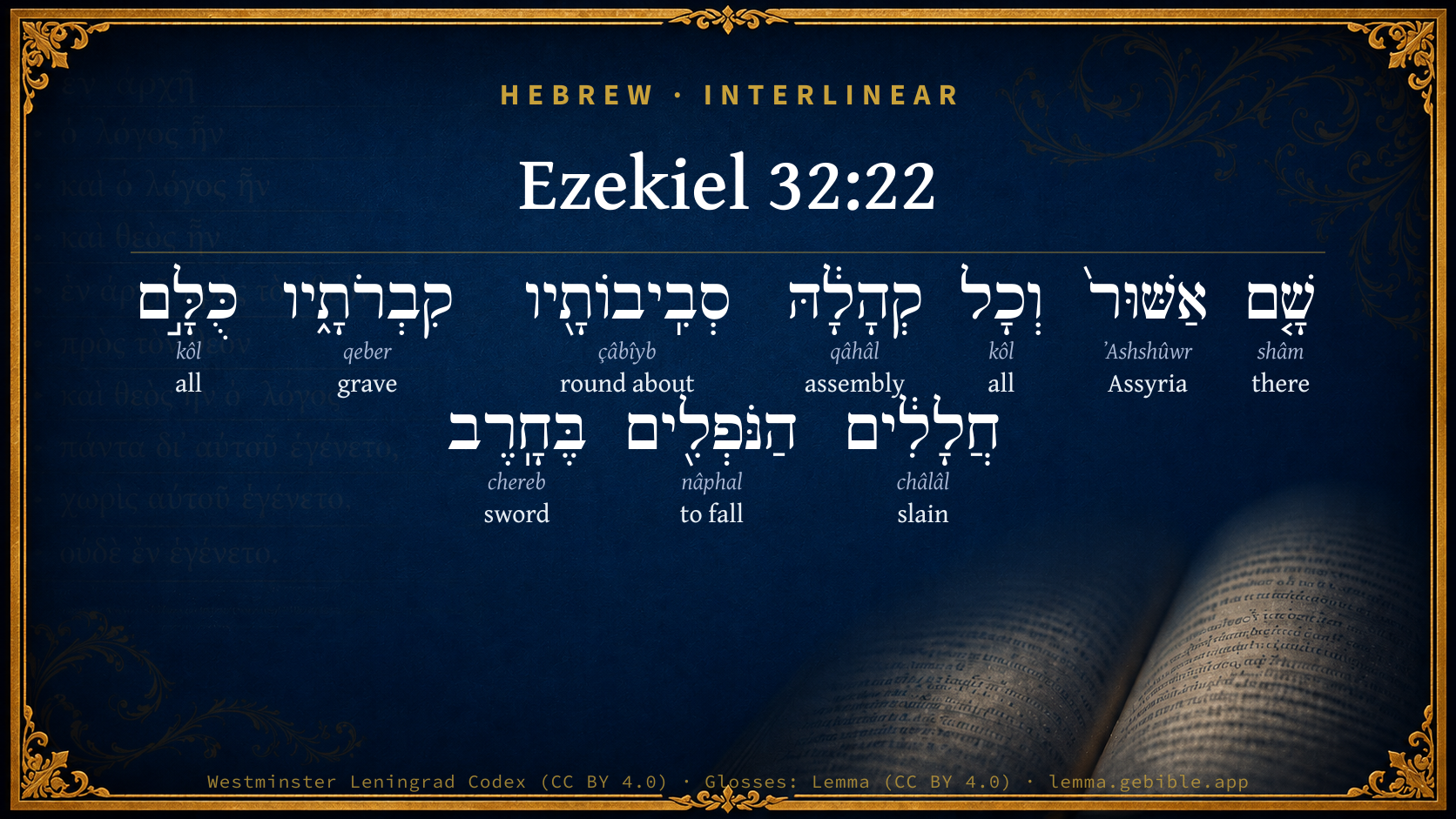
Ezekiel 32:22

Hebrew (Westminster Leningrad Codex) Ezekiel 32:22 appears in the Hebrew Old Testament. The text above is from the Westminster Leningrad Codex. Each word links to its Strong’s number, a concise gloss, and parsing drawn from the Open Scriptures Hebrew Bible morphology. Click any word for its full Brown-Driver-Briggs (BDB) entry.
Download image
Cite this verse

Ezekiel 32:22 (World English Bible). Public Domain. Lemma interlinear Bible study tool, https://lemma.gebible.app/v/ezekiel/32/22.

Show BibTeX & RIS
BibTeX
RIS
English Translation
Asshur is there and all her company; her graves are round about her; all of them slain, fallen by the sword;
World English Bible · Public Domain
Download a study sheet

One document with this verse’s original text, its word-by-word gloss line, the meaning frame, cross-references with their text, attributed commentary, and full source and license credits — printable, and it pastes into notes with its structure intact.

This verse Autodidact and up

Study sheet (.html) Plain text (.txt)

A passage Seminary Student

Up to 50 verses in one chapter. A passage sheet keeps up to 6 commentary sources and 12 cross-references per verse, in the order this page ranks them, and says so on the sheet whenever that leaves anything out. Ask for a single verse and you get the Autodidact verse sheet above.

Everything on this page stays free to read, with no account — the sheet is a download of what is already on screen, not access to it.

Want to remove ads? Support Godless Engineer
Compare translations 3

The same verse in 3 English versions, stacked beneath the original-language interlinear above. Click any original word for its lexicon entry.

Each is an independent rendering of the whole verse — the interlinear is not word-aligned to these translations.

Highlighted words mark where these versions differ — a whole-verse word diff, not a word-by-word alignment.

  • World English Bible Public Domain
    Asshur is there and all her company; her graves are round about her; all of them slain, fallen by the sword;
  • King James Version Public Domain
    Asshur is there and all her company: his graves are about him: all of them slain, fallen by the sword:
  • unfoldingWord Literal Text CC BY-SA 4.0
    Assyria is there with all her assembly. Her graves surround her; all of them were killed by the sword.

unfoldingWord Literal Text — © unfoldingWord, licensed CC BY-SA 4.0. Word-aligned USFM3 via Door43 (git.door43.org/unfoldingWord/en_ult).

Versions to compare (up to 4)

3 of 4 selected

Show all 18 translations

Every available English version of this verse, each an independent rendering of the whole verse.

  • World English Bible Public Domain
    Asshur is there and all her company; her graves are round about her; all of them slain, fallen by the sword;
  • Berean Standard Bible Public Domain
    Assyria is there with her whole company; her graves are all around her. All of them are slain, fallen by the sword.
  • Majority Standard Bible Public Domain
    Assyria is there with her whole company; her graves are all around her. All of them are slain, fallen by the sword.
  • King James Version Public Domain
    Asshur is there and all her company: his graves are about him: all of them slain, fallen by the sword:
  • American Standard Version (1901) Public Domain
    Asshur is there and all her company; her graves are round about her; all of them slain, fallen by the sword;
  • Revised Version (1885) Public Domain
    Asshur is there and all her company; his graves are round about him: all of them slain, fallen by the sword:
  • Geneva Bible (1599) Public Domain
    Asshur is there and all his companie: their graues are about him: all they are slaine and fallen by the sworde.
  • Douay-Rheims (1899) Public Domain
    Assur is there, and all his multitude: their graves are round about him, all of them slain, and that fell by the sword.
  • Young's Literal Translation Public Domain
    There `is' Asshur, and all her assembly, Round about him `are' his graves, All of them `are' wounded, who are falling by sword,
  • Literal Standard Version CC BY-SA 4.0
    There [is] Asshur, and all her assembly, || His graves [are] around him, || All of them [are] wounded, who are falling by sword,
  • Unlocked Literal Bible CC BY-SA 4.0
    Assyria is there with all her assembly. Her graves surround her; all of them were killed by the sword.
  • unfoldingWord Literal Text CC BY-SA 4.0
    Assyria is there with all her assembly. Her graves surround her; all of them were killed by the sword.
  • Darby Bible Public Domain
    There is Asshur and all his assemblage, his graves round about him: all of them slain, fallen by the sword;
  • World Messianic Bible Public Domain
    “Asshur is there with all her company. Her graves are all around her. All of them are slain, fallen by the sword,
  • Webster's Bible Public Domain
    Asshur is there and all her company: his graves are about him: all of them slain, fallen by the sword:
  • Free Bible Version CC BY-SA 4.0
    Assyria is there with all its people—it's surrounded by graves. All of them died violent deaths, killed by the sword.
  • Bible in Basic English Public Domain
    There is Asshur and all her army, round about her last resting-place: all of them put to death by the sword:
  • JPS Tanakh (1917) Public Domain
    Asshur is there and all her company; their graves are round about them; all of them slain, fallen by the sword;

Literal Standard Version (2020), Covenant Press — licensed CC BY-SA 4.0. Text via the HelloAO Bible API (eBible.org). Unlocked Literal Bible (unfoldingWord) — licensed CC BY-SA 4.0. Text via the HelloAO Bible API (eBible.org). unfoldingWord Literal Text — © unfoldingWord, licensed CC BY-SA 4.0. Word-aligned USFM3 via Door43 (git.door43.org/unfoldingWord/en_ult). Free Bible Version, Dr. Jonathan Gallagher — licensed CC BY-SA 4.0. Text via the HelloAO Bible API (eBible.org).

Word by word

More ways to search: Search by grammar → Find every occurrence → Compare this word →

Practice this passage: Drill this verse → Learn its vocabulary →

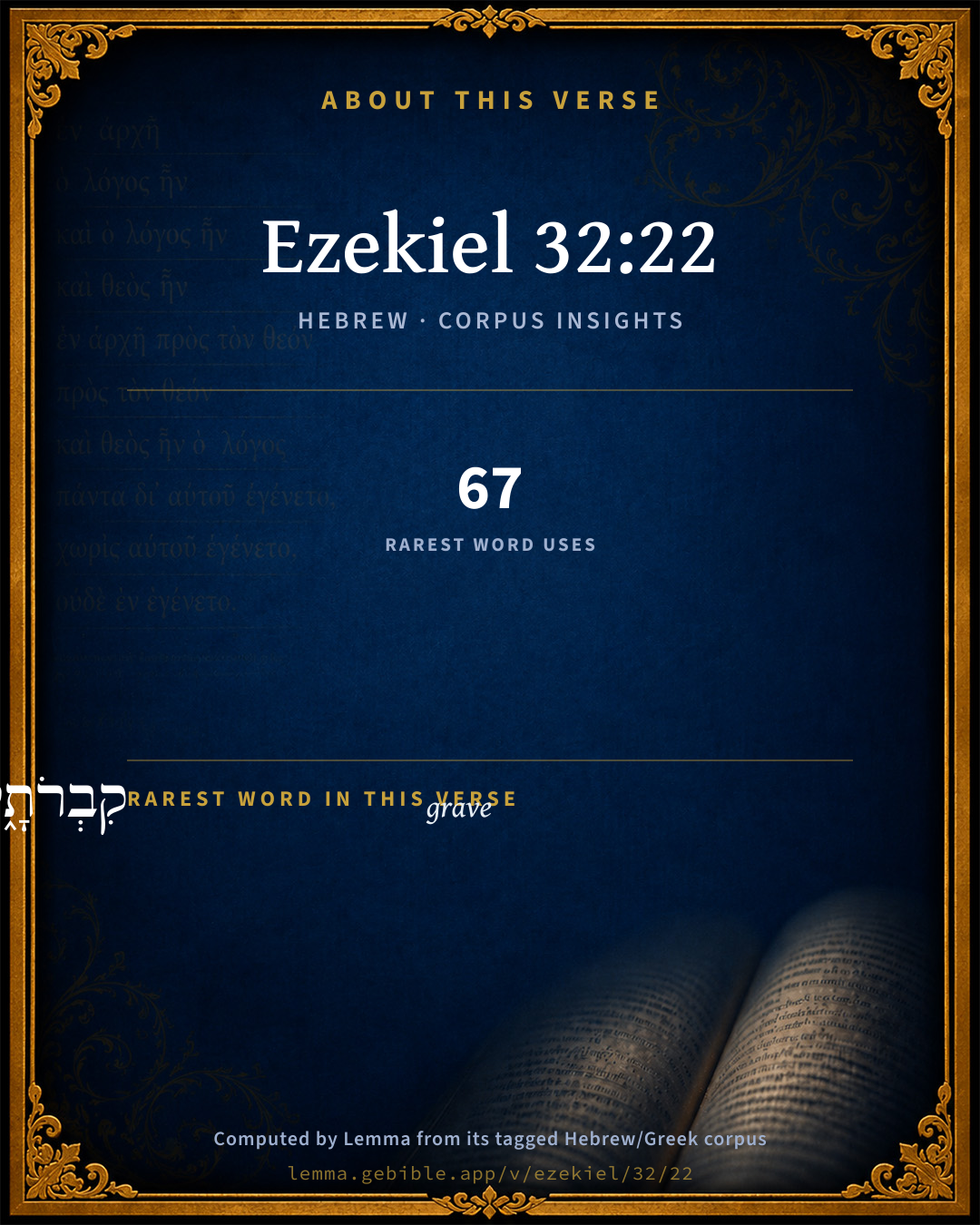
קִבְרֹתָ֑יו
qeber
H6913
“graves · his”
Noun, Common, Masculine, Plural, Construct + Suffix, Personal, 3rd Person, Masculine, Singular
Part of Speech
Noun
Type
Common
Gender
Masculine
Number
Plural
State
Construct
Full BDB Definition

Origin: from H6912

TWOT: 1984a

grave, sepulchre, tomb
  1. שָׁ֤ם shâm H8033 “there” Adverb
  2. אַשּׁוּר֙ ʼAshshûwr H804 “Assyria” Noun, Proper
  3. וְכָל kôl H3605 “and · all of” Conjunction + Noun, Common, Masculine, Singular, Construct
  4. קְהָלָ֔הּ qâhâl H6951 “assembly · her” Noun, Common, Masculine, Singular, Construct + Suffix, Personal, 3rd Person, Feminine, Singular
  5. סְבִֽיבוֹתָ֖יו çâbîyb H5439 “surroundings · his” Noun, Common, Both, Plural, Construct + Suffix, Personal, 3rd Person, Masculine, Singular
  6. כֻּלָּ֣ם kôl H3605 “all · their” Noun, Common, Masculine, Singular, Construct + Suffix, Personal, 3rd Person, Masculine, Plural
  7. חֲלָלִ֔ים châlâl H2491 “slain” Adjective, Adjective, Masculine, Plural, Absolute
  8. הַנֹּפְלִ֖ים nâphal H5307 “the · falling” Particle, Definite Article + Verb, Qal, Participle Active, Masculine, Plural, Absolute
  9. בֶּחָֽרֶב chereb H2719 “in/at the · sword” Preposition, Determined + Noun, Common, Feminine, Singular, Absolute

About this verse

These counts appear in no published source. They are computed here, from the morphology-tagged text and Lemma’s own curated glosses. What Lemma adds →

10
words
9
distinct lemmas
Prophets
section

Grammatical profile

  • 1 verb
  • 7 nouns
  • 1 adjective
  • 1 adverb

Verb forms

  • הַנֹּפְלִ֖ים Qal · Participle Active

Repetition

A word recurs within this verse — often emphatic in Hebrew:

  • וְכָל all H3605 ×2

Hebrew & Septuagint length

In English translation the verse runs 21 words from the Hebrew and 14 from the Septuagint (LXX English) — the Septuagint runs noticeably shorter here. See the side-by-side →

A rough comparison of the two English renderings, which tokenize alike — not a word-level alignment.

Word counts can differ between the Hebrew and the Greek without any difference in meaning — e.g. the Hebrew direct-object marker אֵת has no separate Greek word, and Greek often adds the article ὁ.

Cross-references

10

Topical passages linked to Ezekiel 32:22 in the Treasury of Scripture Knowledge — connected by theme and wording, ordered by reader-vote popularity; previews shown in the World English Bible.

  • Ezekiel 32:26 There is Meshech, Tubal, and all their multitude; their graves are round about them; all of them uncircumcised, slain by the sword; for they caused their terror in the land of the living.
  • Ezekiel 32:24 There is Elam and all her multitude round about her grave; all of them slain, fallen by the sword, who are gone down uncircumcised into the lower parts of the earth, who caused their terror in the land of the living, and have borne their shame with those who go down to the pit.
  • Ezekiel 32:29–30 There is Edom, her kings and all her princes, who in their might are laid with those who are slain by the sword: they shall lie with the uncircumcised, and with those who go down to the pit.
  • Numbers 24:24 But ships [shall come] from the coast of Kittim, They shall afflict Asshur, and shall afflict Eber; He also shall come to destruction.
  • Psalms 83:8–10 Assyria also is joined with them. They have helped the children of Lot. Selah.
  • Isaiah 30:33 For a Topheth is prepared of old; yes, for the king it is made ready; he has made it deep and large; the pile of it is fire and much wood; the breath of Yahweh, like a stream of sulfur, does kindle it.
  • Isaiah 37:36–38 The angel of Yahweh went forth, and struck in the camp of the Assyrians one hundred and eighty-five thousand; and when men arose early in the morning, behold, these were all dead bodies.
  • Ezekiel 31:3–18 Behold, the Assyrian was a cedar in Lebanon with beautiful branches, and with a forest-like shade, and of high stature; and its top was among the thick boughs.
  • Nahum 1:7–12 Yahweh is good, a stronghold in the day of trouble; and he knows those who take refuge in him.
  • Nahum 3:1–19 Woe to the bloody city! It is all full of lies and robbery. The prey doesn't depart.

Cross-references courtesy of OpenBible.info (CC BY 4.0).

Hebrew and Greek witnesses Masoretic Hebrew ↔ Greek Septuagint

The same verse in the two great witnesses to the Old Testament, shown verse-for-verse.

Here the Septuagint runs noticeably shorter than the Hebrew — LXX2012 (modern English Septuagint) 14 words vs World English Bible 21. A rough length comparison of the two English translations, not a word-level alignment — read both below.

These are two independent witnesses, not word-aligned to each other, and the Septuagint is shown in lemma (dictionary) form.

Hebrew Ezekiel 32:22 Masoretic · Westminster Leningrad Codex

שָׁ֤ם אַשּׁוּר֙ וְכָל קְהָלָ֔הּ סְבִֽיבוֹתָ֖יו קִבְרֹתָ֑יו כֻּלָּ֣ם חֲלָלִ֔ים הַנֹּפְלִ֖ים בֶּחָֽרֶב

Asshur is there and all her company; her graves are round about her; all of them slain, fallen by the sword;

World English Bible · Public Domain

Greek LXX Ezekiel 32:22 Septuagint · lemma form

ἐκεῖ ασσουρ καί πᾶς ὁ συναγωγή αὐτός πᾶς τραυματίας ἐκεῖ δίδωμι καί ὁ ταφή αὐτός ἐν βαθύς βόθρος καί γίγνομαι ὁ συναγωγή αὐτός περικύκλῳ ὁ μνῆμα αὐτός πᾶς ὁ τραυματίας ὁ πίπτω μάχαιρα

There are Assur and all his company: all his slain have been laid there:

LXX2012 (modern English Septuagint) · Public Domain

On this verse, The Cambridge Bible for Schools and Colleges discusses the Septuagint’s reading. Read the note in Commentary ↓

Hebrew: Westminster Leningrad Codex (CC BY 4.0). Greek: Septuagint (public domain); English from LXX2012 (modern English Septuagint) (Public Domain). How the Septuagint differs from the Hebrew →

Targum (Aramaic paraphrase)

1

The Targum is the ancient Jewish Aramaic paraphrase of the Hebrew Scriptures — an interpretive translation, not the Hebrew text itself. Onkelos (literal) and Pseudo-Jonathan (expansive) render the Torah, and Jonathan the Prophets. Coverage is partial: where no permissively-licensed English translation exists for a verse, only the Aramaic is shown. This is verse-level text, not a word-by-word alignment to the Hebrew.

  1. Targum Jonathan Prophets (Joshua–Malachi)
    תַּמָן אַתּוּר וְכָל מַשִׁרְיָתֵהּ סָחֲרָנוּתְהוֹן קִבְרֵיהוֹן כּוּלְהוֹן קְטִילִין דְאִתְקְטָלוּ בְּחַרְבָּא:

    (no public-domain English translation for this verse)

    Targum Jonathan — Aramaic: “Mikraot Gedolot” (public domain). English: “Sefaria Community Translation” (CC0 1.0 (public-domain dedication)); “London "Chaldee Paraphrase," 1871” (public domain). Text via Sefaria.

Commentary

Notes on Ezekiel 32:22 from classic Christian and Jewish commentators (each source and its license shown beneath its notes). The classic Christian expositions comment on the surrounding passage and are grouped to its opening verse, so a note may address several verses; the Jewish commentaries on the Tanakh (Rashi and others) are per-verse, so they appear only where the commentator wrote on this verse.

Lemma curates 59 commentaries, every one of them public domain or Creative Commons licensed, each selected and text-cleaned for this edition rather than reprinted as found. About our sources →

Ellicott's Commentary for English Readers

(22) Asshur is there.—In the previous verses we have had a general picture of the fallen nations awaiting to receive Egypt as their companion; in Eze_32:22-30 there follows an enumeration of the most prominent of them, with a few words about each. Some of them were not yet fallen; but in this prophetic view it is their ultimate condition which rises to the prophet’s mind. All worldly power that opposes itself to God must go down and share the judgment soon to fall on Egypt.

His graves are about him.—The graves of the people are about those of their monarch. All are fallen together into one common ruin.

A Bible Commentary for English Readers, edited by Charles John Ellicott (1878–1897) — public domain. Text from a community e-Sword module.

Trapp's Complete Commentary

John Trapp

Eze 32:22 Asshur [is] there and all her company: his graves [are] about him: all of them slain, fallen by the sword:

Ver. 22. Ashur is there.] To wit, in the belly of hell, among the uncircumcised, as Lazarus and other saints are in the bosom of Abraham, the place of bliss. Slain they were with the sword; but that was but a beginning of their sorrows, a trap door to eternal torment. Virgil, by a like figure, brings in Aeneas going down to hell, and there seeing Agamemnon, Dido, the Titans, Cyclopes, and other tyrants.

John Trapp, A Commentary or Exposition upon All the Books of the Old and New Testament (1647–1656) — public domain. Text from a community e-Sword module.

Joseph Benson's Commentary

Eze 32:22-23. Asshur is there and all her company — The Assyrians, both king and people, whose destruction is represented in the foregoing chapter: though famous, warlike, and victorious, that mighty monarch fell. His graves are about him — The graves of his soldiers slain in the war. This expression, and that in the next verse, her company is round about her grave, seem to signify no more than a universal destruction of high and low, and that death had made them all equal. The masculine and feminine genders are promiscuously used in the following verses. The masculine referring to the prince, whose subjects the deceased were; the feminine to the nation or country to which they belonged. Whose graves are set in the sides of the pit — Here is supposed a spacious vault, in the midst whereof the king of Asshur lies, and round the vault, in receptacles hewn about its sides, his famous captains and commanders. And her company is round about her grave — Like lesser graves placed round the monument of some person of great quality. All of them slain, which caused terror, &c. —

Who were a terror while they were alive to their neighbours.

Joseph Benson's Commentary on the Old and New Testaments (1811–1818) — public domain. Text from a community e-Sword module.

Jamieson, Fausset & Brown

Robert Jamieson, A. R. Fausset & David Brown

her . . . his--The abrupt change of gender is, because Ezekiel has in view at one time the kingdom (feminine), at another the monarch. "Asshur," or Assyria, is placed first in punishment, as being first in guilt.

Jamieson, Fausset & Brown — Commentary Critical and Explanatory on the Whole Bible (1871) — public domain (CC PDM 1.0). Text via the HelloAO Bible API.

Adam Clarke's Commentary

Verse 22. Asshur is there] The mightiest conquerors of the earth have gone down to the grave before thee; there they and their soldiers lie together, all slain by the sword.

Adam Clarke's Commentary on the Bible (1810–1826) — public domain. Text from a community e-Sword/MySword module.

The Cambridge Bible for Schools and Colleges

gen. ed. J. J. S. Perowne

22, 23. Asshur.

her company] In ref. to the other peoples “multitude” is used. The term “company” may be used of the many nationalities in the Assyrian empire, cf. Eze_23:24.

his graves … him] The gender varies as the country (fem.) or king, as representative of the people, is thought of. The ref. here is to the king. LXX. uses the mas. pron. throughout. The text here is shorter in LXX., but no difference of sense arises.

The Cambridge Bible for Schools and Colleges (gen. ed. J. J. S. Perowne; Cambridge University Press, 1878–1918) — public domain. Text from a community e-Sword module.

John Gill's Exposition

Ashur is there, and all her company,.... In the state of the dead, or in a most desolate and ruinous condition; the great Assyrian monarchy, the kings of it, the princes, nobles, generals, soldiers, and the vast number of subjects in all the dominions of it; all his army, as the Targum; this, with what follows, shows who the mighty are, that should meet and address the king of Egypt at his funeral:

his graves are about him; either the graves of Pharaoh and his multitude are round about the graves of the Assyrian monarch and his subjects, as Kimchi; or rather the graves of his subjects and soldiers are round about him: it seems to represent the king of Assyria as having a more stately monument, and the graves of his people as lesser ones round about him, but all in the same condition:

all of them slain, fallen by the sword of their enemies, the Medes and the Babylonians, by whom the Assyrian monarchy was destroyed.

John Gill's Exposition of the Whole Bible (1746–1763) — public domain (CC PDM 1.0). Text via the HelloAO Bible API.

Albert Barnes' Notes on the Bible

In Jer. 25 there is an enumeration of nations destined to be subject to the fury of the Chaldaeans. Here we find those of them who had already fallen not named by Jeremiah. Asshur is the king of Assyria, representing as usual the whole nation. The king is surrounded by the graves of his people.

Albert Barnes' Notes on the Bible (1834–1885) — public domain. Text from a community e-Sword/MySword module.

Matthew Poole's English Annotations

Asshur, the famous, warlike, victorious kings of Assyria, is there; in the state of the dead, in the land of darkness and oblivion;

and all her company; princes, captains, soldiers, subjects, and confederates.

His graves are about him; perhaps his the greater, yet a grave, and they about him who were slain with him.

All of them slain; some in wars, whilst the kingdom began, grew, and flourished; others, when the kingdom was destroyed; these fell by the sword. Awhile their sword was longest; at last a longer sword, that of Arbaces the Mede, with his accomplices, wounds Asshur to the heart, and he is brought to the grave.

Matthew Poole's English Annotations on the Holy Bible (1683–1685) — public domain. Text from a community e-Sword/MySword module.

Whedon's Commentary on the Bible

Daniel D. Whedon

22-31. The prophet, in a style which Dante has imitated, now catalogues the nations whom he sees in the underworld. This has well been called “one of the most weird passages in literature.” He sees Assyria, whose graveyards Nebuchadnezzar had filled with dead. Once these strong warriors had “caused terrors,” but now they lie with their allies “in the uttermost parts of the pit” (Eze_32:23). He sees Elam also, the nation which bordered on Assyria, Media, and Persia, the long-time enemy of Babylon (Isa_21:2; Isa_22:6; Jer_25:25; Jer_49:34; Jer_49:39), who in the most ancient texts is called the “hostile Elamite,” “the evil one,” now fallen by the stroke of Nebuchadnezzar and occupying a place of shame with the “uncircumcised” in some base part of Sheol (Eze_32:24-25). He sees Meshech and Tubal (see notes Eze_27:13) with all their multitudes who fell upon the field of battle, but with their bones unburied and dishonored — their heads not lying upon their swords as the “mighty ones” loved to lie (compare Eze_32:21; Vergil, AEneid, 6:233; Herodotus, 1:62, and other references in the Pulpit Commentary) — now gone down into hell (literally, Sheol), “because they caused terror” while in the land of the living (Eze_32:26-27). So also shall Pharaoh fall and lie dishonored with the half-civilized hordes of Meshech and Tubal, whom he despises (Eze_32:28). There are the princes of Edom also (notes Eze_25:12) who “for all their might” now lie helpless (Eze_32:29); and also the underchiefs of the north (Damascus, Hamath, etc.), with the Sidonians, ashamed “for all the terror which they caused by their might” (R.V., margin, Eze_32:30). The only comfort that can come to Pharaoh as he drops with all his army into the comfortless abode is the fact that his predecessors and rivals suffer a like calamity (Eze_32:31; compare Eze_31:16). Again it is emphasized that it was because “he put his terror in the land of the living [Eze_32:32, LXX.] that Pharaoh is now dishonored in the land of the dead.” Such is the general meaning of this passage, the text of which is in considerable disorder, as may be seen by comparing the usual reading of Eze_32:27 with that of the Polychrome text, “And they lie not down with the fallen warriors of old who went down to Sheol with their weapons of war, with their swords under their heads, and their shields on their bones because the terror of their might was in the land of the living.” As the Expositor’s Bible justly says, it should not be overlooked that the picture is in the highest degree poetical, and cannot be taken as an exact statement of what the Hebrews believed about the state after death.

APPENDIX ON THE BABYLONIAN AND HEBREW UNDERWORLD.

The underworld of the Babylonians was pictured as a cold, dark, cheerless place — “the land whence none return, a land of corruption, a city of darkness and dust, a house of chaos, the hostile land.” The cemeteries and the underworld were very closely connected in ancient imagery and thought. There was indeed — at least some Assyriologists think so — one spot in the future world, “a field of the blessed,” where there was water and health-giving food and cure for disease, whose inhabitants were “bright as the heavens,” holding communion with the gods; but only great heroes or special divine favorites could ever hope to enter. Mankind in general must sink down into a shadowy, ghostlike, feeble existence, where “their nourishment is dust and their food clay.” For yet others, whose bodies had been mutilated or for whom the funeral rites had been omitted, there was prepared a yet deeper depth of horror and torture by the lord of the underworld, who is called “the Destroyer” (compare Rev_9:11), “the Devourer,” “the Terrifier,” “the Pitiless One.” One inscription reads: —

He who was killed in battle,

Thou seest it, I have seen it,

His father and his mother hold his head,

His wife stands at his side —

Whose corpse, however, lies upon the field,

Thou seest it, I have seen it —

Whoso does not rest in the earth

His soul has no one to care for it.

* * * * * * * * *

What is thrown upon the streets he eats.

This explains the terrible threat of Ezekiel, that these Babylonians should die without being paid funeral honors. The heaviest curse upon an enemy that the cuneiform inscriptions reveal is this: —

That his body may be cast aside,

No grave be his lot.

(See notes Eze_27:29-36.) This also explains why the Assyrian and Babylonian kings mutilated the bodies and scattered the pieces “like thorns and thistles,” beyond all hope of future recovery. So Assurbanipal, when the king of Lydia broke his oath, cried out, “May his corpse be thrown before his enemies; may he have no burial;” and Sennacherib dug up the bones of the ancestors of one of his most hated enemies and scattered them far and wide. But even if one escaped this future torture, the world of the dead was a hopeless, comfortless abode of gloom, full of monsters and presided over by cruel lion-headed deities.

The day is but a sigh, a stream of tears the night,

Crying fills the months, and bitter woe the year.

A very pathetic appeal found in one of these cuneiform funeral texts shows the anxiety of a deceased sister to be remembered by her brother in annual gifts and songs: —

My only brother, let me not perish.

On the day of Tammuz, play for me on the flute of lapis lazuli;

Together with the lyre of pearl, play for me.

Together let the professional dirge singers, male and female, play for me,

That the dead may arise and inhale the incense of offerings.

The Old Testament writers also conceive of Sheol, the subterranean world of the dead, as a place of silence, dust, and darkness. The very word Sheol (Su-alu) means “hollow,” and zalmat, the Assyrian word for darkness, is exactly reproduced in the Hebrew zalmoth. (Compare Psa_49:19; Job_3:5; Job_12:22; Job_16:16; Job_24:17; Job_33:18.) The Hebrews do not picture the future world as full of dangers, as do all other ancient nations, but nevertheless it is heavy with chill and painful negations. As Dr. Salmond has so well shown, the only important difference between the Hebrews’ thought of the future and the thought of other nations is found in their conception of the potentialities of God. The future world might be full of gloom and unknown foes, but God was there, still merciful and gracious, as truly Lord of Sheol as of earth. He was omnipotent, and his wings could shelter and his arm could as easily protect there as here. It was the Hebrew’s belief in a living omnipotent God that made him take it for granted that he would live on in the future and live on under the same divine protection which never failed him here. For this reason he cared nothing for charms and amulets or magical words to guard him from the perils of the long hard journey beyond the grave. For this reason he could confidentially write as the epitaph of his departed friend this hopeful word — so full of prophecy concerning his eternal well-being — “God took him” (Gen_5:24 ). Jeremias, Die Babylonish-Assyrischen Vorstellung, vom Leben nach dem Tode, Leipzig, 1887; W. St. Chad. Boscawen, Sheol and other Essays; Salmond, The Christian Doctrine of Immortality, 1895; Religion of Babylonia and Assyria, Jastrow, 1898.

Daniel D. Whedon (gen. ed.), Commentary on the Old and New Testaments (1874–1909) — public domain. Text from a community e-Sword module.

The Pulpit Commentary

Vers. 22, 23Asshur is there. The verses that follow contain, as it were, the prophet"s retrospect of the history of the past, as far as he had knowledge of it. Foremost in those is Assyria, which the prophet had already chosen (Eze_31:3) as the pattern instance of a fallen greatness. There in the sides of the pit (i.e. in its remotest and deepest regions) lie the graves of the rulers surrounded by those of their subjects. They had caused terror, the prophet adds, with a keen irony, in the land of the living. They can cause no terror now.

The Pulpit Commentary (1880–1919), ed. H.D.M. Spence-Jones & Joseph S. Exell — public domain. Text from a community e-Sword module.

John Wesley's Explanatory Notes

Ashur - The famous, warlike, king of Assyria. Is there - In the state of the dead, in the land of darkness and oblivion. Her company - Princes, soldiers, subjects, and confederates. Are about him - They are about him, who were slain with him.

John Wesley, Explanatory Notes Upon the Whole Bible (1754–1765) — public domain. Text via the GEBible commentary corpus.

unfoldingWord translationNotes

Door43 World Missions Community

General Information:

Yahweh continues speaking to Ezekiel about nations in Sheol. Because what God is showing Ezekiel may be for future time, either the present tense or the future tense is suitable for these verses and the following verses.

Assyria is there with all her assembly

The land of Assyria is represented as a woman. AT: "The people of Assyria and all its army are there in Sheol" (See: Metaphor)

her assembly

"all her people together"

all of them were killed by the sword

The word "sword" is a metonym for soldiers who use swords to kill people. This can be put in active form. AT: "Soldiers used swords to kill them all" (See: Metonymy and Active or Passive)

are set in the recesses of the pit

"The pit" refers to the grave; because the grave was thought to be the entrance to the world of the dead, the pit also represents that world. See how you translated this in Ezekiel 32:18. (See: Metonymy)

all of those who were killed, who fell by the sword

This can be put in active form. AT: "all those whom enemies killed in battle" (See: Active or Passive and Metonymy)

fell by the sword

The word "fell" here is a euphemism for "died." (See: Euphemism)

those who brought terror on the land of the living

The abstract noun "terror" can be stated as "afraid." AT: "those who, when they were still alive, caused people to be extremely afraid" (See: Abstract Nouns)

the land of the living

This represents the people who were alive. (See: Metonymy)

translationWords

Assyria

assembly

grave

sword

pit

terror

unfoldingWord translationNotes — © Distant Shores Media and the Door43 World Missions Community, licensed CC BY-SA 4.0. Source: git.door43.org/Door43/en_tn.

Rashi

Rabbi Shlomo Yitzchaki (Rashi)

There are Assyria in Gehinnom.

around it [are its graves] In the midst of the Grave its graves are prepared, for from there it will not emerge to rest in a grave.

Rashi on the Tanakh — English translations: “The Judaica Press complete Tanach with Rashi, translated by A. J. Rosenberg” (CC BY 4.0); “Pentateuch with Rashi's commentary by M. Rosenbaum and A.M. Silbermann, 1929-1934” (public domain); “The Metsudah Tanach series, Lakewood, N.J” (CC BY 4.0); and “The Book of Joshua, Metsudah Publications, 1997” (CC BY 4.0). Text via Sefaria.

Lesson kit

Teaching starters — assembled from the data on this page, not authored interpretation. Every prompt links to the verse data it draws on. Edit before teaching.

Ezekiel, in the Prophets, opens this verse with 10 words (9 distinct Hebrew lemmas). Its most distinctive word is qeber (“grave”). The Greek Septuagint runs shorter here. A historical commentator’s framing appears above. Read the whole chapter for the surrounding context.

Discussion questions

  1. What does “grave” (qeber) contribute to the verse as a whole?
  2. Ezekiel 32:26 shares this passage’s theme. How do the two illuminate each other?
  3. “all” occurs 2× in this one verse. What is the effect of the repetition?
  4. Compared with the Hebrew, the Septuagint runs shorter here. What questions does that raise?
  5. The translations on this page render this verse differently — a whole-verse word diff, not a word-by-word alignment. What might account for the different wordings?
  6. The verb «הַנֹּפְלִ֖ים» is Qal Participle Active. How does its form color the action?
  7. Reading how Ellicott's Commentary for English Readers and Trapp's Complete Commentary read this verse, where do the two commentators agree and where do they part?

Things to notice

Reading settings

Reading text

Shown beneath each verse's original-language words.

Old Testament
Old Testament edition

Read the OT as the Masoretic Hebrew (MT) or the Greek Septuagint (LXX).

English shown for the Greek Septuagint (in the Hebrew ↔ Greek comparison).

Comparing translations? Open the Compare panel on any verse page to stack up to four side by side.