
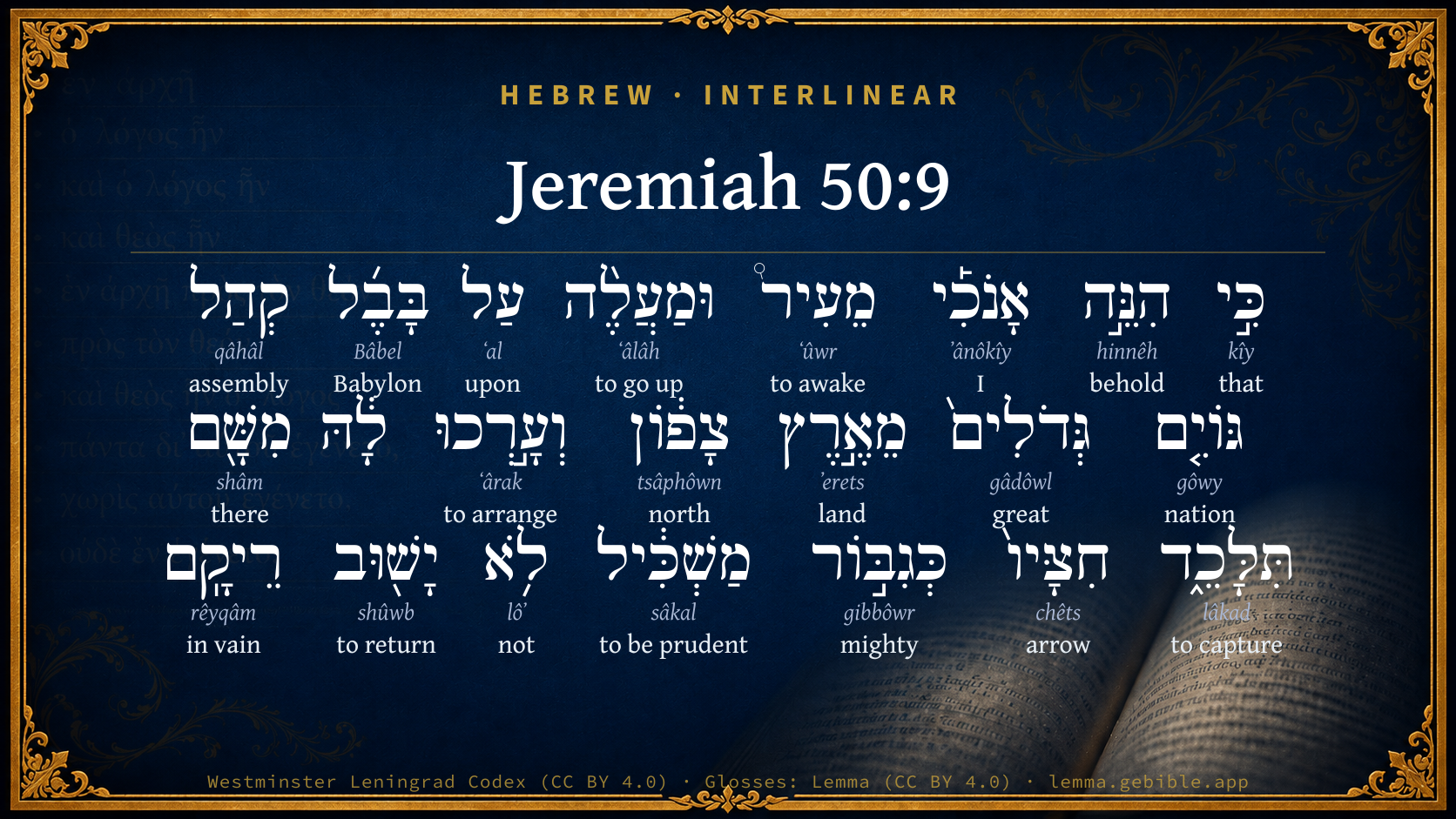
Jeremiah 50:9

Hebrew (Westminster Leningrad Codex) Jeremiah 50:9 appears in the Hebrew Old Testament. The text above is from the Westminster Leningrad Codex. Each word links to its Strong’s number, a concise gloss, and parsing drawn from the Open Scriptures Hebrew Bible morphology. Click any word for its full Brown-Driver-Briggs (BDB) entry.
Download image
Cite this verse

Jeremiah 50:9 (World English Bible). Public Domain. Lemma interlinear Bible study tool, https://lemma.gebible.app/v/jeremiah/50/9.

Show BibTeX & RIS
BibTeX
RIS
English Translation
For, behold, I will stir up and cause to come up against Babylon a company of great nations from the north country; and they shall set themselves in array against her; from there she shall be taken: their arrows shall be as of an expert mighty man; none shall return in vain.
World English Bible · Public Domain
Download a study sheet

One document with this verse’s original text, its word-by-word gloss line, the meaning frame, cross-references with their text, attributed commentary, and full source and license credits — printable, and it pastes into notes with its structure intact.

This verse Autodidact and up

Study sheet (.html) Plain text (.txt)

A passage Seminary Student

Up to 50 verses in one chapter. A passage sheet keeps up to 6 commentary sources and 12 cross-references per verse, in the order this page ranks them, and says so on the sheet whenever that leaves anything out. Ask for a single verse and you get the Autodidact verse sheet above.

Everything on this page stays free to read, with no account — the sheet is a download of what is already on screen, not access to it.

Want to remove ads? Support Godless Engineer
Compare translations 3

The same verse in 3 English versions, stacked beneath the original-language interlinear above. Click any original word for its lexicon entry.

Each is an independent rendering of the whole verse — the interlinear is not word-aligned to these translations.

Highlighted words mark where these versions differ — a whole-verse word diff, not a word-by-word alignment.

  • World English Bible Public Domain
    For, behold, I will stir up and cause to come up against Babylon a company of great nations from the north country; and they shall set themselves in array against her; from there she shall be taken: their arrows shall be as of an expert mighty man; none shall return in vain.
  • King James Version Public Domain
    For, lo, I will raise and cause to come up against Babylon an assembly of great nations from the north country: and they shall set themselves in array against her; from thence she shall be taken: their arrows shall be as of a mighty expert man; none shall return in vain.
  • unfoldingWord Literal Text CC BY-SA 4.0
    For see, I am about to set in motion and raise up a group of great nations from the north against Babylon. They will arrange themselves against her. Babylon will be captured from there. Their arrows are like a skilled warrior who does not return empty-handed.

unfoldingWord Literal Text — © unfoldingWord, licensed CC BY-SA 4.0. Word-aligned USFM3 via Door43 (git.door43.org/unfoldingWord/en_ult).

Versions to compare (up to 4)

3 of 4 selected

Show all 18 translations

Every available English version of this verse, each an independent rendering of the whole verse.

  • World English Bible Public Domain
    For, behold, I will stir up and cause to come up against Babylon a company of great nations from the north country; and they shall set themselves in array against her; from there she shall be taken: their arrows shall be as of an expert mighty man; none shall return in vain.
  • Berean Standard Bible Public Domain
    For behold, I stir up and bring against Babylon an assembly of great nations from the land of the north. They will line up against her; from the north she will be captured. Their arrows will be like skilled warriors who do not return empty-handed.
  • Majority Standard Bible Public Domain
    For behold, I stir up and bring against Babylon an assembly of great nations from the land of the north. They will line up against her; from the north she will be captured. Their arrows will be like skilled warriors who do not return empty-handed.
  • King James Version Public Domain
    For, lo, I will raise and cause to come up against Babylon an assembly of great nations from the north country: and they shall set themselves in array against her; from thence she shall be taken: their arrows shall be as of a mighty expert man; none shall return in vain.
  • American Standard Version (1901) Public Domain
    For, lo, I will stir up and cause to come up against Babylon a company of great nations from the north country; and they shall set themselves in array against her; from thence she shall be taken: their arrows shall be as of an expert mighty man; none shall return in vain.
  • Revised Version (1885) Public Domain
    For, lo, I will stir up and cause to come up against Babylon an assembly of great nations from the north country: and they shall set themselves in array against her; from thence she shall be taken: their arrows shall be as of an expert mighty man; none shall return in vain.
  • Geneva Bible (1599) Public Domain
    For loe, I will raise, and cause to come vp against Babel a multitude of mightie natios from the North countrey, and they shall set themselues in aray against her, whereby shee shall be taken: their arrowes shall be as of a strong man, which is expert, for none shall returne in vaine.
  • Douay-Rheims (1899) Public Domain
    For behold I raise up, and will bring against Babylon an assembly of great nations from the land of the north: and they shall be prepared against her, and from thence she shall be taken: their arrows, like those of a mighty man, a destroyer, shall not return in vain.
  • Young's Literal Translation Public Domain
    For, lo, I am stirring up, And am causing to come up against Babylon, An assembly of great nations from a land of the north, And they have set in array against her, From thence she is captured, Its arrow -- as a skilful hero -- returneth not empty,
  • Literal Standard Version CC BY-SA 4.0
    For behold, I am stirring up, || And am causing to come up against Babylon, || An assembly of great nations from [the] land of the north, || And they have set in array against her, || From there she is captured, || Its arrow—as a skillful hero—does not return empty,
  • Unlocked Literal Bible CC BY-SA 4.0
    For see, I am about to set in motion and raise up a group of great nations from the north against Babylon. They will arrange themselves against her. Babylon will be captured from there. Their arrows are like a skilled warrior who does not return empty-handed.
  • unfoldingWord Literal Text CC BY-SA 4.0
    For see, I am about to set in motion and raise up a group of great nations from the north against Babylon. They will arrange themselves against her. Babylon will be captured from there. Their arrows are like a skilled warrior who does not return empty-handed.
  • Darby Bible Public Domain
    For behold, I will raise and cause to come up against Babylon, an assemblage of great nations from the north country; and they shall set themselves in array against her: from thence shall she be taken. Their arrows shall be as those of a mighty expert man: none shall return empty.
  • World Messianic Bible Public Domain
    For, behold, I will stir up and cause to come up against Babylon a company of great nations from the north country; and they will set themselves in array against her. She will be taken from there. Their arrows will be as of an expert mighty man. None of them will return in vain.
  • Webster's Bible Public Domain
    For lo, I will raise and cause to come against Babylon an assembly of great nations from the north country: and they shall set themselves in array against her; from thence she shall be taken: their arrows shall be as of a mighty expert man; none shall return in vain.
  • Free Bible Version CC BY-SA 4.0
    Look! I'm assembling a coalition of strong northern nations who will come and attack Babylon. They will line up in battle against her; she will be conquered from the north. Their arrows will be like the best warriors—they don't miss!
  • Bible in Basic English Public Domain
    For see, I am moving and sending up against Babylon a band of great nations from the north country: and they will put their armies in position against her; and from there she will be taken: their arrows will be like those of an expert man of war; not one will come back without getting its mark.
  • JPS Tanakh (1917) Public Domain
    For, lo, I will stir up and cause to come up against Babylon an assembly of great nations from the north country; and they shall set themselves in array against her, from thence she shall be taken; their arrows shall be as of a mighty man that maketh childless; none shall return in vain.

Literal Standard Version (2020), Covenant Press — licensed CC BY-SA 4.0. Text via the HelloAO Bible API (eBible.org). Unlocked Literal Bible (unfoldingWord) — licensed CC BY-SA 4.0. Text via the HelloAO Bible API (eBible.org). unfoldingWord Literal Text — © unfoldingWord, licensed CC BY-SA 4.0. Word-aligned USFM3 via Door43 (git.door43.org/unfoldingWord/en_ult). Free Bible Version, Dr. Jonathan Gallagher — licensed CC BY-SA 4.0. Text via the HelloAO Bible API (eBible.org).

Word by word

More ways to search: Search by grammar → Find every occurrence → Compare this word →

Practice this passage: Drill this verse → Learn its vocabulary →

רֵיקָֽם
rêyqâm
H7387
“in vain”
Adverb
Part of Speech
Adverb
Full BDB Definition

Origin: from H7386

TWOT: 2161c

vainly, emptily - in empty condition, empty, emptily - in vain, without effect, vainly
  1. כִּ֣י kîy H3588 “that” Conjunction
  2. הִנֵּ֣ה hinnêh H2009 “behold” Particle, Demonstrative
  3. אָנֹכִ֡י ʼânôkîy H595 “I” Pronoun, Personal, 1st Person, Common, Singular
  4. מֵעִיר֩ ʻûwr H5782 “awaking” Verb, Hiphil, Participle Active, Masculine, Singular, Absolute
  5. וּמַעֲלֶ֨ה ʻâlâh H5927 “and · going up” Conjunction + Verb, Hiphil, Participle Active, Masculine, Singular, Absolute
  6. עַל ʻal H5921 “upon” Preposition
  7. בָּבֶ֜ל Bâbel H894 “Babylon” Noun, Proper
  8. קְהַל qâhâl H6951 “assembly of” Noun, Common, Masculine, Singular, Construct
  9. גּוֹיִ֤ם gôwy H1471 “nations” Noun, Common, Masculine, Plural, Absolute
  10. גְּדֹלִים֙ gâdôwl H1419 “great” Adjective, Adjective, Masculine, Plural, Absolute
  11. מֵאֶ֣רֶץ ʼerets H776 “from · land of” Preposition + Noun, Common, Both, Singular, Construct
  12. צָפ֔וֹן tsâphôwn H6828 “north” Noun, Common, Feminine, Singular, Absolute
  13. וְעָ֣רְכוּ ʻârak H6186 “and · to arrange” Conjunction + Verb, Qal, Sequential Perfect, 3rd Person, Common, Plural
  14. מִשָּׁ֖ם shâm H8033 “from · there” Preposition + Adverb
  15. תִּלָּכֵ֑ד lâkad H3920 “to capture” Verb, Niphal, Imperfect, 3rd Person, Feminine, Singular
  16. חִצָּיו֙ chêts H2671 “arrows · his” Noun, Common, Masculine, Plural, Construct + Suffix, Personal, 3rd Person, Masculine, Singular
  17. כְּגִבּ֣וֹר gibbôwr H1368 “like/as · mighty” Preposition + Adjective, Adjective, Masculine, Singular, Absolute
  18. מַשְׁכִּ֔יל sâkal H7919 “being prudent” Verb, Hiphil, Participle Active, Masculine, Singular, Absolute
  19. לֹ֥א lôʼ H3808 “not” Particle, Negative
  20. יָשׁ֖וּב shûwb H7725 “to return” Verb, Qal, Imperfect, 3rd Person, Masculine, Singular

About this verse

These counts appear in no published source. They are computed here, from the morphology-tagged text and Lemma’s own curated glosses. What Lemma adds →

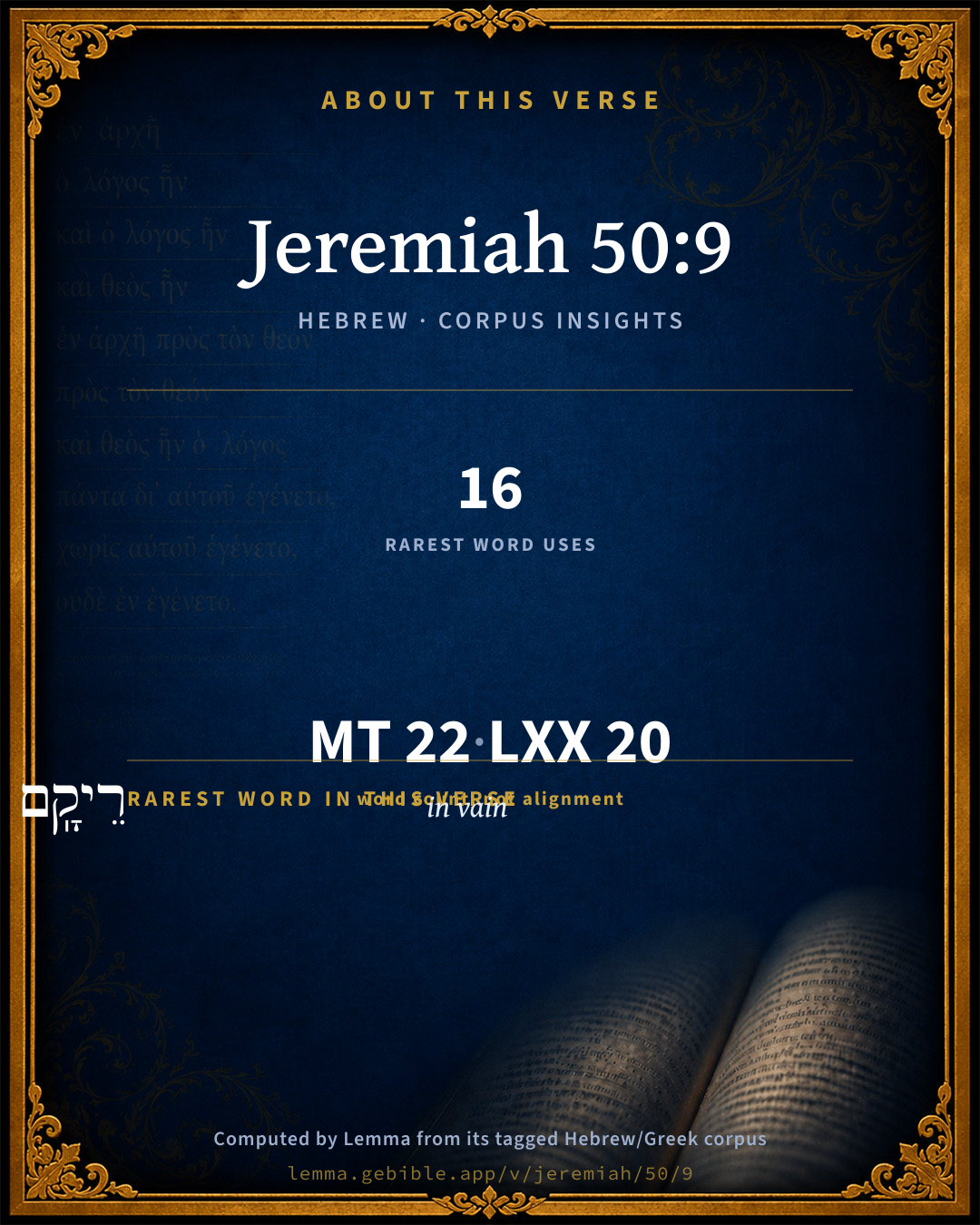
22
words
21
distinct lemmas
Prophets
section

Notable vocabulary

The rarest word here is רֵיקָֽם in vain H7387 — appearing just 16 times in the whole Hebrew Bible.

Shared distinctive vocabulary

רֵיקָֽם in vain H7387 occurs in 16 verses of the Hebrew Bible. Also found in:

Grammatical profile

  • 6 verbs
  • 6 nouns
  • 2 adjectives
  • 1 pronoun
  • 2 prepositions
  • 1 conjunction
  • 2 adverbs
  • 2 particles

Verb forms

  • מֵעִיר֩ Hiphil · Participle Active
  • וּמַעֲלֶ֨ה Hiphil · Participle Active
  • וְעָ֣רְכוּ Qal · Sequential Perfect
  • תִּלָּכֵ֑ד Niphal · Imperfect
  • מַשְׁכִּ֔יל Hiphil · Participle Active
  • יָשׁ֖וּב Qal · Imperfect

Hebrew & Septuagint length

In the original languages it is 22 Hebrew tokens and 20 Greek tokens — but the two are counted differently (Hebrew bundles its prefixes and suffixes into one token; the Greek is in lemma form), so that isn’t a like-for-like length.

Cross-references

17

Topical passages linked to Jeremiah 50:9 in the Treasury of Scripture Knowledge — connected by theme and wording, ordered by reader-vote popularity; previews shown in the World English Bible.

  • 2 Samuel 1:22 From the blood of the slain, from the fat of the mighty, The bow of Jonathan didn't turn back, The sword of Saul didn't return empty.
  • Ezra 1:1–2 Now in the first year of Cyrus king of Persia, that the word of Yahweh by the mouth of Jeremiah might be accomplished, Yahweh stirred up the spirit of Cyrus king of Persia, so that he made a proclamation throughout all his kingdom, and [put it] also in writing, saying,
  • Isaiah 13:2–5 Set up an ensign on the bare mountain, lift up the voice to them, wave the hand, that they may go into the gates of the nobles.
  • Isaiah 13:17–18 Behold, I will stir up the Medes against them, who shall not regard silver, and as for gold, they shall not delight in it.
  • Isaiah 21:2 A grievous vision is declared to me; the treacherous man deals treacherously, and the destroyer destroys. Go up, Elam; besiege, Media; all the sighing of it have I made to cease.
  • Isaiah 41:25 I have raised up one from the north, and he has come; from the rising of the sun one who calls on my name: and he shall come on rulers as on mortar, and as the potter treads clay.
  • Isaiah 45:1–4 Thus says Yahweh to his anointed, to Cyrus, whose right hand I have held, to subdue nations before him, and I will loose the loins of kings; to open the doors before him, and the gates shall not be shut:
  • Jeremiah 15:14 I will make [them] to pass with your enemies into a land which you don't know; for a fire is kindled in my anger, which shall burn on you.
  • Jeremiah 50:3 For out of the north there comes up a nation against her, which shall make her land desolate, and none shall dwell therein: they are fled, they are gone, both man and animal.
  • Jeremiah 50:14 Set yourselves in array against Babylon round about, all you who bend the bow; shoot at her, spare no arrows: for she has sinned against Yahweh.
  • Jeremiah 50:21 Go up against the land of Merathaim, even against it, and against the inhabitants of Pekod: kill and utterly destroy after them, says Yahweh, and do according to all that I have commanded you.
  • Jeremiah 50:26 Come against her from the utmost border; open her store-houses; cast her up as heaps, and destroy her utterly; let nothing of her be left.
  • Jeremiah 50:29 Call together the archers against Babylon, all those who bend the bow; encamp against her round about; let none of it escape: recompense her according to her work; according to all that she has done, do to her; for she has been proud against Yahweh, against the Holy One of Israel.
  • Jeremiah 50:41–42 Behold, a people comes from the north; and a great nation and many kings shall be stirred up from the uttermost parts of the earth.
  • Jeremiah 51:1–4 Thus says Yahweh: Behold, I will raise up against Babylon, and against those who dwell in Lebkamai, a destroying wind.
  • Jeremiah 51:11 Make sharp the arrows; hold firm the shields: Yahweh has stirred up the spirit of the kings of the Medes; because his purpose is against Babylon, to destroy it: for it is the vengeance of Yahweh, the vengeance of his temple.
  • Jeremiah 51:27–28 Set up a standard in the land, blow the trumpet among the nations, prepare the nations against her, call together against her the kingdoms of Ararat, Minni, and Ashkenaz: appoint a marshal against her; cause the horses to come up as the rough canker-worm.

Cross-references courtesy of OpenBible.info (CC BY 4.0).

Hebrew and Greek witnesses Masoretic Hebrew ↔ Greek Septuagint

The same verse in the two great witnesses to the Old Testament, shown verse-for-verse.

These are two independent witnesses, not word-aligned to each other, and the Septuagint is shown in lemma (dictionary) form.

Hebrew Jeremiah 50:9 Masoretic · Westminster Leningrad Codex

כִּ֣י הִנֵּ֣ה אָנֹכִ֡י מֵעִיר֩ וּמַעֲלֶ֨ה עַל בָּבֶ֜ל קְהַל גּוֹיִ֤ם גְּדֹלִים֙ מֵאֶ֣רֶץ צָפ֔וֹן וְעָ֣רְכוּ לָ֔הּ מִשָּׁ֖ם תִּלָּכֵ֑ד חִצָּיו֙ כְּגִבּ֣וֹר מַשְׁכִּ֔יל לֹ֥א יָשׁ֖וּב רֵיקָֽם

For, behold, I will stir up and cause to come up against Babylon a company of great nations from the north country; and they shall set themselves in array against her; from there she shall be taken: their arrows shall be as of an expert mighty man; none shall return in vain.

World English Bible · Public Domain

Greek LXX Structure differs

In the Septuagint, Jeremiah is about an eighth shorter than the Hebrew and arranges its material differently — the Oracles Against the Nations (Hebrew chapters 46–51) appear in the middle of the Greek book, after 25:13. Because the chapter and verse boundaries do not line up, a verse-for-verse comparison with the Hebrew is not shown.

A verse-for-verse comparison isn’t shown here because the chapters and verses don’t line up. Switch to the LXX edition with the MT / LXX toggle above to read the Greek directly.

On this verse, Jamieson, Fausset & Brown discusses the Septuagint’s reading. Read the note in Commentary ↓

Hebrew: Westminster Leningrad Codex (CC BY 4.0). Greek: Septuagint (public domain); English from a public-domain English Septuagint. How the Septuagint differs from the Hebrew →

Targum (Aramaic paraphrase)

1

The Targum is the ancient Jewish Aramaic paraphrase of the Hebrew Scriptures — an interpretive translation, not the Hebrew text itself. Onkelos (literal) and Pseudo-Jonathan (expansive) render the Torah, and Jonathan the Prophets. Coverage is partial: where no permissively-licensed English translation exists for a verse, only the Aramaic is shown. This is verse-level text, not a word-by-word alignment to the Hebrew.

  1. Targum Jonathan Prophets (Joshua–Malachi)
    אֲרֵי הָא אֲנָא מֵיתֵי וּמַסֵיק עַל בָּבֶל מַשִׁרְיַת עַמְמִין סַגִיאִין מֵאַרְעָא צִפּוּנָא וִיסַדְרוּן עֲלָהּ קְרָב מִתַּמָן תִּתְאֲחַד גִרְרוֹהִי כְּגִבַּר מְתַכֵּיל לָא תָיְבִין רֵיקָן:

    (no public-domain English translation for this verse)

    Targum Jonathan — Aramaic: “Mikraot Gedolot” (public domain). English: “Sefaria Community Translation” (CC0 1.0 (public-domain dedication)); “London "Chaldee Paraphrase," 1871” (public domain). Text via Sefaria.

Commentary

Notes on Jeremiah 50:9 from classic Christian and Jewish commentators (each source and its license shown beneath its notes). The classic Christian expositions comment on the surrounding passage and are grouped to its opening verse, so a note may address several verses; the Jewish commentaries on the Tanakh (Rashi and others) are per-verse, so they appear only where the commentator wrote on this verse.

Lemma curates 59 commentaries, every one of them public domain or Creative Commons licensed, each selected and text-cleaned for this edition rather than reprinted as found. About our sources →

Matthew Henry's Commentary

God is here by his prophet, as afterwards in his providence, proceeding in his controversy with Babylon. Observe,

I. The commission and charge given to the instruments that were to be employed in destroying Babylon. The army that is to do it is called an assembly of great nations (Jer 50:9), the Medes and Persians, and all their allies and auxiliaries; it is called an assembly, because regularly formed by the divine will and counsel to do this execution. God will raise them up to do it, will incline them to and fir them for this service, and then he will cause them to come up, for all their motions are under his conduct and direction: he shall give the word of command, shall order them to put themselves in array against Babylon (Jer 50:14), and then they shall put themselves in array (Jer 50:9), for what God appoints to be done shall be done; and thence she shall be quickly taken; from their first sitting down before it they shall be still gaining ground against it till it be taken. God shall bid them shoot at her and spare no arrows (Jer 50:14), and then their arrows shall be as of a mighty expert man, that has both skill and strength, a good eye and a good hand (Jer 50:9); none shall return in vain. When God gives commission he will give success. Nay, they are bidden not only to shoot at her (Jer 50:14), but to shout against her (Jer 50:15) with a triumphant shout, as those that are already sure of victory. Those whom God directs to shoot may do so with shouting, for they are sure not to miss the mark.

II. The desolation and destruction itself that shall be brought upon Babylon. This is here set forth in a great variety of expressions. 1. The wealth of Babylon shall be a rich and easy prey to the conquerors (Jer 50:10): Chaldea shall be a spoil to all her destroyers, who shall enrich themselves by plundering her, and, which is strange, all that spoil her shall be satisfied; they shall have so much that even they themselves shall say that they have enough. 2. The country of Babylon shall be depopulated and lie uninhabited: It shall be wholly desolate (Jer 50:13) to such a degree that every one who goes by shall triumph in her fall, and, instead of condoling with them, shall hiss at all her plagues, Jer 50:13. 3. Their ancestors shall be ashamed of their cowardice, in fleeing from the first onset (Jer 50:12), or, Your mother, Babylon itself, the mother-city, shall be confounded, when she sees herself deserted by those that should have been her guards. Thus the former ages of Christians may justly be confounded and ashamed to see how unlike them the latter ages are, and how wretchedly they have degenerated; and no sin brings a surer and sorer ruin upon persons, or people, than apostasy. 4. The great admirers of Babylon shall see it rendered very despicable: the last of kingdoms, the very tail of the nations, shall it be, a wilderness, a dry land, a desert, Jer 50:12. The country that was populous shall be dispeopled, that was enriched with a fertile soil shall become barren. 5. The great city, the head of it, shall be quite ruined. Her foundations have fallen, and therefore her walls are thrown down; for how can the walls stand when divine vengeance is at the door and shakes the very foundations? It is the vengeance of the Lord, which nothing can contend with either in law or battle. 6. There shall not be left in Babylon so much as the poor of the land, for vine-dressers and husbandmen, as there was in Israel (Jer 50:16): The sower shall be cut off from Babylon, and he that handles the sickle; the country shall be so emptied of people that there shall be none to till the ground and gather in the fruits of it. Harvest shall come, and there shall be no reapers; seed-time shall come, but there shall be no sower; God will do his part, but there shall be no men to do theirs. 7. All their auxiliary forces, which they have hired into their service, shall ??desert them, as mercenary men often do upon the approach of danger (Jer 50:16): For fear of the oppressing sword they shall turn every one to his people. This was threatened before concerning Egypt, Jer 46:16.

III. The procuring provoking cause of this destruction. It comes from God's displeasure; it is because of the wrath of the Lord that Babylon shall be wholly desolate (Jer 50:13), and his wrath is righteous, for (Jer 50:14) she hath sinned against the Lord, therefore spare no arrows. Note, It is sin that makes men a mark for the arrows of God's judgments. An abundance of idolatry and immorality was to be found in Babylon, yet those are not mentioned as the reason of God's displeasure against them, but the injuries they had done to the people of God, from a principle of enmity to them as his people. They have been the destroyers of God's heritage (Jer 50:11); herein indeed God made use of them for the necessary correction of his people, and yet it is laid to their charge as a heinous crime, because they designed nothing but their utter destruction. 1. What they did against Jerusalem they did with pleasure (Jer 50:11): You were glad, you rejoice. God does not afflict his people willingly, and therefore takes it very ill if the instruments he employs afflict them willingly. When Titus Vespasian destroyed Jerusalem he wept over it, but these Chaldeans triumphed over it. 2. The spoils of Jerusalem they made use of to feed their own luxury: "You have grown fat as the heifer at grass, and bellow as bulls; your having conquered Jerusalem has made you very wanton and proud, easy to yourselves and formidable to all about you, and therefore you must be a spoil." Those that have thus swallowed down riches must vomit them up again. Therefore they have given their hand (Jer 50:15); they have surrendered themselves to the conqueror, have tamely yielded so that now you may take vengeance on her, now you may make reprisals and do unto her as she hath done. 3. They aimed at nothing less than the utter ruin of God's Israel: Israel is a scattered sheep, as before (Jer 50:6), that is not only barked at and worried by dogs, but even lions, the most potent adversaries, have roared upon him and driven him away, Jer 50:17. One king of Assyria carried the ten tribes quite away and devoured them; another invaded Judah, and plundered and impoverished it, tore the fleece and flesh of this poor sheep; and now at last this Nebuchadnezzar, that is the terror and plague of all his neighbours, has taken advantage of the low condition to which he is reduced, and he has fallen upon him and broken his bones, has quite ruined him, and therefore the king of Babylon must be punished as the king of Assyria was, Jer 50:18. Note, Those who pursue and prosecute the sins of their predecessors must expect to be pursued and prosecuted by their plagues; if they do as they did, let them fare as they fared.

IV. The mercy promised to the Israel of God, which shall not only accompany, but accrue from, the destruction of Babylon. 1. God will return their captivity; they shall be released out of their bondage, and brought again to their own habitation as sheep that were scattered to their own fold Jer 50:19. They still retained a title to the land of Canaan; it is their habitation still. The discontinuance of their possession was not the destruction of their right. But now they shall recover the enjoyment of it again. 2. He will restore their prosperity; they shall not only live, but live comfortably, in their own land again; they shall feed upon Carmel and Bashan, the richest and most fruitful parts of the country. These sheep shall be gathered from the deserts to which they were dispersed, and put again into good pasture, which their soul shall be satisfied with though they shall come hungry to it, having been so long stinted, and straitened, and kept short, yet they shall find enough to satiate them and shall have hearts to be satiated with it. They enquired the way to Zion (Jer 50:5), where God was to be served and worshipped. This was what they chiefly aimed at in their return; but God will not only bring them thither, but bring them also to Carmel and Bashan, where they shall abundantly feed themselves. Note, Those that return to God and their duty shall find true satisfaction of soul in so doing; and those that seek first the kingdom of God and the righteousness thereof, that aim to make their habitation in Zion, the holy hill, shall have other things added to them, even all the comforts of Ephraim and Gilead, the fruitful hills. 3. God will pardon their iniquity; this is the root of all the rest (Jer 50:20): In those days the iniquity of Israel shall be sought for, and there shall be none. Not only the punishments of their iniquity shall be taken off, but the offence which it gave to God shall be forgotten, and he will be reconciled to them. Their sin shall be before him as if it had never been; it shall be blotted out as a cloud, crossed out as a debt, shall be cast behind his back; nay, it shall be cast into the depth of the sea, shall be no longer sealed up among God's treasures, nor in any danger of appearing again or rising up against them. This denotes how fully God forgives sin; he remembers it no more. Note, Deliverances out of trouble are then comforts indeed when they are the fruits of the forgiveness of sin, Isa 38:17. Judah and Israel were so fully forgiven when they were brought back out of Babylon that they are said to have received of the Lord's hand double for all their sins, Isa 40:2. This may include also a thorough reformation of their hearts and lives, as well as a full remission of their sins. If any seek for idols or any idolatrous customs among them, after their return, there shall be none, they shall not find them; their dross shall be purely purged away, and by that it shall appear that their guilt is so; for I will pardon those whom I reserve; I will be propitious to them (so the word is) and that must be through him who is the great propitiation. Note, Those whose sins God pardons he reserves for something very great; for whom he justifies them he glorifies.

Matthew Henry's Commentary on the Whole Bible (1708–1710) — public domain (CC PDM 1.0). Text via the HelloAO Bible API.

Trapp's Complete Commentary

John Trapp

Jer 50:9 For, lo, I will raise and cause to come up against Babylon an assembly of great nations from the north country: and they shall set themselves in array against her; from thence she shall be taken: their arrows [shall be] as of a mighty expert man; none shall return in vain.

Ver. 9. From the north country.] See on Jer 50:3.

Their arrows shall be as a mighty expert man.] Or, Of a potent prosperous man, that can hit where he pleaseth, and that without fail.

None shall return in vain.] No shaft shall, or no soldier shall miss of booty; for whereas Babylon, like a sea, had taken in the wealth of all nations, so it was meet that it should be exhausted, like as Rome was by the Goths and Vandals, and as Constantinople was by the Turks and Tartars.

John Trapp, A Commentary or Exposition upon All the Books of the Old and New Testament (1647–1656) — public domain. Text from a community e-Sword module.

Joseph Benson's Commentary

Jer 50:9-11. For, lo, I will raise against Babylon, &c. — See Jer 50:41, and Jer 51:27. From thence, or, as משׁם, may be rendered, immediately, she shall be taken. Their arrows, &c. — The Medes and Persians were famous for the use of the bow. And Chaldea shall be a spoil — To all her destroyers, who shall enrich themselves by plundering her. All that spoil her shall be satisfied — Namely, with spoil and plunder, for Chaldea, with Babylon its metropolis, was, at that time, the richest country in the world. Because ye were glad, &c. — They rejoiced at the ruin of the Jews, a sin laid also to the charge of the Edomites, Oba 1:12. Though the Chaldeans were the executioners of God’s judgments upon the Jews, yet he punished them, because they were influenced in what they did purely by their own ambition and covetousness and acted with inhumanity and cruelty toward the conquered, though Providence directed their cruelties and oppressions, to the fulfilling its own ends and purposes. In like manner, God threatens to punish the king of Assyria after he had been the executioner of his judgments upon Jerusalem. Because ye are grown fat, &c. — The insolence and rudeness of oppressors are often compared to the wantonness of full-fed cattle.

Joseph Benson's Commentary on the Old and New Testaments (1811–1818) — public domain. Text from a community e-Sword module.

Jamieson, Fausset & Brown

Robert Jamieson, A. R. Fausset & David Brown

from thence--that is, from the north country.

expert--literally, "prosperous." Besides "might," "expertness" is needed, that an arrow may do execution. The Margin has a different Hebrew reading; "destroying," literally, "bereaving, childless-making" (Jer 15:7). The Septuagint and Syriac support English Version.

In vain--without killing him at whom it was aimed (Sa2 1:22).

Jamieson, Fausset & Brown — Commentary Critical and Explanatory on the Whole Bible (1871) — public domain (CC PDM 1.0). Text via the HelloAO Bible API.

Adam Clarke's Commentary

Verse 9. An assembly of great nations] The army of Cyrus was composed of Medes, Persians, Armenians, Caducians, Sacae, c. Though all these did not come from the north yet they were arranged under the Medes, who did come from the north, in reference to Babylon.

Their arrows] They are such expert archers, that they shall never miss their mark.

Adam Clarke's Commentary on the Bible (1810–1826) — public domain. Text from a community e-Sword/MySword module.

John Calvin's Commentaries

Here, again, God declares that enemies would come and overthrow the monarchy of Babylon; but what has been before referred to is here more clearly expressed. For he says, first, that he would be the leader of that war — that the Persians and Medes would fight under his authority. I, he says (the pronoun אנכי, anki, is here emphatical,) I am he, says God, who rouse and bring, and then he adds, an, assembly of great nations The Chaldeans, as we know, had devoured many kingdoms, for Babylon had subjugated all the neighboring nations. Except, then, this had been distinctly expressed, they might have disregarded the prophetic threatenings. But Jeremiah speaks here of the assembly of great nations, lest the Chaldeans, relying on their power, the largeness of the monarchy, and the multitude of their men, should promise themselves victory, and thus lie asleep in their indulgences. God then, in these words, shortly intimates that there would be ready at hand those who in number and power would surpass the Chaldeans.

He afterwards adds, They will set in order against her. Something is to be here supplied — that they would set the battle in order. Now, by this expression, the Prophet sets forth the boldness of the Persians and Medes, as they would be immediately ready for the conflict; they would not long consult, but quickly advance to the fight. In short, he refers to the quickness and boldness of the Persians and Medes, when he says, They shall set in order against her; for they who distrust their own strength, take convenient positions, or contrive ambushes, or withdraw for a time until they know all the plans of their enemies; but the Prophet says that the Persians would by no means be such, because they would be prepared for battle at the first onset, and have the army set in order against the Babylonians.

It follows, thence taken shall be Babylon. The word משם, mesham, means from that place. But the Prophet intimates that the Persians would become conquerors by one battle only, so that the Chaldeans would no more dare to resist. We indeed know that those once put to flight, do often prepare new forces and renew the battle; this is indeed usually the case, and it seldom happens that any one is conquered in one battle. But the Prophet here declares that Babylon would be taken at one time; as soon, he says, as the fight begins, the enemies shall not only overcome, but shall by one assault take Babylon, so as to make it captive.

We now, then, perceive the design of the Prophet; but, doubtless, this prophecy was a derision to the unbelieving, for he seemed to speak of a thing impossible: thus he sang a fable to the deaf. But God, however, did not without reason predict that Babylon would be so taken, that it would, as it were, in one moment fall into the hands of enemies. We said, indeed, yesterday, that it was long besieged and taken by treachery in the night; but we also said that this prophecy is not to be confined to one period; for Babylon was often taken. It was taken through the contrivance of Zopyrus, as we said yesterday, when it thought itself sufficiently strong to resist, and Darius had nearly despaired. We shall therefore find nothing inconsistent in this prophecy, when we consider how great and how supine was the security of that people even at the time when they were suddenly overthrown.

He now adds, Its arrows as of a valiant man; some render it, as of a bereaving man, because some put the point on the right side and some on the left. The word שכל, shecal, means to act prudently, to be prosperous, and also to be bereaved. But I agree with those who take the first sense, for it immediately follows, it shall not return in vain Those who render the word “bereaved,” understand thereby that the arrows of the Persians would be deadly or fatal. But the context does not correspond, for an explanation is afterwards given, that it would not return in vain. It seems, then, that by this word Jeremiah denotes their dexterity, as though he had said that the Persians would be so skillful in throwing arrows, that they would not discharge one arrow in vain; as those who are well exercised in that art always aim directly at an enemy, and never shoot their arrows here and there without effect. So then the Prophet says that the arrows of the Persians would be those of men shooting skillfully, who know how to take a right aim. And he calls them valiant or strong; for it is not enough to send arrows straight against an enemy, except there be also nerve and strength to shoot them; for arrows might touch one, but not penetrate into his body, or hardly hurt his skin. But the Prophet refers to both these things — that arrows would be hurled with sufficient force to strike and wound the Chaldeans — and that they would also have always a direct aim, so that no one would miss its object. It afterwards follows, —

John Calvin's Commentaries (1540-1563) — public domain. Text from the Calvin Translation Society English edition (1840s-50s) via the Christian Classics Ethereal Library (ccel.org). Calvin's coverage is partial (roughly two-thirds of the Bible); uncommented books and verses are honest gaps, never fabricated. The 19th-century editor's footnotes and remarks are omitted so the notes are faithfully Calvin's own voice.

Ellicott's Commentary for English Readers

(9) An assembly of great nations from the north country.—Like all the great monarchies of the East, the Medo-Persian kingdom, which was to be the destroyer of Babylon, was made up of a congeries of many different races. Herodotus (vii. 61-69), in his account of the army of Xerxes, names twenty-two, from the Medes and Persians at the head of the list to the Arabians and Ethiopians at its close.

From thence she shall be taken.—The Hebrew adverb may be taken either of time or place. The latter, as referring to the region from which the assailants come, gives the better sense.

As of a mighty expert man.—The marginal rendering, “destroyer,” follows the Vulgate and the Targum, and represents a various reading. There is no sufficient reason for rejecting the Authorised Version, which has the support of the LXX. and the Syriac versions.

None shall return in vain.—Grammatically the words may refer either to the warrior or the arrow. The use of the same phrase in 2Sa_1:22; Isa_55:11 is perhaps in favour of the latter.

A Bible Commentary for English Readers, edited by Charles John Ellicott (1878–1897) — public domain. Text from a community e-Sword module.

The Cambridge Bible for Schools and Colleges

gen. ed. J. J. S. Perowne

9. an assembly of great nations] such as Ararat, Minni, Ashkenaz. Cp. Jer_51:27 f.

an expert mighty man] better than the mg. a mighty man that maketh childless. In the Heb. the two readings differ by the position of a dot.

none shall return] Rightly mg. that returneth not.

in vain] empty-handed, making the reference to be to the return of warriors with abundant spoil. Cp. 2Sa_1:22.

The Cambridge Bible for Schools and Colleges (gen. ed. J. J. S. Perowne; Cambridge University Press, 1878–1918) — public domain. Text from a community e-Sword module.

John Gill's Exposition

For, lo, I will raise and cause to come up against Babylon,.... The work was of the Lord; it was he that would give a commission and a command to the enemies of Babylon; that would incline them, and stir them up, to come against her; that would direct their motions and guide them thither, so that it would assuredly be; wherefore it behooves the people of God to make haste out of it:

an assembly of great nations from the north country; the Medes and Persians, with their allies and auxiliaries which came with them from the north; as also a collection of Christian nations from the north of Europe against antichrist:

and they shall set themselves in array against her; draw up their army in form of battle, or prepare and dispose their instruments of war for the siege of Babylon:

from thence shall she be taken; on the north side, from which quarter the enemy should come; or from the place where their army is drawn up in battle array; or suddenly, and at once: so Babylon was destroyed by Cyrus; and the destruction of Rome, or mystical Babylon, will be sudden and at an unawares, Rev 18:8;

their arrows shall be as of a mighty expert man; or "that bereaves" (g) women of their husbands, and parents of their children: the Medes and Persians were famous for archery, strong to draw the bow, and skilful to guide and direct the arrow. Strabo (h) says of Media major, that it sometimes furnished out thirteen thousand archers to the Elymaeans, or Persians, against the Susians and Babylonians;

none shall return in vain; not one of the arrows but shall do execution, kill a man: or "it", or "he, which" or "who, shall not return in vain" (i); the assembly of nations, or anyone of the archers or soldiers.

(g) "orbantis", Pagninus, Vatablus, Piscator. (h) Geograph. l. 11. p. 361. (i) "quae non redibit frustra", Schmidt; "quae non revertitur frustra", De Dieu; "qui non redit vacuus", Cocceius.

John Gill's Exposition of the Whole Bible (1746–1763) — public domain (CC PDM 1.0). Text via the HelloAO Bible API.

Albert Barnes' Notes on the Bible

I will raise - Or, stir up.

An assembly of great nations - The Medo-Persian empire was as much an aggregate of discordant nations as that of Babylon.

From thence - From the north, i. e., by the great nations coming thence.

Return in vain - A proverbial expression for ill success (compare Isa 55:11). Here the skillful warrior returns not empty.

Albert Barnes' Notes on the Bible (1834–1885) — public domain. Text from a community e-Sword/MySword module.

Haydock's Catholic Bible Commentary

Nations. Cyrus had Armenians, &c., in his army. (Calmet) --- Thence, by the bed of the Euphrates, the waters of which were mostly let out into the marshes. Thus the city was taken, while the people were feasting. (Herodotus i. 191.) --- Aristotle (Pol. iii. 3.) says, three days passed before all the citizens were apprised of its fate, it was so extensive: but this is incredible. If we follow the account of Berosus, Cyrus routed Nabonides, who fled to Borsippe, while he took Babylon and demolished the outer walls. (Josephus, contra Apion i.) (Calmet) --- North, with respect to Babylon. (Worthington) --- The Persians lay rather to the south, and to the east of Palestine, (Haydock) if our maps be accurate. (Calmet)

George Leo Haydock (1774–1849), Haydock's Catholic Family Bible and Commentary, 1859 edition — public domain. Excludes Psalms (Douay-Rheims chapter numbering differs from Protestant) and Deuterocanonical books (Catholic canon only).

Matthew Poole's English Annotations

He means the Medes and Persians, as it is expounded afterward.

Their arrows shall be as of a mighty expert man; none shall return in vain; I will so direct their arrows, that every arrow they shoot shall pierce one or other. Or, (as some raffler choose to interpret it,) no soldier of that assembly of great nations that shall come up against Babylon shall return without some booty or other. The reason of the different reading noted in the margin is the difference of a point in the Hebrew, which if set on the right side of the letter, the word signifieth a destroyer; if on the left side, an expert man, as we translate it.

Matthew Poole's English Annotations on the Holy Bible (1683–1685) — public domain. Text from a community e-Sword/MySword module.

Whedon's Commentary on the Bible

Daniel D. Whedon

9. I will raise — Stir up.

An assembly of great nations — A very just description of these heterogeneous oriental monarchies.

From thence — From the place where these nations come together against her.

Their arrows — Literally, his arrows, implying the union of all these peoples as one enemy.

Daniel D. Whedon (gen. ed.), Commentary on the Old and New Testaments (1874–1909) — public domain. Text from a community e-Sword module.

The Pulpit Commentary

I will raise; literally, I will stir up (or, awaken); comp. Jer_6:22 Isa_13:17. An assembly of great nations. So in a parallel prophecy, "the kingdoms of nations gathered together". (Isa_13:4) Callias in Ebers" learned story, "The Egyptian Princess," speaks of "an empire so casually heaped together, and consisting of seventy populations of different tongues and customs, as that of Persia." From thence; i.e. from the headquarters of the array of nations. As of a mighty expert man; rather, as of an expert warrior (or, mighty man). The marginal rendering of the Authorized Version represents a various reading of the Hebrew found in three old editions, and presupposed in the Targum and Vulgate, "one making childless," i.e. "a destroyer." The received reading, however, is self-evidently right. None shall return in vain. It seems doubtful whether this refers to the arrow or to the mighty man. The arrow may be said to "return or, "turn in vain" when it misses its aim or strikes the mark without piercing it; (comp. 2Sa_1:22, where, however, it is the sword which is thus spoken of) the mighty man when he retires from the field defeated. This wider use of the phrase is sanctioned Isa_55:11.

The Pulpit Commentary (1880–1919), ed. H.D.M. Spence-Jones & Joseph S. Exell — public domain. Text from a community e-Sword module.

Rashi

Rabbi Shlomo Yitzchaki (Rashi)

and they shall set themselves in array against her They shall array themselves in battle against her.

Rashi on the Tanakh — English translations: “The Judaica Press complete Tanach with Rashi, translated by A. J. Rosenberg” (CC BY 4.0); “Pentateuch with Rashi's commentary by M. Rosenbaum and A.M. Silbermann, 1929-1934” (public domain); “The Metsudah Tanach series, Lakewood, N.J” (CC BY 4.0); and “The Book of Joshua, Metsudah Publications, 1997” (CC BY 4.0). Text via Sefaria.

Lesson kit

Teaching starters — assembled from the data on this page, not authored interpretation. Every prompt links to the verse data it draws on. Edit before teaching.

Jeremiah, in the Prophets, opens this verse with 22 words (21 distinct Hebrew lemmas). Its most distinctive word is rêyqâm (“in vain”). A historical commentator’s framing appears above. Read the whole chapter for the surrounding context.

Discussion questions

  1. What does “in vain” (rêyqâm) contribute to the verse as a whole?
  2. How does Genesis 31:42, which shares the word «in vain», read alongside this verse?
  3. The translations on this page render this verse differently — a whole-verse word diff, not a word-by-word alignment. What might account for the different wordings?
  4. «מֵעִיר֩» is a Hiphil Participle Active verb. How does that grammatical form shape the action described?
  5. Compare how Matthew Henry's Commentary and Trapp's Complete Commentary read this verse. Where do they agree or differ?

Things to notice

Reading settings

Reading text

Shown beneath each verse's original-language words.

Old Testament
Old Testament edition

Read the OT as the Masoretic Hebrew (MT) or the Greek Septuagint (LXX).

English shown for the Greek Septuagint (in the Hebrew ↔ Greek comparison).

Comparing translations? Open the Compare panel on any verse page to stack up to four side by side.