
Ezekiel 26:7

Hebrew (Westminster Leningrad Codex) Ezekiel 26:7 appears in the Hebrew Old Testament. The text above is from the Westminster Leningrad Codex. Each word links to its Strong’s number, a concise gloss, and parsing drawn from the Open Scriptures Hebrew Bible morphology. Click any word for its full Brown-Driver-Briggs (BDB) entry.
Download image
Cite this verse

Ezekiel 26:7 (World English Bible). Public Domain. Lemma interlinear Bible study tool, https://lemma.gebible.app/v/ezekiel/26/7.

Show BibTeX & RIS
BibTeX
RIS
English Translation
For thus says the Lord Yahweh: Behold, I will bring on Tyre Nebuchadrezzar king of Babylon, king of kings, from the north, with horses, and with chariots, and with horsemen, and a company, and much people.
World English Bible · Public Domain
Download a study sheet

One document with this verse’s original text, its word-by-word gloss line, the meaning frame, cross-references with their text, attributed commentary, and full source and license credits — printable, and it pastes into notes with its structure intact.

This verse Autodidact and up

Study sheet (.html) Plain text (.txt)

A passage Seminary Student

Up to 50 verses in one chapter. A passage sheet keeps up to 6 commentary sources and 12 cross-references per verse, in the order this page ranks them, and says so on the sheet whenever that leaves anything out. Ask for a single verse and you get the Autodidact verse sheet above.

Everything on this page stays free to read, with no account — the sheet is a download of what is already on screen, not access to it.

Want to remove ads? Support Godless Engineer
Compare translations 3

The same verse in 3 English versions, stacked beneath the original-language interlinear above. Click any original word for its lexicon entry.

Each is an independent rendering of the whole verse — the interlinear is not word-aligned to these translations.

Highlighted words mark where these versions differ — a whole-verse word diff, not a word-by-word alignment.

  • World English Bible Public Domain
    For thus says the Lord Yahweh: Behold, I will bring on Tyre Nebuchadrezzar king of Babylon, king of kings, from the north, with horses, and with chariots, and with horsemen, and a company, and much people.
  • King James Version Public Domain
    For thus saith the Lord GOD; Behold, I will bring upon Tyrus Nebuchadrezzar king of Babylon, a king of kings, from the north, with horses, and with chariots, and with horsemen, and companies, and much people.
  • unfoldingWord Literal Text CC BY-SA 4.0
    For this is what Yahweh says: Behold, from the north I am bringing Nebuchadnezzar king of Babylon, king of kings, against Tyre, with horses and chariots, and with horsemen and a great many people.

unfoldingWord Literal Text — © unfoldingWord, licensed CC BY-SA 4.0. Word-aligned USFM3 via Door43 (git.door43.org/unfoldingWord/en_ult).

Versions to compare (up to 4)

3 of 4 selected

Show all 18 translations

Every available English version of this verse, each an independent rendering of the whole verse.

  • World English Bible Public Domain
    For thus says the Lord Yahweh: Behold, I will bring on Tyre Nebuchadrezzar king of Babylon, king of kings, from the north, with horses, and with chariots, and with horsemen, and a company, and much people.
  • Berean Standard Bible Public Domain
    For this is what the Lord GOD says: ‘Behold, I will bring against Tyre from the north Nebuchadnezzar king of Babylon, king of kings, with horses and chariots, with cavalry and a great company of troops.
  • Majority Standard Bible Public Domain
    For this is what the Lord GOD says: ‘Behold, I will bring against Tyre from the north Nebuchadnezzar king of Babylon, king of kings, with horses and chariots, with cavalry and a great company of troops.
  • King James Version Public Domain
    For thus saith the Lord GOD; Behold, I will bring upon Tyrus Nebuchadrezzar king of Babylon, a king of kings, from the north, with horses, and with chariots, and with horsemen, and companies, and much people.
  • American Standard Version (1901) Public Domain
    For thus saith the Lord Jehovah: Behold, I will bring upon Tyre Nebuchadrezzar king of Babylon, king of kings, from the north, with horses, and with chariots, and with horsemen, and a company, and much people.
  • Revised Version (1885) Public Domain
    For thus saith the Lord GOD: Behold, I will bring upon Tyre Nebuchadrezzar king of Babylon, king of kings, from the north, with horses; and with chariots, and with horsemen, and a company, and much people.
  • Geneva Bible (1599) Public Domain
    For thus sayth the Lord God, Behold, I will bring vpon Tyrus Nebuchad-nezzar King of Babel, a King of Kings from the North, with horses and with charets, and with horsemen, with a multitude and much people.
  • Douay-Rheims (1899) Public Domain
    For thus saith the Lord God: Behold I will bring against Tyre Nabuchodonosor king of Babylon, the king of kings, from the north, with horses, and chariots, and horsemen, and companies, and much people.
  • Young's Literal Translation Public Domain
    For, thus said the Lord Jehovah: Lo, I am bringing in unto Tyre Nebuchadrezzar king of Babylon, From the north -- a king of kings, With horse, and with chariot, and with horsemen, Even an assembly, and a numerous people.
  • Literal Standard Version CC BY-SA 4.0
    For thus said Lord YHWH: “Behold, I am bringing Nebuchadnezzar king of Babylon to Tyre, || From the north—a king of kings, || With horse, and with chariot, and with horsemen, || Even an assembly, and a numerous people.
  • Unlocked Literal Bible CC BY-SA 4.0
    For this is what Yahweh says: Behold, from the north I am bringing Nebuchadnezzar king of Babylon, king of kings, against Tyre, with horses and chariots, and with horsemen and a great many people.
  • unfoldingWord Literal Text CC BY-SA 4.0
    For this is what Yahweh says: Behold, from the north I am bringing Nebuchadnezzar king of Babylon, king of kings, against Tyre, with horses and chariots, and with horsemen and a great many people.
  • Darby Bible Public Domain
    For thus saith the Lord Jehovah: Behold, I will bring from the north, against Tyre, Nebuchadrezzar king of Babylon, the king of kings, with horses, and with chariots, and with horsemen, and an assemblage, and much people.
  • World Messianic Bible Public Domain
    “For the Lord GOD says: ‘Behold, I will bring on Tyre Nebuchadnezzar king of Babylon, king of kings, from the north, with horses, with chariots, with horsemen, and an army with many people.
  • Webster's Bible Public Domain
    For thus saith the Lord GOD; Behold, I will bring upon Tyre Nebuchadrezzar king of Babylon, a king of kings, from the north, with horses, and with chariots, and with horsemen, and companies, and much people.
  • Free Bible Version CC BY-SA 4.0
    For this is what the Lord God says: Watch as I bring Nebuchadnezzar, king of kings, to attack Tyre from the north. He will come with horses, chariots, cavalry, and a huge army.
  • Bible in Basic English Public Domain
    For this is what the Lord has said: See, I will send up from the north Nebuchadrezzar, king of Babylon, king of kings, against Tyre, with horses and war-carriages and with an army and great numbers of people.
  • JPS Tanakh (1917) Public Domain
    For thus saith the Lord GOD: Behold, I will bring upon Tyre Nebuchadrezzar king of Babylon, king of kings, from the north, with horses, and with chariots, and with horsemen, and a company, and much people.

Literal Standard Version (2020), Covenant Press — licensed CC BY-SA 4.0. Text via the HelloAO Bible API (eBible.org). Unlocked Literal Bible (unfoldingWord) — licensed CC BY-SA 4.0. Text via the HelloAO Bible API (eBible.org). unfoldingWord Literal Text — © unfoldingWord, licensed CC BY-SA 4.0. Word-aligned USFM3 via Door43 (git.door43.org/unfoldingWord/en_ult). Free Bible Version, Dr. Jonathan Gallagher — licensed CC BY-SA 4.0. Text via the HelloAO Bible API (eBible.org).

Word by word

More ways to search: Search by grammar → Find every occurrence → Compare this word →

Practice this passage: Drill this verse → Learn its vocabulary →

צֹ֗ר
Tsôr
H6865
“Tyre”
Noun, Proper
Part of Speech
Noun
Type
Proper
Full BDB Definition

Origin: the same as H6864

TWOT: 1965

Tyre or Tyrus = "a rock" - the Phoenician city on the Mediterranean coast
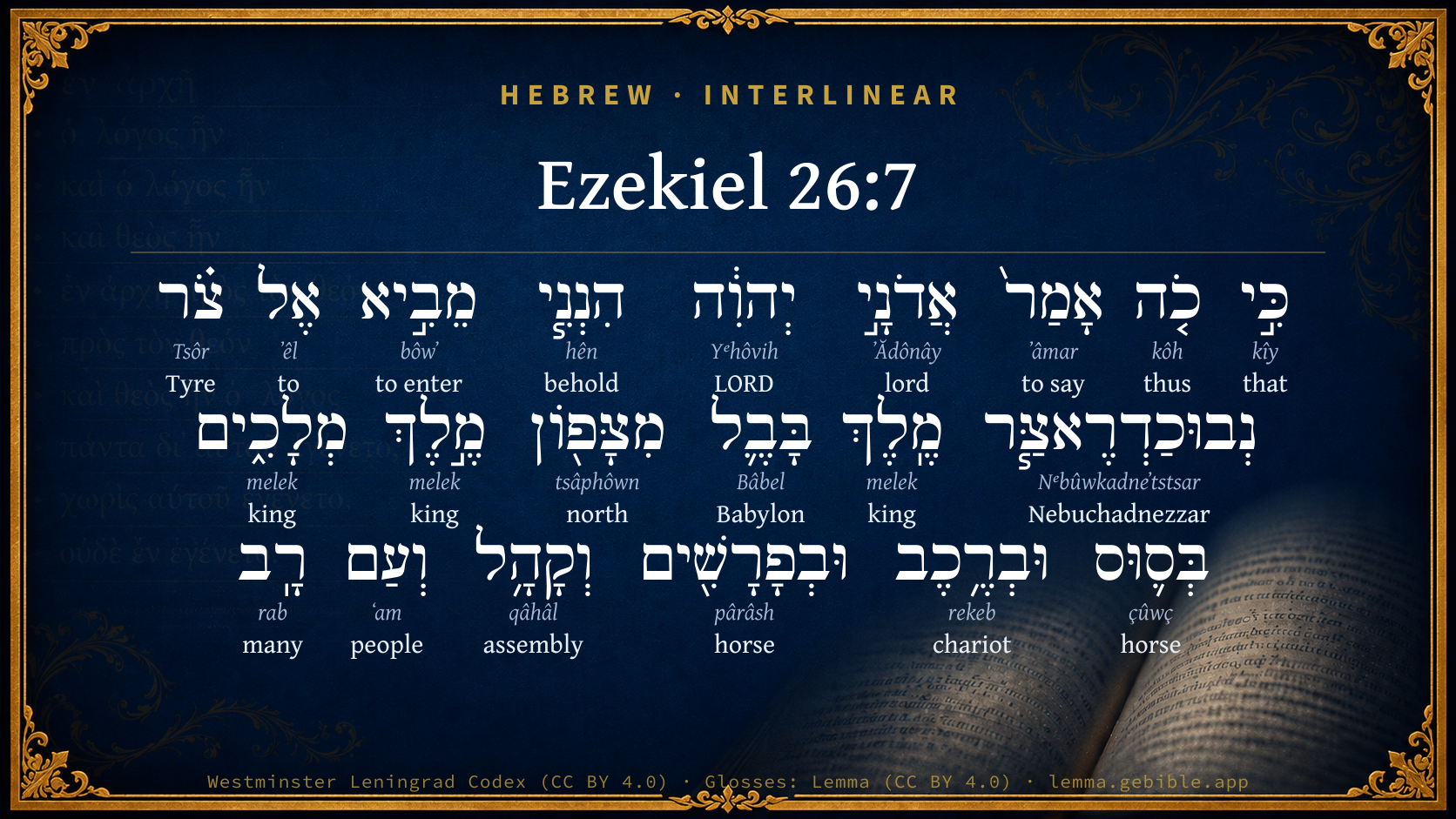
  1. כִּ֣י kîy H3588 “that” Conjunction
  2. כֹ֤ה kôh H3541 “thus” Adverb
  3. אָמַר֙ ʼâmar H559 “to say” Verb, Qal, Perfect, 3rd Person, Masculine, Singular
  4. אֲדֹנָ֣י ʼĂdônây H136 “Lord · my” Noun, Common, Masculine, Plural, Construct + Suffix, Personal, 1st Person, Common, Singular
  5. יְהוִ֔ה Yᵉhôvih H3069 “LORD” Noun, Proper
  6. הִנְנִ֧י hên H2005 “behold · me” Particle, Demonstrative + Suffix, Personal, 1st Person, Common, Singular
  7. מֵבִ֣יא bôwʼ H935 “entering” Verb, Hiphil, Participle Active, Masculine, Singular, Absolute
  8. אֶל ʼêl H413 “to” Preposition
  9. נְבוּכַדְרֶאצַּ֧ר Nᵉbûwkadneʼtstsar H5019 “Nebuchadnezzar” Noun, Proper
  10. מֶֽלֶךְ melek H4428 “king of” Noun, Common, Masculine, Singular, Construct
  11. בָּבֶ֛ל Bâbel H894 “Babylon” Noun, Proper
  12. מִצָּפ֖וֹן tsâphôwn H6828 “from · north” Preposition + Noun, Common, Feminine, Singular, Absolute
  13. מֶ֣לֶךְ melek H4428 “king of” Noun, Common, Masculine, Singular, Construct
  14. מְלָכִ֑ים melek H4428 “kings” Noun, Common, Masculine, Plural, Absolute
  15. בְּס֛וּס çûwç H5483 “in/at · horse” Preposition + Noun, Common, Masculine, Singular, Absolute
  16. וּבְרֶ֥כֶב rekeb H7393 “and · in/at · chariot” Conjunction + Preposition + Noun, Common, Masculine, Singular, Absolute
  17. וּבְפָרָשִׁ֖ים pârâsh H6571 “and · in/at · horses” Conjunction + Preposition + Noun, Common, Masculine, Plural, Absolute
  18. וְקָהָ֥ל qâhâl H6951 “and · assembly” Conjunction + Noun, Common, Masculine, Singular, Absolute
  19. וְעַם ʻam H5971 “and · people” Conjunction + Noun, Common, Masculine, Singular, Absolute
  20. רָֽב rab H7227 “many” Adjective, Adjective, Masculine, Singular, Absolute

About this verse

These counts appear in no published source. They are computed here, from the morphology-tagged text and Lemma’s own curated glosses. What Lemma adds →

21
words
19
distinct lemmas
Prophets
section

Shared distinctive vocabulary

צֹ֗ר Tyre H6865 occurs in 39 verses of the Hebrew Bible. Also found in:

Grammatical profile

  • 2 verbs
  • 14 nouns
  • 1 adjective
  • 1 preposition
  • 1 conjunction
  • 1 adverb
  • 1 particle

Verb forms

  • אָמַר֙ Qal · Perfect
  • מֵבִ֣יא Hiphil · Participle Active

Repetition

A word recurs within this verse — often emphatic in Hebrew:

  • מֶֽלֶךְ king H4428 ×3

Hebrew & Septuagint length

In English translation the verse runs 36 words from the Hebrew and 40 from the Septuagint (LXX English) — closely comparable.

A rough comparison of the two English renderings, which tokenize alike — not a word-level alignment.

Word counts can differ between the Hebrew and the Greek without any difference in meaning — e.g. the Hebrew direct-object marker אֵת has no separate Greek word, and Greek often adds the article ὁ.

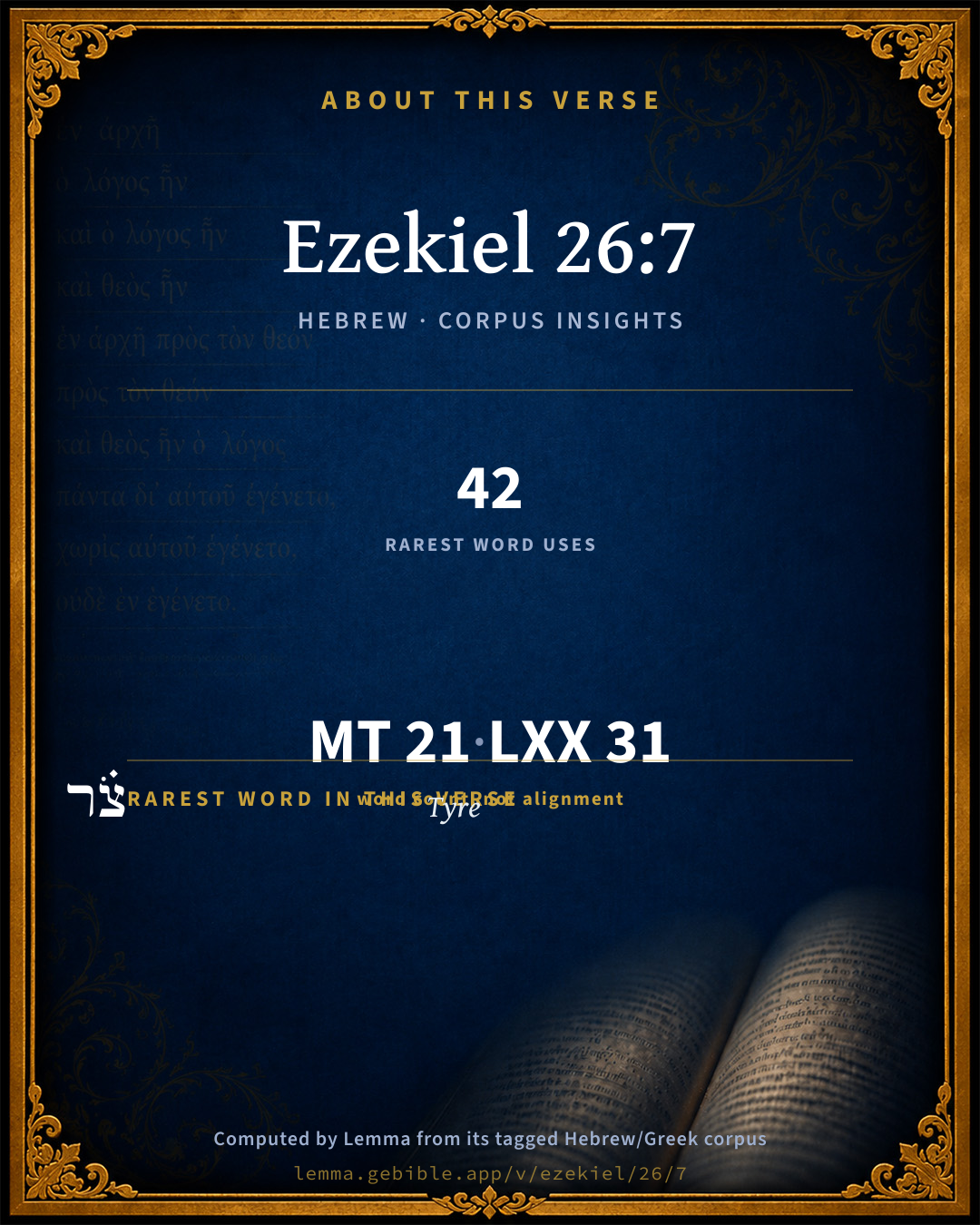
In the original languages it is 21 Hebrew tokens and 31 Greek tokens — but the two are counted differently (Hebrew bundles its prefixes and suffixes into one token; the Greek is in lemma form), so that isn’t a like-for-like length.

Cross-references

21

Topical passages linked to Ezekiel 26:7 in the Treasury of Scripture Knowledge — connected by theme and wording, ordered by reader-vote popularity; previews shown in the World English Bible.

  • Ezra 7:12 Artaxerxes, king of kings, to Ezra the priest, the scribe of the law of the God of heaven, perfect and so forth.
  • Daniel 2:37 You, O king, are king of kings, to whom the God of heaven has given the kingdom, the power, and the strength, and the glory;
  • Ezekiel 23:24 They shall come against you with weapons, chariots, and wagons, and with a company of peoples; they shall set themselves against you with buckler and shield and helmet round about; and I will commit the judgment to them, and they shall judge you according to their judgments.
  • Nahum 2:3–4 The shield of his mighty men is made red. The valiant men are in scarlet. The chariots flash with steel in the day of his preparation, and the pine spears are brandished.
  • Isaiah 10:8 For he says, Aren't my princes all of them kings?
  • Jeremiah 25:9 behold, I will send and take all the families of the north, says Yahweh, and [I will send] to Nebuchadrezzar the king of Babylon, my servant, and will bring them against this land, and against the inhabitants of it, and against all these nations round about; and I will utterly destroy them, and make them an astonishment, and a hissing, and perpetual desolations.
  • Jeremiah 52:32 and he spoke kindly to him, and set his throne above the throne of the kings who were with him in Babylon,
  • Hosea 8:10 But although they sold themselves among the nations, I will now gather them; and they begin to waste away because of the oppression of the king of mighty ones.
  • Ezekiel 32:11–12 For thus says the Lord Yahweh: The sword of the king of Babylon shall come on you.
  • Daniel 2:47 The king answered to Daniel, and said, Of a truth your God is the God of gods, and the Lord of kings, and a revealer of secrets, seeing you have been able to reveal this secret.
  • Nahum 3:2–3 The noise of the whip, the noise of the rattling of wheels, prancing horses, and bounding chariots,
  • Jeremiah 4:13 Behold, he shall come up as clouds, and his chariots [shall be] as the whirlwind: his horses are swifter than eagles. Woe to us! for we are ruined.
  • Jeremiah 6:23 They lay hold on bow and spear; they are cruel, and have no mercy; their voice roars like the sea, and they ride on horses, everyone set in array, as a man to the battle, against you, daughter of Zion.
  • Jeremiah 25:22 and all the kings of Tyre, and all the kings of Sidon, and the kings of the isle which is beyond the sea;
  • Jeremiah 27:3–6 and send them to the king of Edom, and to the king of Moab, and to the king of the children of Ammon, and to the king of Tyre, and to the king of Sidon, by the hand of the messengers who come to Jerusalem to Zedekiah king of Judah;
  • Ezekiel 17:14 that the kingdom might be base, that it might not lift itself up, but that by keeping his covenant it might stand.
  • Ezekiel 26:3 therefore thus says the Lord Yahweh, Behold, I am against you, Tyre, and will cause many nations to come up against you, as the sea causes its waves to come up.
  • Ezekiel 26:10–11 By reason of the abundance of his horses their dust shall cover you: your walls shall shake at the noise of the horsemen, and of the wagons, and of the chariots, when he shall enter into your gates, as men enter into a city in which is made a breach.
  • Ezekiel 28:7 therefore, behold, I will bring strangers on you, the terrible of the nations; and they shall draw their swords against the beauty of your wisdom, and they shall defile your brightness.
  • Ezekiel 29:18–20 Son of man, Nebuchadrezzar king of Babylon caused his army to serve a great service against Tyre: every head was made bald, and every shoulder was worn; yet had he no wages, nor his army, from Tyre, for the service that he had served against it.
  • Ezekiel 30:10–11 Thus says the Lord Yahweh: I will also make the multitude of Egypt to cease, by the hand of Nebuchadrezzar king of Babylon.

Cross-references courtesy of OpenBible.info (CC BY 4.0).

Hebrew and Greek witnesses Masoretic Hebrew ↔ Greek Septuagint

The same verse in the two great witnesses to the Old Testament, shown verse-for-verse.

These are two independent witnesses, not word-aligned to each other, and the Septuagint is shown in lemma (dictionary) form.

Hebrew Ezekiel 26:7 Masoretic · Westminster Leningrad Codex

כִּ֣י כֹ֤ה אָמַר֙ אֲדֹנָ֣י יְהוִ֔ה הִנְנִ֧י מֵבִ֣יא אֶל צֹ֗ר נְבוּכַדְרֶאצַּ֧ר מֶֽלֶךְ בָּבֶ֛ל מִצָּפ֖וֹן מֶ֣לֶךְ מְלָכִ֑ים בְּס֛וּס וּבְרֶ֥כֶב וּבְפָרָשִׁ֖ים וְקָהָ֥ל וְעַם רָֽב

For thus says the Lord Yahweh: Behold, I will bring on Tyre Nebuchadrezzar king of Babylon, king of kings, from the north, with horses, and with chariots, and with horsemen, and a company, and much people.

World English Bible · Public Domain

Greek LXX Ezekiel 26:7 Septuagint · lemma form

ὅτι ὅδε λέγω κύριος ἰδού ἐγώ ἐπιἄγω ἐπί σύ σορ ὁ ναβουχοδονοσορ βασιλεύς βαβυλών ἀπό ὁ βορέας βασιλεύς βασιλεύς εἰμί μετά ἵππος καί ἅρμα καί ἱππεύς καί συναγωγή ἔθνος πολύς σφόδρα

For thus says the Lord; Behold, I will bring up against you, O Sor, Nabuchodonosor king of Babylon from the north: he is a king of kings, with horses, and chariots, and horsemen, and a concourse of very many nations.

LXX2012 (modern English Septuagint) · Public Domain

On this verse, The Cambridge Bible for Schools and Colleges discusses the Septuagint’s reading. Read the note in Commentary ↓

Hebrew: Westminster Leningrad Codex (CC BY 4.0). Greek: Septuagint (public domain); English from LXX2012 (modern English Septuagint) (Public Domain). How the Septuagint differs from the Hebrew →

Targum (Aramaic paraphrase)

1

The Targum is the ancient Jewish Aramaic paraphrase of the Hebrew Scriptures — an interpretive translation, not the Hebrew text itself. Onkelos (literal) and Pseudo-Jonathan (expansive) render the Torah, and Jonathan the Prophets. Coverage is partial: where no permissively-licensed English translation exists for a verse, only the Aramaic is shown. This is verse-level text, not a word-by-word alignment to the Hebrew.

  1. Targum Jonathan Prophets (Joshua–Malachi)
    אֲרֵי כִדְנַן אֲמַר יְיָ אֱלֹהִים הָא אֲנָא מַיְתִי עַל צוֹר נְבוּכַדְרֶאצַר מַלְכָּא דְבָבֶל מִצִפּוּנָא מְלַךְ מַלְכַיָא בְּסוּסְוָן וּבִרְתִיכִין וּבְפָרָשִׁין וּמַשִׁרְיָן וְעַם סַגִי:

    (no public-domain English translation for this verse)

    Targum Jonathan — Aramaic: “Mikraot Gedolot” (public domain). English: “Sefaria Community Translation” (CC0 1.0 (public-domain dedication)); “London "Chaldee Paraphrase," 1871” (public domain). Text via Sefaria.

Commentary

Notes on Ezekiel 26:7 from classic Christian and Jewish commentators (each source and its license shown beneath its notes). The classic Christian expositions comment on the surrounding passage and are grouped to its opening verse, so a note may address several verses; the Jewish commentaries on the Tanakh (Rashi and others) are per-verse, so they appear only where the commentator wrote on this verse.

Lemma curates 59 commentaries, every one of them public domain or Creative Commons licensed, each selected and text-cleaned for this edition rather than reprinted as found. About our sources →

The Cambridge Bible for Schools and Colleges

gen. ed. J. J. S. Perowne

7. The correct spelling, Nebuchadrezzar (Eze_29:18, Eze_30:10), the name being Nabû-Kudurri-usur, “Nebo protect the crown!” Schrader KAT, p. 361 (on 2Ki_24:1).

a king of kings] the king. Ezr_7:12; Dan_2:37. Already the king of Assyria had said, “Are not my princes altogether kings?” Isa_10:8; Isa_36:4.

and companies, and] and a company, and. LXX. reads: company of much people (very many nations), which may be the meaning of the Heb.

7–14. Jehovah’s instrument in Tyre’s destruction, Nebuchadnezzar

The description is graphic: the advance of the assailant with his great army (Eze_26:7); the siege with the powerful train of engines (8, 9); the assault, and capture and sack of the city (10–12), which is left a joyless ruin, a naked rock in the midst of the sea, never again to be built (13, 14).

The Cambridge Bible for Schools and Colleges (gen. ed. J. J. S. Perowne; Cambridge University Press, 1878–1918) — public domain. Text from a community e-Sword module.

Trapp's Complete Commentary

John Trapp

Eze 26:7 For thus saith the Lord GOD; Behold, I will bring upon Tyrus Nebuchadrezzar king of Babylon, a king of kings, from the north, with horses, and with chariots, and with horsemen, and companies, and much people.

Ver. 7. Behold, I will bring upon Tyrus Nebuchadnezzar.] A name as dreadful then as was at any time the name of the great Turk: a man as famous for his valour and victories as ever was Hercules, saith Megasthenes in Josephus, {a} and such as whom we may well call, as Orosius doth Alexander, magnum miseriarum gurgitem, et totius Orientis atrocissimum turbinem, The great troubleworld.

{a} Antiq., lib. x. cap. 13.

John Trapp, A Commentary or Exposition upon All the Books of the Old and New Testament (1647–1656) — public domain. Text from a community e-Sword module.

Albert Barnes' Notes on the Bible

The description of the siege is that of a town invested by land.

Eze 26:7

Nebuchadrezzar - Jer 21:2 note.

Eze 26:8

Lift up the buckler - i. e., set a wall of shields, under cover of which the walls could be approached.

Eze 26:9

Engines of war - Or, his battering ram. “axes” swords. They who would break flown the towers, rush on with their swords to slay the defenders.

Eze 26:11

Garrisons - pillars, on which stood statues of some protecting god. Compare 2Ki 10:26.

Eze 26:14

The siege had been on land, but the victory was to be completed by the subjection of the island-citadel.

Albert Barnes' Notes on the Bible (1834–1885) — public domain. Text from a community e-Sword/MySword module.

The Biblical Illustrator

Joseph S. Exell

Eze_26:7-14

Behold, I will bring upon Tyrus Nebuchadrezzar King of Babylon.

The prophecy against Tyre

I. What were the grounds of her judgment. She was judged for her sins.

1. She abused the privilege of civilisation. Tyre was the most cultivated state of antiquity, invented letters, weights and measures, money, arithmetic, the art of keeping accounts. She made her painting and sculpture and architecture and music and letters, all her skill and learning and refinement, instruments of corruption.

2. Tyre abused also the privilege of commerce. The Tyrians were a nation of merchants. But there are two classes of merchants. There are those who aim to develop new countries, to introduce new crops and arts and industries, to elevate races, to make commerce the servant of God. There are others who make everything bend to gain. A prince or an entire people may thus abuse the privilege of commerce. So Tyre abused her privilege.

3. She abused the privilege of her intimate connection with the Jewish people. In the enjoyment of this distinction she stood alone. Tyre was a bulwark of Israel, covering Zion as the wing of the cherub covered the altar. In the unscrupulousness of her lust of empire and gain she broke the brotherly covenant, and when Jerusalem fell she rejoiced in her overthrow. To her unscrupulousness nothing was too sacred to be turned to profit.

II. The delay of the judgment. The method of God, sometimes, is swift retribution, as with Sodom and Gomorrah, sometimes slow, as with Tyre. She was long in filling her measure of guilt. Over two hundred years before the siege of Nebuchadnezzar, Joel prophesied against her. A few years later Amos took up the prophecy, then Isaiah in 712 B.C., Ezekiel in 590, Zechariah in 487. Yet the judgment delayed. She suffered calamities, but always rose above them. The prophecies were not literally fulfilled. The Christian era came in. Tyre still stood; Shalmaneser had besieged it; Nebuchadnezzar had invested it by sea and land for thirteen years, and conquered it; Alexander the Great, in 332 B.C., after a frightful siege of six months, had stormed, captured, and destroyed it, massacring thousands of its inhabitants, and selling thirty thousand into slavery. But after each disaster it had arisen anew, In the days of Jerome, in the fifth century, it was still standing, e city powerful and opulent. It was still flourishing eight hundred years later, in the times of the Crusades. It was the seat of a Christian bishopric. It had stood over twenty-five hundred years. The prophecies against it were nearly two thousand years old. Was the Bible, then, which had proved true in prophecies against Egypt and Nineveh, and Edom and Judah, to be found at fault here?

III. The literal fulfilment of judgment. In the year 1291 the Sultan of Egypt laid siege to the strong city of Ptolemais or Acre. Terror spread through the crusaders kingdom. Tyre shared it. Capture meant massacre and slavery. Ptolemais fell on the very day on which the evil news reached Tyre. At vespers the people in mass forsook their city. In panic and haste they embarked upon their galleys, and went out never to return. The Mahometan came. He overthrew the city. He choked one of the matchless harbours with the ruins. He cast into the sea, statues and columns and the huge stones of warehouses and palaces. He set the last fire to her splendour. He scraped the rock. Standing amid the ruins we may see the dust and ashes of her conflagration, the broken marble columns beneath the sea and scattered upon the shore, the fishers nets spread upon the rock, and feel, with every traveller who thus stands, that the last prophecy concerning her must also prove true, That shalt be built no more.

1. The fate of Tyre is a warning to those engaged in traffic. Beware of the iniquity of traffic, of the pride, the luxury, the unscrupulousness, the atheism.

2. The fate of Tyre exalts the Word of God. If we look upon its ruins simply as a record of fulfilled prophecy, they force the conviction, This is the accomplishment of the Word of God, the one thing on earth amid the vast mutations of time, as passes unceasingly the glory of the world, which is unchangeable. (Sermons by Monday Club.)

The Biblical Illustrator, edited by Joseph S. Exell (c. 1880s–1900s) — public domain. Text from a community e-Sword module.

Joseph Benson's Commentary

Eze 26:7-11. Behold, I will bring upon Tyrus Nebuchadrezzar — Josephus asserts, upon the authority of the Phenician Annals, translated by Menander, the Ephesian, into Greek, “that Nebuchadnezzar besieged Tyre thirteen years, when Ithobal was king there, and began the siege in the seventh year of Ithobal’s reign, and that he subdued Syria and all Phenicia. It further appears from the Phenician Annals, quoted by the same historian, that the Tyrians received their kings afterward from Babylon. These Annals too, as Dr. Prideaux hath clearly shown, agree exactly with Ezekiel’s account of the time and year wherein the city was taken.” — Bishop Newton. Nebuchadnezzar is here called king of kings, because he had several other kings under him as his vassals and tributaries. With horses and with chariots, &c. — With a vast army, but all land forces; for we do not find that he had any naval force, or any means of attacking the place by sea, which made his undertaking the more difficult. He shall make a fort against thee, &c. — The various operations and actions of a siege are here set forth, all which it is said Nebuchadnezzar should employ against Tyre. And in a siege of so long continuance as thirteen years, undoubtedly every method and art of annoying and injuring the city was made use of. By reason of the abundance of horses, &c. — This is a lively description of the tumult and desolation that attend a conquering army making themselves masters of a great city. When he shall enter into thy gates, as men enter, &c. — Shalmaneser, king of Assyria, had besieged Tyre, but without success: the Tyrians with a few ships had beaten his large fleet; (Josephus’s Antiq.;) but yet, it is here foretold, Nebuchadnezzar should prevail. Thy strong garrisons — Or, thy strong fortresses, or, the fortresses of thy strength, as מצבות עזןrather signifies; shall go down to the ground — Shall be entirely demolished, The LXX., however, render the clause, Την υποστασιν της ισχυος σου επι την γην καταξει, He shall bring down the station of thy strength, or, thy strong (that is, military) station to the ground. The Vulgate understands the expression of their images, or tutelary gods, rendering the words, Et statuæ nobiles in terram corruent, Thy famous statues shall fall to the ground.

Joseph Benson's Commentary on the Old and New Testaments (1811–1818) — public domain. Text from a community e-Sword module.

Fairbairn on Ezekiel, Jonah & the Pastoral Epistles

Patrick Fairbairn

Eze 26:7. For thus saith the Lord Jehovah, Behold, I am bringing against Tyre, Nebuchadnezzar, king of Babylon, from the north, a king of kings, with horses, and with chariots, and with horsemen, and a multitude, and much people.

Eze 26:8. Thy daughters in the field he shall slay with the sword, and set a watch-tower against thee, and cast up against thee a rampart, and lift up against thee the buckler.

Eze 26:9. And his enginery of Destruction (I give here what I take to be the proper meaning of the words, rather than a literal translation. מְחִי is evidently a noun from מָחָה, which, as Havernick notes, is always used in the sense of destroying, extirpating, etc.; therefore, not percussio, as many take it, but rather extirpatio, destruction. קְבֵל is anything in front of or opposition to another; hence קָבֳלּוֹ is a general designation of what the enemy was to put in hostile array against the walls of Tyre—his enginery. So that the two words together may best be rendered: his enginery of destruction, or the destruction of his enginery.) he will set against thy walls, and thy towers be will break down with his swords. (It certainly sounds rather strange to speak of breaking down towers with swords; and on this account our translators, with the greater part of commentators, substitute axes or hatchets for swords. But חֶרֶר is not elsewhere used of any warlike instrument, except the sword. In Exo 20:25, it seems to denote an iron tool for hewing stones; and perhaps the general meaning of iron or steel might, with Ewald, be adopted here: Thy towers he breaks down with his iron. It is rather against this, however, that the word is plural, and so appears to denote specific instruments. We therefore adhere to the usual meaning, swords; believing, with Hävernick, that the coupling of swords with the destruction of towers was intended to heighten the idea of the extraordinary and resistless character of the Babylonians, who, as God’s instruments of vengeance, would do with their swords what common warriors could not attempt. Compare as a like mark of the peculiar and extraordinary, though on a different account, the lines in the ode on Sir John Moore:— “We buried him darkly by dead of night, The sods with our bayonets turning.”)

Eze 26:10. By the abundance of his horses their dust shall cover thee; by the noise of his horsemen, the wheelwork, (It seems evident from the use of גַלְגַּל here, and in Eze 23:24, also Eze 10:13, that it is employed by our author not in the ordinary sense of wheels, as part of a conveyance, but for a separate conveyance or instrument of operations. He means by it some sort of wheelwork, whether as a car for riding on, or for the operations of the siege.) and chariots, thy walls shall shake when he enters into thy gates as those that enter into a city taken by breach. (Imbreached, if we had such a word, would be the exact meaning of the original here. The prophet intimates, that strong and impregnable as the fortifications of Tyre were deemed, a breach would be made in them, through which, as in other vanquished cities, the army should enter. Even Tyre’s sea-girt position, and massy walls to the water’s edge, would not be sufficient to prevent the catastrophe.)

Eze 26:11. With the hoofs of his horses he shall trample upon all thy streets, he shall slay thy people with the sword, and the pillars of thy strength he shall cast down to the ground. (I adhere to the usual meaning of מַצֵּבָה, a statue or pillar. It is no where found in the sense of garrison, as a thing that could be thrown down,—a military fort or building. It is commonly used of sacred or monumental pillars. And possibly some allusion is made here to the famous pillars in the temple of Hercules (Herod, ii. 44).)

12. And they shall spoil thy wealth, and make a prey of thy merchandise, and break down thy walls, and destroy thy pleasant houses; and thy stones, and thy wood, and thy dust they shall lay in the midst of the waters.

Eze 26:13. And I will make to cease the noise of thy songs, and the sound of thy harps shall no more be heard.

Eze 26:14. And I will render thee a bare rock, a spreading-ground for nets shalt thou be; thou shalt not be built again: for I Jehovah have spoken, saith the Lord Jehovah.

It is necessary here, first of all, to look to the part which Nebuchadnezzar was predicted to take in the punishment of Tyre; for it admits of no doubt that the prophet represents the victorious assault of that monarch as the commencement of Tyre’s degradation. But to what extent precisely do the terms of the prediction warrant us to carry the result of Nebuchadnezzar’s hostility? Does it positively ascribe to him both the capture and the complete destruction of the city? Unquestionably the capture of it, and, of course, along with that the destruction, to some extent, of its power and splendour; but not necessarily anything further. It is plainly foretold that Nebuchadnezzar and his army should enter the city by storm, spread terror and dismay among its inhabitants, and generally inflict a blow on the strength and prosperity of the state. But no one even moderately acquainted with the characteristics of the prophetic style, can be ignorant how usual it is to connect a delineation of events with some grand starting-point, as if all were to spring immediately from it, while ages, perhaps, were needed to consummate the process. Thus Isaiah, in announcing the doom of Babylon (Isaiah 13.), introduces the Medes as the instruments of her coming fall; and without a break, without an intimation of any future conquerors or any other adverse influences, goes on to paint, in the strongest terms, her utter ruin and desolation, though this end was not to be reached till many a century had revolved after the conquest by the Medes, and many a hostile element besides had played its part on the devoted city. But still it was neither mistake nor caprice to connect the result so peculiarly with the Median conquest; for that was the first link in the long chain of evil—the first deadly blow that was never to be properly healed again; it was such a beginning of sorrows as already foreboded the coming end. In like manner Jeremiah, speaking of the Philistines (with whom he also couples those of Tyre and Sidon), and foretelling the destined prostration of the country, even to a state of hopeless exhaustion, points merely to the destructive agency of the king of Babylon, as if he saw in that the fountainhead of the whole evil. How many similar examples also might be referred to of predictions entirely opposite as to their substance, but perfectly alike as to the mode of representation—predictions of good and not of evil, but which connect with a particular event (such as the birth of Christ) a long line of operations or issues which many an age should be required to develope? In all such cases, the Omniscient Spirit that animated the prophets perceived in the particular fact specified the commencement of the entire series of related events; so that from the outset he made known this as the germinant force—the sure sign and earnest of all that might otherwise be needed to accomplish the predicted result. (Cautious and reverential students of the prophetic word have in every age noted the peculiarity above referred to, though they have not always made a judicious use of it. Even Abarbinel has the following remark concerning it: morem hunc esse prophetarum, etc., “that it is the custom of the prophets in their predictions to have respect at once to a near and a remote period; so that prophecies pointing to very distant times are found amongst others which relate to the immediate future. Whence we may the more certainly conclude, that God might threaten the Tyrians with the destruction of their city, though it might be brought on at different times and by gradual advances.”)

Such, there can be no reasonable doubt, is the manner in which the prophecy respecting Tyre ought to be interpreted. The prophet distinctly announces Nebuchadnezzar as the beginner of the work of judgment, but not on that account its sole and final executor. It would have been to act against all probability, in despite of the commonest rules and lessons of experience, if he had given it forth as his conviction that one individual should extinguish the very existence of Tyre, and, as by a single stroke, reduce her from being the first commercial power in the world to the condition of a shattered fortress and a nearly unpeopled rock. Common sense alone, apart from the principles of the prophetic style, might satisfy us that such could not be the meaning of the prophet; and the change in the narration at Eze 26:12, from the individual to the general, gives no obscure intimation of the real import of the description. Up to that point it is Nebuchadnezzar who does all; he who storms the city, effects a breach in its walls, slays and subdues and triumphs. But as if what he did only served to pave the way for what was to be carried forward by many other hands, the language then becomes quite general:” And they shall spoil thy wealth, and make a prey on. thy merchandise,” etc.; in short, a progressive work of spoliation and trouble, until she becomes a helpless and a hopeless ruin.

We shall not say it is for the purpose of fastening upon the prophet a more distinct charge of error, when Hitzig alleges it as certain that the passage ascribes to Nebuchadnezzar the total destruction of Tyre,—a thing “which notoriously was not accomplished” (p. 227), but we have no hesitation in saying that such an assertion is made in palpable disregard of one of the commonest principles of prophetical interpretation. The whole that the prophet can in fairness be understood to declare is, that Nebuchadnezzar should by violent means become master of Tyre, and thus commence the process of her downfall—a process which might be delayed, but would never altogether cease till the period of her complete destruction. But the question still remains: Did the king of Babylon actually do what is here affirmed of him? Did he in truth gain possession of the city, and subject Tyre to his dominion? This is now positively denied (by Hitzig, first in his Commentary on Isaiah, Isaiah 23, and again in his Commentary on Ezekiel; also by Winer in his Real Wört., art. Tyrus); and the charge is distinctly brought against Ezekiel, of having uttered a prediction which failed in its accomplishment. Nay, Ezekiel himself is adduced as chief evidence in support of the assertion, since at Eze 29:18 he makes mention of the Divine commission to Nebuchadnezzar to go against Egypt, because “he had served a great service against Tyre, yet had he no wages for his army.” This is construed into a virtual confession that he had not taken and spoiled Tyre, but had been obliged to desist from the undertaking after the loss of much time and treasure. But it is manifestly a hasty conclusion; for the passage indicates nothing as to the result of the expedition against Tyre, excepting that it yielded no booty as a recompense adequate to the toil and labour that had been spent in it. And surely this might well have been the case, even if the expedition had been successful, considering that it lasted for the extrarordinary period of thirteen years. For how much of the available wealth of the Tyrians must have been wasted during such a protracted contest. And how likely that, before the close, they would take the precaution of securing what was left in their ships or their colonies. This is what Jerome expressly affirms to have been done; (“Quod quum viderent Tyrii jam jamque perfectum, et percussione arietum, murorum fundamenta quaterentur, quidquid pretiosum in auro, argento, vestibusque, et varia supellectili nobilitas habuit, impositum navibus ad insulas asportavit; ita ut capta urbe, nihil dignum labore suo inveniret Nebuchodonosor” (on Eze 29:18).) and it is also what we know to have happened to a very considerable extent in connection with the next great siege Tyre sustained, though it only lasted as many months as the other did years—that, namely, conducted by Alexander the Great (Quint. Cur. iv. 3; Diod. Sic. xvii. 41).

It is, therefore, to adduce that subsequent passage in Ezekiel for more than it can fairly substantiate, when it is produced as a counter testimony to the one before us; for anything that it contains, Nebuchadnezzar may have executed to the full what is here ascribed to him respecting Tyre. And this oracle is so far borne out by the evidence of collateral testimony, that both Menander of Ephesus and Philostratus report, from the Phœnician annals, a thirteen years siege of Tyre by Nebuchadnezzar (Josephus, c. Apion, i. 20; Ant. x. 11. 1). True, but then it is one thing to besiege, and another to carry the siege; these profane authors make no mention of this, and that no-mention is held as a proof by those who would fain detect some flaw in the evidence, that the city was not taken by the king of Babylon. One would have thought that, on the supposition of only selfish principles influencing the mind of Ezekiel—allowing him but a measure of common sense, to say nothing of any higher endowments—he would have cancelled that portion of his writings which had announced Nebuchadnezzar as the conqueror of Tyre if the word had palpably proved a mistaken augury. Could he possibly wish to appear before the world as a self-convicted impostor? Or, if he was so regardless himself about the character of his own consistency, how certainly would Ezra and the elders, when making up the Jewish canon, have rejected an oracle which events, still fresh in the recollection of all, had proved to be false! The supposition is every way incredible; and besides, there is not an entire want of external evidence that Nebuchadnezzar succeeded in his attempts against Tyre, for both the heathen writers above referred to, in the passages quoted by Josephus from their abstract of Phoenician affairs, represent the king of Babylon as having made himself master of all Phoenicia, which could with no propriety have been done if the principal Phoenician state had successfully withstood his assault. And it admits of no doubt that in the history of the period the Phœnician interest is presently afterwards found in a depressed condition, the hereditary monarchy of Tyre ceases, and she is first governed by a joint magistracy, then gets a king from Babylon; also during the Persian dynasty, which very soon supplanted that of Babylon, Tyre is named after Zidon, as if it had become the second in rank, and both Tyre and Zidon appear in the train of the new lords of the world as tributary states,—all plainly implying some great work of conquest going before, and compelling the proud mistress of the seas to take this inferior place. To say that the long siege of thirteen years may have so far wasted her resources as to render it politic or necessary for her to descend to such a subordinate position, is an assumption alike gratuitous and improbable, since nothing could have contributed so much to foster the pride and confirm the ascendancy of Tyre as the circumstance of having so long, if she had but successfully, defied the mighty conqueror of nations. Not her successful resistance, but only her subjection, could account for so altered a turn in her affairs. (For the proof of the facts last referred to, see the passages from Menander and Philostratus in Josephus; also Ezra, iii. 7; Herod, vii. 99, 100; viii. 67; or Movers’ Das Phönizische Alterthum, c. 11, where the matter is fully investigated. Even Gesenius, on Isaiah 23, holds it as certain that the Tyrians, if not actually overthrown, must have been brought to terms by Nebuchadnezzar, “as we see that subsequently the Tyrians sent to Babylon to fetch Merbal, one of their later kings” (referring to Jos. c. Ap. i. 21). In a matter of this kind, it is only the broader statements of history that should be brought into notice, especially as the historical fragments to be depended on are from the pen, not of contemporary writers, but of persons who lived two or more centuries after the events in question, and who merely wrote compends of history. In such a case it is unwise to urge little points, as it only gives the adversary an opportunity of pressing improbabilities or inconsistencies in the accounts relied on. Hengstenberg, and in part also Hävernick, have in this way laid themselves open, at various points, to the attacks of a sharp and unsparing writer like Hitzig, who has a quick eye for any small discrepance or mistake, but does not know often how to estimate things of greater moment. It is unwise, also, to speculate about the probable way which Nebuchadnezzar took to carry the siege of Tyre, whether by mounds, floats, or ships, or by any other means. No information has come down to us on the subject; but surely it is not to be supposed that such a monarch as Nebuchadnezzar, accustomed to such gigantic undertakings, was to conduct a thirteen years’ siege without resorting to prodigious appliances of some sort. See for proof of such in Movers, p. 446, sq.)

In regard to the future fortunes of Tyre, all is matter of well-known and ascertained history; and the result has been a remarkable verification of the words of the prophet. After the times of Nebuchadnezzar, the next great blow struck at its greatness and prosperity, was the conquest of it by Alexander, which took place about 322 years before the Christian era, and which was only gained after he had, with incredible pains, connected the mainland with the island by a mound or causeway. The stones of old Tyre were all used in the construction of this huge work of art; and so well compacted had it been from the first, that it continued ever afterwards to stand, and in the course of time has grown, by the gradual accumulations of sand, to the breadth of about half a mile. The site of Tyre, therefore, ceased from the time of Alexander to be an isolated rock, and became, what it still remains, a peninsula. It again, however, endured a long siege in the time of Antigonus, one of Alexander’s successors, but was obliged to yield at last. Still, even in New Testament times, it had not altogether lost its prosperity. It was even then a place of considerable traffic, and was known in the first centuries as the seat of a Christian bishop. Though nothing compared with what it had been in former ages, it continued to be a place of considerable importance and great strength. The Crusaders in 1124 only got possession of it after a siege of nearly five months, and were surprised at the splendour of its houses and the strength of its fortifications. Though it continued for a long period to withstand the arms of the Saracens, yet ultimately (about the beginning of the 14th century) it fell into their hands, and they appear to have soon razed its fortifications, as they did also those of Sidon and Beirût; for shortly afterwards Abulfeda speaks of it as being in a state of desolation and ruin. The travellers who in more recent times have been on the spot, have all delivered an unvarying testimony concerning it, describing it as a heap of ruins, “not so much as one entire house left, and only a few poor fishermen harbouring themselves in the vaults” (Maundrell). The growth and export of tobacco to Egypt has tended slightly to improve its condition during the present century; but the accumulation of sand in its harbours, which has rendered them too shallow for large vessels, and the more favourable position of Beirut at a short distance, prevent the hope of Tyre’s ancient glory ever returning to her. The remains of her former magnificence lie for ever buried in the deep, and she can never again be the homestead of merchant princes, but only at most the abode of fishermen and a resort for the smaller craft of traders. So surely does the word of God travel on to its accomplishment, though ages may elapse in the process, and seeming impossibilities have to be vanquished before the destined result can be reached.

Patrick Fairbairn — An Exposition of Ezekiel (1851), Jonah (1849), and The Pastoral Epistles (1874) — public domain. Text from a community e-Sword module.

Tyndale Open Study Notes

Tyndale Open Resources

26:7-11 Tyre’s projected destruction is described in great detail, conveying certainty as to the conflict’s outcome.

Tyndale Open Study Notes — © Tyndale Open Resources, licensed CC BY-SA 4.0. Text via the HelloAO Bible API.

Jamieson, Fausset & Brown

Robert Jamieson, A. R. Fausset & David Brown

from the north--the original locality of the Chaldeans; also, the direction by which they entered Palestine, taking the route of Riblah and Hamath on the Orontes, in preference to that across the desert between Babylon and Judea.

king of kings--so called because of the many kings who owned allegiance to him (Kg2 18:28). God had delegated to him the universal earth-empire which is His (Dan 2:47). The Son of God alone has the right and title inherently, and shall assume it when the world kings shall have been fully proved as abusers of the trust (Ti1 6:15; Rev 17:12-14; Rev 19:15-16). Ezekiel's prophecy was not based on conjecture from the past, for Shalmaneser, with all the might of the Assyrian empire, had failed in his siege of Tyre. Yet Nebuchadnezzar was to succeed. JOSEPHUS tells us that Nebuchadnezzar began the siege in the seventh year of Ithobal's reign, king of Tyre.

Jamieson, Fausset & Brown — Commentary Critical and Explanatory on the Whole Bible (1871) — public domain (CC PDM 1.0). Text via the HelloAO Bible API.

Adam Clarke's Commentary

Verse 7. Nebuchadrezzar - king of kings] An ancient title among those proud Asiatic despots [Arabic] shahinshah and padshah, titles still in use.

Adam Clarke's Commentary on the Bible (1810–1826) — public domain. Text from a community e-Sword/MySword module.

Ellicott's Commentary for English Readers

(7) Nebuchadrezzar.—So the name is very often written by Jeremiah and a few times by Ezekiel. It is, perhaps, a closer representation of the Nabu-kudurriuzur of the Babylonian cylinders than the form finally adopted by the Hebrews of Nebuchadnezzar.

A king of kings, from the north.—He is called a “king of kings” because of the many countries subject to his sway, whose kings were his vassals; and he is described as “from the north,” because, as often before said, it was from this direction that his armies must approach Tyre, although Babylon itself was in actual latitude to the south of Tyre.

A Bible Commentary for English Readers, edited by Charles John Ellicott (1878–1897) — public domain. Text from a community e-Sword module.

John Gill's Exposition

For thus saith the Lord God,.... What follows; and declares by name the person that should be the instrument of this ruin, and the manner in which it should be brought about:

I will bring upon Tyrus Nebuchadrezzar, king of Babylon; a prince whose name was terrible, having conquered many nations: the Lord is said to bring him against Tyre, because, he inclined his heart to steer his course this way; encouraged him to this work; led and protected his army; and, at last, gave him success: it held out thirteen years against him, and then was taken. The siege began, according to Mr. Whiston (f), A.M. 3650 or before Christ 586; and was taken A.M. 3663 or before Christ 573; according to Bishop Usher, (g), it began A.M. 3419 or before Christ 585; and was taken A.M. 3432 or before Christ 572. The Phoenician historians make mention of the siege of Tyre by Nebuchadnezzar; and Berosus speaks of his subduing the whole country of Phoenicia, in which Tyre was; with whom agree Philostratus and Megasthenes (h):

a king of kings from the north; who had many kings tributaries to him; the metropolis of whose kingdom lay somewhat, though not fully, north to Tyre:

with horses, and with chariots, and with horsemen, and companies, and much people: with a very numerous army, consisting of a large cavalry; horses being very numerous in the countries subject to him; and which he mounted his men on, both for their more easy travelling, and for their better fighting, and for the terror of their enemies.

(f) Chronological Tables, cent. 10. (g) Annales Vet. Test. A. M. 3419, 3432. (h) Apud Joseph. adv. Apien. l. 1. c. 19, 20, 21.

John Gill's Exposition of the Whole Bible (1746–1763) — public domain (CC PDM 1.0). Text via the HelloAO Bible API.

Haydock's Catholic Bible Commentary

Kings: Nabuchodonosor (4 Kings xxv. 28.) or Alexander [the Great], who took Tyre. (Menochius)

George Leo Haydock (1774–1849), Haydock's Catholic Family Bible and Commentary, 1859 edition — public domain. Excludes Psalms (Douay-Rheims chapter numbering differs from Protestant) and Deuterocanonical books (Catholic canon only).

Matthew Poole's English Annotations

I will bring: see Eze 23:46.

A king of kings; so he styled himself, according to the vaunting manner of those countries, and indeed, by the right of conquest, he was king of kings, having many tributary kings under him, and many captive kings with him in Babylon, 2Ki 18:28; Jer 52:32. From the north; so was Babylon accounted to lie, as observed, Eze 1:4, though it did not lie full north, but had some points of the north from Tyre. With horses; those Eastern kings had store of horses, and used many in their wars: see Eze 26:11.

With chariots: see Eze 23:24.

With horsemen: see Eze 23:12. And companies; an assembly of all sorts, from all parts of the large kingdom of Babylon.

And much people; a mighty army for fighting, and mighty train of hangers-on, who were ready enough to do mischief to the country, though not very fit to assist the army; if need required, these would sweep all before them wherever they came.

Matthew Poole's English Annotations on the Holy Bible (1683–1685) — public domain. Text from a community e-Sword/MySword module.

Whedon's Commentary on the Bible

Daniel D. Whedon

7. I will bring upon Tyrus Nebuchadrezzar — See Dan_2:37, and Introduction to Daniel, III, 3.

Daniel D. Whedon (gen. ed.), Commentary on the Old and New Testaments (1874–1909) — public domain. Text from a community e-Sword module.

The Pulpit Commentary

I will bring against thee, etc. There is a special emphasis of abruptness in the way in which Ezekiel brings in the name of the great Chaldean conqueror (we note, by the way, that he adopts the less common spelling of the name), of whom he speaks as "king of kings." The title is used by Daniel (2:37) of Nebuchadnezzar, and by Artaxerxes of himself, (Ezr_7:12) by Darius in the Nakshi Rustam inscription ("Records of the Past," 5:151), by Tiglatb-Pileser, with the addition of "lord of lords" (ibid., 5:8).

The mission of Nebuchadnezzar.

I GOD EMPLOYS HUMAN AGENTS. He does not shatter Tyre as he created the world, with a word. Nor does he send Michael and the hosts of heaven with flaming swords to smite the devoted city. The devastating conquests of Babylon effect his purpose. Nebuchadnezzar is his "servant.". (Jer_25:9) In the happier work of bringing salvation to a ruined world God uses human agents. God appeared incarnate in a human form. Apostles were next sent forth to proclaim the glad tidings. In the present day God uses human ministers of justice and human ministers of mercy.

II GOD EMPLOYS AS HIS AGENTS MEN WHO DO NOT KNOW HIM. This is the singular fact brought before us in relation to the use of Nebuchadnezzar as a minister of Divine judgment. The King of Babylon was a heathen monarch, who did not acknowledge the true God. (see Dan_3:15) Yet he was impressed into the Divine service. We may serve God unconsciously. It is possible to be an instrument for effecting his purposes even when we are thinking that we are resisting them. The Jews who crucified Christ were unconsciously the means of leading his work on to completion. Thus God controls men. He claims all; he uses all. For he is the God of all, though all do not own or even know him.

III GOD EMPLOYS BAD MEN AS HIS AGENTS. The worst thing about Nebuchadnezzar was not his paganism, for which he was not responsible, as he had inherited it from his ancestors; but his wickedness, his cruelty, his ambitious greed and intolerant despotism. Yet not only was this than unconsciously enlisted in the service of God. His very wrath was made to praise God, and the very exercise of his wicked disposition was just the thing that carried out the Divine purpose. The nations were chastised according to the ends of Divine justice by the unjust and wicked scourge of Nebuchadnezzar"s invasions. This wonderful fact does not solve the enigma of evil, but it helps to lighten the burden of that great mystery. We see that evil itself may be turned into a ministry of good.

IV GOD"S EMPLOYMENT OF HUMAN AGENTS IS NO JUSTIFICATION OF THEIR CONDUCT. The use of their action is no defense for it. God does not approve of Nebuchadnezzar because he seizes that cruel monarch"s plans and makes them to fall in with his own holy purposes. Nebuchadnezzar must be content to be judged by the moral character of his deeds, not by the unsuspected Divine issue of them. It is no excuse for sin that God may overrule it for good. The Jews were not exonerated from blame in rejecting Christ because this rejection was the means of the world"s redemption. We may be used by God to high ends, and then cast away as worthless souls unless we serve him consciously and do his will from our hearts.

Vers. 7-14. The besieging of Tyre.

The fate foretold for the famous city is here related, so to speak, beforehand, with singular copiousness and exactness of detail.

I THE ENEMY THE KING OF BABYLON. Tyre had many foes, but at most of them she could afford to laugh, for they had no power to carry their hostility into effect. But Nebuchadnezzar, the king of kings, was an enemy that none could despise. His power and his resources were such as to render him formidable even to the mightiest. Flushed with previous successes, confident in the irresistible force of his arms, this puissant monarch, in unconscious obedience to Divine behests, turned his sword against the proud mistress of the seas.

II THE HOSTILE ARMY AND THE APPARATUS OF WAR. Ezekiel describes, with the accuracy and minuteness of one who beheld it, the force which the King of Babylon directed against Tyre. We see the dreaded conqueror of the nations advance from the north-east "with horses, and with chariots, and with horsemen, and a company of much people." The undertaking was only possible to a power which commanded abundance of military resources, and which was able to bring up successive reinforcements, and to continue warlike operations through the changing fortunes and the long delays often incident to ancient campaigns. All that was necessary for his purpose, Nebuchadnezzar knew, before he commenced operations, that he could command.

III THE SIEGE. The several stages of this enterprise are described as by an eyewitness. First, engagements take place with the neighboring powers dependent upon and in alliance with Tyre. These are defeated, and their opposition is subdued. Then forts are constructed and a mount is raised from which the besiegers can direct their attack against the beleaguered city. Further, battering-engines are brought forward to play against the walls, and the towers are assaulted by the battle-axes of the besiegers. The dust raised by the galloping horses marks where the cavalry repel the sally from the garrison. The sights of warfare rise before the eye, its sounds salute and deafen the ear. Through long years these military maneuvers go forward with changing fortune; yet leaving the city weaker and less able, even with the open communication seawards, to sustain the siege.

IV THE ASSAULT, CONQUEST, AND SUBJUGATION. At length the fatal breach is made in the city wall, and we seem to see the victorious army rush forward to overpower the gallant but now disheartened defenders. The walls shake at the noise of the horsemen, the wagons, and the chariots, as the conquerors pour into the streets of the city. The conquering troops, mad with long-delayed success, ride over and cut down every armed man they meet, and even slay the defenseless inhabitants with the sword. The famous city, which had boasted itself invincible and impregnable, is taken and occupied by the Babylonian forces.

V THE SPOILING AND DESTRUCTION. The riches and merchandise fall a prey into the hands of the victors, who are satiated with booty. The monuments of Tyrian pride and grandeur are leveled in the dust. The fortifications are demolished, the pleasant houses, luxurious abodes of merchant-princes, are pulled down, and the stone and timber are flung into the sea. Precious goods are appropriated or wantonly destroyed. As ever in warfare, so here, the spoils go to the conquerors, Vae victis!

VI THE DESOLATION AND WASTE. In those palaces and halls were once heard the songs of joy and of love, of feasting and of mirth the strains of music vibrating from harp and lyre, and breathing from the tuneful flute. Now a mournful silence reigns, broken only by the cry of the sea-bird or the plash of the wind-smitten waves. In those harbors rode but lately the fleets laden with the commerce of the world, and Tyrian merchants gazed with pride upon their noble and richly laden argosies. Now the fisherman spreads his nets upon the deserted rocks, and looks wistfully over the forsaken roadsteads and the waste of waters where no sail curves before the wind or glitters in the sunshine. "The Lord has spoken it," and what he has said has come to pass. The Tyrian splendor and opulence were of this world, and they are no more. Sic transit gloria mundi! T.

Vers. 7-14. A miracle of foreknowledge.

False prophets discourse only in general terms and in ambiguous language. Their announcements may have the most contrary meanings. At best they are happy conjectures, fortunate guesses. But the prophecies of Scripture are like sunlight compared with such a phosphorescent flame. The clearness and fullness of these prophetic utterances can be accounted for only as a revelation from the omniscient God.

I DIVINE PREDICTIONS ARE ALWAYS RIGHTEOUS IN THEIR SUBSTANCE. The predictions of pretentious men are usually trivial the effect of a prurient curiosity. God"s revelations of the future are always concerned in the rebuke of sin and in the furtherance of righteousness. As in the manufacture of cordage in our Government arsenals a worsted thread of a distinct color runs through every yard of rope, so through all God"s dealings with men this principle of righteousness is ever prominent. What does not serve a righteous end is not of God.

II DIVINE PREDICTIONS ARE CLEAR IN THEIR ANNOUNCEMENTS. There is no ambiguity, no double meaning, here. No one is left in doubt whether the event to happen is to be favorable or unfavorable. No one is left in doubt what place or people is the subject-matter of the prophecy. In this case every circumstance is narrated with as much minuteness of detail as if it were a piece of history acted before the eye of the speaker. The place to be overthrown, its peculiar situation and structure, its former greatness and splendor, the name of the invader, all his military enginery and tactics, the steps by which he should proceed, and the extent of his triumph, are announced beforehand with a dearness and definiteness that can only come from a superhuman source. The contents of the prophecy are often so unlikely in themselves that no human foresight, however shrewd, would conceive such issues; and the fulfillment of such improbable predictions most plainly indicate the operation of a Divine mind.

III DIVINE PREDICTIONS ARE CERTAIN IN THEIR FULFILMENT. "I the Lord have spoken it, saith the Lord." The true prophet of Jehovah is modest and self-oblivious. He does not speak in his own name. He keeps himself in the background. His object is to exalt his Master and to gain homage for him. The predictions of God always take effect. For with God there is no future. He sees things distant as though they were near. Looking along the vista of ages, he perceives how every event unfolds from preceding event. The history of men and of nations is, to his eye, drawn out in long perspective. And his word is the mightiest force in the universe. He spake, and it was done;" "By the word of the Lord were the heavens made;" "By the breath of his lips shall he slay the wicked.

IV DIVINE PREDICTIONS ARE MERCIFUL IN THEIR INTENTIONS. Wherefore did God declare beforehand this coming suffering and disaster? Was it not enough to endure the calamity when the destined hour came? As the main design was to promote righteousness, this shall be done, if possible, in a way of mercy. The prediction would serve to instruct and console the Jews in captivity. It would be beneficial for them to be convinced that Jehovah ruled in all the affairs of men. If the prophecy reached the ears of the King of Babylon, it would serve a good purpose for him to know that he was a servant of the King of heaven, that his army was under the control of God, and that the success of his military expeditions depended on the good will of Jehovah. And if the prophecy should be repeated in the ears of the Tyriaus, who can tell that some among them may repent and opportunely escape from the catastrophe? To foreshadow the dread event is an act of kindness, which the humble and teachable would appreciate. D.

The Pulpit Commentary (1880–1919), ed. H.D.M. Spence-Jones & Joseph S. Exell — public domain. Text from a community e-Sword module.

Kretzmann's Popular Commentary

Paul E. Kretzmann

The Prophecy Concerning Nebuchadnezzar’s Coming

v. 7. For thus saith the Lord God, Behold, I will bring upon Tyrus Nebuchadnezzar, king of Babylon, a king of kings, a ruler excelling in power, from the north, for it was from that side that the attack would naturally be made, with horses, and with chariots, and with horsemen, and companies, and much people, both infantry and cavalry being strongly represented in his armies of conquest.

v. 8. He shall slay with the sword thy daughters in the field, quickly subduing the smaller cities tributary to Tyre; and he shall make a fort against thee, battering-towers from which the attacking troops could throw missiles into a besieged city, and cast a mount against thee, breast-works behind which trenches could be constructed, and lift up the buckler against thee, setting the infantry in array for an attack upon the city, one section of which was built on the mainland.

v. 9. And he shall set engines of war against thy walls, literally, "wall-breakers," that is, battering-rams. and with his axes he shall break down thy towers, the swords of the invaders killing the soldiers on the towers and leaving the towers of the walls unmanned, so that they could easily be torn down by the enemy.

v. 10. By reason of the abundance of his horses their dust shall cover thee, a strong picture to emphasize the immense mass of horses in the invader’s army; thy walls shall shake at the noise of the horsemen, as they move forward, galloping to the attack, and of the wheels and of the chariots when he shall enter into thy gates, after a victorious onslaught, as men enter into a city wherein is made a breach, which can no longer hold out in the siege.

v. 11. With the hoofs of his horses shall he tread down all thy streets, tramping the pavement to pieces; he shall slay thy people by the sword, and thy strong garrisons shall go down to the ground, literally, "and the pillars of thy strength shall sink to the ground," probably a reference to two monuments in the temple of Hercules and expressing the proud boast of the citizens that they could not be conquered.

v. 12. And they shall make a spoil of thy riches, the great treasures stored up in this great commercial city, and make a prey of thy merchandise, taking it away as a welcome booty; and they shall break down thy walls and destroy thy pleasant houses, the proud palaces of the merchants, Cf Isa 23:13; and they shall lay thy stones and thy timber and thy dust in the midst of the water, thus razing the city down to the very rock on which it was built.

v. 13. And I will cause the noise of thy songs, shouted in the proud consciousness of prosperity, to cease; and the sound of thy harps, as expressing the joyousness of the inhabitants, shall be no more heard, for all joy would give way to sorrow and grief.

v. 14. And I will make thee like the top of a rock, utterly bare, with not even a heap of ruins to mark the spot; thou shalt be a place to spread nets upon, the draw-nets of fishermen being stretched out there to dry. Thou shalt be built no more; for I, the Lord, have spoken it, saith the Lord God. Throughout the entire passage the overwhelming strength of the invading host is vividly pictured; for, as the instruments of Jehovah in carrying out His punishment, no one was able to withstand them.

Paul E. Kretzmann, Popular Commentary of the Bible (1921–1924) — public domain. Text from a community e-Sword module.

unfoldingWord translationNotes

Door43 World Missions Community

Connecting Statement:

Yahweh continues giving Ezekiel his message to Tyre.

Behold

"Look" or "Listen" or "Pay attention to what I am about to tell you"

Nebuchadnezzar king of Babylon, king of kings

The phrase "king of kings" was a title, meaning that he was the greatest of kings, the king that other kings obeyed. AT: "Nebuchadnezzar king of Babylon, the greatest king" (See: Assumed Knowledge and Implicit Information)

a great many people

This emphasizes the great size of Nebuchadnezzar's army.

He will kill

Here the word "He" refers to Nebuchadnezzar and is a metonym for his army. AT: "His army will kill" (See: Metonymy)

your daughters in the field

Possible meanings are 1) "your daughters" refers to the young women of Tyre who were working in the fields or 2) "your daughters" is a metonym for nearby towns and villages on the mainland that supported the main city of Tyre. See how you translated a similar phrase in Ezekiel 26:6. AT: "your daughter communities who are on the mainland" (See: Metonymy)

translationWords

Nebuchadnezzar

king

Babylon

horse

chariot

siege

unfoldingWord translationNotes — © Distant Shores Media and the Door43 World Missions Community, licensed CC BY-SA 4.0. Source: git.door43.org/Door43/en_tn.

Lesson kit

Teaching starters — assembled from the data on this page, not authored interpretation. Every prompt links to the verse data it draws on. Edit before teaching.

Ezekiel, in the Prophets, opens this verse with 21 words (19 distinct Hebrew lemmas). Its most distinctive word is Tsôr (“Tyre”). A historical commentator’s framing appears above. Read the whole chapter for the surrounding context.

Discussion questions

  1. The word Tsôr carries the sense “Tyre.” How does it shape the verse?
  2. Joshua 19:29 shares the word «Tyre» with this verse. How do the two illuminate each other?
  3. “king” occurs 3× in this one verse. What is the effect of the repetition?
  4. The translations on this page render this verse differently — a whole-verse word diff, not a word-by-word alignment. What might account for the different wordings?
  5. The verb «אָמַר֙» is Qal Perfect. How does its form color the action?
  6. Reading how The Cambridge Bible for Schools and Colleges and Trapp's Complete Commentary read this verse, where do the two commentators agree and where do they part?

Things to notice

Reading settings

Reading text

Shown beneath each verse's original-language words.

Old Testament
Old Testament edition

Read the OT as the Masoretic Hebrew (MT) or the Greek Septuagint (LXX).

English shown for the Greek Septuagint (in the Hebrew ↔ Greek comparison).

Comparing translations? Open the Compare panel on any verse page to stack up to four side by side.