
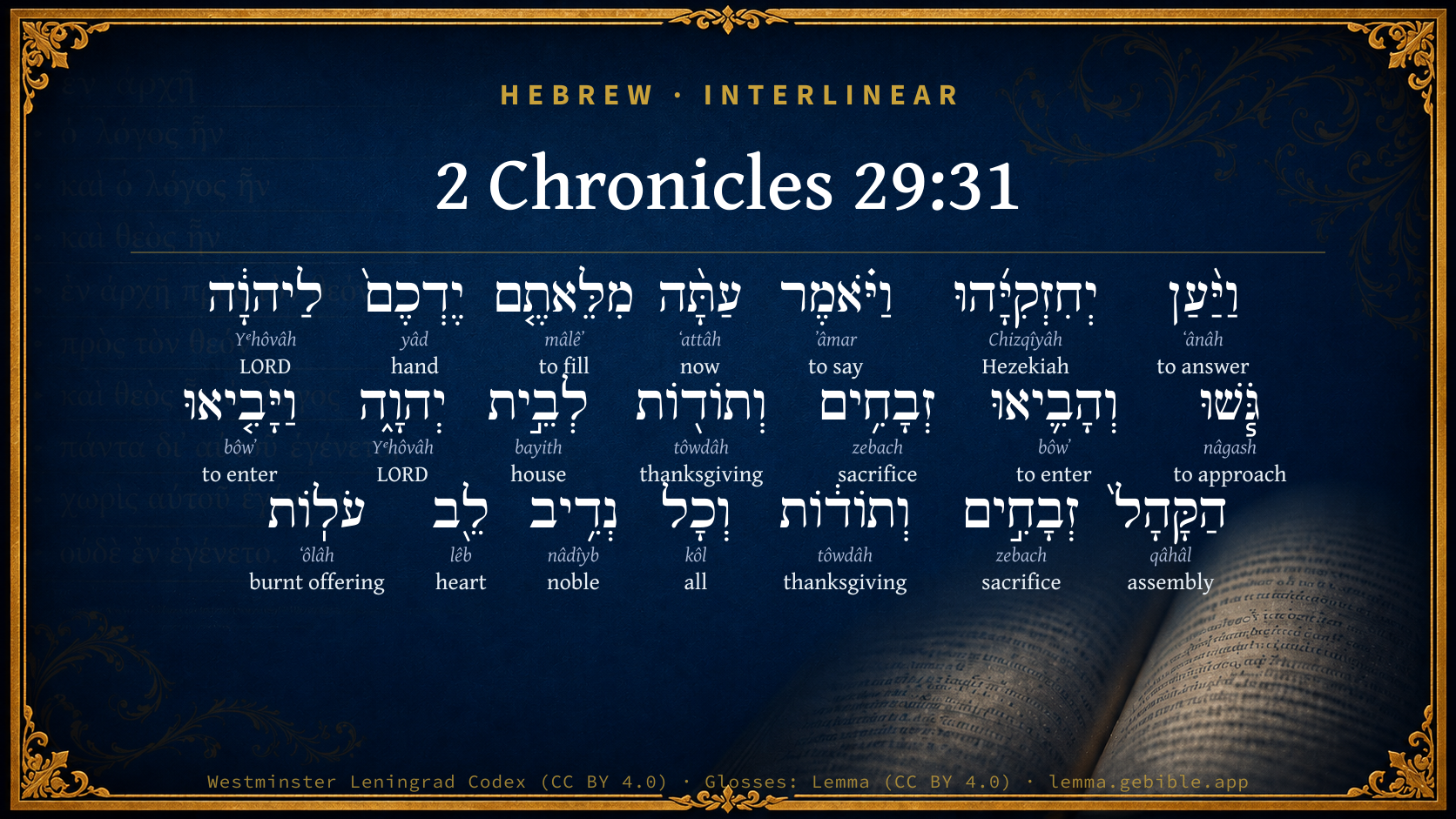
2 Chronicles 29:31

Hebrew (Westminster Leningrad Codex) 2 Chronicles 29:31 appears in the Hebrew Old Testament. The text above is from the Westminster Leningrad Codex. Each word links to its Strong’s number, a concise gloss, and parsing drawn from the Open Scriptures Hebrew Bible morphology. Click any word for its full Brown-Driver-Briggs (BDB) entry.
Download image
Cite this verse

2 Chronicles 29:31 (World English Bible). Public Domain. Lemma interlinear Bible study tool, https://lemma.gebible.app/v/2-chronicles/29/31.

Show BibTeX & RIS
BibTeX
RIS
English Translation
Then Hezekiah answered, Now you have consecrated yourselves to Yahweh; come near and bring sacrifices and thank-offerings into the house of Yahweh. The assembly brought in sacrifices and thank-offerings; and as many as were of a willing heart [brought] burnt offerings.
World English Bible · Public Domain
Download a study sheet

One document with this verse’s original text, its word-by-word gloss line, the meaning frame, cross-references with their text, attributed commentary, and full source and license credits — printable, and it pastes into notes with its structure intact.

This verse Autodidact and up

Study sheet (.html) Plain text (.txt)

A passage Seminary Student

Up to 50 verses in one chapter. A passage sheet keeps up to 6 commentary sources and 12 cross-references per verse, in the order this page ranks them, and says so on the sheet whenever that leaves anything out. Ask for a single verse and you get the Autodidact verse sheet above.

Everything on this page stays free to read, with no account — the sheet is a download of what is already on screen, not access to it.

Want to remove ads? Support Godless Engineer
Compare translations 3

The same verse in 3 English versions, stacked beneath the original-language interlinear above. Click any original word for its lexicon entry.

Each is an independent rendering of the whole verse — the interlinear is not word-aligned to these translations.

Highlighted words mark where these versions differ — a whole-verse word diff, not a word-by-word alignment.

  • World English Bible Public Domain
    Then Hezekiah answered, Now you have consecrated yourselves to Yahweh; come near and bring sacrifices and thank-offerings into the house of Yahweh. The assembly brought in sacrifices and thank-offerings; and as many as were of a willing heart [brought] burnt offerings.
  • King James Version Public Domain
    Then Hezekiah answered and said, Now ye have consecrated yourselves unto the LORD, come near and bring sacrifices and thank offerings into the house of the LORD. And the congregation brought in sacrifices and thank offerings; and as many as were of a free heart burnt offerings.
  • unfoldingWord Literal Text CC BY-SA 4.0
    And Hezekiah answered, and he said, “You yourselves have filled your hand to Yahweh. Come near and bring in sacrifices and thanksgivings to the house of Yahweh.” And the assembly brought in sacrifices and thanksgivings, and all inclined of heart, burnt offerings.

unfoldingWord Literal Text — © unfoldingWord, licensed CC BY-SA 4.0. Word-aligned USFM3 via Door43 (git.door43.org/unfoldingWord/en_ult).

Versions to compare (up to 4)

3 of 4 selected

Show all 18 translations

Every available English version of this verse, each an independent rendering of the whole verse.

  • World English Bible Public Domain
    Then Hezekiah answered, Now you have consecrated yourselves to Yahweh; come near and bring sacrifices and thank-offerings into the house of Yahweh. The assembly brought in sacrifices and thank-offerings; and as many as were of a willing heart [brought] burnt offerings.
  • Berean Standard Bible Public Domain
    Then Hezekiah said, “Now that you have consecrated yourselves to the LORD, come near and bring sacrifices and thank offerings to the house of the LORD.” So the assembly brought sacrifices and thank offerings, and all whose hearts were willing brought burnt offerings.
  • Majority Standard Bible Public Domain
    Then Hezekiah said, “Now that you have consecrated yourselves to the LORD, come near and bring sacrifices and thank offerings to the house of the LORD.” So the assembly brought sacrifices and thank offerings, and all whose hearts were willing brought burnt offerings.
  • King James Version Public Domain
    Then Hezekiah answered and said, Now ye have consecrated yourselves unto the LORD, come near and bring sacrifices and thank offerings into the house of the LORD. And the congregation brought in sacrifices and thank offerings; and as many as were of a free heart burnt offerings.
  • American Standard Version (1901) Public Domain
    Then Hezekiah answered and said, Now ye have consecrated yourselves unto Jehovah; come near and bring sacrifices and thank-offerings into the house of Jehovah. And the assembly brought in sacrifices and thank-offerings; and as many as were of a willing heart `brought' burnt-offerings.
  • Revised Version (1885) Public Domain
    Then Hezekiah answered and said, Now ye have consecrated yourselves unto the LORD, come near and bring sacrifices and thank offerings into the house of the LORD. And the congregation brought in sacrifices and thank offerings; and as many as were of a willing heart brought burnt offerings.
  • Geneva Bible (1599) Public Domain
    And Hezekiah spake, and sayde, Now ye haue consecrate your selues to the Lord: come neere and bring the sacrifices and offerings of prayse into the house of the Lord. And the Congregation brought sacrifices; and offrings of prayses, and euery man that was willing in heart, offred burnt offrings.
  • Douay-Rheims (1899) Public Domain
    And Ezechias added, and said: You have filled your hands to the Lord, come and offer victims, and praises in the house of the Lord. And all the multitude offered victims, and praises, and holocausts with a devout mind.
  • Young's Literal Translation Public Domain
    And Hezekiah answereth and saith, `Now ye have filled your hand to Jehovah, come nigh, and bring in sacrifices and thank-offerings to the house of Jehovah;' and the assembly bring in sacrifices and thank-offerings, and every willing-hearted one -- burnt-offerings.
  • Literal Standard Version CC BY-SA 4.0
    And Hezekiah answers and says, “Now you have filled your hand for YHWH, come near, and bring in sacrifices and thank-offerings to the house of YHWH”; and the assembly brings in sacrifices and thank-offerings, and every willing-hearted one—burnt-offerings.
  • Unlocked Literal Bible CC BY-SA 4.0
    Then Hezekiah said, “Now you have consecrated yourselves to Yahweh. Come here and bring sacrifices and thank offerings into the house of Yahweh.” The assembly brought sacrifices and thank offerings, and all who had a willing heart brought burnt offerings.
  • unfoldingWord Literal Text CC BY-SA 4.0
    And Hezekiah answered, and he said, “You yourselves have filled your hand to Yahweh. Come near and bring in sacrifices and thanksgivings to the house of Yahweh.” And the assembly brought in sacrifices and thanksgivings, and all inclined of heart, burnt offerings.
  • Darby Bible Public Domain
    And Hezekiah answered and said, Now ye have consecrated yourselves to Jehovah, come near and bring sacrifices and thank-offerings into the house of the Lord. And the congregation brought in sacrifices and thank-offerings; and as many as were of a willing heart, burnt-offerings.
  • World Messianic Bible Public Domain
    Then Hezekiah answered, “Now you have consecrated yourselves to the LORD. Come near and bring sacrifices and thank offerings into the LORD’s house.” The assembly brought in sacrifices and thank offerings, and as many as were of a willing heart brought burnt offerings.
  • Webster's Bible Public Domain
    Then Hezekiah answered and said, Now ye have consecrated yourselves to the LORD, come near and bring sacrifices and thank-offerings into the house of the LORD. And the congregation brought in sacrifices and thank-offerings; and, as many as were of a free heart, burnt-offerings.
  • Free Bible Version CC BY-SA 4.0
    Then Hezekiah told them, “Now that you have dedicated yourselves to the Lord, come and bring your sacrifices and thank offerings to the Lord's Temple.” So the people in the assembly brought their sacrifices and thank offerings, and everyone who wanted to brought burnt offerings.
  • Bible in Basic English Public Domain
    Then Hezekiah made answer and said, Now that you have given yourselves to the Lord, come near and take offerings and praise-offerings into the house of the Lord. So all the people took in offerings and praise-offerings: and those whose hearts were moved, took in burned offerings.
  • JPS Tanakh (1917) Public Domain
    Then Hezekiah answered and said: 'Now ye have consecrated yourselves unto the LORD, come near and bring sacrifices and thank-offerings into the house of the LORD.' And the congregation brought in sacrifices and thank-offerings; and as many as were of a willing heart brought burnt-offerings.

Literal Standard Version (2020), Covenant Press — licensed CC BY-SA 4.0. Text via the HelloAO Bible API (eBible.org). Unlocked Literal Bible (unfoldingWord) — licensed CC BY-SA 4.0. Text via the HelloAO Bible API (eBible.org). unfoldingWord Literal Text — © unfoldingWord, licensed CC BY-SA 4.0. Word-aligned USFM3 via Door43 (git.door43.org/unfoldingWord/en_ult). Free Bible Version, Dr. Jonathan Gallagher — licensed CC BY-SA 4.0. Text via the HelloAO Bible API (eBible.org).

Word by word

More ways to search: Search by grammar → Find every occurrence → Compare this word →

Practice this passage: Drill this verse → Learn its vocabulary →

נְדִ֥יב
nâdîyb
H5081
“noble of”
Adjective, Adjective, Masculine, Singular, Construct
Part of Speech
Adjective
Type
Adjective
Gender
Masculine
Number
Singular
State
Construct
Full BDB Definition

Origin: from H5068

TWOT: 1299b

inclined, willing, noble, generous (adjective) - incited, inclined, willing - noble, princely (in rank) - noble (in mind and character) - noble one (noun masculine)
  1. וַיַּ֨עַן ʻânâh H6030 “and · to answer” Conjunction + Verb, Qal, Sequential Imperfect, 3rd Person, Masculine, Singular
  2. יְחִזְקִיָּ֜הוּ Chizqîyâh H2396 “Hezekiah” Noun, Proper
  3. וַיֹּ֗אמֶר ʼâmar H559 “and · to say” Conjunction + Verb, Qal, Sequential Imperfect, 3rd Person, Masculine, Singular
  4. עַתָּ֨ה ʻattâh H6258 “now” Adverb
  5. מִלֵּאתֶ֤ם mâlêʼ H4390 “to fill” Verb, Piel, Perfect, 2nd Person, Masculine, Plural
  6. יֶדְכֶם֙ yâd H3027 “hand · your” Noun, Common, Both, Singular, Construct + Suffix, Personal, 2nd Person, Masculine, Plural
  7. לַיהוָ֔ה Yᵉhôvâh H3068 “to/for · LORD” Preposition + Noun, Proper
  8. גֹּ֧שׁוּ nâgash H5066 “approach” Verb, Qal, Imperative, 2nd Person, Masculine, Plural
  9. וְהָבִ֛יאוּ bôwʼ H935 “and · enter” Conjunction + Verb, Hiphil, Imperative, 2nd Person, Masculine, Plural
  10. זְבָחִ֥ים zebach H2077 “sacrifices” Noun, Common, Masculine, Plural, Absolute
  11. וְתוֹד֖וֹת tôwdâh H8426 “and · thanksgivings” Conjunction + Noun, Common, Feminine, Plural, Absolute
  12. לְבֵ֣ית bayith H1004 “to/for · house of” Preposition + Noun, Common, Masculine, Singular, Construct
  13. יְהוָ֑ה Yᵉhôvâh H3068 “LORD” Noun, Proper
  14. וַיָּבִ֤יאוּ bôwʼ H935 “and · to enter” Conjunction + Verb, Hiphil, Sequential Imperfect, 3rd Person, Masculine, Plural
  15. הַקָּהָל֙ qâhâl H6951 “the · assembly” Particle, Definite Article + Noun, Common, Masculine, Singular, Absolute
  16. זְבָחִ֣ים zebach H2077 “sacrifices” Noun, Common, Masculine, Plural, Absolute
  17. וְתוֹד֔וֹת tôwdâh H8426 “and · thanksgivings” Conjunction + Noun, Common, Feminine, Plural, Absolute
  18. וְכָל kôl H3605 “and · all of” Conjunction + Noun, Common, Masculine, Singular, Construct
  19. לֵ֖ב lêb H3820 “heart” Noun, Common, Masculine, Singular, Absolute
  20. עֹלֽוֹת ʻôlâh H5930 “burnt offerings” Noun, Common, Feminine, Plural, Absolute

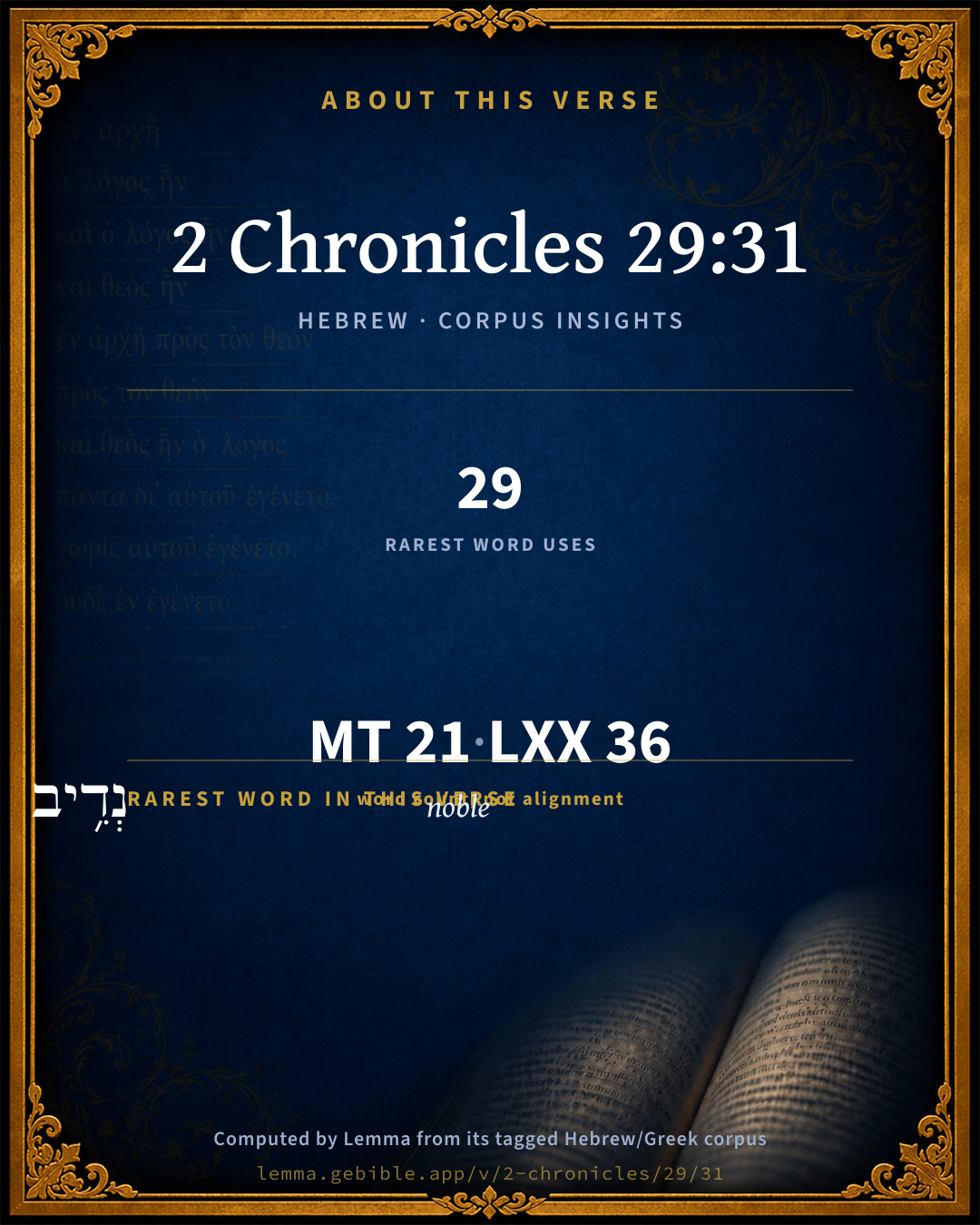
About this verse

These counts appear in no published source. They are computed here, from the morphology-tagged text and Lemma’s own curated glosses. What Lemma adds →

21
words
17
distinct lemmas
Historical
section

Shared distinctive vocabulary

נְדִ֥יב noble H5081 occurs in 26 verses of the Hebrew Bible. Also found in:

Grammatical profile

  • 6 verbs
  • 13 nouns
  • 1 adjective
  • 1 adverb

Verb forms

  • וַיַּ֨עַן Qal · Sequential Imperfect
  • וַיֹּ֗אמֶר Qal · Sequential Imperfect
  • מִלֵּאתֶ֤ם Piel · Perfect
  • גֹּ֧שׁוּ Qal · Imperative
  • וְהָבִ֛יאוּ Hiphil · Imperative
  • וַיָּבִ֤יאוּ Hiphil · Sequential Imperfect

Repetition

Words recur within this verse — often emphatic in Hebrew:

  • לַיהוָ֔ה LORD H3068 ×2
  • וְהָבִ֛יאוּ to enter H935 ×2
  • זְבָחִ֥ים sacrifice H2077 ×2
  • וְתוֹד֖וֹת thanksgiving H8426 ×2

Hebrew & Septuagint length

In English translation the verse runs 41 words from the Hebrew and 52 from the Septuagint (LXX English) — closely comparable.

A rough comparison of the two English renderings, which tokenize alike — not a word-level alignment.

Word counts can differ between the Hebrew and the Greek without any difference in meaning — e.g. the Hebrew direct-object marker אֵת has no separate Greek word, and Greek often adds the article ὁ.

In the original languages it is 21 Hebrew tokens and 36 Greek tokens — but the two are counted differently (Hebrew bundles its prefixes and suffixes into one token; the Greek is in lemma form), so that isn’t a like-for-like length.

Cross-references

7

Topical passages linked to 2 Chronicles 29:31 in the Treasury of Scripture Knowledge — connected by theme and wording, ordered by reader-vote popularity; previews shown in the World English Bible.

  • 2 Chronicles 13:9 Haven't you driven out the priests of Yahweh, the sons of Aaron, and the Levites, and made you priests after the manner of the peoples of [other] lands? so that whoever comes to consecrate himself with a young bull and seven rams, the same may be a priest of [those who are] no gods.
  • Exodus 35:22 They came, both men and women, as many as were willing-hearted, and brought brooches, ear-rings, signet-rings, and armlets, all jewels of gold; even every man who offered an offering of gold to Yahweh.
  • Exodus 35:5 'Take from among you an offering to Yahweh. Whoever is of a willing heart, let him bring it, Yahweh's offering: gold, silver, brass,
  • Leviticus 1:1–3 Yahweh called to Moses, and spoke to him out of the Tent of Meeting, saying,
  • Leviticus 7:12 If he offers it for a thanksgiving, then he shall offer with the sacrifice of thanksgiving unleavened cakes mixed with oil, and unleavened wafers anointed with oil, and cakes mixed with oil.
  • Leviticus 23:38 besides the Sabbaths of Yahweh, and besides your gifts, and besides all your vows, and besides all your freewill offerings, which you give to Yahweh.
  • Ezra 1:4 Whoever is left, in any place where he sojourns, let the men of his place help him with silver, and with gold, and with goods, and with animals, besides the freewill-offering for the house of God which is in Jerusalem.

Cross-references courtesy of OpenBible.info (CC BY 4.0).

Hebrew and Greek witnesses Masoretic Hebrew ↔ Greek Septuagint

The same verse in the two great witnesses to the Old Testament, shown verse-for-verse.

These are two independent witnesses, not word-aligned to each other, and the Septuagint is shown in lemma (dictionary) form.

Hebrew 2 Chronicles 29:31 Masoretic · Westminster Leningrad Codex

וַיַּ֨עַן יְחִזְקִיָּ֜הוּ וַיֹּ֗אמֶר עַתָּ֨ה מִלֵּאתֶ֤ם יֶדְכֶם֙ לַיהוָ֔ה גֹּ֧שׁוּ וְהָבִ֛יאוּ זְבָחִ֥ים וְתוֹד֖וֹת לְבֵ֣ית יְהוָ֑ה וַיָּבִ֤יאוּ הַקָּהָל֙ זְבָחִ֣ים וְתוֹד֔וֹת וְכָל נְדִ֥יב לֵ֖ב עֹלֽוֹת

Then Hezekiah answered, Now you have consecrated yourselves to Yahweh; come near and bring sacrifices and thank-offerings into the house of Yahweh. The assembly brought in sacrifices and thank-offerings; and as many as were of a willing heart [brought] burnt offerings.

World English Bible · Public Domain

Greek LXX 2 Chronicles 29:31 Septuagint · lemma form

καί ἀποκρίνω εζεκιας καί εἶπον νῦν πληρόω ὁ χείρ σύ κύριος προςἄγω καί φέρω θυσία καί αἴνεσις εἰς οἶκος κύριος καί ἀναφέρω ὁ ἐκκλησία θυσία καί αἴνεσις εἰς οἶκος κύριος καί πᾶς πρόθυμος ὁ καρδία ὁλοκαύτωσις

Then Ezekias answered and said, Now you⌃ have consecrated yourselves to the Lord, bring near and offer sacrifices of praise in the house of the Lord. And the congregation brought sacrifices and thank-offerings into the house of the Lord; and every one who was ready in his heart brought whole burnt offerings.

LXX2012 (modern English Septuagint) · Public Domain

Hebrew: Westminster Leningrad Codex (CC BY 4.0). Greek: Septuagint (public domain); English from LXX2012 (modern English Septuagint) (Public Domain). How the Septuagint differs from the Hebrew →

Commentary

Notes on 2 Chronicles 29:31 from classic Christian and Jewish commentators (each source and its license shown beneath its notes). The classic Christian expositions comment on the surrounding passage and are grouped to its opening verse, so a note may address several verses; the Jewish commentaries on the Tanakh (Rashi and others) are per-verse, so they appear only where the commentator wrote on this verse.

Lemma curates 59 commentaries, every one of them public domain or Creative Commons licensed, each selected and text-cleaned for this edition rather than reprinted as found. About our sources →

Ellicott's Commentary for English Readers

THE CONSECRATION COMPLETED BY ADDITIONAL SACRIFICES

(2Ch_29:31-36).

(31) Answered and said.—See 1Ch_12:17. The phrase is used as we should use it in Exo_4:1; 2Ki_7:13.

Ye have consecrated . . .—Literally, ye have filled your hand for Jehovah, a phrase used of the consecration of priests (Lev_7:37). Here it is addressed to the whole assembly, as the following words prove (unless the text be unsound). The congregation, as well as the sacerdotal order, had consecrated themselves anew to Jehovah, by their presence and participation in the previous solemnities. Others suppose that these words are spoken to the priests only, and that then the king turns to the congregation with the words “Come near,” &c. (There should be a semicolon after “the Lord.”)

Sacrifices and thank offerings (zebahîn we thôdôth).—The first word means “thank-offerings” ( = zébahîm shelamîm); the second, a peculiar species of thank-offering, apparently accompanied by a special kind of psalms called tôdôth (“thanksgivings”). “Sacrifices and thank-offerings” therefore means “sacrifices, that is, thank-offerings.” (See Lev_7:12; Lev_7:16, for the three kinds of thank-offerings.)

As many as were of a free heart.—Literally, Every free-hearted one (1Ch_29:6; 1Ch_29:9).

Burnt offerings were a token of greater self-denial and disinterestedness than thank-offerings, because they were wholly consumed on the altar, whereas the worshippers feasted upon the latter.

A Bible Commentary for English Readers, edited by Charles John Ellicott (1878–1897) — public domain. Text from a community e-Sword module.

Trapp's Complete Commentary

John Trapp

2Ch 29:31 Then Hezekiah answered and said, Now ye have consecrated yourselves unto the LORD, come near and bring sacrifices and thank offerings into the house of the LORD. And the congregation brought in sacrifices and thank offerings; and as many as were of a free heart burnt offerings.

Ver. 31. Come near, and bring sacrifices.] So unsatisfiable was his good heart in serving and praising God.

John Trapp, A Commentary or Exposition upon All the Books of the Old and New Testament (1647–1656) — public domain. Text from a community e-Sword module.

The Biblical Illustrator

Joseph S. Exell

2Ch_29:31

Now ye have consecrated yourselves unto the Lord.

Consecration

The reign of Hezekiah was like the spasmodic brightness of a candle about to go out for ever. The root principle in consecrating anything is the recognition of Gods exclusive ownership.

I. A real consecration is an act of free will.

II. Consecration means a giving to God Himself.

III. Nor will such consecration be complete without a personal consecration. (Bishop Charles E. Cheney.)

Worship and thank-offerings

I. The occasion referred to: it was the opening of the house of God.

1. This house was a sacred edifice, consecrated to God and typical of the body of Christ.

2. In the house they opened for God, they recognised a place of meeting between God and souls.

3. In the house that was opened for the worship of God, there was an inner court. Into this inner court we have now access by the Spirit unto the Father.

II. The nature of their worship. By sacrifice. There is no acceptable worship of God without sacrifice.

III. The expressions of thankfulness among the people. They were happy--

1. In the knowledge of their acceptance with God.

2. In the extension of the life of God in their souls.

3. In the revival of the worship of God among them publicly.

4. In the expression of their ardent concern to rival one another in the service of God--for they all brought their thankofferings. (Joseph Irons.)

The Biblical Illustrator, edited by Joseph S. Exell (c. 1880s–1900s) — public domain. Text from a community e-Sword module.

Joseph Benson's Commentary

2Ch 29:31. Now ye have consecrated yourselves to the Lord — Have both made an atonement, and made a covenant by sacrifice; are solemnly reconciled and engaged to him; come near and bring sacrifices — Our covenant with God must be pursued and improved in communion with him. Having consecrated ourselves in the first place to the Lord, we must bring the sacrifices of prayer, and praise, and alms, to his house. As many as were of a free heart brought burnt-offerings — Wherein there was more generosity than in the other sacrifices, because they were wholly burned and offered to God.

Joseph Benson's Commentary on the Old and New Testaments (1811–1818) — public domain. Text from a community e-Sword module.

The Pulpit Commentary

Ye have consecrated yourselves. The Hebrew text is (with the margin of both Authorized and Revised Versions), "have filled your hands to Jehovah." Our somewhat awkward and somewhat misleading reproduction in English of the Hebrew text is, nevertheless, on the whole defensible. The phrase occurs some seventeen times (Exo_28:41 Exo_29:9, Exo_29:29, Exo_29:33, 35 32:29; Lev_8:33 Lev_16:32 Lev_21:10; Num_3:3; Jud_1:17:5, 12; 1Ki_13:33; 1Ch_29:5; 2Ch_13:9; Eze_43:26) and in some of these instances is most conveniently represented by the rendering "consecrate." The plural noun or is found thirteen times, in three of which places it is spoken of "stones to be set," as e.g. "for" or "in the ephod" (Exo_25:7 Exo_35:9, Exo_35:27; 1Ch_29:2) and in the other ten, of "consecration," as e.g. "a ram of consecration," "the ram of Aaron"s consecration" (Exo_29:22, Exo_29:26, Exo_29:27, Exo_29:31, Exo_29:34; Lev_7:37 Lev_8:22, Lev_8:28, Lev_8:29, Lev_8:31, Lev_8:33) Some think our text, "Now ye have consecrated yourselves," glances at the sacrifices of a propitiatory sort, which had just been completed; others, that the reference is by anticipation to the fact that the people invited to draw near had, in an honourable, holy, and sincerely devoted way, armed themselves with worthy offerings. The sacrifices and thank offerings were sacrifices "of thank offerings," in the nature of the peace offerings. (Lev_7:11-21, Lev_7:29-36) The burnt offerings marked the "free heart," inasmuch as there was nothing of them reserved from the consuming of the altar for use. As many as were of a free heart; Hebrew, ble byrinAlkw. Among some sixty occurrences of this word, in its verb, noun, or (as hero) adjective form, perhaps the most touching and beautifully expressive is that of Psa_60:12, "Uphold me with thy free Spirit." Sacrifices; Hebrew, This is the plural of jbz a word that expresses the generic idea, as e.g. the feast of sacrifice; again, the act of slaying and sacrificing a victim; again, the victim itself; again, those kinds of sacrifices that were expiatory or eucharistic, but not holocaustic. (Lev_7:12) Thank offerings; Hebrew, twOdwOT. This word occurs about thirty-two times; in about two-thirds of that number denoting the spiritual acts of giving of thanks, even when accompanied by the figurative idea of "sacrifices", (Psa_56:13 Psa_107:22 Psa_116:17) the genuine adoring praise or thanksgiving constituting the sacrifice; and in the other third denoting strictly sacrificial offerings, as several times in Leviticus (vii. 12; 22:29) and here. Our, (2Ch_33:16 classifies these with "peace offerings" ( v) as do many other passages with "burnt offerings" generally (Jud_1:20:26 21:4; 1Sa_13:9; 2Sa_6:17; 1Ch_16:1 1Ch_21:26)

The revival of religion in Church or state.

I PREPARATORY STEPS. In order to secure such an awakening of religious life as took place in Judah under Hezekiah, three things are indispensable.

1. Confession of sin. "Our fathers have trespassed," etc. (ver. 6). As all religion begins with saying, "Father, I have sinned", (Luk_15:18) so the first symptoms of reviving life in souls that have been apathetic is acknowledgment of their trespass. (Psa_51:3)

2. Cleansing of the sanctuary. "We have cleansed all the house of the Lord" (ver. 18). As the visible Church is a temple of the Lord (Psa_132:14; Mat_18:20; Eph_2:21, Eph_2:22; 1Ti_3:15; Heb_3:6) this may symbolize the removing from its doctrine, worship, and practice of everything that is contrary to the mind and will of God as revealed in the Scriptures; and again, as the individual heart is a habitation of the living God, (1Co_6:19) it may suggest the duty, of purging... it from every known sin". (2Co_7:1)

3. Renewal of the covenant. Now it is in mine heart to make a covenant with the Lord God of Israel" (ver. 10); and the same must be done by all, whether communities or individuals, who would experience a quickening in their religious life. Unnecessary now, as in the days of Hezekiah, to offer slain victims and make propitiation for sin, that having been done once for all by Jesus Christ, (Heb_9:11-14) it is still indispensable to appropriate the reconciliation and make the self-surrender to which Hezekiah"s offerings pointed.

II CERTAIN RESULTS. A revived condition of the religious life of either Church or individual will discover itself in three things, as it did with Hezekiah and his people.

1. Self-consecration. Already expressed in the act of covenant-making, this will reveal itself in the life that proceeds therefrom. Christian individuals in the Church, recognizing themselves to be not their own, but bought with a price, will lay themselves upon the altar as a willing sacrifice. (Rom_12:1)

1. Gladness. "And all the congregation worshipped, and the singers sang," etc. (ver. 28). Joy an invariable accompaniment of a revived condition of

2. religion in the soul or in the Church (Psa_149:2, Psa_149:5; Isa_65:14; Hab_3:18; Eph_5:18; 1Jn_1:4)

3. Liberality. "And the congregation brought in sacrifices," etc. (ver. 31). Generosity in giving almost necessarily follows on a heightened experience of Divine grace. "Freely ye have received, freely give. W.

The Pulpit Commentary (1880–1919), ed. H.D.M. Spence-Jones & Joseph S. Exell — public domain. Text from a community e-Sword module.

Tyndale Open Study Notes

Tyndale Open Resources

29:31-36 The purification and rededication of the Temple was followed by individual offerings and sacrifices by the people. • The thanksgiving offerings were also called praise offerings, peace offerings, or offerings of well-being (see Lev 3).

Tyndale Open Study Notes — © Tyndale Open Resources, licensed CC BY-SA 4.0. Text via the HelloAO Bible API.

Geneva Bible (1599)

Geneva Bible translators

Hebrew, filled your hands.

Geneva Bible (1599) marginal notes — public domain. Text via Bolls.life.

Jamieson, Fausset & Brown

Robert Jamieson, A. R. Fausset & David Brown

Hezekiah . . . said, Now ye have consecrated yourselves unto the Lord, come near--This address was made to the priests as being now, by the sacrifice of the expiation offerings, anew consecrated to the service of God and qualified to resume the functions of their sacred office (Exo 28:41; Exo 29:32).

the congregation brought in--that is, the body of civic rulers present.

Jamieson, Fausset & Brown — Commentary Critical and Explanatory on the Whole Bible (1871) — public domain (CC PDM 1.0). Text via the HelloAO Bible API.

The Cambridge Bible for Schools and Colleges

gen. ed. J. J. S. Perowne

31–36 (not in Kings). A Great Sacrifice of Burnt Offerings and Thank Offerings

31. answered and said] i.e. answered the thoughts or expectation of the people, for no question had been asked; cp. Job_3:2 (R.V.).

ye have consecrated yourselves] Heb. “filled your hand”; cp. 2Ch_13:9; Exo_28:41.

were of a free heart burnt offerings] R.V. were of a willing heart brought burnt offerings.

The Cambridge Bible for Schools and Colleges (gen. ed. J. J. S. Perowne; Cambridge University Press, 1878–1918) — public domain. Text from a community e-Sword module.

John Gill's Exposition

But the priests were too few, so that they could not flay all the burnt offerings,.... Take off the skins of them, which used to be done by the priests, Lev 1:6,

wherefore their brethren the Levites did help them till the work was ended; assisted in the flaying of the sacrifices, until they had gone through the service of this time, and the skins of all the sacrifices were flayed off:

and until the other priests had sanctified themselves; who had been negligent of it, or had defiled themselves by idolatry:

for the Levites were more upright in heart to sanctify themselves than the priests; were more ready to do it, and did it with greater cheerfulness and good will; were not backward to do it, but did it at once.

John Gill's Exposition of the Whole Bible (1746–1763) — public domain (CC PDM 1.0). Text via the HelloAO Bible API.

Albert Barnes' Notes on the Bible

Hezekiah addresses, not the priests, but the congregation: “Now that by the atoning sacrifice which has been offered for you, you are consecrated once more to be a holy people to the Lord, approach with confidence and offer your free-will offerings as of old.”

Burnt offerings - The term thus translated is applied especially to those victims which were to be wholly consumed upon the altar. In the “sacrifices,” or peace offerings generally, and the “thank offerings” - a particular kind of peace offering Lev 7:12) - the greater part of the victim belonged to, and was consumed by, the worshipper. Hence, to offer “burnt offerings,” was indicative of a “free heart.”

Albert Barnes' Notes on the Bible (1834–1885) — public domain. Text from a community e-Sword/MySword module.

Haydock's Catholic Bible Commentary

Added. Heb. and Sept. "answered," a term used in Scripture, though no question had been proposed. H. --- Filled. You are, in some sense, priests. Prot. "you have consecrated yourselves." The people brought victims but the priests poured the blood round the altar, v. 34. H.

George Leo Haydock (1774–1849), Haydock's Catholic Family Bible and Commentary, 1859 edition — public domain. Excludes Psalms (Douay-Rheims chapter numbering differs from Protestant) and Deuterocanonical books (Catholic canon only).

Matthew Poole's English Annotations

Now ye have consecrated yourselves unto the Lord; now that you have reconciled yourselves and the house to God’s favour, and that he is willing and ready to accept your sacrifices.

Burnt-offerings; wherein there was more generosity than in the ether sacrifices, because they were wholly burnt and offered to God, and the people had no share in them as they had in the rest.

Matthew Poole's English Annotations on the Holy Bible (1683–1685) — public domain. Text from a community e-Sword/MySword module.

John Wesley's Explanatory Notes

Consecrated - Now that you have reconciled yourselves and the house to God, and that he is willing and ready to accept your sacrifices. Burnt-offerings - Wherein there was more generosity than in the other sacrifices, because they were wholly burnt and offered to God.

John Wesley, Explanatory Notes Upon the Whole Bible (1754–1765) — public domain. Text via the GEBible commentary corpus.

unfoldingWord translationNotes

Door43 World Missions Community

thank offerings

These were offerings of thanksgiving.

the house of Yahweh

The word "house" represents the temple. AT: "the temple of Yahweh" (See: Metonymy)

who had a willing heart

Here the word "heart" represents the person who was willing. AT: "who were willing" or "who desired" (See: Synecdoche)

translationWords

heart

unfoldingWord translationNotes — © Distant Shores Media and the Door43 World Missions Community, licensed CC BY-SA 4.0. Source: git.door43.org/Door43/en_tn.

Rashi

Rabbi Shlomo Yitzchaki (Rashi)

and the congregation brought [peace] offerings and thanksgiving offerings which are permissible for the owner to eat.

and every generous-hearted one - burnt offerings Some of them, whoever was moved by his heart, brought burnt-offerings, but not all of them [i.e., not all the people brought burnt-offerings], because the owner has no permission to eat them.

Rashi on the Tanakh — English translations: “The Judaica Press complete Tanach with Rashi, translated by A. J. Rosenberg” (CC BY 4.0); “Pentateuch with Rashi's commentary by M. Rosenbaum and A.M. Silbermann, 1929-1934” (public domain); “The Metsudah Tanach series, Lakewood, N.J” (CC BY 4.0); and “The Book of Joshua, Metsudah Publications, 1997” (CC BY 4.0). Text via Sefaria.

Lesson kit

Teaching starters — assembled from the data on this page, not authored interpretation. Every prompt links to the verse data it draws on. Edit before teaching.

2 Chronicles, in the Historical, opens this verse with 21 words (17 distinct Hebrew lemmas). Its most distinctive word is nâdîyb (“noble”). A historical commentator’s framing appears above. Read the whole chapter for the surrounding context.

Discussion questions

  1. What does “noble” (nâdîyb) contribute to the verse as a whole?
  2. How does Exodus 35:5, which shares the word «noble», read alongside this verse?
  3. What does the repetition of “LORD” (2× in this one verse) do in this verse?
  4. These translations render this verse differently. What is at stake in choosing one wording over another?
  5. «וַיַּ֨עַן» is a Qal Sequential Imperfect verb. How does that grammatical form shape the action described?
  6. Compare how Ellicott's Commentary for English Readers and Trapp's Complete Commentary read this verse. Where do they agree or differ?

Things to notice

Reading settings

Reading text

Shown beneath each verse's original-language words.

Old Testament
Old Testament edition

Read the OT as the Masoretic Hebrew (MT) or the Greek Septuagint (LXX).

English shown for the Greek Septuagint (in the Hebrew ↔ Greek comparison).

Comparing translations? Open the Compare panel on any verse page to stack up to four side by side.