
Psalms 40:10

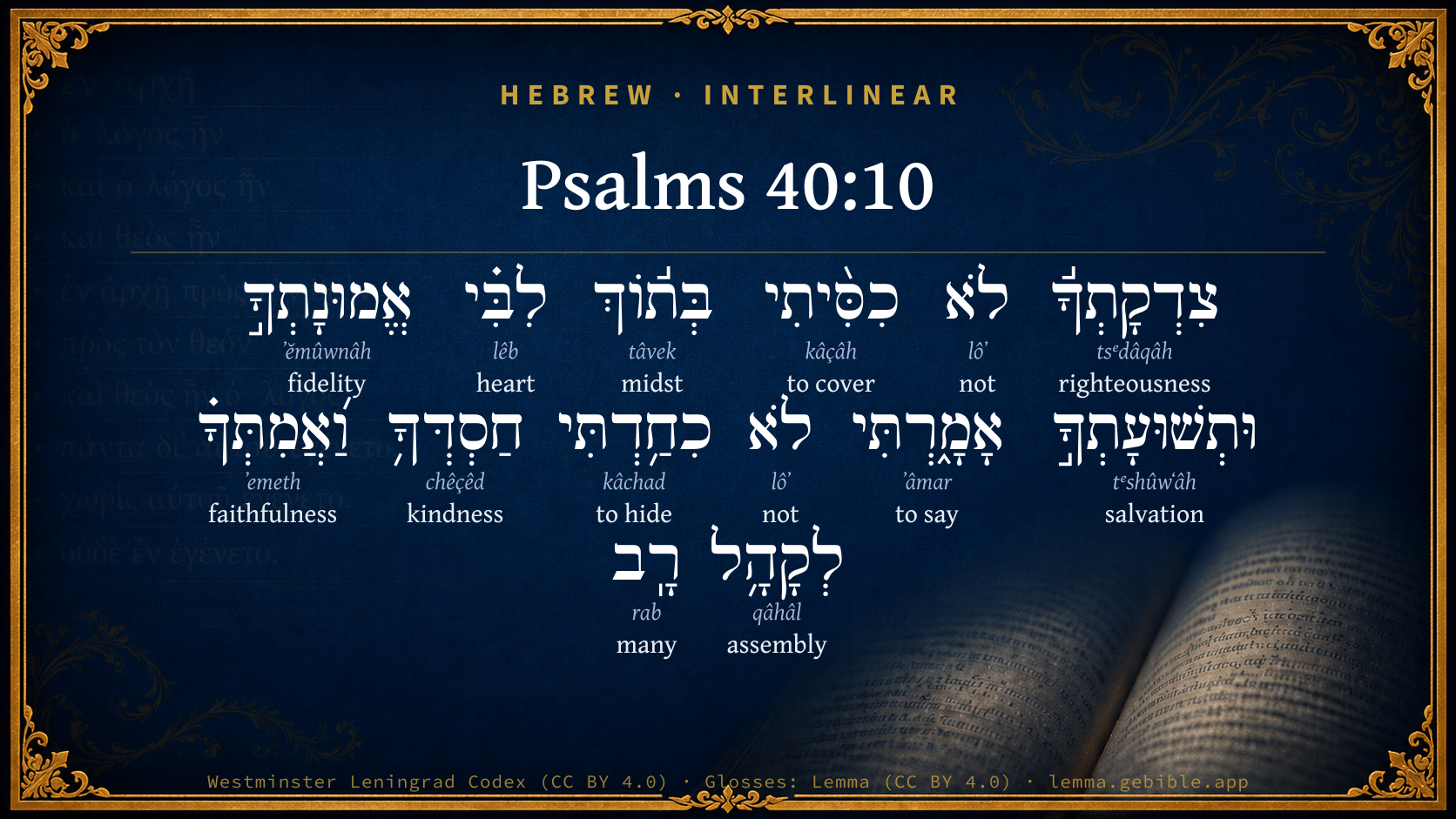
Hebrew (Westminster Leningrad Codex) Psalms 40:10 appears in the Hebrew Old Testament. The text above is from the Westminster Leningrad Codex. Each word links to its Strong’s number, a concise gloss, and parsing drawn from the Open Scriptures Hebrew Bible morphology. Click any word for its full Brown-Driver-Briggs (BDB) entry.
Download image
Cite this verse

Psalms 40:10 (World English Bible). Public Domain. Lemma interlinear Bible study tool, https://lemma.gebible.app/v/psalms/40/10.

Show BibTeX & RIS
BibTeX
RIS
English Translation
I have not hidden your righteousness within my heart. I have declared your faithfulness and your salvation. I have not concealed your loving kindness and your truth from the great assembly.
World English Bible · Public Domain
Download a study sheet

One document with this verse’s original text, its word-by-word gloss line, the meaning frame, cross-references with their text, attributed commentary, and full source and license credits — printable, and it pastes into notes with its structure intact.

This verse Autodidact and up

Study sheet (.html) Plain text (.txt)

A passage Seminary Student

Up to 50 verses in one chapter. A passage sheet keeps up to 6 commentary sources and 12 cross-references per verse, in the order this page ranks them, and says so on the sheet whenever that leaves anything out. Ask for a single verse and you get the Autodidact verse sheet above.

Everything on this page stays free to read, with no account — the sheet is a download of what is already on screen, not access to it.

Want to remove ads? Support Godless Engineer
Compare translations 3

The same verse in 3 English versions, stacked beneath the original-language interlinear above. Click any original word for its lexicon entry.

Each is an independent rendering of the whole verse — the interlinear is not word-aligned to these translations.

Highlighted words mark where these versions differ — a whole-verse word diff, not a word-by-word alignment.

  • World English Bible Public Domain
    I have not hidden your righteousness within my heart. I have declared your faithfulness and your salvation. I have not concealed your loving kindness and your truth from the great assembly.
  • King James Version Public Domain
    I have not hid thy righteousness within my heart; I have declared thy faithfulness and thy salvation: I have not concealed thy lovingkindness and thy truth from the great congregation.
  • unfoldingWord Literal Text CC BY-SA 4.0
    I have not concealed your righteousness in the midst of my heart; I have declared your faithfulness and your salvation. I have not hidden your covenant faithfulness and your trustworthiness from the great assembly.

unfoldingWord Literal Text — © unfoldingWord, licensed CC BY-SA 4.0. Word-aligned USFM3 via Door43 (git.door43.org/unfoldingWord/en_ult).

Versions to compare (up to 4)

3 of 4 selected

Show all 18 translations

Every available English version of this verse, each an independent rendering of the whole verse.

  • World English Bible Public Domain
    I have not hidden your righteousness within my heart. I have declared your faithfulness and your salvation. I have not concealed your loving kindness and your truth from the great assembly.
  • Berean Standard Bible Public Domain
    I have not covered up Your righteousness in my heart; I have declared Your faithfulness and salvation; I have not concealed Your loving devotion and faithfulness from the great assembly.
  • Majority Standard Bible Public Domain
    I have not covered up Your righteousness in my heart; I have declared Your faithfulness and salvation; I have not concealed Your loving devotion and faithfulness from the great assembly.
  • King James Version Public Domain
    I have not hid thy righteousness within my heart; I have declared thy faithfulness and thy salvation: I have not concealed thy lovingkindness and thy truth from the great congregation.
  • American Standard Version (1901) Public Domain
    I have not hid thy righteousness within my heart; I have declared thy faithfulness and thy salvation; I have not concealed thy lovingkindness and thy truth from the great assembly.
  • Revised Version (1885) Public Domain
    I have not hid thy righteousness within my heart; I have declared thy faithfulness and thy salvation: I have not concealed thy lovingkindness and thy truth from the great congregation.
  • Geneva Bible (1599) Public Domain
    I haue not hidde thy righteousnesse within mine heart, but I haue declared thy trueth and thy saluation: I haue not conceiled thy mercy and thy trueth from the great Congregation.
  • Douay-Rheims (1899) Public Domain
    I have declared thy justice in a great church, lo, I will not restrain my lips: O Lord, thou knowest it.
  • Young's Literal Translation Public Domain
    Thy righteousness I have not concealed In the midst of my heart, Thy faithfulness and Thy salvation I have told, I have not hidden Thy kindness and Thy truth, To the great assembly.
  • Literal Standard Version CC BY-SA 4.0
    I have not concealed Your righteousness || In the midst of my heart, || I have told of Your faithfulness and Your salvation, || I have not hidden Your kindness and Your truth, || To the great assembly.
  • Unlocked Literal Bible CC BY-SA 4.0
    I have not concealed your righteousness in my heart; I have declared your faithfulness and your salvation; I have not concealed your covenant faithfulness or your trustworthiness from the great assembly.
  • unfoldingWord Literal Text CC BY-SA 4.0
    I have not concealed your righteousness in the midst of my heart; I have declared your faithfulness and your salvation. I have not hidden your covenant faithfulness and your trustworthiness from the great assembly.
  • Darby Bible Public Domain
    I have not hidden thy righteousness within my heart; I have declared thy faithfulness and thy salvation: I have not concealed thy loving-kindness and thy truth from the great congregation.
  • World Messianic Bible Public Domain
    I have not hidden your righteousness within my heart. I have declared your faithfulness and your salvation. I have not concealed your loving kindness and your truth from the great assembly.
  • Webster's Bible Public Domain
    \\40:9\\I have preached righteousness in the great congregation: lo, I have not refrained my lips, O LORD, thou knowest.
  • Free Bible Version CC BY-SA 4.0
    I have not kept the truth of your goodness hidden inside me—I have spoken of your trustworthiness and your salvation. I have not concealed your unfailing love and your faithfulness from the whole congregation.
  • Bible in Basic English Public Domain
    Your righteousness has not been folded away in my heart; I have made clear your true word and your salvation; I have not kept secret your mercy or your faith from the great meeting.
  • JPS Tanakh (1917) Public Domain
    (40-11) I have not hid Thy righteousness within my heart; I have declared Thy faithfulness and Thy salvation; I have not concealed Thy mercy and Thy truth from the great congregation.

Literal Standard Version (2020), Covenant Press — licensed CC BY-SA 4.0. Text via the HelloAO Bible API (eBible.org). Unlocked Literal Bible (unfoldingWord) — licensed CC BY-SA 4.0. Text via the HelloAO Bible API (eBible.org). unfoldingWord Literal Text — © unfoldingWord, licensed CC BY-SA 4.0. Word-aligned USFM3 via Door43 (git.door43.org/unfoldingWord/en_ult). Free Bible Version, Dr. Jonathan Gallagher — licensed CC BY-SA 4.0. Text via the HelloAO Bible API (eBible.org).

Word by word

More ways to search: Search by grammar → Find every occurrence → Compare this word →

Practice this passage: Drill this verse → Learn its vocabulary →

כִחַ֥דְתִּי
kâchad
H3582
“to hide”
Verb, Piel, Perfect, 1st Person, Common, Singular
Part of Speech
Verb
Stem
Piel
Form
Perfect
Person
1st Person
Gender
Common
Number
Singular
Full BDB Definition

Origin: a primitive root

TWOT: 972

to hide, conceal, cut off, cut down, make desolate, kick - (Niphal) - to be hidden - to be effaced, be destroyed, be cut off - (Piel) to cover, hide - (Hiphil) - to hide - to efface, annihilate
  1. צִדְקָתְךָ֬ tsᵉdâqâh H6666 “righteousness · your” Noun, Common, Feminine, Singular, Construct + Suffix, Personal, 2nd Person, Masculine, Singular
  2. לֹא lôʼ H3808 “not” Particle, Negative
  3. כִסִּ֨יתִי kâçâh H3680 “to cover” Verb, Piel, Perfect, 1st Person, Common, Singular
  4. בְּת֬וֹךְ tâvek H8432 “in/at · midst of” Preposition + Noun, Common, Masculine, Singular, Construct
  5. לִבִּ֗י lêb H3820 “heart · my” Noun, Common, Masculine, Singular, Construct + Suffix, Personal, 1st Person, Common, Singular
  6. אֱמוּנָתְךָ֣ ʼĕmûwnâh H530 “fidelity · your” Noun, Common, Feminine, Singular, Construct + Suffix, Personal, 2nd Person, Masculine, Singular
  7. וּתְשׁוּעָתְךָ֣ tᵉshûwʻâh H8668 “and · salvation · your” Conjunction + Noun, Common, Feminine, Singular, Construct + Suffix, Personal, 2nd Person, Masculine, Singular
  8. אָמָ֑רְתִּי ʼâmar H559 “to say” Verb, Qal, Perfect, 1st Person, Common, Singular
  9. לֹא lôʼ H3808 “not” Particle, Negative
  10. חַסְדְּךָ֥ chêçêd H2617 “kindness · your” Noun, Common, Masculine, Singular, Construct + Suffix, Personal, 2nd Person, Masculine, Singular
  11. וַ֝אֲמִתְּךָ֗ ʼemeth H571 “and · faithfulness · your” Conjunction + Noun, Common, Feminine, Singular, Construct + Suffix, Personal, 2nd Person, Masculine, Singular
  12. לְקָהָ֥ל qâhâl H6951 “to/for · assembly” Preposition + Noun, Common, Masculine, Singular, Absolute
  13. רָֽב rab H7227 “many” Adjective, Adjective, Masculine, Singular, Absolute

About this verse

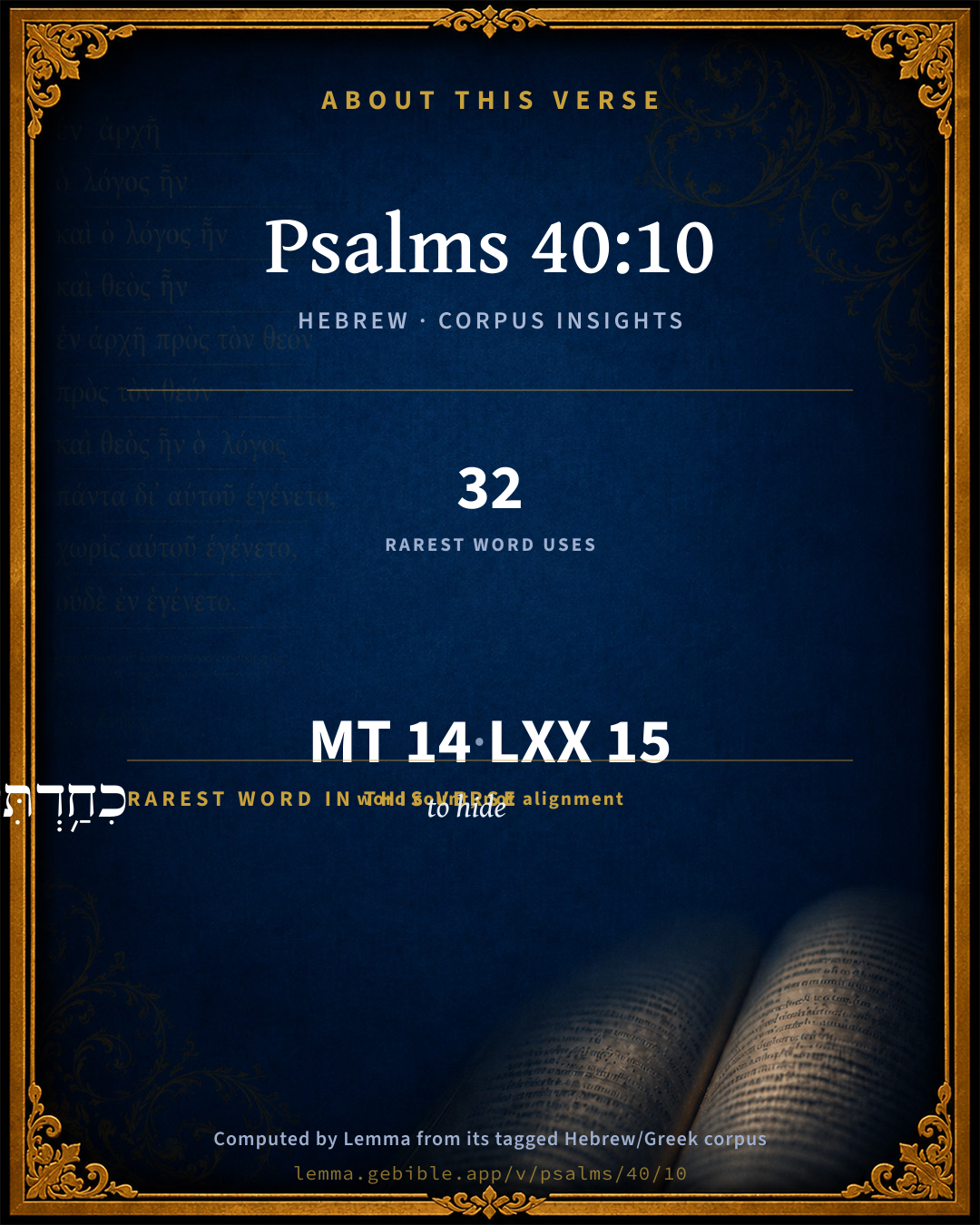
These counts appear in no published source. They are computed here, from the morphology-tagged text and Lemma’s own curated glosses. What Lemma adds →

14
words
13
distinct lemmas
Wisdom
section

Shared distinctive vocabulary

כִחַ֥דְתִּי to hide H3582 occurs in 30 verses of the Hebrew Bible. Also found in:

Grammatical profile

  • 3 verbs
  • 8 nouns
  • 1 adjective
  • 2 particles

Verb forms

  • כִסִּ֨יתִי Piel · Perfect
  • אָמָ֑רְתִּי Qal · Perfect
  • כִחַ֥דְתִּי Piel · Perfect

Repetition

A word recurs within this verse — often emphatic in Hebrew:

Hebrew & Septuagint length

In English translation the verse runs 31 words from the Hebrew and 28 from the Septuagint (LXX English) — closely comparable.

A rough comparison of the two English renderings, which tokenize alike — not a word-level alignment.

Word counts can differ between the Hebrew and the Greek without any difference in meaning — e.g. the Hebrew direct-object marker אֵת has no separate Greek word, and Greek often adds the article ὁ.

In the original languages it is 14 Hebrew tokens and 15 Greek tokens — but the two are counted differently (Hebrew bundles its prefixes and suffixes into one token; the Greek is in lemma form), so that isn’t a like-for-like length.

Cross-references

23

Topical passages linked to Psalms 40:10 in the Treasury of Scripture Knowledge — connected by theme and wording, ordered by reader-vote popularity; previews shown in the World English Bible.

  • Romans 1:16–17 For I am not ashamed of the Gospel of Christ, for it is the power of God for salvation for everyone who believes; for the Jew first, and also for the Greek.
  • Acts 20:20–21 how I didn't shrink from declaring to you anything that was profitable, teaching you publicly and from house to house,
  • Romans 10:9–10 that if you will confess with your mouth the Lord Jesus, and believe in your heart that God raised him from the dead, you will be saved.
  • 1 Timothy 1:15 The saying is faithful and worthy of all acceptance, that Christ Jesus came into the world to save sinners; of whom I am chief.
  • Luke 2:30–32 For my eyes have seen your salvation,
  • 1 Thessalonians 1:8 For from you has sounded forth the word of the Lord, not only in Macedonia and Achaia, but also in every place your faith toward God has gone forth; so that we need not to say anything.
  • Psalms 25:10 All the paths of Yahweh are loving kindness and truth To such as keep his covenant and his testimonies.
  • Psalms 34:6 This poor man cried, and Yahweh heard him, And saved him out of all his troubles.
  • Psalms 89:1 I will sing of the loving kindness of Yahweh forever. With my mouth, I will make known your faithfulness to all generations.
  • Isaiah 49:6 yes, he says, It is too light a thing that you should be my servant to raise up the tribes of Jacob, and to restore the preserved of Israel: I will also give you for a light to the Gentiles, that you may be my salvation to the end of the earth.
  • Ezekiel 2:7 You shall speak my words to them, whether they will hear, or whether they will forbear; for they are most rebellious.
  • Ezekiel 3:17–18 Son of man, I have made you a watchman to the house of Israel: therefore hear the word at my mouth, and give them warning from me.
  • Micah 7:20 You will give truth to Jacob, and mercy to Abraham, As you have sworn to our fathers from the days of old.
  • Luke 3:6 All flesh will see God's salvation.'"
  • Acts 13:32–33 We bring you good news of the promise made to the fathers,
  • Acts 20:26–27 Therefore I testify to you this day that I am clean from the blood of all men,
  • Romans 3:22–26 even the righteousness of God through faith in Jesus Christ to all and on all those who believe. For there is no distinction,
  • Romans 10:3 For being ignorant of God's righteousness, and seeking to establish their own righteousness, they didn't subject themselves to the righteousness of God.
  • Romans 15:8–9 Now I say that Christ has been made a minister of the circumcision for the truth of God, that he might confirm the promises given to the fathers,
  • Philippians 3:9 and be found in him, not having a righteousness of my own, that which is of the law, but that which is through faith in Christ, the righteousness which is from God by faith;
  • John 1:17 For the law was given through Moses. Grace and truth came through Jesus Christ.
  • John 3:16–17 For God so loved the world, that he gave his one and only Son, that whoever believes in him should not perish, but have eternal life.
  • Revelation 22:17 The Spirit and the bride say, "Come!" He who hears, let him say, "Come!" He who is thirsty, let him come. He who desires, let him take the water of life freely.

Cross-references courtesy of OpenBible.info (CC BY 4.0).

Hebrew and Greek witnesses Masoretic Hebrew ↔ Greek Septuagint

The same verse in the two great witnesses to the Old Testament, shown verse-for-verse.

You’re reading Greek Psalm 39 (Hebrew Psalm 40). The Septuagint counts the superscription, so verse numbers can differ from the Hebrew — chapter-level alignment, not verse-by-verse. Numbering follows Rahlfs.

These are two independent witnesses, not word-aligned to each other, and the Septuagint is shown in lemma (dictionary) form.

Hebrew Psalms 40:10 Masoretic · Westminster Leningrad Codex

צִדְקָתְךָ֬ לֹא כִסִּ֨יתִי בְּת֬וֹךְ לִבִּ֗י אֱמוּנָתְךָ֣ וּתְשׁוּעָתְךָ֣ אָמָ֑רְתִּי לֹא כִחַ֥דְתִּי חַסְדְּךָ֥ וַ֝אֲמִתְּךָ֗ לְקָהָ֥ל רָֽב

I have not hidden your righteousness within my heart. I have declared your faithfulness and your salvation. I have not concealed your loving kindness and your truth from the great assembly.

World English Bible · Public Domain

Greek LXX Greek Psalm 39:10 Septuagint · lemma form

εὐαγγελίζω δικαιοσύνη ἐν ἐκκλησία μέγας ἰδού ὁ χεῖλος ἐγώ οὐ μή κωλύω κύριος σύ γιγνώσκω

I have not hid your truth within my heart, and I have declared your salvation; I have not hid your mercy and your truth from the great congregation.

LXX2012 (modern English Septuagint) · Public Domain

Hebrew: Westminster Leningrad Codex (CC BY 4.0). Greek: Septuagint (public domain); English from LXX2012 (modern English Septuagint) (Public Domain). How the Septuagint differs from the Hebrew →

Commentary

Notes on Psalms 40:10 from classic Christian and Jewish commentators (each source and its license shown beneath its notes). The classic Christian expositions comment on the surrounding passage and are grouped to its opening verse, so a note may address several verses; the Jewish commentaries on the Tanakh (Rashi and others) are per-verse, so they appear only where the commentator wrote on this verse.

Lemma curates 59 commentaries, every one of them public domain or Creative Commons licensed, each selected and text-cleaned for this edition rather than reprinted as found. About our sources →

Trapp's Complete Commentary

John Trapp

Psa 40:10 I have not hid thy righteousness within my heart; I have declared thy faithfulness and thy salvation: I have not concealed thy lovingkindness and thy truth from the great congregation.

Ver. 10. I have not hid thy righteousness within my heart] Or, if he did, as Psa 119:11, it was, that having wrought it first on his own affections, he might afterwards utter it a corde ad cor, from the heart to the heart, and so be able to save himself and those that heard him.

I have declared thy faithfulness, &c.] See Psa 40:9.

John Trapp, A Commentary or Exposition upon All the Books of the Old and New Testament (1647–1656) — public domain. Text from a community e-Sword module.

J. A. Alexander on Psalms

Joseph Addison Alexander

11. (Psa 40:10). Thy righteousness I have not hid in the midst of my heart; thy faithfulness and thy salvation I have uttered; I have not concealed thy mercy and thy truth from the great congregation (or assembly). The same dea is again expressed, but with a pointed allusion to the last clause of Psa 40:9 (8), as if to guard against a misconstruction of its language. In opposition to a mere external formal service, he had there said that the Law of God was in his heart. But now he hastens, as it were, to add that it was not confined there. He was not contented with his own impressions of God's righteousness, derived both from his word and from his providence. He considered himself bound to make it known to the whole body of God's people, for the twofold purpose of comforting and edifying them, and of promoting the divine glory. The expression of the same thing, both in negative and positive form, is a natural method of enforcing what is said, which is common to all languages, although particularly frequent in the Hebrew.

Joseph Addison Alexander, The Psalms Translated and Explained (1850) — public domain. Text from a community e-Sword module.

Geneva Bible (1599)

Geneva Bible translators

David here numbereth 3 degrees of our salvation: God’s mercy, whereby he pitieth us: his righteousness, which signifieth his continual protection: and his truth, whereby appeareth his constant favor, so that hereof proceedeth our salvation.

Geneva Bible (1599) marginal notes — public domain. Text via Bolls.life.

Adam Clarke's Commentary

Verse 10. Thy faithfulness] This means the exact fulfilment of the promises made by the prophets relative to the incarnation of Christ, and the opening of the door of faith to the Gentiles.

Loving-kindness] Shows the gift itself of Jesus Christ, the highest proof that God could give to a lost world of his mercy, kindness, and loving-kindness.

Adam Clarke's Commentary on the Bible (1810–1826) — public domain. Text from a community e-Sword/MySword module.

John Calvin's Commentaries

10 I have not hidden thy righteousness within my heart. Here it is necessary to observe the accumulation of terms which are employed to denote the same thing. To the righteousness of God the Psalmist adds his truth, his salvation, and his mercy. And what is the design of this, but to magnify and set forth the goodness of God by many terms or expressions of praise? We must, however, notice in what respects these terms differ; for in this way we may be able to ascertain in what respects they apply to the deliverance of which David here discourses. If these four things should be taken in their proper order, mercy will hold the first place, as it is that by which alone God is induced to vouchsafe, to regard us. His righteousness is the protection by which he constantly defends his own people, and the goodness by which, as we have already said elsewhere, he preserves them. And, lest any should doubt that it will flow in a constant and uninterrupted course, David adds in the third place truth; by which we are taught that God continues always the same, and is never wearied of helping us, nor at any time withdraws his hand. There is, at the same time, implied in this an exhibition of the promises; for no man will ever rightly take hold of the righteousness of God but he who embraces it as it is offered and held forth in the Word. Salvation is the effect of righteousness, for God continues to manifest his free favor to his people, daily affording them aid and assistance, until he has completely saved them.

John Calvin's Commentaries (1540-1563) — public domain. Text from the Calvin Translation Society English edition (1840s-50s) via the Christian Classics Ethereal Library (ccel.org). Calvin's coverage is partial (roughly two-thirds of the Bible); uncommented books and verses are honest gaps, never fabricated. The 19th-century editor's footnotes and remarks are omitted so the notes are faithfully Calvin's own voice.

The Cambridge Bible for Schools and Colleges

gen. ed. J. J. S. Perowne

10. Neither indolence nor ingratitude nor fear of man has deterred him from openly celebrating those fundamental attributes of the divine character which have been once more manifested in his deliverance. For thy righteousness, see Psa_5:8, note; for lovingkindness, faithfulness, righteousness, cp. Psa_36:5-7; Psa_36:10; for truth and salvation, Psa_25:5; lovingkindness and truth, Psa_25:10.

The Cambridge Bible for Schools and Colleges (gen. ed. J. J. S. Perowne; Cambridge University Press, 1878–1918) — public domain. Text from a community e-Sword module.

John Gill's Exposition

I have not not hid thy righteousness within my heart,.... Meaning not the essential righteousness of God, though that was abundantly declared in the wounds, sufferings, and death of Christ; and which was the end indeed of his being a propitiation for sin, Rom 3:25; but his own righteousness, as before, which he wrought out, and brought in; and which is called the righteousness of God his Father, because it is approved of by him, and accepted with him, and which he imputes to all his people;

I have declared thy faithfulness and thy salvation: trial is, the "faithfulness" of God in executing all his purposes, counsels, and decrees, which are said to be faithfulness and truth; and in fulfilling his covenant and promises, relating to the redemption and salvation of men by Christ; and in the mission of Christ into this world on that account; and in the accomplishment of all the prophecies of the Old Testament concerning him; and in making good all the particular promises of support, help, and strength, made to the Messiah himself: and by his "salvation" is meant, that which is of God the Father's appointing, continuing, and settling, in the council and covenant of grace; which he sent his Son to be the author of, and which he has obtained; and is the great doctrine of the Gospel preached by himself, and his faithful ministers, Luk 19:9;

I have not concealed thy lovingkindness and thy truth from the great congregation; or "in the great congregation", as the Targum. By the "lovingkindness" of God is designed both his love to Christ, which was before the foundation of the world, and continued in his lowest state of humiliation, and which our Lord was far from concealing, but gave openly instances of it, Joh 17:24; and this love to his people; and which he declared to be the same with that which he is loved with, and instances in the gift of himself to them by his Father, as the great evidence of it, Joh 17:23; and by "truth" is intended the Gospel in general, which came by Christ, was preached by him, which he bore witness to, to do which was one end of his coming into the world; and this was not concealed by him, who is truth itself; but was fully and plainly declared by him, as it had not been before, Joh 1:17.

John Gill's Exposition of the Whole Bible (1746–1763) — public domain (CC PDM 1.0). Text via the HelloAO Bible API.

Albert Barnes' Notes on the Bible

I have not hid thy righteousness within my heart - The word “righteousness” here may denote the divine views on the subject of righteousness, or the divine method of making man righteous; that is, the method of justification, as the word is used in the New Testament. See the notes at Rom 1:17. The word, as it might have been employed by David, would have been used in the former sense, as meaning that, knowing what God requires of men, he had not concealed that in his heart, or had not kept it to himself; as used by the Messiah, as I suppose it to be here, it would be employed in the latter sense, or perhaps embrace both. The idea would be, that he had not concealed in his own mind, or had not kept to himself, the knowledge which he had of the requirements of the law of God, or of the way in which man can be justified or regarded and treated as righteous in his sight. He had fully communicated this knowledge to others. It is not necessary to say that this was literally fulfilled in the work of the Redeemer. He spent his life in making known the great truths about the righteousness of God; he died that he might disclose to man a way by which God could consistently regard and treat men as righteous. See the notes at Rom 3:24-26.

I have declared thy faithfulness - Thy truthfulness; I have showed that God is worthy of confidence. And thy salvation. Thy method of salvation, or of saving men.

I have not concealed thy loving kindness - Thy mercy or thy merciful disposition toward men. He had shown to the human race that God was a merciful Being; a Being who would pardon sin.

And thy truth - The truth which thou hast revealed; the truth on all subjects which it was important for men to understand.

From the great congregation - That is, as in Psa 40:9, the assembled multitudes - the throngs that gathered to hear the words of the Great Teacher. Compare Mat 5:1; Mat 13:2; Luk 8:4.

Albert Barnes' Notes on the Bible (1834–1885) — public domain. Text from a community e-Sword/MySword module.

Matthew Poole's English Annotations

I have not hid thy righteousness within my heart; I had it there, Psa 40:8, but I did not smother or shut it up there, but spread it abroad for thy glory, and the good of the world; which thou hast wrought both for me and by me.

Matthew Poole's English Annotations on the Holy Bible (1683–1685) — public domain. Text from a community e-Sword/MySword module.

The Treasury of David

Charles H. Spurgeon

Ver. 10. I have not hid thy righteousness within my heart. On the contrary, "Never man spake like this man." God's divine plan of making men righteous was well known to him, and he plainly taught it. What was in our great Master's heart he poured forth in holy eloquence from his lips. The doctrine of righteousness by faith he spake with great simplicity of speech. Law and gospel equally found in him a clear expositor. I have declared thy faithfulness and thy salvation. Jehovah's fidelity to his promises and his grace in saving believers were declared by the Lord Jesus on many occasions, and are blessedly blended in the gospel which he came to preach. God, faithful to his own character, law and threatenings, and yet saving sinners, is a peculiar revelation of the gospel. God faithful to the saved ones evermore is the joy of the followers of Christ Jesus. I have not concealed thy lovingkindness and thy truth from the great congregation. The tender as well as the stern attributes of God, our Lord Jesus fully unveiled. Concealment was far from the Great Apostle of our profession. Cowardice he never exhibited, hesitancy never weakened his language. He who as a child of twelve years spake in the temple among the doctors, and afterward preached to five thousand at Gennesaret, and to the vast crowds at Jerusalem on that great day, the last day of the feast, was always ready to proclaim the name of the Lord, and could never be charged with unholy silence. He could be dumb when so the prophecy demanded and patience suggested, but otherwise, preaching was his meat and his drink, and he kept back nothing which would be profitable to his disciples. This in the day of his trouble, according to this Psalm, he used as a plea for divine aid. He had been faithful to his God, and now begs the Lord to be faithful to him. Let every dumb professor, tongue tied by sinful shame, bethink himself how little he will be able to plead after this fashion in the day of his distress.

Ver. 10. I have not hid. This intimates, that whoever undertook to preach the gospel of Christ would be in great temptation to hide it, and conceal it, because it must be preached with great contention, and in the face of great opposition. Matthew Henry.

Ver. 10. I have not hid, etc. What God has done for us, or for the church, we should lay to heart; but not lock up in our heart. Carl Bernhard Moll in Lange's "Bibelwerk." 1869.

Ver. 10. (first clause).

1. The righteousness possessed by God.

2. The righteousness prescribed by God.

3. The righteousness provided by God. James Frame.

Ver. 10.

I. The preacher must reveal his whole message. II. He must not conceal any part.

1. Not of the righteousness of the law or the gospel.

2. Not of the lovingkindness of grace.

3. Not of any portion of the truth with flowers of rhetoric.

4. To give a partial representation.

5. To put one truth in the place of another.

6. To give the letter without the spirit. G.R.

Ver. 10. The great sin of concealing what we know of God.

Psalms 40:11*

Charles H. Spurgeon's The Treasury of David (1869–1885) — public domain. Psalms only. Text from a community e-Sword/MySword module.

The Pulpit Commentary

I have not hid thy righteousness within my heart; I have declared thy faithfulness and thy salvation; I have not concealed thy loving-kindness and thy truth from the great congregation. David"s psalms furnish a running commentary on these statements. Composed, as appears from the titles, mainly for use in the "great congregation," they set forth the righteousness, faithfulness, salvation, loving-kindness, and truth of God in the strongest possible way. Contemporary Israel, and later Israel, and the Church which has succeeded to the place of the original Israelites, and become "the Israel of God," are alike indebted to him for the wonderful strains in which he has shown forth and magnified these qualities of the Almighty.

The Pulpit Commentary (1880–1919), ed. H.D.M. Spence-Jones & Joseph S. Exell — public domain. Text from a community e-Sword module.

Keil & Delitzsch

C. F. Keil & F. Delitzsch

The self-presentation before Jahve, introduced by אז אמרתּי, extends from הנה to מעי; consequently בּשּׂרתּי yltn joins on to אמרתי, and the אכלא which stands in the midst of perfects describes the synchronous past. The whole is a retrospect. בּשּׂר, Arab. bššr (root בש), starting from its sensible primary signification to scrape off, scratch off, rub smooth, means: to smooth any one (gltten), Engl. to gladden one, i.e., vultum ejus diducere, to make him joyful and glad, more especially to cheer one by good news (e.g., basharahu or bashsharuhu bi̇maulûdin, bashsharuhu bi-maulûdin, he has cheered him by the intelligence of the birth of a son), in Hebrew directly equivalent to εὐαγγελίζειν (εὐαγγελίζεσθαι). He has proclaimed to all Israel the evangel of Jahve's justifying and gracious rule, which only changes into retribution towards those who despise His love; and he can appeal to the Omniscient One (Jer 15:15), that neither through fear of men, nor through shame and indolence, has he restrained his lips from confessing Him. God's conduct, in accordance with the prescribed order of redemption, is as a matter of fact called צדק, and as an attribute of His holy love, צדקה; just as אמוּנה is His faithfulness which fulfils the promises made and which does not suffer hope to be put to shame, and תּשׁוּעה is His salvation as it is manifested in facts. This rich matter for the preaching of the evangel, which may be comprehended in the two words חסד ועמת, the Alpha and Omega of God's self-attestation in the course of the redemptive history, he has not allowed to slumber as a dead, unfruitful knowledge hidden deep down in his heart. The new song which Jahve put into his mouth, he has also really sung. Thus far we have the first part of the song, which renders thanks for past mercies.

Keil & Delitzsch — Biblical Commentary on the Old Testament (1861–1891) — public domain (CC PDM 1.0). Text via the HelloAO Bible API. (Old Testament only.)

unfoldingWord translationNotes

Door43 World Missions Community

I have not concealed your righteousness in my heart

"I have not kept your righteousness a secret." This can also be stated in positive form. AT: "I have openly told every one about your righteousness" (See: Litotes)

in my heart

Here this refers to the writer's inner being. (See: Metonymy)

I have not concealed your covenant faithfulness or your trustworthiness from the great assembly

This can be stated in positive form. AT: "I have told everyone in the great assembly about your covenant faithfulness or your trustworthiness" (See: Litotes)

your covenant faithfulness

The abstract noun "faithfulness" can be stated as "faithful." AT: "how faithful you are to your covenant" (See: Abstract Nouns)

your trustworthiness

This abstract noun "trustworthiness" can be stated as "trustworthy." AT: "how trustworthy you are" (See: Abstract Nouns)

let your covenant faithfulness and your trustworthiness always preserve me

Here "covenant faithfulness" and "trustworthiness" are spoken of as if they were living people who could protect the writer. AT: "I want your covenant faithfulness and your trustworthiness to always preserve" (See: Personification)

translationWords

righteous

heart

faithful

save

covenant faithfulness

trust

mercy

unfoldingWord translationNotes — © Distant Shores Media and the Door43 World Missions Community, licensed CC BY-SA 4.0. Source: git.door43.org/Door43/en_tn.

Rashi

Rabbi Shlomo Yitzchaki (Rashi)

I brought tidings of righteousness The song by the sea, the song by the well (Num. 21:17-20), and the song of Deborah (Jud. 5).

I will not withhold Heb. אכלא, I will not withhold, an expression of (Gen. 8:2): “And the rain was restrained (ויכלא).”

Rashi on the Tanakh — English translations: “The Judaica Press complete Tanach with Rashi, translated by A. J. Rosenberg” (CC BY 4.0); “Pentateuch with Rashi's commentary by M. Rosenbaum and A.M. Silbermann, 1929-1934” (public domain); “The Metsudah Tanach series, Lakewood, N.J” (CC BY 4.0); and “The Book of Joshua, Metsudah Publications, 1997” (CC BY 4.0). Text via Sefaria.

Lesson kit

Teaching starters — assembled from the data on this page, not authored interpretation. Every prompt links to the verse data it draws on. Edit before teaching.

Psalms, in the Wisdom, opens this verse with 14 words (13 distinct Hebrew lemmas). Its most distinctive word is kâchad (“to hide”). A historical commentator’s framing appears above. Read the whole chapter for the surrounding context.

Discussion questions

  1. How does “to hide” (kâchad) shape what this verse is saying?
  2. How does Genesis 47:18, which shares the word «to hide», read alongside this verse?
  3. What does the repetition of “not” (2× in this one verse) do in this verse?
  4. These translations render this verse differently. What is at stake in choosing one wording over another?
  5. «כִסִּ֨יתִי» is a Piel Perfect verb. How does that grammatical form shape the action described?
  6. Compare how Trapp's Complete Commentary and J. A. Alexander on Psalms read this verse. Where do they agree or differ?

Things to notice

Reading settings

Reading text

Shown beneath each verse's original-language words.

Old Testament
Old Testament edition

Read the OT as the Masoretic Hebrew (MT) or the Greek Septuagint (LXX).

English shown for the Greek Septuagint (in the Hebrew ↔ Greek comparison).

Comparing translations? Open the Compare panel on any verse page to stack up to four side by side.