
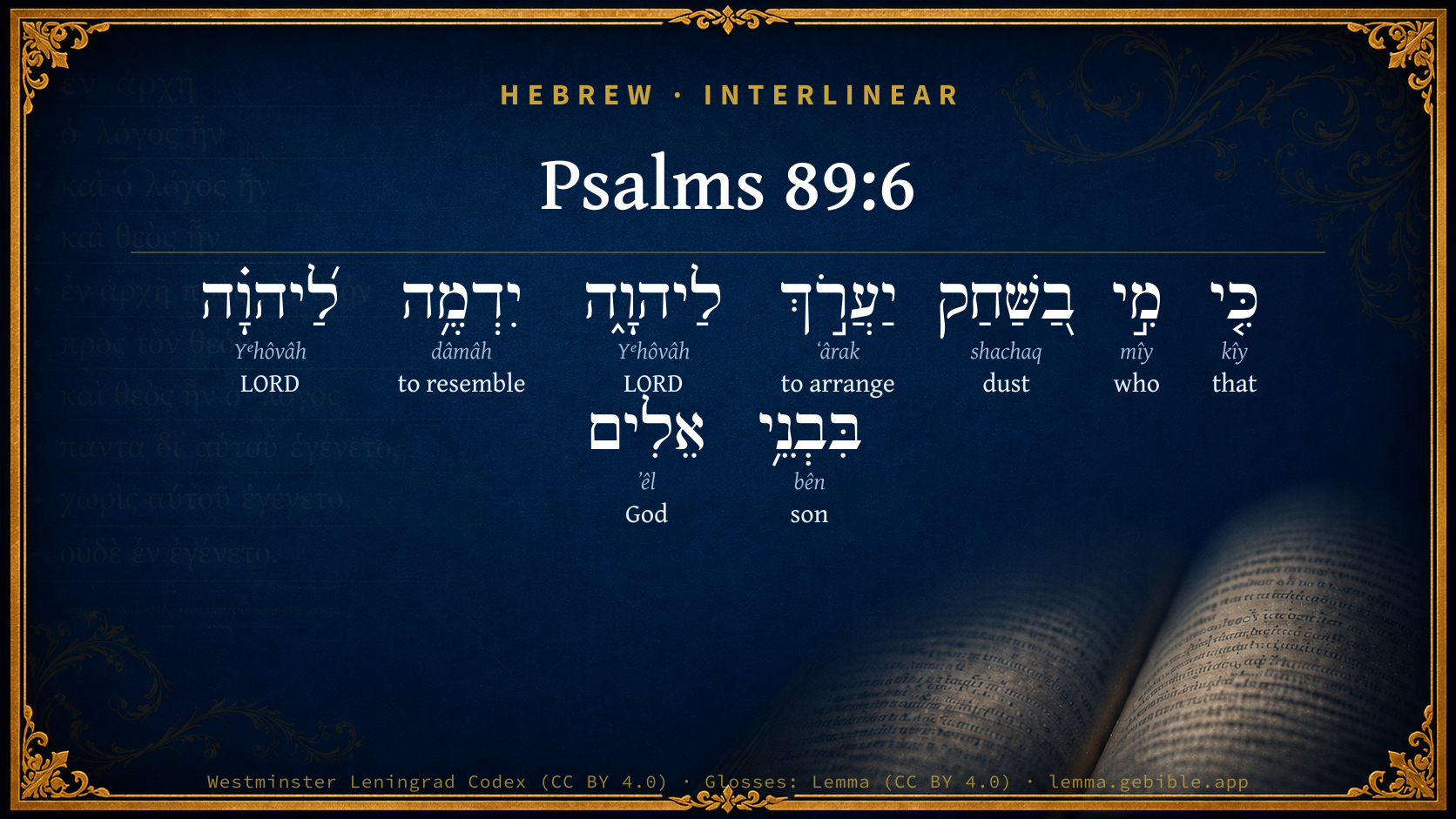
Psalms 89:6

Hebrew (Westminster Leningrad Codex) Psalms 89:6 appears in the Hebrew Old Testament. The text above is from the Westminster Leningrad Codex. Each word links to its Strong’s number, a concise gloss, and parsing drawn from the Open Scriptures Hebrew Bible morphology. Click any word for its full Brown-Driver-Briggs (BDB) entry.
Download image
Cite this verse

Psalms 89:6 (World English Bible). Public Domain. Lemma interlinear Bible study tool, https://lemma.gebible.app/v/psalms/89/6.

Show BibTeX & RIS
BibTeX
RIS
English Translation
For who in the skies can be compared to Yahweh? Who among the sons of the heavenly beings is like Yahweh,
World English Bible · Public Domain
Download a study sheet

One document with this verse’s original text, its word-by-word gloss line, the meaning frame, cross-references with their text, attributed commentary, and full source and license credits — printable, and it pastes into notes with its structure intact.

This verse Autodidact and up

Study sheet (.html) Plain text (.txt)

A passage Seminary Student

Up to 50 verses in one chapter. A passage sheet keeps up to 6 commentary sources and 12 cross-references per verse, in the order this page ranks them, and says so on the sheet whenever that leaves anything out. Ask for a single verse and you get the Autodidact verse sheet above.

Everything on this page stays free to read, with no account — the sheet is a download of what is already on screen, not access to it.

Want to remove ads? Support Godless Engineer
Compare translations 3

The same verse in 3 English versions, stacked beneath the original-language interlinear above. Click any original word for its lexicon entry.

Each is an independent rendering of the whole verse — the interlinear is not word-aligned to these translations.

Highlighted words mark where these versions differ — a whole-verse word diff, not a word-by-word alignment.

  • World English Bible Public Domain
    For who in the skies can be compared to Yahweh? Who among the sons of the heavenly beings is like Yahweh,
  • King James Version Public Domain
    For who in the heaven can be compared unto the LORD? who among the sons of the mighty can be likened unto the LORD?
  • unfoldingWord Literal Text CC BY-SA 4.0
    For who in the sky arrays with Yahweh, compares to Yahweh among the sons of God?

unfoldingWord Literal Text — © unfoldingWord, licensed CC BY-SA 4.0. Word-aligned USFM3 via Door43 (git.door43.org/unfoldingWord/en_ult).

Versions to compare (up to 4)

3 of 4 selected

Show all 18 translations

Every available English version of this verse, each an independent rendering of the whole verse.

  • World English Bible Public Domain
    For who in the skies can be compared to Yahweh? Who among the sons of the heavenly beings is like Yahweh,
  • Berean Standard Bible Public Domain
    For who in the skies can compare with the LORD? Who among the heavenly beings is like the LORD?
  • Majority Standard Bible Public Domain
    For who in the skies can compare with the LORD? Who among the heavenly beings is like the LORD?
  • King James Version Public Domain
    For who in the heaven can be compared unto the LORD? who among the sons of the mighty can be likened unto the LORD?
  • American Standard Version (1901) Public Domain
    For who in the skies can be compared unto Jehovah? Who among the sons of the mighty is like unto Jehovah,
  • Revised Version (1885) Public Domain
    For who in the skies can be compared unto the LORD? who among the sons of the mighty is like unto the LORD,
  • Geneva Bible (1599) Public Domain
    For who is equall to the Lord in the heauen? and who is like the Lord among the sonnes of the gods?
  • Douay-Rheims (1899) Public Domain
    The heavens shall confess thy wonders, O Lord: and thy truth in the church of the saints.
  • Young's Literal Translation Public Domain
    For who in the sky, Compareth himself to Jehovah? Is like to Jehovah among sons of the mighty?
  • Literal Standard Version CC BY-SA 4.0
    For who in the sky, compares himself to YHWH? [Who] is like to YHWH among sons of the mighty?
  • Unlocked Literal Bible CC BY-SA 4.0
    For who in the skies can be compared to Yahweh? Who among the sons of the gods is like Yahweh?
  • unfoldingWord Literal Text CC BY-SA 4.0
    For who in the sky arrays with Yahweh, compares to Yahweh among the sons of God?
  • Darby Bible Public Domain
    For who in the heaven can be compared to Jehovah? [who] among the sons of the mighty shall be likened to Jehovah?
  • World Messianic Bible Public Domain
    For who in the skies can be compared to the LORD? Who among the sons of the heavenly beings is like the LORD,
  • Webster's Bible Public Domain
    \\89:5\\And the heavens shall praise thy wonders, O LORD; thy faithfulness also in the congregation of the saints.
  • Free Bible Version CC BY-SA 4.0
    For who in heaven can compare to the Lord? Who is like the Lord even among the angels?
  • Bible in Basic English Public Domain
    For who is there in the heavens in comparison with the Lord? who is like the Lord among the sons of the gods?
  • JPS Tanakh (1917) Public Domain
    (89-7) For who in the skies can be compared unto the LORD, who among the sons of might can be likened unto the LORD,

Literal Standard Version (2020), Covenant Press — licensed CC BY-SA 4.0. Text via the HelloAO Bible API (eBible.org). Unlocked Literal Bible (unfoldingWord) — licensed CC BY-SA 4.0. Text via the HelloAO Bible API (eBible.org). unfoldingWord Literal Text — © unfoldingWord, licensed CC BY-SA 4.0. Word-aligned USFM3 via Door43 (git.door43.org/unfoldingWord/en_ult). Free Bible Version, Dr. Jonathan Gallagher — licensed CC BY-SA 4.0. Text via the HelloAO Bible API (eBible.org).

Word by word

More ways to search: Search by grammar → Find every occurrence → Compare this word →

Practice this passage: Drill this verse → Learn its vocabulary →

About this verse

These counts appear in no published source. They are computed here, from the morphology-tagged text and Lemma’s own curated glosses. What Lemma adds →

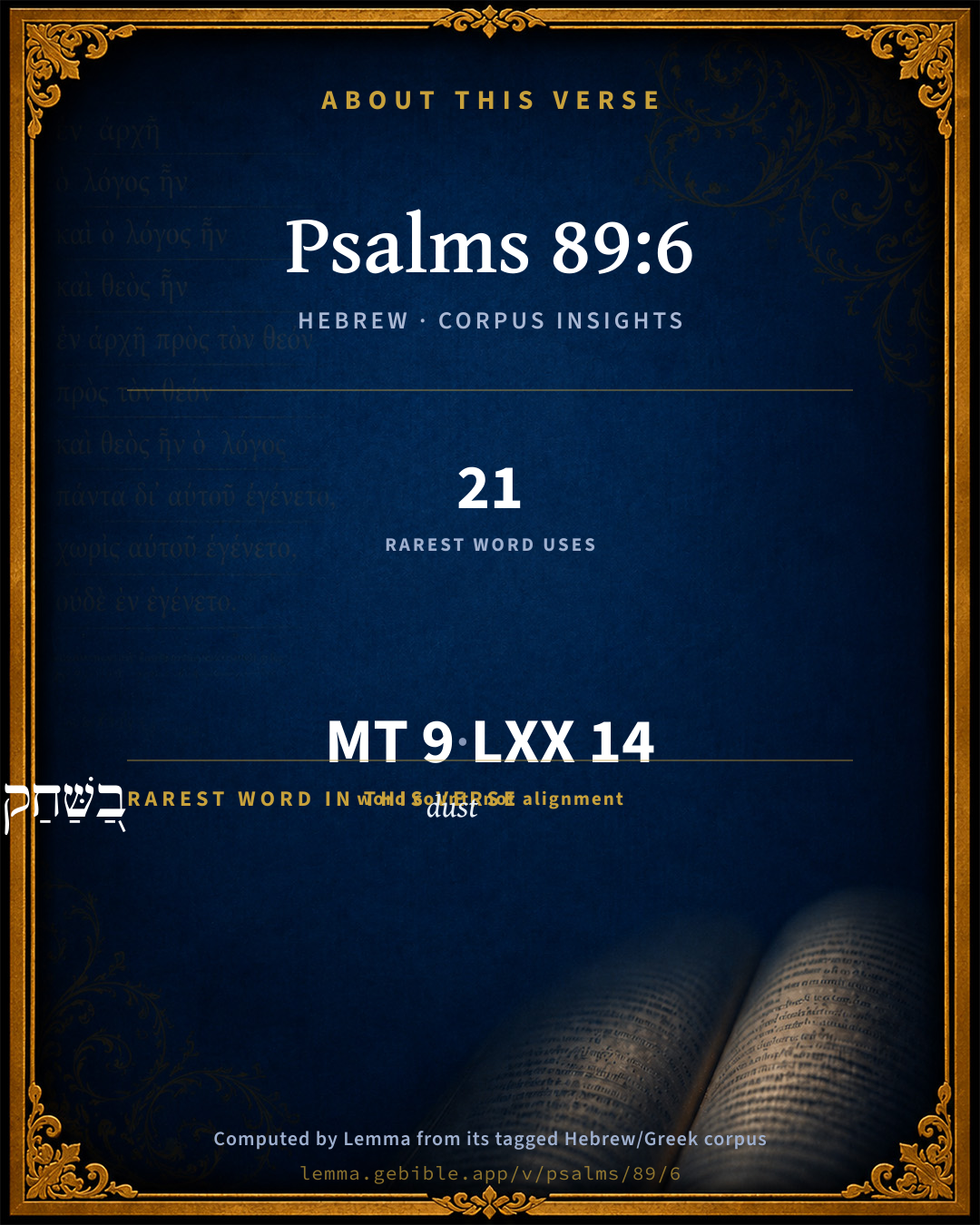
9
words
8
distinct lemmas
Wisdom
section

Notable vocabulary

The rarest word here is בַ֭שַּׁחַק dust H7834 — appearing just 21 times in the whole Hebrew Bible.

Shared distinctive vocabulary

בַ֭שַּׁחַק dust H7834 occurs in 21 verses of the Hebrew Bible. Also found in:

Grammatical profile

  • 2 verbs
  • 5 nouns
  • 1 conjunction
  • 1 particle

Verb forms

  • יַעֲרֹ֣ךְ Qal · Imperfect
  • יִדְמֶ֥ה Qal · Imperfect

Repetition

A word recurs within this verse — often emphatic in Hebrew:

  • לַיהוָ֑ה LORD H3068 ×2

Hebrew & Septuagint length

In English translation the verse runs 21 words from the Hebrew and 24 from the Septuagint (LXX English) — closely comparable.

A rough comparison of the two English renderings, which tokenize alike — not a word-level alignment.

Word counts can differ between the Hebrew and the Greek without any difference in meaning — e.g. the Hebrew direct-object marker אֵת has no separate Greek word, and Greek often adds the article ὁ.

In the original languages it is 9 Hebrew tokens and 14 Greek tokens — but the two are counted differently (Hebrew bundles its prefixes and suffixes into one token; the Greek is in lemma form), so that isn’t a like-for-like length.

Cross-references

10

Topical passages linked to Psalms 89:6 in the Treasury of Scripture Knowledge — connected by theme and wording, ordered by reader-vote popularity; previews shown in the World English Bible.

  • Psalms 86:8 There is no one like you among the gods, Lord, Nor any deeds like your deeds.
  • Psalms 71:19 Your righteousness also, God, reaches to the heavens; You have done great things. God, who is like you?
  • Exodus 15:11 Who is like you, Yahweh, among the gods? Who is like you, glorious in holiness, Fearful in praises, doing wonders?
  • Psalms 29:1 Ascribe to Yahweh, you sons of the mighty, Ascribe to Yahweh glory and strength.
  • Psalms 113:5 Who is like Yahweh, our God, Who has his seat on high,
  • Jeremiah 10:6 There is none like you, Yahweh; you are great, and your name is great in might.
  • Psalms 73:25 Who do I have in heaven? There is no one on earth who I desire besides you.
  • Psalms 40:5 Many, Yahweh, my God, are the wonderful works which you have done, And your thoughts which are toward us. They can't be set in order to you; If I would declare and speak of them, they are more than can be numbered.
  • Psalms 52:1 Why do you boast of mischief, mighty man? God's loving kindness endures continually.
  • Psalms 89:8 Yahweh, God of hosts, who is a mighty one, like you? Yah, your faithfulness is around you.

Cross-references courtesy of OpenBible.info (CC BY 4.0).

Hebrew and Greek witnesses Masoretic Hebrew ↔ Greek Septuagint

The same verse in the two great witnesses to the Old Testament, shown verse-for-verse.

You’re reading Greek Psalm 88 (Hebrew Psalm 89). The Septuagint counts the superscription, so verse numbers can differ from the Hebrew — chapter-level alignment, not verse-by-verse. Numbering follows Rahlfs.

These are two independent witnesses, not word-aligned to each other, and the Septuagint is shown in lemma (dictionary) form.

Hebrew Psalms 89:6 Masoretic · Westminster Leningrad Codex

כִּ֤י מִ֣י בַ֭שַּׁחַק יַעֲרֹ֣ךְ לַיהוָ֑ה יִדְמֶ֥ה לַ֝יהוָ֗ה בִּבְנֵ֥י אֵלִים

For who in the skies can be compared to Yahweh? Who among the sons of the heavenly beings is like Yahweh,

World English Bible · Public Domain

Greek LXX Greek Psalm 88:6 Septuagint · lemma form

ἐκὁμολογέω ὁ οὐρανός ὁ θαυμάσιος σύ κύριος καί ὁ ἀλήθεια σύ ἐν ἐκκλησία ἅγιος

For who in the heavens shall be compared to the Lord? and who shall be likened to the Lord among the sons of God?

LXX2012 (modern English Septuagint) · Public Domain

Hebrew: Westminster Leningrad Codex (CC BY 4.0). Greek: Septuagint (public domain); English from LXX2012 (modern English Septuagint) (Public Domain). How the Septuagint differs from the Hebrew →

Commentary

Notes on Psalms 89:6 from classic Christian and Jewish commentators (each source and its license shown beneath its notes). The classic Christian expositions comment on the surrounding passage and are grouped to its opening verse, so a note may address several verses; the Jewish commentaries on the Tanakh (Rashi and others) are per-verse, so they appear only where the commentator wrote on this verse.

Lemma curates 59 commentaries, every one of them public domain or Creative Commons licensed, each selected and text-cleaned for this edition rather than reprinted as found. About our sources →

Trapp's Complete Commentary

John Trapp

Psa 89:6 For who in the heaven can be compared unto the LORD? [who] among the sons of the mighty can be likened unto the LORD?

Ver. 6. For who in the heaven can be compared? &c] Thou far transcendest the brightest cherub, all Whose excellence is but derivative, a drop of thine ocean, a spark of thy flame.

Who among the sons of the mighty] Inter chores Angelorum, saith the Chaldee: What angel, what man?

John Trapp, A Commentary or Exposition upon All the Books of the Old and New Testament (1647–1656) — public domain. Text from a community e-Sword module.

The Biblical Illustrator

Joseph S. Exell

Psa_89:6

For who In the heaven can be compared unto the Lord?

The greatness of God

The true God, Sovereign of heaven and earth, is incomparably great--

I. In His being and existence.

1. Eternal.

2. Perfect.

3. Independent.

4. Unchangeable. There are no tenses with God--past, present, and to come; but one eternal Now.

II. In His attributes and perfections.

1. Holiness.

2. Wisdom and knowledge.

3. Power.

4. Justice.

5. Patience.

6. Love and goodness.

III. In his works.

1. Creation.

2. Providence.

3. Redemption and human salvation.

Concluding inferences.

1. Is God so great?--what a horrid nature sin is of, and rebellion against such a God I--yes, horrid the sin and folly that attempts to oppose God!

2. If God be so great, what love, reverence, worship, and obedience we owe to Him!

3. Is God so great?--what must be His condescension to notice such creatures as we are!

4. If God be so great, what must it be to be under His wrath for ever!

5. If God he so great, what will it be to enjoy His love, favour, and presence for ever. (T. Jones.)

The Biblical Illustrator, edited by Joseph S. Exell (c. 1880s–1900s) — public domain. Text from a community e-Sword module.

The Treasury of David

Charles H. Spurgeon

Ver. 6. For who in the heaven can be compared unto the Lord therefore all heaven worships him, seeing none can equal him.

Who among the sons of the mighty can be likened unto the Lord? therefore the assemblies of the saints on earth adore him, seeing none can rival him. Until we can find one equally worthy to be praised, we will give unto the Lord alone all the homage of our praise. Neither among the sons of the morning nor the sons of the mighty can any peer be found for Jehovah, yea none that can be mentioned in the same day; therefore he is rightly praised. Since the Lord Jesus, both as God and as man, is far above all creatures, he also is to be devoutly worshipped. How full of poetic fire is this verse! How bold is the challenge! How triumphant the holy boasting! The sweet singer dwells upon the name of Jehovah with evident exultation; to him the God of Israel is God indeed and God alone. He closely follows the language long before rehearsed by Miriam, when she sang, "Who is like unto thee, O Jehovah, among the gods? Who is like thee?" His thoughts are evidently flying back to the days of Moses and the marvels of the Red Sea, when God was gloriously known by his incommunicable name; there is a ring of timbrels in the double question, and a sound as of the twinkling feet of rejoicing maidens. Have we no poets now? Is there not a man among us who can compose hymns flaming with this spirit? O, Spirit of the living God, be thou the inspirer of some master minds among us!

Ver. 6. Who in the heaven? Who in the sky? Ainsworth reads it. In the clouds, in nubibus, oequabitur, is to be equalled, saith Calvin, to Jehovah, Quis enim in superiore nube par oestimetur Jehova. Who in the higher clouds is equal to Jehovah, so Tremellius reads it. Who in the heavens? i.e., say some, in the starry heavens, among the celestial bodies, sun, moon, or stars; which were adored as gods, not only by the Persians, but also by some idolatrous Jews, because of their brightness and beauty, their lustre and glory. Which of all those famous lamps, and heavenly luminaries, is to be compared to the Father of lights, and Sun of righteousness? They may glisten like glowworms in the night of Paganism, among them who are covered with the mantle of darkness, but when this Sun ariseth, and day appeareth, they all vanish and disappear.

"Who in the heavens?" i.e., say others, in the heaven of heavens, the highest, the third heavens, among the celestial spirits, cherubims and seraphims, angels and archangels, principalities and powers, thrones and dominions? Who among the innumerable company of angels? Who among those pure, those perfect spirits, who are the most ancient, the most honourable house of the creation, is to be compared to the Father of Spirits. George Swinnock.

Ver. 6. Who can be compared? The Dutch have translated these words, Who can be shadowed with him? that is, they are not worthy to be accounted shadows unto such a comparison with him. Thomas Goodwin.

Ver. 6. Who among the sons of the mighty. Literally, "Who is he among the sons of" Alim (or of Gods, as in Ps 29:1,) i.e., according to Suicer, the powerful, the princes of the earth. Daniel Cresswell.

Ver. 6. We have a comparison between God and the most excellent in heaven and earthchallenge both worlds.

(a) The true God, sovereign of heaven and earth is

incomparably great in his BEING and EXISTENCE;

(1) because his being is of himself eternal;

(2) because he is a perfect being;

(3) because he is independent;

(4) because he is unchangeable.

2. God is incomparably great in his ATTRIBUTES and PERFECTIONS.

(1) In his holiness;

(2) in his wisdom and knowledge;

(3) in his power;

(4) in his justice;

(5) in his patience;

(6) in his love and goodness.

3. God is incomparably great in his WORKScreation; providence; redemption, and human salvation.

Theophilus Jones, 1830.

Ver. 6. The incomparableness of God, in his Being, Attributes, Works, and Word. Swinnock. (Nichol's Edition of Swinnock's Works, Vol. 4, pp. 373-508.)

Ver. 6-7.

1. In creation God is far above other beings. Ps 89:6.

2. In Redemption he is far above himself in creation. Ps 89:7.

Psalms 89:7*

Charles H. Spurgeon's The Treasury of David (1869–1885) — public domain. Psalms only. Text from a community e-Sword/MySword module.

Joseph Benson's Commentary

Psa 89:6-7. Who among the sons of the mighty — That is, of the most mighty princes upon earth: or among the highest angels; who well may and needs must admire and adore thee, because thou art incomparably and infinitely more excellent than they. God is greatly to be feared — With a fear of reverence; for dread and terror have no place in those blessed mansions, and holy spirits. In the assembly of the saints — The whole society of angels, called saints, or holy ones, again, as in Psa 89:5. And to be had in reverence of all about him — The angels, who are always in his presence, and encompass his throne.

Joseph Benson's Commentary on the Old and New Testaments (1811–1818) — public domain. Text from a community e-Sword module.

J. A. Alexander on Psalms

Joseph Addison Alexander

7. (Psa 89:6) For who, in the sky, can compare to Jehovah? (Who) is like and Jehovah among the Sons of the Mighty? The question involves a strong negation, or an affirmation that there is none like him, even in the orders of existence superior to man. This is given as a reason for the adoring recognition of his power and veracity in Psa 89:5). The word translated sky is elsewhere used in the plural to denote the clouds collectively. See above, on Psa 68:34; Psa 77:17; Psa 78:23. The singular form, in this sense, is peculiar to the psalm before us. See below, Psa 89:37). The twofold usage of the English verb compare, as active and neuter, corresponds exactly to that of the original expression, for the primary and proper sense of which, see above on Psa 5:3; Psa 40:5; Psa 50:21. The Sons of the Mighty or Almighty are the angels. As to the peculiar form of the description, see above, on Psa 29:1, from which it seems to be directly borrowed in the case before us.

Joseph Addison Alexander, The Psalms Translated and Explained (1850) — public domain. Text from a community e-Sword module.

Tyndale Open Study Notes

Tyndale Open Resources

89:6 mightiest angel: Literally son of God (see study note on 29:1-2).

Tyndale Open Study Notes — © Tyndale Open Resources, licensed CC BY-SA 4.0. Text via the HelloAO Bible API.

Geneva Bible (1599)

Geneva Bible translators

Meaning, the Angels.

Geneva Bible (1599) marginal notes — public domain. Text via Bolls.life.

Adam Clarke's Commentary

Verse 6. For who in the heaven] שחק shachak signifies the ethereal regions, all visible or unbounded space; the universe. Who is like Jesus? given in his human nature none of the sons of the mighty can be compared with him. He atones for the sin of the world, and saves to the uttermost all who come unto God through him.

This may also be considered a reproof to idolaters. Is there any among the heavenly hosts like to God? Even the most glorious of them were made by his hands. Can the stars, or the more distant planets, or the moon, or the sun, be likened unto God most high?

Who among the sons of the mighty] Instead of אלים elim, mighty ones, four of Kennicott's and De Rossi's MSS. have איל eil, strength: - sons of strength, strong persons. Several of the Versions seem to have read אלהים Elohim, GOD, instead of אלים elim, strong ones. So my old Psalter, following the Vulgate. - For wha in the clowdes sal be evened to Lorde; like sal be to God in sons of God! which it paraphrases thus: "Emang al haly men nane may be evened to Ihu Crist: and nane may be like to hym in God's sons: for he is God's son be kynde, and thai thrugh grace."

Adam Clarke's Commentary on the Bible (1810–1826) — public domain. Text from a community e-Sword/MySword module.

John Calvin's Commentaries

6 For who in the clouds can be compared to Jehovah? The prophet now proceeds to illustrate farther what he had said respecting God’s wonders, and exclaims emphatically, Who in the clouds can be compared to God? The reason why he speaks of the clouds, or heaven, is because, what is not surprising, nothing is to be found upon the earth which can at all approach the glory of God. Although man excels other living creatures, yet we see how contemptible and miserable his condition is, or rather, how full it is of shame and reproach. Whence it follows, that under heaven there is no excellence which can compete with that of God. But when we ascend to heaven, immediately ravished with admiration, we conceive of a multitude of gods, which do away with the true God. The last clause of the verse, in which it is said, that among the sons of the gods there is none like the true and only God, is an explanation of the first. The opinion of some, that by the clouds, or the heavens, is to be understood the sun, moon, and stars, is disproved by the context itself. The amount then is, that even in the heavens, God alone has the entire pre-eminence, having there none as a companion or equal. The appellation the sons of the gods is here given to angels, because they neither have their origin from the earth, nor are clothed with a corruptible body, but are celestial spirits, adorned with a Divine glory. It is not meant that they are a part of the Divine essence or substance, as some fanatics dream; but as God displays his power in them, this title is attributed to them, to distinguish between their nature and ours. In short, although a greater majesty shines forth in the angels than in other creatures, at the contemplation of which we are ravished with admiration, yet come they not near God, so as to obscure and impair his glory by their excellence, or to share with him in the sovereignty of the universe. This is a point worthy of our careful attention; for, although God everywhere declares in his word that the angels are only his servants, and always ready to execute his commands, yet the world, not contented with having only one God, forges for itself a countless number of deities.

John Calvin's Commentaries (1540-1563) — public domain. Text from the Calvin Translation Society English edition (1840s-50s) via the Christian Classics Ethereal Library (ccel.org). Calvin's coverage is partial (roughly two-thirds of the Bible); uncommented books and verses are honest gaps, never fabricated. The 19th-century editor's footnotes and remarks are omitted so the notes are faithfully Calvin's own voice.

Ellicott's Commentary for English Readers

(6) Sons of the mighty.—Rather, sons of God—i.e., angels. (Comp. Psa_29:1.)

A Bible Commentary for English Readers, edited by Charles John Ellicott (1878–1897) — public domain. Text from a community e-Sword module.

The Cambridge Bible for Schools and Colleges

gen. ed. J. J. S. Perowne

6, 7. For who in the sky can be compared unto Jehovah?

Who is like Jehovah among the sons of God,

A God greatly to be dreaded in the council of the holy ones,

And to be feared above all that are round about him?

God’s nature is unique, incomparable. Even among celestial beings there is none that can be compared with Him.

The phrase bnç çlîm, found elsewhere only in Psa_29:1, denotes angels. It might be rendered sons of the mighty, describing them as mighty celestial beings; or sons of the gods, beings “belonging to the class of superhuman, heavenly powers” (Cheyne); but it is best taken as a doubly-formed plural, and rendered as in R.V. marg., sons of God (El); synonymous with bnç Elôhîm in Job_1:6; Job_2:1; Job_38:7.

With Psa_89:7 cp. Isa_8:13. The angels form the council of the great King (Job_15:8, R.V. marg.; Jer_23:18; Jer_23:22), but He towers above them all in unapproachable majesty.

The Cambridge Bible for Schools and Colleges (gen. ed. J. J. S. Perowne; Cambridge University Press, 1878–1918) — public domain. Text from a community e-Sword module.

John Gill's Exposition

God is greatly to be feared in the assembly of the saints,.... Which Jarchi and Kimchi understand of angels again, and render it "God is to be feared in the great assembly of them"; for they are a very large number, even an innumerable company, in and by whom the Lord is feared and worshipped, Heb 12:21, but rather an assembly or congregation of holy men are designed: it is the duty of such to assemble together publicly for religious worship; they ought to do it on account of the Lord, who requires it, and encourages it by his presence, he has promised; on the account of themselves, it being for their profit and pleasure; and on the account of others, for their conversion and comfort; and in imitation of the people of God, in all ages; nor should they forsake the assembling of themselves: the word rendered "assembly", signifies "counsel" or "secret"; see Gen 49:6 and so the Targum,

"God is mighty in the secrets of the saints, sitting on a throne of glory;''

in the assembly of the saints, the secrets of God's love are disclosed unto them; the doctrines and mysteries of his grace, called the whole counsel of God, Act 20:27 are there made known; and the ordinances of the Gospel, which also are styled the counsel of God, Luk 7:30, are there administered: now, where all this is done,

God is greatly feared herein; not with a slavish fear, a fear of hell and damnation, such as may be in devils; nor with an hypocritical fear, such as is taught by the precepts of men; but with a filial, godly fear, such as is peculiar to the children of God; with an holy and humble fear, with a fiducial and fearless one; with a reverential affection for the Divine Being, and such as includes all worship of him, internal and external: and to be had in reverence of all them that are about him; which the Targum paraphrases

"and is to be feared above all the angels that stand round about him''

and so Kimchi interprets it; see Rev 5:11, but the same thing, in different words, is meant, as in the preceding clause.

John Gill's Exposition of the Whole Bible (1746–1763) — public domain (CC PDM 1.0). Text via the HelloAO Bible API.

Albert Barnes' Notes on the Bible

For who in the heaven ... - literally, In the cloud; that is, in the sky. The idea is that none in the regions above - the upper world - can be compared with God. There is no other god - there is no one among the angels, great and glorious as they are, that can be likened to him.

Who among the sons of the mighty ... - The angels - regarded as mighty. The “sons of the mighty” on earth are spoken of as mighty men - as men of power - as men of exalted rank. So here, the idea is, that none of the angels, though of exalted rank (“principalities,” or “powers,” compare Rom 8:38; Eph 1:21), could be put in comparison with God. See the notes at Isa 40:25.

Albert Barnes' Notes on the Bible (1834–1885) — public domain. Text from a community e-Sword/MySword module.

Matthew Poole's English Annotations

Among the sons of the mighty; either, first, among the potentates of the earth; or rather, secondly, among the highest angels; who well may and needs must admire and adore time, because thou art incomparably and infinitely more excellent than they.

Matthew Poole's English Annotations on the Holy Bible (1683–1685) — public domain. Text from a community e-Sword/MySword module.

Whedon's Commentary on the Bible

Daniel D. Whedon

6. Who in the heaven—This recognises orders of created beings in “heaven.” To say glorified saints are not included, is to deny that they are in “heaven.” See notes on Psa_16:3; Psa_73:25.

Sons of the mighty— Hebrew, Sons of God. So in Psa_29:1, “O ye mighty,” is O sons of God, an advance upon “who in heaven,” which included all orders whatsoever, while this designates angels, specially the higher order, archangels. These are created beings—messengers of God doing his will. The supremacy of God over nature and all orders of being is pure theism.

Daniel D. Whedon (gen. ed.), Commentary on the Old and New Testaments (1874–1909) — public domain. Text from a community e-Sword module.

The Pulpit Commentary

For who in the heaven can be compared unto the Lord? God"s angels praise him, and only him; since there is none in heaven or earth to be compared to him. Who among the sons of the mighty can be likened unto the Lord? "The sons of the mighty" are the angels. (comp. Psa_29:1)

Comparisons with Jehovah.

"Who in the heaven can be compared unto the Lord?" It does not come to our minds to attempt any comparisons of God with any one, because, according to our associations, there is no one on the same plane with him, and so no comparisons are suggested. But in ancient times every nation had its separate deity; these deities were thought, by their worshippers, to be real and supreme, and so comparisons with Jehovah could be made. They were made, by outsiders, to his disadvantage; and they might well be made, by psalmist and prophet, to his honour. (see the eloquent comparisons in Isa 40) Here the psalmist is but assuring himself by thinking high things of God, because the actual present dealings of God suggested doubting thoughts. What God is always steadies our thinking when we are perplexed by what God does. The comparison need not be fully elaborated; the following points may be illustrated.

I GOD IS INCOMPARABLE IN POWER. If God does a thing, we may first of all say he was under no compulsion to do it. He could have done otherwise. If he has put forth his power in this particular way, we may be sure he willed to act this way, and his will is based on perfect knowledge and absolute wisdom. Of no created being, of no so called deity, can it be declared that he has uncontrolled power, and yet the power is in no way to be teared, because it is in the control of perfect intelligence, absolute wisdom, and infinite love.

II GOD IS INCOMPARABLE IN PURITY. Here the one idea on which we may dwell is God"s truthfulness, faithfulness, to his word. Scripture constantly asserts that God never disappoints men. He is true to his word. This cannot be asserted of any created being, or of any so called deity, whose word can only be the word of some created being representing him. "Hath he said, and shall he not do it? hath he spoken, and shall he not make it good?" "God is not a man, that he should lie.

III GOD IS INCOMPARABLE IN PITY. It seems to the psalmist of Rehoboam"s distressed age as if God "had forgotten to be gracious." But he may rest his soul in the confidence that none can pity like God; and if Divine action should ever seem strange, it can only be said that God"s pity is checking the action of what, in God, men may think to be severity. R.T.

The Pulpit Commentary (1880–1919), ed. H.D.M. Spence-Jones & Joseph S. Exell — public domain. Text from a community e-Sword module.

John Wesley's Explanatory Notes

Among - The highest angels.

John Wesley, Explanatory Notes Upon the Whole Bible (1754–1765) — public domain. Text via the GEBible commentary corpus.

Rashi

Rabbi Shlomo Yitzchaki (Rashi)

And the heavens acknowledge Your wonder If You had kept Your promise.

and Your faithfulness in the congregation of the holy ones The realization of Your words they will acknowledge in the congregation of the holy ones.

Rashi on the Tanakh — English translations: “The Judaica Press complete Tanach with Rashi, translated by A. J. Rosenberg” (CC BY 4.0); “Pentateuch with Rashi's commentary by M. Rosenbaum and A.M. Silbermann, 1929-1934” (public domain); “The Metsudah Tanach series, Lakewood, N.J” (CC BY 4.0); and “The Book of Joshua, Metsudah Publications, 1997” (CC BY 4.0). Text via Sefaria.

Lesson kit

Teaching starters — assembled from the data on this page, not authored interpretation. Every prompt links to the verse data it draws on. Edit before teaching.

Psalms, in the Wisdom, opens this verse with 9 words (8 distinct Hebrew lemmas). Its most distinctive word is shachaq (“dust”). A historical commentator’s framing appears above. Read the whole chapter for the surrounding context.

Discussion questions

  1. What does “dust” (shachaq) contribute to the verse as a whole?
  2. How does Deuteronomy 33:26, which shares the word «dust», read alongside this verse?
  3. What does the repetition of “LORD” (2× in this one verse) do in this verse?
  4. These translations render this verse differently. What is at stake in choosing one wording over another?
  5. «יַעֲרֹ֣ךְ» is a Qal Imperfect verb. How does that grammatical form shape the action described?
  6. Compare how Trapp's Complete Commentary and The Biblical Illustrator read this verse. Where do they agree or differ?

Things to notice

Reading settings

Reading text

Shown beneath each verse's original-language words.

Old Testament
Old Testament edition

Read the OT as the Masoretic Hebrew (MT) or the Greek Septuagint (LXX).

English shown for the Greek Septuagint (in the Hebrew ↔ Greek comparison).

Comparing translations? Open the Compare panel on any verse page to stack up to four side by side.