2 Chronicles 29:23

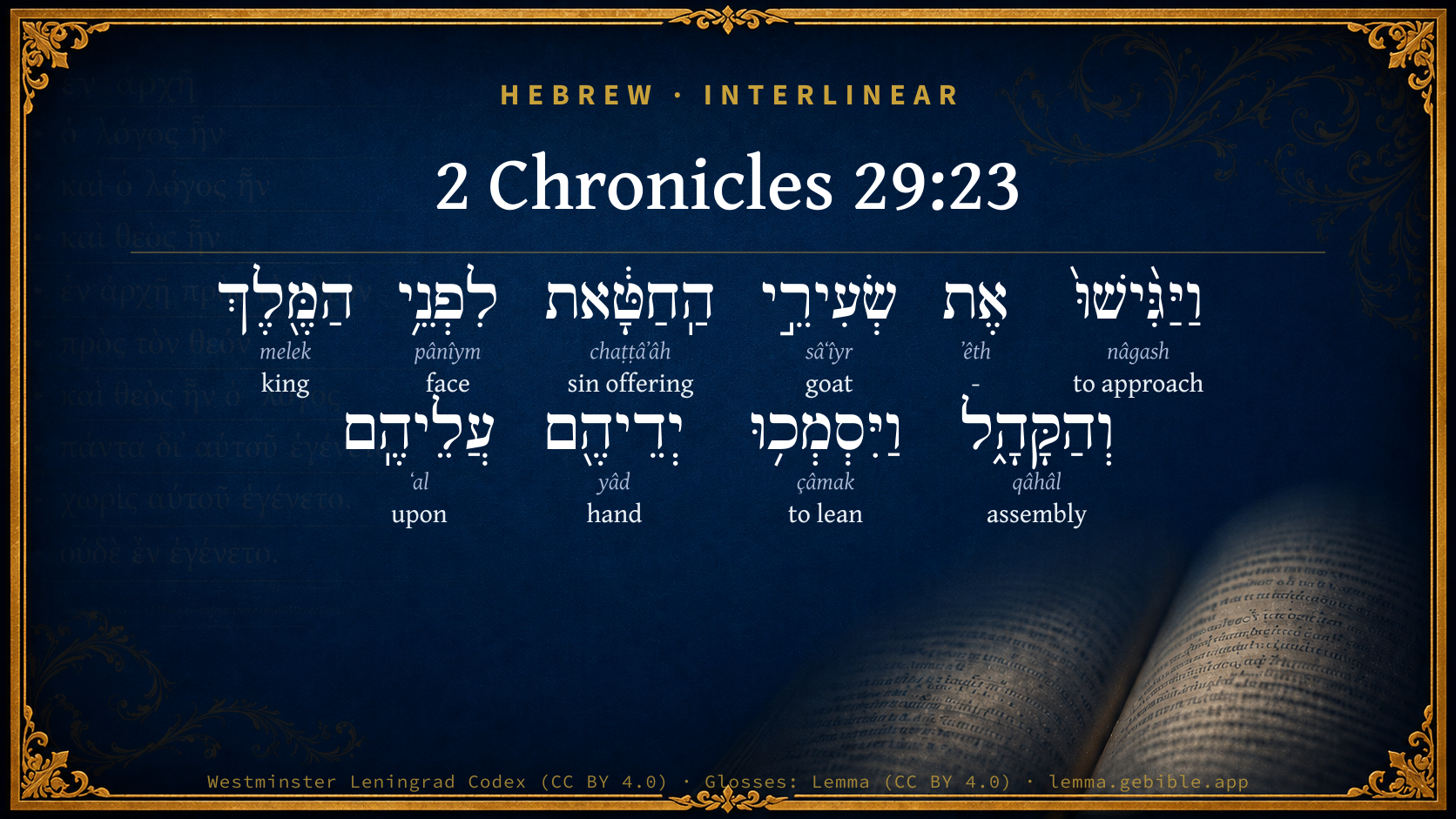
Hebrew (Westminster Leningrad Codex) 2 Chronicles 29:23 appears in the Hebrew Old Testament. The text above is from the Westminster Leningrad Codex. Each word links to its Strong’s number, a concise gloss, and parsing drawn from the Open Scriptures Hebrew Bible morphology. Click any word for its full Brown-Driver-Briggs (BDB) entry.
Download image
Cite this verse

2 Chronicles 29:23 (World English Bible). Public Domain. Lemma interlinear Bible study tool, https://lemma.gebible.app/v/2-chronicles/29/23.

Show BibTeX & RIS
BibTeX
RIS
English Translation
They brought near the male goats for the sin-offering before the king and the assembly; and they laid their hands on them:
World English Bible · Public Domain
Download a study sheet

One document with this verse’s original text, its word-by-word gloss line, the meaning frame, cross-references with their text, attributed commentary, and full source and license credits — printable, and it pastes into notes with its structure intact.

This verse Autodidact and up

Study sheet (.html) Plain text (.txt)

A passage Seminary Student

Up to 50 verses in one chapter. A passage sheet keeps up to 6 commentary sources and 12 cross-references per verse, in the order this page ranks them, and says so on the sheet whenever that leaves anything out. Ask for a single verse and you get the Autodidact verse sheet above.

Everything on this page stays free to read, with no account — the sheet is a download of what is already on screen, not access to it.

Want to remove ads? Support Godless Engineer
Compare translations 3

The same verse in 3 English versions, stacked beneath the original-language interlinear above. Click any original word for its lexicon entry.

Each is an independent rendering of the whole verse — the interlinear is not word-aligned to these translations.

Highlighted words mark where these versions differ — a whole-verse word diff, not a word-by-word alignment.

  • World English Bible Public Domain
    They brought near the male goats for the sin-offering before the king and the assembly; and they laid their hands on them:
  • King James Version Public Domain
    And they brought forth the he goats for the sin offering before the king and the congregation; and they laid their hands upon them:
  • unfoldingWord Literal Text CC BY-SA 4.0
    And they brought near the goats of the sin offering before the king and the assembly, and they laid their hands on them.

unfoldingWord Literal Text — © unfoldingWord, licensed CC BY-SA 4.0. Word-aligned USFM3 via Door43 (git.door43.org/unfoldingWord/en_ult).

Versions to compare (up to 4)

3 of 4 selected

Show all 18 translations

Every available English version of this verse, each an independent rendering of the whole verse.

  • World English Bible Public Domain
    They brought near the male goats for the sin-offering before the king and the assembly; and they laid their hands on them:
  • Berean Standard Bible Public Domain
    Then they brought the goats for the sin offering before the king and the assembly, who laid their hands on them.
  • Majority Standard Bible Public Domain
    Then they brought the goats for the sin offering before the king and the assembly, who laid their hands on them.
  • King James Version Public Domain
    And they brought forth the he goats for the sin offering before the king and the congregation; and they laid their hands upon them:
  • American Standard Version (1901) Public Domain
    And they brought near the he-goats for the sin-offering before the king and the assembly; and they laid their hands upon them:
  • Revised Version (1885) Public Domain
    And they brought near the he-goats for the sin offering before the king and the congregation; and they laid their hands upon them:
  • Geneva Bible (1599) Public Domain
    Then they brought the hee goates for the sinne offring before the King and the Congregation, and they layde their hands vpon them.
  • Douay-Rheims (1899) Public Domain
    And they brought the he goats for sin before the king, and the whole multitude, and they laid their hand upon them:
  • Young's Literal Translation Public Domain
    and they bring nigh the he-goats of the sin-offering before the king and the assembly, and they lay their hands upon them;
  • Literal Standard Version CC BY-SA 4.0
    and they bring the male goats of the sin-offering near before the king and the assembly, and they lay their hands on them;
  • Unlocked Literal Bible CC BY-SA 4.0
    They brought the male goats for the sin offering before the king and the assembly; they laid their hands on them.
  • unfoldingWord Literal Text CC BY-SA 4.0
    And they brought near the goats of the sin offering before the king and the assembly, and they laid their hands on them.
  • Darby Bible Public Domain
    And they brought near the he-goats of the sin-offering before the king and the congregation; and they laid their hands upon them.
  • World Messianic Bible Public Domain
    They brought near the male goats for the sin offering before the king and the assembly; and they laid their hands on them.
  • Webster's Bible Public Domain
    And they brought forth the he-goats for the sin-offering before the king and the congregation; and they laid their hands upon them:
  • Free Bible Version CC BY-SA 4.0
    Then they brought the goats for the sin offering before the king and the assembly, who placed their hands on them.
  • Bible in Basic English Public Domain
    Then they took the he-goats for the sin-offering, placing them before the king and the meeting of the people, and they put their hands on them:
  • JPS Tanakh (1917) Public Domain
    And they brought near the he-goats for the sin-offering before the king and the congregation, and they laid their hands upon them;

Literal Standard Version (2020), Covenant Press — licensed CC BY-SA 4.0. Text via the HelloAO Bible API (eBible.org). Unlocked Literal Bible (unfoldingWord) — licensed CC BY-SA 4.0. Text via the HelloAO Bible API (eBible.org). unfoldingWord Literal Text — © unfoldingWord, licensed CC BY-SA 4.0. Word-aligned USFM3 via Door43 (git.door43.org/unfoldingWord/en_ult). Free Bible Version, Dr. Jonathan Gallagher — licensed CC BY-SA 4.0. Text via the HelloAO Bible API (eBible.org).

Word by word

More ways to search: Search by grammar → Find every occurrence → Compare this word →

Practice this passage: Drill this verse → Learn its vocabulary →

וַיִּסְמְכ֥וּ
çâmak
H5564
“and · to lean”
Conjunction + Verb, Qal, Sequential Imperfect, 3rd Person, Masculine, Plural
Part of Speech
Conjunction + Verb
Stem
Qal
Form
Sequential Imperfect
Person
3rd Person
Gender
Masculine
Number
Plural
Full BDB Definition

Origin: a primitive root

TWOT: 1514

to lean, lay, rest, support, put, uphold, lean upon - (Qal) - to lean or lay upon, rest upon, lean against - to support, uphold, sustain - (Niphal) to support or brace oneself - (Piel) to sustain, refresh, revive
  1. וַיַּגִּ֨ישׁוּ֙ nâgash H5066 “and · to approach” Conjunction + Verb, Hiphil, Sequential Imperfect, 3rd Person, Masculine, Plural
  2. אֶת ʼêth H853 “-” Particle, Direct Object
  3. שְׂעִירֵ֣י sâʻîyr H8163 “goats of” Noun, Common, Masculine, Plural, Construct
  4. הַֽחַטָּ֔את chaṭṭâʼâh H2403 “the · sin offering” Particle, Definite Article + Noun, Common, Feminine, Singular, Absolute
  5. לִפְנֵ֥י pânîym H6440 “to/for · face(s) of” Preposition + Noun, Common, Both, Plural, Construct
  6. הַמֶּ֖לֶךְ melek H4428 “the · king” Particle, Definite Article + Noun, Common, Masculine, Singular, Absolute
  7. וְהַקָּהָ֑ל qâhâl H6951 “and · the · assembly” Conjunction + Particle, Definite Article + Noun, Common, Masculine, Singular, Absolute
  8. יְדֵיהֶ֖ם yâd H3027 “hands · their” Noun, Common, Both, Dual, Construct + Suffix, Personal, 3rd Person, Masculine, Plural
  9. עֲלֵיהֶֽם ʻal H5921 “upon · them” Preposition + Suffix, Personal, 3rd Person, Masculine, Plural

About this verse

These counts appear in no published source. They are computed here, from the morphology-tagged text and Lemma’s own curated glosses. What Lemma adds →

10
words
10
distinct lemmas
Historical
section

Shared distinctive vocabulary

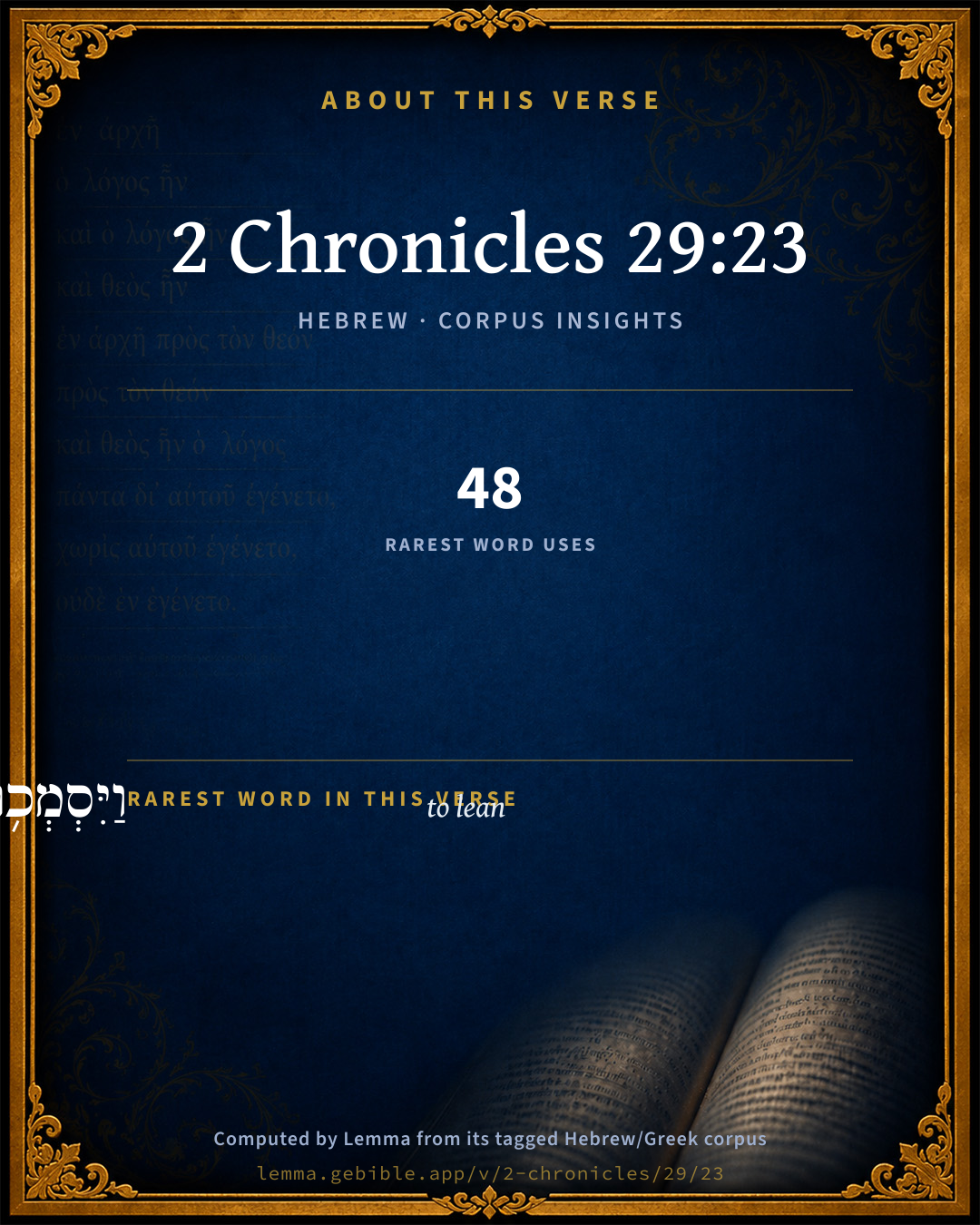
וַיִּסְמְכ֥וּ to lean H5564 occurs in 47 verses of the Hebrew Bible. Also found in:

Grammatical profile

  • 2 verbs
  • 6 nouns
  • 1 preposition
  • 1 particle

Verb forms

  • וַיַּגִּ֨ישׁוּ֙ Hiphil · Sequential Imperfect
  • וַיִּסְמְכ֥וּ Qal · Sequential Imperfect

Hebrew & Septuagint length

In English translation the verse runs 22 words from the Hebrew and 20 from the Septuagint (LXX English) — closely comparable.

A rough comparison of the two English renderings, which tokenize alike — not a word-level alignment.

Word counts can differ between the Hebrew and the Greek without any difference in meaning — e.g. the Hebrew direct-object marker אֵת has no separate Greek word, and Greek often adds the article ὁ.

Cross-references

3

Topical passages linked to 2 Chronicles 29:23 in the Treasury of Scripture Knowledge — connected by theme and wording, ordered by reader-vote popularity; previews shown in the World English Bible.

  • Leviticus 4:15 The elders of the congregation shall lay their hands on the head of the bull before Yahweh; and the bull shall be killed before Yahweh.
  • Leviticus 1:4 He shall lay his hand on the head of the burnt offering, and it shall be accepted for him to make atonement for him.
  • Leviticus 4:24 He shall lay his hand on the head of the goat, and kill it in the place where they kill the burnt offering before Yahweh. It is a sin offering.

Cross-references courtesy of OpenBible.info (CC BY 4.0).

Hebrew and Greek witnesses Masoretic Hebrew ↔ Greek Septuagint

The same verse in the two great witnesses to the Old Testament, shown verse-for-verse.

These are two independent witnesses, not word-aligned to each other, and the Septuagint is shown in lemma (dictionary) form.

Hebrew 2 Chronicles 29:23 Masoretic · Westminster Leningrad Codex

וַיַּגִּ֨ישׁוּ֙ אֶת שְׂעִירֵ֣י הַֽחַטָּ֔את לִפְנֵ֥י הַמֶּ֖לֶךְ וְהַקָּהָ֑ל וַיִּסְמְכ֥וּ יְדֵיהֶ֖ם עֲלֵיהֶֽם

They brought near the male goats for the sin-offering before the king and the assembly; and they laid their hands on them:

World English Bible · Public Domain

Greek LXX 2 Chronicles 29:23 Septuagint · lemma form

καί προςἄγω ὁ χίμαρος ὁ περί ἁμαρτία ἐναντίον ὁ βασιλεύς καί ὁ ἐκκλησία καί ἐπιτίθημι ὁ χείρ αὐτός ἐπί αὐτός

And they brought the goats for a sin-offering before the king and the congregation; and laid their hands upon them.

LXX2012 (modern English Septuagint) · Public Domain

Hebrew: Westminster Leningrad Codex (CC BY 4.0). Greek: Septuagint (public domain); English from LXX2012 (modern English Septuagint) (Public Domain). How the Septuagint differs from the Hebrew →

Commentary

Notes on 2 Chronicles 29:23 from classic Christian and Jewish commentators (each source and its license shown beneath its notes). The classic Christian expositions comment on the surrounding passage and are grouped to its opening verse, so a note may address several verses; the Jewish commentaries on the Tanakh (Rashi and others) are per-verse, so they appear only where the commentator wrote on this verse.

Lemma curates 59 commentaries, every one of them public domain or Creative Commons licensed, each selected and text-cleaned for this edition rather than reprinted as found. About our sources →

Trapp's Complete Commentary

John Trapp

2Ch 29:23 And they brought forth the he goats [for] the sin offering before the king and the congregation; and they laid their hands upon them:

Ver. 23. They laid their hands upon them.] Manibus suis nixi sunt eis; by this ceremony they confessed their sins, and laid them, as it were, upon their sacrifice, indeed upon Christ, "who his own self bore our sins in his own body upon the tree." {1Pe 2:24}

John Trapp, A Commentary or Exposition upon All the Books of the Old and New Testament (1647–1656) — public domain. Text from a community e-Sword module.

Joseph Benson's Commentary

2Ch 29:23. They laid their hands upon them — The king and the elders of the people, in the name of the whole congregation: thereby owning themselves guilty before God, and expressing their desire that the guilt of their sin might be transferred upon the sacrifice. By faith we lay our hands on the Lord Jesus, and so receive the atonement, Rom 5:11. Burnt- offerings were offered with the sin-offerings, the intention of which was to give glory to the God of Israel, whom they owned as the only true God, and their God, which it was proper to do, at the same time that they were, by the sin-offering, making atonement for their offences.

Joseph Benson's Commentary on the Old and New Testaments (1811–1818) — public domain. Text from a community e-Sword module.

Geneva Bible (1599)

Geneva Bible translators

That is, the King and the Elders, as Lev. 4:15, for they that offered a sin offering, must lay their hands upon it, to signify that they had deserved that death, and also that they did consecrate it to God to be thereby sanctified, Exod. 29:10.

Geneva Bible (1599) marginal notes — public domain. Text via Bolls.life.

Adam Clarke's Commentary

Verse 23. They laid their hands upon them] That is, they confessed their sin; and as they had by their transgression forfeited their lives, they now offer these animals to die as vicarious offerings, their life being taken for the life of their owners.

Adam Clarke's Commentary on the Bible (1810–1826) — public domain. Text from a community e-Sword/MySword module.

Ellicott's Commentary for English Readers

(23) Brought forth.—Rather, brought near—viz., to the altar.

He goats.—Se ‘îrîm (“hairy ones”). A different term—çëphîrê ‘izzîm, “spring-bucks of goats”—was used in 2Ch_29:21. This latter is properly an Aramean word, and only found in late Heb., se ’îrîm being the classical term.

Laid their hands upon them.—Comp. Lev_1:4; Lev_3:2; Lev_4:4, from which it appears that the person offering laid his hand upon the head of the victim, whether he were making a burnt offering or a thank-offering or a sin-offering.

The natural fitness of the ceremony in the case of expiatory sacrifices is obvious. “The king and the congregation” performed it, in the present instance, on behalf of the entire nation.

A Bible Commentary for English Readers, edited by Charles John Ellicott (1878–1897) — public domain. Text from a community e-Sword module.

The Cambridge Bible for Schools and Colleges

gen. ed. J. J. S. Perowne

23. brought forth] R.V. brought near, i.e. to the king and the people.

and they laid their hands] “they” = the representatives of the people; cp. Lev_4:15.

The Cambridge Bible for Schools and Colleges (gen. ed. J. J. S. Perowne; Cambridge University Press, 1878–1918) — public domain. Text from a community e-Sword module.

John Gill's Exposition

And he set the Levites in the house of the Lord with cymbals, with psalteries, and with harps,.... To play upon, which were the three principal instruments of music used in religious worship, and what had been disused in the times of Ahaz:

according to the commandment of David, and of Gad the king's seer, and Nathan the prophet; this sort of music was not commanded by the law of Moses, but was directed to by David under a divine influence, and was approved of by the prophets of the Lord here mentioned:

for so was the commandment of the Lord by his prophets; the Targum is,"for by the Word of the Lord was the commandment by the hand of the prophets.''

John Gill's Exposition of the Whole Bible (1746–1763) — public domain (CC PDM 1.0). Text via the HelloAO Bible API.

Albert Barnes' Notes on the Bible

The he goats for the sin offering - Rather, “the he goats of the sin offering” - that portion of the Sin offering which had been reserved to the last.

Albert Barnes' Notes on the Bible (1834–1885) — public domain. Text from a community e-Sword/MySword module.

Haydock's Catholic Bible Commentary

They laid. The king and princes of the people confessed their sins, Lev. iv. 15.

George Leo Haydock (1774–1849), Haydock's Catholic Family Bible and Commentary, 1859 edition — public domain. Excludes Psalms (Douay-Rheims chapter numbering differs from Protestant) and Deuterocanonical books (Catholic canon only).

Matthew Poole's English Annotations

i.e. The king and the elders of the congregation in the name of the whole congregation.

Matthew Poole's English Annotations on the Holy Bible (1683–1685) — public domain. Text from a community e-Sword/MySword module.

The Pulpit Commentary

The he-goats for the sin offering. No preposition "for" is found in the Hebrew text, and the previous noun is in the construct state, yreyc. Laid their hands. This signified the supposed laying of sins the sins of the people on the head of the animal. (Lev_1:4 Lev_4:4, etc.)

The Pulpit Commentary (1880–1919), ed. H.D.M. Spence-Jones & Joseph S. Exell — public domain. Text from a community e-Sword module.

John Wesley's Explanatory Notes

They laid - The king and the elders of the congregation in the name of the whole congregation.

John Wesley, Explanatory Notes Upon the Whole Bible (1754–1765) — public domain. Text via the GEBible commentary corpus.

Lesson kit

Teaching starters — assembled from the data on this page, not authored interpretation. Every prompt links to the verse data it draws on. Edit before teaching.

2 Chronicles, in the Historical, opens this verse with 10 words (10 distinct Hebrew lemmas). Its most distinctive word is çâmak (“to lean”). A historical commentator’s framing appears above. Read the whole chapter for the surrounding context.

Discussion questions

  1. How does “to lean” (çâmak) shape what this verse is saying?
  2. Genesis 27:37 shares the word «to lean» with this verse. How do the two illuminate each other?
  3. These translations render this verse differently. What is at stake in choosing one wording over another?
  4. The verb «וַיַּגִּ֨ישׁוּ֙» is Hiphil Sequential Imperfect. How does its form color the action?
  5. Reading how Trapp's Complete Commentary and Joseph Benson's Commentary read this verse, where do the two commentators agree and where do they part?

Things to notice

Reading settings

Reading text

Shown beneath each verse's original-language words.

Old Testament
Old Testament edition

Read the OT as the Masoretic Hebrew (MT) or the Greek Septuagint (LXX).

English shown for the Greek Septuagint (in the Hebrew ↔ Greek comparison).

Comparing translations? Open the Compare panel on any verse page to stack up to four side by side.