
Ezra 2:64

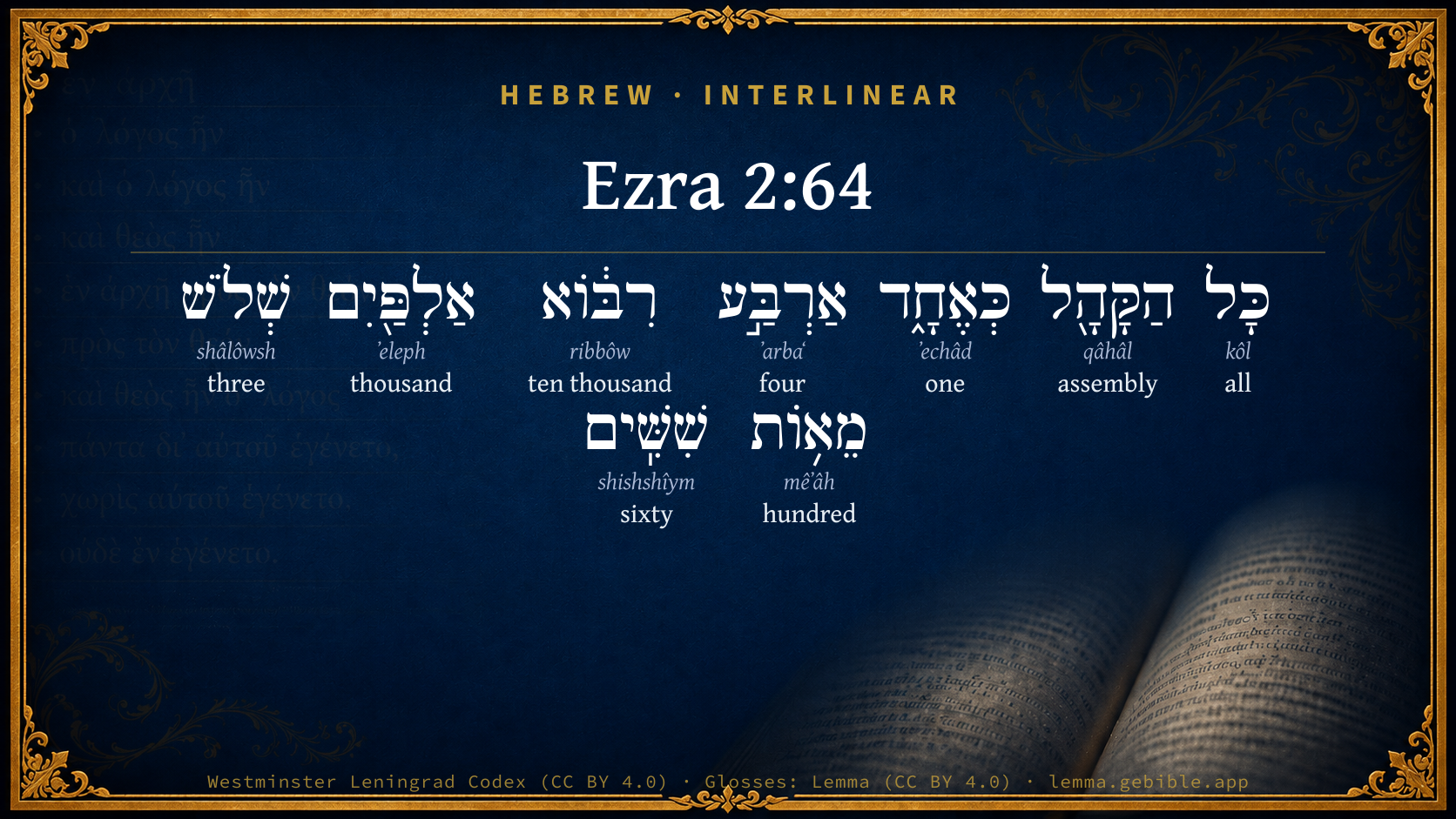
Hebrew (Westminster Leningrad Codex) Ezra 2:64 appears in the Hebrew Old Testament. The text above is from the Westminster Leningrad Codex. Each word links to its Strong’s number, a concise gloss, and parsing drawn from the Open Scriptures Hebrew Bible morphology. Click any word for its full Brown-Driver-Briggs (BDB) entry.
Download image
Cite this verse

Ezra 2:64 (World English Bible). Public Domain. Lemma interlinear Bible study tool, https://lemma.gebible.app/v/ezra/2/64.

Show BibTeX & RIS
BibTeX
RIS
English Translation
The whole assembly together was forty-two thousand three hundred sixty,
World English Bible · Public Domain
Download a study sheet

One document with this verse’s original text, its word-by-word gloss line, the meaning frame, cross-references with their text, attributed commentary, and full source and license credits — printable, and it pastes into notes with its structure intact.

This verse Autodidact and up

Study sheet (.html) Plain text (.txt)

A passage Seminary Student

Up to 50 verses in one chapter. A passage sheet keeps up to 6 commentary sources and 12 cross-references per verse, in the order this page ranks them, and says so on the sheet whenever that leaves anything out. Ask for a single verse and you get the Autodidact verse sheet above.

Everything on this page stays free to read, with no account — the sheet is a download of what is already on screen, not access to it.

Want to remove ads? Support Godless Engineer
Compare translations 3

The same verse in 3 English versions, stacked beneath the original-language interlinear above. Click any original word for its lexicon entry.

Each is an independent rendering of the whole verse — the interlinear is not word-aligned to these translations.

Highlighted words mark where these versions differ — a whole-verse word diff, not a word-by-word alignment.

  • World English Bible Public Domain
    The whole assembly together was forty-two thousand three hundred sixty,
  • King James Version Public Domain
    The whole congregation together was forty and two thousand three hundred and threescore,
  • unfoldingWord Literal Text CC BY-SA 4.0
    All the assembly, as one, was 42, 360:

unfoldingWord Literal Text — © unfoldingWord, licensed CC BY-SA 4.0. Word-aligned USFM3 via Door43 (git.door43.org/unfoldingWord/en_ult).

Versions to compare (up to 4)

3 of 4 selected

Show all 18 translations

Every available English version of this verse, each an independent rendering of the whole verse.

  • World English Bible Public Domain
    The whole assembly together was forty-two thousand three hundred sixty,
  • Berean Standard Bible Public Domain
    The whole assembly numbered 42,360,
  • Majority Standard Bible Public Domain
    The whole assembly numbered 42,360,
  • King James Version Public Domain
    The whole congregation together was forty and two thousand three hundred and threescore,
  • American Standard Version (1901) Public Domain
    The whole assembly together was forty and two thousand three hundred and threescore,
  • Revised Version (1885) Public Domain
    The whole congregation together was forty and two thousand three hundred and threescore,
  • Geneva Bible (1599) Public Domain
    The whole Congregation together was two and fourtie thousande, three hundreth and threescore,
  • Douay-Rheims (1899) Public Domain
    All the multitudes as one man, were forty-two thousand three hundred and sixty:
  • Young's Literal Translation Public Domain
    All the assembly together `is' four myriad two thousand three hundred sixty,
  • Literal Standard Version CC BY-SA 4.0
    All the assembly together [is] forty-two thousand three hundred sixty,
  • Unlocked Literal Bible CC BY-SA 4.0
    The whole group totaled 42,360,
  • unfoldingWord Literal Text CC BY-SA 4.0
    All the assembly, as one, was 42, 360:
  • Darby Bible Public Domain
    The whole congregation together was forty-two thousand three hundred and sixty,
  • World Messianic Bible Public Domain
    The whole assembly together was forty-two thousand three hundred sixty,
  • Webster's Bible Public Domain
    The whole congregation together was forty and two thousand three hundred and sixty,
  • Free Bible Version CC BY-SA 4.0
    The total of number of people returning was 42,360.
  • Bible in Basic English Public Domain
    The number of all the people together was forty-two thousand, three hundred and sixty,
  • JPS Tanakh (1917) Public Domain
    The whole congregation together was forty and two thousand three hundred and threescore,

Literal Standard Version (2020), Covenant Press — licensed CC BY-SA 4.0. Text via the HelloAO Bible API (eBible.org). Unlocked Literal Bible (unfoldingWord) — licensed CC BY-SA 4.0. Text via the HelloAO Bible API (eBible.org). unfoldingWord Literal Text — © unfoldingWord, licensed CC BY-SA 4.0. Word-aligned USFM3 via Door43 (git.door43.org/unfoldingWord/en_ult). Free Bible Version, Dr. Jonathan Gallagher — licensed CC BY-SA 4.0. Text via the HelloAO Bible API (eBible.org).

Word by word

More ways to search: Search by grammar → Find every occurrence → Compare this word →

Practice this passage: Drill this verse → Learn its vocabulary →

About this verse

These counts appear in no published source. They are computed here, from the morphology-tagged text and Lemma’s own curated glosses. What Lemma adds →

9
words
9
distinct lemmas
Historical
section

Notable vocabulary

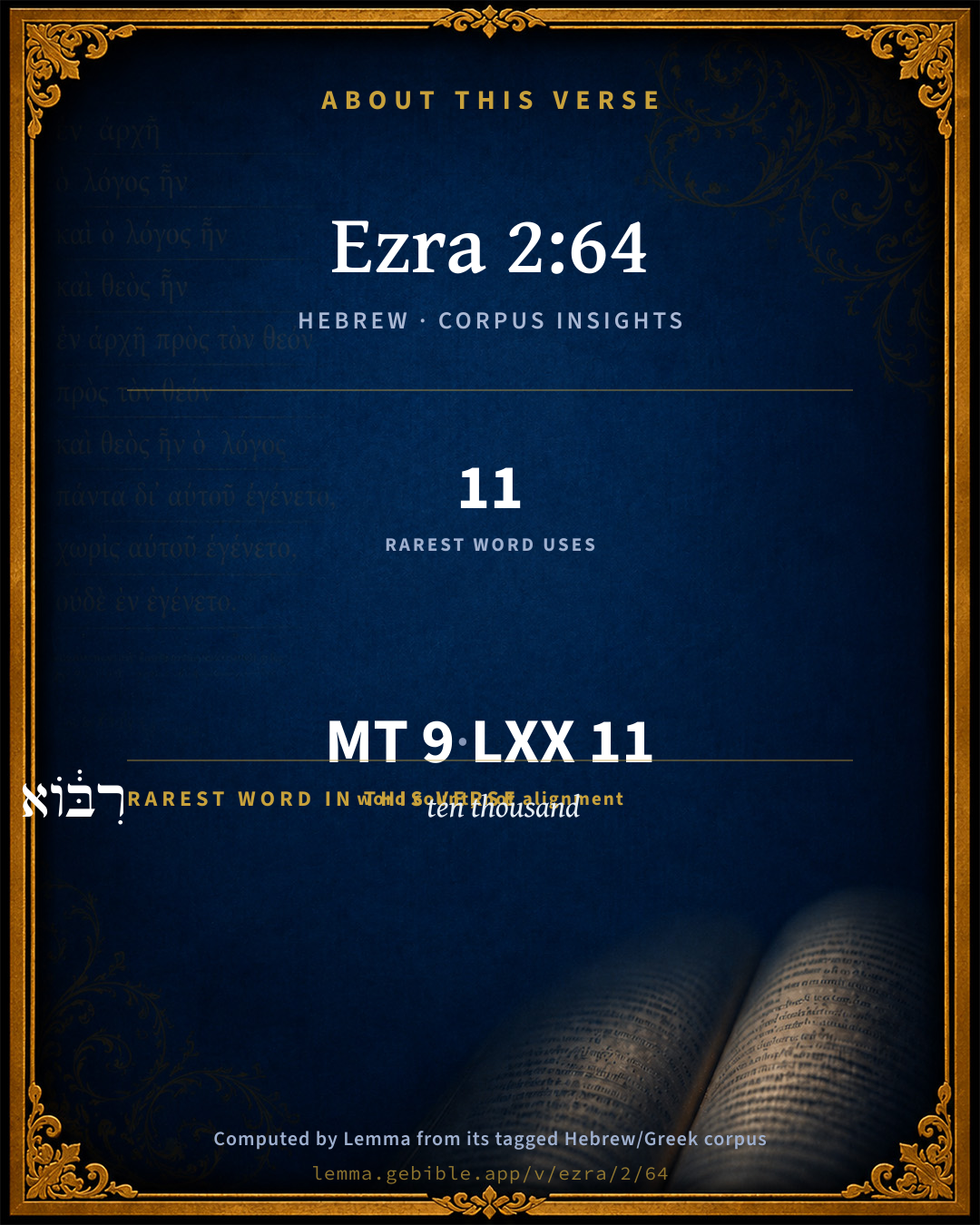
The rarest word here is רִבּ֔וֹא ten thousand H7239 — appearing just 11 times in the whole Hebrew Bible.

Shared distinctive vocabulary

רִבּ֔וֹא ten thousand H7239 occurs in 10 verses of the Hebrew Bible. Also found in:

Grammatical profile

  • 2 nouns
  • 7 adjectives

Hebrew & Septuagint length

In English translation the verse runs 10 words from the Hebrew and 13 from the Septuagint (LXX English) — closely comparable.

A rough comparison of the two English renderings, which tokenize alike — not a word-level alignment.

Word counts can differ between the Hebrew and the Greek without any difference in meaning — e.g. the Hebrew direct-object marker אֵת has no separate Greek word, and Greek often adds the article ὁ.

In the original languages it is 9 Hebrew tokens and 11 Greek tokens — but the two are counted differently (Hebrew bundles its prefixes and suffixes into one token; the Greek is in lemma form), so that isn’t a like-for-like length.

Cross-references

4

Topical passages linked to Ezra 2:64 in the Treasury of Scripture Knowledge — connected by theme and wording, ordered by reader-vote popularity; previews shown in the World English Bible.

  • Jeremiah 23:3 I will gather the remnant of my flock out of all the countries where I have driven them, and will bring them again to their folds; and they shall be fruitful and multiply.
  • Ezra 9:8 Now for a little moment grace has been shown from Yahweh our God, to leave us a remnant to escape, and to give us a nail in his holy place, that our God may lighten our eyes, and give us a little reviving in our bondage.
  • Nehemiah 7:66–69 The whole assembly together was forty-two thousand three hundred sixty,
  • Isaiah 10:20–22 It shall come to pass in that day, that the remnant of Israel, and those who are escaped of the house of Jacob, shall no more again lean on him who struck them, but shall lean on Yahweh, the Holy One of Israel, in truth.

Cross-references courtesy of OpenBible.info (CC BY 4.0).

Hebrew and Greek witnesses Masoretic Hebrew ↔ Greek Septuagint

The same verse in the two great witnesses to the Old Testament, shown verse-for-verse.

These are two independent witnesses, not word-aligned to each other, and the Septuagint is shown in lemma (dictionary) form.

Hebrew Ezra 2:64 Masoretic · Westminster Leningrad Codex

כָּל הַקָּהָ֖ל כְּאֶחָ֑ד אַרְבַּ֣ע רִבּ֔וֹא אַלְפַּ֖יִם שְׁלֹשׁ מֵא֥וֹת שִׁשִּֽׁים

The whole assembly together was forty-two thousand three hundred sixty,

World English Bible · Public Domain

Greek LXX Ezra 2:64 Septuagint · lemma form

πᾶς δέ ὁ ἐκκλησία ὡς εἷς τέσσαρες μυριάς δισχίλιοι τριακόσιοι ἑξήκοντα

And all the congregation together were about forty-two thousand three hundred and sixty;

LXX2012 (modern English Septuagint) · Public Domain

In the Septuagint this is one book — Esdras B (2 Esdras): Ezra is chapters 1–10, Nehemiah 11–23.

Hebrew: Westminster Leningrad Codex (CC BY 4.0). Greek: Septuagint (public domain); English from LXX2012 (modern English Septuagint) (Public Domain). How the Septuagint differs from the Hebrew →

Commentary

Notes on Ezra 2:64 from classic Christian and Jewish commentators (each source and its license shown beneath its notes). The classic Christian expositions comment on the surrounding passage and are grouped to its opening verse, so a note may address several verses; the Jewish commentaries on the Tanakh (Rashi and others) are per-verse, so they appear only where the commentator wrote on this verse.

Lemma curates 59 commentaries, every one of them public domain or Creative Commons licensed, each selected and text-cleaned for this edition rather than reprinted as found. About our sources →

Trapp's Complete Commentary

John Trapp

Ezr 2:64 The whole congregation together [was] forty and two thousand three hundred [and] threescore,

Ver. 64. Forty and two thousand] Ten or twelve thousand whereof seem to be of the ten tribes that were first carried captive, and, together with Judah and Benjamin, made up that Dωδεκαφυλον St Paul speaketh of, Act 26:7.

John Trapp, A Commentary or Exposition upon All the Books of the Old and New Testament (1647–1656) — public domain. Text from a community e-Sword module.

Joseph Benson's Commentary

Ezr 2:64. Forty and two thousand three hundred and threescore — This is more than double the number which were carried away captive by Nebuchadnezzar. But here occurs a small difficulty; (like that in the end of the foregoing chapter;) for if we put together the several sums before mentioned, they amount to no more than twenty-nine thousand eight hundred and eighteen; so there wants about twelve thousand to make up this number of forty-two thousand three hundred and sixty. Therefore, either these were of the rest of the tribes of Israel, who came up with those of Judah and Benjamin: or, they might be Levites or other Israelites, who could not make out their descent: or else, which is most probable, some mistake in the numbers has been made by transcribers, which might easily happen, even though in general very great care was taken.

Joseph Benson's Commentary on the Old and New Testaments (1811–1818) — public domain. Text from a community e-Sword module.

Keil & Delitzsch

C. F. Keil & F. Delitzsch

The whole number of those who returned, their servants, maids, and beasts of burden. Comp. Neh 7:66-69. - The sum-total of the congregation (כּאחד, as one, i.e., reckoned together; comp. Ezr 3:9; Ezr 6:20) is the same in both texts, as also in 1 Esdras, viz., 42,360; the sums of the separate statements being in all three different, and indeed amounting in each to less than the given total. The separate statements are as follow: -

AccordingtoEzra AccordingtoNehemiah Accordingto1 Esdras Men of Israel 24,144 25,406 26,390 Priests 4,289 4,289 2,388 Levites 341 360 341 Nethinim and servants of Solomon 392 392 372 Those who could not prove their Israelitish origin 652 642 652 Total 29,818 31,089 30,143

These differences are undoubtedly owing to mere clerical errors, and attempts to reconcile them in other ways cannot be justified. Many older expositors, both Jewish and Christian (Seder olam, Raschi, Ussher, J. H. Mich., and others), were of opinion that only Jews and Benjamites are enumerated in the separate statements, while the sum-total includes also those Israelites of the ten tribes who returned with them. In opposing this notion, it cannot, indeed, be alleged that no regard at all is had to members of the other tribes (Bertheau); for the several families of the men of Israel are not designated according to their tribes, but merely as those whom Nebuchadnezzar had taken away to Babylon; and among these would certainly be included, as Ussher expressly affirms, many belonging to the other tribes who had settled in the kingdom of Judah. But the very circumstances, that neither in the separate statements nor in the sum-total is any allusion made to tribal relations, and that even in the case of those families who could not prove their Israelitish origin the only question was as to whether they were of the houses and of the seed of Israel, exclude all distinction of tribes, and the sum-total is evidently intended to be the joint sum of the separate numbers. Nor can it be inferred, as J. D. Mich. conjectures, that because the parallel verse to Ezr 2:64 of our present chapter, viz., 1 Esdr. 5:41, reads thus, "and all of Israel from twelve years old and upwards, besides the servants and maids, were 42,360," the separate statements are therefore the numbers only of those of twenty years old and upwards, while the sum-total includes those also from twelve to twenty years of age. The addition "from twelve years and upwards" is devoid of critical value; because, if it had been genuine, the particular "from twenty years old and upwards" must have been added to the separate statements. Hence it is not even probable that the author of the 1st book of Esdras contemplated a reconciliation of the difference by this addition. In transcribing such a multitude of names and figures, errors could scarcely be avoided, whether through false readings of numbers or the omission of single items. The sum-total being alike in all three texts, we are obliged to assume its correctness.

Ezr 2:65

"Besides these, their servants and their maids, 7337." אלּה is, by the accent, connected with the preceding words. The further statement, "And there were to them (i.e., they had) 200 singing men and singing women," is striking. The remark of Bertheau, that by להם the property of the community is intended to be expressed, is incorrect; להם denotes merely computation among, and does not necessarily imply proprietorship. J. D. Mich., adopting the latter meaning, thought that oxen and cows originally stood in the text, and were changed by transcribers into singing men and singing women, "for both words closely resemble each other in appearance in the Hebrew." Berth., on the contrary, remarks that שׁורים, oxen, might easily be exchanged for שׁררים or משׁררים, but that שׁור has no feminine form for the plural, and that פּרות, cows, is very different from משׁררות; that hence we are obliged to admit that in the original text שׁורים stood alone, and that after this word had been exchanged for משׁררים, משׁררות was added as its appropriate complement. Such fanciful notions can need no serious refutation. Had animals been spoken of as property, להם would not have been used, but a suffix, as in the enumeration of the animals in Ezr 2:66. Besides, oxen and cows are not beasts of burden used in journeys, like the horses, mules, camels, and asses enumerated in Ezr 2:66, and hence are here out of place. וּמשׁררות משׁררים are singing men and singing women, in 1 Esdras ψάλται καὶ ψαλτῳδοί, who, as the Rabbis already supposed, were found among the followers of the returning Jews, ut laetior esset Israelitarum reditus. The Israelites had from of old employed singing men and singing women not merely for the purpose of enhancing the cheerfulness of festivities, but also for the singing of lamentations on sorrowful occasions; comp. Ecc 2:8; Ch2 35:25 : these, because they sang and played for hire, are named along with the servants and maids, and distinguished from the Levitical singers and players. In stead of 200, we find both in Nehemiah and 1 Esdras the number 245, which probably crept into the text from the transcriber fixing his eye upon the 245 of the following verse.

Ezr 2:66-67

The numbers of the beasts, whether for riding or baggage: horses, 736; mules, 245; camels, 435; and asses, 6720. The numbers are identical in Neh 7:68. In 1 Esdr. 5:42 the camels are the first named, and the numbers are partially different, viz., horses, 7036, and asses, 5525.

Keil & Delitzsch — Biblical Commentary on the Old Testament (1861–1891) — public domain (CC PDM 1.0). Text via the HelloAO Bible API. (Old Testament only.)

Tyndale Open Study Notes

Tyndale Open Resources

2:64-66 42,360 people: This number, which does not match the total of individuals (28,774) listed in 2:3-42, might include children. • The large number of servants and animals shows that some of the Jews who returned were wealthy.

Tyndale Open Study Notes — © Tyndale Open Resources, licensed CC BY-SA 4.0. Text via the HelloAO Bible API.

Matthew Henry's Commentary

Here is, I. The sum total of the company that returned out of Babylon. The particular sums before mentioned amount not quite to 30,000 (29,818), so that there were above 12,000 that come out into any of those accounts, who, it is probable, were of the rest of the tribes of Israel, besides Judah and Benjamin, that could not tell of what particular family or city they were, but that they were Israelites, and of what tribe. Now, 1. This was more than double the number that were carried captive into Babylon by Nebuchadnezzar, so that, as in Egypt, the time of their affliction was the time of their increase. 2. These were but few to begin a nation with, and yet, by virtue of the old promise made to their fathers, they multiplied so as before their last destruction by the Romans, about 500 years after, to be a very numerous people. When God says, "Increase and multiply," a little one shall become a thousand.

II. Their retinue. They were themselves little better than servants, and therefore no wonder that their servants were comparatively but few (Ezr 2:65) and their beasts of burden about as many, Ezr 2:66, Ezr 2:67. It was not with them now as in days past. But notice is taken of 200 singing-men and women whom they had among them, who, we will suppose, were intended (as those Ch2 35:25) to excite their mourning, for it was foretold that they should, upon this occasion, go weeping (Jer 50:4), with ditties of lamentation.

III. Their oblations. It is said (Ezr 2:68, Ezr 2:69), 1. That they came to the house of the Lord at Jerusalem; and yet that house, that holy and beautiful house, was now in ruins, a heap of rubbish. But, like their father Abraham, when the altar was gone they came with devotion to the place of the altar (Gen 13:4); and it is the character of the genuine sons of Zion that they favour even the dust thereof, Psa 102:14. 2. That they offered freely towards the setting of it up in its place. That, it seems, was the first house they talked of setting up; and though they came off a journey, and were beginning the world (two chargeable things), yet they offered, and offered freely, towards the building of the temple. Let none complain of the necessary expenses of their religion, but believe that when they come to balance the account they will find that it clears the cost. Their offering was nothing in comparison with the offerings of the princes in David's time; then they offered by talents (Ch1 29:7), now by drams, yet these drams, being after their ability, were as acceptable to God as those talents, like the widow's two mites. The 61,000 drams of gold amount, by Cumberland's calculation, to so many pounds of our money and so many groats. Every maneh, or pound of silver, he reckons to be sixty shekels (that is, thirty ounces), which we may reckon 7l. 10s. of our money, so that this 5000 pounds of silver will be above 37,000l. of our money. It seems, God had blessed them with an increase of their wealth, as well as of their numbers, in Babylon; and, as God had prospered them, they gave cheerfully to the service of his house. 3. That they dwelt in their cities, Ezr 2:70. Though their cities were out of repair, yet, because they were their cities, such as God had assigned them, they were content to dwell in them, and were thankful for liberty and property, though they had little of pomp, plenty, or power. Their poverty was a bad cause, but their unity and unanimity were a good effect of it. Here was room enough for them all and all their substance, so that there was no strife among them, but perfect harmony, a blessed presage of their settlement, as their discords in the latter times of that state were of their ruin.

Matthew Henry's Commentary on the Whole Bible (1708–1710) — public domain (CC PDM 1.0). Text via the HelloAO Bible API.

Jamieson, Fausset & Brown

Robert Jamieson, A. R. Fausset & David Brown

The whole congregation together was forty and two thousand three hundred and threescore--This gross amount is twelve thousand more than the particular numbers given in the catalogue, when added together, come to. Reckoning up the smaller numbers, we shall find that they amount to 29,818 in this chapter, and to 31,089 in the parallel chapter of Nehemiah [see Neh 7:66-69]. Ezra also mentions four hundred ninety-four persons omitted by Nehemiah, and Nehemiah mentions 1765 not noticed by Ezra. If, therefore, Ezra's surplus be added to the sum in Nehemiah, and Nehemiah's surplus to the number in Ezra, they will both become 31,583. Subtracting this from 42,360, there will be a deficiency of 10,777. These are omitted because they did not belong to Judah and Benjamin, or to the priests, but to the other tribes. The servants and singers, male and female, are reckoned separately (Ezr 2:65), so that putting all these items together, the number of all who went with Zerubbabel amounted to fifty thousand, with eight thousand beasts of burden [ALTING, quoted in DAVIDSON'S Hermeneutics].

Jamieson, Fausset & Brown — Commentary Critical and Explanatory on the Whole Bible (1871) — public domain (CC PDM 1.0). Text via the HelloAO Bible API.

Ellicott's Commentary for English Readers

(64) This sum total is the same in Nehemiah; but the several sums in Ezra make 29,818, and in Nehemiah 31,089. The apocryphal Esdras agrees in the total, but makes in the particulars 33,950, adding that children below twelve were not reckoned. Many expedients of reconciliation have been adopted; but it is better to suppose that errors had crept into the original documents.

A Bible Commentary for English Readers, edited by Charles John Ellicott (1878–1897) — public domain. Text from a community e-Sword module.

The Cambridge Bible for Schools and Colleges

gen. ed. J. J. S. Perowne

64. The same total i.e. 42,360 is given in Ezra, Nehemiah and 1 Esdras. The items however fail in all three lists to produce this figure.

Ezra

Neh.

1 Esdr.

Men of the people of Israel

24,144

25,406

26,390

Priests

4289

4289

2388

Levites

74

74

74

Singers

128

148

128

Porters

139

138

139

Nethinim and Solomon’s servants

392

392

372

Unregistered

652

642

652

Total

29,818

31,089

30,143

other MSS. 30,678

These remarkable discrepancies from the sum total in which there is so much agreement have been variously accounted for. (a) Jewish interpreters have supposed that the sum total comprised members of the ten tribes who have not been enumerated: (b) 1Es_5:41 adds the words ‘of twelve years old and upward’, and the unlikely suggestion has been made that the numbers of the totals include all over 12 years of age, although the numbers of the items included all over 20 years of age. (c) The disagreement is considered to be due to the corruptions in the text arising from copyists’ errors in transcription of numbers and signs for numbers.

Of these explanations the last seems the most probable. But it is undoubtedly strange that the three disagreeing sum totals should come within 2000 of one another and yet should fall so far short of the total figure which each text has preserved.

The Cambridge Bible for Schools and Colleges (gen. ed. J. J. S. Perowne; Cambridge University Press, 1878–1918) — public domain. Text from a community e-Sword module.

John Gill's Exposition

And some of the chief of the fathers, when they came to the house of the Lord that is at Jerusalem,.... That is, when they came to the place where it formerly stood, and where were still the ruins of it:

offered freely for the house of God, to set it up in its place; to rebuild it upon the spot where it formerly stood; this they did besides the freewill offerings they brought with them from Babylon.

John Gill's Exposition of the Whole Bible (1746–1763) — public domain (CC PDM 1.0). Text via the HelloAO Bible API.

Albert Barnes' Notes on the Bible

The sum total is given without any variation by Ezra, by Nehemiah (see the marginal reference), and by Esdras (1 Esdras 5:41), who adds, that in this reckoning only those of twelve years of age and upward were counted.

It is curious that the total 42,360, is so greatly in excess of the items. Ezra’s items make the number 29,818; Nehemiah’s 31,089, Esdras, 33,950. The original document was probably illegible in places, and the writers were forced to make omissions.

Albert Barnes' Notes on the Bible (1834–1885) — public domain. Text from a community e-Sword/MySword module.

Haydock's Catholic Bible Commentary

Forty-two thousand, &c. Those who are reckoned up above of the tribes of Juda, Benjamin, and Levi, fall short of this number. The rest, who must be taken in to make up the whole sum, were of the other tribes. (Challoner) --- This explanation is given by R. Solomon. (Worthington) --- But we have seen that cities belonging to the ten tribes are specified. See ver. 1, and 29. (Haydock) --- Some might not be able to make out their genealogies, (Calmet) ver. 62. Yet some of these also are counted, ver. 60. (Haydock) --- The particular sums may therefore be incorrect. Josephus ([Antiquities?] xi. 1,) adds 102 to the number. (Calmet) --- 3 Esdras has, "But they were all of Israel from 12 years old and upwards, exclusive of boys and girls, (or male and female servants) 42,300." Grabe has in another character "sixty. The men and women servants of these, 7300." Then the Alexandrian Manuscript continues, "thirty-seven." So that without the addition it would give for the total, 42,337. Some copies (Haydock) have 40. (Calmet) --- But the most correct (Haydock) read 60. (Kennicott) The small number of servants and cattle shew that the people were poor. (Du Hamel)

George Leo Haydock (1774–1849), Haydock's Catholic Family Bible and Commentary, 1859 edition — public domain. Excludes Psalms (Douay-Rheims chapter numbering differs from Protestant) and Deuterocanonical books (Catholic canon only).

Matthew Poole's English Annotations

The particular sums here recited come only 29,818; unto whom are added in this total sum, 12,542; which either were of the other tribes beside Judah and Benjamin, or were such as were supposed by themselves and others to be Israelites, but could not prove their pedigree by their genealogies, and therefore could not be so punctually and particularly described as the former.

Matthew Poole's English Annotations on the Holy Bible (1683–1685) — public domain. Text from a community e-Sword/MySword module.

The Pulpit Commentary

The whole congregation together was forty and two thousand three hundred and threescore. Ezra"s numbers, as given in detail (vers. 3-60), produce when added together a total of only 29, 818; Nehemiah"s items (Neh_7:8-62) give a total of 31, 089; those of the apocryphal Esdras a total of 33, 950. The three authorities agree, however, in their summation, all alike declaring that the actual number of those who returned with Zerubbabel was 42, 360. Esdras adds that children under twelve years of age are not included. If this were so, the entire number must have exceeded 50, 000 an enormous body of persons to transport a distance of above a thousand miles, according to Western experience, but one which will not surprise those acquainted with the East. In the East caravans of from ten to twenty thousand souls often traverse huge distances without serious mishap, and migrations frequently take place on a much grander scale. In the year 1771, 50, 000 families of Torgouths, reckoned to number 300, 000 souls, arrived on the frontiers of China, after a journey of 10, 000 leagues through a most difficult country, and were given lands in the Chinese empire. They were followed in the next year by 180, 000 Eleuths and others, who had accomplished a similar distance (see De Hell, "Travels," pp. 228, 229). Jenghis Khan is said to have forced 100, 000 artisans and craftsmen to emigrate in a body from Khiva into Mongolia (Howarth"s "History of the Mongols," p. 85). The transplantation of entire nations was an established practice among the Assyrians, Babylonians, and Persians.

The Pulpit Commentary (1880–1919), ed. H.D.M. Spence-Jones & Joseph S. Exell — public domain. Text from a community e-Sword module.

John Wesley's Explanatory Notes

The whole, &c. - The particular sums here recited, come only to twenty and nine thousand eight hundred and eighteen. Unto whom are added in this total sum twelve thousand five hundred and forty two. Which, either were of the other tribes beside Judah and Benjamin: or were such as were supposed to be Israelites, but could not prove their pedigree by their genealogies.

John Wesley, Explanatory Notes Upon the Whole Bible (1754–1765) — public domain. Text via the GEBible commentary corpus.

unfoldingWord translationNotes

Door43 World Missions Community

whole group

This means the whole group that returned back to the land of Judah from the exile.

42,360

"forty-two thousand three hundred and sixty" (See: Numbers)

their maidservants

"their female servants"

these were 7,337

"these were seven thousand three hundred and thirty-seven" (See: Numbers)

two hundred

"200" (See: Numbers)

translationWords

servant

temple

unfoldingWord translationNotes — © Distant Shores Media and the Door43 World Missions Community, licensed CC BY-SA 4.0. Source: git.door43.org/Door43/en_tn.

Rashi

Rabbi Shlomo Yitzchaki (Rashi)

The entire congregation together When they were all together with the priests, the Levites and the Nethinim, they amounted to this number; and the Children of Israel counted above were of the tribe of Judah and Benjamin, and those missing from this number, which you will not find above, were of the other tribes. So it is explained in Seder Olam (ch. 29): “‘The entire congregation together was forty-two thousand etc.’ But if you add them up, they are only thirty thousand. Where are the thirteen thousand? They ascended from the other tribes.”

Rashi on the Tanakh — English translations: “The Judaica Press complete Tanach with Rashi, translated by A. J. Rosenberg” (CC BY 4.0); “Pentateuch with Rashi's commentary by M. Rosenbaum and A.M. Silbermann, 1929-1934” (public domain); “The Metsudah Tanach series, Lakewood, N.J” (CC BY 4.0); and “The Book of Joshua, Metsudah Publications, 1997” (CC BY 4.0). Text via Sefaria.

Lesson kit

Teaching starters — assembled from the data on this page, not authored interpretation. Every prompt links to the verse data it draws on. Edit before teaching.

Ezra, in the Historical, opens this verse with 9 words (9 distinct Hebrew lemmas). Its most distinctive word is ribbôw (“ten thousand”). A historical commentator’s framing appears above. Read the whole chapter for the surrounding context.

Discussion questions

  1. How does “ten thousand” (ribbôw) shape what this verse is saying?
  2. 1 Chronicles 29:7 shares the word «ten thousand» with this verse. How do the two illuminate each other?
  3. The translations on this page render this verse differently — a whole-verse word diff, not a word-by-word alignment. What might account for the different wordings?
  4. Reading how Trapp's Complete Commentary and Joseph Benson's Commentary read this verse, where do the two commentators agree and where do they part?

Things to notice

Reading settings

Reading text

Shown beneath each verse's original-language words.

Old Testament
Old Testament edition

Read the OT as the Masoretic Hebrew (MT) or the Greek Septuagint (LXX).

English shown for the Greek Septuagint (in the Hebrew ↔ Greek comparison).

Comparing translations? Open the Compare panel on any verse page to stack up to four side by side.