
2 Chronicles 24:6

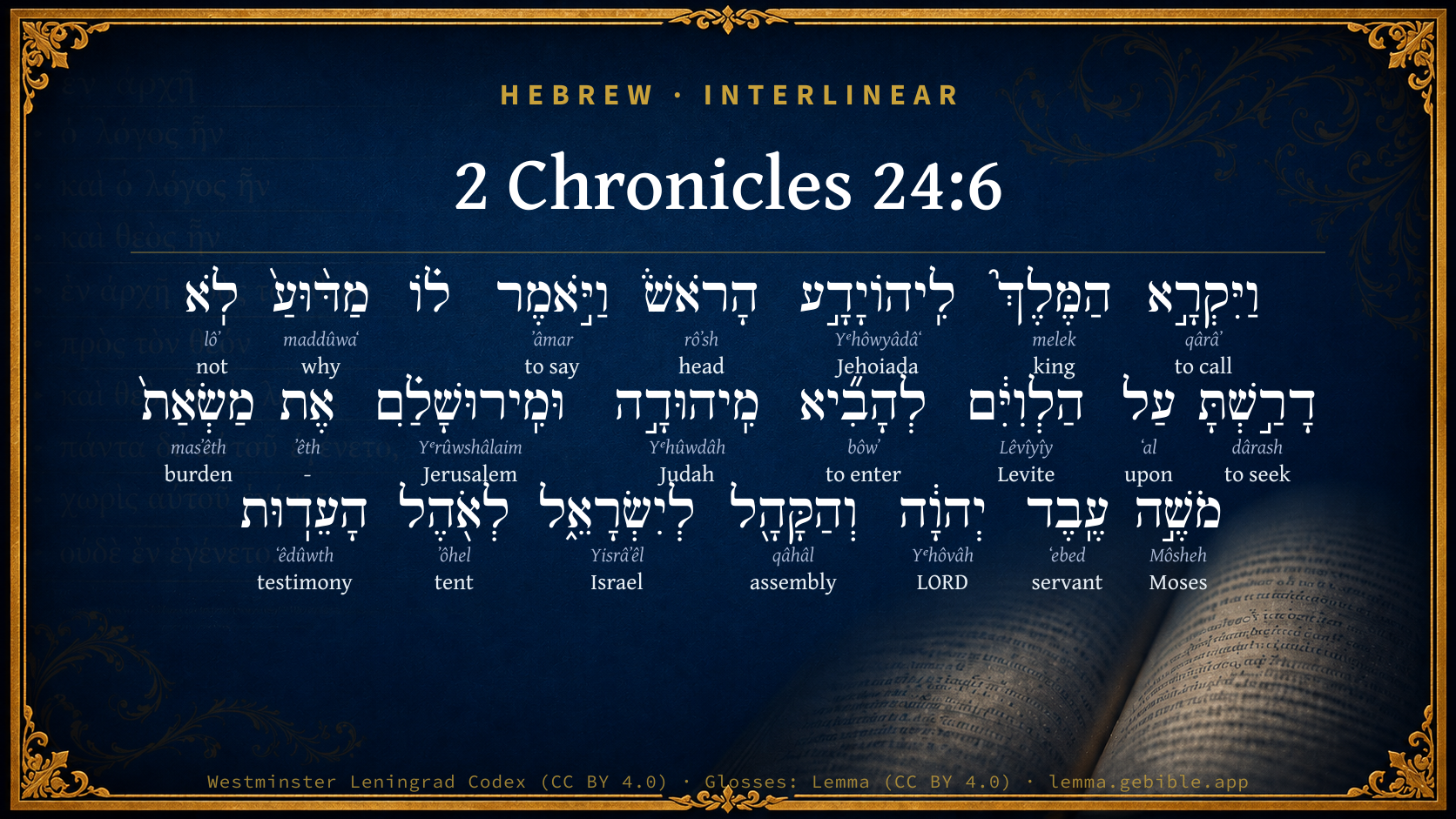
Hebrew (Westminster Leningrad Codex) 2 Chronicles 24:6 appears in the Hebrew Old Testament. The text above is from the Westminster Leningrad Codex. Each word links to its Strong’s number, a concise gloss, and parsing drawn from the Open Scriptures Hebrew Bible morphology. Click any word for its full Brown-Driver-Briggs (BDB) entry.
Download image
Cite this verse

2 Chronicles 24:6 (World English Bible). Public Domain. Lemma interlinear Bible study tool, https://lemma.gebible.app/v/2-chronicles/24/6.

Show BibTeX & RIS
BibTeX
RIS
English Translation
The king called for Jehoiada the chief, and said to him, Why haven't you required of the Levites to bring in out of Judah and out of Jerusalem the tax of Moses the servant of Yahweh, and of the assembly of Israel, for the tent of the testimony?
World English Bible · Public Domain
Download a study sheet

One document with this verse’s original text, its word-by-word gloss line, the meaning frame, cross-references with their text, attributed commentary, and full source and license credits — printable, and it pastes into notes with its structure intact.

This verse Autodidact and up

Study sheet (.html) Plain text (.txt)

A passage Seminary Student

Up to 50 verses in one chapter. A passage sheet keeps up to 6 commentary sources and 12 cross-references per verse, in the order this page ranks them, and says so on the sheet whenever that leaves anything out. Ask for a single verse and you get the Autodidact verse sheet above.

Everything on this page stays free to read, with no account — the sheet is a download of what is already on screen, not access to it.

Want to remove ads? Support Godless Engineer
Compare translations 3

The same verse in 3 English versions, stacked beneath the original-language interlinear above. Click any original word for its lexicon entry.

Each is an independent rendering of the whole verse — the interlinear is not word-aligned to these translations.

Highlighted words mark where these versions differ — a whole-verse word diff, not a word-by-word alignment.

  • World English Bible Public Domain
    The king called for Jehoiada the chief, and said to him, Why haven't you required of the Levites to bring in out of Judah and out of Jerusalem the tax of Moses the servant of Yahweh, and of the assembly of Israel, for the tent of the testimony?
  • King James Version Public Domain
    And the king called for Jehoiada the chief, and said unto him, Why hast thou not required of the Levites to bring in out of Judah and out of Jerusalem the collection, according to the commandment of Moses the servant of the LORD, and of the congregation of Israel, for the tabernacle of witness?
  • unfoldingWord Literal Text CC BY-SA 4.0
    And the king called for Jehoiada the head, and he said to him, “Why did you not seek after the Levites to bring in from Judah and from Jerusalem the tribute of Moses, the servant of Yahweh, and of the assembly of Israel for the tent of the testimony?”

unfoldingWord Literal Text — © unfoldingWord, licensed CC BY-SA 4.0. Word-aligned USFM3 via Door43 (git.door43.org/unfoldingWord/en_ult).

Versions to compare (up to 4)

3 of 4 selected

Show all 18 translations

Every available English version of this verse, each an independent rendering of the whole verse.

  • World English Bible Public Domain
    The king called for Jehoiada the chief, and said to him, Why haven't you required of the Levites to bring in out of Judah and out of Jerusalem the tax of Moses the servant of Yahweh, and of the assembly of Israel, for the tent of the testimony?
  • Berean Standard Bible Public Domain
    So the king called Jehoiada the high priest and said, “Why have you not required the Levites to bring from Judah and Jerusalem the tax imposed by Moses the servant of the LORD and by the assembly of Israel for the Tent of the Testimony?”
  • Majority Standard Bible Public Domain
    So the king called Jehoiada the high priest and said, “Why have you not required the Levites to bring from Judah and Jerusalem the tax imposed by Moses the servant of the LORD and by the assembly of Israel for the Tent of the Testimony?”
  • King James Version Public Domain
    And the king called for Jehoiada the chief, and said unto him, Why hast thou not required of the Levites to bring in out of Judah and out of Jerusalem the collection, according to the commandment of Moses the servant of the LORD, and of the congregation of Israel, for the tabernacle of witness?
  • American Standard Version (1901) Public Domain
    And the king called for Jehoiada the chief, and said unto him, Why hast thou not required of the Levites to bring in out of Judah and out of Jerusalem the tax of Moses the servant of Jehovah, and of the assembly of Israel, for the tent of the testimony?
  • Revised Version (1885) Public Domain
    And the king called for Jehoiada the chief, and said unto him, Why hast thou not required of the Levites to bring in out of Judah and out of Jerusalem the tax of Moses the servant of the LORD, and of the congregation of Israel, for the tent of the testimony?
  • Geneva Bible (1599) Public Domain
    Therefore the King called Iehoiada, the chiefe, and said vnto him, Why hast thou not required of the Leuites to bring in out of Iudah and Ierusalem the taxe of Moses the seruant of the Lord, and of the Congregation of Israel, for the Tabernacle of the testimonie?
  • Douay-Rheims (1899) Public Domain
    And the king called Joiada the chief, and said to him: Why hast thou not taken care to oblige the Levites to bring in out of Juda and Jerusalem the money that was appointed by Moses the servant of the Lord for all the multitude of Israel to bring into the tabernacle of the testimony?
  • Young's Literal Translation Public Domain
    And the king calleth for Jehoiada the head, and saith to him, `Wherefore hast thou not required of the Levites to bring in out of Judah and out of Jerusalem the tribute of Moses, servant of Jehovah, and of the assembly of Israel, for the tent of the testimony?
  • Literal Standard Version CC BY-SA 4.0
    And the king calls for Jehoiada the head and says to him, “Why have you not required of the Levites to bring in out of Judah and out of Jerusalem the tribute of Moses, servant of YHWH, and of the assembly of Israel, for the Tent of the Testimony?
  • Unlocked Literal Bible CC BY-SA 4.0
    So the king called for Jehoiada the high priest and said to him, “Why have you not required the Levites to bring in from Judah and Jerusalem the tax levied by Moses the servant of Yahweh and by the assembly of Israel for the tent of the covenant decrees?”
  • unfoldingWord Literal Text CC BY-SA 4.0
    And the king called for Jehoiada the head, and he said to him, “Why did you not seek after the Levites to bring in from Judah and from Jerusalem the tribute of Moses, the servant of Yahweh, and of the assembly of Israel for the tent of the testimony?”
  • Darby Bible Public Domain
    And the king called for Jehoiada the chief, and said to him, Why hast thou not required of the Levites to bring in out of Judah and out of Jerusalem the tribute of Moses the servant of Jehovah [laid upon] the congregation of Israel, for the tent of the testimony?
  • World Messianic Bible Public Domain
    The king called for Jehoiada the chief, and said to him, “Why haven’t you required of the Levites to bring in the tax of Moses the servant of the LORD, and of the assembly of Israel, out of Judah and out of Jerusalem, for the Tent of the Testimony?”
  • Webster's Bible Public Domain
    And the king called for Jehoiada the chief, and said to him, Why hast thou not required of the Levites to bring in out of Judah and out of Jerusalem the collection, according to the commandment of Moses the servant of the LORD, and of the congregation of Israel, for the tabernacle of witness?
  • Free Bible Version CC BY-SA 4.0
    So the king called for Jehoiada the high priest and asked him, “Why haven't you ordered the Levites to collect from Judah and Jerusalem the tax that Moses, the Lord's servant, and the assembly of Israel imposed to maintain the Tent of the Law?”
  • Bible in Basic English Public Domain
    Then the king sent for Jehoiada, the chief priest, and said to him, Why have you not given the Levites orders that the tax fixed by Moses, the servant of the Lord, and by the meeting of Israel, for the Tent of witness, is to be got in from Judah and Jerusalem and handed over?
  • JPS Tanakh (1917) Public Domain
    And the king called for Jehoiada the chief, and unto him: 'Why hast thou not required of the Levites to bring in out of Judah and out of Jerusalem the tax of Moses the servant of the LORD, and of the congregation of Israel, for the tent of the testimony?'

Literal Standard Version (2020), Covenant Press — licensed CC BY-SA 4.0. Text via the HelloAO Bible API (eBible.org). Unlocked Literal Bible (unfoldingWord) — licensed CC BY-SA 4.0. Text via the HelloAO Bible API (eBible.org). unfoldingWord Literal Text — © unfoldingWord, licensed CC BY-SA 4.0. Word-aligned USFM3 via Door43 (git.door43.org/unfoldingWord/en_ult). Free Bible Version, Dr. Jonathan Gallagher — licensed CC BY-SA 4.0. Text via the HelloAO Bible API (eBible.org).

Word by word

More ways to search: Search by grammar → Find every occurrence → Compare this word →

Practice this passage: Drill this verse → Learn its vocabulary →

מַשְׂאַת֙
masʼêth
H4864
“burden of”
Noun, Common, Feminine, Singular, Construct
Part of Speech
Noun
Type
Common
Gender
Feminine
Number
Singular
State
Construct
Full BDB Definition

Origin: from \H5375\\

TWOT: 1421h

uprising, utterance, burden, portion, uplifting - that which rises, uprising, uplifting, signal, rising - utterance, oracle - burden - portion, present, largesse, gift, contribution, offering, tribute
  1. וַיִּקְרָ֣א qârâʼ H7121 “and · to call” Conjunction + Verb, Qal, Sequential Imperfect, 3rd Person, Masculine, Singular
  2. הַמֶּלֶךְ֮ melek H4428 “the · king” Particle, Definite Article + Noun, Common, Masculine, Singular, Absolute
  3. לִֽיהוֹיָדָ֣ע Yᵉhôwyâdâʻ H3077 “to/for · Jehoiada” Preposition + Noun, Proper
  4. הָרֹאשׁ֒ rôʼsh H7218 “the · head” Particle, Definite Article + Noun, Common, Masculine, Singular, Absolute
  5. וַיֹּ֣אמֶר ʼâmar H559 “and · to say” Conjunction + Verb, Qal, Sequential Imperfect, 3rd Person, Masculine, Singular
  6. מַדּ֨וּעַ֙ maddûwaʻ H4069 “why” Particle, Interrogative
  7. לֹֽא lôʼ H3808 “not” Particle, Negative
  8. דָרַ֣שְׁתָּ dârash H1875 “to seek” Verb, Qal, Perfect, 2nd Person, Masculine, Singular
  9. עַל ʻal H5921 “upon” Preposition
  10. הַלְוִיִּ֔ם Lêvîyîy H3881 “the · Levites” Particle, Definite Article + Noun, Gentilic, Masculine, Plural, Absolute
  11. לְהָבִ֞יא bôwʼ H935 “to enter” Preposition + Verb, Hiphil, Infinitive Construct
  12. מִֽיהוּדָ֣ה Yᵉhûwdâh H3063 “from · Judah” Preposition + Noun, Proper
  13. וּמִֽירוּשָׁלִַ֗ם Yᵉrûwshâlaim H3389 “and · from · Jerusalem” Conjunction + Preposition + Noun, Proper
  14. אֶת ʼêth H853 “-” Particle, Direct Object
  15. מֹשֶׁ֣ה Môsheh H4872 “Moses” Noun, Proper
  16. עֶֽבֶד ʻebed H5650 “servant of” Noun, Common, Masculine, Singular, Construct
  17. יְהוָ֔ה Yᵉhôvâh H3068 “LORD” Noun, Proper
  18. וְהַקָּהָ֖ל qâhâl H6951 “and · the · assembly” Conjunction + Particle, Definite Article + Noun, Common, Masculine, Singular, Absolute
  19. לְיִשְׂרָאֵ֑ל Yisrâʼêl H3478 “to/for · Israel” Preposition + Noun, Proper
  20. לְאֹ֖הֶל ʼôhel H168 “to/for · tent of” Preposition + Noun, Common, Masculine, Singular, Construct
  21. הָעֵדֽוּת ʻêdûwth H5715 “the · testimony” Particle, Definite Article + Noun, Common, Feminine, Singular, Absolute

About this verse

These counts appear in no published source. They are computed here, from the morphology-tagged text and Lemma’s own curated glosses. What Lemma adds →

23
words
22
distinct lemmas
Historical
section

Notable vocabulary

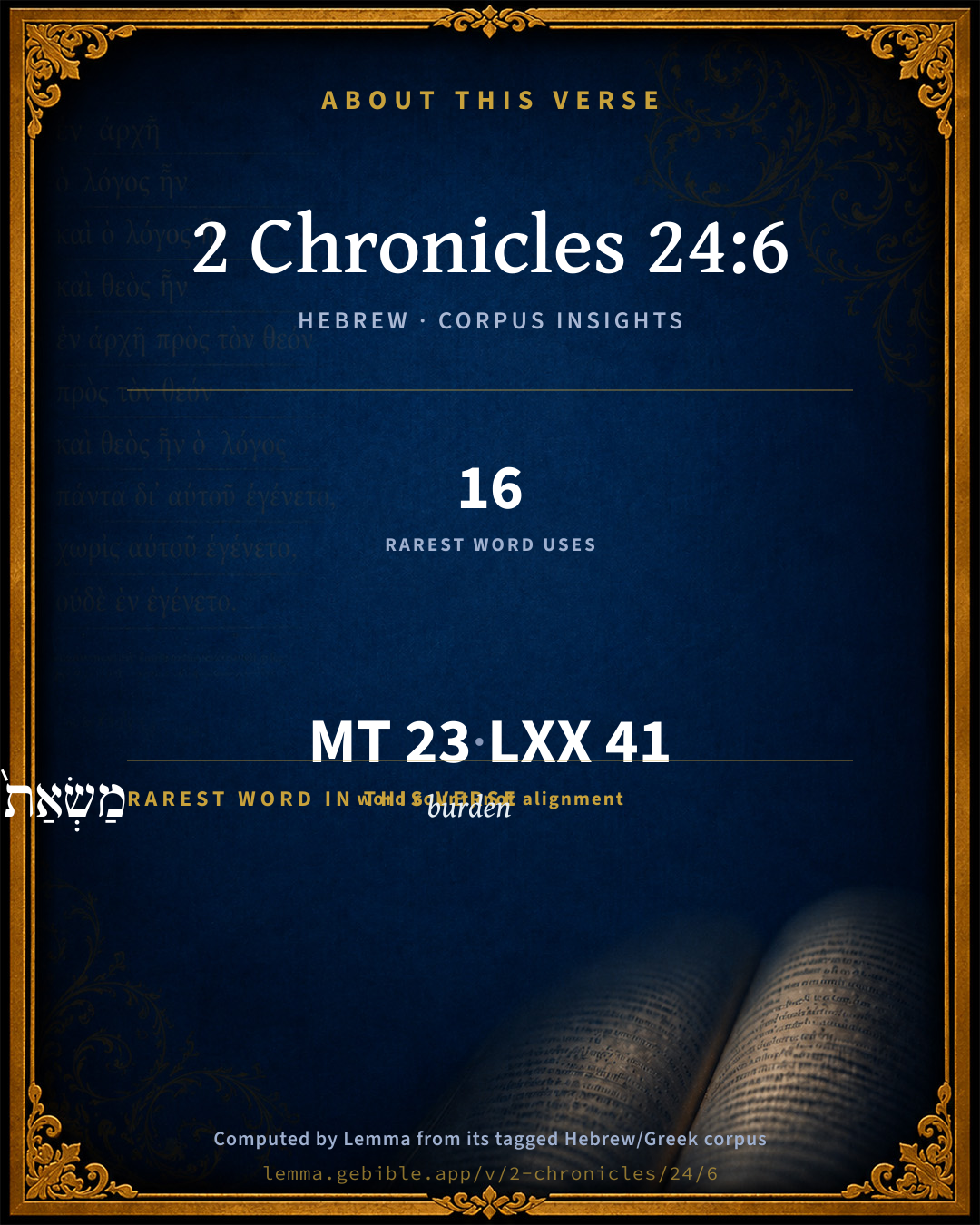
The rarest word here is מַשְׂאַת֙ burden H4864 — appearing just 16 times in the whole Hebrew Bible.

Shared distinctive vocabulary

מַשְׂאַת֙ burden H4864 occurs in 14 verses of the Hebrew Bible. Also found in:

Grammatical profile

  • 4 verbs
  • 14 nouns
  • 2 prepositions
  • 3 particles

Verb forms

  • וַיִּקְרָ֣א Qal · Sequential Imperfect
  • וַיֹּ֣אמֶר Qal · Sequential Imperfect
  • דָרַ֣שְׁתָּ Qal · Perfect
  • לְהָבִ֞יא Hiphil · Infinitive Construct

Hebrew & Septuagint length

In English translation the verse runs 48 words from the Hebrew and 47 from the Septuagint (LXX English) — closely comparable.

A rough comparison of the two English renderings, which tokenize alike — not a word-level alignment.

Word counts can differ between the Hebrew and the Greek without any difference in meaning — e.g. the Hebrew direct-object marker אֵת has no separate Greek word, and Greek often adds the article ὁ.

In the original languages it is 23 Hebrew tokens and 41 Greek tokens — but the two are counted differently (Hebrew bundles its prefixes and suffixes into one token; the Greek is in lemma form), so that isn’t a like-for-like length.

Cross-references

6

Topical passages linked to 2 Chronicles 24:6 in the Treasury of Scripture Knowledge — connected by theme and wording, ordered by reader-vote popularity; previews shown in the World English Bible.

  • Exodus 30:12–16 "When you take a census of the children of Israel, according to those who are numbered among them, then each man shall give a ransom for his soul to Yahweh, when you number them; that there be no plague among them when you number them.
  • Numbers 1:50 but appoint the Levites over the Tabernacle of the Testimony, and over all its furnishings, and over all that belongs to it. They shall carry the tabernacle, and all its furnishings; and they shall take care of it, and shall encamp around it.
  • Numbers 17:7–8 Moses laid up the rods before Yahweh in the tent of the testimony.
  • Numbers 18:2 Your brothers also, the tribe of Levi, the tribe of your father, bring you near with you, that they may be joined to you, and minister to you: but you and your sons with you shall be before the tent of the testimony.
  • 2 Samuel 24:3 Joab said to the king, Now Yahweh your God add to the people, however many they may be, one hundred times; and may the eyes of my lord the king see it: but why does my lord the king delight in this thing?
  • Acts 7:44 "Our fathers had the tent of the testimony in the wilderness, even as he who spoke to Moses commanded him to make it according to the pattern that he had seen;

Cross-references courtesy of OpenBible.info (CC BY 4.0).

Hebrew and Greek witnesses Masoretic Hebrew ↔ Greek Septuagint

The same verse in the two great witnesses to the Old Testament, shown verse-for-verse.

These are two independent witnesses, not word-aligned to each other, and the Septuagint is shown in lemma (dictionary) form.

Hebrew 2 Chronicles 24:6 Masoretic · Westminster Leningrad Codex

וַיִּקְרָ֣א הַמֶּלֶךְ֮ לִֽיהוֹיָדָ֣ע הָרֹאשׁ֒ וַיֹּ֣אמֶר ל֗וֹ מַדּ֨וּעַ֙ לֹֽא דָרַ֣שְׁתָּ עַל הַלְוִיִּ֔ם לְהָבִ֞יא מִֽיהוּדָ֣ה וּמִֽירוּשָׁלִַ֗ם אֶת מַשְׂאַת֙ מֹשֶׁ֣ה עֶֽבֶד יְהוָ֔ה וְהַקָּהָ֖ל לְיִשְׂרָאֵ֑ל לְאֹ֖הֶל הָעֵדֽוּת

The king called for Jehoiada the chief, and said to him, Why haven't you required of the Levites to bring in out of Judah and out of Jerusalem the tax of Moses the servant of Yahweh, and of the assembly of Israel, for the tent of the testimony?

World English Bible · Public Domain

Greek LXX 2 Chronicles 24:6 Septuagint · lemma form

καί καλέω ὁ βασιλεύς ιωας ὁ ιωδαε ὁ ἄρχων καί εἶπον αὐτός διά τίς οὐ ἐπισκέπτομαι περί ὁ λευείτης ὁ εἰςφέρω ἀπό ἰουδά καί ἰερουσαλήμ ὁ κρίνω ὑπό μωυσῆ ἄνθρωπος ὁ θεός ὅτε ἐκκλησιάζω ὁ ἰσραήλ εἰς ὁ σκηνή ὁ μαρτύριον

And king Joas called Jodae the chief, and said to him, Why have you not looked after the Levites, so that they should bring from Juda and Jerusalem that which was prescribed by Moses the man of God, when he assembled Israel at the tabernacle of witness?

LXX2012 (modern English Septuagint) · Public Domain

On this verse, Ellicott's Commentary for English Readers discusses the Septuagint’s reading. Read the note in Commentary ↓

Hebrew: Westminster Leningrad Codex (CC BY 4.0). Greek: Septuagint (public domain); English from LXX2012 (modern English Septuagint) (Public Domain). How the Septuagint differs from the Hebrew →

Commentary

Notes on 2 Chronicles 24:6 from classic Christian and Jewish commentators (each source and its license shown beneath its notes). The classic Christian expositions comment on the surrounding passage and are grouped to its opening verse, so a note may address several verses; the Jewish commentaries on the Tanakh (Rashi and others) are per-verse, so they appear only where the commentator wrote on this verse.

Lemma curates 59 commentaries, every one of them public domain or Creative Commons licensed, each selected and text-cleaned for this edition rather than reprinted as found. About our sources →

Trapp's Complete Commentary

John Trapp

2Ch 24:6 And the king called for Jehoiada the chief, and said unto him, Why hast thou not required of the Levites to bring in out of Judah and out of Jerusalem the collection, [according to the commandment] of Moses the servant of the LORD, and of the congregation of Israel, for the tabernacle of witness?

Ver. 6. Why hast thou not?] Wonder that Jehoiada should need a chiding from Joash. See 2Ki 12:7.

The collection, according to the commandment of Moses.] Heb., The collection of Moses, i.e., such as Moses used. {Exo 30:12; Exo 30:16; Exo 25:2-9} to the which this was somewhat like, and therefore thus called. See the like, 2Ki 12:7 Jdg 1:11, &c.

John Trapp, A Commentary or Exposition upon All the Books of the Old and New Testament (1647–1656) — public domain. Text from a community e-Sword module.

Joseph Benson's Commentary

2Ch 24:6. The king called for Jehoiada the chief — It is observable, that he is not called the chief priest, or high-priest, but only the chief, or the head; which he might be in many other respects, either by reason of his near relation to the royal family, or because he was the chief of one of the twenty-four families. And the high-priest seems to be mentioned as a distinct person from Jehoiada, 2Ki 12:9-10; which things make it questionable whether Jehoiada was the high-priest or not.

Joseph Benson's Commentary on the Old and New Testaments (1811–1818) — public domain. Text from a community e-Sword module.

Geneva Bible (1599)

Geneva Bible translators

For he was the high Priest.

Geneva Bible (1599) marginal notes — public domain. Text via Bolls.life.

Adam Clarke's Commentary

Verse 6. The collection - of Moses] This was the poll-tax, fixed by Moses, of half a shekel, which was levied on every man from twenty years old and upward; and which was considered as a ransom for their souls, that there might be no plague among them. See Ex 30:12-14.

Adam Clarke's Commentary on the Bible (1810–1826) — public domain. Text from a community e-Sword/MySword module.

Ellicott's Commentary for English Readers

(6) And the king called for Jehoiada.—So 2Ki_12:7.

The chief.—Literally, the head, i.e., of the sacerdotal caste. Usually kôhçn, “priest,” is added, as in 2Ch_19:11; 2Ch_26:20. Kings has simply “the priest,” adding “and for the priests.”

Why hast thou not required of the Levites.—Or, Why hast thou not attended to the Levites (comp. 2Ch_31:9), that they might bring . . .? (i.e., seen about the Levites bringing). LXX., Διὰ τί οὐκ ἐπεσκέψω περὶ τῶν Λευιτῶν τοῦ εἰσενέγκαι, κ.τ.λ.

The collection.—Rather, the tax (Eze_20:40). “The tax of Moses” is not the poll-tax of half-a-shekel, for the sanctuary, imposed Exo_30:12-16, and collected Exo_38:25-26; but rather a general designation of the moneys mentioned in 2 Kings 12:25. (See Note on 2Ch_24:4, supra.)

For the tabernacle of witness.—Or, the tent of the testimony (Num_9:15; comp. Note on 2Ch_23:11); i.e., the “Tent of the Law.”

In Kings, the question of Joash is, “Why are ye not repairing the breaches of the house?” He then continues: “And now, receive not money from your acquaintances, for the breaches of the house ye should give it” (scil., instead of appropriating it yourselves). In consequence, “the priests obeyed so as not to take money from the people, and not to repair the breaches of the house” (2Ki_12:8).

A Bible Commentary for English Readers, edited by Charles John Ellicott (1878–1897) — public domain. Text from a community e-Sword module.

The Cambridge Bible for Schools and Colleges

gen. ed. J. J. S. Perowne

6. of the Levites] See note on 2Ch_24:5.

the collection, according to the commandment of Moses] R.V. the tax of Moses; cp. Exo_30:14-16; Exo_38:25-26.

the taberna43cle of Witness] R.V. the tent of the testimony. “The testimony” refers to the Ten Commandments, which contained the substance of God’s testimony (protestation) to Israel. The two tables of stone were called “tables of the testimony” (Exo_31:18, R.V.); the ark which contained them was called the “ark of the testimony” (Exo_25:22); the vail which hung before the ark was the “vail of the testimony” (Lev_24:3); the tent which contained the ark was either the “tabernacle (Heb. miskan) of the testimony” (Exo_38:21, R.V.) or the “tent (Heb. ôhel) of the testimony” (Num_9:15). The tabernacle, with all its contents, was to be a standing protest to Israel that Jehovah was with His people according to covenant, and that every breach of the covenant would call forth punishment. Cp. Deu_4:25-26; Deu_8:19, etc.

The Cambridge Bible for Schools and Colleges (gen. ed. J. J. S. Perowne; Cambridge University Press, 1878–1918) — public domain. Text from a community e-Sword module.

John Gill's Exposition

For the sons of Athaliah, that wicked woman,.... Not Ahaziah and his brethren, in the lifetime of Jehoram, but sons of Athaliah by another man, as Kimchi suggests:

had broken up the house of God; not that they had made ruptures in it, or broke down the walls of it, but had defaced it by taking off the gold and silver upon it:

and also all the dedicated things of the house of the Lord did they bestow upon Baalim; not strictly all, but a great many of them, as this word in many instances is used, as Kimchi observes, and with them furnished, beautified, and adorned the temple of Baal.

John Gill's Exposition of the Whole Bible (1746–1763) — public domain (CC PDM 1.0). Text via the HelloAO Bible API.

Albert Barnes' Notes on the Bible

It appears from 2Ki 12:4 that Joash had assigned to the restoration-fund two other payments also.

Albert Barnes' Notes on the Bible (1834–1885) — public domain. Text from a community e-Sword/MySword module.

Haydock's Catholic Bible Commentary

Chief "priest," (v. 11,) where he is called the first. Heb. "the head priest."

George Leo Haydock (1774–1849), Haydock's Catholic Family Bible and Commentary, 1859 edition — public domain. Excludes Psalms (Douay-Rheims chapter numbering differs from Protestant) and Deuterocanonical books (Catholic canon only).

Matthew Poole's English Annotations

Jehoiada the chief: it is observable, that he is not called the chief priest, or high priest, but only

the chief, or &c the head, which he might be in many other respects, either by reason of his near relation to the royal family; or because he was the chief of one of the twenty-four families; or because he had been the chief man in the contriving and bringing about of this great change, and the general of the forces employed about it. And the high priest seems to be mentioned as a distinct person from Jehoiada here, 2Ki 12:9,10; all which make it questionable whether Jehoiada was the high priest or no.

The collection, according to the commandment of Moses, Heb. the collection of Moses, i.e. such a one as he commanded or made in the like case; of which See Poole "2Ch 24:5". In like manner we read of the sins of Manasseh, 2Ki 24:3, and of the sin of Jeroboam frequently.

Matthew Poole's English Annotations on the Holy Bible (1683–1685) — public domain. Text from a community e-Sword/MySword module.

The Pulpit Commentary

Jehoiada the chief; so. priest, for comp. our ver. 11; 2Ch_19:11 2Ch_26:20. In each of those instances the Hebrew text shows varh; and the Authorized Version "chief" except inconsistently in our ver. 11. Revised Version "chief" in all the instances. The name "priest" occurs just about six hundred and sixty-six times in the Old Testament, the title "high" or "chief priest" only about twenty-six times, the first occurrence being in Lev_21:10, the last Zec_6:11; and both set forth by the Hebrew adjective lwOdG as also in fifteen other of the occurrences. Seven times the word vaOr is the word employed, and yrec; the other two times. In these last two cases, however, (Ezr_8:24, 29 10:5) it is not "high priests" nor "chief priests" that are perhaps even really intended, but the "princes" of the priests, or those who, for whatever reasons of personal characteristics, were chief. Out of Judah and out of Jerusalem. The statement here is precise, that the call of money was to be made both in the cities of Judah and in the metropolis Jerusalem. The collection; Hebrew, tavm; Revised Version, better, the tax of, etc. Of this we read in Exo_30:13-15 Exo_38:25, Exo_38:26; Num_1:30. It was of the uniform amount of half a sanctuary shekel, for rich or poor, and was ordered to be set apart "for the service of the tabernacle of the conregation," here called in the Authorized Version the tabernacle of witness; Revised Version, the tent of the testimony. Exodus has dewOm for our tWdej. This source of money for the holy design of Joash is again most specifically stated in our ver. 9. The version of this whole transaction seems rather confusing as given in the parallel, where ver. 4 mentions three sources of money, without any quotation as such of the ordained tax of Moses, which was apparently the first of those three, and where ver. 8, at first blush at any rate, might seem to imply recusant priests. The meaning, however, is probably the contrary, the verse purporting that the priests consented to forego what they had been accustomed on receiving to apply to some personal or current-funds purpose, and who consented to forego the superintending of the outlay of the money on. the repairing, that it might be done with more expedition by "scribe" and high priest" (ver. 10; comp. ver. 16; both of the parallel). All these details the writer of Chronicles passes over, only pursuing the essential business, Joash"s pious resolve, the delay in its execution, and how he finally overcame the obstructive delay.

The Pulpit Commentary (1880–1919), ed. H.D.M. Spence-Jones & Joseph S. Exell — public domain. Text from a community e-Sword module.

John Wesley's Explanatory Notes

The chief - It is observable, that he is not called the chief priest, or high-priest, but only the chief, or the head, which he might be in many other respects, either by reason of his near relation to the royal family: or because he was the chief of one of the twenty- four families.

John Wesley, Explanatory Notes Upon the Whole Bible (1754–1765) — public domain. Text via the GEBible commentary corpus.

unfoldingWord translationNotes

Door43 World Missions Community

Why have you not required the Levites ... covenant decrees?

King Joash asks this rhetorical question to accuse Jehoiada of not doing his duty. It can be translated as a statement. AT: "You have neglected your duty. I told you to require the Levites ... covenant decrees, but you have not done it." (See: Rhetorical Question)

for the tent of the covenant decrees

Although it refers to the temple that Solomon built, it is a reminder that this tax has been collected since the time of Moses and the "tent of meeting."

holy things

This refers to the items used for worship in the temple.

to the Baals

"to people to use for the worship of idols of Baal"

translationWords

high priest

Jerusalem

tax

Moses

servant

assembly

tent

covenant

decree

Athaliah

evil

Baal

unfoldingWord translationNotes — © Distant Shores Media and the Door43 World Missions Community, licensed CC BY-SA 4.0. Source: git.door43.org/Door43/en_tn.

Rashi

Rabbi Shlomo Yitzchaki (Rashi)

the tax of Moses the servant of the Lord i.e., the shekels which he mandated upon them in the desert.

the tax of - Heb. מַשְׂאַת, reminiscent of (Exod. 30:12): “When you take (כִּי תִשָּׂא) [the sum].”

Rashi on the Tanakh — English translations: “The Judaica Press complete Tanach with Rashi, translated by A. J. Rosenberg” (CC BY 4.0); “Pentateuch with Rashi's commentary by M. Rosenbaum and A.M. Silbermann, 1929-1934” (public domain); “The Metsudah Tanach series, Lakewood, N.J” (CC BY 4.0); and “The Book of Joshua, Metsudah Publications, 1997” (CC BY 4.0). Text via Sefaria.

Lesson kit

Teaching starters — assembled from the data on this page, not authored interpretation. Every prompt links to the verse data it draws on. Edit before teaching.

2 Chronicles, in the Historical, opens this verse with 23 words (22 distinct Hebrew lemmas). Its most distinctive word is masʼêth (“burden”). A historical commentator’s framing appears above. Read the whole chapter for the surrounding context.

Discussion questions

  1. What does “burden” (masʼêth) contribute to the verse as a whole?
  2. Genesis 43:34 shares the word «burden» with this verse. How do the two illuminate each other?
  3. These translations render this verse differently. What is at stake in choosing one wording over another?
  4. The verb «וַיִּקְרָ֣א» is Qal Sequential Imperfect. How does its form color the action?
  5. Reading how Trapp's Complete Commentary and Joseph Benson's Commentary read this verse, where do the two commentators agree and where do they part?

Things to notice

Reading settings

Reading text

Shown beneath each verse's original-language words.

Old Testament
Old Testament edition

Read the OT as the Masoretic Hebrew (MT) or the Greek Septuagint (LXX).

English shown for the Greek Septuagint (in the Hebrew ↔ Greek comparison).

Comparing translations? Open the Compare panel on any verse page to stack up to four side by side.