
2 Chronicles 1:5

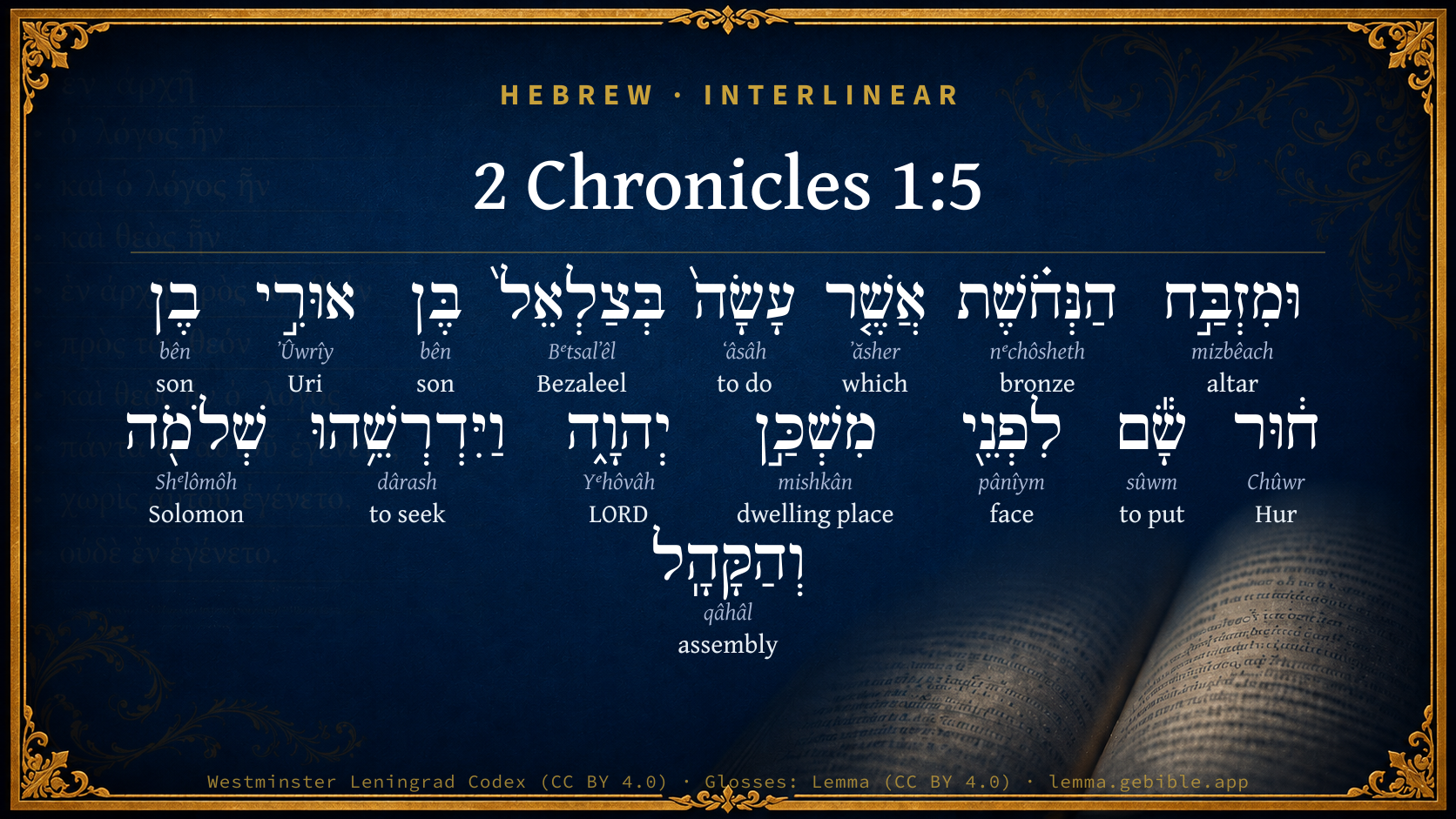
Hebrew (Westminster Leningrad Codex) 2 Chronicles 1:5 appears in the Hebrew Old Testament. The text above is from the Westminster Leningrad Codex. Each word links to its Strong’s number, a concise gloss, and parsing drawn from the Open Scriptures Hebrew Bible morphology. Click any word for its full Brown-Driver-Briggs (BDB) entry.
Download image
Cite this verse

2 Chronicles 1:5 (World English Bible). Public Domain. Lemma interlinear Bible study tool, https://lemma.gebible.app/v/2-chronicles/1/5.

Show BibTeX & RIS
BibTeX
RIS
English Translation
Moreover the brazen altar, that Bezalel the son of Uri, the son of Hur, had made, was there before the tent of Yahweh: and Solomon and the assembly sought to it.
World English Bible · Public Domain
Download a study sheet

One document with this verse’s original text, its word-by-word gloss line, the meaning frame, cross-references with their text, attributed commentary, and full source and license credits — printable, and it pastes into notes with its structure intact.

This verse Autodidact and up

Study sheet (.html) Plain text (.txt)

A passage Seminary Student

Up to 50 verses in one chapter. A passage sheet keeps up to 6 commentary sources and 12 cross-references per verse, in the order this page ranks them, and says so on the sheet whenever that leaves anything out. Ask for a single verse and you get the Autodidact verse sheet above.

Everything on this page stays free to read, with no account — the sheet is a download of what is already on screen, not access to it.

Want to remove ads? Support Godless Engineer
Compare translations 3

The same verse in 3 English versions, stacked beneath the original-language interlinear above. Click any original word for its lexicon entry.

Each is an independent rendering of the whole verse — the interlinear is not word-aligned to these translations.

Highlighted words mark where these versions differ — a whole-verse word diff, not a word-by-word alignment.

  • World English Bible Public Domain
    Moreover the brazen altar, that Bezalel the son of Uri, the son of Hur, had made, was there before the tent of Yahweh: and Solomon and the assembly sought to it.
  • King James Version Public Domain
    Moreover the brazen altar, that Bezaleel the son of Uri, the son of Hur, had made, he put before the tabernacle of the LORD: and Solomon and the congregation sought unto it.
  • unfoldingWord Literal Text CC BY-SA 4.0
    And the bronze altar which Bezalel, the son of Uri, the son of Hur, made was there before the tabernacle of Yahweh; and Solomon and the assembly sought him.

unfoldingWord Literal Text — © unfoldingWord, licensed CC BY-SA 4.0. Word-aligned USFM3 via Door43 (git.door43.org/unfoldingWord/en_ult).

Versions to compare (up to 4)

3 of 4 selected

Show all 18 translations

Every available English version of this verse, each an independent rendering of the whole verse.

  • World English Bible Public Domain
    Moreover the brazen altar, that Bezalel the son of Uri, the son of Hur, had made, was there before the tent of Yahweh: and Solomon and the assembly sought to it.
  • Berean Standard Bible Public Domain
    But the bronze altar made by Bezalel son of Uri, the son of Hur, was in Gibeon before the tabernacle of the LORD. So Solomon and the assembly inquired of Him there.
  • Majority Standard Bible Public Domain
    But the bronze altar made by Bezalel son of Uri, the son of Hur, was in Gibeon before the tabernacle of the LORD. So Solomon and the assembly inquired of Him there.
  • King James Version Public Domain
    Moreover the brazen altar, that Bezaleel the son of Uri, the son of Hur, had made, he put before the tabernacle of the LORD: and Solomon and the congregation sought unto it.
  • American Standard Version (1901) Public Domain
    Moreover the brazen altar, that Bezalel the son of Uri, the son of Hur, had made, was there before the tabernacle of Jehovah: and Solomon and the assembly sought unto it.
  • Revised Version (1885) Public Domain
    Moreover the brasen altar, that Bezalel the son of Uri, the son of Hur, had made, was there before the tabernacle of the LORD: and Solomon and the congregation sought unto it.
  • Geneva Bible (1599) Public Domain
    Moreouer the brasen altar that Bezaleel the sonne of Vri, the sonne of Hur had made, did hee set before the Tabernacle of the Lord: and Salomon and the Congregation sought it.
  • Douay-Rheims (1899) Public Domain
    And the altar of brass, which Beseleel the son of Uri the son of Hur had made, was there before the tabernacle of the Lord: and Solomon and all the assembly sought it:
  • Young's Literal Translation Public Domain
    and the altar of brass that Bezaleel son of Uri, son of Hur made, he put before the tabernacle of Jehovah; and Solomon and the assembly seek to it.
  • Literal Standard Version CC BY-SA 4.0
    and the altar of bronze that Bezaleel son of Uri, son of Hur made, he put before the Dwelling Place of YHWH; and Solomon and the assembly seek Him [there].
  • Unlocked Literal Bible CC BY-SA 4.0
    In addition, the bronze altar made by Bezalel son of Uri son of Hur was there before the tabernacle of Yahweh; Solomon and the assembly went to it.
  • unfoldingWord Literal Text CC BY-SA 4.0
    And the bronze altar which Bezalel, the son of Uri, the son of Hur, made was there before the tabernacle of Yahweh; and Solomon and the assembly sought him.
  • Darby Bible Public Domain
    And the brazen altar that Bezaleel the son of Uri, the son of Hur, had made, was there before the tabernacle of Jehovah; and Solomon and the congregation sought unto it.
  • World Messianic Bible Public Domain
    Moreover the bronze altar that Bezalel the son of Uri, the son of Hur, had made was there before the LORD’s tabernacle; and Solomon and the assembly were seeking counsel there.
  • Webster's Bible Public Domain
    Moreover the brazen altar, that Bezaleel the son of Uri, the son of Hur, had made, he put before the tabernacle of the LORD: and Solomon and the congregation sought to it.
  • Free Bible Version CC BY-SA 4.0
    However, the bronze altar made by Bezalel, son of Uri, son of Hur, was there in front of the Tent of the Lord, so that is where Solomon and the assembly went to worship.
  • Bible in Basic English Public Domain
    And the altar of brass which Bezalel, the son of Uri, the son of Hur, had made, was there before the Tent of the Lord; and Solomon and all the people went to give worship there.
  • JPS Tanakh (1917) Public Domain
    Moreover the brazen altar, that Bezalel the son of Uri, the son of Hur, had made, had been put before the tabernacle of the LORD; and Solomon and the congregation sought unto it.

Literal Standard Version (2020), Covenant Press — licensed CC BY-SA 4.0. Text via the HelloAO Bible API (eBible.org). Unlocked Literal Bible (unfoldingWord) — licensed CC BY-SA 4.0. Text via the HelloAO Bible API (eBible.org). unfoldingWord Literal Text — © unfoldingWord, licensed CC BY-SA 4.0. Word-aligned USFM3 via Door43 (git.door43.org/unfoldingWord/en_ult). Free Bible Version, Dr. Jonathan Gallagher — licensed CC BY-SA 4.0. Text via the HelloAO Bible API (eBible.org).

Word by word

More ways to search: Search by grammar → Find every occurrence → Compare this word →

Practice this passage: Drill this verse → Learn its vocabulary →

אוּרִ֣י
ʼÛwrîy
H221
“Uri”
Noun, Proper
Part of Speech
Noun
Type
Proper
Full BDB Definition

Origin: from H217

TWOT: None

Uri = "fiery" - a prince of Judah, a son of Hur who was used by God to prepare the tabernacle - an officer (or the father of an officer) of Solomon in Gilead - a porter or gatekeeper in time of Ezra who took a foreign woman as wife
  1. וּמִזְבַּ֣ח mizbêach H4196 “and · altar of” Conjunction + Noun, Common, Masculine, Singular, Construct
  2. הַנְּחֹ֗שֶׁת nᵉchôsheth H5178 “the · bronze” Particle, Definite Article + Noun, Common, Feminine, Singular, Absolute
  3. אֲשֶׁ֤ר ʼăsher H834 “which” Particle, Relative
  4. עָשָׂה֙ ʻâsâh H6213 “to do” Verb, Qal, Perfect, 3rd Person, Masculine, Singular
  5. בְּצַלְאֵל֙ Bᵉtsalʼêl H1212 “Bezaleel” Noun, Proper
  6. בֶּן bên H1121 “son of” Noun, Common, Masculine, Singular, Construct
  7. בֶן bên H1121 “son of” Noun, Common, Masculine, Singular, Construct
  8. ח֔וּר Chûwr H2354 “Hur” Noun, Proper
  9. שָׂ֕ם sûwm H7760 “to put” Verb, Qal, Perfect, 3rd Person, Masculine, Singular
  10. לִפְנֵ֖י pânîym H6440 “to/for · face(s) of” Preposition + Noun, Common, Both, Plural, Construct
  11. מִשְׁכַּ֣ן mishkân H4908 “dwelling place of” Noun, Common, Masculine, Singular, Construct
  12. יְהוָ֑ה Yᵉhôvâh H3068 “LORD” Noun, Proper
  13. וַיִּדְרְשֵׁ֥הוּ dârash H1875 “and · to seek · him” Conjunction + Verb, Qal, Sequential Imperfect, 3rd Person, Masculine, Singular + Suffix, Personal, 3rd Person, Masculine, Singular
  14. שְׁלֹמֹ֖ה Shᵉlômôh H8010 “Solomon” Noun, Proper
  15. וְהַקָּהָֽל qâhâl H6951 “and · the · assembly” Conjunction + Particle, Definite Article + Noun, Common, Masculine, Singular, Absolute

About this verse

These counts appear in no published source. They are computed here, from the morphology-tagged text and Lemma’s own curated glosses. What Lemma adds →

16
words
15
distinct lemmas
Historical
section

Notable vocabulary

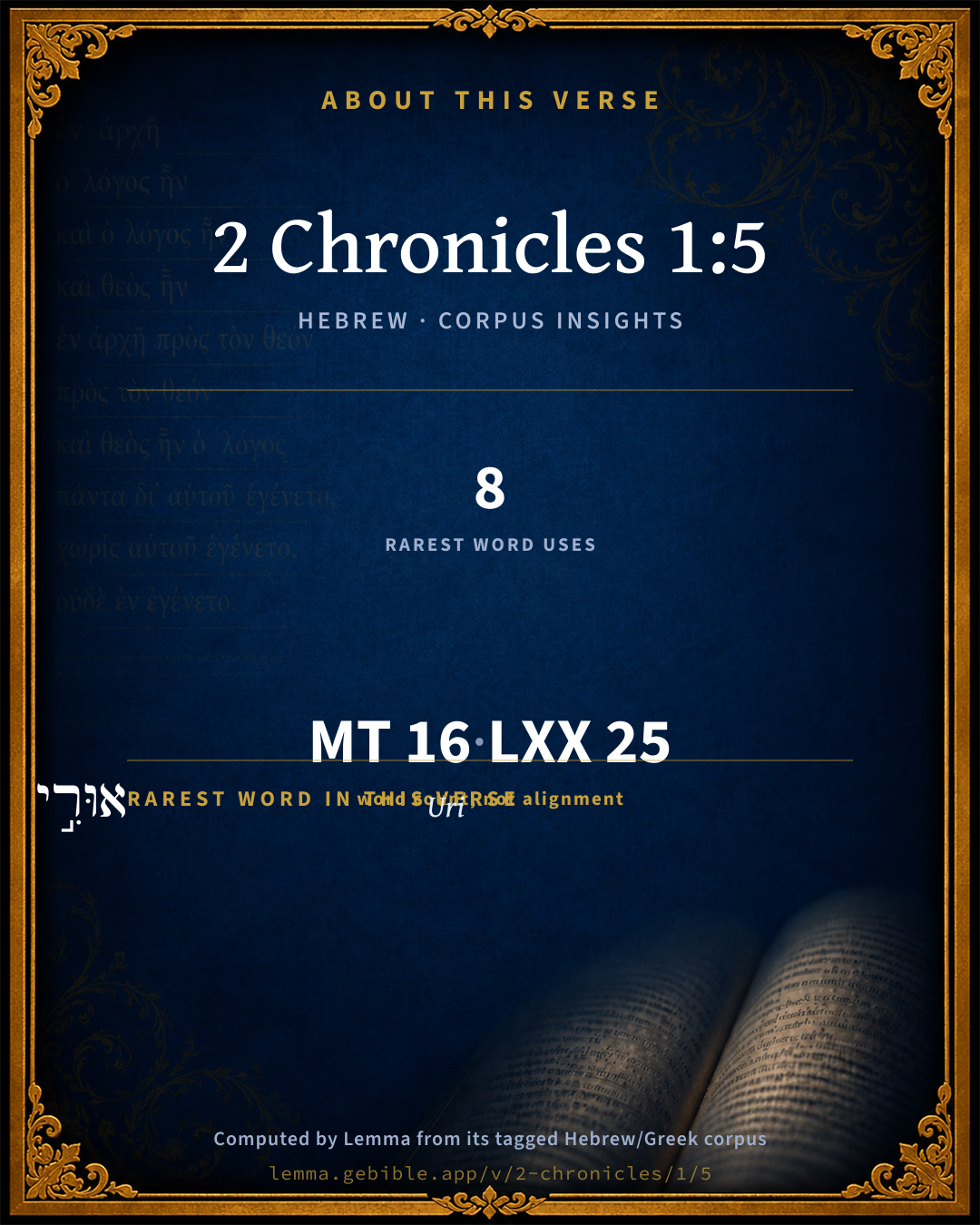
The rarest word here is אוּרִ֣י Uri H221 — appearing just 8 times in the whole Hebrew Bible.

Shared distinctive vocabulary

אוּרִ֣י Uri H221 occurs in 7 verses of the Hebrew Bible. Also found in:

Grammatical profile

  • 3 verbs
  • 12 nouns
  • 1 particle

Verb forms

  • עָשָׂה֙ Qal · Perfect
  • שָׂ֕ם Qal · Perfect
  • וַיִּדְרְשֵׁ֥הוּ Qal · Sequential Imperfect

Repetition

A word recurs within this verse — often emphatic in Hebrew:

Hebrew & Septuagint length

In English translation the verse runs 31 words from the Hebrew and 32 from the Septuagint (LXX English) — closely comparable.

A rough comparison of the two English renderings, which tokenize alike — not a word-level alignment.

Word counts can differ between the Hebrew and the Greek without any difference in meaning — e.g. the Hebrew direct-object marker אֵת has no separate Greek word, and Greek often adds the article ὁ.

In the original languages it is 16 Hebrew tokens and 25 Greek tokens — but the two are counted differently (Hebrew bundles its prefixes and suffixes into one token; the Greek is in lemma form), so that isn’t a like-for-like length.

Cross-references

5

Topical passages linked to 2 Chronicles 1:5 in the Treasury of Scripture Knowledge — connected by theme and wording, ordered by reader-vote popularity; previews shown in the World English Bible.

  • Exodus 31:2 "Behold, I have called by name Bezalel the son of Uri, the son of Hur, of the tribe of Judah:
  • Exodus 38:1–7 He made the altar of burnt offering of acacia wood. It was square. Its length was five cubits, its breadth was five cubits, and its height was three cubits.
  • Exodus 27:1–8 "You shall make the altar of acacia wood, five cubits long, and five cubits broad; the altar shall be foursquare: and its height shall be three cubits.
  • 1 Chronicles 2:19–20 Azubah died, and Caleb took to him Ephrath, who bore him Hur.
  • 1 Chronicles 13:3 and let us bring again the ark of our God to us: for we didn't seek it in the days of Saul.

Cross-references courtesy of OpenBible.info (CC BY 4.0).

Hebrew and Greek witnesses Masoretic Hebrew ↔ Greek Septuagint

The same verse in the two great witnesses to the Old Testament, shown verse-for-verse.

These are two independent witnesses, not word-aligned to each other, and the Septuagint is shown in lemma (dictionary) form.

Hebrew 2 Chronicles 1:5 Masoretic · Westminster Leningrad Codex

וּמִזְבַּ֣ח הַנְּחֹ֗שֶׁת אֲשֶׁ֤ר עָשָׂה֙ בְּצַלְאֵל֙ בֶּן אוּרִ֣י בֶן ח֔וּר שָׂ֕ם לִפְנֵ֖י מִשְׁכַּ֣ן יְהוָ֑ה וַיִּדְרְשֵׁ֥הוּ שְׁלֹמֹ֖ה וְהַקָּהָֽל

Moreover the brazen altar, that Bezalel the son of Uri, the son of Hur, had made, was there before the tent of Yahweh: and Solomon and the assembly sought to it.

World English Bible · Public Domain

Greek LXX 2 Chronicles 1:5 Septuagint · lemma form

καί ὁ θυσιαστήριον ὁ χαλκοῦς ὅς ποιέω βεσελεηλ υἱός ουριας υἱός ωρ ἐκεῖ εἰμί ἔναντι ὁ σκηνή κύριος καί ἐκζητέω αὐτός σαλωμών καί ὁ ἐκκλησία

And the brazen altar which Beseleel the son of Urias, the son of Or, had made, was there before the tabernacle of the Lord: and Solomon and the congregation enquired at it.

LXX2012 (modern English Septuagint) · Public Domain

On this verse, Ellicott's Commentary for English Readers discusses the Septuagint’s reading. Read the note in Commentary ↓

Hebrew: Westminster Leningrad Codex (CC BY 4.0). Greek: Septuagint (public domain); English from LXX2012 (modern English Septuagint) (Public Domain). How the Septuagint differs from the Hebrew →

Commentary

Notes on 2 Chronicles 1:5 from classic Christian and Jewish commentators (each source and its license shown beneath its notes). The classic Christian expositions comment on the surrounding passage and are grouped to its opening verse, so a note may address several verses; the Jewish commentaries on the Tanakh (Rashi and others) are per-verse, so they appear only where the commentator wrote on this verse.

Lemma curates 59 commentaries, every one of them public domain or Creative Commons licensed, each selected and text-cleaned for this edition rather than reprinted as found. About our sources →

Trapp's Complete Commentary

John Trapp

2Ch 1:5 Moreover the brasen altar, that Bezaleel the son of Uri, the son of Hur, had made, he put before the tabernacle of the LORD: and Solomon and the congregation sought unto it.

Ver. 5. He put,] i.e., Moses put.

And Solomon and all the congregation sought unto it.] Or, Unto him, i.e., the Lord; there they did their devotions to him: they diligently sought him, as the word signitieth. Compare Heb 11:6.

John Trapp, A Commentary or Exposition upon All the Books of the Old and New Testament (1647–1656) — public domain. Text from a community e-Sword module.

Joseph Benson's Commentary

2Ch 1:5. The brazen altar he put before the tabernacle, &c. — He continued it there, and did not remove it, as he did the ark, from the tabernacle. Solomon and the congregation sought unto it — Sought the Lord and his favour by hearty prayers and sacrifices in the place which God had appointed for that work, Lev 17:3-4.

Joseph Benson's Commentary on the Old and New Testaments (1811–1818) — public domain. Text from a community e-Sword module.

Geneva Bible (1599)

Geneva Bible translators

Which was for the burnt offerings, Exod. 27:1.

Geneva Bible (1599) marginal notes — public domain. Text via Bolls.life.

Adam Clarke's Commentary

Verse 5. Sought unto it.] Went to seek the Lord there.

Adam Clarke's Commentary on the Bible (1810–1826) — public domain. Text from a community e-Sword/MySword module.

Ellicott's Commentary for English Readers

(5) Moreover the brasen altar . . . he put before the tabernacle of the Lord.—Rather, And the brasen altar . . . was there before the dwelling of Jehovah. In Hebrew, shâm is “there”; and sâm, “he put.” Some MSS., supported by the LXX. and Vulg., read the former; most of the MSS. and the Syr., Arab., and Targ., the latter. The former reading is preferable, as it is not likely that David found the brazen altar separated from the Mosaic sanctuary, and restored it to its place. The sentence further explains why Solomon resorted to Gibeon. The presence of the old brazen altar constituted it the legitimate place of sacrifice. With perfect consistency, the chronicler accounted for David’s not going to Gibeon (1Ch_21:28-30).

That Bezaleel the son of Uri . . . had made—See Exo_31:2; Exo_31:9; Exo_38:1-8; Exo_27:1-8.

And Solomon and the congregation sought unto it.—Rather, And Solomon and the assembly sought Him—i.e., the Lord. (Comp. 1Ch_13:3; 1Ch_15:13; 1Ch_21:30.) The old versions translate as A. V.

A Bible Commentary for English Readers, edited by Charles John Ellicott (1878–1897) — public domain. Text from a community e-Sword module.

The Cambridge Bible for Schools and Colleges

gen. ed. J. J. S. Perowne

5. Bezalel] See Exo_31:2; Exo_38:1-7.

he put] R.V. was there. In the Hebrew the position of a point makes the difference between these two translations.

sought unto it] See 1Ch_28:8, note.

The Cambridge Bible for Schools and Colleges (gen. ed. J. J. S. Perowne; Cambridge University Press, 1878–1918) — public domain. Text from a community e-Sword module.

Haydock's Catholic Bible Commentary

Sought it: went (Menochius) to offer sacrifice, (Tirinus) in the second year of his reign, the year before Christ 1013.

George Leo Haydock (1774–1849), Haydock's Catholic Family Bible and Commentary, 1859 edition — public domain. Excludes Psalms (Douay-Rheims chapter numbering differs from Protestant) and Deuterocanonical books (Catholic canon only).

Matthew Poole's English Annotations

He put; either Moses, mentioned 2Ch 1:3, or Bezaleel, here last named, by the command and direction of Moses; or David, who may be said to put it there, because he continued it there, and did not remove it, as he did the ark from the tabernacle.

Sought unto it, i.e. sought the Lord and his favour by hearty prayers and sacrifices in the place which God had appointed for that work, Lev 17:3,4.

Matthew Poole's English Annotations on the Holy Bible (1683–1685) — public domain. Text from a community e-Sword/MySword module.

The Pulpit Commentary

The brazen altar. This statement is introduced to lay stress on the fact that, though the ark indeed was not with the tabernacle, the brazen altar of burnt offering assuredly was there, this constituting the place, the proper spot, for sacrifice and worship. (For the account of the brazen altar and its making, (see Exo_27:1-8 Exo_38:1-7; also Num_16:38, Num_16:39) This altar of burnt offering is often spoken of as the altar, to distinguish it from the altar of incense (Exo_30:1 Exo_39:38; Num_4:11) Bezaleel. (For detailed genealogy, see our 1Ch_2:3-20; also (Exo_31:2-5 Exo_35:30-35) He put before. The reading ( "was there before," is to be preferred, tallying as it does exactly with Exo_40:6. This was the reading understood by the Septuagint and Vulgate. The majority of manuscripts, however, and the Syriac Version, have Sought unto it. The analogy of the use of this word would make to be preferred the translation "sought him," i.e. the "Jehovah" just spoken of. But whether the object of the verb be in this place Jehovah or the altar, it would seem probable that the clause purports to say that Solomon and his people were accustomed to repair thither, while now they were about to repair thither with a very vast burnt offering.

The Pulpit Commentary (1880–1919), ed. H.D.M. Spence-Jones & Joseph S. Exell — public domain. Text from a community e-Sword module.

John Wesley's Explanatory Notes

Sought - Sought the Lord and his favour by hearty prayers and sacrifices in the place which God had appointed.

John Wesley, Explanatory Notes Upon the Whole Bible (1754–1765) — public domain. Text via the GEBible commentary corpus.

Lesson kit

Teaching starters — assembled from the data on this page, not authored interpretation. Every prompt links to the verse data it draws on. Edit before teaching.

2 Chronicles, in the Historical, opens this verse with 16 words (15 distinct Hebrew lemmas). Its most distinctive word is ʼÛwrîy (“Uri”). A historical commentator’s framing appears above. Read the whole chapter for the surrounding context.

Discussion questions

  1. What does “Uri” (ʼÛwrîy) contribute to the verse as a whole?
  2. Exodus 31:2 shares the word «Uri» with this verse. How do the two illuminate each other?
  3. “son” occurs 2× in this one verse. What is the effect of the repetition?
  4. The translations on this page render this verse differently — a whole-verse word diff, not a word-by-word alignment. What might account for the different wordings?
  5. The verb «עָשָׂה֙» is Qal Perfect. How does its form color the action?
  6. Reading how Trapp's Complete Commentary and Joseph Benson's Commentary read this verse, where do the two commentators agree and where do they part?

Things to notice

Reading settings

Reading text

Shown beneath each verse's original-language words.

Old Testament
Old Testament edition

Read the OT as the Masoretic Hebrew (MT) or the Greek Septuagint (LXX).

English shown for the Greek Septuagint (in the Hebrew ↔ Greek comparison).

Comparing translations? Open the Compare panel on any verse page to stack up to four side by side.