
Deuteronomy 23:3

Hebrew (Westminster Leningrad Codex) Deuteronomy 23:3 appears in the Hebrew Old Testament. The text above is from the Westminster Leningrad Codex. Each word links to its Strong’s number, a concise gloss, and parsing drawn from the Open Scriptures Hebrew Bible morphology. Click any word for its full Brown-Driver-Briggs (BDB) entry.
Download image
Cite this verse

Deuteronomy 23:3 (World English Bible). Public Domain. Lemma interlinear Bible study tool, https://lemma.gebible.app/v/deuteronomy/23/3.

Show BibTeX & RIS
BibTeX
RIS
English Translation
An Ammonite or a Moabite shall not enter into the assembly of Yahweh; even to the tenth generation shall none belonging to them enter into the assembly of Yahweh forever:
World English Bible · Public Domain
Download a study sheet

One document with this verse’s original text, its word-by-word gloss line, the meaning frame, cross-references with their text, attributed commentary, and full source and license credits — printable, and it pastes into notes with its structure intact.

This verse Autodidact and up

Study sheet (.html) Plain text (.txt)

A passage Seminary Student

Up to 50 verses in one chapter. A passage sheet keeps up to 6 commentary sources and 12 cross-references per verse, in the order this page ranks them, and says so on the sheet whenever that leaves anything out. Ask for a single verse and you get the Autodidact verse sheet above.

Everything on this page stays free to read, with no account — the sheet is a download of what is already on screen, not access to it.

Want to remove ads? Support Godless Engineer
Compare translations 3

The same verse in 3 English versions, stacked beneath the original-language interlinear above. Click any original word for its lexicon entry.

Each is an independent rendering of the whole verse — the interlinear is not word-aligned to these translations.

Highlighted words mark where these versions differ — a whole-verse word diff, not a word-by-word alignment.

  • World English Bible Public Domain
    An Ammonite or a Moabite shall not enter into the assembly of Yahweh; even to the tenth generation shall none belonging to them enter into the assembly of Yahweh forever:
  • King James Version Public Domain
    An Ammonite or Moabite shall not enter into the congregation of the LORD; even to their tenth generation shall they not enter into the congregation of the LORD for ever:
  • unfoldingWord Literal Text CC BY-SA 4.0
    An Ammonite or a Moabite shall not enter the assembly of Yahweh; even their tenth generation shall not enter the assembly of Yahweh, until forever,

unfoldingWord Literal Text — © unfoldingWord, licensed CC BY-SA 4.0. Word-aligned USFM3 via Door43 (git.door43.org/unfoldingWord/en_ult).

Versions to compare (up to 4)

3 of 4 selected

Show all 18 translations

Every available English version of this verse, each an independent rendering of the whole verse.

  • World English Bible Public Domain
    An Ammonite or a Moabite shall not enter into the assembly of Yahweh; even to the tenth generation shall none belonging to them enter into the assembly of Yahweh forever:
  • Berean Standard Bible Public Domain
    No Ammonite or Moabite or any of their descendants may enter the assembly of the LORD, even to the tenth generation.
  • Majority Standard Bible Public Domain
    No Ammonite or Moabite or any of their descendants may enter the assembly of the LORD, even to the tenth generation.
  • King James Version Public Domain
    An Ammonite or Moabite shall not enter into the congregation of the LORD; even to their tenth generation shall they not enter into the congregation of the LORD for ever:
  • American Standard Version (1901) Public Domain
    An Ammonite or a Moabite shall not enter into the assembly of Jehovah; even to the tenth generation shall none belonging to them enter into the assembly of Jehovah for ever:
  • Revised Version (1885) Public Domain
    An Ammonite or a Moabite shall not enter into the assembly of the LORD; even to the tenth generation shall none belonging to them enter into the assembly of the LORD for ever:
  • Geneva Bible (1599) Public Domain
    The Ammonites and the Moabites shall not enter into the Congregation of the Lord: euen to their tenth generation shall they not enter into the Congregation of the Lord for euer,
  • Douay-Rheims (1899) Public Domain
    The Ammonite and the Moabite, even after the tenth generation shall not enter into the church of the Lord for ever:
  • Young's Literal Translation Public Domain
    `An Ammonite and a Moabite doth not enter into the assembly of Jehovah; even a tenth generation of them doth not enter into the assembly of Jehovah -- to the age;
  • Literal Standard Version CC BY-SA 4.0
    An Ammonite and a Moabite do not enter into the assembly of YHWH; even a tenth generation of them do not enter into the assembly of YHWH—for all time,
  • Unlocked Literal Bible CC BY-SA 4.0
    An Ammonite or a Moabite may not belong to the assembly of Yahweh; as far as to the tenth generation of his descendants, none of them may belong to the assembly of Yahweh.
  • unfoldingWord Literal Text CC BY-SA 4.0
    An Ammonite or a Moabite shall not enter the assembly of Yahweh; even their tenth generation shall not enter the assembly of Yahweh, until forever,
  • Darby Bible Public Domain
    An Ammonite or Moabite shall not come into the congregation of Jehovah; even their tenth generation shall not come into the congregation of Jehovah for ever;
  • World Messianic Bible Public Domain
    An Ammonite or a Moabite shall not enter into the LORD’s assembly; even to the tenth generation shall no one belonging to them enter into the LORD’s assembly forever,
  • Webster's Bible Public Domain
    An Ammonite or Moabite shall not enter into the congregation of the LORD; even to their tenth generation shall they not enter into the congregation of the LORD for ever:
  • Free Bible Version CC BY-SA 4.0
    No Ammonite or Moabite or any of their descendants are allowed to enter the Lord's sanctuary, up to the tenth generation.
  • Bible in Basic English Public Domain
    No Ammonite or Moabite or any of their people to the tenth generation may come into the meeting of the Lord's people:
  • JPS Tanakh (1917) Public Domain
    (23-4) An Ammonite or a Moabite shall not enter into the assembly of the LORD; even to the tenth generation shall none of them enter into the assembly of the LORD for ever;

Literal Standard Version (2020), Covenant Press — licensed CC BY-SA 4.0. Text via the HelloAO Bible API (eBible.org). Unlocked Literal Bible (unfoldingWord) — licensed CC BY-SA 4.0. Text via the HelloAO Bible API (eBible.org). unfoldingWord Literal Text — © unfoldingWord, licensed CC BY-SA 4.0. Word-aligned USFM3 via Door43 (git.door43.org/unfoldingWord/en_ult). Free Bible Version, Dr. Jonathan Gallagher — licensed CC BY-SA 4.0. Text via the HelloAO Bible API (eBible.org).

Word by word

More ways to search: Search by grammar → Find every occurrence → Compare this word →

Practice this passage: Drill this verse → Learn its vocabulary →

וּמוֹאָבִ֖י
Môwʼâbîy
H4125
“and · Moabite”
Conjunction + Noun, Gentilic, Masculine, Singular, Absolute
Part of Speech
Conjunction + Noun
Type
Gentilic
Gender
Masculine
Number
Singular
State
Absolute
Full BDB Definition

Origin: patronymical from H4124

TWOT: 1155a

Moabite = "from father: what father?" - an citizen of Moab - an inhabitant of the land of Moab
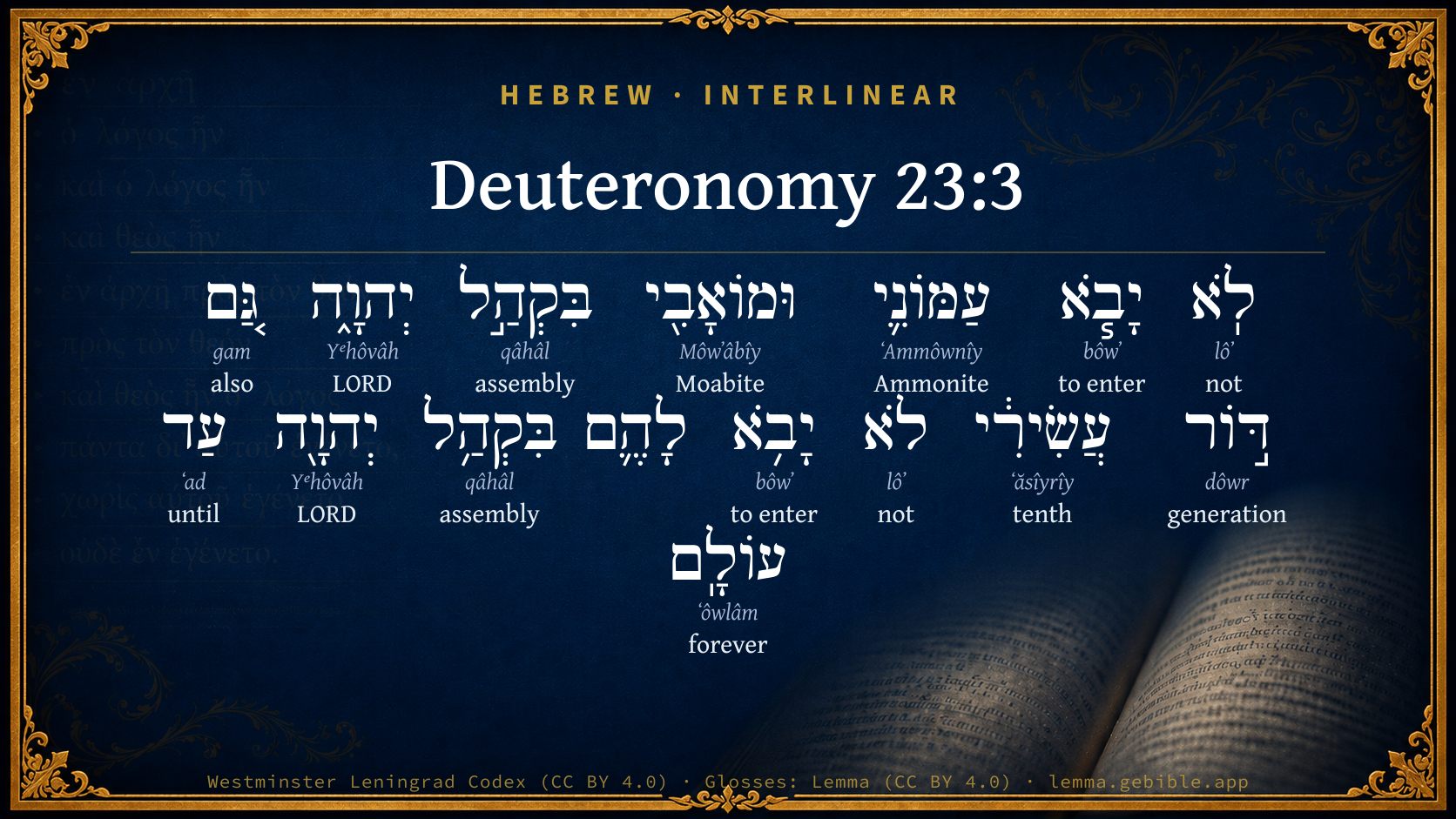
  1. לֹֽא lôʼ H3808 “not” Particle, Negative
  2. יָבֹ֧א bôwʼ H935 “to enter” Verb, Qal, Imperfect, 3rd Person, Masculine, Singular
  3. עַמּוֹנִ֛י ʻAmmôwnîy H5984 “Ammonite” Noun, Gentilic, Masculine, Singular, Absolute
  4. בִּקְהַ֣ל qâhâl H6951 “in/at · assembly of” Preposition + Noun, Common, Masculine, Singular, Construct
  5. יְהוָ֑ה Yᵉhôvâh H3068 “LORD” Noun, Proper
  6. גַּ֚ם gam H1571 “also” Particle, Accusative
  7. דּ֣וֹר dôwr H1755 “generation” Noun, Common, Masculine, Singular, Absolute
  8. עֲשִׂירִ֔י ʻăsîyrîy H6224 “tenth” Adjective, Ordinal number, Masculine, Singular, Absolute
  9. לֹא lôʼ H3808 “not” Particle, Negative
  10. יָבֹ֥א bôwʼ H935 “to enter” Verb, Qal, Imperfect, 3rd Person, Masculine, Singular
  11. בִּקְהַ֥ל qâhâl H6951 “in/at · assembly of” Preposition + Noun, Common, Masculine, Singular, Construct
  12. יְהוָ֖ה Yᵉhôvâh H3068 “LORD” Noun, Proper
  13. עַד ʻad H5704 “until” Preposition
  14. עוֹלָֽם ʻôwlâm H5769 “forever” Noun, Common, Masculine, Singular, Absolute

About this verse

These counts appear in no published source. They are computed here, from the morphology-tagged text and Lemma’s own curated glosses. What Lemma adds →

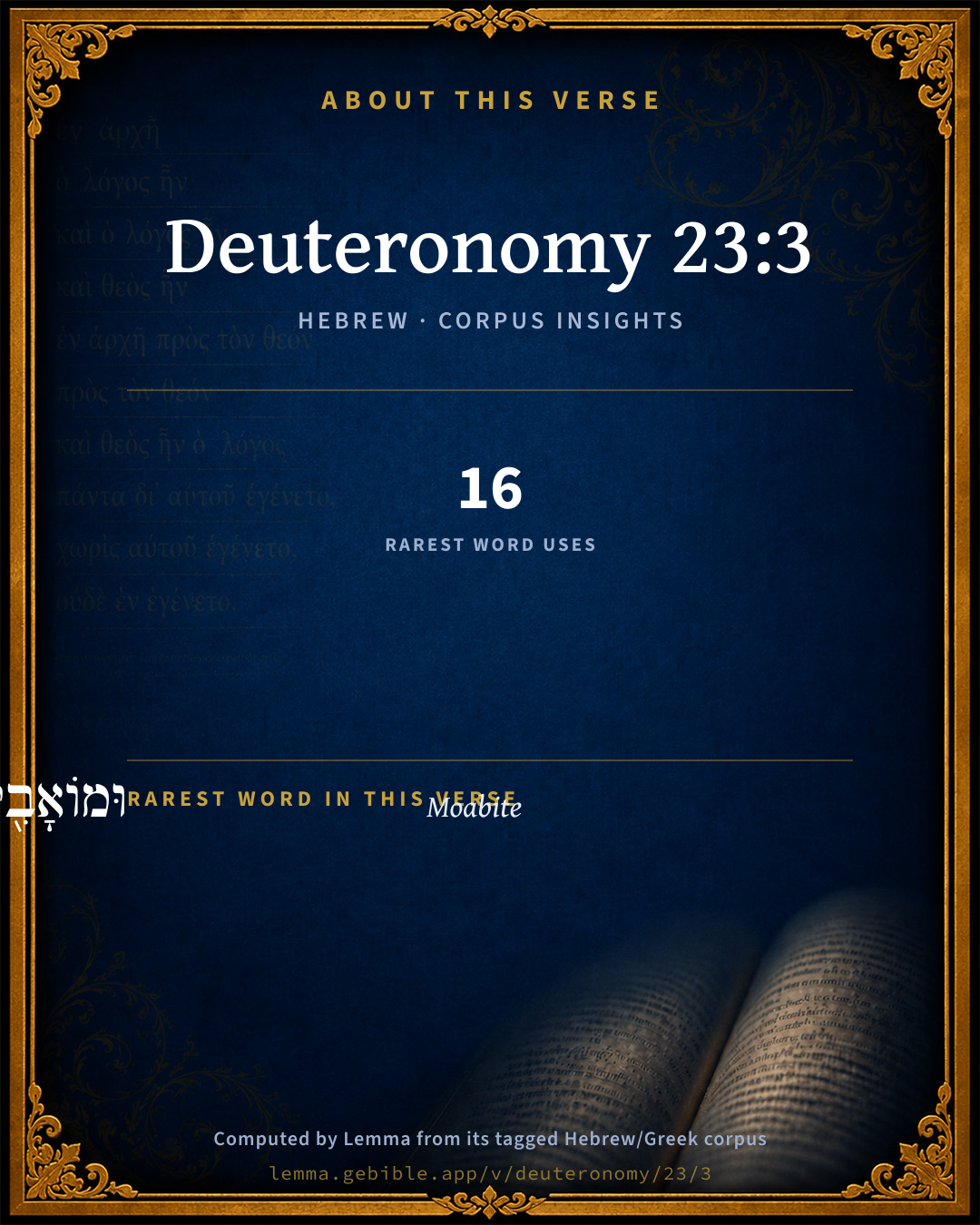
16
words
11
distinct lemmas
Pentateuch
section

Notable vocabulary

The rarest word here is וּמוֹאָבִ֖י Moabite H4125 — appearing just 16 times in the whole Hebrew Bible.

Shared distinctive vocabulary

וּמוֹאָבִ֖י Moabite H4125 occurs in 16 verses of the Hebrew Bible. Also found in:

Grammatical profile

  • 2 verbs
  • 8 nouns
  • 1 adjective
  • 2 prepositions
  • 3 particles

Verb forms

  • יָבֹ֧א Qal · Imperfect
  • יָבֹ֥א Qal · Imperfect

Repetition

Words recur within this verse — often emphatic in Hebrew:

  • יָבֹ֧א to enter H935 ×2
  • בִּקְהַ֣ל assembly H6951 ×2
  • יְהוָ֑ה LORD H3068 ×2
  • לֹֽא not H3808 ×2

Hebrew & Septuagint length

In English translation the verse runs 30 words from the Hebrew and 31 from the Septuagint (LXX English) — closely comparable.

A rough comparison of the two English renderings, which tokenize alike — not a word-level alignment.

Word counts can differ between the Hebrew and the Greek without any difference in meaning — e.g. the Hebrew direct-object marker אֵת has no separate Greek word, and Greek often adds the article ὁ.

Cross-references

7

Topical passages linked to Deuteronomy 23:3 in the Treasury of Scripture Knowledge — connected by theme and wording, ordered by reader-vote popularity; previews shown in the World English Bible.

  • Nehemiah 13:1–2 On that day they read in the book of Moses in the audience of the people; and therein was found written, that an Ammonite and a Moabite should not enter into the assembly of God forever,
  • Ruth 4:6 The near kinsman said, I can't redeem it for myself, lest I mar my own inheritance: take my right of redemption on you; for I can't redeem it.
  • Nehemiah 13:23 In those days also saw I the Jews who had married women of Ashdod, of Ammon, [and] of Moab:
  • Ruth 4:10–22 Moreover Ruth the Moabitess, the wife of Mahlon, have I purchased to be my wife, to raise up the name of the dead on his inheritance, that the name of the dead not be cut off from among his brothers, and from the gate of his place: you are witnesses this day.
  • Nehemiah 4:3 Now Tobiah the Ammonite was by him, and he said, Even that which they are building, if a fox go up, he shall break down their stone wall.
  • Nehemiah 4:7 But it happened that when Sanballat, Tobiah, the Arabians, the Ammonites, and the Ashdodites heard that the repairing of the walls of Jerusalem went forward, [and] that the breaches began to be stopped, then they were very angry;
  • Isaiah 56:3 Neither let the foreigner, who has joined himself to Yahweh, speak, saying, Yahweh will surely separate me from his people; neither let the eunuch say, Behold, I am a dry tree.

Cross-references courtesy of OpenBible.info (CC BY 4.0).

Hebrew and Greek witnesses Masoretic Hebrew ↔ Greek Septuagint

The same verse in the two great witnesses to the Old Testament, shown verse-for-verse.

These are two independent witnesses, not word-aligned to each other, and the Septuagint is shown in lemma (dictionary) form.

Hebrew Deuteronomy 23:3 Masoretic · Westminster Leningrad Codex

לֹֽא יָבֹ֧א עַמּוֹנִ֛י וּמוֹאָבִ֖י בִּקְהַ֣ל יְהוָ֑ה גַּ֚ם דּ֣וֹר עֲשִׂירִ֔י לֹא יָבֹ֥א לָהֶ֛ם בִּקְהַ֥ל יְהוָ֖ה עַד עוֹלָֽם

An Ammonite or a Moabite shall not enter into the assembly of Yahweh; even to the tenth generation shall none belonging to them enter into the assembly of Yahweh forever:

World English Bible · Public Domain

Greek LXX Deuteronomy 23:3 Septuagint · lemma form

οὐ εἰςἔρχομαι ἐκ πόρνη εἰς ἐκκλησία κύριος

The Ammanite and Moabite shall not enter into the assembly of the Lord, even until the tenth generation he shall not enter into the assembly of the Lord, even for ever:

LXX2012 (modern English Septuagint) · Public Domain

Hebrew: Westminster Leningrad Codex (CC BY 4.0). Greek: Septuagint (public domain); English from LXX2012 (modern English Septuagint) (Public Domain). How the Septuagint differs from the Hebrew →

Targum (Aramaic paraphrase)

2

The Targum is the ancient Jewish Aramaic paraphrase of the Hebrew Scriptures — an interpretive translation, not the Hebrew text itself. Onkelos (literal) and Pseudo-Jonathan (expansive) render the Torah, and Jonathan the Prophets. Coverage is partial: where no permissively-licensed English translation exists for a verse, only the Aramaic is shown. This is verse-level text, not a word-by-word alignment to the Hebrew.

  1. Targum Onkelos Torah (Genesis–Deuteronomy)
    לָא יִדְכֵּי מַמְזֵרָא לְמֵעַל בִּקְהָלָא דַיְיָ אַף דָרָא עֲשִׂירָאָה לָא יִדְכֵּי לֵהּ לְמֵעַל בִּקְהָלָא דַיְיָ

    (no public-domain English translation for this verse)

    Targum Onkelos — Aramaic: “Onkelos Genesis” (public domain); “Onkelos Exodus” (public domain); “Onkelos Leviticus” (public domain); “Onkelos Numbers” (public domain); “Onkelos Deuteronomy” (public domain). English: “Sefaria Community Translation” (CC0 1.0 (public-domain dedication)); “J.W. Etheridge. The Targums of Onkelos and Jonathan Ben Uzziel on the Pentateuch. London: Longmans, Green, 1862” (public domain). Text via Sefaria.

  2. Targum Pseudo-Jonathan Torah (Genesis–Deuteronomy)
    לָא יִדְכֵּי דְמִתְיְלִיד מִן זְנוּ דְבֵיהּ מוּמָא בִּישָׁא דְאִיתְיְהִיב בְּעַמְמַיָא חוֹלוֹנָאֵי לְמֵיסַב אִיתָא כַּשְׁרָא מִקְהַל עַמָּא דַיְיָ אוֹף דּוֹר עֲשִירָאֵי לָא יִדְכֵּי לֵיהּ לְמֵיעַל בִּקְהָלָא דַיְיָ

    He who is born of fornication, or who hath upon him the evil mark which is set upon the unclean Gentiles, is not fit to take an upright wife from the congregation of the people of the Lord; nor unto the tenth generation shall it be fit for him to enter into the congregation of the Lord.

    Targum Pseudo-Jonathan — Aramaic: “Targum Jonathan on Genesis” (public domain); “Targum Jonathan on Exodus” (public domain); “Targum Jonathan on Leviticus” (public domain); “Targum Jonathan on Numbers” (public domain); “Targum Jonathan on Deuteronomy” (public domain). English: “The Targum of Jonathan ben Uzziel, trans. J. W. Etheridge, London, 1862” (public domain). Text via Sefaria.

Commentary

Notes on Deuteronomy 23:3 from classic Christian and Jewish commentators (each source and its license shown beneath its notes). The classic Christian expositions comment on the surrounding passage and are grouped to its opening verse, so a note may address several verses; the Jewish commentaries on the Tanakh (Rashi and others) are per-verse, so they appear only where the commentator wrote on this verse.

Lemma curates 59 commentaries, every one of them public domain or Creative Commons licensed, each selected and text-cleaned for this edition rather than reprinted as found. About our sources →

Trapp's Complete Commentary

John Trapp

Deu 23:3 An Ammonite or Moabite shall not enter into the congregation of the LORD; even to their tenth generation shall they not enter into the congregation of the LORD for ever:

Ver. 3. For ever,] i.e., This law is perpetual and indispensable; so highly displeasing are many mere omissions of duty. Omission of diet breeds diseases, brings death; so here.

John Trapp, A Commentary or Exposition upon All the Books of the Old and New Testament (1647–1656) — public domain. Text from a community e-Sword module.

Joseph Benson's Commentary

Deu 23:3. An Ammonite or a Moabite — The Jews will have it, that the women of these two nations were not concerned in this law. And that though an Israelitish woman might not marry an Ammonite or Moabite, yet a man of Israel might marry one of their women, after she professed the Jewish religion. For ever — This seems to denote the perpetuity of this law, that it should be inviolably observed in all succeeding ages.

Joseph Benson's Commentary on the Old and New Testaments (1811–1818) — public domain. Text from a community e-Sword module.

Tyndale Open Study Notes

Tyndale Open Resources

23:3 No Ammonite or Moabite: These nations were Lot’s descendants by his incestuous daughters (see study notes on 2:9, 19). In addition, they had forbidden Israel access to their lands during their desert wanderings (23:4). • Exclusion for ten generations means an indefinitely long period of time.

Tyndale Open Study Notes — © Tyndale Open Resources, licensed CC BY-SA 4.0. Text via the HelloAO Bible API.

Jamieson, Fausset & Brown

Robert Jamieson, A. R. Fausset & David Brown

even to the their tenth generation shall they not enter--Many eminent writers think that this law of exclusion was applicable only to males; at all events that a definite is used for an indefinite number (Neh 13:1; Rut 4:10; Kg2 10:2). Many of the Israelites being established on the east side of Jordan in the immediate neighborhood of those people, God raised this partition wall between them to prevent the consequences of evil communications. More favor was to be shown to Edomites and Egyptians--to the former from their near relationship to Israel; and to the latter, from their early hospitalities to the family of Jacob, as well as the many acts of kindness rendered them by private Egyptians at the Exodus (Exo 12:36). The grandchildren of Edomite or Egyptian proselytes were declared admissible to the full rights of citizenship as native Israelites; and by this remarkable provision, God taught His people a practical lesson of generosity and gratitude for special deeds of kindness, to the forgetfulness of all the persecution and ill services sustained from those two nations.

Jamieson, Fausset & Brown — Commentary Critical and Explanatory on the Whole Bible (1871) — public domain (CC PDM 1.0). Text via the HelloAO Bible API.

Adam Clarke's Commentary

Verse 3. An Ammonite or Moabite] These nations were subjected for their impiety and wickedness, (see De 23:4; De 23:5), to peculiar disgrace, and on this account were not permitted to hold any office among the Israelites. But this did not disqualify them from being proselytes: Ruth, who was a Moabitess, was married to Boaz, and she became one of the progenitors of our Lord.

Even to their tenth generation] That is, for ever, as the next clause explains; see Ne 13:1.

Adam Clarke's Commentary on the Bible (1810–1826) — public domain. Text from a community e-Sword/MySword module.

Ellicott's Commentary for English Readers

(3) An Ammonite or Moabite shall not enter. According to Rashi, “shall not marry an Israelitish woman.” It must be remembered that the children, according to Jewish law, follow the father, not the mother. The case of Ruth would not, therefore, be touched by this precept.

A Bible Commentary for English Readers, edited by Charles John Ellicott (1878–1897) — public domain. Text from a community e-Sword module.

John Gill's Exposition

An Ammonite or Moabite shall not enter into the congregation of the Lord,.... Or marry an Israelitish woman, as Jarchi, and so the Targum of Jonathan,"the male Ammonites and Moabites are not fit to take a wife of the congregation of the Lord;''for the Jews restrain this to men, because it is, as Aben Ezra observes, an Ammonite, not an Ammonitess, a Moabite, not a Moabitess; they allow that females of those nations might be married to Israelites, that is, provided they were proselytesses, as Ruth was (m):

even to their tenth generation, shall they not enter into the congregation of the Lord for ever; that is, not only to the tenth generation, but for ever; and this law was understood as in force in Nehemiah's time, which was more than ten generations from the making of it; though now, as these nations are no more a distinct people, they suppose it is no longer binding (n).

(m) Misn. Yebamot, c. 8. sect. 3. (n) Misn. Yadaim, c. 4. sect. 4.

John Gill's Exposition of the Whole Bible (1746–1763) — public domain (CC PDM 1.0). Text via the HelloAO Bible API.

Albert Barnes' Notes on the Bible

This law forbids only the naturalization of those against whom it is directed. It does not forbid their dwelling in the land; and seems to refer rather to the nations than to individuals. It was not understood at any rate to interdict marriage with a Moabitess; compare Rth 1:4; Rth 4:13. Ruth however, and her sister were doubtless proselytes.

Deu 23:4

Compare the marginal reference. The Moabites and the Ammonites are to be regarded as clans of the same stock rather than as two independent nations, and as acting together. Compare 2Ch 20:1.

Albert Barnes' Notes on the Bible (1834–1885) — public domain. Text from a community e-Sword/MySword module.

Haydock's Catholic Bible Commentary

Ever. This shews that the former verse only excludes bastards for a time. But why are these nations treated with more severity than the Edomite and Egyptian? Because their enmity seemed to proceed from pure malice, and they attempted to ruin the souls of the Hebrews by lust and by idolatry, without any prospect of interest to themselves. Their parents were also of very base origin, and Abraham had rescued their father, Lot, from destruction; so that for his children to oppose with such virulence the descendants of Abraham, manifested a degree of ingratitude and perversity. (Calmet) --- They had found their attempts to hurt Israel abortive, and yet ceased not to persecute their near relations, (Haydock) by drawing them into carnal sins. Those who are obstinate in their evil ways can never be rightly received into the Church of God. (Worthington) --- Achior and Ruth embraced the Jewish religion, but it does not appear they were admitted to places of trust, Judith xiv. 6. (Haydock) --- These regulations were observed till the Babylonian captivity, while the genealogies might be ascertained. (Calmet) --- In cases of extraordinary merit, as in that of Achior, the Ammonite, (Judith xiv.,) a dispensation might be granted. (Tirinus)

George Leo Haydock (1774–1849), Haydock's Catholic Family Bible and Commentary, 1859 edition — public domain. Excludes Psalms (Douay-Rheims chapter numbering differs from Protestant) and Deuterocanonical books (Catholic canon only).

Matthew Poole's English Annotations

This may be understood either,

1. Of the males only, or the children of such fathers, as interpreters commonly take it. Or rather,

2. Of females also, or of all that were born either of such fathers or mothers, as may be gathered from Ezr 10 Ne 13, where the children of strange wives were separated from Israel no less than the children of strange fathers. And it is an allowed maxim, that the birth follows the belly. And whereas the children of Rahab and Ruth are produced to the contrary, it may be said as it was before, that these were extraordinary instances, and that God when he pleased might exempt any particular person of them from this curse, though the Israelites might not do so.

For ever; so it seems to note the immutability and perpetuity of this law, that it should be inviolably observed in all succeeding ages, and not dispensed with for any merit in the persons, or any pretence whatsoever. But why then should this clause be added only here, seeing the foregoing laws are as inviolable as this? It seems therefore to extend the duration of this exclusion of them from the congregation of the Lord beyond what was said at first, and to be added by way of aggravation, even to their tenth generation shall they not enter—yea, even for ever, i.e. they shall never enter, as it is expressed, without any mention of the tenth generation, Neh 13:1, that they shall not come into the congregation of God for ever.

Matthew Poole's English Annotations on the Holy Bible (1683–1685) — public domain. Text from a community e-Sword/MySword module.

Whedon's Commentary on the Bible

Daniel D. Whedon

3-6. An Ammonite or Moabite shall not enter — Not as such. The case of Ruth shows they might on embracing Judaism. Knobel considers that the reason for the prohibition of the text was because Ammon and Moab were begotten in incest. Here Moses gives as reasons that they had failed to meet the Israelites with hospitality, and had hired Balaam to curse them.

Daniel D. Whedon (gen. ed.), Commentary on the Old and New Testaments (1874–1909) — public domain. Text from a community e-Sword module.

The Pulpit Commentary

As Ammon and Moab had met the Israelites with hostility, and had brought Balaam to curse them, a curse had thereby been brought upon themselves, and they also were to be forever excluded from the congregation of Israel.

The Pulpit Commentary (1880–1919), ed. H.D.M. Spence-Jones & Joseph S. Exell — public domain. Text from a community e-Sword module.

John Wesley's Explanatory Notes

For ever - This seems to note the perpetuity of this law, that it should be inviolably observed in all succeeding ages.

John Wesley, Explanatory Notes Upon the Whole Bible (1754–1765) — public domain. Text via the GEBible commentary corpus.

unfoldingWord translationNotes

Door43 World Missions Community

may not belong to the assembly of Yahweh

This is an idiom. AT: "may not be a full member of the Israelite community" (See: Idiom)

as far as to the tenth generation of his descendants

This "tenth"is the ordinal number for ten. AT: "even after ten generations of his descendants" (See: Ordinal Numbers)

they did not meet you with bread and with water

The full meaning of this statement can be made explicit. AT: "they did not welcome you by bringing you food and drink" (See: Assumed Knowledge and Implicit Information)

against you ... curse you

Moses speaks to the Israelites as if they were one man, so the word "you" here is singular. (See: Forms of You)

translationWords

Ammon

Moab

assembly

Yahweh

generation

descend

bread

Egypt

Balaam

curse

unfoldingWord translationNotes — © Distant Shores Media and the Door43 World Missions Community, licensed CC BY-SA 4.0. Source: git.door43.org/Door43/en_tn.

Rashi

Rabbi Shlomo Yitzchaki (Rashi)

לא יבא ממזר בקהל ה׳ ONE BORN IN INCEST OR ADULTERY SHALL NOT COME INTO THE ASSEMBLY OF THE LORD — i.e. he shall not marry an Israelite woman (Yevamot 78b).

Rashi on the Tanakh — English translations: “The Judaica Press complete Tanach with Rashi, translated by A. J. Rosenberg” (CC BY 4.0); “Pentateuch with Rashi's commentary by M. Rosenbaum and A.M. Silbermann, 1929-1934” (public domain); “The Metsudah Tanach series, Lakewood, N.J” (CC BY 4.0); and “The Book of Joshua, Metsudah Publications, 1997” (CC BY 4.0). Text via Sefaria.

Ramban (Nachmanides)

Rabbi Moshe ben Nachman (Ramban / Nachmanides)

MAMZEIR’ (BASTARD). The term signifies a man who is muzar (estranged) from his brothers and his friends, for it is not known whence he comes. This is similar to the verse, And a ‘mamzeir’ shall dwell in Ashdod, and I will cut off the pride of the Philistines, the verse stating that no one will dwell in Ashdod save a foreigner or a stranger who will chance to pass by, for the pride of the Philistines will have been cut off from it [Ashdod]. Now, if a child is born to a man from his father’s wife, he [the father] will put him far away and not acknowledge him because of his shame and disgrace [resulting] from the evil deed that he committed. His mother also will cast him away by night, like the asufi (any cast-off child whose father and mother are unknown) that is mentioned in the Talmud. Thus the mamzeir is “estranged” in his native city, and so also the offspring of any of the forbidden relations as our Rabbis have said in Yerushalmi Kiddushin: “Rabbi Abahu said: What is the meaning of mamzeir? Mum zar (a strange blemish”).

Ramban (Nachmanides) on the Tanakh — English translation: “Commentary on the Torah by Ramban (Nachmanides). Translated and annotated by Charles B. Chavel. New York, Shilo Pub. House, 1971-1976” (CC BY 4.0). Text via Sefaria.

Lesson kit

Teaching starters — assembled from the data on this page, not authored interpretation. Every prompt links to the verse data it draws on. Edit before teaching.

Deuteronomy, in the Pentateuch, opens this verse with 16 words (11 distinct Hebrew lemmas). Its most distinctive word is Môwʼâbîy (“Moabite”). A historical commentator’s framing appears above. Read the whole chapter for the surrounding context.

Discussion questions

  1. The word Môwʼâbîy carries the sense “Moabite.” How does it shape the verse?
  2. How does Deuteronomy 2:11, which shares the word «Moabite», read alongside this verse?
  3. What does the repetition of “to enter” (2× in this one verse) do in this verse?
  4. These translations render this verse differently. What is at stake in choosing one wording over another?
  5. «יָבֹ֧א» is a Qal Imperfect verb. How does that grammatical form shape the action described?
  6. Compare how Trapp's Complete Commentary and Joseph Benson's Commentary read this verse. Where do they agree or differ?

Things to notice

Reading settings

Reading text

Shown beneath each verse's original-language words.

Old Testament
Old Testament edition

Read the OT as the Masoretic Hebrew (MT) or the Greek Septuagint (LXX).

English shown for the Greek Septuagint (in the Hebrew ↔ Greek comparison).

Comparing translations? Open the Compare panel on any verse page to stack up to four side by side.