
2 Chronicles 31:18

Hebrew (Westminster Leningrad Codex) 2 Chronicles 31:18 appears in the Hebrew Old Testament. The text above is from the Westminster Leningrad Codex. Each word links to its Strong’s number, a concise gloss, and parsing drawn from the Open Scriptures Hebrew Bible morphology. Click any word for its full Brown-Driver-Briggs (BDB) entry.
Download image
Cite this verse

2 Chronicles 31:18 (World English Bible). Public Domain. Lemma interlinear Bible study tool, https://lemma.gebible.app/v/2-chronicles/31/18.

Show BibTeX & RIS
BibTeX
RIS
English Translation
and those who were reckoned by genealogy of all their little ones, their wives, and their sons, and their daughters, through all the congregation: for in their office of trust they sanctified themselves in holiness.
World English Bible · Public Domain
Download a study sheet

One document with this verse’s original text, its word-by-word gloss line, the meaning frame, cross-references with their text, attributed commentary, and full source and license credits — printable, and it pastes into notes with its structure intact.

This verse Autodidact and up

Study sheet (.html) Plain text (.txt)

A passage Seminary Student

Up to 50 verses in one chapter. A passage sheet keeps up to 6 commentary sources and 12 cross-references per verse, in the order this page ranks them, and says so on the sheet whenever that leaves anything out. Ask for a single verse and you get the Autodidact verse sheet above.

Everything on this page stays free to read, with no account — the sheet is a download of what is already on screen, not access to it.

Want to remove ads? Support Godless Engineer
Compare translations 3

The same verse in 3 English versions, stacked beneath the original-language interlinear above. Click any original word for its lexicon entry.

Each is an independent rendering of the whole verse — the interlinear is not word-aligned to these translations.

Highlighted words mark where these versions differ — a whole-verse word diff, not a word-by-word alignment.

  • World English Bible Public Domain
    and those who were reckoned by genealogy of all their little ones, their wives, and their sons, and their daughters, through all the congregation: for in their office of trust they sanctified themselves in holiness.
  • King James Version Public Domain
    And to the genealogy of all their little ones, their wives, and their sons, and their daughters, through all the congregation: for in their set office they sanctified themselves in holiness:
  • unfoldingWord Literal Text CC BY-SA 4.0
    and to the genealogy with all their children, their wives, and their sons, and their daughters, to all the assembly, for in their faithfulness they were consecrating themselves in holiness.

unfoldingWord Literal Text — © unfoldingWord, licensed CC BY-SA 4.0. Word-aligned USFM3 via Door43 (git.door43.org/unfoldingWord/en_ult).

Versions to compare (up to 4)

3 of 4 selected

Show all 18 translations

Every available English version of this verse, each an independent rendering of the whole verse.

  • World English Bible Public Domain
    and those who were reckoned by genealogy of all their little ones, their wives, and their sons, and their daughters, through all the congregation: for in their office of trust they sanctified themselves in holiness.
  • Berean Standard Bible Public Domain
    The genealogy included all the little ones, wives, sons, and daughters in the whole assembly. For they had faithfully consecrated themselves as holy.
  • Majority Standard Bible Public Domain
    The genealogy included all the little ones, wives, sons, and daughters of the whole assembly. For they had faithfully consecrated themselves as holy.
  • King James Version Public Domain
    And to the genealogy of all their little ones, their wives, and their sons, and their daughters, through all the congregation: for in their set office they sanctified themselves in holiness:
  • American Standard Version (1901) Public Domain
    and them that were reckoned by genealogy of all their little ones, their wives, and their sons, and their daughters, through all the congregation: for in their office of trust they sanctified themselves in holiness.
  • Revised Version (1885) Public Domain
    and them that were reckoned by genealogy of all their little ones, their wives, and their sons, and their daughters, through all the congregation: for in their set office they sanctified themselves in holiness:
  • Geneva Bible (1599) Public Domain
    And to the generation of all their children, their wiues, and their sonnes and their daughters throughout all ye Congregation: for by their fidelitie are they partakers of the holy things.
  • Douay-Rheims (1899) Public Domain
    And to all the multitude, both to their wives, and to their children of both sexes, victuals were given faithfully out of the things that had been sanctified.
  • Young's Literal Translation Public Domain
    and to the genealogy among all their infants, their wives, and their sons, and their daughters to all the congregation, for in their faithfulness they sanctify themselves in holiness.
  • Literal Standard Version CC BY-SA 4.0
    and to the genealogy among all their infants, their wives, and their sons, and their daughters to all the congregation, for in their faithfulness they sanctify themselves in holiness.
  • Unlocked Literal Bible CC BY-SA 4.0
    They included all their little ones, their wives, their sons, and their daughters, through the whole community, for they were faithful in keeping themselves holy.
  • unfoldingWord Literal Text CC BY-SA 4.0
    and to the genealogy with all their children, their wives, and their sons, and their daughters, to all the assembly, for in their faithfulness they were consecrating themselves in holiness.
  • Darby Bible Public Domain
    and to all their little ones, their wives, and their sons, and their daughters, the whole congregation of those entered in the register; for in their trust they hallowed themselves to be holy.
  • World Messianic Bible Public Domain
    and those who were listed by genealogy of all their little ones, their wives, their sons, and their daughters, through all the congregation; for in their office of trust they sanctified themselves in holiness.
  • Webster's Bible Public Domain
    And to the genealogy of all their little ones, their wives, and their sons, and their daughters, through all the congregation: for in their set office they sanctified themselves in holiness:
  • Free Bible Version CC BY-SA 4.0
    The genealogy included all the babies, wives, sons, and daughters of the whole community, for they were faithful in making sure they dedicated themselves as holy.
  • Bible in Basic English Public Domain
    And in the lists were all their little ones and their wives and their sons and daughters, through all the people: they made themselves holy in the positions which they were given.
  • JPS Tanakh (1917) Public Domain
    even to give to them that were reckoned by genealogy of all their little ones, their wives, and their sons, and their daughters, through all the congregation; for in their office of trust they administered the sacred gifts;

Literal Standard Version (2020), Covenant Press — licensed CC BY-SA 4.0. Text via the HelloAO Bible API (eBible.org). Unlocked Literal Bible (unfoldingWord) — licensed CC BY-SA 4.0. Text via the HelloAO Bible API (eBible.org). unfoldingWord Literal Text — © unfoldingWord, licensed CC BY-SA 4.0. Word-aligned USFM3 via Door43 (git.door43.org/unfoldingWord/en_ult). Free Bible Version, Dr. Jonathan Gallagher — licensed CC BY-SA 4.0. Text via the HelloAO Bible API (eBible.org).

Word by word

More ways to search: Search by grammar → Find every occurrence → Compare this word →

Practice this passage: Drill this verse → Learn its vocabulary →

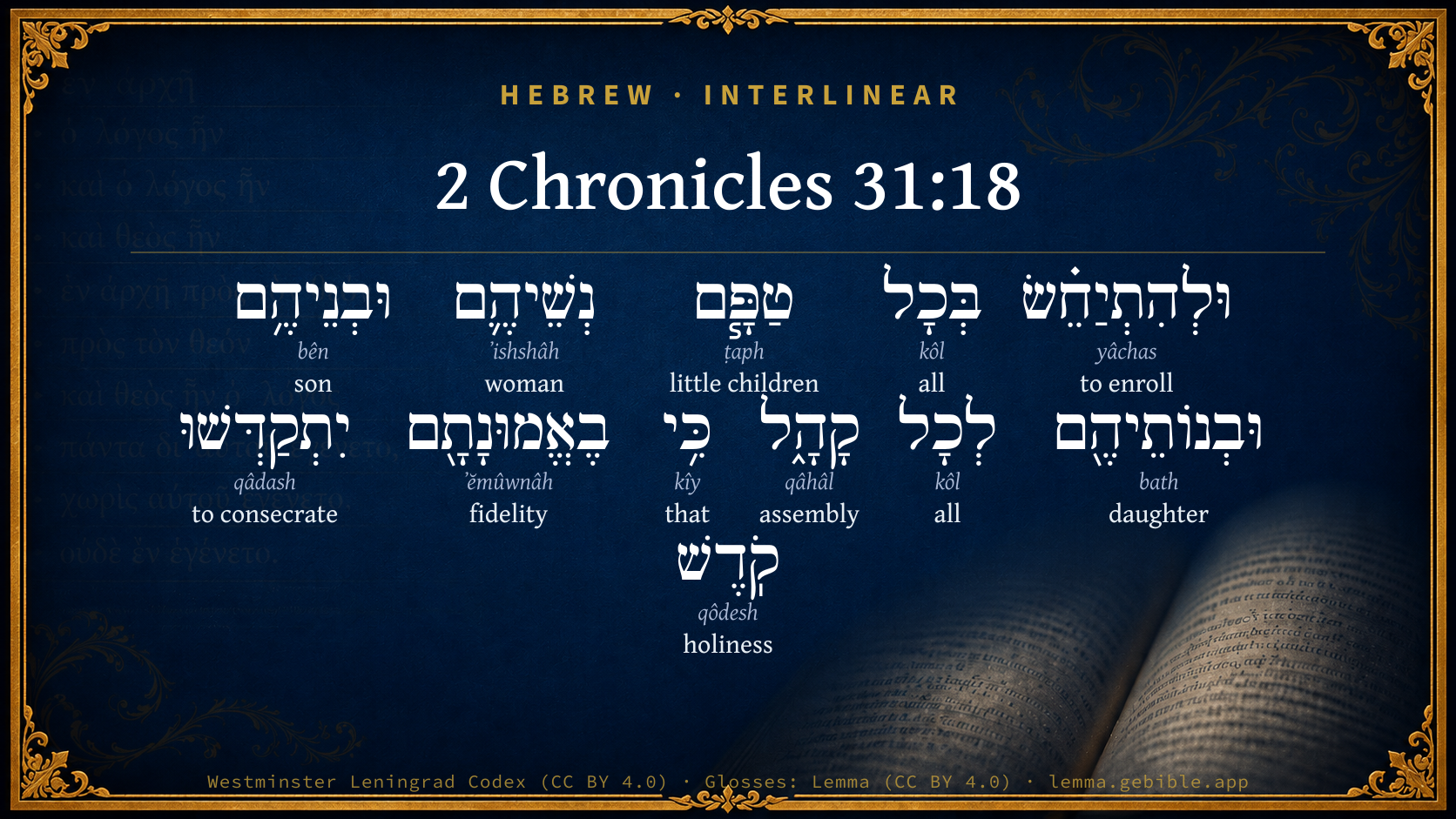
וּלְהִתְיַחֵ֗שׂ
yâchas
H3187
“and · to enroll”
Conjunction + Preposition + Verb, Hithpael, Infinitive Construct
Part of Speech
Conjunction + Preposition + Verb
Stem
Hithpael
Form
Infinitive Construct
Full BDB Definition

Origin: a primitive root

TWOT: 862

(Hithpael) to reckon genealogically, enroll on a genealogy, enroll, be enrolled
  1. בְּכָל kôl H3605 “in/at · all of” Preposition + Noun, Common, Masculine, Singular, Construct
  2. טַפָּ֧ם ṭaph H2945 “little children · their” Noun, Common, Masculine, Singular, Construct + Suffix, Personal, 3rd Person, Masculine, Plural
  3. נְשֵׁיהֶ֛ם ʼishshâh H802 “women · their” Noun, Common, Feminine, Plural, Construct + Suffix, Personal, 3rd Person, Masculine, Plural
  4. וּבְנֵיהֶ֥ם bên H1121 “and · sons · their” Conjunction + Noun, Common, Masculine, Plural, Construct + Suffix, Personal, 3rd Person, Masculine, Plural
  5. וּבְנוֹתֵיהֶ֖ם bath H1323 “and · daughters · their” Conjunction + Noun, Common, Feminine, Plural, Construct + Suffix, Personal, 3rd Person, Masculine, Plural
  6. לְכָל kôl H3605 “to/for · all of” Preposition + Noun, Common, Masculine, Singular, Construct
  7. קָהָ֑ל qâhâl H6951 “assembly” Noun, Common, Masculine, Singular, Absolute
  8. כִּ֥י kîy H3588 “that” Conjunction
  9. בֶאֱמוּנָתָ֖ם ʼĕmûwnâh H530 “in/at · fidelity · their” Preposition + Noun, Common, Feminine, Singular, Construct + Suffix, Personal, 3rd Person, Masculine, Plural
  10. יִתְקַדְּשׁוּ qâdash H6942 “to consecrate” Verb, Hithpael, Imperfect, 3rd Person, Masculine, Plural
  11. קֹֽדֶשׁ qôdesh H6944 “holiness” Noun, Common, Masculine, Singular, Absolute

About this verse

These counts appear in no published source. They are computed here, from the morphology-tagged text and Lemma’s own curated glosses. What Lemma adds →

12
words
11
distinct lemmas
Historical
section

Notable vocabulary

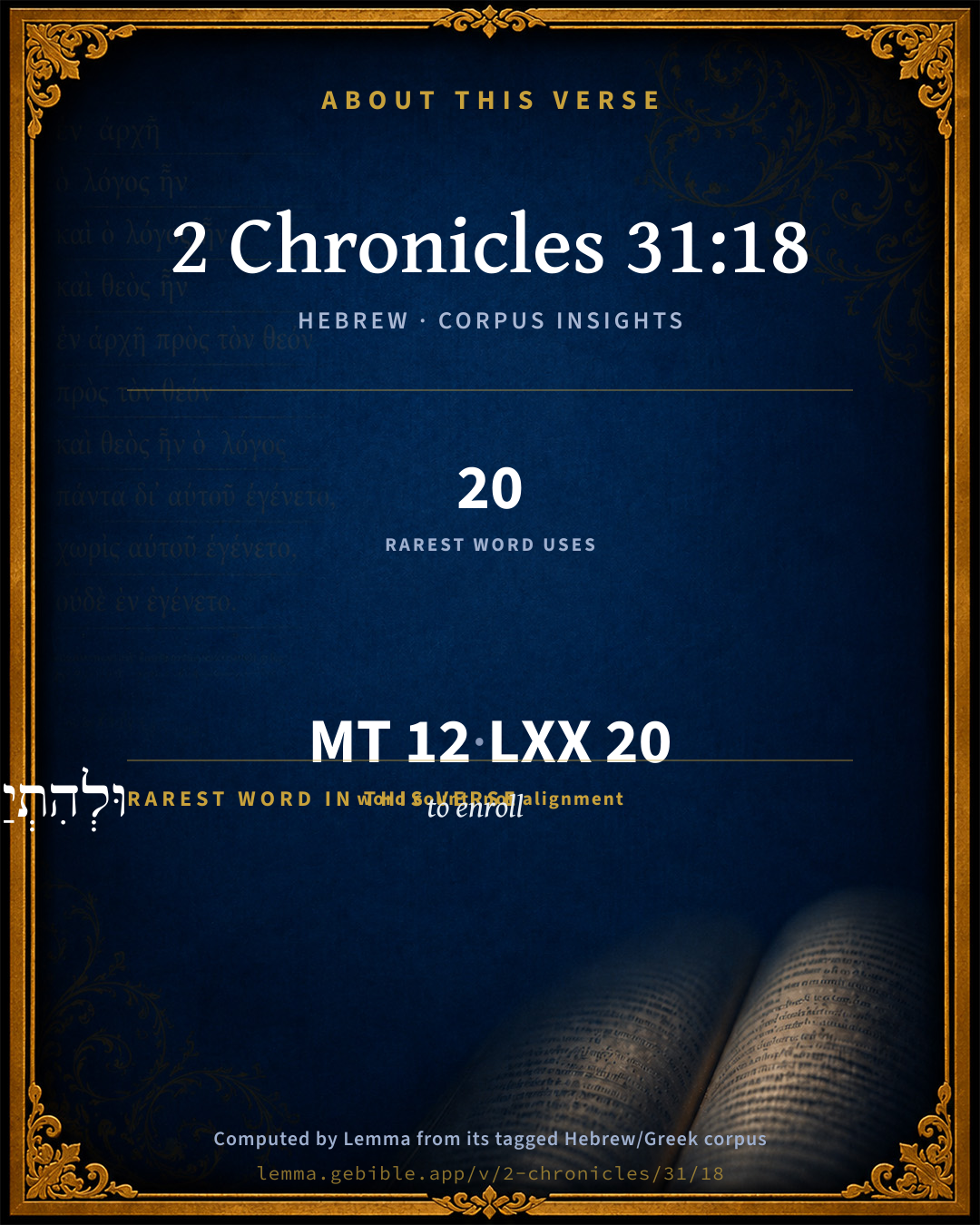
The rarest word here is וּלְהִתְיַחֵ֗שׂ to enroll H3187 — appearing just 20 times in the whole Hebrew Bible.

Shared distinctive vocabulary

וּלְהִתְיַחֵ֗שׂ to enroll H3187 occurs in 20 verses of the Hebrew Bible. Also found in:

Grammatical profile

  • 2 verbs
  • 9 nouns
  • 1 conjunction

Verb forms

  • וּלְהִתְיַחֵ֗שׂ Hithpael · Infinitive Construct
  • יִתְקַדְּשׁוּ Hithpael · Imperfect

Repetition

A word recurs within this verse — often emphatic in Hebrew:

  • בְּכָל all H3605 ×2

Hebrew & Septuagint length

In English translation the verse runs 35 words from the Hebrew and 24 from the Septuagint (LXX English) — the Septuagint runs noticeably shorter here. See the side-by-side →

A rough comparison of the two English renderings, which tokenize alike — not a word-level alignment.

Word counts can differ between the Hebrew and the Greek without any difference in meaning — e.g. the Hebrew direct-object marker אֵת has no separate Greek word, and Greek often adds the article ὁ.

In the original languages it is 12 Hebrew tokens and 20 Greek tokens — but the two are counted differently (Hebrew bundles its prefixes and suffixes into one token; the Greek is in lemma form), so that isn’t a like-for-like length.

Cross-references

4

Topical passages linked to 2 Chronicles 31:18 in the Treasury of Scripture Knowledge — connected by theme and wording, ordered by reader-vote popularity; previews shown in the World English Bible.

  • 1 Chronicles 9:22 All these who were chosen to be porters in the thresholds were two hundred and twelve. These were reckoned by genealogy in their villages, whom David and Samuel the seer did ordain in their office of trust.
  • 2 Chronicles 31:15 Under him were Eden, and Miniamin, and Jeshua, and Shemaiah, Amariah, and Shecaniah, in the cities of the priests, in their office of trust, to give to their brothers by divisions, as well to the great as to the small:
  • Isaiah 5:16 But Yahweh of Hosts is exalted in justice, And God the Holy One is sanctified in righteousness.
  • Romans 15:16 that I should be a servant of Christ Jesus to the Gentiles, ministering as a priest the Gospel of God, that the offering up of the Gentiles might be made acceptable, sanctified by the Holy Spirit.

Cross-references courtesy of OpenBible.info (CC BY 4.0).

Hebrew and Greek witnesses Masoretic Hebrew ↔ Greek Septuagint

The same verse in the two great witnesses to the Old Testament, shown verse-for-verse.

Here the Septuagint runs noticeably shorter than the Hebrew — LXX2012 (modern English Septuagint) 24 words vs World English Bible 35. A rough length comparison of the two English translations, not a word-level alignment — read both below.

These are two independent witnesses, not word-aligned to each other, and the Septuagint is shown in lemma (dictionary) form.

Hebrew 2 Chronicles 31:18 Masoretic · Westminster Leningrad Codex

וּלְהִתְיַחֵ֗שׂ בְּכָל טַפָּ֧ם נְשֵׁיהֶ֛ם וּבְנֵיהֶ֥ם וּבְנוֹתֵיהֶ֖ם לְכָל קָהָ֑ל כִּ֥י בֶאֱמוּנָתָ֖ם יִתְקַדְּשׁוּ קֹֽדֶשׁ

and those who were reckoned by genealogy of all their little ones, their wives, and their sons, and their daughters, through all the congregation: for in their office of trust they sanctified themselves in holiness.

World English Bible · Public Domain

Greek LXX 2 Chronicles 31:18 Septuagint · lemma form

ἐν καταλοχία ἐν πᾶς ἐπιγονή υἱός αὐτός καί θυγάτηρ αὐτός εἰς πᾶς ὁ πλῆθος ὅτι ἐν πίστις ἁγνίζω ὁ ἅγιος

to assign stations for all the increase of their sons and their daughters, for the whole number: for they faithfully sanctified the holy place.

LXX2012 (modern English Septuagint) · Public Domain

Hebrew: Westminster Leningrad Codex (CC BY 4.0). Greek: Septuagint (public domain); English from LXX2012 (modern English Septuagint) (Public Domain). How the Septuagint differs from the Hebrew →

Commentary

Notes on 2 Chronicles 31:18 from classic Christian and Jewish commentators (each source and its license shown beneath its notes). The classic Christian expositions comment on the surrounding passage and are grouped to its opening verse, so a note may address several verses; the Jewish commentaries on the Tanakh (Rashi and others) are per-verse, so they appear only where the commentator wrote on this verse.

Lemma curates 59 commentaries, every one of them public domain or Creative Commons licensed, each selected and text-cleaned for this edition rather than reprinted as found. About our sources →

Ellicott's Commentary for English Readers

(18) And to the genealogy.—After the parenthetic statements of 2Ch_31:16-17 the thread of the narrative, broken off at 2Ch_31:15, is taken up again at that point. The six Levites there named were in the priests’ cities “to give (their portions) to their brethren,” and further (2Ch_31:18) “for the registering in the case of all their little ones, their wives and their sons and their daughters, of the whole corporation” (of priests). The board of Levites had to keep a register of all who had claims on the provisions which they had to distribute. The general sense is the same if, as seems better, we trace the connection thus: “to give to their brethren, and to those who were registered among all their little ones” &c., explaining lĕhithyahçsh bĕkol-tappâm as a relative sentence with the relative suppressed. (Comp. 2Ch_30:18-19, and 2Ch_31:19, ad fin.)

Through all the congregation.—Or, to a whole assembly—scil., of wives and children of the priests and Levites.

In their set office.—Or trust, or faithfulness (emûnah). (See Note on 1Ch_9:22.)

They sanctified themselves.—They used to show themselves holy (i.e., behave conscientiously) in regard to the holy (i.e., the hallowed gifts, which they had to distribute). Perhaps, however, the Authorised Version is here substantially correct, the sense being that the Levites fulfilled their trust with perfect good faith.

A Bible Commentary for English Readers, edited by Charles John Ellicott (1878–1897) — public domain. Text from a community e-Sword module.

Trapp's Complete Commentary

John Trapp

2Ch 31:18 And to the genealogy of all their little ones, their wives, and their sons, and their daughters, through all the congregation: for in their set office they sanctified themselves in holiness:

Ver. 18. Of all their little ones, their wives, &c.] Their wives and children depended upon them for a maintenance, and had it.

John Trapp, A Commentary or Exposition upon All the Books of the Old and New Testament (1647–1656) — public domain. Text from a community e-Sword module.

Joseph Benson's Commentary

2Ch 31:18. For in their set office they sanctified themselves unto holiness — This is alleged as a reason why their wives and children were provided for out of the holy things, because they sequestered themselves from worldly affairs, by which they might otherwise have provided for their families, and entirely devoted themselves to holy administrations.

Joseph Benson's Commentary on the Old and New Testaments (1811–1818) — public domain. Text from a community e-Sword module.

Geneva Bible (1599)

Geneva Bible translators

Meaning, that either by the faithful distributions of the officers, everyone had their part in the things that were offered, or else that their wives and children were relieved, because the Levites were faithful in their office, and so depended on them.

Geneva Bible (1599) marginal notes — public domain. Text via Bolls.life.

Jamieson, Fausset & Brown

Robert Jamieson, A. R. Fausset & David Brown

for in their set office they sanctified themselves--This is the reason assigned for providing for the wives and children out of the revenues of the sanctuary, that priests, withdrawing from those secular pursuits by which they might have maintained their households, devoted themselves entirely to the functions of the ministry.

Jamieson, Fausset & Brown — Commentary Critical and Explanatory on the Whole Bible (1871) — public domain (CC PDM 1.0). Text via the HelloAO Bible API.

The Cambridge Bible for Schools and Colleges

gen. ed. J. J. S. Perowne

18. and to the genealogy of all their little ones] Render with R.V. mg. even to give to them that were reckoned by genealogy of all their little ones.

The connexion of 2Ch_31:15-18 is difficult to trace and the text is perhaps faulty. Assuming however the general correctness of the text, we may regard 2Ch_31:16-17 as a parenthesis stating that the ministration of Eden and his colleagues did not extend to those priests and Levites and male children of the priests who presented themselves in person at the Temple.

in their set office] R.V. mg. in their trust.

they sanctified themselves in holiness] Or, they busied themselves with the distribution of the sanctified things.

The Cambridge Bible for Schools and Colleges (gen. ed. J. J. S. Perowne; Cambridge University Press, 1878–1918) — public domain. Text from a community e-Sword module.

John Gill's Exposition

Also of the sons of Aaron the priests, which were in the fields of the suburbs of their cities, in every several city,.... Which were allowed to them out of the several tribes, and where they dwelt, when it was not the turn of their course to officiate in the temple; now to these, as well as to those in Jerusalem, a portion was distributed for the support of them and their families:

the men that were expressed by name; before mentioned, Ch2 31:13, though some understand it of such as were nominated and appointed by them, and to act under them in the country:

to give portions to all the males among the priests, and to all that were reckoned by genealogies among the Levites: as before declared.

John Gill's Exposition of the Whole Bible (1746–1763) — public domain (CC PDM 1.0). Text via the HelloAO Bible API.

Albert Barnes' Notes on the Bible

And to the genealogy of all their little ones ... - Or, “And as to the list of all their little ones, their wives, their sons, and their daughters, it extended to the whole body, for they dealt with the holy things faithfully.”

Albert Barnes' Notes on the Bible (1834–1885) — public domain. Text from a community e-Sword/MySword module.

Haydock's Catholic Bible Commentary

To all. Prot. "the genealogy of all their little ones, their wives, and their sons, and their daughters, through all the congregation: for in their set office they sanctified themselves in holiness." H. --- All complied with their respective duties; the people, the distributors, and the priests. C.

George Leo Haydock (1774–1849), Haydock's Catholic Family Bible and Commentary, 1859 edition — public domain. Excludes Psalms (Douay-Rheims chapter numbering differs from Protestant) and Deuterocanonical books (Catholic canon only).

Matthew Poole's English Annotations

This is alleged as a reason why their wives and children were provided for out of the holy things, because they sequestered themselves from worldly affairs, by which they might otherwise have provided for their families, and entirely devoted themselves to holy administrations.

Matthew Poole's English Annotations on the Holy Bible (1683–1685) — public domain. Text from a community e-Sword/MySword module.

The Pulpit Commentary

(Comp. our 2Ch_20:13)

The Pulpit Commentary (1880–1919), ed. H.D.M. Spence-Jones & Joseph S. Exell — public domain. Text from a community e-Sword module.

John Wesley's Explanatory Notes

For, &c. - This is alleged as a reason why their wives and children were provided for out of the holy things, because they sequestered themselves from worldly affairs, by which they might otherwise have provided for their families.

John Wesley, Explanatory Notes Upon the Whole Bible (1754–1765) — public domain. Text via the GEBible commentary corpus.

Lesson kit

Teaching starters — assembled from the data on this page, not authored interpretation. Every prompt links to the verse data it draws on. Edit before teaching.

2 Chronicles, in the Historical, opens this verse with 12 words (11 distinct Hebrew lemmas). Its most distinctive word is yâchas (“to enroll”). The Greek Septuagint runs shorter here. A historical commentator’s framing appears above. Read the whole chapter for the surrounding context.

Discussion questions

  1. The word yâchas carries the sense “to enroll.” How does it shape the verse?
  2. How does 1 Chronicles 4:33, which shares the word «to enroll», read alongside this verse?
  3. What does the repetition of “all” (2× in this one verse) do in this verse?
  4. The Septuagint runs shorter here than the Hebrew. What might account for the difference?
  5. The translations on this page render this verse differently — a whole-verse word diff, not a word-by-word alignment. What might account for the different wordings?
  6. «וּלְהִתְיַחֵ֗שׂ» is a Hithpael Infinitive Construct verb. How does that grammatical form shape the action described?
  7. Compare how Ellicott's Commentary for English Readers and Trapp's Complete Commentary read this verse. Where do they agree or differ?

Things to notice

Reading settings

Reading text

Shown beneath each verse's original-language words.

Old Testament
Old Testament edition

Read the OT as the Masoretic Hebrew (MT) or the Greek Septuagint (LXX).

English shown for the Greek Septuagint (in the Hebrew ↔ Greek comparison).

Comparing translations? Open the Compare panel on any verse page to stack up to four side by side.