Psalms 40:9

Hebrew (Westminster Leningrad Codex) Psalms 40:9 appears in the Hebrew Old Testament. The text above is from the Westminster Leningrad Codex. Each word links to its Strong’s number, a concise gloss, and parsing drawn from the Open Scriptures Hebrew Bible morphology. Click any word for its full Brown-Driver-Briggs (BDB) entry.
Download image
Cite this verse

Psalms 40:9 (World English Bible). Public Domain. Lemma interlinear Bible study tool, https://lemma.gebible.app/v/psalms/40/9.

Show BibTeX & RIS
BibTeX
RIS
English Translation
I have proclaimed glad news of righteousness in the great assembly. Behold, I will not seal my lips, Yahweh, you know.
World English Bible · Public Domain
Download a study sheet

One document with this verse’s original text, its word-by-word gloss line, the meaning frame, cross-references with their text, attributed commentary, and full source and license credits — printable, and it pastes into notes with its structure intact.

This verse Autodidact and up

Study sheet (.html) Plain text (.txt)

A passage Seminary Student

Up to 50 verses in one chapter. A passage sheet keeps up to 6 commentary sources and 12 cross-references per verse, in the order this page ranks them, and says so on the sheet whenever that leaves anything out. Ask for a single verse and you get the Autodidact verse sheet above.

Everything on this page stays free to read, with no account — the sheet is a download of what is already on screen, not access to it.

Want to remove ads? Support Godless Engineer
Compare translations 3

The same verse in 3 English versions, stacked beneath the original-language interlinear above. Click any original word for its lexicon entry.

Each is an independent rendering of the whole verse — the interlinear is not word-aligned to these translations.

Highlighted words mark where these versions differ — a whole-verse word diff, not a word-by-word alignment.

  • World English Bible Public Domain
    I have proclaimed glad news of righteousness in the great assembly. Behold, I will not seal my lips, Yahweh, you know.
  • King James Version Public Domain
    I have preached righteousness in the great congregation: lo, I have not refrained my lips, O LORD, thou knowest.
  • unfoldingWord Literal Text CC BY-SA 4.0
    I have proclaimed righteousness in the great assembly; behold, I will not restrain my lips. Yahweh, you, you know.

unfoldingWord Literal Text — © unfoldingWord, licensed CC BY-SA 4.0. Word-aligned USFM3 via Door43 (git.door43.org/unfoldingWord/en_ult).

Versions to compare (up to 4)

3 of 4 selected

Show all 18 translations

Every available English version of this verse, each an independent rendering of the whole verse.

  • World English Bible Public Domain
    I have proclaimed glad news of righteousness in the great assembly. Behold, I will not seal my lips, Yahweh, you know.
  • Berean Standard Bible Public Domain
    I proclaim righteousness in the great assembly; behold, I do not seal my lips, as You, O LORD, do know.
  • Majority Standard Bible Public Domain
    I proclaim righteousness in the great assembly; behold, I do not seal my lips, as You, O LORD, do know.
  • King James Version Public Domain
    I have preached righteousness in the great congregation: lo, I have not refrained my lips, O LORD, thou knowest.
  • American Standard Version (1901) Public Domain
    I have proclaimed glad tidings of righteousness in the great assembly; Lo, I will not refrain my lips, O Jehovah, thou knowest.
  • Revised Version (1885) Public Domain
    I have published righteousness in the great congregation; lo, I will not refrain my lips, O LORD, thou knowest.
  • Geneva Bible (1599) Public Domain
    I haue declared thy righteousnesse in the great Congregation: loe, I will not refraine my lippes: O Lord, thou knowest.
  • Douay-Rheims (1899) Public Domain
    that I should do thy will: O my God, I have desired it, and thy law in the midst of my heart.
  • Young's Literal Translation Public Domain
    I have proclaimed tidings of righteousness In the great assembly, lo, my lips I restrain not, O Jehovah, Thou hast known.
  • Literal Standard Version CC BY-SA 4.0
    I have proclaimed tidings of righteousness || In the great assembly, || Behold, I do not restrain my lips, || O YHWH, You have known.
  • Unlocked Literal Bible CC BY-SA 4.0
    I have proclaimed good news of your righteousness in the great assembly; Yahweh, you know that my lips have not kept back from doing this.
  • unfoldingWord Literal Text CC BY-SA 4.0
    I have proclaimed righteousness in the great assembly; behold, I will not restrain my lips. Yahweh, you, you know.
  • Darby Bible Public Domain
    I have published righteousness in the great congregation: behold, I have not withheld my lips, Jehovah, *thou* knowest.
  • World Messianic Bible Public Domain
    I have proclaimed glad news of righteousness in the great assembly. Behold, I will not seal my lips, LORD, you know.
  • Webster's Bible Public Domain
    \\40:8\\I delight to do thy will, O my God: yea, thy law is within my heart.
  • Free Bible Version CC BY-SA 4.0
    I have announced the good news of salvation to the whole congregation. I don't keep quiet, Lord, as you know.
  • Bible in Basic English Public Domain
    I have given news of righteousness in the great meeting; O Lord, you have knowledge that I have not kept back my words.
  • JPS Tanakh (1917) Public Domain
    (40-10) I have preached righteousness in the great congregation, lo, I did not refrain my lips; O LORD, Thou knowest.

Literal Standard Version (2020), Covenant Press — licensed CC BY-SA 4.0. Text via the HelloAO Bible API (eBible.org). Unlocked Literal Bible (unfoldingWord) — licensed CC BY-SA 4.0. Text via the HelloAO Bible API (eBible.org). unfoldingWord Literal Text — © unfoldingWord, licensed CC BY-SA 4.0. Word-aligned USFM3 via Door43 (git.door43.org/unfoldingWord/en_ult). Free Bible Version, Dr. Jonathan Gallagher — licensed CC BY-SA 4.0. Text via the HelloAO Bible API (eBible.org).

Word by word

More ways to search: Search by grammar → Find every occurrence → Compare this word →

Practice this passage: Drill this verse → Learn its vocabulary →

אֶכְלָ֑א
kâlâʼ
H3607
“to restrain”
Verb, Qal, Imperfect, 1st Person, Common, Singular
Part of Speech
Verb
Stem
Qal
Form
Imperfect
Person
1st Person
Gender
Common
Number
Singular
Full BDB Definition

Origin: a primitive root

TWOT: 980

to restrict, restrain, withhold, shut up, keep back, refrain, forbid - (Qal) - to shut up - to restrain - to withhold - (Niphal) to be restrained - (Piel) to finish
  1. בִּשַּׂ֤רְתִּי bâsar H1319 “to preach” Verb, Piel, Perfect, 1st Person, Common, Singular
  2. צֶ֨דֶק tsedeq H6664 “righteousness” Noun, Common, Masculine, Singular, Absolute
  3. בְּקָ֘הָ֤ל qâhâl H6951 “in/at · assembly” Preposition + Noun, Common, Masculine, Singular, Absolute
  4. רָ֗ב rab H7227 “many” Adjective, Adjective, Masculine, Singular, Absolute
  5. הִנֵּ֣ה hinnêh H2009 “behold” Particle, Demonstrative
  6. שְׂ֭פָתַי sâphâh H8193 “lips · my” Noun, Common, Feminine, Dual, Construct + Suffix, Personal, 1st Person, Common, Singular
  7. לֹ֣א lôʼ H3808 “not” Particle, Negative
  8. יְ֝הוָ֗ה Yᵉhôvâh H3068 “LORD” Noun, Proper
  9. אַתָּ֥ה ʼattâh H859 “you” Pronoun, Personal, 2nd Person, Masculine, Singular
  10. יָדָֽעְתָּ yâdaʻ H3045 “to know” Verb, Qal, Perfect, 2nd Person, Masculine, Singular

About this verse

These counts appear in no published source. They are computed here, from the morphology-tagged text and Lemma’s own curated glosses. What Lemma adds →

11
words
11
distinct lemmas
Wisdom
section

Notable vocabulary

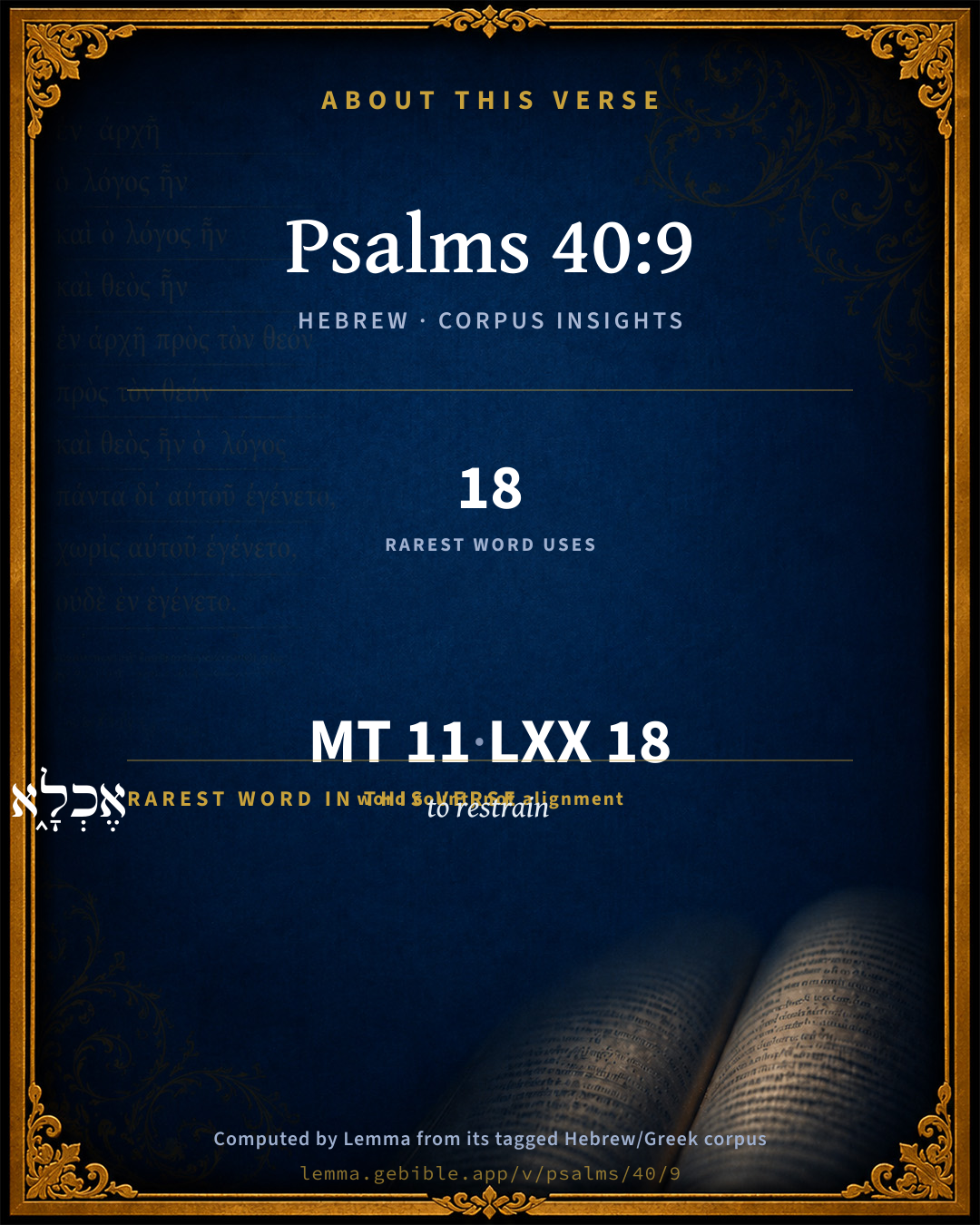
The rarest word here is אֶכְלָ֑א to restrain H3607 — appearing just 18 times in the whole Hebrew Bible.

Shared distinctive vocabulary

אֶכְלָ֑א to restrain H3607 occurs in 17 verses of the Hebrew Bible. Also found in:

Grammatical profile

  • 3 verbs
  • 4 nouns
  • 1 adjective
  • 1 pronoun
  • 2 particles

Verb forms

  • בִּשַּׂ֤רְתִּי Piel · Perfect
  • אֶכְלָ֑א Qal · Imperfect
  • יָדָֽעְתָּ Qal · Perfect

Hebrew & Septuagint length

In English translation the verse runs 21 words from the Hebrew and 21 from the Septuagint (LXX English) — the same length.

A rough comparison of the two English renderings, which tokenize alike — not a word-level alignment.

Word counts can differ between the Hebrew and the Greek without any difference in meaning — e.g. the Hebrew direct-object marker אֵת has no separate Greek word, and Greek often adds the article ὁ.

In the original languages it is 11 Hebrew tokens and 18 Greek tokens — but the two are counted differently (Hebrew bundles its prefixes and suffixes into one token; the Greek is in lemma form), so that isn’t a like-for-like length.

Cross-references

12

Topical passages linked to Psalms 40:9 in the Treasury of Scripture Knowledge — connected by theme and wording, ordered by reader-vote popularity; previews shown in the World English Bible.

  • Psalms 22:25 Of you comes my praise in the great assembly. I will pay my vows before those who fear him.
  • Mark 16:15–16 He said to them, "Go into all the world, and preach the Gospel to the whole creation.
  • Psalms 22:22 I will declare your name to my brothers. In the midst of the assembly, I will praise you.
  • Psalms 71:15–18 My mouth will tell about your righteousness, And of your salvation all day, Though I don't know its full measure.
  • Psalms 119:13 With my lips, I have declared all the ordinances of your mouth.
  • Psalms 35:18 I will give you thanks in the great assembly. I will praise you among many people.
  • Luke 4:16–22 He came to Nazareth, where he had been brought up. He entered, as was his custom, into the synagogue on the Sabbath day, and stood up to read.
  • Hebrews 2:12 saying, "I will declare your name to my brothers. In the midst of the congregation I will sing your praise."
  • Joshua 22:22 The Mighty One, God, Yahweh, the Mighty One, God, Yahweh, he knows; and Israel he shall know: if it be in rebellion, or if in trespass against Yahweh (don't save us this day),
  • Psalms 119:171–172 Let my lips utter praise, For you teach me your statutes.
  • Psalms 139:2 You know my sitting down and my rising up. You perceive my thoughts from afar.
  • John 21:17 He said to him the third time, "Simon, son of Jonah, do you have affection for me?" Peter was grieved because he asked him the third time, "Do you have affection for me?" He said to him, "Lord, you know everything. You know that I have affection for you." Jesus said to him, "Feed my sheep.

Cross-references courtesy of OpenBible.info (CC BY 4.0).

Hebrew and Greek witnesses Masoretic Hebrew ↔ Greek Septuagint

The same verse in the two great witnesses to the Old Testament, shown verse-for-verse.

You’re reading Greek Psalm 39 (Hebrew Psalm 40). The Septuagint counts the superscription, so verse numbers can differ from the Hebrew — chapter-level alignment, not verse-by-verse. Numbering follows Rahlfs.

These are two independent witnesses, not word-aligned to each other, and the Septuagint is shown in lemma (dictionary) form.

Hebrew Psalms 40:9 Masoretic · Westminster Leningrad Codex

בִּשַּׂ֤רְתִּי צֶ֨דֶק בְּקָ֘הָ֤ל רָ֗ב הִנֵּ֣ה שְׂ֭פָתַי לֹ֣א אֶכְלָ֑א יְ֝הוָ֗ה אַתָּ֥ה יָדָֽעְתָּ

I have proclaimed glad news of righteousness in the great assembly. Behold, I will not seal my lips, Yahweh, you know.

World English Bible · Public Domain

Greek LXX Greek Psalm 39:9 Septuagint · lemma form

ὁ ποιέω ὁ θέλημα σύ ὁ θεός ἐγώ βούλομαι καί ὁ νόμος σύ ἐν μέσος ὁ κοιλία ἐγώ

I have preached righteousness in the great congregation; behold! I will not refrain my lips; O Lord, you know my righteousness.

LXX2012 (modern English Septuagint) · Public Domain

On this verse, The Cambridge Bible for Schools and Colleges discusses the Septuagint’s reading. Read the note in Commentary ↓

Hebrew: Westminster Leningrad Codex (CC BY 4.0). Greek: Septuagint (public domain); English from LXX2012 (modern English Septuagint) (Public Domain). How the Septuagint differs from the Hebrew →

Commentary

Notes on Psalms 40:9 from classic Christian and Jewish commentators (each source and its license shown beneath its notes). The classic Christian expositions comment on the surrounding passage and are grouped to its opening verse, so a note may address several verses; the Jewish commentaries on the Tanakh (Rashi and others) are per-verse, so they appear only where the commentator wrote on this verse.

Lemma curates 59 commentaries, every one of them public domain or Creative Commons licensed, each selected and text-cleaned for this edition rather than reprinted as found. About our sources →

Trapp's Complete Commentary

John Trapp

Psa 40:9 I have preached righteousness in the great congregation: lo, I have not refrained my lips, O LORD, thou knowest.

Ver. 9. I have preached righteousness in the great congregation] David did this, but Christ much more, by the everlasting gospel, sent the whole world throughout. Great was the company of preachers, and large was their commission. See a draught of it Act 26:18.

I have declared thy faithfulness, and thy salvation] Righteousness of Christ imputed, faithfulness of God in fulfilling his promises, salvation the end of faith, lovingkindness and truth the ground of all the former, God’s lovingkindness, or mercy moving him to promise, and his truth binding him to perform; these are those pearls that Christ by his preachers casteth before people, if they be but as forward to take them as he is to tender them. How beautiful should the feet be of those that bring such glad tidings! and how heavy will the dust of such feet be, shaken off against despisers!

O Lord, thou knowest] sc. That I have herein done mine utmost, and with an upright heart.

John Trapp, A Commentary or Exposition upon All the Books of the Old and New Testament (1647–1656) — public domain. Text from a community e-Sword module.

The Biblical Illustrator

Joseph S. Exell

Psa_40:9-10

I have preached righteousness in the great congregation: lo, I have not refrained my lips, O Lord, Thou knowest.

Christian conversation

There is a recluse and sequestered piety in the world which shuns expression. It preserves decorum and propriety; but it rarely speaks out for Christ. We are all acquainted with praying, pious, upright people, strict observers of the moral law, who yet have never been heard, at any time, to give utterance to their religious convictions, or to stand forth in defence of the faith against its assailants, or in the way of exhortation to holiness.

1. In this matter our age stands in strong contrast to some former notable periods. In the days of Whitefield and Wesley men everywhere and in all conditions made religion a matter of common converse. Then great reforms took place. The traffic in slaves was stopped; the condition of prisoners improved; Church missions and Sunday schools were established. Then society was almost universally stirred and excited by the most glorious themes of the Gospel.

2. Observe how desirable in every way is the practice of converse upon the things of God. Christianity is no private monopoly, no exclusive, personal possession. It is a social religion, because it is made to be talked of, and talked into every sphere of life, and to rule and govern them all.

3. It is, then, very clearly our duty to use the faculty of speech for Gods glory, for the health and strengthening of human souls. All the processes of building and uprearing in this world are prized by men. But by just so much as souls are nobler, grander structure than houses or palaces, or bodies, so the vital energy of pure and holy speech, dropped into the outward and inner ears of men, startling, quickening, sobering, prompting, guiding, elevating, sanctifying them, to good resolves, to noble acts, to self-devotion to God and man, to purity, to excellence and heavenly-mindedness; so the work and power of holy speech towers immeasurably above all the constructive work of architects and builders in this outward, visible world.

4. You tell me it is bard to talk about religion. Many people are reluctant and unwilling to speak concerning this most sacred of all themes, lest they should be betrayed into a habit of cant; which is the simulation of feeling when one has no feeling. Others are afraid of becoming flippant about holy things. And, first let me say there can be no general rule given concerning religious conversation. Perhaps the nearest approach one can make to a precept are the words of St. Paul (Col_4:6). That is, our conversation should be saturated with pious and religious prudence flowing from the Holy Spirit. In ordinary conversation we should talk with such a sense of sacred propriety, with such Christian cheerfulness, with such generous courtesy for the opinions and feelings of others, that although the name of Christ be never mentioned, people may gather that we have been with Him, and that His Holy Spirit is the prompter of our life and thought. On the other hand, there are times when our discourse should be most direct and distinct. When we are dealing with the sick, with people who are anxious and inquiring, with indifferent and careless people, then circumlocution or indirection is a great fault. Be faithful to souls, in your conversation as well as in your walk and bearing. But bear in mind two things.

(1) That no stilted, formal, unmeaning words on religion will reach any mans soul. If you are not impelled by duty and interest in men to talk with them concerning religious matters, hold your tongue.

(2) Join to this the duty of avoiding all debate and wrangling upon religion. The work of Christians is to persuade and invite the careless; not to dispute with them. (A. Crummell.)

The Masters profession the disciples pursuit

These are the words of the Lord Jesus Christ spoken by Him through the spirit of prophecy in the Old Testament. And--

I. Our Lord did undoubtedly fulfil them. He concentrated every faculty and power to this work; He testified frequently to the greatest crowd. His preaching was never heartless. As if He had said, Thy righteousness is in my heart, but I have never concealed it there. And He always kept to vital matters--to God and His attributes. Thy righteousness, Thy faithfulness, etc.

II. Let us strive to be able to say the same. It is certain that many will never be able to, for in all our churches there is a very large proportion of idle people. I hope they are saved; the Lord knows whether they are or not, but whatever else they are saved from, certainly they are not saved from laziness. They must imagine that they are ornaments, for certainly they are of no use, so far as any good offices are concerned. Nor will cowardly people be able to make this protest. The retiring disposition of many Christians is seen in somewhat the same way as that of the soldier who, when a charge was ordered, felt himself unworthy to be in the front ranks. Nor again will spasmodic people--people who begin things with much zeal, and then drop them. But many men of one talent will. I have known many such--good, earnest, humble, patient, praying toilers, hidden in obscure villages, with an extremely narrow sphere. And some, too, to whom larger talents have been entrusted. Let all such resolve to be able to lay claim to its praise.

III. If we can, much comfort on many solemn subjects will be gained. The death of so many unsaved men; their hereafter, so awful; the doom of the heathen, the uprisings of error--for the blame of this wilt not lie at our door. Now, are not some of you ready to undertake this work of going forth as Gods missionaries? In the sight of God ask yourselves--is it not your duty? (C. H. Spurgeon.)

I have not hid Thy righteousness within my heart; I have declared Thy faithfulness and Thy salvation.--

Those who know God will confess Him

The psalmist here tells not only of what was an actual fact, but what is more, that he could not help thus testifying of Gods salvation. What I propose, accordingly, at the present time, is to speak of the necessary openness of a holy experience; or, in other words, of the impossibility that the inward revelation of God in the soul should be shut up in it, and remain hid or unacknowledged. I shall have in view especially two classes of hearers that are widely distinguished one from the other; first, the class who lude the grace of God in their heart undesignedly, or by reason of some undue modesty; and secondly, the class who, pretending to have it, or consciously having it not, take a pleasure in throwing discredit on all the appropriate expressions of it, such as are made by the open testimony and formal profession of Christ before men. The former class are certainly blameable in no such sense or degree as the others. They are naturally timorous and self-distrustful persons, it may be, and do not see that they are distrusting God rather than themselves. They seem to themselves to have been truly renewed in the love of God, but they have some doubts, and they make it appear to be wiser that they should not, just now, testify their supposed new experience. In opposition to both these claims we would affirm the necessary openness of a holy experience. For--

1. Such experience is even an impulse to self-manifestation, as all love and gratitude are. It wants to speak and declare itself as naturally as a child will utter its first cry. Thus, if one of you had been rescued, in a shipwreck on a foreign shore, by some common sailor who had risked his life to save you, and you should discover him across the street in some great city, you would rush to his side, seize his hand, and begin at once, with a choking utterance, to testify your gratitude to him for so great a deliverance. Or, if you should pass restrainedly on, making no sign, pretending to yourself that you might be wanting in delicacy or modesty to publish your private feelings by any such eager acknowledgment of your deliverer, or that you ought first to be more sure of the genuineness of your gratitude, what opinion must we have, in such a case, of your heartlessness and falseness to nature? In the same way how can the young convert keep from saying, Come and hear, all ye that fear God, and I will declare, etc. etc.

2. Such an inward change is in its very nature the soul and root of a corresponding outward change. It is the righteousness of God revealed within, to be henceforth the actuating spring and power of a righteous and devoted life. It will inform the whole man. It will glow in the countenance. It will irradiate the eye. It will speak from the tongue. It will modulate the very gait. The good tree will show the good fruit. It cannot go on to bear the old, bad fruit out of modesty, or a pretended shrinking from ostentation; it must reveal the righteousness of God within, by the fruits of righteousness without, else it is only a mockery.

3. If any one proposes beforehand in his religious endeavours, or in seeking after God, to come into a secret experience and keep it a secret, his endeavour is plainly one that falsifies the very notion of Christian piety, and if he succeeds or seems to succeed, he only practises a fraud in which he imposes on himself.

4. It is not less clear, as I have already said incidentally, and now say only more directly, that the grace of God in the heart, unmanifested or kept secret, as many propose that it shall be, even for their whole life, will be certainly stifled and extinguished. The thought itself is a mockery of the Holy Spirit. The heart might as well be required to live and not beat as the new heart of love to hush itself and keep still in the bosom. Nothing can live that is not permitted to show the signs of life.

5. This is the express teaching of the Gospel, which everywhere and in every possible way calls out the souls renewed in Christ to live an open life of sacrifice and duty. He calls upon them to endure hardness, to make a loss of all things for His sake, to be His witnesses before men; leading always the way by their own bold, faithful testimony. The nearest approach to such encouragement anywhere given, is that which is afforded by the ease of the two senators, Joseph and Nicodemus. One of them, we are told, was a disciple secretly, for fear of the Sews. And the other came to Jesus by night, to inquire of Him, that he might not be counted a disciple. Both of them appear to have kept silence on His trial before the council, letting the decision go against Him there, and taking no responsibility on His account. But after He was crucified, they came to ask the body, and brought spices to embalm it. They were good, as disciples, to bury Jesus, but not to save His life, or serve Him while living. The truth is, that there is a very heavy shade over these two delicate and courtly friends of Jesus. They were men of society, and therefore saw the dignity of Jesus; but if you would like to be reasonably confident of your salvation, it certainly becomes you to do something a great deal more positive than to let your Master die, making no stand for Him oven in the council where His death is voted, and then come in with spices to bury Him. The most fragrant spices are those that honour ones life, and not the posthumous odours that embalm His body. How singular is it, too, that not even the Pentecost calls out these disciples of the tomb. It is as if they had been buried with their Master and had not risen. In that wondrous scene of fellowship, where so many from all parts of the world are surprised to find themselves confessing and embracing, in open brotherhood, strangers of all climes and orders, and selling even their goods to relieve the common wants, it does not appear that any spices of the heavenly charity are brought in by these two. The real truth is, in respect to almost all these pretenders to a secret religion, that they are persons who know nothing of it. They are moralists, it may be, practising at what they call a virtue by themselves, but they do nothing that brings them into any relationship with God. It is not the righteousness of God which they have hidden so carefully, but it is their own--which, after all, is not hid. What value there may be in discoveries of Christian experience. Some of the best and holiest impulses ever given to the cause of God in mens hearts are given by testimonies of Christian experience. They may be abused, but that is no reason against their proper use. Besides, there is a higher view of these personal testimonies and confessions. All these experiences, or life-histories of the faithful, will be among the grandest studies and most glorious revelations of the future. Exactly as an apostle intimates in those most hopeful, inspiring words of his, When lie shall come to be glorified in His saints, and to be admired in all them that believe. May He not be glorified in them here, and, in some feebler measure, admired for the testimonies yielded by their experience as their warfare goes on. How many are there in our Christian communities that are living afar off and apparently quite inaccessible, who, if, at a certain time in their life, they had gone forward and taken the places to which they were called, would now be among the shining members of the great body of saints. Then testify freely, act but naturally, live openly the grace that is in you. (Horace Bushnell, D. D.)

The Biblical Illustrator, edited by Joseph S. Exell (c. 1880s–1900s) — public domain. Text from a community e-Sword module.

The Treasury of David

Charles H. Spurgeon

Ver. 9. I have preached righteousness in the great congregation. The purest morality and the highest holiness were preached by Jesus. Righteousness divine was his theme. Our Lord's whole life was a sermon, eloquent beyond compare, and it is heard each day by myriads. Moreover, he never shunned in his ministry to declare the whole counsel of God; God's great plan of righteousness he plainly set forth. He taught openly in the temple, and was not ashamed to be a faithful and a true witness. He was the great evangelist; the master of itinerant preachers; the head of the clan of open air missionaries. O servants of the Lord, hide not your lights, but reveal to others what your God has revealed to you; and especially by your lives testify for holiness, be champions for the right, both in word and deed. Lo, I have not refrained my lips, O Lord, thou knowest. Never either from love of ease, of fear of men, did the Great Teacher's lips become closed. He was instant in season and out of season. The poor listened to him, and princes heard his rebuke; Publicans rejoiced at him, and Pharisees raged, but to them both he proclaimed the truth from heaven. It is well for a tried believer when he can appeal to God and call him to witness that he has not been ashamed to bear witness for him; for rest assured if we are not ashamed to confess our God, he will never be ashamed to own us. Yet what a wonder is here, that the Son of God should plead, just as we plead, and urge just such arguments as would befit the mouths of his diligent minsters! How truly is he "made like unto his brethren."

Ver. 9. I have preached righteousness, etc. It is Jesus who speaks, and he speaks of himself as a PREACHER. He was a preacher, and a great preacher too. He was great1. In genuine eloquence. All the handmaids of the choicest rhetoric ministered to him as he spake. His mind touched the minds of his auditors on all sides. 2. He was great in knowledge. Many who have an astonishing command of words, and who can use their words with astonishing rhetorical adroitness, spoil their influence by their "lack of knowledge." They go blunderingly onward when they attempt to think for themselves, or to guide their hearers into fields of thought which have not been tracked by minds of the pioneer order. 3. He was great also in goodness. There is a greatness in goodness, and the greatness of goodness is an important element in the greatness of a preacher. 4. Jesus was great, too, in official status. Official status, whether in things civil, literary, or sacred, when conferred on worthy individuals, confers, in its turn, undoubted weight and moral authority. Now Jesus was the highest official in the universe. His authority extended to all other office bearers, his office exceeded all others offices. He came from above, and was "above all." He was Lord of lords, and King of kings. 5. Another element still in the greatness of Jesus, as a preacher, consisted in the greatness of his essential dignity. He was God as well as man. Such was Christ as a preacher. True he was more than a preacher; he was likewise a pattern, and a priest, and a propitiator; and as pattern, priest, and propitiator, he stands without a peer. But he was a preacher too, and as a preacher, he has never had, and never will have an equal. James Frame.

Ver. 9. The great congregation. The congregation here referred to was great not only in numbers, but great also in the necessities of its individual members, and great in pollution. James Frame.

Ver. 9-10. I have published...I would not refrain...I have not covered...I have uttered...I have not hid: words are heaped upon words to express the eager forwardness of a heart burning to show forth its gratitude. No elaborate description could so well have given us the likeness of one whose "life was a thanksgiving." J. J. Stewart Perowne.

Ver. 9-10. See Psalms on "Ps 40:9" for further information.

Ver. 9-10. Thy. See Psalms on "Ps 40:9" for further information.

Ver. 9. Referring to our Lord; a great preacher, a great subject, a great congregation, and his great faithfulness in the work.

Psalms 40:10*

Ver. 9-10. See Psalms on "Ps 40:9" for further information.

Ver. 9-10. See Psalms on "Ps 40:9" for further information.

Ver. 9-10. Thy. See Psalms on "Ps 40:9" for further information.

Charles H. Spurgeon's The Treasury of David (1869–1885) — public domain. Psalms only. Text from a community e-Sword/MySword module.

Joseph Benson's Commentary

Psa 40:9-10. I have preached righteousness — Namely, thy righteousness, as it is expressed in the next verse; that is, thy faithfulness, as it is there explained; or, righteousness properly so called; for both were fully declared and demonstrated in Christ; the former in God’s sending him into the world, according to his promise, Act 13:23; and the latter in inflicting death upon him for man’s sin, Rom 3:25-26. In the great congregation — In the most public and solemn assemblies; not only to the Jews, but also to all nations; to whom Christ preached by his apostles, as is observed, Eph 2:17. I have not refrained — From preaching it, even to the face of mine enemies, though I knew my preaching would cost me my life. O Lord, thou knowest — I call thee to witness the truth of what I say. I have not hid thy righteousness within my heart — I had it there, Psa 40:8; but did not shut it up there, but spread it abroad for thy glory and the good of mankind. I have declared thy salvation — Which thou hast wrought both for me and by me.

Joseph Benson's Commentary on the Old and New Testaments (1811–1818) — public domain. Text from a community e-Sword module.

J. A. Alexander on Psalms

Joseph Addison Alexander

10. (Psa 40:9). I have proclaimed righteousness in a great assembly. Lo, my lips I will not restrain; Jehovah, thou knowest (or hast known). The first verb is the nearest Hebrew equivalent to the Greek to announce good news, to proclaim glad tidings. uThe righteousness meant is that of God. The great congregation or assembly is his church or people. Restrain, i.e. from still proclaiming it. The past tense, in the first clause, shews this to be, not a mere engagement or a promise, but a statement of what has been already done. The future following completes the statement, by providing also for the time to come. The return to the preterite in the last clause appeals to God's omniscience for the truth of what was first alleged, as well as of the promise just recorded. "Thou hast already been a witness of my zeal in the annunciation of thy righteousness, and art a witness, at this moment, of the sincerity with which I vow that it shall be continued."

Joseph Addison Alexander, The Psalms Translated and Explained (1850) — public domain. Text from a community e-Sword module.

Geneva Bible (1599)

Geneva Bible translators

In the Church assembled in the Sanctuary.

Geneva Bible (1599) marginal notes — public domain. Text via Bolls.life.

Jamieson, Fausset & Brown

Robert Jamieson, A. R. Fausset & David Brown

I have preached--literally, "announced good tidings." Christ's prophetical office is taught. He "preached" the great truths of God's government of sinners.

Jamieson, Fausset & Brown — Commentary Critical and Explanatory on the Whole Bible (1871) — public domain (CC PDM 1.0). Text via the HelloAO Bible API.

Adam Clarke's Commentary

Verse 9. I have preached righteousness] I think it best to refer these words to Christ and his apostles. In consequence of his having become a sacrifice for sin, the Jewish sacrificial system being ended, the middle wall of partition was broken down, and the door of faith, the doctrine of justification by faith, opened to the Gentiles. Hence the Gospel was preached in all the world, and the mercy of God made known to the Gentiles; and thus righteousness - justification by faith, was preached in the great congregation-to Jews and Gentiles, throughout the Roman empire.

The great congregation, both in this and the following verse, I think, means the Gentiles, contradistinguished from the Jews.

The word righteousness means the plan or method of salvation by Jesus Christ - God's method of justifying sinners by faith, without the deeds of the law. See Ro 3:25-26, and the notes there.

Adam Clarke's Commentary on the Bible (1810–1826) — public domain. Text from a community e-Sword/MySword module.

John Calvin's Commentaries

9. I have proclaimed thy righteousness in the great assembly. Here David again brings forward his own thankfulness, and for no other reason but to induce God to continue his goodness towards him. God, whenever he manifests his liberality towards us, encourages us to render thanks to him; and he continues to act in a similar manner towards us when he sees that we are thankful and mindful of what he has done for us. In the first place, David makes use simply of the word righteousness; but it must be understood of the righteousness of God, which he expressly mentions soon after. Nor does he say, that it was only in the secret affection of the heart, or in private, that he offered praise to God, but that he had openly proclaimed it in the solemn assembly, even as the faithful in those days were wont to testify their devotion by presenting peace-offerings to God when they had been delivered from any great danger. The great assembly of which he speaks is not to be understood of the concourse of people that assemble at courts of law, or at the public market-places, but it denotes the true and lawfully constituted Church of God, which we know assembled in the place of his sanctuary. Accordingly, he declares that he had not concealed in his heart the righteousness of God, which it becomes us publicly to make known for the edification of one another. Those who keep it hid in their hearts are surely seeking as much as in them lies that the memory of God may be buried in oblivion. He calls upon God as a witness of this, not only to distinguish between himself and hypocrites, who often proclaim loudly, and with all their might, the praises of God, and yet do so without the least spark of affection; but also to make it the more abundantly obvious that he had sincerely and heartily uttered the praises of God, and was careful not to defraud him of any part of them. This affirmation teaches us that the subject which is here treated of is one of no small importance; for although God stands in no need of our praises, yet it is his will that this exercise for many reasons should prevail amongst us.

John Calvin's Commentaries (1540-1563) — public domain. Text from the Calvin Translation Society English edition (1840s-50s) via the Christian Classics Ethereal Library (ccel.org). Calvin's coverage is partial (roughly two-thirds of the Bible); uncommented books and verses are honest gaps, never fabricated. The 19th-century editor's footnotes and remarks are omitted so the notes are faithfully Calvin's own voice.

Ellicott's Commentary for English Readers

(9) I have preached.—Literally, I have made countenances glad.

Notice the rapid succession of clauses, like successive wave-beats of praise, better than any elaborate description to represent the feelings of one whose life was a thanksgiving.

A Bible Commentary for English Readers, edited by Charles John Ellicott (1878–1897) — public domain. Text from a community e-Sword module.

The Cambridge Bible for Schools and Colleges

gen. ed. J. J. S. Perowne

9. I have preached righteousness] R.V. I have published: better, as R.V. marg., I have proclaimed glad tidings of, εὐηγγελισάμην δικαιοσύνην (LXX). His theme was ‘righteousness;’ all the facts which are the concrete manifestation and evidence of God’s righteousness (Psa_40:10). The good news which he can proclaim is the certainty of the just moral government of the world, and Jehovah’s faithfulness to His people. And this he has done in the great congregation, with the utmost publicity (Psa_22:25; Psa_35:18), perhaps, as the prophets often delivered their messages, on some festival (Jer_26:2).

I have not refrained] R.V. restores Coverdale’s I will not refrain: but the words refer rather to what he did in the past than to what he resolves to do in the future. By rendering I did not restrain, the connexion with Psa_40:11 may be brought out.

thou knowest] For the appeal to God’s omniscience, cp. Psa_69:5; Jer_15:15.

9–11. Beside the sacrifice of himself, he has not failed to render the sacrifice of praise and thanksgiving, by the fullest public proclamation of Jehovah’s goodness, which he trusts he will still continue to experience.

The Cambridge Bible for Schools and Colleges (gen. ed. J. J. S. Perowne; Cambridge University Press, 1878–1918) — public domain. Text from a community e-Sword module.

John Gill's Exposition

I have preached righteousness in the great congregation,.... Not the righteousness which the law requires men to do; but the righteousness which Christ himself wrought out, for the justification of them that believe; this he was a preacher, as well as the author of, and is part of the glad tidings he was anointed to preach, Isa 61:1; and the word (n) here used signifies, for the most part, the publishing of good tidings; and this our Lord did publicly, before all the people, in the synagogues of the Jews, and in the temple, whither the people in great numbers resorted; especially at the three great festivals in the year; the feasts of passover, pentecost, and tabernacles, when all the males were obliged to appear, and made up a great congregation indeed; see Joh 2:23;

lo, I have not refrained my lips, O Lord, thou knowest; Christ appeals to his divine Father, the searcher of hearts, and trier of reins, for the truth of this; that he had not laid any restraint upon his lips, nor kept back anything in his ministry that was profitable; but had taught the way of God in great integrity and sincerity; had opened his mouth, and spoke freely and fully, and used great plainness of speech.

(n) Sept. "evangelizavi", Schmidt, Michaelis; "I have preached the glad tidings of justice", Ainsworth.

John Gill's Exposition of the Whole Bible (1746–1763) — public domain (CC PDM 1.0). Text via the HelloAO Bible API.

Albert Barnes' Notes on the Bible

I have preached righteousness in the great congregation - I have main tained and defended the principles of righteousness and truth among assembled multitudes. it would be difficult to see how this could be applied to David himself, or on what occasion of his life this could be said of him; but no one can doubt that this is applicable to the Messiah:

(a) He was a preacher.

(b) He addressed vast multitudes.

(c) Before them all, and at all times, he maintained and illustrated the great principles of “righteousness” as demanded by the law of God, and unfolded the way in which all those multitudes might become righteous before God.

Lo, I have not refrained my lips - I have not closed my lips. I have not kept back the truth.

O Lord, thou knowest - He could make this solemn appeal to God as the Searcher of hearts, in proof that he had faithfully uttered all that had been required of him in making known the will of God. Compare Joh 17:4, Joh 17:6,Joh 17:8, Joh 17:14, Joh 17:26.

Albert Barnes' Notes on the Bible (1834–1885) — public domain. Text from a community e-Sword/MySword module.

Matthew Poole's English Annotations

Righteousness, to wit, thy righteousness, as it is expressed in the next verse, i.e. thy faithfulness, as it is there explained; or righteousness properly so called; for both were fully declared and demonstrated in Christ, the former in sending him into the world according to his promise, Act 13:23, and the latter in inflicting death upon him for man’s sin, Rom 3:25,26. In the great congregation; in the most public and solemn assemblies; not only to the Jews, but also to all other nations; to whom Christ preached by his apostles, as is observed, Eph 2:17.

I have not refrained my lips, to wit, from preaching it, out of sloth, or fear, or self love, but have preached it publicly, and even to the face of mine enemies, though I knew my preaching would cost me my life.

Thou knowest; I call thee to witness the truth of what I say.

Matthew Poole's English Annotations on the Holy Bible (1683–1685) — public domain. Text from a community e-Sword/MySword module.

Whedon's Commentary on the Bible

Daniel D. Whedon

9. I have preached—The word preach is too modern and technical. The idea is, to announce, publish, make manifest. This was Christ’s distinctive office. See note on Psa_22:22; Psa_22:25; and compare Mat_4:23.

Righteousness—This was the subject announced called Psa_40:10, “thy righteousness,” “thy faithfulness,” “thy salvation,” “thy lovingkindness and thy truth.” These are evangelical themes involving the justice and faithfulness of God in the methods of atonement and pardon. Rom_3:21-22; Isa_61:1.

Great congregation— “Congregation” is the title of the collective body of the Hebrew nation as a religious community, an ecclesiastical rather than a civil designation. The Septuagint here is, εκκλησια, the New Testament word for church. In the closing line of this verse the Greek has it, great synagogue, another Jewish designation of a religious assembly. “Great congregation,” probably only stands opposed to local or partial gatherings, or to masses as opposed to representative elders or princes. The repeated asseverations, “I have preached,” “I have not refrained,” “I have not bid,” “I have declared,” “I have not concealed,” evince the earnest faithfulness of the psalmist in making known God’s mercy.

Daniel D. Whedon (gen. ed.), Commentary on the Old and New Testaments (1874–1909) — public domain. Text from a community e-Sword module.

The Pulpit Commentary

I have preached righteousness in the great congregation: rather, I have proclaimed righteousness. David has sung the praises of God in the "great congregation," and extolled his righteousness and truth. (Psa_35:18) He has not "preached," in the modern sense of the word, since the preaching office was reserved for the priests and Levites. Lo, I have not refrained my lips; or, I will not refrain my lips. I will continue to glorify thee openly, and praise thy Name while I have my being. (Psa_104:33) O Lord, thou knowest; i.e. thou knowest the truth of my statement as to the past, and the sincerity of my promise as to the future.

The Pulpit Commentary (1880–1919), ed. H.D.M. Spence-Jones & Joseph S. Exell — public domain. Text from a community e-Sword module.

John Wesley's Explanatory Notes

Righteousness - Thy faithfulness. Great congregation - In the most public and solemn assemblies: not only to the Jews, but also to all nations; to whom Christ preached by his apostles, as is observed Eph. ii, 17. Not refrained - From preaching it, even to the face of mine enemies.

John Wesley, Explanatory Notes Upon the Whole Bible (1754–1765) — public domain. Text via the GEBible commentary corpus.

Rashi

Rabbi Shlomo Yitzchaki (Rashi)

and [to have] Your law within my innards Even my food is according to Your law; I ate neither unclean beasts nor untithed produce.

Rashi on the Tanakh — English translations: “The Judaica Press complete Tanach with Rashi, translated by A. J. Rosenberg” (CC BY 4.0); “Pentateuch with Rashi's commentary by M. Rosenbaum and A.M. Silbermann, 1929-1934” (public domain); “The Metsudah Tanach series, Lakewood, N.J” (CC BY 4.0); and “The Book of Joshua, Metsudah Publications, 1997” (CC BY 4.0). Text via Sefaria.

Lesson kit

Teaching starters — assembled from the data on this page, not authored interpretation. Every prompt links to the verse data it draws on. Edit before teaching.

Psalms, in the Wisdom, opens this verse with 11 words (11 distinct Hebrew lemmas). Its most distinctive word is kâlâʼ (“to restrain”). A historical commentator’s framing appears above. Read the whole chapter for the surrounding context.

Discussion questions

  1. What does “to restrain” (kâlâʼ) contribute to the verse as a whole?
  2. How does Genesis 8:2, which shares the word «to restrain», read alongside this verse?
  3. These translations render this verse differently; the difference is in the English rendering, not the original. What questions does that raise?
  4. «בִּשַּׂ֤רְתִּי» is a Piel Perfect verb. How does that grammatical form shape the action described?
  5. Compare how Trapp's Complete Commentary and The Biblical Illustrator read this verse. Where do they agree or differ?

Things to notice

Reading settings

Reading text

Shown beneath each verse's original-language words.

Old Testament
Old Testament edition

Read the OT as the Masoretic Hebrew (MT) or the Greek Septuagint (LXX).

English shown for the Greek Septuagint (in the Hebrew ↔ Greek comparison).

Comparing translations? Open the Compare panel on any verse page to stack up to four side by side.