Ezekiel 32:3

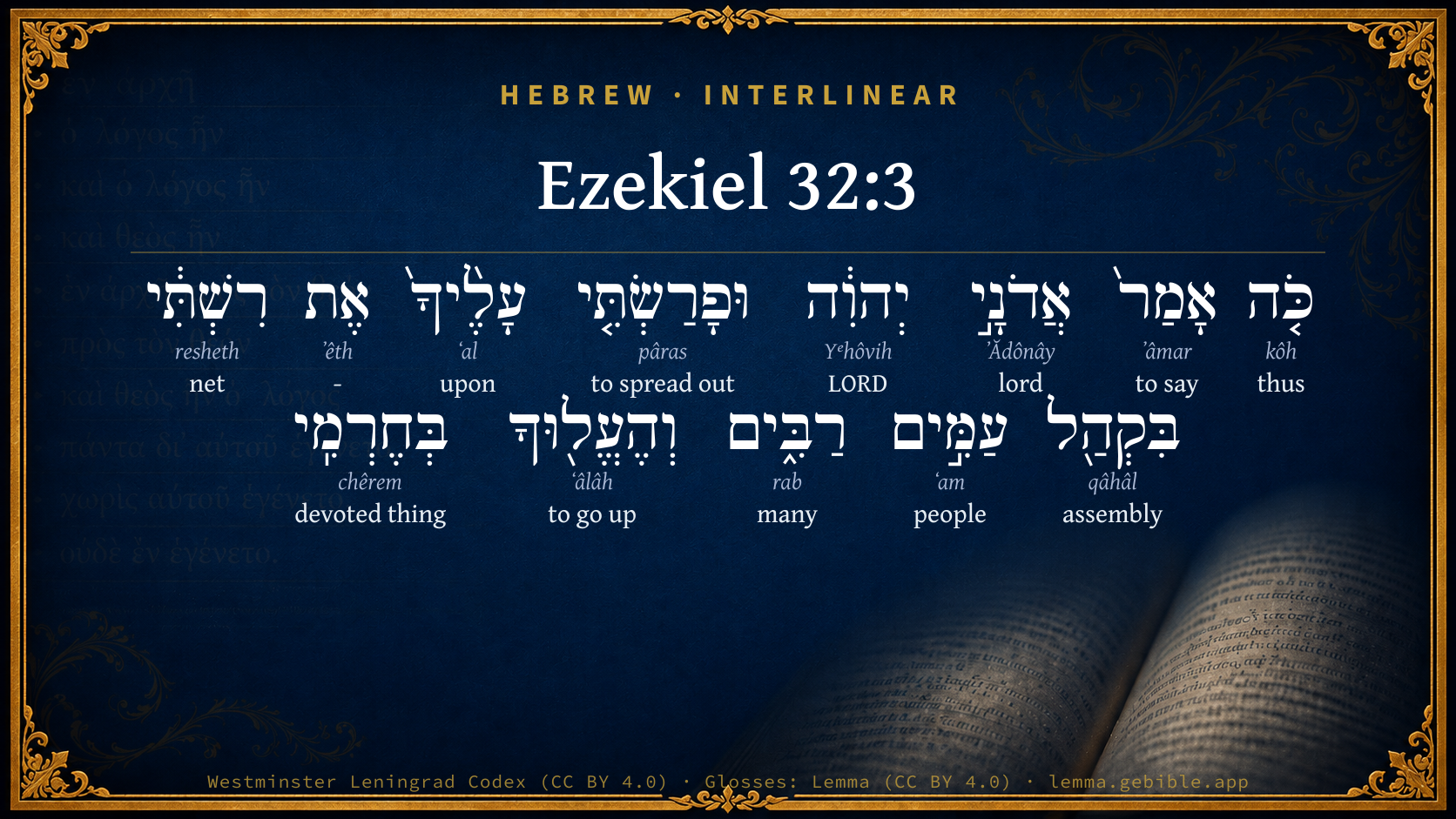
Hebrew (Westminster Leningrad Codex) Ezekiel 32:3 appears in the Hebrew Old Testament. The text above is from the Westminster Leningrad Codex. Each word links to its Strong’s number, a concise gloss, and parsing drawn from the Open Scriptures Hebrew Bible morphology. Click any word for its full Brown-Driver-Briggs (BDB) entry.
Download image
Cite this verse

Ezekiel 32:3 (World English Bible). Public Domain. Lemma interlinear Bible study tool, https://lemma.gebible.app/v/ezekiel/32/3.

Show BibTeX & RIS
BibTeX
RIS
English Translation
Thus says the Lord Yahweh: I will spread out my net on you with a company of many peoples; and they shall bring you up in my net.
World English Bible · Public Domain
Download a study sheet

One document with this verse’s original text, its word-by-word gloss line, the meaning frame, cross-references with their text, attributed commentary, and full source and license credits — printable, and it pastes into notes with its structure intact.

This verse Autodidact and up

Study sheet (.html) Plain text (.txt)

A passage Seminary Student

Up to 50 verses in one chapter. A passage sheet keeps up to 6 commentary sources and 12 cross-references per verse, in the order this page ranks them, and says so on the sheet whenever that leaves anything out. Ask for a single verse and you get the Autodidact verse sheet above.

Everything on this page stays free to read, with no account — the sheet is a download of what is already on screen, not access to it.

Want to remove ads? Support Godless Engineer
Compare translations 3

The same verse in 3 English versions, stacked beneath the original-language interlinear above. Click any original word for its lexicon entry.

Each is an independent rendering of the whole verse — the interlinear is not word-aligned to these translations.

Highlighted words mark where these versions differ — a whole-verse word diff, not a word-by-word alignment.

  • World English Bible Public Domain
    Thus says the Lord Yahweh: I will spread out my net on you with a company of many peoples; and they shall bring you up in my net.
  • King James Version Public Domain
    Thus saith the Lord GOD; I will therefore spread out my net over thee with a company of many people; and they shall bring thee up in my net.
  • unfoldingWord Literal Text CC BY-SA 4.0
    The Lord Yahweh says this: So I will spread my net over you in the assembly of many peoples, and they will lift you up in my net.

unfoldingWord Literal Text — © unfoldingWord, licensed CC BY-SA 4.0. Word-aligned USFM3 via Door43 (git.door43.org/unfoldingWord/en_ult).

Versions to compare (up to 4)

3 of 4 selected

Show all 18 translations

Every available English version of this verse, each an independent rendering of the whole verse.

  • World English Bible Public Domain
    Thus says the Lord Yahweh: I will spread out my net on you with a company of many peoples; and they shall bring you up in my net.
  • Berean Standard Bible Public Domain
    This is what the Lord GOD says: ‘I will spread My net over you with a company of many peoples, and they will draw you up in My net.
  • Majority Standard Bible Public Domain
    This is what the Lord GOD says: ‘I will spread My net over you with a company of many peoples, and they will draw you up in My net.
  • King James Version Public Domain
    Thus saith the Lord GOD; I will therefore spread out my net over thee with a company of many people; and they shall bring thee up in my net.
  • American Standard Version (1901) Public Domain
    Thus saith the Lord Jehovah: I will spread out my net upon thee with a company of many peoples; and they shall bring thee up in my net.
  • Revised Version (1885) Public Domain
    Thus saith the Lord GOD: I will spread out my net over thee with a company of many peoples; and they shall bring thee up in my net.
  • Geneva Bible (1599) Public Domain
    Thus sayth the Lord God, I will therefore spread my net ouer thee with a great multitude of people, and they shall make thee come vp into my net.
  • Douay-Rheims (1899) Public Domain
    Therefore, thus saith the Lord God: I will spread out my net over thee with the multitude of many people, and I will draw thee up in my net.
  • Young's Literal Translation Public Domain
    Thus said the Lord Jehovah: And -- I have spread out for thee My net, With an assembly of many peoples, And they have brought thee up in My net.
  • Literal Standard Version CC BY-SA 4.0
    Thus said Lord YHWH: And I have spread out My net for you, || With an assembly of many peoples, || And they have brought you up in My net.
  • Unlocked Literal Bible CC BY-SA 4.0
    The Lord Yahweh says this: So I will spread my net over you in the assembly of many peoples, and they will lift you up in my net.
  • unfoldingWord Literal Text CC BY-SA 4.0
    The Lord Yahweh says this: So I will spread my net over you in the assembly of many peoples, and they will lift you up in my net.
  • Darby Bible Public Domain
    Thus saith the Lord Jehovah: I will also spread out my net over thee with an assemblage of many peoples; and they shall bring thee up in my net.
  • World Messianic Bible Public Domain
    The Lord GOD says: “I will spread out my net on you with a company of many peoples. They will bring you up in my net.
  • Webster's Bible Public Domain
    Thus saith the Lord GOD; I will therefore spread out my net over thee with a company of many people; and they shall bring thee up in my net.
  • Free Bible Version CC BY-SA 4.0
    This is what the Lord God says: In the presence of many nations I'm going to spread my net over you, and they will pull you up in my net.
  • Bible in Basic English Public Domain
    This is what the Lord has said: My net will be stretched out over you, and I will take you up in my fishing-net.
  • JPS Tanakh (1917) Public Domain
    Thus saith the Lord GOD: I will therefore spread out My net over thee with a company of many peoples; and they shall bring thee up in My net.

Literal Standard Version (2020), Covenant Press — licensed CC BY-SA 4.0. Text via the HelloAO Bible API (eBible.org). Unlocked Literal Bible (unfoldingWord) — licensed CC BY-SA 4.0. Text via the HelloAO Bible API (eBible.org). unfoldingWord Literal Text — © unfoldingWord, licensed CC BY-SA 4.0. Word-aligned USFM3 via Door43 (git.door43.org/unfoldingWord/en_ult). Free Bible Version, Dr. Jonathan Gallagher — licensed CC BY-SA 4.0. Text via the HelloAO Bible API (eBible.org).

Word by word

More ways to search: Search by grammar → Find every occurrence → Compare this word →

Practice this passage: Drill this verse → Learn its vocabulary →

רִשְׁתִּ֔י
resheth
H7568
“net · my”
Noun, Common, Feminine, Singular, Construct + Suffix, Personal, 1st Person, Common, Singular
Part of Speech
Noun
Type
Common
Gender
Feminine
Number
Singular
State
Construct
Full BDB Definition

Origin: from H3423

TWOT: 920c

net - net - for catching - of judgment (figuratively) - of leaders leading people to sin - as a trap for man - network (brazen - for altar of tabernacle)
  1. כֹּ֤ה kôh H3541 “thus” Adverb
  2. אָמַר֙ ʼâmar H559 “to say” Verb, Qal, Perfect, 3rd Person, Masculine, Singular
  3. אֲדֹנָ֣י ʼĂdônây H136 “Lord · my” Noun, Common, Masculine, Plural, Construct + Suffix, Personal, 1st Person, Common, Singular
  4. יְהוִ֔ה Yᵉhôvih H3069 “LORD” Noun, Proper
  5. וּפָרַשְׂתִּ֤י pâras H6566 “and · to spread out” Conjunction + Verb, Qal, Sequential Perfect, 1st Person, Common, Singular
  6. עָלֶ֨יךָ֙ ʻal H5921 “upon · you” Preposition + Suffix, Personal, 2nd Person, Masculine, Singular
  7. אֶת ʼêth H853 “-” Particle, Direct Object
  8. בִּקְהַ֖ל qâhâl H6951 “in/at · assembly of” Preposition + Noun, Common, Masculine, Singular, Construct
  9. עַמִּ֣ים ʻam H5971 “peoples” Noun, Common, Masculine, Plural, Absolute
  10. רַבִּ֑ים rab H7227 “many” Adjective, Adjective, Masculine, Plural, Absolute
  11. וְהֶעֱל֖וּךָ ʻâlâh H5927 “and · to go up · you” Conjunction + Verb, Hiphil, Sequential Perfect, 3rd Person, Common, Plural + Suffix, Personal, 2nd Person, Masculine, Singular
  12. בְּחֶרְמִֽי chêrem H2764 “in/at · devoted thing · my” Preposition + Noun, Common, Masculine, Singular, Construct + Suffix, Personal, 1st Person, Common, Singular

About this verse

These counts appear in no published source. They are computed here, from the morphology-tagged text and Lemma’s own curated glosses. What Lemma adds →

13
words
13
distinct lemmas
Prophets
section

Notable vocabulary

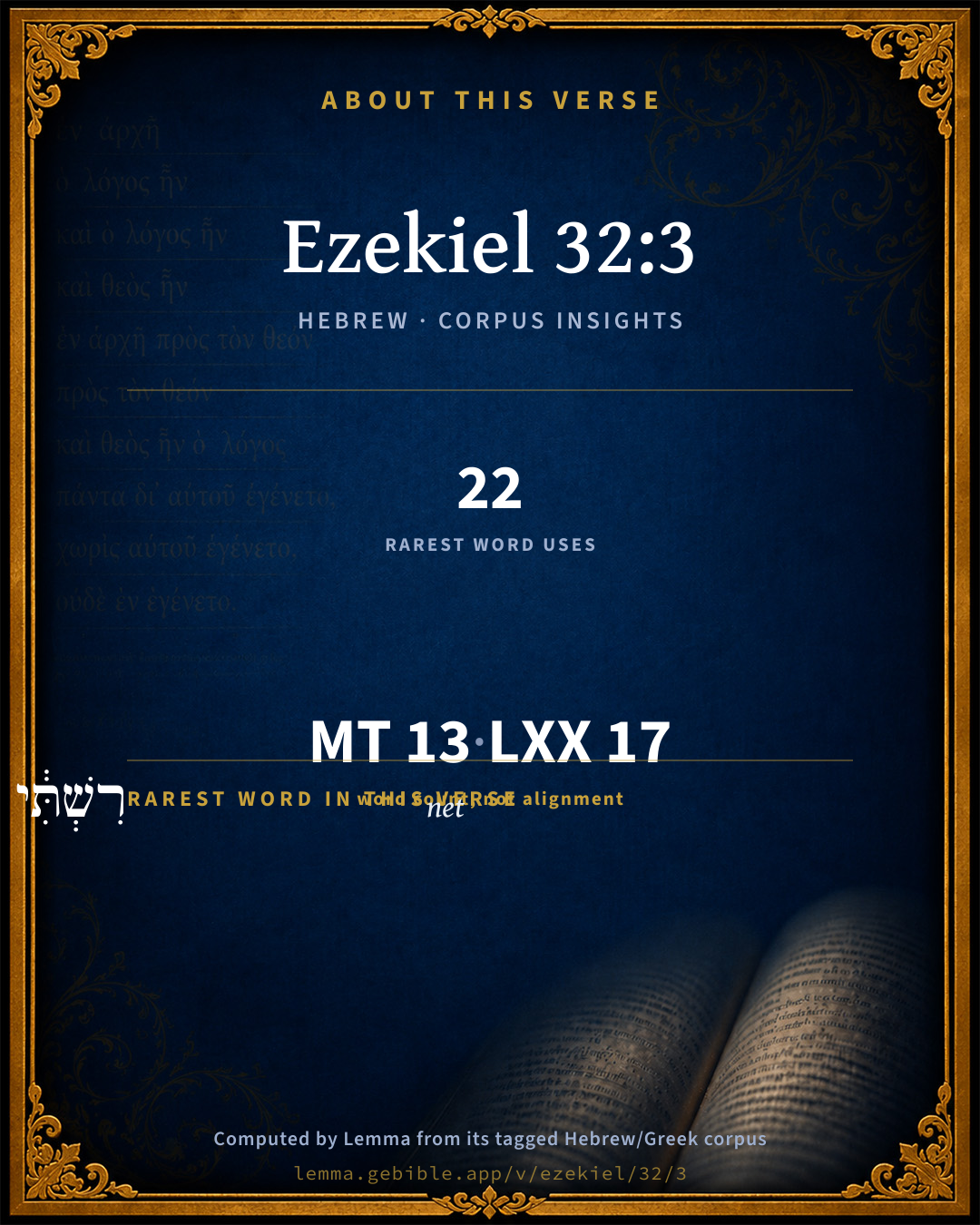
The rarest word here is רִשְׁתִּ֔י net H7568 — appearing just 22 times in the whole Hebrew Bible.

Shared distinctive vocabulary

רִשְׁתִּ֔י net H7568 occurs in 21 verses of the Hebrew Bible. Also found in:

Grammatical profile

  • 3 verbs
  • 6 nouns
  • 1 adjective
  • 1 preposition
  • 1 adverb
  • 1 particle

Verb forms

  • אָמַר֙ Qal · Perfect
  • וּפָרַשְׂתִּ֤י Qal · Sequential Perfect
  • וְהֶעֱל֖וּךָ Hiphil · Sequential Perfect

Hebrew & Septuagint length

In English translation the verse runs 28 words from the Hebrew and 23 from the Septuagint (LXX English) — closely comparable.

A rough comparison of the two English renderings, which tokenize alike — not a word-level alignment.

Word counts can differ between the Hebrew and the Greek without any difference in meaning — e.g. the Hebrew direct-object marker אֵת has no separate Greek word, and Greek often adds the article ὁ.

In the original languages it is 13 Hebrew tokens and 17 Greek tokens — but the two are counted differently (Hebrew bundles its prefixes and suffixes into one token; the Greek is in lemma form), so that isn’t a like-for-like length.

Cross-references

7

Topical passages linked to Ezekiel 32:3 in the Treasury of Scripture Knowledge — connected by theme and wording, ordered by reader-vote popularity; previews shown in the World English Bible.

  • Ezekiel 12:13 My net also will I spread on him, and he shall be taken in my snare; and I will bring him to Babylon to the land of the Chaldeans; yet shall he not see it, though he shall die there.
  • Jeremiah 16:16 Behold, I will send for many fishermen, says Yahweh, and they shall fish them up; and afterward I will send for many hunters, and they shall hunt them from every mountain, and from every hill, and out of the clefts of the rocks.
  • Ecclesiastes 9:12 For man also doesn't know his time. As the fish that are taken in an evil net, and as the birds that are caught in the snare, even so are the sons of men snared in an evil time, when it falls suddenly on them.
  • Lamentations 1:13 From on high has he sent fire into my bones, and it prevails against them; He has spread a net for my feet, he has turned me back: He has made me desolate and faint all the day.
  • Ezekiel 17:20 I will spread my net on him, and he shall be taken in my snare, and I will bring him to Babylon, and will enter into judgment with him there for his trespass that he has trespassed against me.
  • Hosea 7:12 When they go, I will spread my net on them. I will bring them down like the birds of the sky. I will chastise them, as their congregation has heard.
  • Habakkuk 1:14–17 and make men like the fish of the sea, like the creeping things, that have no ruler over them?

Cross-references courtesy of OpenBible.info (CC BY 4.0).

Hebrew and Greek witnesses Masoretic Hebrew ↔ Greek Septuagint

The same verse in the two great witnesses to the Old Testament, shown verse-for-verse.

These are two independent witnesses, not word-aligned to each other, and the Septuagint is shown in lemma (dictionary) form.

Hebrew Ezekiel 32:3 Masoretic · Westminster Leningrad Codex

כֹּ֤ה אָמַר֙ אֲדֹנָ֣י יְהוִ֔ה וּפָרַשְׂתִּ֤י עָלֶ֨יךָ֙ אֶת רִשְׁתִּ֔י בִּקְהַ֖ל עַמִּ֣ים רַבִּ֑ים וְהֶעֱל֖וּךָ בְּחֶרְמִֽי

Thus says the Lord Yahweh: I will spread out my net on you with a company of many peoples; and they shall bring you up in my net.

World English Bible · Public Domain

Greek LXX Ezekiel 32:3 Septuagint · lemma form

ὅδε λέγω κύριος καί περιβάλλω ἐπί σύ δίκτυον λαός πολύς καί ἀναἄγω σύ ἐν ὁ ἄγκιστρον ἐγώ

Thus says the Lord; I will also cast over you the nets of many nations, and will bring you up with my hook:

LXX2012 (modern English Septuagint) · Public Domain

On this verse, Haydock's Catholic Bible Commentary discusses the Septuagint’s reading. Read the note in Commentary ↓

Hebrew: Westminster Leningrad Codex (CC BY 4.0). Greek: Septuagint (public domain); English from LXX2012 (modern English Septuagint) (Public Domain). How the Septuagint differs from the Hebrew →

Targum (Aramaic paraphrase)

1

The Targum is the ancient Jewish Aramaic paraphrase of the Hebrew Scriptures — an interpretive translation, not the Hebrew text itself. Onkelos (literal) and Pseudo-Jonathan (expansive) render the Torah, and Jonathan the Prophets. Coverage is partial: where no permissively-licensed English translation exists for a verse, only the Aramaic is shown. This is verse-level text, not a word-by-word alignment to the Hebrew.

  1. Targum Jonathan Prophets (Joshua–Malachi)
    כִּדְנַן אֲמַר יְיָ אֱלֹהִים וְאַפְרֵס עֲלָךְ יַת מְצַדְתִּי בִּקְהַל עַמְמִין סַגִיאִין וְתִתְאַחַד בִּסְרִיגְתִּי:

    (no public-domain English translation for this verse)

    Targum Jonathan — Aramaic: “Mikraot Gedolot” (public domain). English: “Sefaria Community Translation” (CC0 1.0 (public-domain dedication)); “London "Chaldee Paraphrase," 1871” (public domain). Text via Sefaria.

Commentary

Notes on Ezekiel 32:3 from classic Christian and Jewish commentators (each source and its license shown beneath its notes). The classic Christian expositions comment on the surrounding passage and are grouped to its opening verse, so a note may address several verses; the Jewish commentaries on the Tanakh (Rashi and others) are per-verse, so they appear only where the commentator wrote on this verse.

Lemma curates 59 commentaries, every one of them public domain or Creative Commons licensed, each selected and text-cleaned for this edition rather than reprinted as found. About our sources →

Trapp's Complete Commentary

John Trapp

Eze 32:3 Thus saith the Lord GOD; I will therefore spread out my net over thee with a company of many people; and they shall bring thee up in my net.

Ver. 3. I will therefore spread out my net.] Thou shalt be taken in an evil net, when thou little thinkest of it: "Evil shall hunt the violent man, to overthrow him." {Psa 140:11} Look how Leo cassibus irretitus ait, Si praescivissem; and as the whale, enclosed by fishers, is lugged to land, done to death, cleft in pieces with axes, his flesh being made a prey for birds and beasts, his blood far and near drenching the earth, so shall it fare with Pharaoh and his forces.

John Trapp, A Commentary or Exposition upon All the Books of the Old and New Testament (1647–1656) — public domain. Text from a community e-Sword module.

Joseph Benson's Commentary

Eze 32:3-6. I will spread out my net over thee, &c. — I will bring thine enemies upon thee, who shall encompass thee on every side, and master thee as a wild beast or monstrous fish is taken in a net. Then will I leave thee upon the land — That is, leave thee to certain destruction, or take away from thee all means of recovery. For Pharaoh being here spoken of as a water animal, leaving him upon the land, signified leaving him to certain death, without the means of escaping it; for a fish left upon the land must needs die, let it struggle as it will, water being absolutely necessary to its life. This was literally fulfilled when, making war upon the Cyrenians, he was vanquished, and his army cut in pieces, and left a prey to the fowls and beasts in the deserts of Libya and Cyrene: see note on Eze 29:4-5. And I will fill the beasts of the whole earth with thee — With the flesh of thy vast armies. Or rather, understanding the words figuratively, I will enrich all nations with thy spoils. And I will lay thy flesh upon the mountains, &c. — Thy people shall be slain, both upon the mountains and in the valleys, and their carcasses lie unburied there. I will also water with thy blood the land wherein thou swimmest — The land of Egypt, wherein thou bearest rule; even to the mountains — The mountains shall be wet with it, as well as the lower grounds: compare Isa 34:3. And the rivers shall be full of thee — All places, both high and low, both land and water. All the expressions in these verses are hyperbolical, signifying the vast slaughter that should be made of the Egyptians, and the immense booty that should be obtained by their enemies.

Joseph Benson's Commentary on the Old and New Testaments (1811–1818) — public domain. Text from a community e-Sword module.

Jamieson, Fausset & Brown

Robert Jamieson, A. R. Fausset & David Brown

with a company of many people--namely, the Chaldeans (Eze 29:3-4; Hos 7:12).

my net--for they are My instrument.

Jamieson, Fausset & Brown — Commentary Critical and Explanatory on the Whole Bible (1871) — public domain (CC PDM 1.0). Text via the HelloAO Bible API.

Ellicott's Commentary for English Readers

(3) Spread out my net over thee.—The figure (Eze_32:4-6) of drawing the crocodile to land and casting him upon the desert for food to the birds and beasts of prey is the same as in Eze_29:4-5. (Comp. also Eze_31:12-13.) In Eze_32:6, “the land wherein thou swimmest” is, literally, the land of thine outflow, and may be taken either of the land on which his blood is poured out, or, more probably, the land of the inundations of the Nile, now to be watered with blood.

A Bible Commentary for English Readers, edited by Charles John Ellicott (1878–1897) — public domain. Text from a community e-Sword module.

The Cambridge Bible for Schools and Colleges

gen. ed. J. J. S. Perowne

3. Jehovah shall drag him out with his net by means of many peoples (Eze_32:11-12). On figure, cf. Eze_12:13, Eze_17:20; Hos_7:12. For people read peoples.

The Cambridge Bible for Schools and Colleges (gen. ed. J. J. S. Perowne; Cambridge University Press, 1878–1918) — public domain. Text from a community e-Sword module.

John Gill's Exposition

Thus saith the Lord God,.... The Lord God Almighty, who is able to manage this fierce and turbulent creature, this mighty monarch and disturber of the nations:

I will therefore spread out my net over thee with a company of many people; meaning the Chaldean army, which the Lord would instigate, and by his providence bring against the king of Egypt, and surround him as fishes in a net, and take him and his people; see Eze 12:13,

and they shall bring thee up in my net; out of his rivers, out of his fortresses, out of his own land, and carry him captive, or destroy him.

John Gill's Exposition of the Whole Bible (1746–1763) — public domain (CC PDM 1.0). Text via the HelloAO Bible API.

Haydock's Catholic Bible Commentary

Net. Septuagint, "hook," chap. xxix. 4. (Calmet) --- Some take the crocodile with a net, ver. 3. (Elian. Hist. x. 21.)

George Leo Haydock (1774–1849), Haydock's Catholic Family Bible and Commentary, 1859 edition — public domain. Excludes Psalms (Douay-Rheims chapter numbering differs from Protestant) and Deuterocanonical books (Catholic canon only).

Matthew Poole's English Annotations

My net; a large, long, and wide net, drawn out to full extent.

Over thee; with which both lions and crocodiles might be taken, and in which this lion and crocodile should certainly be taken; for God, whose hand never erreth, will spread the net.

With a company of many people: in the countries where these creatures were hunted, they went in mighty companies to the game, as they accounted it.

Bring thee up in my net; drag thee along to destroy thee, pull thee up out of the pit, in which the net was laid to take the lion to kill him, and draw this crocodile up out of the water for the same end; in brief, war by land and sea by a confederacy of many people against Hophra shall be God’s net, wherein he shall be taken, kept a prisoner, as he was, and at last strangled: see Eze 29:4.

Matthew Poole's English Annotations on the Holy Bible (1683–1685) — public domain. Text from a community e-Sword/MySword module.

Whedon's Commentary on the Bible

Daniel D. Whedon

3. They shall bring me up in my net — LXX., I will, etc. Jehovah will capture the great monster in a net as if he were a harmless bird. (Compare Eze_29:4.) For people read, as usual, peoples.

Daniel D. Whedon (gen. ed.), Commentary on the Old and New Testaments (1874–1909) — public domain. Text from a community e-Sword module.

The Pulpit Commentary

I will spread out my net. The imagery of Eze_29:3 is repeated, with a variation as to the mode of capture. There is no evidence that the crocodile was ever taken with a net; but Ezekiel may have chosen the comparison for that very reason. What was impossible in the parable, according to its letter, was possible when it received its application.

The Pulpit Commentary (1880–1919), ed. H.D.M. Spence-Jones & Joseph S. Exell — public domain. Text from a community e-Sword module.

John Wesley's Explanatory Notes

With a company - In the countries, where these creatures were hunted, they went in mighty companies.

John Wesley, Explanatory Notes Upon the Whole Bible (1754–1765) — public domain. Text via the GEBible commentary corpus.

unfoldingWord translationNotes

Door43 World Missions Community

General Information:

Yahweh continues to speak to Pharaoh and to speak of him as if he were a monster, perhaps a crocodile, in the water.

The Lord Yahweh says this

See how you translated this in Ezekiel 5:5.

So I will spread my net over you in the assembly of many peoples

God's punishment of Pharaoh is spoken of as if the king were the river monster caught in a net. AT: "So I will gather many peoples and throw my net over you" (See: Metaphor)

I will abandon you in the land

"I will leave you helpless on the land." The monster that was fearsome and powerful when it was in the water cannot do anything when it is left on dry land.

all the birds of the heavens

"all the birds that fly in the sky"

the hunger of all living animals on earth will be satisfied by you

This can be put into active form. AT: "I will let all the animals of the earth eat your body until they are hungry no longer" (See: Active or Passive)

translationWords

Lord Yahweh

assembly

people group

heaven

earth

unfoldingWord translationNotes — © Distant Shores Media and the Door43 World Missions Community, licensed CC BY-SA 4.0. Source: git.door43.org/Door43/en_tn.

Rashi

Rabbi Shlomo Yitzchaki (Rashi)

with My net [Heb. בְּחֶרְמִי,] a word for a net, and there are many in Scriptures, [e.g.,] (Hab. 1: 15): “he catches them in his net (בְּחֶרְמוֹ)”; (Ecc. 7:26), “snares and nets (וַחֲרָמִים).”

Rashi on the Tanakh — English translations: “The Judaica Press complete Tanach with Rashi, translated by A. J. Rosenberg” (CC BY 4.0); “Pentateuch with Rashi's commentary by M. Rosenbaum and A.M. Silbermann, 1929-1934” (public domain); “The Metsudah Tanach series, Lakewood, N.J” (CC BY 4.0); and “The Book of Joshua, Metsudah Publications, 1997” (CC BY 4.0). Text via Sefaria.

Lesson kit

Teaching starters — assembled from the data on this page, not authored interpretation. Every prompt links to the verse data it draws on. Edit before teaching.

Ezekiel, in the Prophets, opens this verse with 13 words (13 distinct Hebrew lemmas). Its most distinctive word is resheth (“net”). A historical commentator’s framing appears above. Read the whole chapter for the surrounding context.

Discussion questions

  1. The word resheth carries the sense “net.” How does it shape the verse?
  2. How does Exodus 27:4, which shares the word «net», read alongside this verse?
  3. These translations render this verse differently. What is at stake in choosing one wording over another?
  4. «אָמַר֙» is a Qal Perfect verb. How does that grammatical form shape the action described?
  5. Compare how Trapp's Complete Commentary and Joseph Benson's Commentary read this verse. Where do they agree or differ?

Things to notice

Reading settings

Reading text

Shown beneath each verse's original-language words.

Old Testament
Old Testament edition

Read the OT as the Masoretic Hebrew (MT) or the Greek Septuagint (LXX).

English shown for the Greek Septuagint (in the Hebrew ↔ Greek comparison).

Comparing translations? Open the Compare panel on any verse page to stack up to four side by side.