
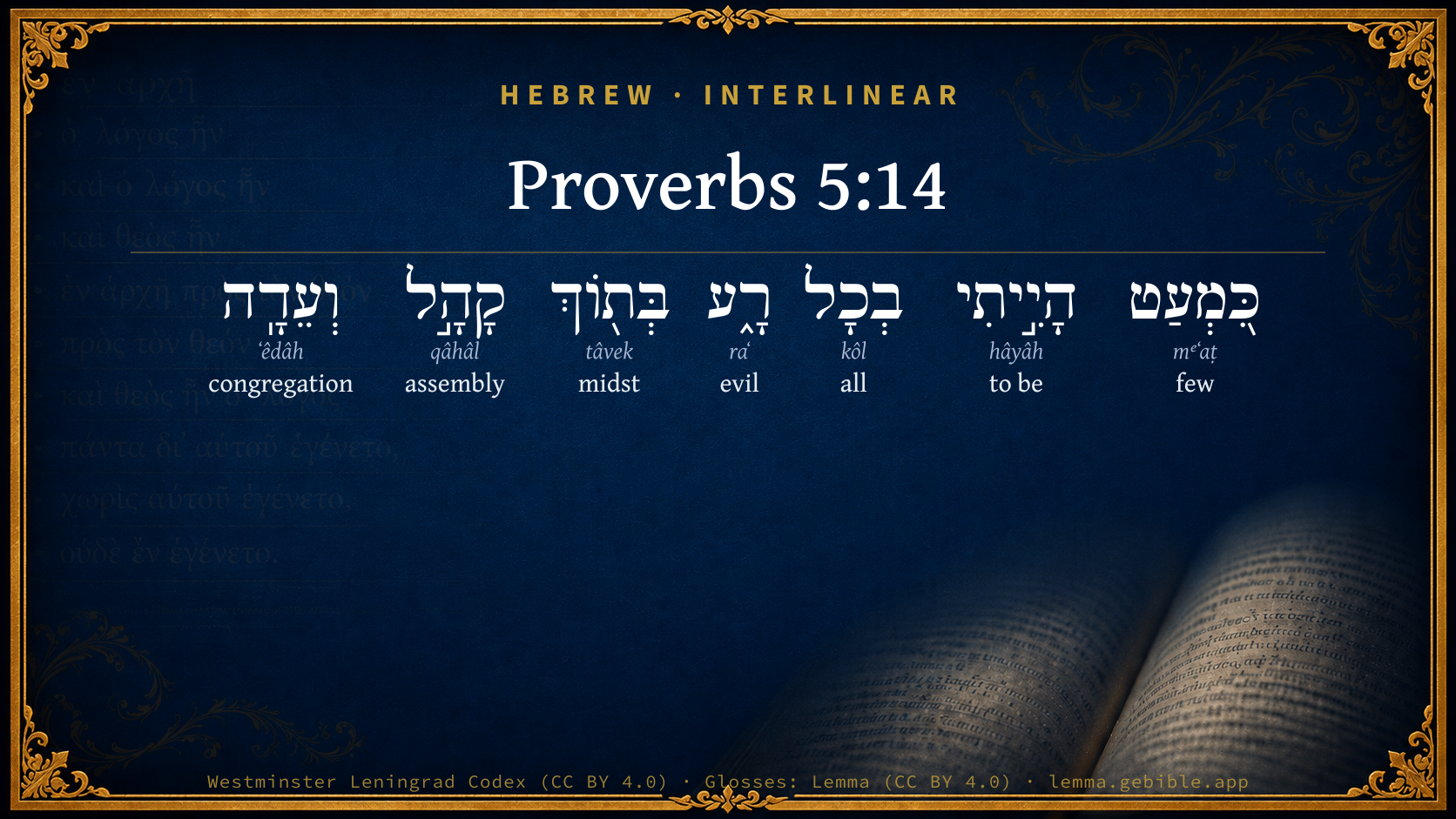
Proverbs 5:14

Hebrew (Westminster Leningrad Codex) Proverbs 5:14 appears in the Hebrew Old Testament. The text above is from the Westminster Leningrad Codex. Each word links to its Strong’s number, a concise gloss, and parsing drawn from the Open Scriptures Hebrew Bible morphology. Click any word for its full Brown-Driver-Briggs (BDB) entry.
Download image
Cite this verse

Proverbs 5:14 (World English Bible). Public Domain. Lemma interlinear Bible study tool, https://lemma.gebible.app/v/proverbs/5/14.

Show BibTeX & RIS
BibTeX
RIS
English Translation
I have come to the brink of utter ruin, In the midst of the gathered assembly."
World English Bible · Public Domain
Download a study sheet

One document with this verse’s original text, its word-by-word gloss line, the meaning frame, cross-references with their text, attributed commentary, and full source and license credits — printable, and it pastes into notes with its structure intact.

This verse Autodidact and up

Study sheet (.html) Plain text (.txt)

A passage Seminary Student

Up to 50 verses in one chapter. A passage sheet keeps up to 6 commentary sources and 12 cross-references per verse, in the order this page ranks them, and says so on the sheet whenever that leaves anything out. Ask for a single verse and you get the Autodidact verse sheet above.

Everything on this page stays free to read, with no account — the sheet is a download of what is already on screen, not access to it.

Want to remove ads? Support Godless Engineer
Compare translations 3

The same verse in 3 English versions, stacked beneath the original-language interlinear above. Click any original word for its lexicon entry.

Each is an independent rendering of the whole verse — the interlinear is not word-aligned to these translations.

Highlighted words mark where these versions differ — a whole-verse word diff, not a word-by-word alignment.

  • World English Bible Public Domain
    I have come to the brink of utter ruin, In the midst of the gathered assembly."
  • King James Version Public Domain
    I was almost in all evil in the midst of the congregation and assembly.
  • unfoldingWord Literal Text CC BY-SA 4.0
    I am as a little in all evil in the midst of the assembly and the congregation.”

unfoldingWord Literal Text — © unfoldingWord, licensed CC BY-SA 4.0. Word-aligned USFM3 via Door43 (git.door43.org/unfoldingWord/en_ult).

Versions to compare (up to 4)

3 of 4 selected

Show all 18 translations

Every available English version of this verse, each an independent rendering of the whole verse.

  • World English Bible Public Domain
    I have come to the brink of utter ruin, In the midst of the gathered assembly."
  • Berean Standard Bible Public Domain
    I am on the brink of utter ruin in the midst of the whole assembly.”
  • Majority Standard Bible Public Domain
    I am on the brink of utter ruin in the midst of the whole assembly.”
  • King James Version Public Domain
    I was almost in all evil in the midst of the congregation and assembly.
  • American Standard Version (1901) Public Domain
    I was well-nigh in all evil In the midst of the assembly and congregation.
  • Revised Version (1885) Public Domain
    I was well nigh in all evil in the midst of the congregation and assembly.
  • Geneva Bible (1599) Public Domain
    I was almost brought into all euil in ye mids of the Congregation and assemblie.
  • Douay-Rheims (1899) Public Domain
    I have almost been in all evil, in the midst of the church and of the congregation.
  • Young's Literal Translation Public Domain
    As a little thing I have been all evil, In the midst of an assembly and a company.
  • Literal Standard Version CC BY-SA 4.0
    As a little thing I have been all evil, || In the midst of an assembly and a congregation.”
  • Unlocked Literal Bible CC BY-SA 4.0
    I was almost completely ruined in the midst of the assembly, among the gathering of the people.”
  • unfoldingWord Literal Text CC BY-SA 4.0
    I am as a little in all evil in the midst of the assembly and the congregation.”
  • Darby Bible Public Domain
    I was well nigh in all evil in the midst of the congregation and assembly.
  • World Messianic Bible Public Domain
    I have come to the brink of utter ruin, among the gathered assembly.”
  • Webster's Bible Public Domain
    I was almost in all evil in the midst of the congregation and assembly.
  • Free Bible Version CC BY-SA 4.0
    Now I'm on the verge of being completely disgraced before everyone in the community.”
  • Bible in Basic English Public Domain
    I was in almost all evil in the company of the people.
  • JPS Tanakh (1917) Public Domain
    I was well nigh in all evil in the midst of the congregation and assembly.'

Literal Standard Version (2020), Covenant Press — licensed CC BY-SA 4.0. Text via the HelloAO Bible API (eBible.org). Unlocked Literal Bible (unfoldingWord) — licensed CC BY-SA 4.0. Text via the HelloAO Bible API (eBible.org). unfoldingWord Literal Text — © unfoldingWord, licensed CC BY-SA 4.0. Word-aligned USFM3 via Door43 (git.door43.org/unfoldingWord/en_ult). Free Bible Version, Dr. Jonathan Gallagher — licensed CC BY-SA 4.0. Text via the HelloAO Bible API (eBible.org).

Word by word

More ways to search: Search by grammar → Find every occurrence → Compare this word →

Practice this passage: Drill this verse → Learn its vocabulary →

About this verse

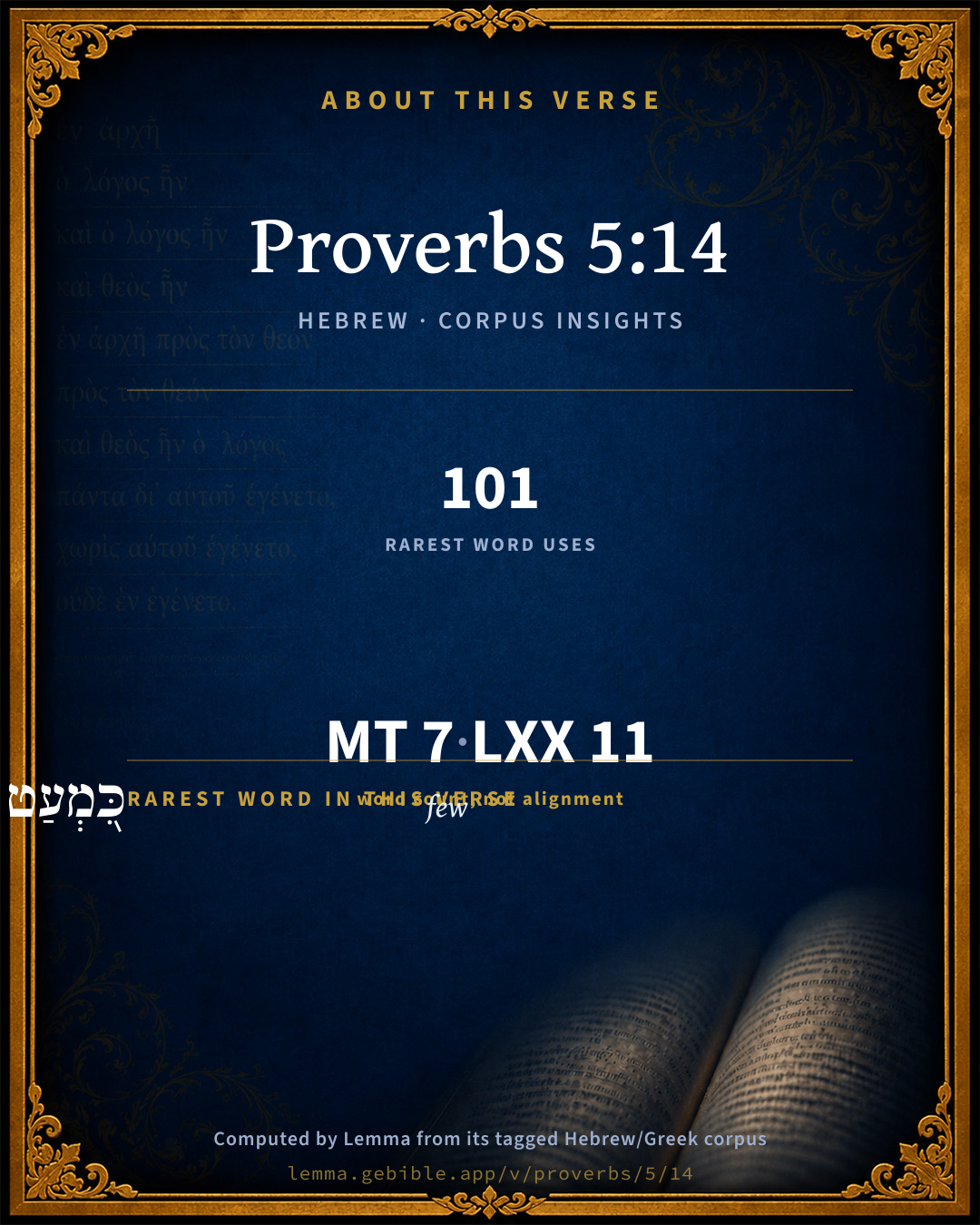
These counts appear in no published source. They are computed here, from the morphology-tagged text and Lemma’s own curated glosses. What Lemma adds →

7
words
7
distinct lemmas
Wisdom
section

Grammatical profile

  • 1 verb
  • 5 nouns
  • 1 adjective

Verb forms

  • הָיִ֣יתִי Qal · Perfect

Hebrew & Septuagint length

In English translation the verse runs 16 words from the Hebrew and 14 from the Septuagint (LXX English) — closely comparable.

A rough comparison of the two English renderings, which tokenize alike — not a word-level alignment.

Word counts can differ between the Hebrew and the Greek without any difference in meaning — e.g. the Hebrew direct-object marker אֵת has no separate Greek word, and Greek often adds the article ὁ.

In the original languages it is 7 Hebrew tokens and 11 Greek tokens — but the two are counted differently (Hebrew bundles its prefixes and suffixes into one token; the Greek is in lemma form), so that isn’t a like-for-like length.

Cross-references

6

Topical passages linked to Proverbs 5:14 in the Treasury of Scripture Knowledge — connected by theme and wording, ordered by reader-vote popularity; previews shown in the World English Bible.

  • Proverbs 13:20 One who walks with wise men grows wise, But a companion of fools suffers harm.
  • 1 Corinthians 10:6–8 Now these things were our examples, to the intent we should not lust after evil things, as they also lusted.
  • 2 Peter 2:10–18 but chiefly those who walk after the flesh in the lust of defilement, and despise authority. Daring, self-willed, they are not afraid to speak evil of dignitaries;
  • Numbers 25:1–6 Israel abode in Shittim; and the people began to play the prostitute with the daughters of Moab:
  • Hosea 4:11–14 Prostitution, wine, and new wine take away understanding.
  • Jude 1:7–13 Even as Sodom and Gomorrah, and the cities around them, having, in the same way as these, given themselves over to sexual immorality and gone after strange flesh, are set forth as an example, suffering the punishment of eternal fire.

Cross-references courtesy of OpenBible.info (CC BY 4.0).

Hebrew and Greek witnesses Masoretic Hebrew ↔ Greek Septuagint

The same verse in the two great witnesses to the Old Testament, shown verse-for-verse.

These are two independent witnesses, not word-aligned to each other, and the Septuagint is shown in lemma (dictionary) form.

Hebrew Proverbs 5:14 Masoretic · Westminster Leningrad Codex

כִּ֭מְעַט הָיִ֣יתִי בְכָל רָ֑ע בְּת֖וֹךְ קָהָ֣ל וְעֵדָֽה

I have come to the brink of utter ruin, In the midst of the gathered assembly."

World English Bible · Public Domain

Greek LXX Proverbs 5:14 Septuagint · lemma form

παρά ὀλίγος γίγνομαι ἐν πᾶς κακός ἐν μέσος ἐκκλησία καί συναγωγή

I was almost in all evil in the midst of the congregation and assembly.

LXX2012 (modern English Septuagint) · Public Domain

On this verse, The Cambridge Bible for Schools and Colleges discusses the Septuagint’s reading. Read the note in Commentary ↓

Hebrew: Westminster Leningrad Codex (CC BY 4.0). Greek: Septuagint (public domain); English from LXX2012 (modern English Septuagint) (Public Domain). How the Septuagint differs from the Hebrew →

Commentary

Notes on Proverbs 5:14 from classic Christian and Jewish commentators (each source and its license shown beneath its notes). The classic Christian expositions comment on the surrounding passage and are grouped to its opening verse, so a note may address several verses; the Jewish commentaries on the Tanakh (Rashi and others) are per-verse, so they appear only where the commentator wrote on this verse.

Lemma curates 59 commentaries, every one of them public domain or Creative Commons licensed, each selected and text-cleaned for this edition rather than reprinted as found. About our sources →

Trapp's Complete Commentary

John Trapp

Pro 5:14 I was almost in all evil in the midst of the congregation and assembly.

Ver. 14. I was almost in all evil.] Abraham Ben Ezra reads it in the future tense, Brevi ero in omni malo, I shall shortly be in all evil; and so his repentance here appears to be poenitentia sera, Iscariotica, such as was that of Judas and of those popelings, {Rev 18:19} a desperate repentance, and not "toward God," {Act 20:24} not a repentance for sin, as it is offensivum Dei, et aversivum a Deo, an offence against God, and a turning away from him. Such a repentance in this man had been, as the Romans said of Pompey, {a} Eχθρου πατρος φιλτατον τεχνον, a fair and happy daughter of an ugly and odious mother - of his sin I mean, the sight whereof had sent him to Christ.

In the midst of the congregation.] That is, Openly, and before all men. And this he brings as an aggravation of his misery, that there were so many eye witnesses thereof. No unclean person can have any assurance that his sin shall always be kept secret, no, not in this life. The Lord hath oft brought such - sometimes by terror of conscience, sometimes by frenzy - to that pass, that themselves have been the blazers and proclaimers of their own secret filtifiness. Yea, observe this, saith one, {b} in them that are the most cunning in this sin, that, though nobody peradventure can convince them evidently of the fact, yet everybody, through the just judgment of God, condemns them we for it. As the Lord seeth their secret villanies, even so ofttimes he testifieth agaiust them, accordins to that which he threateneth, "I will be a swift witness against the adulterers." {Mal 3:5}

{a} Plut. in Pomp. Vita.

{b} Hildersh. on John iv.

John Trapp, A Commentary or Exposition upon All the Books of the Old and New Testament (1647–1656) — public domain. Text from a community e-Sword module.

Whedon's Commentary on the Bible

Daniel D. Whedon

14. In all evil — The common interpretation is, The gratification of my lusts by degrees led me into nearly all kinds of wickedness; not merely in secret, but openly; in the assembly of God’s people even, in the presence of the magistrates and judges. Such persons, however sacred the place, have eyes full of adultery, which cannot cease from sin. Compare Num_25:7; Num_35:12. But very respectable critics interpret differently, namely, that the adulterer was exposed to punishment for his crime, and this punishment usually terminated in his being sold into slavery — probably to a cruel master. Pro_5:9. If the injured person prosecuted the adulterer, he might insist on the punishment of death, (Deu_22:22,) but if he chose he might act more leniently, and sell him into bondage, the price obtained being accepted as a mulct for the crime. What a slave earns by his toil goes into the house of his master, and becomes his wealth. Pro_5:10. By the assembly (Pro_5:14) is understood the magistrates and judges — the sanhedrin, which surrounded him to condemn and punish him by stoning to death. Understood thus, the all evil of the verse would mean the great evil, the extreme danger, to which he was exposed. See Stuart in loco; also Zockler, who translates, “Well nigh had I fallen into utter destruction, in the midst of the assembly and the congregation.”

Daniel D. Whedon (gen. ed.), Commentary on the Old and New Testaments (1874–1909) — public domain. Text from a community e-Sword module.

Geneva Bible (1599)

Geneva Bible translators

Although I was faithfully instructed in the truth, yet had I almost fallen to utter shame and destruction notwithstanding my good bringing up in the assembly of the godly.

Geneva Bible (1599) marginal notes — public domain. Text via Bolls.life.

Jamieson, Fausset & Brown

Robert Jamieson, A. R. Fausset & David Brown

evil--for affliction, as in Gen 19:20; Gen 49:15.

Jamieson, Fausset & Brown — Commentary Critical and Explanatory on the Whole Bible (1871) — public domain (CC PDM 1.0). Text via the HelloAO Bible API.

Adam Clarke's Commentary

Verse 14. I was almost in all evil] This vice, like a whirlpool, sweeps all others into its vortex.

In the midst of the congregation and assembly.] In the mydel of the Curche and of the Synagoge - Old MS. Bible. Such persons, however sacred the place, carry about with them eyes full of adultery, which cannot cease from sin.

Adam Clarke's Commentary on the Bible (1810–1826) — public domain. Text from a community e-Sword/MySword module.

Ellicott's Commentary for English Readers

(14) I was almost in all evil . . .—Rather, I had almost fallen into every sin: I was so infatuated that I might have committed any sin, and that openly before all. Or, I might have been visited with extremest punishment at the hands of the congregation, death by stoning (Lev_20:10, Joh_8:5). The offender’s eyes are now opened, and he shudders at the thought of the still greater troubles into which he might, in his infatuation, have fallen.

A Bible Commentary for English Readers, edited by Charles John Ellicott (1878–1897) — public domain. Text from a community e-Sword module.

The Cambridge Bible for Schools and Colleges

gen. ed. J. J. S. Perowne

14. I was almost in all evil] Ewald and other commentators take this to mean, I had a narrow escape from incurring the extreme penalty which the law of Moses prescribes for this sin (Lev_20:10): I almost, or well nigh, was convicted and stoned to death in public, “in the midst of the congregation and the assembly.” But the writer, if this were his meaning, has hardly chosen a happy phrase in which to convey it to us. It is better to understand the clause as added to lend aggravation to the sin, rather than to the punishment or danger. The words “congregation” and “assembly,” sometimes with the addition, “of Israel,” “of Jehovah,” “of God” (see for examples which abound in the Pentateuch, Exo_16:3; Lev_4:15; Deu_31:30; Num_16:3; Num_27:17; Neh_13:1), had come to be the common designation of Israel, as the people of Jehovah, the holy nation, separated from the abominations of the heathen. The Greek equivalents for these words (ἐν μέσῳ ἐκκλησίας καὶ συναγωγῆς LXX.) became naturally the titles of the Church under its Jewish and Christian aspects. To sin then “in the midst of the congregation and assembly” was to sin against light and knowledge, and to disgrace the body of which the sinner was a member. Somewhat similarly we hear it said, as an aggravation of crime or immorality, that it has been done “in a Christian country.”

The Cambridge Bible for Schools and Colleges (gen. ed. J. J. S. Perowne; Cambridge University Press, 1878–1918) — public domain. Text from a community e-Sword module.

John Gill's Exposition

I was almost in all evil,.... Scarce a sin but he was guilty of; contempt of private and public instructions, the instructions of parents and ministers of the Gospel, and following lewd women, commonly lead to the commission of all other sins, even the most atrocious. Some understand this, not of the evil of sin, but of the evil of punishment; and that the sense is, that there is scarce any calamity, distress, or misery, that a man can be in, but his profaneness and lewdness had brought him into; and he was just upon the brink of hell itself: and so Jarchi paraphrases it,

"there was but a step between me and hell.''

Aben Ezra observes, that the past is put for the future, "I shall be"; and then the meaning is, in a little or in a short time I shall be in complete misery; and so they are the words of one under consciousness of sin, despairing of mercy;

in the midst of the congregation and the assembly; that is, either be despised and neglected the instructions which were given in a public manner; or he committed all the evil he did openly; not only in company with wicked men, which he frequented, but even in the presence and before the people of God; yea, before the civil magistrates, the great sanhedrim, which is sometimes designed by the last word here used: or when he was in the house of God, attending public worship, his eyes were full of adultery, and his heart of impure lusts; and neither place, service, nor people of God, where he was, commanded any awe and reverence in him, nor in the least restrained his unclean thoughts and wanton desires; and which is mentioned as an aggravation of guilt. Or else the sense is, that his calamities and miseries were as public as his crimes; he was made a public example of, and all the people were witnesses of it; which served to spread his infamy, and make his punishment the more intolerable: both the sins and punishment of those that commit fornication with the whore of Rome will be public and manifest, Rev 18:5.

John Gill's Exposition of the Whole Bible (1746–1763) — public domain (CC PDM 1.0). Text via the HelloAO Bible API.

Albert Barnes' Notes on the Bible

The conscience-stricken sinner had been “almost” given up to every form of evil in the sight of the whole assembly of fellow-townsmen; “almost,” therefore, condemned to the death which that assembly might inflict Lev 20:10; Deu 22:22. The public scandal of the sin is brought in as its last aggravating feature.

Albert Barnes' Notes on the Bible (1834–1885) — public domain. Text from a community e-Sword/MySword module.

Haydock's Catholic Bible Commentary

Evil. Infirm and worn out, having lost my reputation, &c. (Calmet) --- Though I lived among the faithful, I was under no restraint. (Menochius)

George Leo Haydock (1774–1849), Haydock's Catholic Family Bible and Commentary, 1859 edition — public domain. Excludes Psalms (Douay-Rheims chapter numbering differs from Protestant) and Deuterocanonical books (Catholic canon only).

Matthew Poole's English Annotations

I was almost in all evil. Oh what a miserable man am I! There is scarce any misery, in respect of estate, or body, or soul, into which I am not already plunged. The words also are and may well be rendered thus, In a moment I am come into all evil. In how little a time, and for what short and momentary pleasures, am I now come into extreme and remediless misery!

In the midst of the congregation and assembly: I, who designed and expected to enjoy my lusts with secrecy and impunity, am now made a public example and shameful spectacle to all men, and that in the congregation of Israel, where I was taught better things, and where such actions are most infamous and hateful.

Matthew Poole's English Annotations on the Holy Bible (1683–1685) — public domain. Text from a community e-Sword/MySword module.

The Pulpit Commentary

I was almost in all evil in the midst of the congregation and assembly; i.e. such was my shamelessness that there was scarcely any wickedness which I did not commit, unrestrained even by the presence of the congregation and assembly. The fact which the ruined youth laments is the extent and audacity of his sins. It is not that he accuses himself of hypocrisy in religion (Delitzsch), but he adds another clement in his career of vice. He has disregarded the warnings and reproofs of his teachers and friends; but more, the presence of the congregation of God"s people, a silent but not a less impressive protest, had no restraining effect upon him. The words, "the congregation and assembly" (Hebrew, kahal v"edah), seem to be used to heighten the conception, rather than to express two distinct and separate ideas, since we find them both used interchangeably to designate the congregation of the Israelites. The radical conception of kahal ("congregation") is the same as that of the LXX ekklhsia and Vulgate ecclesia, viz. the congregation looked upon from the point of its being called together, kahal being derived from kahal, which in hiph. is equivalent to "to call together," while that of edah is the congregation looked at from the point of its having assembled edah being derived from yaad, in niph. equivalent to "to come together." The latter will therefore stand for any assembly of people specially convened or coming together for some definite object, like the LXX sunagwgh and the Vulgate synagoga. The term edah is, however, used in a technical sense as signifying the seventy elders, or senators, who judged the people. (see Num_25:7 Num_35:12) Rabbi Salomon so explains haedah as "the congregation," in Jos_20:6 and Num_27:21. Other explanations, however, have been given of these words. Zockler takes kahal as the convened council of elders acting as judges, (Deu_33:4, Deu_33:5) and edah as the concourse (coetus) of the people executing the condemning sentence, (Num_15:15; cf. Psa_7:7) and renders, "Well nigh had I fallen into utter destruction in the midst of the assembly and the congregation." Fleischer, Vatablus, and Bayne take much the same view, looking upon ra ("evil," Authorized Version) as "punishment," i.e. the evil which follows as a consequence of sin a usage supported by 2Sa_16:18 Exo_5:19 1Ch_7:23 Psa_10:6 rather than as evil per se, i.e. that which is morally bad, as in Exo_32:22. Aben Ezra considers that the perfect is used for the future; "In a little time I shall be involved in all evil;" i.e. punishment, which is looked forward to prospectively. For "almost" (ki-mat, equivalent to "within a little," "almost," "nearly"), see Gen_26:10 Psa_73:2 Psa_119:87.

The Pulpit Commentary (1880–1919), ed. H.D.M. Spence-Jones & Joseph S. Exell — public domain. Text from a community e-Sword module.

John Wesley's Explanatory Notes

A moment - In how little a time am I now come into remediless misery! Assembly - And that in the congregation of Israel, where I was taught better things.

John Wesley, Explanatory Notes Upon the Whole Bible (1754–1765) — public domain. Text via the GEBible commentary corpus.

Rashi

Rabbi Shlomo Yitzchaki (Rashi)

I was almost in all evil There is but a step between me and Gehinnom. (Because of a little thing, I was now “in all evil,” for I did not obey my instructors; had I obeyed them, this would not have happened to me. From Rabbi Joseph Kara.)

Rashi on the Tanakh — English translations: “The Judaica Press complete Tanach with Rashi, translated by A. J. Rosenberg” (CC BY 4.0); “Pentateuch with Rashi's commentary by M. Rosenbaum and A.M. Silbermann, 1929-1934” (public domain); “The Metsudah Tanach series, Lakewood, N.J” (CC BY 4.0); and “The Book of Joshua, Metsudah Publications, 1997” (CC BY 4.0). Text via Sefaria.

Lesson kit

Teaching starters — assembled from the data on this page, not authored interpretation. Every prompt links to the verse data it draws on. Edit before teaching.

Proverbs, in the Wisdom, opens this verse with 7 words (7 distinct Hebrew lemmas). Its most distinctive word is mᵉʻaṭ (“few”). A historical commentator’s framing appears above. Read the whole chapter for the surrounding context.

Discussion questions

  1. The word mᵉʻaṭ carries the sense “few.” How does it shape the verse?
  2. How does Proverbs 13:20, which shares this passage’s theme, read alongside this verse?
  3. The translations on this page render this verse differently — a whole-verse word diff, not a word-by-word alignment. What might account for the different wordings?
  4. «הָיִ֣יתִי» is a Qal Perfect verb. How does that grammatical form shape the action described?
  5. Compare how Trapp's Complete Commentary and Whedon's Commentary on the Bible read this verse. Where do they agree or differ?

Things to notice

Reading settings

Reading text

Shown beneath each verse's original-language words.

Old Testament
Old Testament edition

Read the OT as the Masoretic Hebrew (MT) or the Greek Septuagint (LXX).

English shown for the Greek Septuagint (in the Hebrew ↔ Greek comparison).

Comparing translations? Open the Compare panel on any verse page to stack up to four side by side.