Ezekiel 16:40

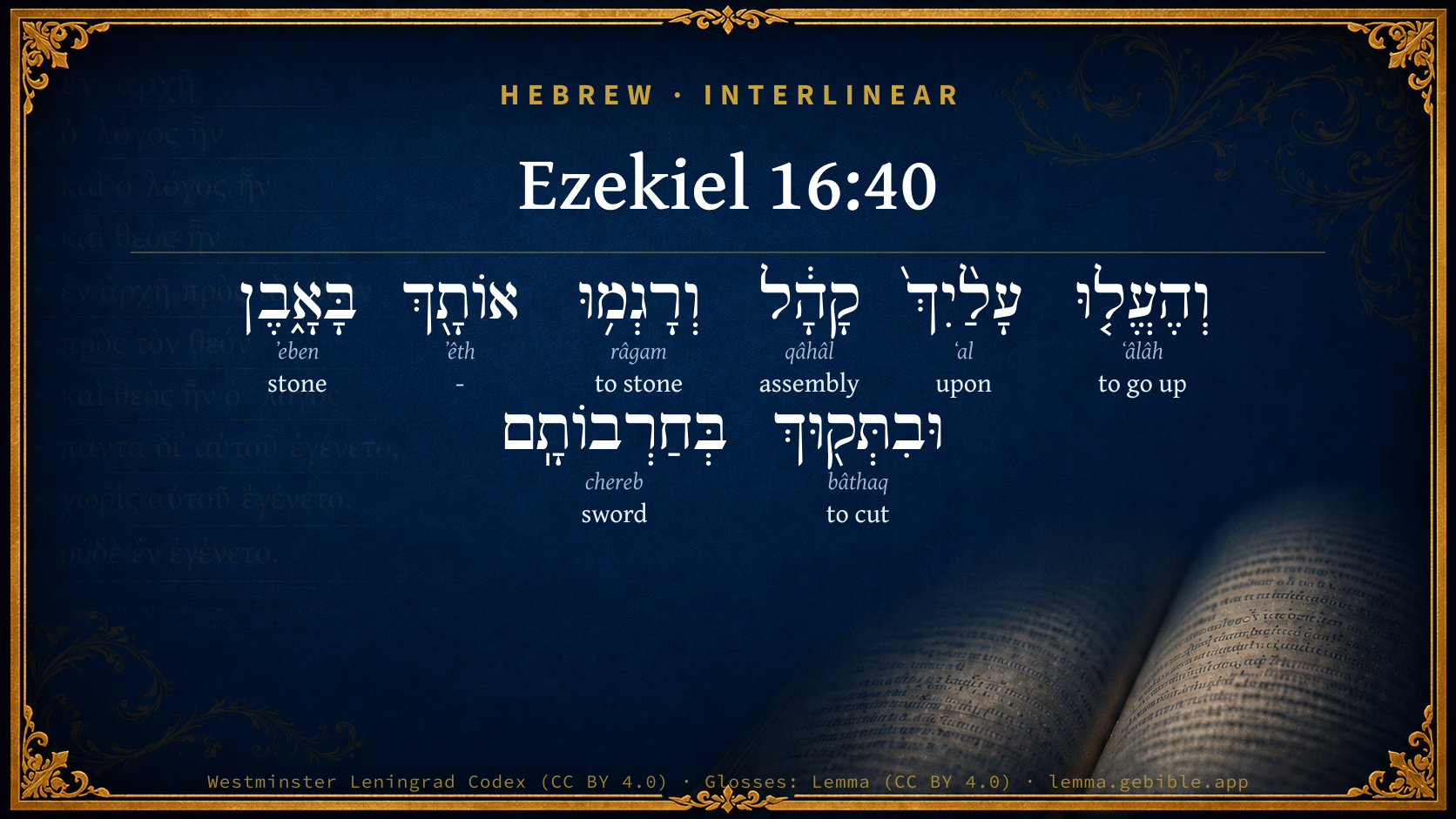
Hebrew (Westminster Leningrad Codex) Ezekiel 16:40 appears in the Hebrew Old Testament. The text above is from the Westminster Leningrad Codex. Each word links to its Strong’s number, a concise gloss, and parsing drawn from the Open Scriptures Hebrew Bible morphology. Click any word for its full Brown-Driver-Briggs (BDB) entry.
Download image
Cite this verse

Ezekiel 16:40 (World English Bible). Public Domain. Lemma interlinear Bible study tool, https://lemma.gebible.app/v/ezekiel/16/40.

Show BibTeX & RIS
BibTeX
RIS
English Translation
They shall also bring up a company against you, and they shall stone you with stones, and thrust you through with their swords.
World English Bible · Public Domain
Highlights
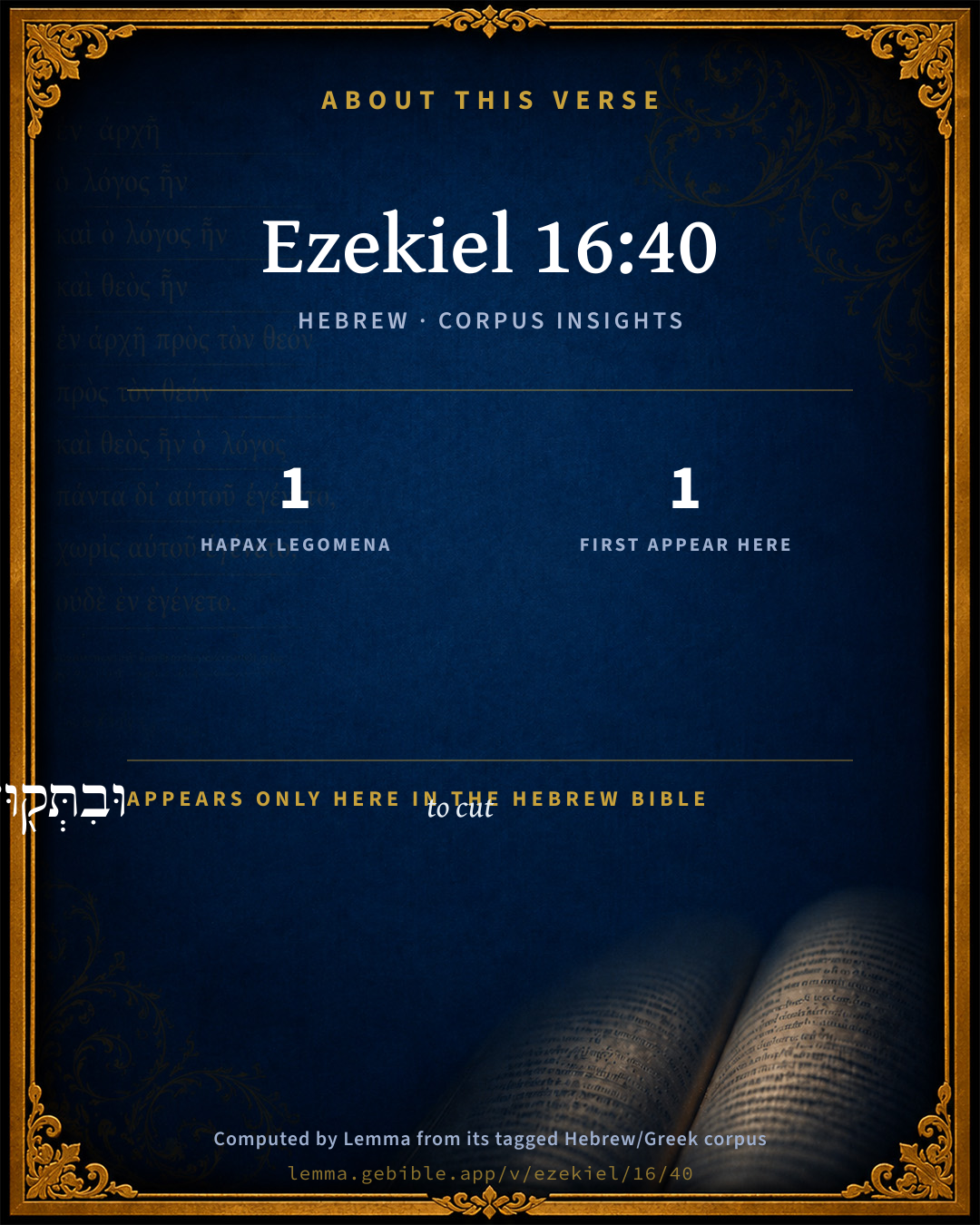
  • 1 hapax legomenon — only here in the Hebrew Bible
  • 1 first appearance in the Hebrew Bible
Full analysis ↓
Download a study sheet

One document with this verse’s original text, its word-by-word gloss line, the meaning frame, cross-references with their text, attributed commentary, and full source and license credits — printable, and it pastes into notes with its structure intact.

This verse Autodidact and up

Study sheet (.html) Plain text (.txt)

A passage Seminary Student

Up to 50 verses in one chapter. A passage sheet keeps up to 6 commentary sources and 12 cross-references per verse, in the order this page ranks them, and says so on the sheet whenever that leaves anything out. Ask for a single verse and you get the Autodidact verse sheet above.

Everything on this page stays free to read, with no account — the sheet is a download of what is already on screen, not access to it.

Want to remove ads? Support Godless Engineer
Compare translations 3

The same verse in 3 English versions, stacked beneath the original-language interlinear above. Click any original word for its lexicon entry.

Each is an independent rendering of the whole verse — the interlinear is not word-aligned to these translations.

Highlighted words mark where these versions differ — a whole-verse word diff, not a word-by-word alignment.

  • World English Bible Public Domain
    They shall also bring up a company against you, and they shall stone you with stones, and thrust you through with their swords.
  • King James Version Public Domain
    They shall also bring up a company against thee, and they shall stone thee with stones, and thrust thee through with their swords.
  • unfoldingWord Literal Text CC BY-SA 4.0
    Then they will bring up a crowd against you and stone you with stones, and they will cut you apart with their swords.

unfoldingWord Literal Text — © unfoldingWord, licensed CC BY-SA 4.0. Word-aligned USFM3 via Door43 (git.door43.org/unfoldingWord/en_ult).

Versions to compare (up to 4)

3 of 4 selected

Show all 18 translations

Every available English version of this verse, each an independent rendering of the whole verse.

  • World English Bible Public Domain
    They shall also bring up a company against you, and they shall stone you with stones, and thrust you through with their swords.
  • Berean Standard Bible Public Domain
    They will bring a mob against you, who will stone you and cut you to pieces with their swords.
  • Majority Standard Bible Public Domain
    They will bring a mob against you, who will stone you and cut you to pieces with their swords.
  • King James Version Public Domain
    They shall also bring up a company against thee, and they shall stone thee with stones, and thrust thee through with their swords.
  • American Standard Version (1901) Public Domain
    They shall also bring up a company against thee, and they shall stone thee with stones, and thrust thee through with their swords.
  • Revised Version (1885) Public Domain
    They shall also bring up an assembly against thee, and they shall stone thee with stones, and thrust thee through with their swords.
  • Geneva Bible (1599) Public Domain
    They shall also bring vp a company against thee, and they shall stone thee with stones, and thrust thee through with their swordes.
  • Douay-Rheims (1899) Public Domain
    And they shall bring upon thee a multitude, and they shall stone thee with stones, and shall slay thee with their swords.
  • Young's Literal Translation Public Domain
    And have caused an assembly to come up against thee, And stoned thee with stones, And thrust thee through with their swords,
  • Literal Standard Version CC BY-SA 4.0
    And have caused an assembly to come up against you, || And stoned you with stones, || And thrust you through with their swords,
  • Unlocked Literal Bible CC BY-SA 4.0
    Then they will bring up a crowd against you and stone you with stones, and they will cut you apart with their swords.
  • unfoldingWord Literal Text CC BY-SA 4.0
    Then they will bring up a crowd against you and stone you with stones, and they will cut you apart with their swords.
  • Darby Bible Public Domain
    And they shall bring up an assemblage against thee, and they shall stone thee with stones, and thrust thee through with their swords.
  • World Messianic Bible Public Domain
    They will also bring up a company against you, and they will stone you with stones, and thrust you through with their swords.
  • Webster's Bible Public Domain
    They shall also bring up a company against thee, and they shall stone thee with stones, and thrust thee through with their swords.
  • Free Bible Version CC BY-SA 4.0
    They will come with a mob to attack you. They will stone you and chop you into pieces with their swords.
  • Bible in Basic English Public Domain
    And they will get together a meeting against you, stoning you with stones and wounding you with their swords.
  • JPS Tanakh (1917) Public Domain
    They shall also bring up an assembly against thee, and they shall stone thee with stones, and thrust thee through with their swords.

Literal Standard Version (2020), Covenant Press — licensed CC BY-SA 4.0. Text via the HelloAO Bible API (eBible.org). Unlocked Literal Bible (unfoldingWord) — licensed CC BY-SA 4.0. Text via the HelloAO Bible API (eBible.org). unfoldingWord Literal Text — © unfoldingWord, licensed CC BY-SA 4.0. Word-aligned USFM3 via Door43 (git.door43.org/unfoldingWord/en_ult). Free Bible Version, Dr. Jonathan Gallagher — licensed CC BY-SA 4.0. Text via the HelloAO Bible API (eBible.org).

Word by word

More ways to search: Search by grammar → Find every occurrence → Compare this word →

Practice this passage: Drill this verse → Learn its vocabulary →

וּבִתְּק֖וּךְ
bâthaq
H1333
“and · to cut · you”
Conjunction + Verb, Piel, Sequential Perfect, 3rd Person, Common, Plural + Suffix, Personal, 2nd Person, Feminine, Singular
Part of Speech
Conjunction + Verb
Stem
Piel
Form
Sequential Perfect
Person
3rd Person
Gender
Common
Number
Plural
Full BDB Definition

Origin: a primitive root

TWOT: 296

(Piel) to cut, cut up, cut off, cut down
  1. וְהֶעֱל֤וּ ʻâlâh H5927 “and · to go up” Conjunction + Verb, Hiphil, Sequential Perfect, 3rd Person, Common, Plural
  2. עָלַ֨יִךְ֙ ʻal H5921 “upon · you” Preposition + Suffix, Personal, 2nd Person, Feminine, Singular
  3. קָהָ֔ל qâhâl H6951 “assembly” Noun, Common, Masculine, Singular, Absolute
  4. וְרָגְמ֥וּ râgam H7275 “and · to stone” Conjunction + Verb, Qal, Sequential Perfect, 3rd Person, Common, Plural
  5. אוֹתָ֖ךְ ʼêth H853 “- · you” Particle, Direct Object + Suffix, Personal, 2nd Person, Feminine, Singular
  6. בָּאָ֑בֶן ʼeben H68 “in/at the · stone” Preposition, Determined + Noun, Common, Feminine, Singular, Absolute
  7. בְּחַרְבוֹתָֽם chereb H2719 “in/at · swords · their” Preposition + Noun, Common, Feminine, Plural, Construct + Suffix, Personal, 3rd Person, Masculine, Plural

About this verse

These counts appear in no published source. They are computed here, from the morphology-tagged text and Lemma’s own curated glosses. What Lemma adds →

8
words
8
distinct lemmas
Prophets
section

Notable vocabulary

1 hapax legomenon — a word that appears only here in the entire Hebrew Bible:

  • וּבִתְּק֖וּךְ to cut H1333

First appearance in Scripture

This word makes its first canonical appearance in the Hebrew Bible here:

  • וּבִתְּק֖וּךְ to cut H1333

Shared distinctive vocabulary

וְרָגְמ֥וּ to stone H7275 occurs in 15 verses of the Hebrew Bible. Also found in:

Grammatical profile

  • 3 verbs
  • 3 nouns
  • 1 preposition
  • 1 particle

Verb forms

  • וְהֶעֱל֤וּ Hiphil · Sequential Perfect
  • וְרָגְמ֥וּ Qal · Sequential Perfect
  • וּבִתְּק֖וּךְ Piel · Sequential Perfect

Hebrew & Septuagint length

In English translation the verse runs 23 words from the Hebrew and 20 from the Septuagint (LXX English) — closely comparable.

A rough comparison of the two English renderings, which tokenize alike — not a word-level alignment.

Word counts can differ between the Hebrew and the Greek without any difference in meaning — e.g. the Hebrew direct-object marker אֵת has no separate Greek word, and Greek often adds the article ὁ.

Cross-references

6

Topical passages linked to Ezekiel 16:40 in the Treasury of Scripture Knowledge — connected by theme and wording, ordered by reader-vote popularity; previews shown in the World English Bible.

  • Ezekiel 23:47 The company shall stone them with stones, and dispatch them with their swords; they shall kill their sons and their daughters, and burn up their houses with fire.
  • Habakkuk 1:6–10 For, behold, I raise up the Chaldeans, that bitter and hasty nation, that march through the breadth of the earth, to possess dwelling places that are not theirs.
  • Jeremiah 25:9 behold, I will send and take all the families of the north, says Yahweh, and [I will send] to Nebuchadrezzar the king of Babylon, my servant, and will bring them against this land, and against the inhabitants of it, and against all these nations round about; and I will utterly destroy them, and make them an astonishment, and a hissing, and perpetual desolations.
  • Ezekiel 23:10 These uncovered her nakedness; they took her sons and her daughters; and her they killed with the sword: and she became a byword among women; for they executed judgments on her.
  • Ezekiel 24:21 Speak to the house of Israel, Thus says the Lord Yahweh: Behold, I will profane my sanctuary, the pride of your power, the desire of your eyes, and that which your soul pities; and your sons and your daughters whom you have left behind shall fall by the sword.
  • John 8:5–7 Now in our law, Moses commanded us to stone such. What then do you say about her?"

Cross-references courtesy of OpenBible.info (CC BY 4.0).

Hebrew and Greek witnesses Masoretic Hebrew ↔ Greek Septuagint

The same verse in the two great witnesses to the Old Testament, shown verse-for-verse.

These are two independent witnesses, not word-aligned to each other, and the Septuagint is shown in lemma (dictionary) form.

Hebrew Ezekiel 16:40 Masoretic · Westminster Leningrad Codex

וְהֶעֱל֤וּ עָלַ֨יִךְ֙ קָהָ֔ל וְרָגְמ֥וּ אוֹתָ֖ךְ בָּאָ֑בֶן וּבִתְּק֖וּךְ בְּחַרְבוֹתָֽם

They shall also bring up a company against you, and they shall stone you with stones, and thrust you through with their swords.

World English Bible · Public Domain

Greek LXX Ezekiel 16:40 Septuagint · lemma form

καί ἄγω ἐπί σύ ὄχλος καί λιθοβολέω σύ ἐν λίθος καί κατασφάζω σύ ἐν ὁ ξίφος αὐτός

And they shall bring multitudes upon you, and they shall stone you with stones, and pierce you with their swords.

LXX2012 (modern English Septuagint) · Public Domain

Hebrew: Westminster Leningrad Codex (CC BY 4.0). Greek: Septuagint (public domain); English from LXX2012 (modern English Septuagint) (Public Domain). How the Septuagint differs from the Hebrew →

Targum (Aramaic paraphrase)

1

The Targum is the ancient Jewish Aramaic paraphrase of the Hebrew Scriptures — an interpretive translation, not the Hebrew text itself. Onkelos (literal) and Pseudo-Jonathan (expansive) render the Torah, and Jonathan the Prophets. Coverage is partial: where no permissively-licensed English translation exists for a verse, only the Aramaic is shown. This is verse-level text, not a word-by-word alignment to the Hebrew.

  1. Targum Jonathan Prophets (Joshua–Malachi)
    וְיִסְקוּן עֲלָךְ מַשִׁרְיָן וְיִרְגְמוּן יָתִיךְ בְּאַבְנֵי קְלַע וְיִבְזְעוּנִיךְ בְּסַיְפֵהוֹן:

    (no public-domain English translation for this verse)

    Targum Jonathan — Aramaic: “Mikraot Gedolot” (public domain). English: “Sefaria Community Translation” (CC0 1.0 (public-domain dedication)); “London "Chaldee Paraphrase," 1871” (public domain). Text via Sefaria.

Commentary

Notes on Ezekiel 16:40 from classic Christian and Jewish commentators (each source and its license shown beneath its notes). The classic Christian expositions comment on the surrounding passage and are grouped to its opening verse, so a note may address several verses; the Jewish commentaries on the Tanakh (Rashi and others) are per-verse, so they appear only where the commentator wrote on this verse.

Lemma curates 59 commentaries, every one of them public domain or Creative Commons licensed, each selected and text-cleaned for this edition rather than reprinted as found. About our sources →

Trapp's Complete Commentary

John Trapp

Eze 16:40 They shall also bring up a company against thee, and they shall stone thee with stones, and thrust thee through with their swords.

Ver. 40. They shall also bring up a company against thee.] The Chaldeans, that "hasty and bitter nation." {Hab 1:6}

And they shall stone thee.] See on Eze 16:35.

John Trapp, A Commentary or Exposition upon All the Books of the Old and New Testament (1647–1656) — public domain. Text from a community e-Sword module.

Joseph Benson's Commentary

Eze 16:40-43. They shall bring a company against thee — A company shall come against thee, and beat down thy walls and houses, with stones slung out of battering-engines: see Jer 33:4. The expression alludes, as in Eze 16:38, to the punishment inflicted upon adulteresses, which was stoning. And they shall burn thy houses, &c. — The punishment allotted to an idolatrous city, Deu 13:16. The word may likewise allude to the punishment of burning, anciently inflicted upon harlots: see Gen 38:24. And execute judgment upon thee in the sight of many women — Nations that shall triumph over thee; such as the Syrians, Philistines, &c. — The judgment which I shall execute upon thee shall be for an instruction to other nations, deterring them from following thine evil practices. It is said, in the sight of women, because Jerusalem is spoken of and represented as a woman. So will I make my fury, &c., to rest — I will fully satisfy my just anger, in inflicting these severe punishments upon thee. I also will recompense thy way upon thy head — Thou hast despised me, I also will despise thee; thou hast forsaken me, I also will forsake thee. Thou shalt not commit this lewdness, &c. — Thou shalt not add these manifold and shameless practices of idolatry to all thy other wickedness. The clause however may be rendered, Neither hast thou laid to heart all these thine abominations.

Joseph Benson's Commentary on the Old and New Testaments (1811–1818) — public domain. Text from a community e-Sword module.

Jamieson, Fausset & Brown

Robert Jamieson, A. R. Fausset & David Brown

(Eze 23:10, Eze 23:47). Compare as to the destruction under Titus, Luk 19:43-44.

Jamieson, Fausset & Brown — Commentary Critical and Explanatory on the Whole Bible (1871) — public domain (CC PDM 1.0). Text via the HelloAO Bible API.

John Calvin's Commentaries

Since what Ezekiel has hitherto brought forward was incredible, he now explains the manner of its accomplishment — that the Chaldmans and Assyrians should bring a large army and bury the whole of Judea with stones, and pierce it through with swords. By these figures he simply means that there should be such slaughter that the whole region should be made desolate, just as if the enemy should slay all that they met with stones and swords. Some think that he alludes to stones which were thrown by engines of war; but I doubt whether the Prophet thought of this. What I have stated is more simple, that the Jews had no cause to think themselves free from that final slaughter of which the Prophet spoke, since numerous and powerful armies should come and overwhelm them with stones, and pierce them through with swords. It follows —

John Calvin's Commentaries (1540-1563) — public domain. Text from the Calvin Translation Society English edition (1840s-50s) via the Christian Classics Ethereal Library (ccel.org). Calvin's coverage is partial (roughly two-thirds of the Bible); uncommented books and verses are honest gaps, never fabricated. The 19th-century editor's footnotes and remarks are omitted so the notes are faithfully Calvin's own voice.

The Cambridge Bible for Schools and Colleges

gen. ed. J. J. S. Perowne

40. a company against thee] A congregation or public assembly of the people, at which the adulteress shall be tried and then executed; Lev_20:2; Deu_22:21 (cf. 1Ki_21:9-15), Pro_5:8-14, I was almost in all evil (danger of death) in the midst of the congregation and assembly. The death of the adulteress was by stoning; Lev_20:10; Deu_22:22; Joh_8:5.

The Cambridge Bible for Schools and Colleges (gen. ed. J. J. S. Perowne; Cambridge University Press, 1878–1918) — public domain. Text from a community e-Sword module.

John Gill's Exposition

And they shall burn thine houses with fire,.... As the houses in Jerusalem were by Nebuchadnezzar's army, even the temple, the house of the Lord, and the king's house, and the houses of great men, even all the houses in the city, Jer 52:13; and as was commanded to be done to idolatrous cities, Deu 13:16; and this also may be said in allusion to the burning of adulterous persons, Gen 38:24;

and execute judgments upon thee in the sight of many women; or provinces, as the Targum; meaning the Philistines, Moabites, Ammonites, and Edomites, who would rejoice in their ruin; the judgments design those before mentioned:

and I will cause thee to cease from playing the harlot, and thou also shalt give no hire any more; their idols, high places, and altars, being demolished, and they plundered of their substance; and after the Babylonish captivity the Jews never returned to idolatry any more.

John Gill's Exposition of the Whole Bible (1746–1763) — public domain (CC PDM 1.0). Text via the HelloAO Bible API.

Matthew Poole's English Annotations

They; the king of Babylon, and his counsellors, and captains.

A company; an assembled army. You had your assemblies for your idol worship, and I will have also an assembly, but it shall be of Chaldeans, Hab 1:6, and others, to destroy you for your idolatry.

They shall stone thee: the punishment by stoning was not inflicted on the condemned, but in the sight of the congregation; so here is a congregation of many nations, before whom this just judgment of God shall be executed on this adulteress. It intimates the manner of battering of the walls of Jerusalem, with stones cast out of their engines.

Thrust thee through with their swords; when the enemy shall assault and take the battered city, he will in his fury slay and destroy with the sword. It is called

their sword, because it might mind the Israelites that the destruction would be with the sword of a cruel one, of either an old professed enemy, or a new revolted friend.

Matthew Poole's English Annotations on the Holy Bible (1683–1685) — public domain. Text from a community e-Sword/MySword module.

Whedon's Commentary on the Bible

Daniel D. Whedon

40. Stone thee — Stoning was the penalty for adultery under the Jewish law (Lev_20:10; Deu_22:22).

Daniel D. Whedon (gen. ed.), Commentary on the Old and New Testaments (1874–1909) — public domain. Text from a community e-Sword module.

The Pulpit Commentary

The punishment of stoning was, as a rule, inflicted by the "congregation", (Num_15:36) or by the men of the city. (Lev_20:2) Other forms of punishement for impurity were those of the sword and burning, as in Lev_20:14 Lev_21:9. The thrusting through (better, hewing; the word is not found elsewhere) probably points to mutilation after death, as in the case of Agog (1Sa_15:33; Jud_1:19:29; Dan_2:5 Dan_3:29) in this case the "congregation" or "company" is the army of the Chaldeans, and each form of punishment has its counterpart in the various agencies which they employed for the punishment of the city.

The Pulpit Commentary (1880–1919), ed. H.D.M. Spence-Jones & Joseph S. Exell — public domain. Text from a community e-Sword module.

unfoldingWord translationNotes

Door43 World Missions Community

General Information:

Yahweh continues to speak about Jerusalem as if the city were his unfaithful wife. He speaks about enemy soldiers as her lovers. The city represents the people who live there. (See: Metaphor and Metonymy)

will perform many acts of punishment on you

The word "punishment" can be translated with a verbal phrase. AT: "will punish you in many different ways" (See: Abstract Nouns)

in the sight of many women

"where many women can see" or "while many women watch"

I will calm my fury against you; my anger will leave you

The words "fury" and "anger" refer to the punishment that Yahweh inflicts because he is angry. The two phrases mean basically the same thing. AT: "I will stop punishing you because I will no longer be angry with you" (See: Metonymy and Parallelism)

translationWords

stone

sword

punish

prostitute

anger

unfoldingWord translationNotes — © Distant Shores Media and the Door43 World Missions Community, licensed CC BY-SA 4.0. Source: git.door43.org/Door43/en_tn.

Rashi

Rabbi Shlomo Yitzchaki (Rashi)

and pierce you Heb. וּבִתְּקוּךְ. There is no similar word elsewhere in Scripture, and Jonathan rendered וְיִבְזְעוּנִיךּ, and they will pierce you, e tre[s]perzeront toy in Old French.

Rashi on the Tanakh — English translations: “The Judaica Press complete Tanach with Rashi, translated by A. J. Rosenberg” (CC BY 4.0); “Pentateuch with Rashi's commentary by M. Rosenbaum and A.M. Silbermann, 1929-1934” (public domain); “The Metsudah Tanach series, Lakewood, N.J” (CC BY 4.0); and “The Book of Joshua, Metsudah Publications, 1997” (CC BY 4.0). Text via Sefaria.

Lesson kit

Teaching starters — assembled from the data on this page, not authored interpretation. Every prompt links to the verse data it draws on. Edit before teaching.

Ezekiel, in the Prophets, opens this verse with 8 words (8 distinct Hebrew lemmas). Its most distinctive word is bâthaq (“to cut”). A historical commentator’s framing appears above. Read the whole chapter for the surrounding context.

Discussion questions

  1. The word bâthaq carries the sense “to cut.” How does it shape the verse?
  2. This verse holds 1 word here found nowhere else in the Hebrew Bible. What might the rare word draw attention to?
  3. The word “to cut” first appears here in Scripture. What is being introduced at this debut?
  4. Leviticus 20:2 shares the word «to stone» with this verse. How do the two illuminate each other?
  5. These translations render this verse differently; the difference is in the English rendering, not the original. What questions does that raise?
  6. The verb «וְהֶעֱל֤וּ» is Hiphil Sequential Perfect. How does its form color the action?
  7. Reading how Trapp's Complete Commentary and Joseph Benson's Commentary read this verse, where do the two commentators agree and where do they part?

Things to notice

  • 1 word in this verse appears nowhere else in the Hebrew Bible.
  • 1 word makes its first canonical appearance in Scripture here.
  • These translations choose different wording for 10 words in this verse.
  • 8 distinct Hebrew lemmas span 8 words in this verse.

Reading settings

Reading text

Shown beneath each verse's original-language words.

Old Testament
Old Testament edition

Read the OT as the Masoretic Hebrew (MT) or the Greek Septuagint (LXX).

English shown for the Greek Septuagint (in the Hebrew ↔ Greek comparison).

Comparing translations? Open the Compare panel on any verse page to stack up to four side by side.