2 Chronicles 20:5

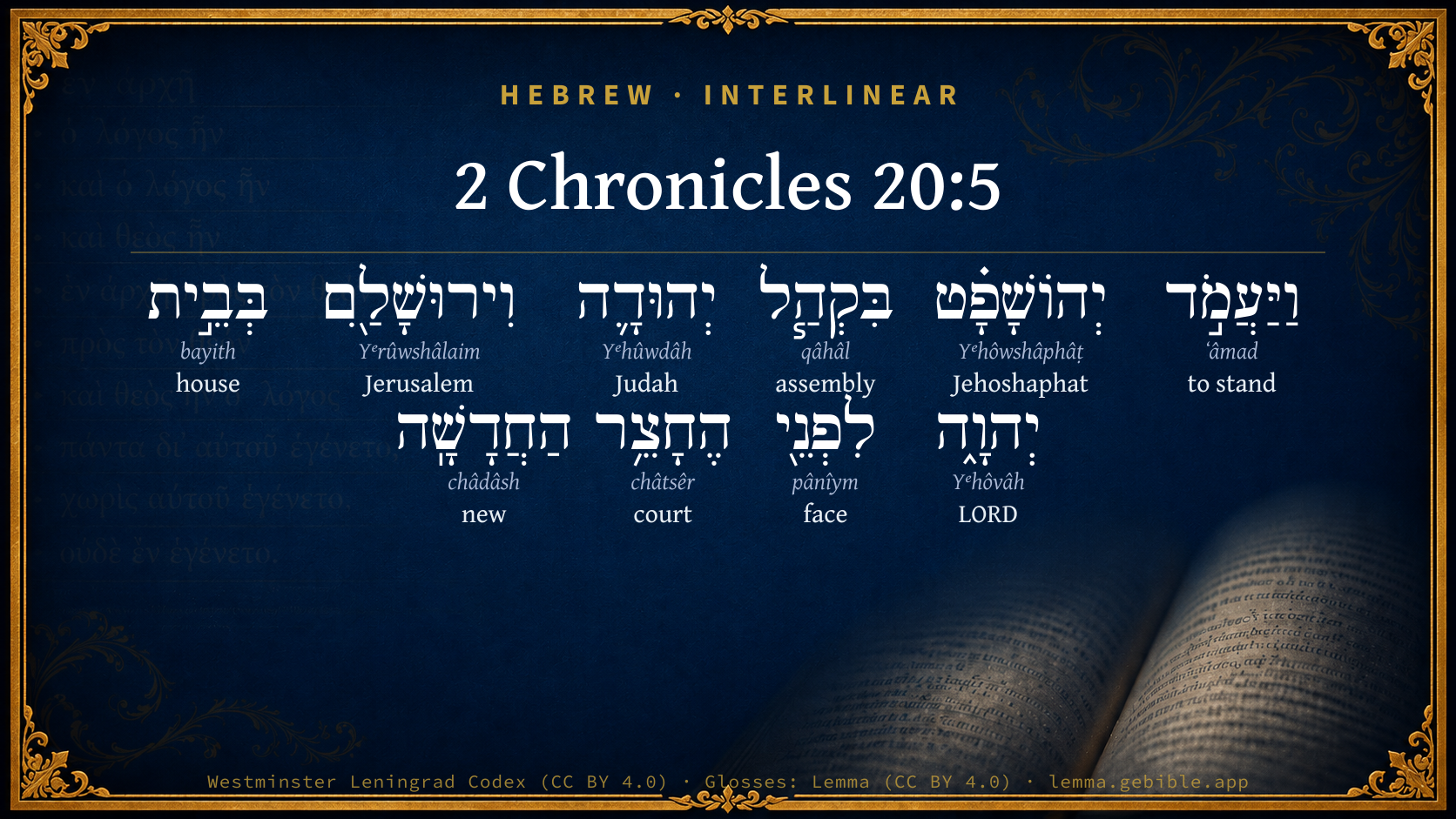
Hebrew (Westminster Leningrad Codex) 2 Chronicles 20:5 appears in the Hebrew Old Testament. The text above is from the Westminster Leningrad Codex. Each word links to its Strong’s number, a concise gloss, and parsing drawn from the Open Scriptures Hebrew Bible morphology. Click any word for its full Brown-Driver-Briggs (BDB) entry.
Download image
Cite this verse

2 Chronicles 20:5 (World English Bible). Public Domain. Lemma interlinear Bible study tool, https://lemma.gebible.app/v/2-chronicles/20/5.

Show BibTeX & RIS
BibTeX
RIS
English Translation
Jehoshaphat stood in the assembly of Judah and Jerusalem, in the house of Yahweh, before the new court;
World English Bible · Public Domain
Download a study sheet

One document with this verse’s original text, its word-by-word gloss line, the meaning frame, cross-references with their text, attributed commentary, and full source and license credits — printable, and it pastes into notes with its structure intact.

This verse Autodidact and up

Study sheet (.html) Plain text (.txt)

A passage Seminary Student

Up to 50 verses in one chapter. A passage sheet keeps up to 6 commentary sources and 12 cross-references per verse, in the order this page ranks them, and says so on the sheet whenever that leaves anything out. Ask for a single verse and you get the Autodidact verse sheet above.

Everything on this page stays free to read, with no account — the sheet is a download of what is already on screen, not access to it.

Want to remove ads? Support Godless Engineer
Compare translations 3

The same verse in 3 English versions, stacked beneath the original-language interlinear above. Click any original word for its lexicon entry.

Each is an independent rendering of the whole verse — the interlinear is not word-aligned to these translations.

Highlighted words mark where these versions differ — a whole-verse word diff, not a word-by-word alignment.

  • World English Bible Public Domain
    Jehoshaphat stood in the assembly of Judah and Jerusalem, in the house of Yahweh, before the new court;
  • King James Version Public Domain
    And Jehoshaphat stood in the congregation of Judah and Jerusalem, in the house of the LORD, before the new court,
  • unfoldingWord Literal Text CC BY-SA 4.0
    And Jehoshaphat stood in the assembly of Judah and Jerusalem, in the house of Yahweh, before the new court.

unfoldingWord Literal Text — © unfoldingWord, licensed CC BY-SA 4.0. Word-aligned USFM3 via Door43 (git.door43.org/unfoldingWord/en_ult).

Versions to compare (up to 4)

3 of 4 selected

Show all 18 translations

Every available English version of this verse, each an independent rendering of the whole verse.

  • World English Bible Public Domain
    Jehoshaphat stood in the assembly of Judah and Jerusalem, in the house of Yahweh, before the new court;
  • Berean Standard Bible Public Domain
    Then Jehoshaphat stood in the assembly of Judah and Jerusalem in the house of the LORD in front of the new courtyard
  • Majority Standard Bible Public Domain
    Then Jehoshaphat stood in the assembly of Judah and Jerusalem in the house of the LORD in front of the new courtyard
  • King James Version Public Domain
    And Jehoshaphat stood in the congregation of Judah and Jerusalem, in the house of the LORD, before the new court,
  • American Standard Version (1901) Public Domain
    And Jehoshaphat stood in the assembly of Judah and Jerusalem, in the house of Jehovah, before the new court;
  • Revised Version (1885) Public Domain
    And Jehoshaphat stood in the congregation of Judah and Jerusalem, in the house of the LORD, before the new court;
  • Geneva Bible (1599) Public Domain
    And Iehoshaphat stoode in the Congregation of Iudah and Ierusalem in the house of the Lord before the new court,
  • Douay-Rheims (1899) Public Domain
    And Josaphat stood in the midst of the assembly of Juda, and Jerusalem, in the house of the Lord before the new court,
  • Young's Literal Translation Public Domain
    And Jehoshaphat standeth in the assembly of Judah and Jerusalem, in the house of Jehovah, at the front of the new court,
  • Literal Standard Version CC BY-SA 4.0
    And Jehoshaphat stands in the assembly of Judah and Jerusalem, in the house of YHWH, at the front of the new court,
  • Unlocked Literal Bible CC BY-SA 4.0
    Jehoshaphat stood in the assembly of Judah and Jerusalem, at the house of Yahweh, in front of the new courtyard.
  • unfoldingWord Literal Text CC BY-SA 4.0
    And Jehoshaphat stood in the assembly of Judah and Jerusalem, in the house of Yahweh, before the new court.
  • Darby Bible Public Domain
    And Jehoshaphat stood in the congregation of Judah and Jerusalem, in the house of Jehovah, before the new court;
  • World Messianic Bible Public Domain
    Jehoshaphat stood in the assembly of Judah and Jerusalem, in the LORD’s house, before the new court;
  • Webster's Bible Public Domain
    And Jehoshaphat stood in the congregation of Judah and Jerusalem, in the house of the LORD, before the new court,
  • Free Bible Version CC BY-SA 4.0
    Jehoshaphat stood before the assembled people of Judah and Jerusalem at the Temple, in front of the new courtyard,
  • Bible in Basic English Public Domain
    And Jehoshaphat took his place in the meeting of Judah and Jerusalem, in the house of the Lord in front of the new open space,
  • JPS Tanakh (1917) Public Domain
    And Jehoshaphat stood in the congregation of Judah and Jerusalem, in the house of the LORD, before the new court;

Literal Standard Version (2020), Covenant Press — licensed CC BY-SA 4.0. Text via the HelloAO Bible API (eBible.org). Unlocked Literal Bible (unfoldingWord) — licensed CC BY-SA 4.0. Text via the HelloAO Bible API (eBible.org). unfoldingWord Literal Text — © unfoldingWord, licensed CC BY-SA 4.0. Word-aligned USFM3 via Door43 (git.door43.org/unfoldingWord/en_ult). Free Bible Version, Dr. Jonathan Gallagher — licensed CC BY-SA 4.0. Text via the HelloAO Bible API (eBible.org).

Word by word

More ways to search: Search by grammar → Find every occurrence → Compare this word →

Practice this passage: Drill this verse → Learn its vocabulary →

הַחֲדָשָֽׁה
châdâsh
H2319
“the · new”
Particle, Definite Article + Adjective, Adjective, Feminine, Singular, Absolute
Part of Speech
Particle + Adjective
Type
Adjective
Gender
Feminine
Number
Singular
State
Absolute
Full BDB Definition

Origin: from H2318

TWOT: 613a

new, new thing, fresh
  1. וַיַּעֲמֹ֣ד ʻâmad H5975 “and · to stand” Conjunction + Verb, Qal, Sequential Imperfect, 3rd Person, Masculine, Singular
  2. יְהוֹשָׁפָ֗ט Yᵉhôwshâphâṭ H3092 “Jehoshaphat” Noun, Proper
  3. בִּקְהַ֧ל qâhâl H6951 “in/at · assembly of” Preposition + Noun, Common, Masculine, Singular, Construct
  4. יְהוּדָ֛ה Yᵉhûwdâh H3063 “Judah” Noun, Proper
  5. וִירוּשָׁלִַ֖ם Yᵉrûwshâlaim H3389 “and · Jerusalem” Conjunction + Noun, Proper
  6. בְּבֵ֣ית bayith H1004 “in/at · house of” Preposition + Noun, Common, Masculine, Singular, Construct
  7. יְהוָ֑ה Yᵉhôvâh H3068 “LORD” Noun, Proper
  8. לִפְנֵ֖י pânîym H6440 “to/for · face(s) of” Preposition + Noun, Common, Both, Plural, Construct
  9. הֶחָצֵ֥ר châtsêr H2691 “the · court” Particle, Definite Article + Noun, Common, Both, Singular, Absolute

About this verse

These counts appear in no published source. They are computed here, from the morphology-tagged text and Lemma’s own curated glosses. What Lemma adds →

10
words
10
distinct lemmas
Historical
section

Shared distinctive vocabulary

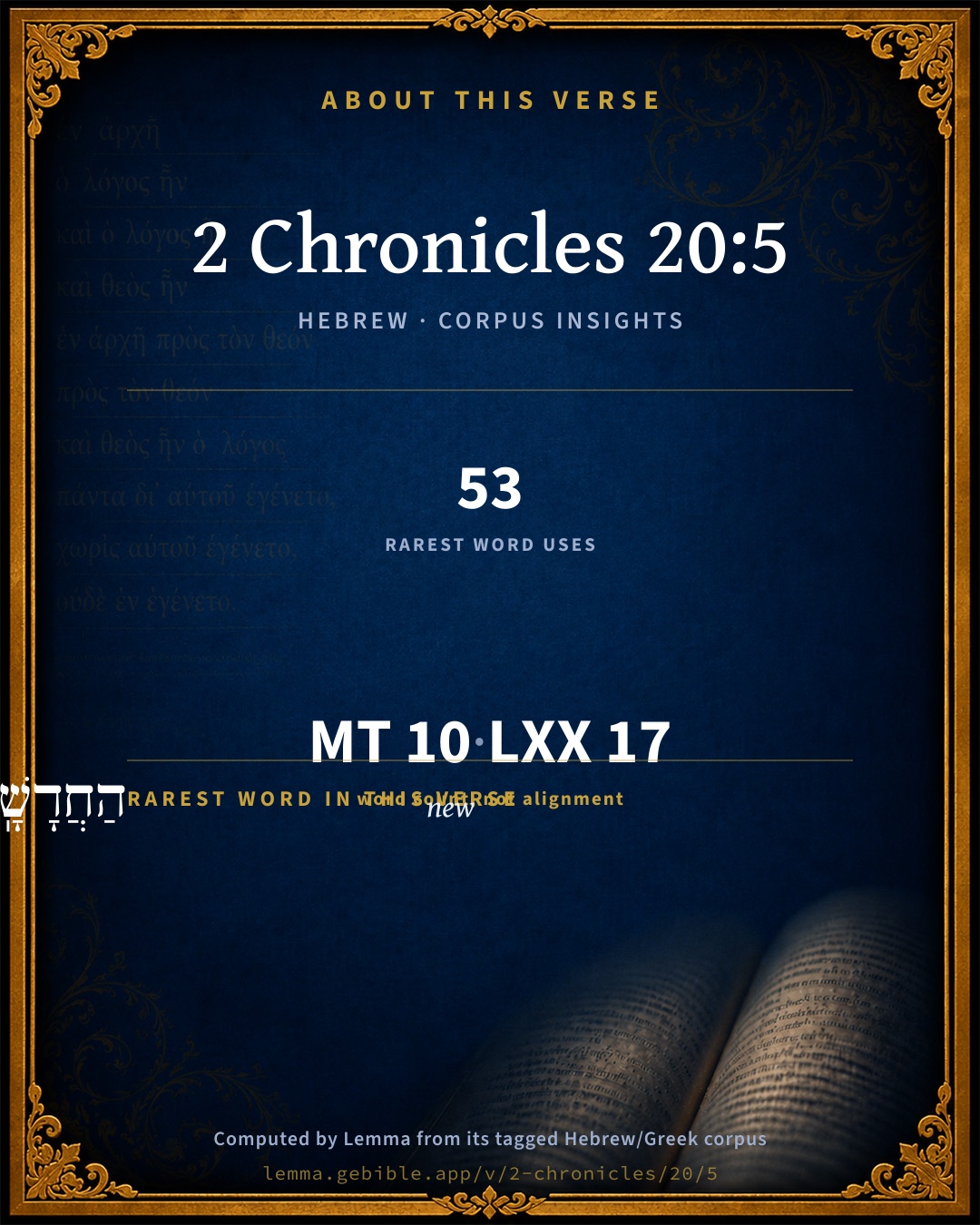
הַחֲדָשָֽׁה new H2319 occurs in 48 verses of the Hebrew Bible. Also found in:

Grammatical profile

  • 1 verb
  • 8 nouns
  • 1 adjective

Verb forms

  • וַיַּעֲמֹ֣ד Qal · Sequential Imperfect

Hebrew & Septuagint length

In English translation the verse runs 18 words from the Hebrew and 23 from the Septuagint (LXX English) — closely comparable.

A rough comparison of the two English renderings, which tokenize alike — not a word-level alignment.

Word counts can differ between the Hebrew and the Greek without any difference in meaning — e.g. the Hebrew direct-object marker אֵת has no separate Greek word, and Greek often adds the article ὁ.

In the original languages it is 10 Hebrew tokens and 17 Greek tokens — but the two are counted differently (Hebrew bundles its prefixes and suffixes into one token; the Greek is in lemma form), so that isn’t a like-for-like length.

Cross-references

3

Topical passages linked to 2 Chronicles 20:5 in the Treasury of Scripture Knowledge — connected by theme and wording, ordered by reader-vote popularity; previews shown in the World English Bible.

  • 2 Kings 19:15–19 Hezekiah prayed before Yahweh, and said, Yahweh, the God of Israel, who sit [above] the cherubim, you are the God, even you alone, of all the kingdoms of the earth; you have made heaven and earth.
  • 2 Chronicles 6:12–13 He stood before the altar of Yahweh in the presence of all the assembly of Israel, and spread forth his hands
  • 2 Chronicles 34:31 The king stood in his place, and made a covenant before Yahweh, to walk after Yahweh, and to keep his commandments, and his testimonies, and his statutes, with all his heart, and with all his soul, to perform the words of the covenant that were written in this book.

Cross-references courtesy of OpenBible.info (CC BY 4.0).

Hebrew and Greek witnesses Masoretic Hebrew ↔ Greek Septuagint

The same verse in the two great witnesses to the Old Testament, shown verse-for-verse.

These are two independent witnesses, not word-aligned to each other, and the Septuagint is shown in lemma (dictionary) form.

Hebrew 2 Chronicles 20:5 Masoretic · Westminster Leningrad Codex

וַיַּעֲמֹ֣ד יְהוֹשָׁפָ֗ט בִּקְהַ֧ל יְהוּדָ֛ה וִירוּשָׁלִַ֖ם בְּבֵ֣ית יְהוָ֑ה לִפְנֵ֖י הֶחָצֵ֥ר הַחֲדָשָֽׁה

Jehoshaphat stood in the assembly of Judah and Jerusalem, in the house of Yahweh, before the new court;

World English Bible · Public Domain

Greek LXX 2 Chronicles 20:5 Septuagint · lemma form

καί ἀναἵστημι ιωσαφατ ἐν ἐκκλησία ἰουδά ἐν ἰερουσαλήμ ἐν οἶκος κύριος κατά πρόσωπον ὁ αὐλή ὁ καινός

And Josaphat stood up in the assembly of Juda in Jerusalem, in the house of the Lord, in front of the new court.

LXX2012 (modern English Septuagint) · Public Domain

Hebrew: Westminster Leningrad Codex (CC BY 4.0). Greek: Septuagint (public domain); English from LXX2012 (modern English Septuagint) (Public Domain). How the Septuagint differs from the Hebrew →

Commentary

Notes on 2 Chronicles 20:5 from classic Christian and Jewish commentators (each source and its license shown beneath its notes). The classic Christian expositions comment on the surrounding passage and are grouped to its opening verse, so a note may address several verses; the Jewish commentaries on the Tanakh (Rashi and others) are per-verse, so they appear only where the commentator wrote on this verse.

Lemma curates 59 commentaries, every one of them public domain or Creative Commons licensed, each selected and text-cleaned for this edition rather than reprinted as found. About our sources →

Trapp's Complete Commentary

John Trapp

2Ch 20:5 And Jehoshaphat stood in the congregation of Judah and Jerusalem, in the house of the LORD, before the new court,

Ver. 5. Before the new court.] Omnes docti ignorant quodnam fuerit atrium illud novum, saith Vatablus. It is generally taken for the priest’s court newly repaired, as the altar had been. {2Ch 15:8}

John Trapp, A Commentary or Exposition upon All the Books of the Old and New Testament (1647–1656) — public domain. Text from a community e-Sword module.

The Biblical Illustrator

Joseph S. Exell

2Ch_20:5-13

And Jehoshaphat stood in the congregation of Judah.

Mans extremity is Gods opportunity

I. That in the discipline of life we should expect dangers and extremities. To know other resources we must learn the weakness of our own.

II. That in these dangers and extremities God has many ways of deliverance. Human agency but a small part of holy ministry. Birds and beasts, insects, elements of Nature, and hosts of angels under His command. Hence the folly of proscribing, measuring, or limiting in Gods work.

III. That in all dangers and extremities of life we should look to God for help. (J. Wolfendale.)

If, when evil cometh upon us.

The cause of famine and our duty

I. What is the cause of famine?

1. Dishonour of God (Eze_14:13).

2. Blasphemy (Jer_23:10).

3. Sabbath-breaking (Isa_58:13-14).

4. Contempt of Gods Word (Rev_22:18-19).

II. What should be our duty when God sends a famine upon the land?

1. Humbling ourselves before Him in prayer.

2. Showing kindness to our neighbours (Psa_41:1-2). (Charles A. Maguire, M.A.)

The Biblical Illustrator, edited by Joseph S. Exell (c. 1880s–1900s) — public domain. Text from a community e-Sword module.

Jamieson, Fausset & Brown

Robert Jamieson, A. R. Fausset & David Brown

Jehoshaphat stood . . . in the house of the Lord, before the new court--that is, the great or outer court (Ch2 4:9) called the new court, probably from having been at that time enlarged or beautified.

Jamieson, Fausset & Brown — Commentary Critical and Explanatory on the Whole Bible (1871) — public domain (CC PDM 1.0). Text via the HelloAO Bible API.

Ellicott's Commentary for English Readers

(5) And Jehoshaphat stood.—Comp. 2Ch_6:12-13.

Judah and Jerusalem.—So 2Ch_20:27. Jerusalem is thus mentioned side by side with the country, as being by far the most important part of it. (See also the headings of Isaiah 1, 2)

Before the new court.—This name, “the New Court,” only occurs here. It probably designates the “Great” (2Ch_4:9) or outer court of the Temple, in which the people assembled. Jehoshaphat stood facing the people, in front of the entrance to the Court of the Priests. Perhaps the court was called New, as having been recently repaired or enlarged. Syr. and Arab., “before the new gate.”

A Bible Commentary for English Readers, edited by Charles John Ellicott (1878–1897) — public domain. Text from a community e-Sword module.

The Cambridge Bible for Schools and Colleges

gen. ed. J. J. S. Perowne

5. stood] Rather, rose up.

before the new court] The Temple of Solomon seems to have differed in respect of its courts from the Second Temple; and it is difficult to tell of what court the Chronicler is thinking in this passage. The Heb. word for “court” here is ḥâçer, but in 2Ch_4:9 (see note there) the “court (ḥâççr) of the priests” is distinguished from a court called the “great court” (Heb. “great Azârâh”). Perhaps the Chronicler means here “the ḥâççr of the priests” for Jehoshaphat stands not in but before it. Solomon’s great prayer was offered according to the Chronicler (2Ch_6:13) in “the court” (Heb. Azârâh).

5–13 (no parallel in Kings). The Prayer of Jehoshaphat

This prayer should be compared with Solomon’s (2Ch_6:14 ff.).

The Cambridge Bible for Schools and Colleges (gen. ed. J. J. S. Perowne; Cambridge University Press, 1878–1918) — public domain. Text from a community e-Sword module.

John Gill's Exposition

And Jehoshaphat stood in the congregation of Judah and Jerusalem, in the house of the Lord,.... In the temple, in the court of the people, where the inhabitants of Judah and Jerusalem were assembled, in the midst of which he stood very probably on the brasen scaffold erected by Solomon, Ch2 6:13,

before the new court: which must be the court of the priests, for he stood in the great court, or court of the people, and before this, which might be so called, because renewed or repaired when the altar was by Asa, Ch2 15:8. Dr. Lightfoot (t) thinks it was the court of the women; but it is a question whether there was any such court in the first temple; or that the great court was then divided into two, one for the men, the other for the women.

(t) Prospect of the Temple, ch 18. p. 1090.

John Gill's Exposition of the Whole Bible (1746–1763) — public domain (CC PDM 1.0). Text via the HelloAO Bible API.

Albert Barnes' Notes on the Bible

The new court - In Solomon’s Temple there were two courts. One of these had probably been renovated by Jehoshaphat or by his father, Asa 2Ch 15:8, and was known as “the new court.”

Albert Barnes' Notes on the Bible (1834–1885) — public domain. Text from a community e-Sword/MySword module.

Haydock's Catholic Bible Commentary

New court of the priests. Why it is so called, does not appear. C. --- Some understand the court for the women; (Salien) others, that for Gentiles. Le Clerc --- Probably some of the courts had been found too spacious after the schism, and had been neglected; but now, as many had returned to serve the Lord in the dominions of Josaphat, he had made some repairs. T.

George Leo Haydock (1774–1849), Haydock's Catholic Family Bible and Commentary, 1859 edition — public domain. Excludes Psalms (Douay-Rheims chapter numbering differs from Protestant) and Deuterocanonical books (Catholic canon only).

Matthew Poole's English Annotations

In the house of the Lord, largely so called, i.e. in one of the courts of the temple, even in the court of the people, and upon that brazen scaffold which Solomon had erected for such a purpose, 2Ch 6:13.

Before the new court, i.e. besides and before the priests’ court; for there were but two courts belonging to the temple, as is noted 2Ki 21:5; 23:12. And Jehoshaphat stood in the one, which must be that of the people; and before the other, which therefore can be no other than that of the priests’, which is called the new court, because it had been lately renewed when the altar was renewed, 2Ch 15:8, as the command of love is called a new command, Joh 13:34; 1Jo 2:8, because it was so solemnly renewed, and revived, and reinforced by Christ.

Matthew Poole's English Annotations on the Holy Bible (1683–1685) — public domain. Text from a community e-Sword/MySword module.

Whedon's Commentary on the Bible

Daniel D. Whedon

5. Before the new court — This was probably the outer, or great court, (2Ch_4:9,) where the people were wont to assemble. It is spoken of as in the house of the Lord, because it belonged to, and so was a part of, the temple in the wider sense in which the term house of Jehovah was sometimes used. It is called the new court, either because it had recently been repaired and renovated by Asa or Jehoshaphat, or because it was a later arrangement than the inner court of the priests. The tabernacle had only one court, but Solomon or David seems to have planned this second or outer court as something new. Jehoshaphat stood before this new court, that is, at its entrance into the inner court, and there, in the presence of the congregation, offered the beautiful and appropriate prayer that follows.

Daniel D. Whedon (gen. ed.), Commentary on the Old and New Testaments (1874–1909) — public domain. Text from a community e-Sword module.

The Pulpit Commentary

The new court. (see 2Ch_4:9 2Ch_15:8)

Vers. 5-19.

The prayer of Jehoshaphat.

I THE SCENE.

1. The place.

(1) Jerusalem, the metropolis of the land, whose safety was imperilled.

(2) The house of Jehovah, the sanctuary on Mount Moriah, erected by Solomon as a dwelling-place for the God of Israel.

(3) The new court, the outer or great court of the temple. (1Ki_7:12) A quadrangle, this was probably called "new," because of having been restored or repaired by either Asa or Jehoshaphat.

2. The assembly.

(1) The inhabitants of Jerusalem with their wives and children.

(2) The representatives of Judah from all the cities of the land whether accompanied with their wives and children uncertain.

3. The suppliant. Jehoshaphat acted as the mouthpiece for himself and his people. Standing forth in the centre of the congregation, he offered "without form or any premeditation (?) one of the most sensible, pious, correct, and, as to its composition, one of the most elegant prayers ever offered under the Old Testament dispensation" (Adam Clarke).

II THE PRAYER.

1. The Being addressed Jehovah. Adored as:

(1) Personal and present. The God of Jehoshaphat and his people (vers. 7, 12). "He that cometh to God must believe that he is". (Heb_11:6)

(2) Ancestral and faithful. The God of their fathers (ver. 6), who had covenanted with these fathers, (Deu_5:2) and would remain true to the engagements then undertaken (2Ch_6:14; 1Ki_8:57)

(3) Celestial and mundane. The God of heaven as well as of earth, who dwelt among the armies of light and ruled among the kingdoms of the heathen. (Dan_4:35)

(4) Universal and local. Not the God of Israel and Judah alone, but the God to whom all empires and sovereigns owed allegiance (Psa_103:19 Psa_135:5, Psa_135:6; 1Ch_29:11; Dan_4:17; Rev_11:4)

(5) Omnipresent and omnipotent. Possessed of resistless power and might which no one could withstand (ver. 6).

2. The pleas offered.

(1) The covenant mercies of Jehovah in first gifting the land to his friend, their father Abraham, and to his seed for ever; (Gen_12:1 Gen_13:17) second, driving out the inhabitants of the land before them (Exo_33:2 Exo_34:11; Deu_11:23; Psa_44:2) and third, in establishing them in possession of the vacated territory, so that for centuries they had dwelt in it (Lev_25:18; Deu_12:10)

(2) The expectation of Judah, that Jehovah would hear and keep them when in danger they called upon his Name (ver. 9). In this hope the temple had been built, and in the belief that this hope would be realized they now stood before Jehovah"s presence. (Psa_146:5)

(3) The ingratitude of the enemy, whom Israel on her way from Egypt had not been suffered to invade, (Deu_2:4, Deu_2:9, Deu_2:19) and who now repaid her clemency by attempting to drive her from her land. Such ingratitude on the part of nations and individuals is by no means infrequent. The only things men find it easy to remember are insults and injuries; kindnesses remain with difficulty in the human memory (Gen_40:23 1Sa_23:5-12; Ecc_9:14-16; 2Ch_24:22)

(4) The helplessness of Judah. Jehoshaphat and his people were without strength to contend with so great a company. Neither knew they in what direction to turn or what to do. No better plea can be laid before Heaven than a confession of human weakness, (Psa_6:2 Psa_22:11) since God"s strength is perfected in weakness. (2Co_12:9)

(5) The attitude in which they then stood. Their eyes were waiting upon Jehovah, (Psa_25:15 Psa_121:1, 2 123:1, 2) trusting, desiring, expecting. They had placed their hope in and anticipated their help from him, as in a similar crisis Asa had done (2Ch_14:11; Psa_121:1)

3. The petitions urged. That Jehovah would

(1) judge and defeat their enemies;

(2) hear and help them, the petitioners. The two requests were inseparable. Deliverance to Judah could only come through destruction of her adversaries. The Church of God may still conjoin the two petitions.

III THE ANSWER.

1. From whom it proceeded. Jehovah (ver. 15), or the Spirit of Jehovah (ver. 14). No answers to prayer except from him. Human lips can reply for God only in so far as God puts his words into them (Isa_51:16; Eze_3:17; Jer_5:14)

2. Through whom communicated. Jahaziel, the son of Zechariah, the son of Benaiah, the son of Jeiel, the son of Mattaniah, a Levite of the sons of Asaph; a man of

(1) honorable pedigree, being the fifth in descent, not from the Hemanite Mattaniah, a contemporary of David, (1Ch_25:4, 1Ch_25:16) but from Nethaniah the Asaphite; (1Ch_25:2, 1Ch_25:12) the letter n having been accidentally changed into a (Movers, Keil, Bertheau);

(2) honourable rank, being a Levite, and therefore of priestly station; and

(3) honourable calling, being, as a son of Asaph, a leader of psalmody in the temple worship, and now suddenly invested with the dignity of the prophetic office. God can find prophets anywhere when he wants them, not being bound to prophetical any more than to apostolical succession Elisha at the plough, (1Ki_19:19) Amos among the herdsmen. (Amo_1:1)

1. To whom it was addressed. To all Judah, to the inhabitants of Jerusalem and to Jehoshaphat, the persons in whose name and on whose behalf the prayer had been offered.

2. Of what it consisted.

(1) A dissuasive against fear. "Be not afraid nor dismayed by reason of this great multitude," similar to that given by Moses to the fleeing Israelites, (Exo_14:13) and for a similar reason, that the battle was Jehovah"s more than theirs, and he would fight with and for them (Exo_14:14; 1Sa_17:47) The same is true of the battle the Christian Church is summoned to maintain against the three powers of evil, known as the world, the flesh, and the devil. (Mat_10:28)

(2) A command to advance. "Go ye down against them" (ver. 16), exactly as Moses was instructed to speak unto the children of Israel that they should go forward. (Exo_14:15) Little as God"s people can or could do if left to themselves, they are not at liberty to play the coward in face of the foe (Deu_31:6; 2Sa_10:12; Mar_15:43; Act_9:27; 2Pe_1:5) to subside into despair or take to their heels. Their duty is to stand fast, quit themselves like men, be strong, and persevere.

(3) A direction where to find the enemy. "Behold, they come up by the cliff or, "ascent" of Ziz, and ye shall find them at the end of the valley, before the wilderness of Jeruel" (ver. 16). This a part of the flat country extending from the Dead Sea to the neighbourhood of Tekoa, and called El Husasah, from a wady on its northern side (Robinson, vol. 2. p. 243). The ascent or mountain-road, Hazziz, led towards it from Engedi.

(4) An instruction what to do on meeting them. To set themselves in battle array stand still and see the salvation of God (ver. 17). They would not require to fight. Jehovah would do the rest. Compare again the orders of Moses to the Israelites. (Exo_14:13) The instruction here given has its counterpart in that given by the gospel to sinners: "To him that worketh not, but believeth," etc. (Rom_4:5)

(5) An encouragement to hope for victory. "The Lord would be with them" (Ver. 17) and fight for them as he did for Israel at the Red Sea (Exo_14:13) and at Gibeon, (Jos_10:14) as Moses promised he would do every time they faced their enemies, (Deu_20:4) and as Nehemiah (Neh_4:20) afterwards believed he did. The same presence is enjoyed by the Church of God still. (Mat_27:20)

IV THE ACKNOWLEDGMENT.

1. By the king. "Jehoshaphat bowed his head with his face to the ground" (ver. 18), in token of humility and reverence, as well as of adoration and submission (2Ch_29:30; Gen_18:2 Gen_24:26; Exo_4:31 Exo_34:8 Jos_23:7)

2. By the people. "All Judah and the inhabitants of Jerusalem fell before the Lord," in a solemn act of worship.

3. By the Levites. Those belonging to the children of the Kohathites and the children of the Korahites "stood up to praise the Lord God of Israel with an exceeding loud voice," adding notes of thanksgiving and rejoicing to those of adoration and self-humiliation which Jehovah"s gracious answer inspired.

Learn:

1. The sorest need of man a God to flee to in the hour of trouble andday of calamity.

2. The highest glory of God that he can hear prayer and rescue theperishing.

3. The greatest peril of the Church"s enemies the fact that Jehovahfights against them.

4. The surest guarantee of victory for the Church of Jesus Christ thefact that the battle is the Lord"s.

5. The brightest hope for an anxious sinner that he only needs to standstill and see the salvation of God. W.

The Pulpit Commentary (1880–1919), ed. H.D.M. Spence-Jones & Joseph S. Exell — public domain. Text from a community e-Sword module.

John Wesley's Explanatory Notes

The house - Largely so called, in the court of the people, upon that brazen scaffold which Solomon had erected. New court - Before the priests court: which is called the new court, because it had lately been renewed when the altar was renewed.

John Wesley, Explanatory Notes Upon the Whole Bible (1754–1765) — public domain. Text via the GEBible commentary corpus.

Keil & Delitzsch

C. F. Keil & F. Delitzsch

When the inhabitants of Judah and Jerusalem had assembled themselves in the house of God, Jehoshaphat came forth before the new court and made supplication in fervent prayer to the Lord. The new court is the outer or great court of the temple, which Solomon had built (Ch2 4:9). It is here called the new court, probably because it had been restored or extended under Jehoshaphat or Asa. This court was the place where the congregation assembled before God in the sanctuary. Jehoshaphat placed himself before it, i.e., at the entrance into the court of the priests, so that the congregation stood opposite to him.

Keil & Delitzsch — Biblical Commentary on the Old Testament (1861–1891) — public domain (CC PDM 1.0). Text via the HelloAO Bible API. (Old Testament only.)

unfoldingWord translationNotes

Door43 World Missions Community

of Judah and Jerusalem

This refers to the people from these places. AT: "of the people from Judah and Jerusalem" (See: Metonymy)

are you not God in heaven? Are you not the ruler over all the kingdoms of the nations?

Jehoshaphat uses this rhetorical question to emphasize that God is in heaven and his authority over all things. This question can be written as statement. AT: "you are indeed God in heaven and the ruler over all the kings of the earth." (See: Rhetorical Question)

Power and might are in your hand

The words "Power" and "might" mean basically the same thing and emphasize the greatness of Yahweh's power. The word "hand" refers to possession. AT: "You possess great power" or "You have great power and might" (See: Doublet and Synecdoche)

Our God, did you not drive out the inhabitants of this land ... to the descendants of Abraham?

Jehoshaphat uses this rhetorical question to emphasize that God drove their enemies from their land and gave it to the Israelites. This question can be written as statement. AT: "It was you who drove out those who lived in this land for the sake of your people Israel and who gave it permanently to the descendants of Abraham." (See: Rhetorical Question)

translationWords

assembly

Jerusalem

house of God

court

heaven

nation

hand

eternity

descend

Abraham

unfoldingWord translationNotes — © Distant Shores Media and the Door43 World Missions Community, licensed CC BY-SA 4.0. Source: git.door43.org/Door43/en_tn.

Lesson kit

Teaching starters — assembled from the data on this page, not authored interpretation. Every prompt links to the verse data it draws on. Edit before teaching.

2 Chronicles, in the Historical, opens this verse with 10 words (10 distinct Hebrew lemmas). Its most distinctive word is châdâsh (“new”). A historical commentator’s framing appears above. Read the whole chapter for the surrounding context.

Discussion questions

  1. The word châdâsh carries the sense “new.” How does it shape the verse?
  2. How does Exodus 1:8, which shares the word «new», read alongside this verse?
  3. These translations render this verse differently; the difference is in the English rendering, not the original. What questions does that raise?
  4. «וַיַּעֲמֹ֣ד» is a Qal Sequential Imperfect verb. How does that grammatical form shape the action described?
  5. Compare how Trapp's Complete Commentary and The Biblical Illustrator read this verse. Where do they agree or differ?

Things to notice

Reading settings

Reading text

Shown beneath each verse's original-language words.

Old Testament
Old Testament edition

Read the OT as the Masoretic Hebrew (MT) or the Greek Septuagint (LXX).

English shown for the Greek Septuagint (in the Hebrew ↔ Greek comparison).

Comparing translations? Open the Compare panel on any verse page to stack up to four side by side.