
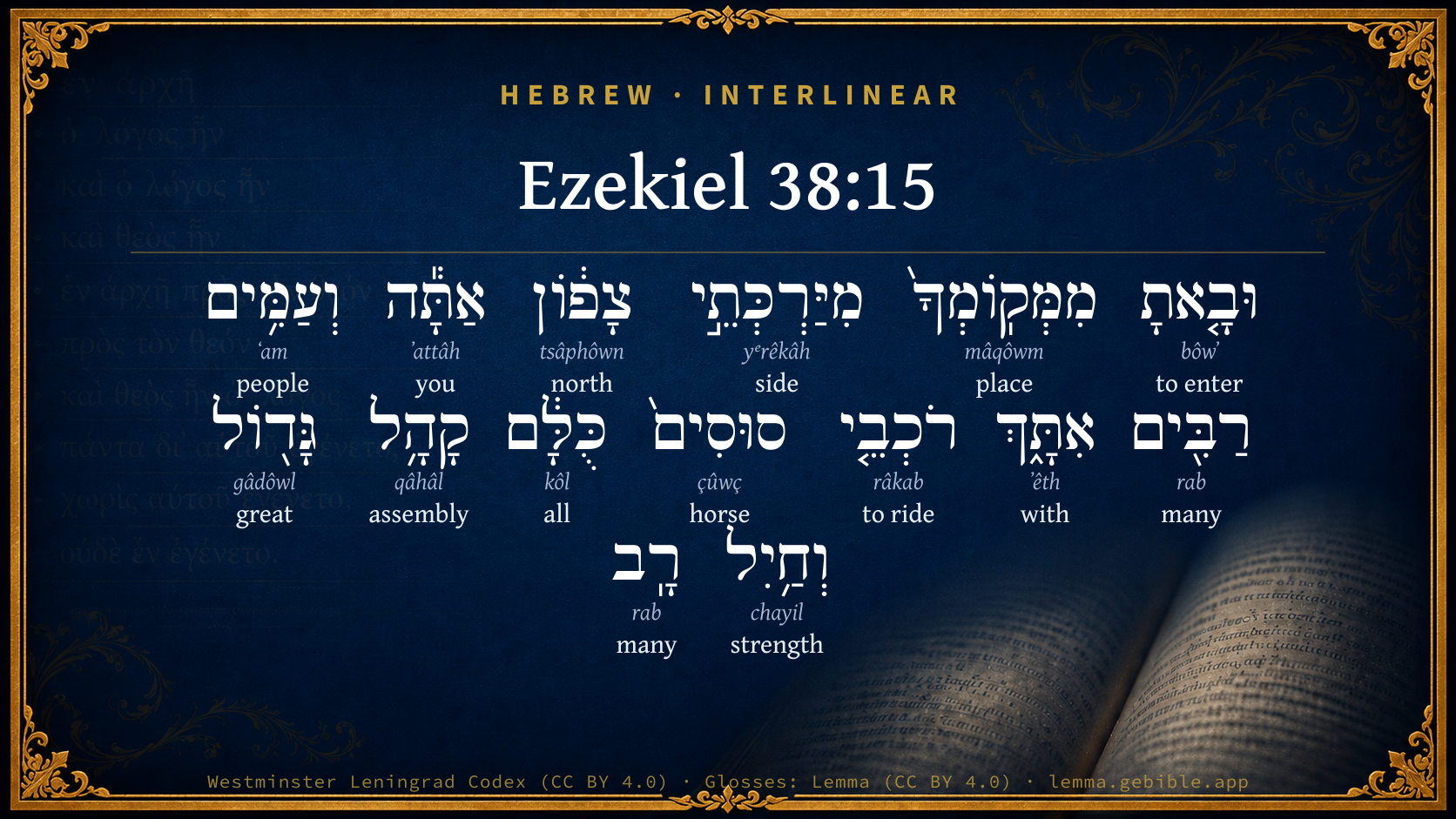
Ezekiel 38:15

Hebrew (Westminster Leningrad Codex) Ezekiel 38:15 appears in the Hebrew Old Testament. The text above is from the Westminster Leningrad Codex. Each word links to its Strong’s number, a concise gloss, and parsing drawn from the Open Scriptures Hebrew Bible morphology. Click any word for its full Brown-Driver-Briggs (BDB) entry.
Download image
Cite this verse

Ezekiel 38:15 (World English Bible). Public Domain. Lemma interlinear Bible study tool, https://lemma.gebible.app/v/ezekiel/38/15.

Show BibTeX & RIS
BibTeX
RIS
English Translation
You shall come from your place out of the uttermost parts of the north, you, and many peoples with you, all of them riding on horses, a great company and a mighty army;
World English Bible · Public Domain
Download a study sheet

One document with this verse’s original text, its word-by-word gloss line, the meaning frame, cross-references with their text, attributed commentary, and full source and license credits — printable, and it pastes into notes with its structure intact.

This verse Autodidact and up

Study sheet (.html) Plain text (.txt)

A passage Seminary Student

Up to 50 verses in one chapter. A passage sheet keeps up to 6 commentary sources and 12 cross-references per verse, in the order this page ranks them, and says so on the sheet whenever that leaves anything out. Ask for a single verse and you get the Autodidact verse sheet above.

Everything on this page stays free to read, with no account — the sheet is a download of what is already on screen, not access to it.

Want to remove ads? Support Godless Engineer
Compare translations 3

The same verse in 3 English versions, stacked beneath the original-language interlinear above. Click any original word for its lexicon entry.

Each is an independent rendering of the whole verse — the interlinear is not word-aligned to these translations.

Highlighted words mark where these versions differ — a whole-verse word diff, not a word-by-word alignment.

  • World English Bible Public Domain
    You shall come from your place out of the uttermost parts of the north, you, and many peoples with you, all of them riding on horses, a great company and a mighty army;
  • King James Version Public Domain
    And thou shalt come from thy place out of the north parts, thou, and many people with thee, all of them riding upon horses, a great company, and a mighty army:
  • unfoldingWord Literal Text CC BY-SA 4.0
    You will come from your place far away in the north with a great army, all of them riding on horses, a great company, a large army.

unfoldingWord Literal Text — © unfoldingWord, licensed CC BY-SA 4.0. Word-aligned USFM3 via Door43 (git.door43.org/unfoldingWord/en_ult).

Versions to compare (up to 4)

3 of 4 selected

Show all 18 translations

Every available English version of this verse, each an independent rendering of the whole verse.

  • World English Bible Public Domain
    You shall come from your place out of the uttermost parts of the north, you, and many peoples with you, all of them riding on horses, a great company and a mighty army;
  • Berean Standard Bible Public Domain
    And you will come from your place out of the far north—you and many peoples with you, all riding horses—a mighty horde, a huge army.
  • Majority Standard Bible Public Domain
    And you will come from your place out of the far north—you and many peoples with you, all riding horses—a mighty horde, a huge army.
  • King James Version Public Domain
    And thou shalt come from thy place out of the north parts, thou, and many people with thee, all of them riding upon horses, a great company, and a mighty army:
  • American Standard Version (1901) Public Domain
    And thou shalt come from thy place out of the uttermost parts of the north, thou, and many peoples with thee, all of them riding upon horses, a great company and a mighty army;
  • Revised Version (1885) Public Domain
    And thou shalt come from thy place out of the uttermost parts of the north, thou, and many peoples with thee, all of them riding upon horses; a great company and a mighty army:
  • Geneva Bible (1599) Public Domain
    And come from thy place out of the North partes, thou and much people with thee? all shall ride vpon horses, euen a great multitude and a mightie armie.
  • Douay-Rheims (1899) Public Domain
    And then shalt come out of thy place from the northern parts, thou and many people with thee, all of them riding upon horses, a great company and a mighty army.
  • Young's Literal Translation Public Domain
    And thou hast come in out of thy place, From the sides of the north, Thou and many peoples with thee, Riding on horses -- all of them, A great assembly, and a numerous force.
  • Literal Standard Version CC BY-SA 4.0
    And you have come in out of your place, || From the sides of the north, || You and many peoples with you, || Riding on horses—all of them, || A great assembly, and a numerous force.
  • Unlocked Literal Bible CC BY-SA 4.0
    You will come from your place far away in the north with a great army, all of them riding on horses, a great company, a large army.
  • unfoldingWord Literal Text CC BY-SA 4.0
    You will come from your place far away in the north with a great army, all of them riding on horses, a great company, a large army.
  • Darby Bible Public Domain
    And thou shalt come from thy place out of the uttermost north, thou and many peoples with thee, all of them riding upon horses, a great assemblage and a mighty army.
  • World Messianic Bible Public Domain
    You will come from your place out of the uttermost parts of the north, you, and many peoples with you, all of them riding on horses, a great company and a mighty army.
  • Webster's Bible Public Domain
    And thou shalt come from thy place out of the north parts, thou, and many people with thee, all of them riding upon horses, a great company, and a mighty army:
  • Free Bible Version CC BY-SA 4.0
    You'll advance from your place in the distant north, you and your many allies, everyone riding horses, a huge number of men, a massive army.
  • Bible in Basic English Public Domain
    And you will come from your place in the inmost parts of the north, you and a great number of peoples with you, all of them on horseback, a great force and a strong army:
  • JPS Tanakh (1917) Public Domain
    And thou shalt come from thy place out of the uttermost parts of the north, thou, and many peoples with thee, all of them riding upon horses, a great company and a mighty army;

Literal Standard Version (2020), Covenant Press — licensed CC BY-SA 4.0. Text via the HelloAO Bible API (eBible.org). Unlocked Literal Bible (unfoldingWord) — licensed CC BY-SA 4.0. Text via the HelloAO Bible API (eBible.org). unfoldingWord Literal Text — © unfoldingWord, licensed CC BY-SA 4.0. Word-aligned USFM3 via Door43 (git.door43.org/unfoldingWord/en_ult). Free Bible Version, Dr. Jonathan Gallagher — licensed CC BY-SA 4.0. Text via the HelloAO Bible API (eBible.org).

Word by word

More ways to search: Search by grammar → Find every occurrence → Compare this word →

Practice this passage: Drill this verse → Learn its vocabulary →

מִיַּרְכְּתֵ֣י
yᵉrêkâh
H3411
“from · sides of”
Preposition + Noun, Common, Feminine, Dual, Construct
Part of Speech
Preposition + Noun
Type
Common
Gender
Feminine
Number
Dual
State
Construct
Full BDB Definition

Origin: from H3409

TWOT: 916b

flank, side, extreme parts, recesses - side - sides, recesses (dual)
  1. וּבָ֤אתָ bôwʼ H935 “and · to enter” Conjunction + Verb, Qal, Sequential Perfect, 2nd Person, Masculine, Singular
  2. מִמְּקֽוֹמְךָ֙ mâqôwm H4725 “from · place · your” Preposition + Noun, Common, Masculine, Singular, Construct + Suffix, Personal, 2nd Person, Masculine, Singular
  3. צָפ֔וֹן tsâphôwn H6828 “north” Noun, Common, Feminine, Singular, Absolute
  4. אַתָּ֕ה ʼattâh H859 “you” Pronoun, Personal, 2nd Person, Masculine, Singular
  5. וְעַמִּ֥ים ʻam H5971 “and · peoples” Conjunction + Noun, Common, Masculine, Plural, Absolute
  6. רַבִּ֖ים rab H7227 “many” Adjective, Adjective, Masculine, Plural, Absolute
  7. אִתָּ֑ךְ ʼêth H854 “with · you” Preposition + Suffix, Personal, 2nd Person, Feminine, Singular
  8. רֹכְבֵ֤י râkab H7392 “riding” Verb, Qal, Participle Active, Masculine, Plural, Construct
  9. סוּסִים֙ çûwç H5483 “horses” Noun, Common, Masculine, Plural, Absolute
  10. כֻּלָּ֔ם kôl H3605 “all · their” Noun, Common, Masculine, Singular, Construct + Suffix, Personal, 3rd Person, Masculine, Plural
  11. קָהָ֥ל qâhâl H6951 “assembly” Noun, Common, Masculine, Singular, Absolute
  12. גָּד֖וֹל gâdôwl H1419 “great” Adjective, Adjective, Masculine, Singular, Absolute
  13. וְחַ֥יִל chayil H2428 “and · strength” Conjunction + Noun, Common, Masculine, Singular, Absolute
  14. רָֽב rab H7227 “many” Adjective, Adjective, Masculine, Singular, Absolute

About this verse

These counts appear in no published source. They are computed here, from the morphology-tagged text and Lemma’s own curated glosses. What Lemma adds →

15
words
14
distinct lemmas
Prophets
section

Shared distinctive vocabulary

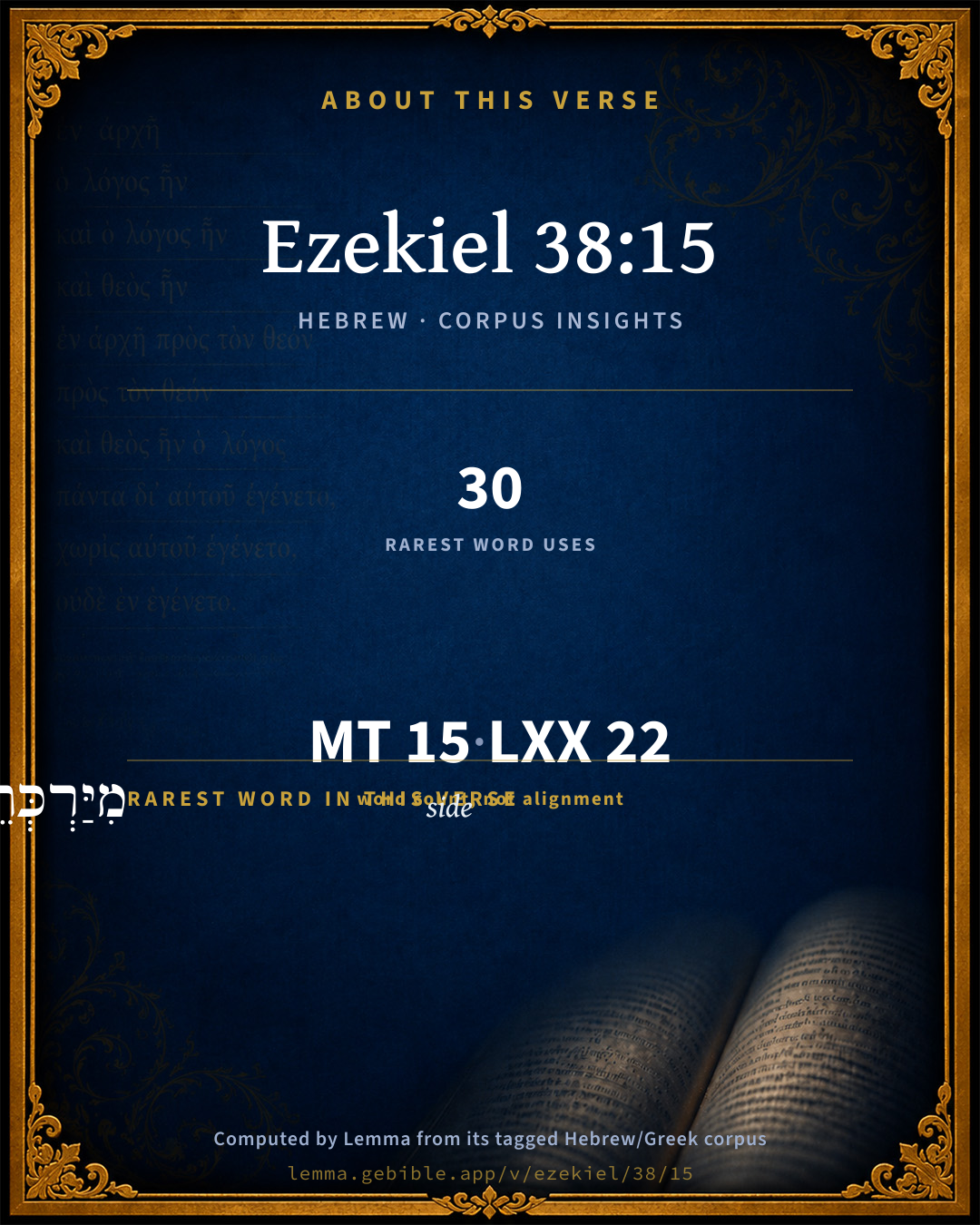
מִיַּרְכְּתֵ֣י side H3411 occurs in 28 verses of the Hebrew Bible. Also found in:

Grammatical profile

  • 2 verbs
  • 8 nouns
  • 3 adjectives
  • 1 pronoun
  • 1 preposition

Verb forms

  • וּבָ֤אתָ Qal · Sequential Perfect
  • רֹכְבֵ֤י Qal · Participle Active

Repetition

A word recurs within this verse — often emphatic in Hebrew:

  • רַבִּ֖ים many H7227 ×2

Hebrew & Septuagint length

In English translation the verse runs 33 words from the Hebrew and 28 from the Septuagint (LXX English) — closely comparable.

A rough comparison of the two English renderings, which tokenize alike — not a word-level alignment.

Word counts can differ between the Hebrew and the Greek without any difference in meaning — e.g. the Hebrew direct-object marker אֵת has no separate Greek word, and Greek often adds the article ὁ.

In the original languages it is 15 Hebrew tokens and 22 Greek tokens — but the two are counted differently (Hebrew bundles its prefixes and suffixes into one token; the Greek is in lemma form), so that isn’t a like-for-like length.

Cross-references

11

Topical passages linked to Ezekiel 38:15 in the Treasury of Scripture Knowledge — connected by theme and wording, ordered by reader-vote popularity; previews shown in the World English Bible.

  • Ezekiel 39:2 and I will turn you about, and will lead you on, and will cause you to come up from the uttermost parts of the north; and I will bring you on the mountains of Israel;
  • Ezekiel 38:6 Gomer, and all his hordes; the house of Togarmah in the uttermost parts of the north, and all his hordes; even many peoples with you.
  • Revelation 20:8 and he will come out to deceive the nations which are in the four corners of the earth, Gog and Magog, to gather them together to the war; the number of whom is as the sand of the sea.
  • Ezekiel 38:4 and I will turn you about, and put hooks into your jaws, and I will bring you forth, and all your army, horses and horsemen, all of them clothed in full armor, a great company with buckler and shield, all of them handling swords;
  • Daniel 11:40 At the time of the end shall the king of the south contend with him; and the king of the north shall come against him like a whirlwind, with chariots, and with horsemen, and with many ships; and he shall enter into the countries, and shall overflow and pass through.
  • Joel 3:2 I will gather all nations, And will bring them down into the valley of Jehoshaphat; And I will execute judgment on them there for my people, And for my heritage, Israel, whom they have scattered among the nations. They have divided my land,
  • Zephaniah 3:8 "Therefore wait for me," says Yahweh, "until the day that I rise up to the prey, for my determination is to gather the nations, that I may assemble the kingdoms, to pour on them my indignation, even all my fierce anger, for all the earth will be devoured with the fire of my jealousy.
  • Zechariah 12:2–4 "Behold, I will make Jerusalem a cup of reeling to all the surrounding peoples, and on Judah also will it be in the siege against Jerusalem.
  • Zechariah 14:2–3 For I will gather all nations against Jerusalem to battle; and the city will be taken, the houses rifled, and the women ravished. half of the city will go out into captivity, and the rest of the people will not be cut off from the city.
  • Revelation 16:14 for they are spirits of demons, performing signs; which go forth to the kings of the whole inhabited earth, to gather them together for the war of that great day of God, the Almighty.
  • Revelation 16:16 He gathered them together into the place which is called in Hebrew, Megiddo.

Cross-references courtesy of OpenBible.info (CC BY 4.0).

Hebrew and Greek witnesses Masoretic Hebrew ↔ Greek Septuagint

The same verse in the two great witnesses to the Old Testament, shown verse-for-verse.

These are two independent witnesses, not word-aligned to each other, and the Septuagint is shown in lemma (dictionary) form.

Hebrew Ezekiel 38:15 Masoretic · Westminster Leningrad Codex

וּבָ֤אתָ מִמְּקֽוֹמְךָ֙ מִיַּרְכְּתֵ֣י צָפ֔וֹן אַתָּ֕ה וְעַמִּ֥ים רַבִּ֖ים אִתָּ֑ךְ רֹכְבֵ֤י סוּסִים֙ כֻּלָּ֔ם קָהָ֥ל גָּד֖וֹל וְחַ֥יִל רָֽב

You shall come from your place out of the uttermost parts of the north, you, and many peoples with you, all of them riding on horses, a great company and a mighty army;

World English Bible · Public Domain

Greek LXX Ezekiel 38:15 Septuagint · lemma form

καί ἥκω ἐκ ὁ τόπος σύ ἀπό ἔσχατος βορέας καί ἔθνος πολύς μετά σύ ἀναβάτης ἵππος πᾶς συναγωγή μέγας καί δύναμις πολύς

and come out of your place from the farthest north, and many nations with you? all of them mounted on horses, a great gathering, and a large force?

LXX2012 (modern English Septuagint) · Public Domain

Hebrew: Westminster Leningrad Codex (CC BY 4.0). Greek: Septuagint (public domain); English from LXX2012 (modern English Septuagint) (Public Domain). How the Septuagint differs from the Hebrew →

Targum (Aramaic paraphrase)

1

The Targum is the ancient Jewish Aramaic paraphrase of the Hebrew Scriptures — an interpretive translation, not the Hebrew text itself. Onkelos (literal) and Pseudo-Jonathan (expansive) render the Torah, and Jonathan the Prophets. Coverage is partial: where no permissively-licensed English translation exists for a verse, only the Aramaic is shown. This is verse-level text, not a word-by-word alignment to the Hebrew.

  1. Targum Jonathan Prophets (Joshua–Malachi)
    וְתֵיתֵי מֵאַתְרָךְ מִסְיָפֵי צִפּוּנָא אַתְּ וְעַמְמִין סַגִיאִין דִי עִמָךְ רוֹכְבֵי סוּסְוָן כּוּלְהוֹן מַשִׁרְיָן סַגִיאִין וְעַם סַגִי:

    (no public-domain English translation for this verse)

    Targum Jonathan — Aramaic: “Mikraot Gedolot” (public domain). English: “Sefaria Community Translation” (CC0 1.0 (public-domain dedication)); “London "Chaldee Paraphrase," 1871” (public domain). Text via Sefaria.

Commentary

Notes on Ezekiel 38:15 from classic Christian and Jewish commentators (each source and its license shown beneath its notes). The classic Christian expositions comment on the surrounding passage and are grouped to its opening verse, so a note may address several verses; the Jewish commentaries on the Tanakh (Rashi and others) are per-verse, so they appear only where the commentator wrote on this verse.

Lemma curates 59 commentaries, every one of them public domain or Creative Commons licensed, each selected and text-cleaned for this edition rather than reprinted as found. About our sources →

Trapp's Complete Commentary

John Trapp

Eze 38:15 And thou shalt come from thy place out of the north parts, thou, and many people with thee, all of them riding upon horses, a great company, and a mighty army:

Ver. 15. Out of the north parts.] Ab aquilone nihil boni. From spiritual Babylon comes all mischief to the Church. The king of Syria is called "king of the north" in Dan 11:6.

A great company, and a mighty army.] Such was the army of Antiochus Epiphanes against the Jews, of the Turk against Christians, of the Pope against the Hussites, Waldenses, &c. He deceiveth the nations which are in the four quarters of the earth, to gather them together to battle, the number of whom is as the sand of the sea. {Rev 20:8} He hath at his command the Italians, Walloons, Spaniards, whom Bellarmine {a} rightly reckoneth among the soldiers of antichrist.

{a} De Rom. Pont., lib. iii. cap. 16 and 17.

John Trapp, A Commentary or Exposition upon All the Books of the Old and New Testament (1647–1656) — public domain. Text from a community e-Sword module.

The Cambridge Bible for Schools and Colleges

gen. ed. J. J. S. Perowne

15. Cf. Eze_38:4; Eze_38:6, Eze_39:2. For many people, peoples.

The Cambridge Bible for Schools and Colleges (gen. ed. J. J. S. Perowne; Cambridge University Press, 1878–1918) — public domain. Text from a community e-Sword module.

John Gill's Exposition

And thou shall come up against my people of Israel,.... Which is repeated for the certainty of it; and not for his comfort, but his ruin; not to the terror of Israel, but for the glory of God:

as a cloud to cover the land; the land of Israel, so great should be his army; See Gill on Eze 38:9,

it shall be in the latter days; of the Gospel state, or kingdom of the Messiah, when the Jews shall be converted, and are returned to their own land, Hos 3:5,

and I will bring thee against my land; not to possess it, nor to hurt it, or to any injury to the people of it: but

that the Heathen may know me; the Pagan kingdoms of China, and others; who by God's judgments on the Turks will come to the knowledge of the true God, and acknowledge him, and will become the kingdoms of our Lord, and of his Christ, Rev 11:15,

when I shall be sanctified in thee, O Gog, before their eyes; that is, when God shall appear to be a holy and just God, in inflicting deserved punishment on the enemies of his people; when his omniscience and omnipotence, his power and faithfulness, and other perfections of his will be displayed, in fulfilling those prophecies concerning Gog or the Turks; infidels will be convinced of the truth of divine revelation; of the God of Israel being the true God; of Jesus being the Messiah; and of the Christian religion being of God, and shall profess the same. The, Targum is,

"that the people may know the vengeance of my power, when I shall be sanctified in thee, who shall see thy vengeance, O Gog.''

John Gill's Exposition of the Whole Bible (1746–1763) — public domain (CC PDM 1.0). Text via the HelloAO Bible API.

Matthew Poole's English Annotations

Thou shalt: see Eze 38:9.

From thy place; out of thine own land.

Out of the north parts; from Scythia, from the Euxine and Caspian seas, and countries thereabouts.

Thou; the leader and chieftain.

Many people; mighty and numerous, as Eze 38:6,9.

Riding upon horses: see Eze 38:4.

A great company: see Eze 38:9.

Matthew Poole's English Annotations on the Holy Bible (1683–1685) — public domain. Text from a community e-Sword/MySword module.

The Pulpit Commentary

All of them riding upon horses. (see on ver. 4; and comp. Eze_23:6 Eze_26:7; Jer_6:23; and Amo_2:15) The Scythians are said to have been able to eat, drink, and sleep in the saddle (Schroder).

The Pulpit Commentary (1880–1919), ed. H.D.M. Spence-Jones & Joseph S. Exell — public domain. Text from a community e-Sword module.

John Wesley's Explanatory Notes

The north parts - From Scythia, from the Euxine and Caspian seas, and countries thereabouts.

John Wesley, Explanatory Notes Upon the Whole Bible (1754–1765) — public domain. Text via the GEBible commentary corpus.

Lesson kit

Teaching starters — assembled from the data on this page, not authored interpretation. Every prompt links to the verse data it draws on. Edit before teaching.

Ezekiel, in the Prophets, opens this verse with 15 words (14 distinct Hebrew lemmas). Its most distinctive word is yᵉrêkâh (“side”). A historical commentator’s framing appears above. Read the whole chapter for the surrounding context.

Discussion questions

  1. What does “side” (yᵉrêkâh) contribute to the verse as a whole?
  2. Genesis 49:13 shares the word «side» with this verse. How do the two illuminate each other?
  3. “many” occurs 2× in this one verse. What is the effect of the repetition?
  4. The translations on this page render this verse differently — a whole-verse word diff, not a word-by-word alignment. What might account for the different wordings?
  5. The verb «וּבָ֤אתָ» is Qal Sequential Perfect. How does its form color the action?
  6. Reading how Trapp's Complete Commentary and The Cambridge Bible for Schools and Colleges read this verse, where do the two commentators agree and where do they part?

Things to notice

Reading settings

Reading text

Shown beneath each verse's original-language words.

Old Testament
Old Testament edition

Read the OT as the Masoretic Hebrew (MT) or the Greek Septuagint (LXX).

English shown for the Greek Septuagint (in the Hebrew ↔ Greek comparison).

Comparing translations? Open the Compare panel on any verse page to stack up to four side by side.