
Lamentations 1:10

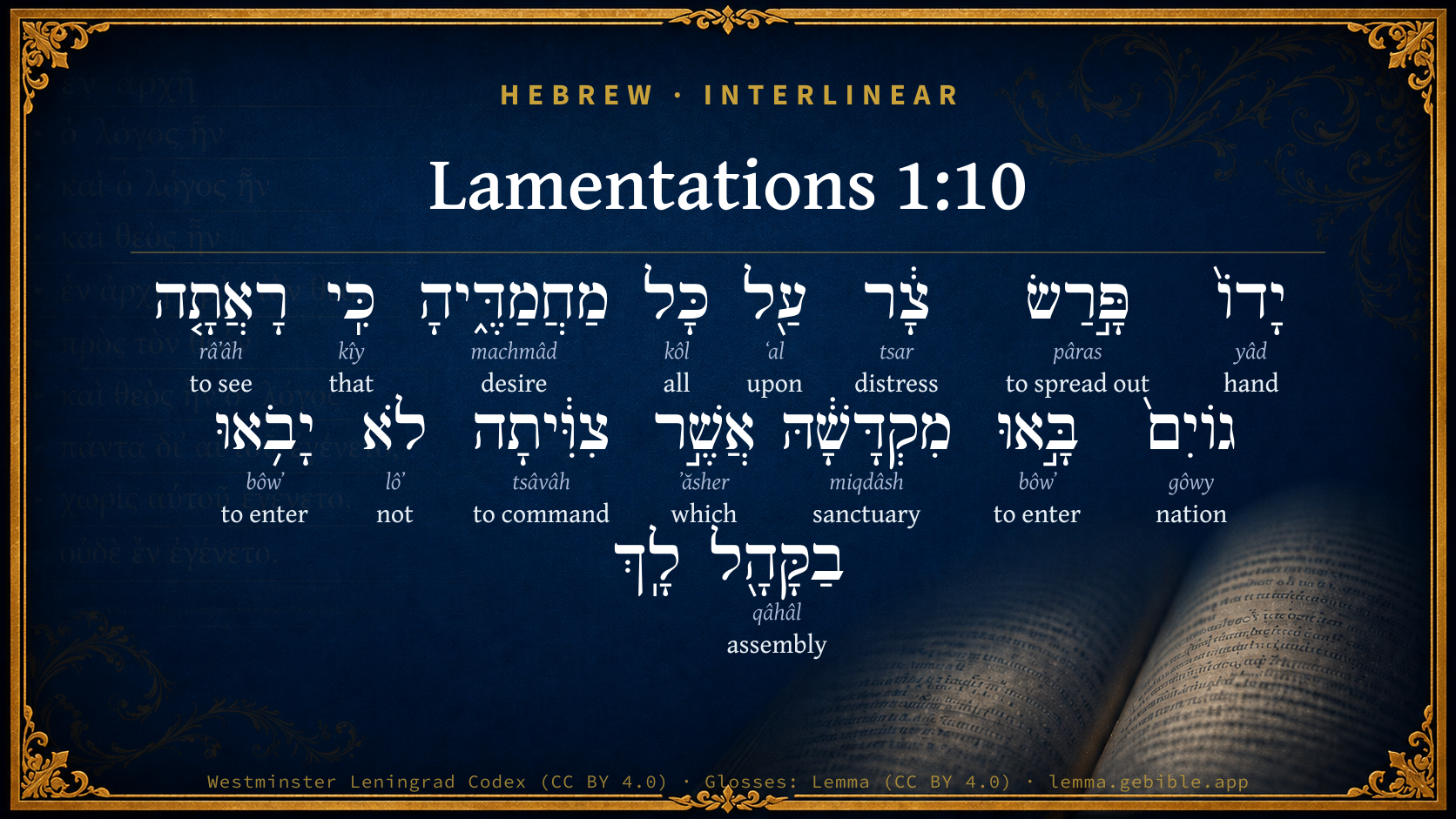
Hebrew (Westminster Leningrad Codex) Lamentations 1:10 appears in the Hebrew Old Testament. The text above is from the Westminster Leningrad Codex. Each word links to its Strong’s number, a concise gloss, and parsing drawn from the Open Scriptures Hebrew Bible morphology. Click any word for its full Brown-Driver-Briggs (BDB) entry.
Download image
Cite this verse

Lamentations 1:10 (World English Bible). Public Domain. Lemma interlinear Bible study tool, https://lemma.gebible.app/v/lamentations/1/10.

Show BibTeX & RIS
BibTeX
RIS
English Translation
The adversary has spread out his hand on all her pleasant things: For she has seen that the nations are entered into her sanctuary, Concerning whom you did command that they should not enter into your assembly.
World English Bible · Public Domain
Download a study sheet

One document with this verse’s original text, its word-by-word gloss line, the meaning frame, cross-references with their text, attributed commentary, and full source and license credits — printable, and it pastes into notes with its structure intact.

This verse Autodidact and up

Study sheet (.html) Plain text (.txt)

A passage Seminary Student

Up to 50 verses in one chapter. A passage sheet keeps up to 6 commentary sources and 12 cross-references per verse, in the order this page ranks them, and says so on the sheet whenever that leaves anything out. Ask for a single verse and you get the Autodidact verse sheet above.

Everything on this page stays free to read, with no account — the sheet is a download of what is already on screen, not access to it.

Want to remove ads? Support Godless Engineer
Compare translations 3

The same verse in 3 English versions, stacked beneath the original-language interlinear above. Click any original word for its lexicon entry.

Each is an independent rendering of the whole verse — the interlinear is not word-aligned to these translations.

Highlighted words mark where these versions differ — a whole-verse word diff, not a word-by-word alignment.

  • World English Bible Public Domain
    The adversary has spread out his hand on all her pleasant things: For she has seen that the nations are entered into her sanctuary, Concerning whom you did command that they should not enter into your assembly.
  • King James Version Public Domain
    The adversary hath spread out his hand upon all her pleasant things: for she hath seen that the heathen entered into her sanctuary, whom thou didst command that they should not enter into thy congregation.
  • unfoldingWord Literal Text CC BY-SA 4.0
    The adversary has spread out his hand over all her precious things, for she has seen nations entering her sanctuary— those whom you commanded should not enter your assembly. KAPH

unfoldingWord Literal Text — © unfoldingWord, licensed CC BY-SA 4.0. Word-aligned USFM3 via Door43 (git.door43.org/unfoldingWord/en_ult).

Versions to compare (up to 4)

3 of 4 selected

Show all 18 translations

Every available English version of this verse, each an independent rendering of the whole verse.

  • World English Bible Public Domain
    The adversary has spread out his hand on all her pleasant things: For she has seen that the nations are entered into her sanctuary, Concerning whom you did command that they should not enter into your assembly.
  • Berean Standard Bible Public Domain
    The adversary has seized all her treasures. For she has seen the nations enter her sanctuary—those You had forbidden to enter Your assembly.
  • Majority Standard Bible Public Domain
    The adversary has seized all her treasures. For she has seen the nations enter her sanctuary—those You had forbidden to enter Your assembly.
  • King James Version Public Domain
    The adversary hath spread out his hand upon all her pleasant things: for she hath seen that the heathen entered into her sanctuary, whom thou didst command that they should not enter into thy congregation.
  • American Standard Version (1901) Public Domain
    The adversary hath spread out his hand upon all her pleasant things: For she hath seen that the nations are entered into her sanctuary, Concerning whom thou didst command that they should not enter into thine assembly.
  • Revised Version (1885) Public Domain
    The adversary hath spread out his hand upon all her pleasant things: for she hath seen that the heathen are entered into her sanctuary, concerning whom thou didst command that they should not enter into thy congregation.
  • Geneva Bible (1599) Public Domain
    The enemie hath stretched out his hande vpon al her pleasant things: for she hath seene the heathen enter into her Sanctuarie, whom thou diddest commande, that they shoulde not enter into thy Church.
  • Douay-Rheims (1899) Public Domain
    Jod. The enemy hath put out his hand to all her desirable things: for she hath seen the Gentiles enter into her sanctuary, of whom thou gavest commandment that they should not enter into thy church.
  • Young's Literal Translation Public Domain
    His hand spread out hath an adversary On all her desirable things, For she hath seen -- Nations have entered her sanctuary, Concerning which Thou didst command, `They do not come into the assembly to thee.'
  • Literal Standard Version CC BY-SA 4.0
    His hand has spread out an adversary || On all her desirable things, || For she has seen—Nations have entered her sanctuary, || Concerning which You commanded, || “They do not come into the assembly to you.”
  • Unlocked Literal Bible CC BY-SA 4.0
    The adversary has put his hand on all our precious treasures. She has seen the nations enter her sanctuary, even though you had commanded that they must not enter into your assembly place.
  • unfoldingWord Literal Text CC BY-SA 4.0
    The adversary has spread out his hand over all her precious things, for she has seen nations entering her sanctuary— those whom you commanded should not enter your assembly. KAPH
  • Darby Bible Public Domain
    The adversary hath spread out his hand upon all her precious things; for she hath seen the nations enter into her sanctuary, concerning whom thou didst command that they should not enter into thy congregation.
  • World Messianic Bible Public Domain
    The adversary has spread out his hand on all her pleasant things; for she has seen that the nations have entered into her sanctuary, concerning whom you commanded that they should not enter into your assembly.
  • Webster's Bible Public Domain
    The adversary hath spread out his hand upon all her pleasant things: for she hath seen that the heathen entered into her sanctuary, whom thou didst command that they should not enter into thy congregation.
  • Free Bible Version CC BY-SA 4.0
    The invader has stolen all her treasures. She even had to watch as heathen nations went into her sanctuary, people you had forbidden to enter.
  • Bible in Basic English Public Domain
    The hand of her hater is stretched out over all her desired things; for she has seen that the nations have come into her holy place, about whom you gave orders that they were not to come into the meeting of your people.
  • JPS Tanakh (1917) Public Domain
    The adversary hath spread out his hand upon all her treasures; for she hath seen that the heathen are entered into her sanctuary, concerning whom Thou didst command that they should not enter into Thy congregation.

Literal Standard Version (2020), Covenant Press — licensed CC BY-SA 4.0. Text via the HelloAO Bible API (eBible.org). Unlocked Literal Bible (unfoldingWord) — licensed CC BY-SA 4.0. Text via the HelloAO Bible API (eBible.org). unfoldingWord Literal Text — © unfoldingWord, licensed CC BY-SA 4.0. Word-aligned USFM3 via Door43 (git.door43.org/unfoldingWord/en_ult). Free Bible Version, Dr. Jonathan Gallagher — licensed CC BY-SA 4.0. Text via the HelloAO Bible API (eBible.org).

Word by word

More ways to search: Search by grammar → Find every occurrence → Compare this word →

Practice this passage: Drill this verse → Learn its vocabulary →

מַחֲמַדֶּ֑יהָ
machmâd
H4261
“desires · her”
Noun, Common, Masculine, Plural, Construct + Suffix, Personal, 3rd Person, Feminine, Singular
Part of Speech
Noun
Type
Common
Gender
Masculine
Number
Plural
State
Construct
Full BDB Definition

Origin: from H2530

TWOT: 673d , 673e

desire, desirable thing, pleasant thing
  1. יָדוֹ֙ yâd H3027 “hand · his” Noun, Common, Both, Singular, Construct + Suffix, Personal, 3rd Person, Masculine, Singular
  2. פָּ֣רַשׂ pâras H6566 “to spread out” Verb, Qal, Perfect, 3rd Person, Masculine, Singular
  3. צָ֔ר tsar H6862 “distress” Noun, Common, Masculine, Singular, Absolute
  4. עַ֖ל ʻal H5921 “upon” Preposition
  5. כָּל kôl H3605 “all of” Noun, Common, Masculine, Singular, Construct
  6. כִּֽי kîy H3588 “that” Conjunction
  7. רָאֲתָ֤ה râʼâh H7200 “to see” Verb, Qal, Perfect, 3rd Person, Feminine, Singular
  8. גוֹיִם֙ gôwy H1471 “nations” Noun, Common, Masculine, Plural, Absolute
  9. בָּ֣אוּ bôwʼ H935 “to enter” Verb, Qal, Perfect, 3rd Person, Common, Plural
  10. מִקְדָּשָׁ֔הּ miqdâsh H4720 “sanctuary · her” Noun, Common, Masculine, Singular, Construct + Suffix, Personal, 3rd Person, Feminine, Singular
  11. אֲשֶׁ֣ר ʼăsher H834 “which” Particle, Relative
  12. צִוִּ֔יתָה tsâvâh H6680 “to command” Verb, Piel, Perfect, 2nd Person, Masculine, Singular
  13. לֹא lôʼ H3808 “not” Particle, Negative
  14. יָבֹ֥אוּ bôwʼ H935 “to enter” Verb, Qal, Imperfect, 3rd Person, Masculine, Plural
  15. בַקָּהָ֖ל qâhâl H6951 “in/at the · assembly” Preposition, Determined + Noun, Common, Masculine, Singular, Absolute

About this verse

These counts appear in no published source. They are computed here, from the morphology-tagged text and Lemma’s own curated glosses. What Lemma adds →

17
words
15
distinct lemmas
Prophets
section

Notable vocabulary

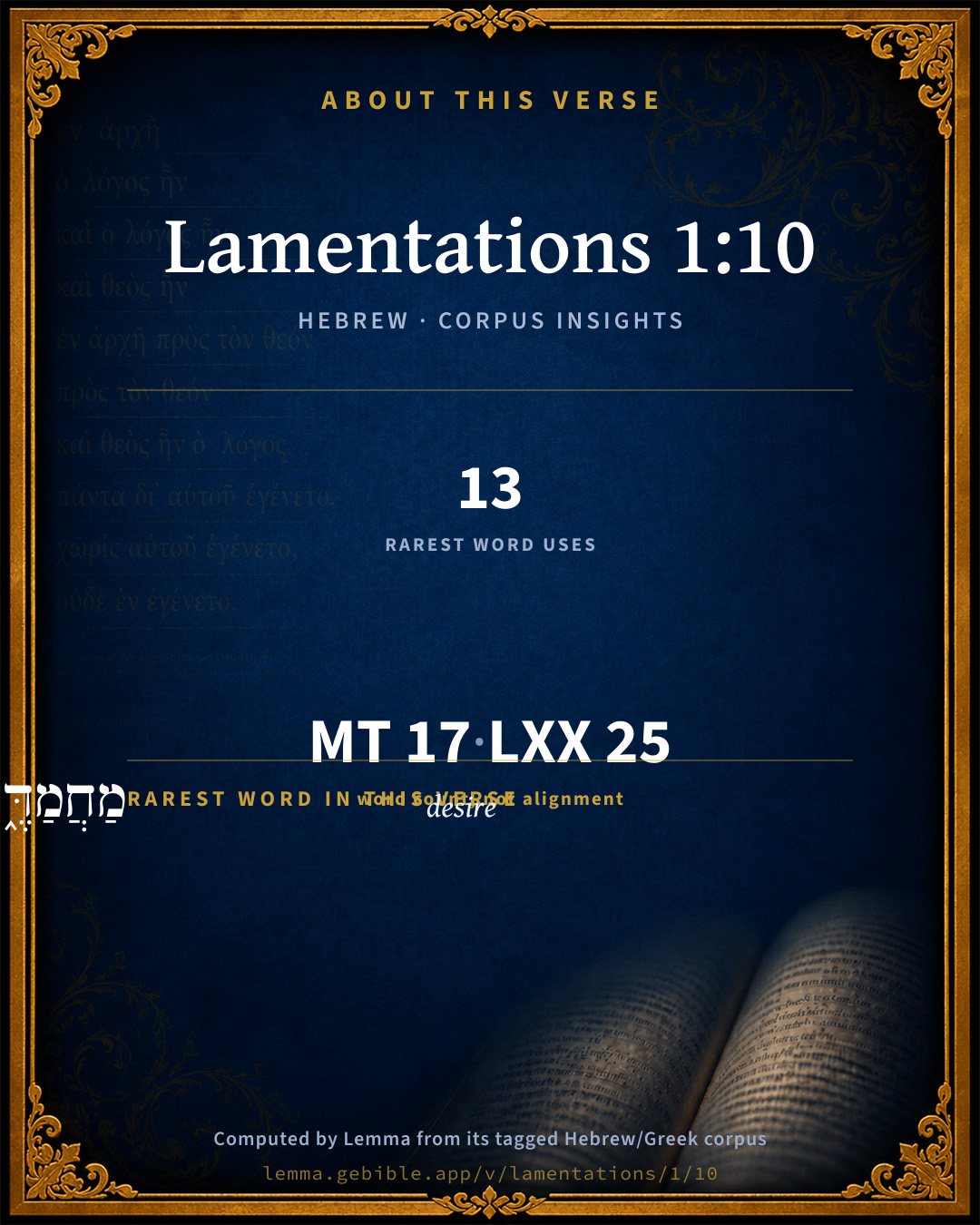
The rarest word here is מַחֲמַדֶּ֑יהָ desire H4261 — appearing just 13 times in the whole Hebrew Bible.

Shared distinctive vocabulary

מַחֲמַדֶּ֑יהָ desire H4261 occurs in 13 verses of the Hebrew Bible. Also found in:

Grammatical profile

  • 5 verbs
  • 7 nouns
  • 2 prepositions
  • 1 conjunction
  • 2 particles

Verb forms

  • פָּ֣רַשׂ Qal · Perfect
  • רָאֲתָ֤ה Qal · Perfect
  • בָּ֣אוּ Qal · Perfect
  • צִוִּ֔יתָה Piel · Perfect
  • יָבֹ֥אוּ Qal · Imperfect

Repetition

A word recurs within this verse — often emphatic in Hebrew:

  • בָּ֣אוּ to enter H935 ×2

Hebrew & Septuagint length

In English translation the verse runs 37 words from the Hebrew and 36 from the Septuagint (LXX English) — closely comparable.

A rough comparison of the two English renderings, which tokenize alike — not a word-level alignment.

Word counts can differ between the Hebrew and the Greek without any difference in meaning — e.g. the Hebrew direct-object marker אֵת has no separate Greek word, and Greek often adds the article ὁ.

In the original languages it is 17 Hebrew tokens and 25 Greek tokens — but the two are counted differently (Hebrew bundles its prefixes and suffixes into one token; the Greek is in lemma form), so that isn’t a like-for-like length.

Cross-references

17

Topical passages linked to Lamentations 1:10 in the Treasury of Scripture Knowledge — connected by theme and wording, ordered by reader-vote popularity; previews shown in the World English Bible.

  • Deuteronomy 23:3 An Ammonite or a Moabite shall not enter into the assembly of Yahweh; even to the tenth generation shall none belonging to them enter into the assembly of Yahweh forever:
  • Jeremiah 51:51 We are confounded, because we have heard reproach; confusion has covered our faces: for strangers are come into the sanctuaries of Yahweh's house.
  • Nehemiah 13:1 On that day they read in the book of Moses in the audience of the people; and therein was found written, that an Ammonite and a Moabite should not enter into the assembly of God forever,
  • Psalms 74:4–8 Your adversaries have roared in the midst of your assembly. They have set up their standards as signs.
  • Isaiah 64:10–11 Your holy cities are become a wilderness, Zion is become a wilderness, Jerusalem a desolation.
  • Lamentations 1:7 Jerusalem remembers in the days of her affliction and of her miseries all her pleasant things that were from the days of old: When her people fell into the hand of the adversary, and none did help her, The adversaries saw her, they did mock at her desolations.
  • Psalms 79:1–7 God, the nations have come into your inheritance. They have defiled your holy temple. They have laid Jerusalem in heaps.
  • Isaiah 5:13–14 Therefore my people go into captivity for lack of knowledge; Their honorable men are famished, And their multitudes are parched with thirst.
  • Isaiah 63:18 Your holy people possessed [it] but a little while: our adversaries have trodden down your sanctuary.
  • Jeremiah 15:13 Your substance and your treasures will I give for a spoil without price, and that for all your sins, even in all your borders.
  • Jeremiah 20:5 Moreover I will give all the riches of this city, and all the gains of it, and all the precious things of it, yes, all the treasures of the kings of Judah will I give into the hand of their enemies; and they shall make them a prey, and take them, and carry them to Babylon.
  • Jeremiah 52:13 and he burned the house of Yahweh, and the king's house; and all the houses of Jerusalem, even every great house, burned he with fire.
  • Jeremiah 52:17–20 The pillars of brass that were in the house of Yahweh, and the bases and the brazen sea that were in the house of Yahweh, did the Chaldeans break in pieces, and carried all the brass of them to Babylon.
  • Ezekiel 7:22 My face will I turn also from them, and they shall profane my secret [place]; and robbers shall enter into it, and profane it.
  • Ezekiel 9:7 He said to them, Defile the house, and fill the courts with the slain: go you forth. They went forth, and struck in the city.
  • Ezekiel 44:7 in that you have brought in foreigners, uncircumcised in heart and uncircumcised in flesh, to be in my sanctuary, to profane it, even my house, when you offer my bread, the fat and the blood, and they have broken my covenant, [to add] to all your abominations.
  • Mark 13:14 But when you see the abomination of desolation, spoken of by Daniel the prophet, standing where it ought not (let the reader understand), then let those who are in Judea flee to the mountains,

Cross-references courtesy of OpenBible.info (CC BY 4.0).

Hebrew and Greek witnesses Masoretic Hebrew ↔ Greek Septuagint

The same verse in the two great witnesses to the Old Testament, shown verse-for-verse.

These are two independent witnesses, not word-aligned to each other, and the Septuagint is shown in lemma (dictionary) form.

Hebrew Lamentations 1:10 Masoretic · Westminster Leningrad Codex

יָדוֹ֙ פָּ֣רַשׂ צָ֔ר עַ֖ל כָּל מַחֲמַדֶּ֑יהָ כִּֽי רָאֲתָ֤ה גוֹיִם֙ בָּ֣אוּ מִקְדָּשָׁ֔הּ אֲשֶׁ֣ר צִוִּ֔יתָה לֹא יָבֹ֥אוּ בַקָּהָ֖ל לָֽךְ

The adversary has spread out his hand on all her pleasant things: For she has seen that the nations are entered into her sanctuary, Concerning whom you did command that they should not enter into your assembly.

World English Bible · Public Domain

Greek LXX Lamentations 1:10 Septuagint · lemma form

χείρ αὐτός ἐκπετάζω θλίβω ἐπί πᾶς ὁ ἐπιθύμημα αὐτός ὁράω γάρ ἔθνος εἰςἔρχομαι εἰς ὁ ἁγίασμα αὐτός ὅς ἐντέλλομαι μή εἰςἔρχομαι αὐτός εἰς ἐκκλησία σύ

JOD. The oppressor has stretched out his hand on all her desirable things: for she has seen the Gentiles entering into her sanctuary, concerning whom you did command that they should not enter into your congregation.

LXX2012 (modern English Septuagint) · Public Domain

On this verse, Keil & Delitzsch discusses the Septuagint’s reading. Read the note in Commentary ↓

Hebrew: Westminster Leningrad Codex (CC BY 4.0). Greek: Septuagint (public domain); English from LXX2012 (modern English Septuagint) (Public Domain). How the Septuagint differs from the Hebrew →

Commentary

Notes on Lamentations 1:10 from classic Christian and Jewish commentators (each source and its license shown beneath its notes). The classic Christian expositions comment on the surrounding passage and are grouped to its opening verse, so a note may address several verses; the Jewish commentaries on the Tanakh (Rashi and others) are per-verse, so they appear only where the commentator wrote on this verse.

Lemma curates 59 commentaries, every one of them public domain or Creative Commons licensed, each selected and text-cleaned for this edition rather than reprinted as found. About our sources →

Trapp's Complete Commentary

John Trapp

Lam 1:10 The adversary hath spread out his hand upon all her pleasant things: for she hath seen [that] the heathen entered into her sanctuary, whom thou didst command [that] they should not enter into thy congregation.

Ver. 10. The adversary.] The common enemy both of God and us, out of hatred of the truth and the professors thereof.

Hath spread out his hand.] His plundering and sacrilegious hand.

Upon her pleasant things.] But especially those that were consecrated to the service of God in the temple. The Rabbis here by pleasant or desirable things understand principally the book of the law, which, say they, the Moabites and the Ammonites sought for in the temple, that they might burn it, because therein was forbidden their admission into the Church for ever.

John Trapp, A Commentary or Exposition upon All the Books of the Old and New Testament (1647–1656) — public domain. Text from a community e-Sword module.

The Biblical Illustrator

Joseph S. Exell

Lam_1:10

The adversary hath spread out his hand upon all her pleasant things.

Spoliation

1. The wicked are usually merciless towards the godly, spoiling them and theirs in most cruel manner, if the Lord restrain them not (Psa_53:4; Psa_137:7).

2. The outward things of this world are uncertain, and made subject to the violence of the wicked.

(1) Learn not to desire the things of this life too much.

(2) Learn, when God guideth them unto us, to employ them aright.

3. The outward things and means of Gods service are often made a prey to the enemies; especially upon our abusing of them (Jer_7:13; Luk_19:44).

4. The injuries that the wicked do unto the godly in their sight, are more grievous unto them than those that they do only hear of.

5. The wicked make havoc of and scorn all the exercises of religion.

6. The outward ordinances of God are of reverent account to them that fear His name.

7. Those that be open wicked ones are not (without their open repentance) to be admitted to the holy exercises of religion. (J. Udall.)

The Biblical Illustrator, edited by Joseph S. Exell (c. 1880s–1900s) — public domain. Text from a community e-Sword module.

Joseph Benson's Commentary

Lam 1:10-11. The adversary hath — Or rather, did, spread his hand upon all her pleasant things — Hebrew, מחמדיה, her desirable things, namely, her riches, and what else she most desired to preserve. She hath seen the heathen entered into her sanctuary, &c. — She saw heathen nations, whom thou hadst forbidden even to be admitted into thy congregation, (as being uncircumcised,) enter into the sanctuary farther than ever her own people themselves were permitted to go. The Chaldeans entered into the inmost part of the sanctuary, even into the holy of holies, into which none of the Jews, except the high-priest, were ever allowed to enter. All her people sigh, they seek bread — He probably refers to the time of the invasion of the country by the Chaldeans, and the siege of Jerusalem, when the whole body of the people were in a sad condition, and, in a land that ordinarily flowed with milk and honey, were at a loss for bread to eat. They have given their pleasant things for meat to relieve the soul — They have parted with their riches and all their desirable things to purchase bread to sustain their lives. See, O Lord, and consider — This is a prayer of Jerusalem to God for relief; for I am become vile — That is, miserable and contemptible.

Joseph Benson's Commentary on the Old and New Testaments (1811–1818) — public domain. Text from a community e-Sword module.

Keil & Delitzsch

C. F. Keil & F. Delitzsch

This is specially mentioned in Lam 1:10. The enemy has spread out his hand over all her jewels (מחמדּיה, the costly treasures of Jerusalem which were plundered), and even forced into the sanctuary of the Lord to spoil it of its treasures and vessels. C. B. Michaelis, Thenius, Gerlach, Ngelsbach, etc., would restrict the meaning of מחמדּיה to the precious things of the sanctuary; but not only are there no sufficient reasons for this, but the structure of the clauses is against it. Neither does the expression, "all our precious things," in Isa. 69:10, signify merely the articles used in public worship on which the people had placed their desire; nor are "all her pleasant vessels" merely the sacred vessels of the temple. In the latter passage, the suffix in מחמדּיה refers to Jerusalem; and inasmuch as the burning of all the palaces of the city (ארמנתיה) has been mentioned immediately before, we are so much the less at liberty to restrict "all her precious vessels" to the vessels of the temple, and must rather, under that expression, include all the precious vessels of the city, i.e., of the palaces and the temple. And Delitzsch has already remarked, on Isa 64:10, that "under מחמדּיה may be included favourite spots, beautiful buildings, pleasure gardens; and only the parallelism induces us to think especially of articles used in public worship." But when Thenius, in the passage now before us, brings forward the succeeding words, "for she hath seen," as a proof that by "all her pleasant things" we are to understand especially the vessels and utensils of the temple, he shows that he has not duly considered the contents of the clause introduced by כּי (for). The clause characterizes the enemy's forcing his way into the sanctuary, i.e., the temple of Jerusalem, as an unheard of act of sacrilege, because גּוים were not to enter even into the קהל of Jahveh. The subject treated of is not by any means the robbing of the temple - the plundering of its utensils and vessels. The prohibition against the coming, i.e., the receiving of foreigners into the "congregation," is given, Deu 23:4, with regard to the Ammonites and Moabites: this neither refers to the jus connubii (Grotius, Rosenmller), nor to the civil rights of Jewish citizens (Kalkschmidt), but to reception into religious communion with Israel, the ecclesia of the Old Covenant (קהל יהוה). In Deu 23:8, the restriction is relaxed in favour of the Edomites and Egyptians, but in Eze 44:7, Eze 44:9, in accordance with the ratio legis, extended to all uncircumcised sons of strangers. Hence, in the verse now before us, we must not, with Rosenmller and Thenius, restrict the reference of גּוים to the Ammonites and Moabites as accomplices of the Chaldeans in the capture of Jerusalem and the plundering of the temple (Kg2 24:2); rather the גּוים are identical with those mentioned in the first member of the verse as צר, i.e., the Chaldeans, so called not "because their army was made up of different nationalities, but because the word contains the notice of their being heathens, - profane ones who had forced into the sanctuary" (Gerlach). But if we look at the structure of the clauses, we find that "for she saw," etc., is parallel to "for the enemy hath boasted" of Lam 1:9; and the clause, "for she saw nations coming," etc., contains a further evidence of the deep humiliation of Jerusalem; so that we may take כּי as showing the last step in a climax, since the connection of the thought is this: For the enemy hath boasted, spreading his hand over all her precious things, - he hath even forced his way into the sanctuary of the Lord. If this is mentioned as the greatest disgrace that could befall Jerusalem, then the spreading out of the hands over the precious things of Jerusalem cannot be understood of the plundering of the temple. The construction ראתּה גּוים בּא is in sense exactly similar to the Latin vidit gentes venisse, cf. Ewald, 284, b; and on the construction צוּיתה לא יבאוּ, cf. Ewald, 336, b. בּקהל לך does not stand for בּקהלך (lxx, Pareau, Rosenmller), for הקהל is not the congregation of Judah, but that of Jahveh; and the meaning is: They shall not come to thee, the people of God, into the congregation of the Lord.

Keil & Delitzsch — Biblical Commentary on the Old Testament (1861–1891) — public domain (CC PDM 1.0). Text via the HelloAO Bible API. (Old Testament only.)

Tyndale Open Study Notes

Tyndale Open Resources

1:10 For historical accounts of these events, see 2 Kgs 25:8-17; 2 Chr 36:13-21; Jer 52:4-30.

Tyndale Open Study Notes — © Tyndale Open Resources, licensed CC BY-SA 4.0. Text via the HelloAO Bible API.

Geneva Bible (1599)

Geneva Bible translators

God forbiddeth that the Ammonites and Moabites should enter into the Congregation of the Lord, and under them he comprehendeth all enemies, Deut. 23:3.

Geneva Bible (1599) marginal notes — public domain. Text via Bolls.life.

Jamieson, Fausset & Brown

Robert Jamieson, A. R. Fausset & David Brown

for--surely she hath seen, &c.

heathen . . . command . . . not enter . . . congregation--for instance, the Ammonites and Moabites (Deu 23:3; Neh 13:1-2). If the heathen, as such, were not allowed to enter the sanctuary for worship, much less were they allowed to enter in order to rob and destroy.

Jamieson, Fausset & Brown — Commentary Critical and Explanatory on the Whole Bible (1871) — public domain (CC PDM 1.0). Text via the HelloAO Bible API.

John Calvin's Commentaries

The Prophet again deplores the profanation of all sacred things; and this complaint, as I have said, proceeded from the bitterest sorrow; for though it was a sad thing for the faithful, to lose all their property, to wander in exile and to suffer the want of all things, yet it must have been more grievous to them to see the Temple polluted, and all religion exposed to shame. This calamity, then, the Prophet again deplores, when he says that enemies had stretched forth their hand against all desirable things. Now, by desirable things, he does not mean riches, nor anything that belongs to the condition of an earthly and fading life, but those invaluable treasures which God had deposited with the chosen people. The enemy, then, had extended his hand against the altar, against the table, against the ark of the covenant, against all the sacred vessels.

Then this indignity was increased, because Jerusalem saw the heathens entering into her sanctuary; for the pronoun is in the feminine gender. But the sanctuary of Jerusalem was God’s Temple for, though properly speaking, it was alone God’s sanctuary, it was yet at the same time the sanctuary of the people, because God had not caused the Temple to be built for his own benefit, but rather for the benefit of his people. What God, then, had consecrated for himself is rightly called the sanctuary of the people. He still increases the indignity, because God had forbidden the heathens to enter the sanctuary; but they had violently rushed in there. They did not, however, enter for the sake of worshipping God, for it was his command to keep them from the holy assembly; but they had by force entered for the purpose of violating the Temple, and also of abolishing the whole worship of God, and of exposing religion to all kinds of mockery.

John Calvin's Commentaries (1540-1563) — public domain. Text from the Calvin Translation Society English edition (1840s-50s) via the Christian Classics Ethereal Library (ccel.org). Calvin's coverage is partial (roughly two-thirds of the Bible); uncommented books and verses are honest gaps, never fabricated. The 19th-century editor's footnotes and remarks are omitted so the notes are faithfully Calvin's own voice.

Ellicott's Commentary for English Readers

(10) Upon all her pleasant things . . .—The use of a like phrase in 2Ch_36:10; 2Ch_36:19, of the vessels of the Temple, leads us to think primarily or them; but the word itself has a wider range, and includes all works of art and ornamentation.

Whom thou didst command.—Stress is laid on the profanation rather than the plunder of the sanctuary. Ammonites and Moabites were excluded from the congregation in Deu_23:3, and yet they and other heathen nations now rushed even into the Holy of holies, which none but the High Priest might enter.

A Bible Commentary for English Readers, edited by Charles John Ellicott (1878–1897) — public domain. Text from a community e-Sword module.

The Cambridge Bible for Schools and Colleges

gen. ed. J. J. S. Perowne

10. pleasant] lit. desirable, precious, with special reference to the Temple treasures (2Ch_36:10; Jer_52:19; 2Ki_25:15). For the whole v. cp. Isa_64:10 f.; also Psalms 74, 79.

the heathen are entered into her sanctuary] Those who were forbidden, at any rate as nations, ever to enter into a religious covenant with Israel (e.g. Ammonites and Moabites, Deu_23:3 f., cp. Eze_44:9), as part of the invading host have entered the very Holy of Holies for plunder. No worse humiliation could befall a Jew than this.

The Cambridge Bible for Schools and Colleges (gen. ed. J. J. S. Perowne; Cambridge University Press, 1878–1918) — public domain. Text from a community e-Sword module.

John Gill's Exposition

The enemy hath spread out his hands on all her pleasant things,.... Meaning not the wealth and riches, the goods and substance, or the rich furniture in their own houses; but the precious things in the house of God, the ark, the table, the altar, the priests garments, and vessels of the sanctuary, and the gifts of the temple, and everything valuable in it; these the enemy stretched out his hands and seized upon, and claimed them as his own; took them as a booty, prey, and plunder. Jarchi (w) interprets the enemy of the Moabites and Ammonites, who seized upon the books of the law, in which are things more desirable than gold and silver, and burnt them; because there was a law in them that forbid them entering into the congregation of Israel; but the Targum better explains it of Nebuchadnezzar the wicked; for he and the Chaldean army are doubtless meant; who plundered and ransacked the temple of all its pleasant, precious, and valuable things:

for she hath seen that the Heathen entered into her sanctuary; not into the land of Israel only, the holy land; but into the temple, the sanctuary of the Lord; but called hers, because it was built for her use, that the congregation of Israel might worship the Lord in it; into this with her own eyes, though forced to it, and sore against her will, and to her great grief and trouble, she saw the Chaldeans enter, and ravage and spoil it:

whom thou didst command that they should not enter into thy congregation; these Jarchi interprets of the Moabites and Ammonites again; and so does the Targum here; paraphrasing them thus,

"whom thou didst command by the hand of Moses the prophet, concerning Ammon and Moab, that they were not worthy to enter into thy congregation;''

and concerning whom there is an express law forbidding it, Deu 23:1; and it may be there were Moabites and Ammonites in the Chaldean army, assisting in the taking of Jerusalem; and who entered into the temple when it was taken.

(w) E Talmud. Bab. Yebamot, fol 16. 2.

John Gill's Exposition of the Whole Bible (1746–1763) — public domain (CC PDM 1.0). Text via the HelloAO Bible API.

Albert Barnes' Notes on the Bible

Her pleasant things - Chiefly, the sacred vessels of the temple 2Ch 36:10.

Sanctuary ... congregation - Even a Jew might not enter the innermost sanctuary, which was for the priests only; but now the tramp of pagan soldiery has been heard within its sacred precincts.

Albert Barnes' Notes on the Bible (1834–1885) — public domain. Text from a community e-Sword/MySword module.

Haydock's Catholic Bible Commentary

Church. Deuteronomy xxxiii. 1., and Ezechiel xliv. 9. The Chaldeans disregarded the ordinance.

George Leo Haydock (1774–1849), Haydock's Catholic Family Bible and Commentary, 1859 edition — public domain. Excludes Psalms (Douay-Rheims chapter numbering differs from Protestant) and Deuterocanonical books (Catholic canon only).

Matthew Poole's English Annotations

Hath spread out his hand upon all her pleasant things; that is, hath got them into possession. By pleasant things are here to be understood the ornaments of the temple, upon which the enemy had laid violent hands; so this phrase of

spreading out the hand is taken Isa 25:11. The things of the sanctuary were always pleasant things to those that feared God; possibly those that little valued them before, now looked upon them in their true notion. We seldom know our mercies till we come to be deprived of them.

The heathen entered into her sanctuary; he means the Ammonites and Moabites, whom the law concerned, Deu 23:3; some of whom probably assisted the Babylonians in the conquest of Judea.

Matthew Poole's English Annotations on the Holy Bible (1683–1685) — public domain. Text from a community e-Sword/MySword module.

Whedon's Commentary on the Bible

Daniel D. Whedon

10. Pleasant things — Not only “pleasant,” but precious, meaning the vessels of the sanctuary, and also their individual treasures. They should not enter, etc. — Those who might not enter even the congregation for the purpose of worship now penetrate even into the sanctuary to rob and destroy.

Daniel D. Whedon (gen. ed.), Commentary on the Old and New Testaments (1874–1909) — public domain. Text from a community e-Sword module.

The Pulpit Commentary

Her pleasant things; or, her precious things; that is, the treasures of the palaces of Jerusalem, (2Ch_36:19) and still more those of the temple. (2Ch_36:10; comp. Isa_64:11) For she hath seen; rather, yea, she hath seen. The heathen entered, etc. In Deu_23:3 only the Ammonites and Moabites are excluded from religious privileges; but in Eze_44:9 the prohibition is extended to all foreigners.

Spoliation and profanation.

The presence of a foreign foe in its capital has always been regarded, and is still regarded, as among the heaviest calamities that can befall a nation. In our own times, a neighbouring nation has been required to endure this humiliation and indignity, shocking its patriotism and its pride. We can understand how bitter must have been the anguish of the Jews when the Chaldean hosts patrolled their city, quartered themselves upon its inhabitants, appropriated its wealth, and violated the sanctity of its temple.

I THE POSSESSIONS OF THE JEWS WERE FORCIBLY APPROPRIATED BY THEIR ADVERSARIES. The greed of the conqueror has ever been the theme of satire and reproach. Voe victis! "Woe to the conquered!" is an old proverb, founded upon an older propensity of human nature in its military condition. The pleasant and desirable things of a city are the spoil of the conqueror. It was so when the Chaldeans entered Jerusalem, sacked the city, and laid their hands upon whatever pleased their fancy.

II THE HOLY HOUSE OF JERUSALEM WAS SACRILEGIOUSLY ABUSED BY THE HEATHEN CONQUERORS. The temples of their gods are always the object of a nation"s reverence and sometimes of affection. But the Jews had especial reason for venerating their sanctuary; it was the scene of their sacrifices and offerings, the depository of their oracles, the spot where the Shechinah glory was displayed. The more sacred portion of the edifice was reserved for the priests; even the devout Jews were not suffered to enter these consecrated precincts. What, then, must have been the disgust, the horror, with which the pious contemporaries of Jeremiah, and especially the prophet himself, witnessed the profanation of the sanctuary, as the Chaldean soldiers polluted it with their heathen presence and speech! Their feelings were injured in the most susceptible part of their nature.

APPLICATION. Retribution is not an accident; neither is it the mere outworking of natural laws. There is Divine providence superintending it; it has a meaning, for it witnesses to human responsibility and sin; it has a purpose, for it summons to repentance and newness of life. T.

The Pulpit Commentary (1880–1919), ed. H.D.M. Spence-Jones & Joseph S. Exell — public domain. Text from a community e-Sword module.

John Wesley's Explanatory Notes

Pleasant things - Has laid violent hands on them. The things of the sanctuary were always pleasant things to those that feared God.

John Wesley, Explanatory Notes Upon the Whole Bible (1754–1765) — public domain. Text via the GEBible commentary corpus.

unfoldingWord translationNotes

Door43 World Missions Community

has put his hand on

This is an idiom. AT: "has taken possession of" or "has stolen" (See: Idiom)

precious treasures

This refers to their valuable possessions.

She has seen

The word "She" refers to Jerusalem. (See: Personification)

the nations

This refers to people from various nations, not the entire population of those nations. AT: "people from the nations" (See: Synecdoche)

you had commanded

The word "you" refers to Yahweh.

translationWords

adversary

hand

precious

nation

sanctuary

command

assembly

unfoldingWord translationNotes — © Distant Shores Media and the Door43 World Missions Community, licensed CC BY-SA 4.0. Source: git.door43.org/Door43/en_tn.

Rashi

Rabbi Shlomo Yitzchaki (Rashi)

The adversary stretched forth his hand Ammon and Moab.

upon all her precious things the Siphrei Torah, which are spoken of as (Ps. 19: 11): “They are to he desired more than gold.” All turned to plunder silver and gold, and they turned upon the Siphrei Torah in order to burn them, because it is written in them, (Deut. 23:4): “An Ammonite or a Moabite shall not enter, etc.”

whom You did command not to enter into Your assembly These are Ammon and Moab.

Rashi on the Tanakh — English translations: “The Judaica Press complete Tanach with Rashi, translated by A. J. Rosenberg” (CC BY 4.0); “Pentateuch with Rashi's commentary by M. Rosenbaum and A.M. Silbermann, 1929-1934” (public domain); “The Metsudah Tanach series, Lakewood, N.J” (CC BY 4.0); and “The Book of Joshua, Metsudah Publications, 1997” (CC BY 4.0). Text via Sefaria.

Lesson kit

Teaching starters — assembled from the data on this page, not authored interpretation. Every prompt links to the verse data it draws on. Edit before teaching.

Lamentations, in the Prophets, opens this verse with 17 words (15 distinct Hebrew lemmas). Its most distinctive word is machmâd (“desire”). A historical commentator’s framing appears above. Read the whole chapter for the surrounding context.

Discussion questions

  1. What does “desire” (machmâd) contribute to the verse as a whole?
  2. How does 1 Kings 20:6, which shares the word «desire», read alongside this verse?
  3. What does the repetition of “to enter” (2× in this one verse) do in this verse?
  4. These translations render this verse differently. What is at stake in choosing one wording over another?
  5. «פָּ֣רַשׂ» is a Qal Perfect verb. How does that grammatical form shape the action described?
  6. Compare how Trapp's Complete Commentary and The Biblical Illustrator read this verse. Where do they agree or differ?

Things to notice

Reading settings

Reading text

Shown beneath each verse's original-language words.

Old Testament
Old Testament edition

Read the OT as the Masoretic Hebrew (MT) or the Greek Septuagint (LXX).

English shown for the Greek Septuagint (in the Hebrew ↔ Greek comparison).

Comparing translations? Open the Compare panel on any verse page to stack up to four side by side.