
Psalms 22:25

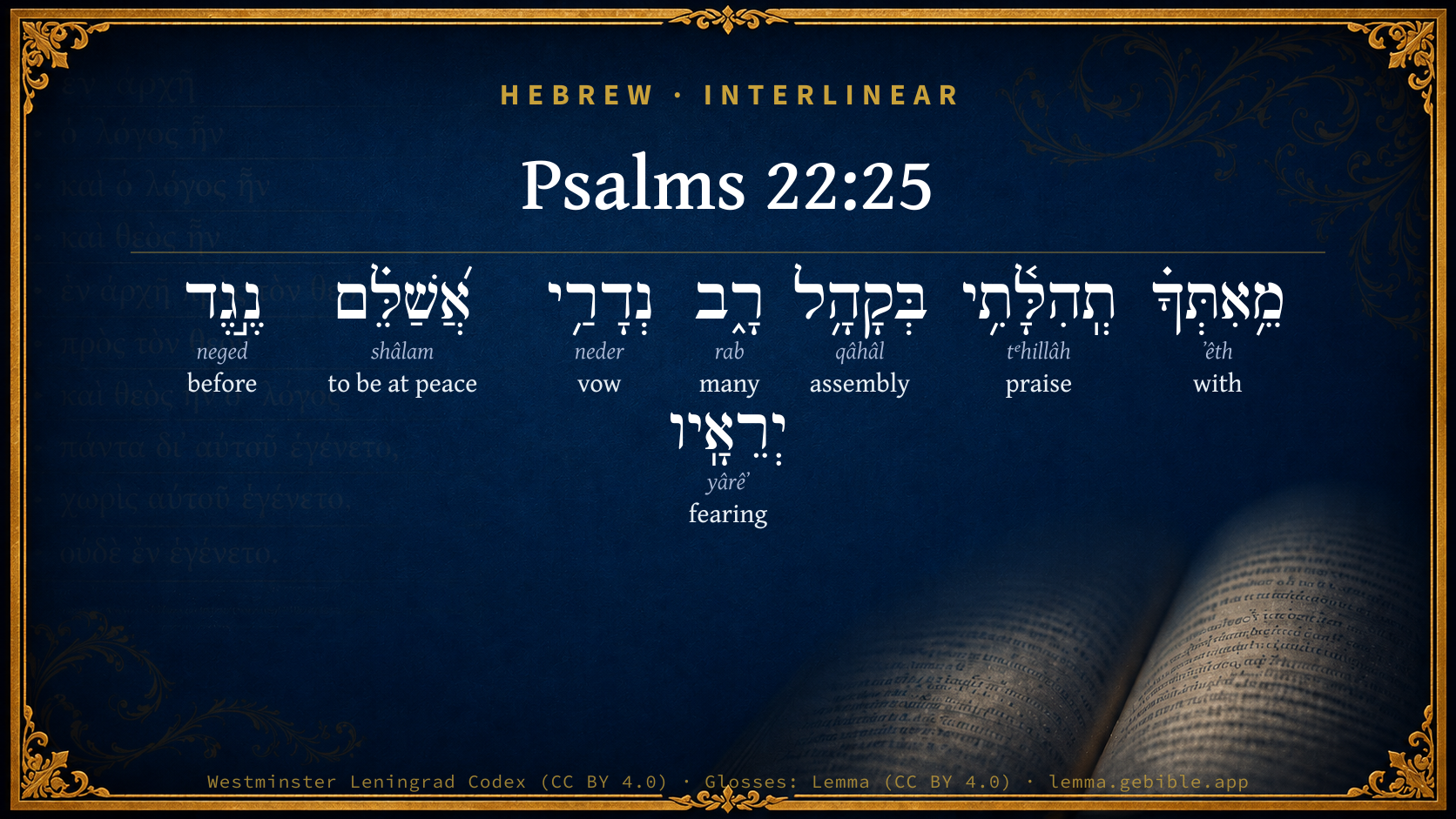
Hebrew (Westminster Leningrad Codex) Psalms 22:25 appears in the Hebrew Old Testament. The text above is from the Westminster Leningrad Codex. Each word links to its Strong’s number, a concise gloss, and parsing drawn from the Open Scriptures Hebrew Bible morphology. Click any word for its full Brown-Driver-Briggs (BDB) entry.
Download image
Cite this verse

Psalms 22:25 (World English Bible). Public Domain. Lemma interlinear Bible study tool, https://lemma.gebible.app/v/psalms/22/25.

Show BibTeX & RIS
BibTeX
RIS
English Translation
Of you comes my praise in the great assembly. I will pay my vows before those who fear him.
World English Bible · Public Domain
Download a study sheet

One document with this verse’s original text, its word-by-word gloss line, the meaning frame, cross-references with their text, attributed commentary, and full source and license credits — printable, and it pastes into notes with its structure intact.

This verse Autodidact and up

Study sheet (.html) Plain text (.txt)

A passage Seminary Student

Up to 50 verses in one chapter. A passage sheet keeps up to 6 commentary sources and 12 cross-references per verse, in the order this page ranks them, and says so on the sheet whenever that leaves anything out. Ask for a single verse and you get the Autodidact verse sheet above.

Everything on this page stays free to read, with no account — the sheet is a download of what is already on screen, not access to it.

Want to remove ads? Support Godless Engineer
Compare translations 3

The same verse in 3 English versions, stacked beneath the original-language interlinear above. Click any original word for its lexicon entry.

Each is an independent rendering of the whole verse — the interlinear is not word-aligned to these translations.

Highlighted words mark where these versions differ — a whole-verse word diff, not a word-by-word alignment.

  • World English Bible Public Domain
    Of you comes my praise in the great assembly. I will pay my vows before those who fear him.
  • King James Version Public Domain
    My praise shall be of thee in the great congregation: I will pay my vows before them that fear him.
  • unfoldingWord Literal Text CC BY-SA 4.0
    From with you my praise in the great assembly; I will fulfill my vows before those who fear him.

unfoldingWord Literal Text — © unfoldingWord, licensed CC BY-SA 4.0. Word-aligned USFM3 via Door43 (git.door43.org/unfoldingWord/en_ult).

Versions to compare (up to 4)

3 of 4 selected

Show all 18 translations

Every available English version of this verse, each an independent rendering of the whole verse.

  • World English Bible Public Domain
    Of you comes my praise in the great assembly. I will pay my vows before those who fear him.
  • Berean Standard Bible Public Domain
    My praise for You resounds in the great assembly; I will fulfill my vows before those who fear You.
  • Majority Standard Bible Public Domain
    My praise for You resounds in the great assembly; I will fulfill my vows before those who fear You.
  • King James Version Public Domain
    My praise shall be of thee in the great congregation: I will pay my vows before them that fear him.
  • American Standard Version (1901) Public Domain
    Of thee cometh my praise in the great assembly: I will pay my vows before them that fear him.
  • Revised Version (1885) Public Domain
    Of thee cometh my praise in the great congregation: I will pay my vows before them that fear him.
  • Geneva Bible (1599) Public Domain
    My prayse shalbe of thee in the great Congregation: my vowes will I perfourme before them that feare him.
  • Douay-Rheims (1899) Public Domain
    Let all the seed of Israel fear him: because he hath not slighted nor despised the supplication of the poor man. Neither hath he turned away his face from me: and when I cried to him he heard me.
  • Young's Literal Translation Public Domain
    Of Thee my praise `is' in the great assembly. My vows I complete before His fearers.
  • Literal Standard Version CC BY-SA 4.0
    Of You My praise [is] in the great assembly. I complete My vows before His fearers.
  • Unlocked Literal Bible CC BY-SA 4.0
    My praise will be because of you in the great assembly; I will fulfill my vows before those who fear him.
  • unfoldingWord Literal Text CC BY-SA 4.0
    From with you my praise in the great assembly; I will fulfill my vows before those who fear him.
  • Darby Bible Public Domain
    My praise is from thee, in the great congregation; I will pay my vows before them that fear him.
  • World Messianic Bible Public Domain
    My praise of you comes in the great assembly. I will pay my vows before those who fear him.
  • Webster's Bible Public Domain
    \\22:24\\For he hath not despised nor abhorred the affliction of the afflicted; neither hath he hid his face from him; but when he cried to him, he heard.
  • Free Bible Version CC BY-SA 4.0
    You are the subject of my praise in the great assembly. I will fulfill my promises before those who worship you.
  • Bible in Basic English Public Domain
    My praise will be of you in the great meeting: I will make my offerings before his worshippers.
  • JPS Tanakh (1917) Public Domain
    (22-26) From Thee cometh my praise in the great congregation; I will pay my vows before them that fear Him.

Literal Standard Version (2020), Covenant Press — licensed CC BY-SA 4.0. Text via the HelloAO Bible API (eBible.org). Unlocked Literal Bible (unfoldingWord) — licensed CC BY-SA 4.0. Text via the HelloAO Bible API (eBible.org). unfoldingWord Literal Text — © unfoldingWord, licensed CC BY-SA 4.0. Word-aligned USFM3 via Door43 (git.door43.org/unfoldingWord/en_ult). Free Bible Version, Dr. Jonathan Gallagher — licensed CC BY-SA 4.0. Text via the HelloAO Bible API (eBible.org).

Word by word

More ways to search: Search by grammar → Find every occurrence → Compare this word →

Practice this passage: Drill this verse → Learn its vocabulary →

About this verse

These counts appear in no published source. They are computed here, from the morphology-tagged text and Lemma’s own curated glosses. What Lemma adds →

8
words
8
distinct lemmas
Wisdom
section

Shared distinctive vocabulary

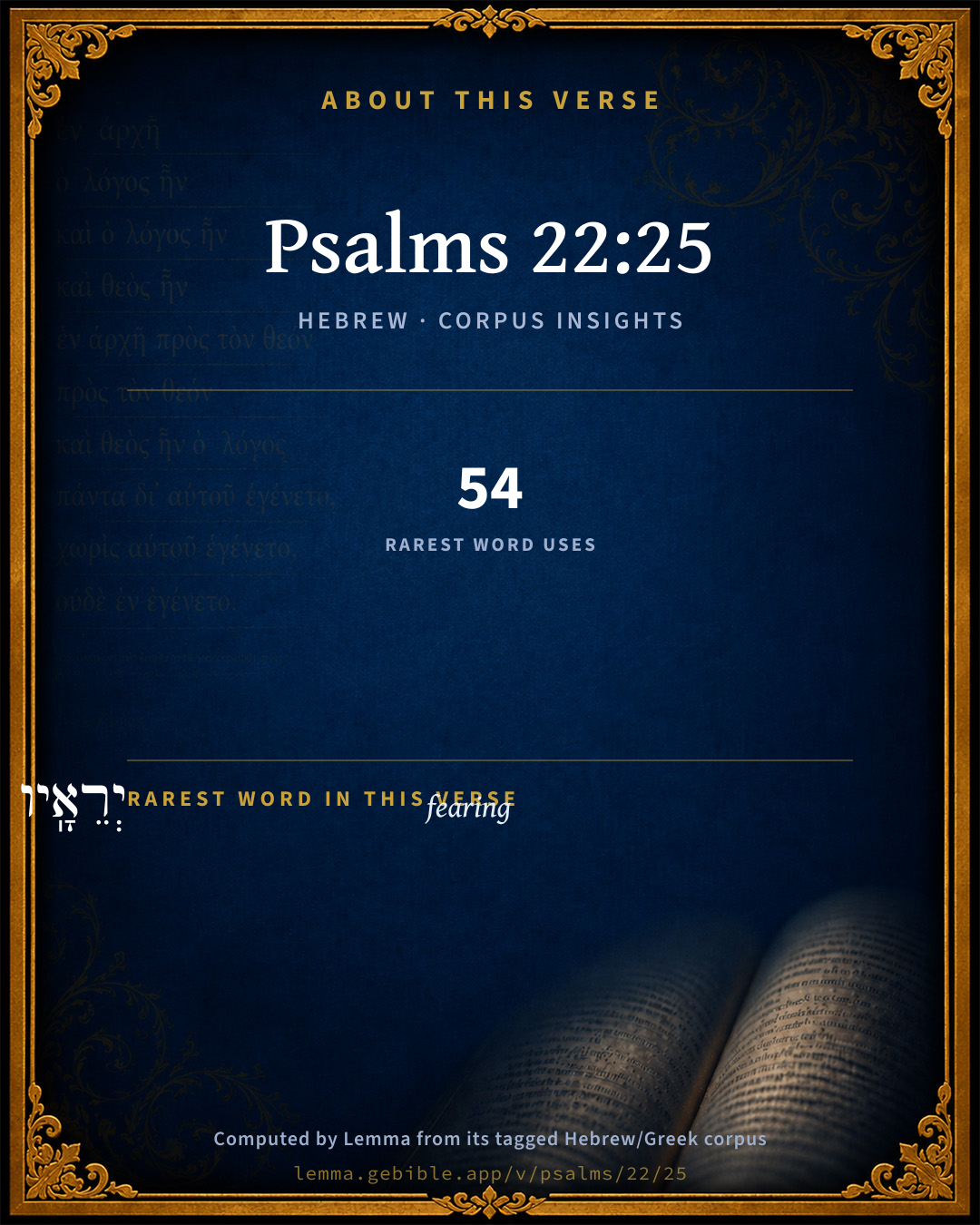
יְרֵאָֽיו fearing H3373 occurs in 54 verses of the Hebrew Bible. Also found in:

Grammatical profile

  • 1 verb
  • 3 nouns
  • 2 adjectives
  • 2 prepositions

Verb forms

  • אֲ֝שַׁלֵּ֗ם Piel · Imperfect

Hebrew & Septuagint length

In English translation the verse runs 19 words from the Hebrew and 19 from the Septuagint (LXX English) — the same length.

A rough comparison of the two English renderings, which tokenize alike — not a word-level alignment.

Word counts can differ between the Hebrew and the Greek without any difference in meaning — e.g. the Hebrew direct-object marker אֵת has no separate Greek word, and Greek often adds the article ὁ.

Cross-references

11

Topical passages linked to Psalms 22:25 in the Treasury of Scripture Knowledge — connected by theme and wording, ordered by reader-vote popularity; previews shown in the World English Bible.

  • Psalms 35:18 I will give you thanks in the great assembly. I will praise you among many people.
  • Psalms 40:9–10 I have proclaimed glad news of righteousness in the great assembly. Behold, I will not seal my lips, Yahweh, you know.
  • Psalms 111:1 Praise Yah! I will give thanks to Yahweh with my whole heart, In the council of the upright, and in the congregation.
  • Psalms 66:13 I will come into your temple with burnt offerings. I will pay my vows to you,
  • Psalms 116:14–19 I will pay my vows to Yahweh, Yes, in the presence of all his people.
  • Psalms 22:22 I will declare your name to my brothers. In the midst of the assembly, I will praise you.
  • Psalms 56:12 Your vows are on me, God. I will give thank offerings to you.
  • Psalms 66:16 Come, and hear, all you who fear God. I will declare what he has done for my soul.
  • Psalms 118:19–20 Open to me the gates of righteousness. I will enter into them. I will give thanks to Yah.
  • Ecclesiastes 5:4–5 When you vow a vow to God, don't defer to pay it; for he has no pleasure in fools. Pay that which you vow.
  • Psalms 65:1 Praise waits for you, God, in Zion. To you shall vows be performed.

Cross-references courtesy of OpenBible.info (CC BY 4.0).

Hebrew and Greek witnesses Masoretic Hebrew ↔ Greek Septuagint

The same verse in the two great witnesses to the Old Testament, shown verse-for-verse.

You’re reading Greek Psalm 21 (Hebrew Psalm 22). The Septuagint counts the superscription, so verse numbers can differ from the Hebrew — chapter-level alignment, not verse-by-verse. Numbering follows Rahlfs.

These are two independent witnesses, not word-aligned to each other, and the Septuagint is shown in lemma (dictionary) form.

Hebrew Psalms 22:25 Masoretic · Westminster Leningrad Codex

מֵ֥אִתְּךָ֗ תְֽהִלָּ֫תִ֥י בְּקָהָ֥ל רָ֑ב נְדָרַ֥י אֲ֝שַׁלֵּ֗ם נֶ֣גֶד יְרֵאָֽיו

Of you comes my praise in the great assembly. I will pay my vows before those who fear him.

World English Bible · Public Domain

Greek LXX Greek Psalm 21:25 Septuagint · lemma form

ὅτι οὐ ἐξουδενόω οὐδέ προςὀχθίζω ὁ δέησις ὁ πτωχός οὐδέ ἀποστρέφω ὁ πρόσωπον αὐτός ἀπό ἐγώ καί ἐν ὁ κράζω ἐγώ πρός αὐτός εἰςἀκούω ἐγώ

My praise is of you in the great congregation: I will pay my vows before them that fear him.

LXX2012 (modern English Septuagint) · Public Domain

Hebrew: Westminster Leningrad Codex (CC BY 4.0). Greek: Septuagint (public domain); English from LXX2012 (modern English Septuagint) (Public Domain). How the Septuagint differs from the Hebrew →

Commentary

Notes on Psalms 22:25 from classic Christian and Jewish commentators (each source and its license shown beneath its notes). The classic Christian expositions comment on the surrounding passage and are grouped to its opening verse, so a note may address several verses; the Jewish commentaries on the Tanakh (Rashi and others) are per-verse, so they appear only where the commentator wrote on this verse.

Lemma curates 59 commentaries, every one of them public domain or Creative Commons licensed, each selected and text-cleaned for this edition rather than reprinted as found. About our sources →

Trapp's Complete Commentary

John Trapp

Psa 22:25 My praise [shall be] of thee in the great congregation: I will pay my vows before them that fear him.

Ver. 25. My praise shall be of thee in the great congregation] Where it may be most public and exemplary. They that neglect public service for private do but read their own indictment, pray their own punishment.

I will pay my vows, &c.] My peace offerings vowed in my distress: these are heavily paid by most people, according to that Italian proverb, The danger once escaped, the saint is defrauded. See David’s care, Psa 116:1-19. and elsewhere.

John Trapp, A Commentary or Exposition upon All the Books of the Old and New Testament (1647–1656) — public domain. Text from a community e-Sword module.

The Treasury of David

Charles H. Spurgeon

Ver. 25. My praise shall be of thee in the great congregation. The one subject of our Master's song is the Lord alone. The Lord and the Lord only is the theme which the believer handleth when he gives himself to imitate Jesus in praise. The word in the original is "from thee", true praise is of celestial origin. The rarest harmonies of music are nothing unless they are sincerely consecrated to God by hearts sanctified by the Spirit. The clerk says, "Let us sing to the praise and glory of God; "but the choir often sing to the praise and glory of themselves. Oh when shall our service of song be a pure offering? Observe in this verse how Jesus loves the public praises of the saints, and thinks with pleasure of the great congregation. It would be wicked on our part to despise the twos and threes; but, on the other hand, let not the little companies snarl at the greater assemblies as though they were necessarily less pure and less approved, for Jesus loves the praise of the great congregation.

I will pay my vows before them that fear him. Jesus dedicates himself anew to the carrying out of the divine purpose in fulfilment of his vows made in anguish. Did our Lord when he ascended to the skies proclaim amid the redeemed in glory the goodness of Jehovah? And was that the vow here meant? Undoubtedly the publication of the gospel is the constant fulfilment of covenant engagements made by our Surety in the councils of eternity. Messiah vowed to build up a spiritual temple for the Lord, and he will surely keep his word.

Ver. 25. My praise shall be of thee in the great congregation etc. The joy and gratitude of our adorable Lord rise to such a height at this great deliverance, his heart so overflows with fresh and blessed consciousness of his heavenly Father's nearness, that he again pours forth the expression of his praise. By its repetition, he teaches us that this is not a temporary burst of gratitude, but an abiding determination, a full and settled resolution. John Stevenson.

Ver. 25. In the great congregation. Saints are fittest witnesses of sacred duties. That which, in Ps 116:14, is implied under this particle of restraint, "his, "in "the presence of all his people", is in Ps 22:25, more expressly noted by a more apparent description, thus: I will pay my vows before them that fear him. None but true saints do truly fear God. 1. This property of God's people, that they fear the Lord, showeth that they will make the best use of such sacred, solemn duties performed in their presence. They will glorify God for this your zeal; they will join their spirits with your spirit in this open performance of duty; they will become followers of you, and learn of you to vow and pay unto the Lord, and that openly, publicly. 2. As for others, they are no better than such hogs and dogs as are not meet to have such precious pearls and holy things cast before them, lest they trample them under their feet. William Gouge.

Ver. 25. Public praise.

1. A delightful exercisepraise.

2. A personal participationMy praise.

3. A fitting objectof thee.

4. A special sourcefrom thee.

5. An appropriate placein the great congregation.

Ver. 25. (second clause). Vows. What vows to make, when and how to make them, and the importance of paying them.

Psalms 22:26*

Charles H. Spurgeon's The Treasury of David (1869–1885) — public domain. Psalms only. Text from a community e-Sword/MySword module.

J. A. Alexander on Psalms

Joseph Addison Alexander

26. (Psa 22:25). From thee (shall be) my praise in (the) great congregation; my vows I will pay before his fearers, those who fear him. From thee is something more than of thee. It does not merely indicate the theme or subject, but the source or cause of his thanksgiving. "It is thou who givest me occasion thus to praise thee." In the last clause there seems to be a reference to the sacrificial feasts connected with the fulfilment of vows made in distress or danger. (See Deu 12:18; Deu 16:11.) These were occasions of festivity, not only to the offerer and his nearest friends, but to a wide circle of invited guests, which makes the metaphor peculiarly appropriate in this place. The essential idea is the same as in Psa 22:23 (22).—His fearers, worshippers, the true Israel, as distinguished from the mere natural descendants of the patriarch.

Joseph Addison Alexander, The Psalms Translated and Explained (1850) — public domain. Text from a community e-Sword module.

Tyndale Open Study Notes

Tyndale Open Resources

22:25-31 The psalmist vows to praise the Lord, the great King of the earth (22:27-28) who cares for the needy. God alone deserves praise.

22:25 The great assembly might include all nations (22:27; 26:12; 35:18).

Tyndale Open Study Notes — © Tyndale Open Resources, licensed CC BY-SA 4.0. Text via the HelloAO Bible API.

Geneva Bible (1599)

Geneva Bible translators

Which were sacrifices of thanksgiving, which they offered by God’s commandment, when they were delivered out of any great danger.

Geneva Bible (1599) marginal notes — public domain. Text via Bolls.life.

Jamieson, Fausset & Brown

Robert Jamieson, A. R. Fausset & David Brown

My praise shall be of thee--or, perhaps better, "from thee," that is, God gives grace to praise Him. With offering praise, he further evinces his gratitude by promising the payment of his vows, in celebrating the usual festival, as provided in the law (Deu 12:18; Deu 16:11), of which the pious or humble, and they that seek the Lord (His true worshippers) shall partake abundantly, and join him in praise [Psa 22:26]. In the enthusiasm produced by his lively feelings, he addresses such in words, assuring them of God's perpetual favor [Psa 22:26]. The dying of the heart denotes death (Sa1 25:37); so its living denotes life.

Jamieson, Fausset & Brown — Commentary Critical and Explanatory on the Whole Bible (1871) — public domain (CC PDM 1.0). Text via the HelloAO Bible API.

Adam Clarke's Commentary

Verse 25. The great congregation] In Ps 22:22 he declares that he will praise God in the midst of the congregation. Here the Jews seem to be intended. In this verse he says he will praise him in the GREAT CONGREGATION. Here the Gentiles are probably meant. The Jewish nation was but a small number in comparison of the Gentile world. And those of the former who received the Gospel were very few when compared with those among the Gentiles who received the Divine testimony. The one was (for there is scarcely a converted Jew now) קהל kahal, an assembly; the other was, is, and will be increasingly, קהל רב kahal rab, a GREAT ASSEMBLY. Salvation was of the Jews, it is now of the Gentiles.

Adam Clarke's Commentary on the Bible (1810–1826) — public domain. Text from a community e-Sword/MySword module.

John Calvin's Commentaries

25. My praise shall proceed from thee. I do not reject the other translation; but in my opinion, the Hebrew manner of expression here requires this sense - that David will take the matter of his song of praise from God. Accordingly, I supply the verb shall proceed, or shall flow, — My praise shall proceed or flow from thee; and he made this statement in order to testify that he owed his deliverance entirely to God. We know that there are many who, under pretense of praising God, trumpet forth their own praises, and those of their friends, and leaving God in the back-ground, take occasion from one thing or another to celebrate their own triumphs. The Psalmist repeats what he had touched upon a little before, that he will show the tokens of his gratitude in a public manner, in order thereby to edify others. He adds, that among these tokens will be the solemn exercise of godliness enjoined by the law: I will pay my vows in the presence of them that fear him. In important affairs, and when threatened with imminent danger, it was a common practice among God’s ancient people to vow a peace-offering, and after having obtained the object of their desire, they performed their vow. As David, therefore, belonged to the number of the saints, he conformed himself, as it became him, to that common and understood regulation of the Church. The vows which he promises to pay are those which he intimates he had made in his extreme distress, and he prepares himself to perform them with a noble and cheerful heart, yea, with a heart full of confidence. Now, although it behoved him to perform this solemn act of religion in the presence of the whole assembly without distinction, he again confesses it to be his desire, that all who should be present there to witness it should be the true worshippers of God. Thus, although it may not be in our power to cleanse the Church of God, it is our duty to desire her purity. The Papists, by wresting this passage to support their false and deceitful vows, show themselves so stupid and so ridiculous, that it is unnecessary to spend much time in refuting them. What resemblance is there between these childish fooleries, with which according to their own imagination they attempt to appease God, and this holy testimony of gratitude, which not only a true sense of religion and the fear of God suggested to the fathers, but which God himself has commanded and ratified in his law? Yea, how can they have the face to equal their foolish and infamous superstitions to the most precious of all sacrifices - the sacrifice of thanksgiving? even as the Scriptures testify, that the principal part of the service of God consists in this, that true believers publicly and solemnly acknowledge that he is the author of all good things.

John Calvin's Commentaries (1540-1563) — public domain. Text from the Calvin Translation Society English edition (1840s-50s) via the Christian Classics Ethereal Library (ccel.org). Calvin's coverage is partial (roughly two-thirds of the Bible); uncommented books and verses are honest gaps, never fabricated. The 19th-century editor's footnotes and remarks are omitted so the notes are faithfully Calvin's own voice.

The Cambridge Bible for Schools and Colleges

gen. ed. J. J. S. Perowne

25. My praise shall be of thee] Rather as R.V., Of thee cometh my praise. From his fellow-worshippers the Psalmist turns to Jehovah, who is not only the object but the source of his praise. “It is the Lord’s doing.”

I will pay my vows] Thank-offerings vowed in the time of trouble. Cp. Psa_66:13, Psa_116:14; Psa_116:18.

The Cambridge Bible for Schools and Colleges (gen. ed. J. J. S. Perowne; Cambridge University Press, 1878–1918) — public domain. Text from a community e-Sword module.

John Gill's Exposition

My praise shall be of thee in the great congregation,.... Or, "my praise is from thee" (o); not that he should have praise of God, as he had, when he was received up into heaven, and set down at the right hand of God; but that God should be the object of his praise, as he was the cause of it; his salvation and deliverance of him, and resurrection from the dead, and exaltation of him, were the occasion and matter of it: the place where Christ determined to praise the Lord is "the great congregation"; either his apostles, who, though a little flock, yet, on account of their extraordinary office and gifts, and peculiar privileges, were the greatest congregation that ever was in the world; or the five hundred brethren to whom Christ appeared at once after his resurrection; or else the whole church under the Gospel dispensation; in the midst of which Christ is, and who in the members of it praises the name of the Lord; and this especially will have its accomplishment at the latter day, when great multitudes will be converted, and the voice of praise and thanksgiving will be among them, Rev 7:9;

I will pay my vows before them that fear him; either those which he made in the council and covenant of grace, when he engaged to become a surety for his people, to assume their nature, to suffer and die for them, to redeem them from sin and misery, and bring them nigh to God, and save them with an everlasting salvation; all which he has openly done; see Psa 31:19; or those which he made in Psa 22:21; that he would declare the name of the Lord unto his brethren, and sing praise unto him in the midst of the church; compare with this Psa 116:12.

(o) , Sept. "a te", Pagninus, Montanus, Rivetus, Cocceius, Ainsworth.

John Gill's Exposition of the Whole Bible (1746–1763) — public domain (CC PDM 1.0). Text via the HelloAO Bible API.

Albert Barnes' Notes on the Bible

My praise shall be of thee - That is, I will praise thee. I will call to remembrance thy goodness, and will unite with others in celebrating thy faithfulness and lovingkindness.

In the great congregation - See the notes at Psa 22:27.

I will pay my vows before them that fear him - In the presence of his worshippers. That is, he would keep the vows which in his afflictions he had made, that he would praise and serve God. These vows or promises were of the nature of a “debt” which he says he would remember to pay. Of the Redeemer, this need not be understood personally, but it means that as the result of his prayer having been heard, the worship of God would be celebrated by those who feared him. The solemn worship of the people of God - the praises which they offer to the Most High - may be regarded as worship paid by the Redeemer himself, for he does it in the persons and services of those whom he redeemed. All the praises which proceed from their hearts and lips are the fruit of his “vows,” of his fidelity, and his prayers.

Albert Barnes' Notes on the Bible (1834–1885) — public domain. Text from a community e-Sword/MySword module.

Matthew Poole's English Annotations

In the great congregation; either in the general assemblies of the Israelites at their solemn feasts; or in the universal church, made up of Jews and Gentiles, as the following verses explain it.

My vows, i.e. those praises and services which in my distress I vowed to return unto thee when thou didst deliver me.

Matthew Poole's English Annotations on the Holy Bible (1683–1685) — public domain. Text from a community e-Sword/MySword module.

Whedon's Commentary on the Bible

Daniel D. Whedon

25. The great congregation—The full assembly of the faithful, as at the great national feasts; prophetically, the Church universal or “holy catholic Church.”

I will pay my vows—I will pay the sacrifice which I vowed— my (זבח נדר) votive offering. This was one species of the שׁלמים, (shelameem,) peace offerings, consisting of a sacrifice accompanied by a social meal in the cloisters of the tabernacle or temple, as an acknowledgment of answer to prayer, and of peace and friendship with God. The allusion is to Lev_7:16-18

Daniel D. Whedon (gen. ed.), Commentary on the Old and New Testaments (1874–1909) — public domain. Text from a community e-Sword module.

The Pulpit Commentary

My praise shall be of thee in the great congregation. The phraseology is that of the Mosaic dispensation, with which alone David was acquainted. But the fulfilment is in those services of praise where, whenever Christ"s disciples are gathered together, there is he in the midst of them. I will pay my vows before them that fear him. "Vows," in the strict sense of the word, are scarcely meant; rather "devotions" generally.

The Pulpit Commentary (1880–1919), ed. H.D.M. Spence-Jones & Joseph S. Exell — public domain. Text from a community e-Sword module.

John Wesley's Explanatory Notes

Great congregation - In the universal church, of Jews and Gentiles.

John Wesley, Explanatory Notes Upon the Whole Bible (1754–1765) — public domain. Text via the GEBible commentary corpus.

Keil & Delitzsch

C. F. Keil & F. Delitzsch

(Heb.: 22:26-27) The call to thanksgiving is now ended; and there follows a grateful upward glance towards the Author of the salvation; and this grateful upward glance grows into a prophetic view of the future. This fact, that the sufferer is able thus to glory and give thanks in the great congregation (Psa 40:10), proceeds from Jahve (מאת as in Psa 118:23, cf. Psa 71:6). The first half of the verse, according to Baer's correct accentuation, closes with בּקהל רב. יראיו does not refer to קהל, but, as everywhere else, is meant to be referred to Jahve, since the address of prayer passes over into a declarative utterance. It is not necessary in this passage to suppose, that in the mind of David the paying of vows is purely ethical, and not a ritualistic act. Being rescued he will bring the שׁלמי נדר, which it is his duty to offer, the thank-offerings, which he vowed to God when in the extremest peril. When the sprinkling with blood (זריקה) and the laying of the fat pieces upon the altar (הקטרה) were completed, the remaining flesh of the shalemim was used by the offerer to make a joyous meal; and the time allowed for this feasting was the day of offering and on into the night in connection with the tda-shelamim offering, and in connection with the shelamim of vows even the following day also (Lev 7:15.). The invitation of the poor to share in it, which the law does not command, is rendered probable by these appointments of the law, and expressly commended by other and analogous appointments concerning the second and third tithes. Psa 22:27 refers to this: he will invite the ענוים, those who are outwardly and spiritually poor, to this "eating before Jahve;" it is to be a meal for which they thank God, who has bestowed it upon them through him whom He has thus rescued. Psa 22:27 is as it were the host's blessing upon his guests, or rather Jahve's guests through him: "your heart live for ever," i.e., may this meal impart to you ever enduring refreshment. יחי optative of חיה, here used of the reviving of the heart, which is as it were dead (Sa1 25:37), to spiritual joy. The reference to the ritual of the peace offerings is very obvious. And it is not less obvious, that the blessing, which, for all who can be saved, springs from the salvation that has fallen to the lot of the sufferer, is here set forth. But it is just as clear, that this blessing consists in something much higher than the material advantage, which the share in the enjoyment of the animal sacrifice imparts; the sacrifice has its spiritual meaning, so that its outward forms are lowered as it were to a mere figure of its true nature; it relates to a spiritual enjoyment of spiritual and lasting results. How natural, then, is the thought of the sacramental eucharist, in which the second David, like to the first, having attained to the throne through the suffering of death, makes us partakers of the fruits of His suffering!

Keil & Delitzsch — Biblical Commentary on the Old Testament (1861–1891) — public domain (CC PDM 1.0). Text via the HelloAO Bible API. (Old Testament only.)

Scofield Reference Notes

C. I. Scofield

fear

(See Scofield "Psa 19:9").

The Scofield Reference Bible (1917 edition), notes by C. I. Scofield — public domain. Text from a community e-Sword module.

Rashi

Rabbi Shlomo Yitzchaki (Rashi)

the cry of the poor Every [expression of] עניה in Scripture is an expression of a cry. ענות can also be interpreted as an expression of humility, as (in Exod. 10:3): “to humble yourself (לענת),” because he (the poor man) humbles himself and prays before You.

Rashi on the Tanakh — English translations: “The Judaica Press complete Tanach with Rashi, translated by A. J. Rosenberg” (CC BY 4.0); “Pentateuch with Rashi's commentary by M. Rosenbaum and A.M. Silbermann, 1929-1934” (public domain); “The Metsudah Tanach series, Lakewood, N.J” (CC BY 4.0); and “The Book of Joshua, Metsudah Publications, 1997” (CC BY 4.0). Text via Sefaria.

Radak

Rabbi David Kimhi (Radak)

For He hath not despised: – And so will they say when they give thanks as they come forth from the exile: “When we were in exile He did not despise nor abhor our affliction wherewith we were afflicted.”

nor abhorred (שׁקץ): – (This word) has the meaning of תועבה (abomination), as (Lev. 11:43): “Ye shall not make yourselves abominable (תשׁקצו).”

the affliction: – (עֱנוּת here) is a noun having the sense of עני (afflicted). Some, however (Targumist, Rashi, and others besides), interpret ענות as the “prayer.”

of the afflicted: – viz. that which he answers with his mouth, as (Prov. 16:1): “the answer (מענה) of the tongue.”

Neither hath He hid His face from him; But when he cried unto Him, He heard: – (שָׁמֵעַ here) is perfect of the verb of the form (חָפֵץ in) “because he had delight (חָפֵץ) in Jacob's daughter” (Gen. 34:19).

Radak on the Tanakh — English translations: “Sefaria Community Translation” (CC0 1.0 (public-domain dedication)); “Eliyahu Munk, HaChut Hameshulash” (CC BY 4.0); “Rabbi Mike Feuer, Jerusalem Anthology” (CC BY 4.0); and “R. David Kimhi on the first book of Psalms, Translated by R.G. Finch, London, 1919” (public domain). Text via Sefaria.

Lesson kit

Teaching starters — assembled from the data on this page, not authored interpretation. Every prompt links to the verse data it draws on. Edit before teaching.

Psalms, in the Wisdom, opens this verse with 8 words (8 distinct Hebrew lemmas). Its most distinctive word is yârêʼ (“fearing”). A historical commentator’s framing appears above. Read the whole chapter for the surrounding context.

Discussion questions

  1. What does “fearing” (yârêʼ) contribute to the verse as a whole?
  2. How does Genesis 22:12, which shares the word «fearing», read alongside this verse?
  3. These translations render this verse differently. What is at stake in choosing one wording over another?
  4. «אֲ֝שַׁלֵּ֗ם» is a Piel Imperfect verb. How does that grammatical form shape the action described?
  5. Compare how Trapp's Complete Commentary and The Treasury of David read this verse. Where do they agree or differ?

Things to notice

Reading settings

Reading text

Shown beneath each verse's original-language words.

Old Testament
Old Testament edition

Read the OT as the Masoretic Hebrew (MT) or the Greek Septuagint (LXX).

English shown for the Greek Septuagint (in the Hebrew ↔ Greek comparison).

Comparing translations? Open the Compare panel on any verse page to stack up to four side by side.