Ezekiel 23:46

Hebrew (Westminster Leningrad Codex) Ezekiel 23:46 appears in the Hebrew Old Testament. The text above is from the Westminster Leningrad Codex. Each word links to its Strong’s number, a concise gloss, and parsing drawn from the Open Scriptures Hebrew Bible morphology. Click any word for its full Brown-Driver-Briggs (BDB) entry.
Download image
Cite this verse

Ezekiel 23:46 (World English Bible). Public Domain. Lemma interlinear Bible study tool, https://lemma.gebible.app/v/ezekiel/23/46.

Show BibTeX & RIS
BibTeX
RIS
English Translation
For thus says the Lord Yahweh: I will bring up a company against them, and will give them to be tossed back and forth and robbed.
World English Bible · Public Domain
Download a study sheet

One document with this verse’s original text, its word-by-word gloss line, the meaning frame, cross-references with their text, attributed commentary, and full source and license credits — printable, and it pastes into notes with its structure intact.

This verse Autodidact and up

Study sheet (.html) Plain text (.txt)

A passage Seminary Student

Up to 50 verses in one chapter. A passage sheet keeps up to 6 commentary sources and 12 cross-references per verse, in the order this page ranks them, and says so on the sheet whenever that leaves anything out. Ask for a single verse and you get the Autodidact verse sheet above.

Everything on this page stays free to read, with no account — the sheet is a download of what is already on screen, not access to it.

Want to remove ads? Support Godless Engineer
Compare translations 3

The same verse in 3 English versions, stacked beneath the original-language interlinear above. Click any original word for its lexicon entry.

Each is an independent rendering of the whole verse — the interlinear is not word-aligned to these translations.

Highlighted words mark where these versions differ — a whole-verse word diff, not a word-by-word alignment.

  • World English Bible Public Domain
    For thus says the Lord Yahweh: I will bring up a company against them, and will give them to be tossed back and forth and robbed.
  • King James Version Public Domain
    For thus saith the Lord GOD; I will bring up a company upon them, and will give them to be removed and spoiled.
  • unfoldingWord Literal Text CC BY-SA 4.0
    So the Lord Yahweh says this: I will raise up a company against them and give them up to be terrorized and plundered.

unfoldingWord Literal Text — © unfoldingWord, licensed CC BY-SA 4.0. Word-aligned USFM3 via Door43 (git.door43.org/unfoldingWord/en_ult).

Versions to compare (up to 4)

3 of 4 selected

Show all 18 translations

Every available English version of this verse, each an independent rendering of the whole verse.

  • World English Bible Public Domain
    For thus says the Lord Yahweh: I will bring up a company against them, and will give them to be tossed back and forth and robbed.
  • Berean Standard Bible Public Domain
    This is what the Lord GOD says: ‘Bring a mob against them and consign them to terror and plunder.
  • Majority Standard Bible Public Domain
    This is what the Lord GOD says: ‘Bring a mob against them and consign them to terror and plunder.
  • King James Version Public Domain
    For thus saith the Lord GOD; I will bring up a company upon them, and will give them to be removed and spoiled.
  • American Standard Version (1901) Public Domain
    For thus saith the Lord Jehovah: I will bring up a company against them, and will give them to be tossed to and fro and robbed.
  • Revised Version (1885) Public Domain
    For thus saith the Lord GOD: I will bring up an assembly against them, and will give them to be tossed to and fro and spoiled.
  • Geneva Bible (1599) Public Domain
    Wherefore thus sayth the Lord God, I will bring a multitude vpon them, and will giue them vnto the tumult, and to the spoyle,
  • Douay-Rheims (1899) Public Domain
    For thus saith the Lord God: Bring a multitude upon them, and deliver them over to tumult and rapine:
  • Young's Literal Translation Public Domain
    For thus said the Lord Jehovah: Bring up against them an assembly, And give them to trembling and to spoiling.
  • Literal Standard Version CC BY-SA 4.0
    For thus said Lord YHWH: Bring up an assembly against them, || And give them to trembling and to spoiling.
  • Unlocked Literal Bible CC BY-SA 4.0
    So the Lord Yahweh says this: I will raise up a company against them and give them up to be terrorized and plundered.
  • unfoldingWord Literal Text CC BY-SA 4.0
    So the Lord Yahweh says this: I will raise up a company against them and give them up to be terrorized and plundered.
  • Darby Bible Public Domain
    For thus saith the Lord Jehovah: I will bring up an assemblage against them, and will give them to be driven hither and thither and spoiled.
  • World Messianic Bible Public Domain
    “For the Lord GOD says: ‘I will bring up a mob against them, and will give them to be tossed back and forth and robbed.
  • Webster's Bible Public Domain
    For thus saith the Lord GOD; I will bring up a company upon them, and will give them to be removed and plundered.
  • Free Bible Version CC BY-SA 4.0
    This is what the Lord God says: Have a mob attack them! Make them terrified and rob them.
  • Bible in Basic English Public Domain
    For this is what the Lord has said: I will make a great meeting of the people come together against her, and will send on her shaking fear and take everything from her.
  • JPS Tanakh (1917) Public Domain
    For thus saith the Lord GOD: An assembly shall be brought up against them, and they shall be made a horror and a spoil.

Literal Standard Version (2020), Covenant Press — licensed CC BY-SA 4.0. Text via the HelloAO Bible API (eBible.org). Unlocked Literal Bible (unfoldingWord) — licensed CC BY-SA 4.0. Text via the HelloAO Bible API (eBible.org). unfoldingWord Literal Text — © unfoldingWord, licensed CC BY-SA 4.0. Word-aligned USFM3 via Door43 (git.door43.org/unfoldingWord/en_ult). Free Bible Version, Dr. Jonathan Gallagher — licensed CC BY-SA 4.0. Text via the HelloAO Bible API (eBible.org).

Word by word

More ways to search: Search by grammar → Find every occurrence → Compare this word →

Practice this passage: Drill this verse → Learn its vocabulary →

לְזַעֲוָ֥ה
zaʻăvâh
H2189
“to/for · terror”
Preposition + Noun, Common, Feminine, Singular, Absolute
Part of Speech
Preposition + Noun
Type
Common
Gender
Feminine
Number
Singular
State
Absolute
Full BDB Definition

Origin: by transposition for H2113

TWOT: 540a

a horror, trembling, object of terror or trembling
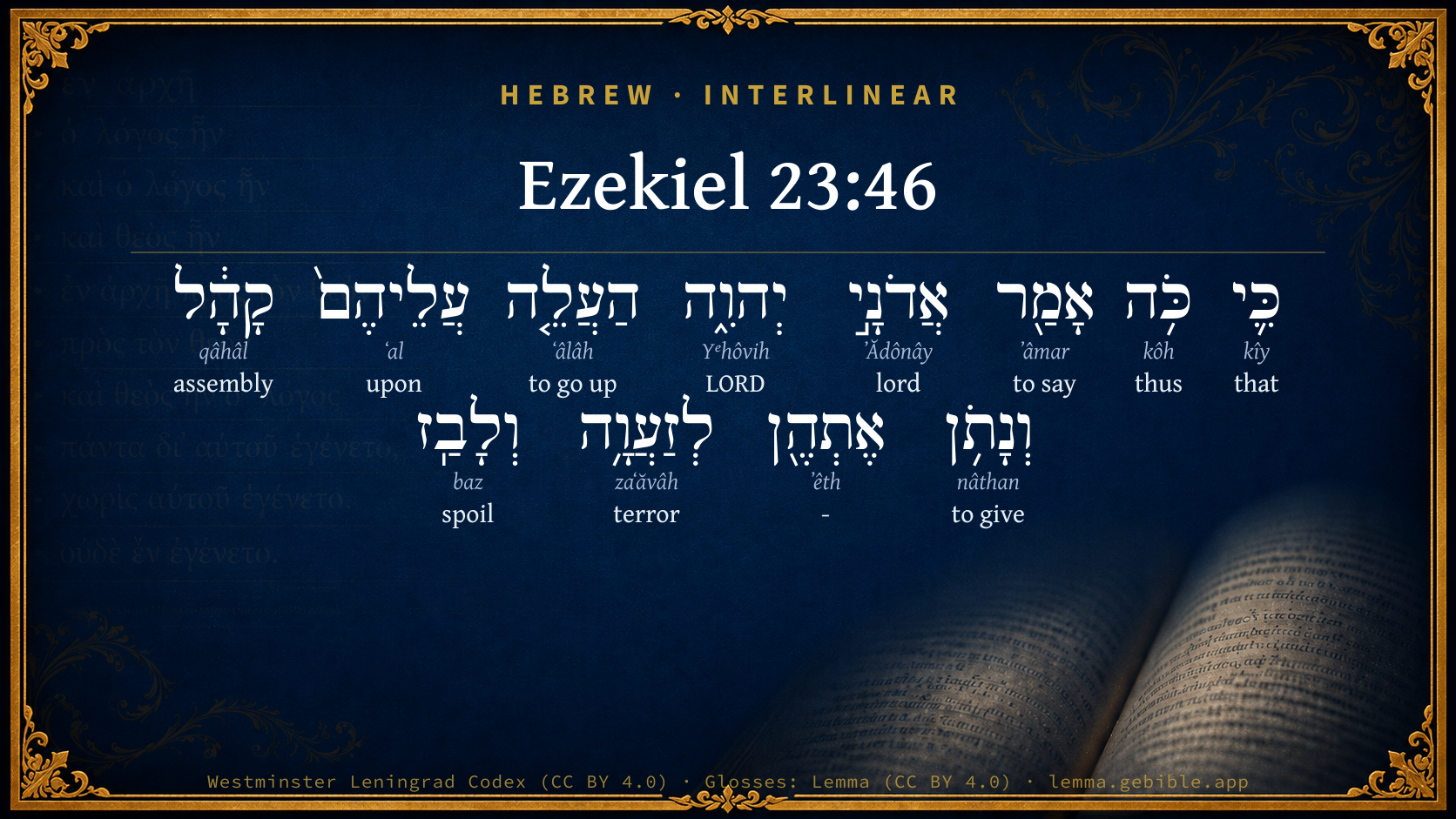
  1. כִּ֛י kîy H3588 “that” Conjunction
  2. כֹּ֥ה kôh H3541 “thus” Adverb
  3. אָמַ֖ר ʼâmar H559 “to say” Verb, Qal, Perfect, 3rd Person, Masculine, Singular
  4. אֲדֹנָ֣י ʼĂdônây H136 “Lord · my” Noun, Common, Masculine, Plural, Construct + Suffix, Personal, 1st Person, Common, Singular
  5. יְהוִ֑ה Yᵉhôvih H3069 “LORD” Noun, Proper
  6. הַעֲלֵ֤ה ʻâlâh H5927 “to go up” Verb, Hiphil, Infinitive Absolute
  7. עֲלֵיהֶם֙ ʻal H5921 “upon · them” Preposition + Suffix, Personal, 3rd Person, Masculine, Plural
  8. קָהָ֔ל qâhâl H6951 “assembly” Noun, Common, Masculine, Singular, Absolute
  9. וְנָתֹ֥ן nâthan H5414 “and · to give” Conjunction + Verb, Qal, Infinitive Absolute
  10. אֶתְהֶ֖ן ʼêth H853 “- · them” Particle, Direct Object + Suffix, Personal, 3rd Person, Feminine, Plural
  11. וְלָבַֽז baz H957 “and · to/for · spoil” Conjunction + Preposition + Noun, Common, Masculine, Singular, Absolute

About this verse

These counts appear in no published source. They are computed here, from the morphology-tagged text and Lemma’s own curated glosses. What Lemma adds →

12
words
12
distinct lemmas
Prophets
section

Notable vocabulary

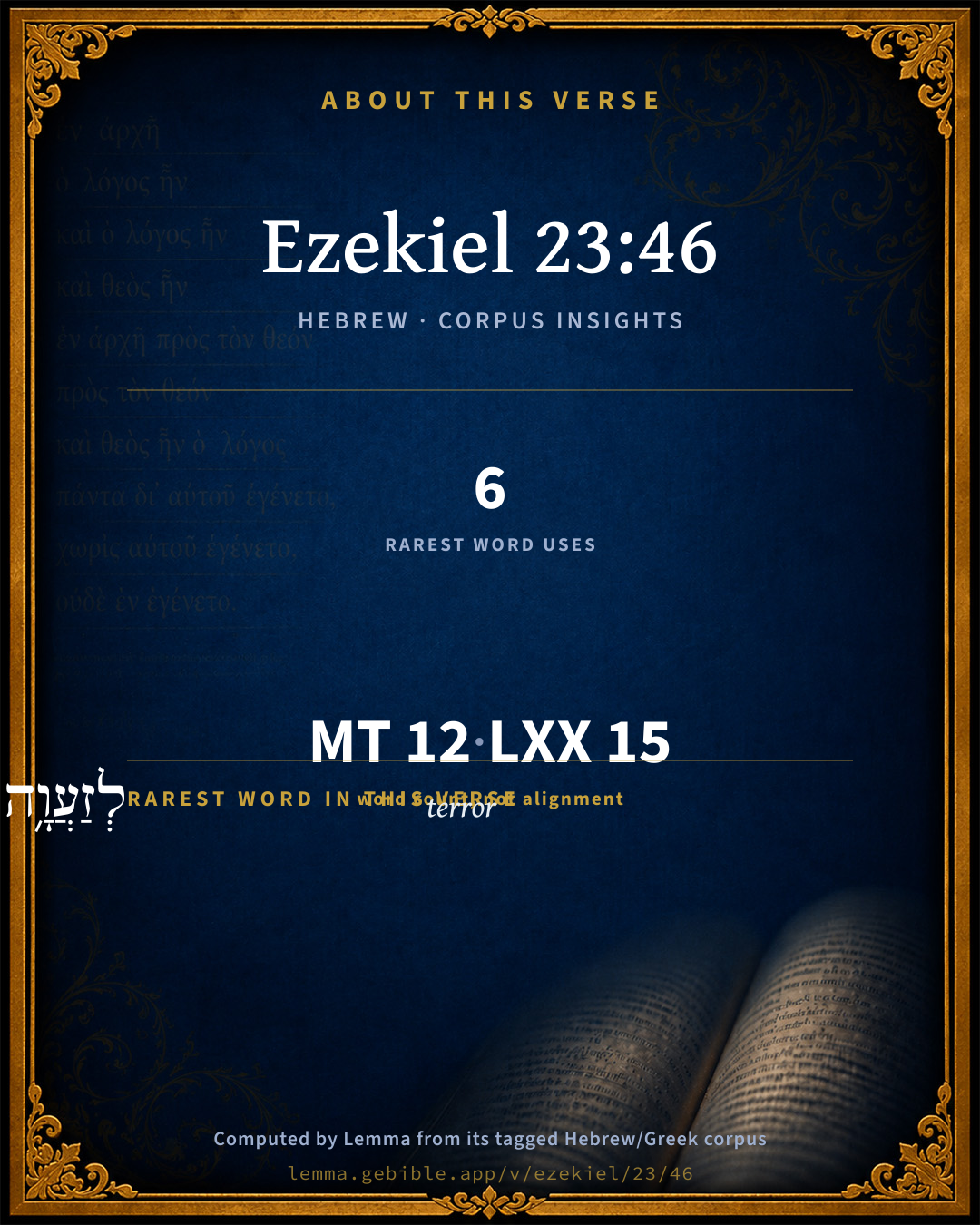
The rarest word here is לְזַעֲוָ֥ה terror H2189 — appearing just 6 times in the whole Hebrew Bible.

Shared distinctive vocabulary

לְזַעֲוָ֥ה terror H2189 occurs in 6 verses of the Hebrew Bible. Also found in:

Grammatical profile

  • 3 verbs
  • 5 nouns
  • 1 preposition
  • 1 conjunction
  • 1 adverb
  • 1 particle

Verb forms

  • אָמַ֖ר Qal · Perfect
  • הַעֲלֵ֤ה Hiphil · Infinitive Absolute
  • וְנָתֹ֥ן Qal · Infinitive Absolute

Hebrew & Septuagint length

In English translation the verse runs 26 words from the Hebrew and 21 from the Septuagint (LXX English) — closely comparable.

A rough comparison of the two English renderings, which tokenize alike — not a word-level alignment.

Word counts can differ between the Hebrew and the Greek without any difference in meaning — e.g. the Hebrew direct-object marker אֵת has no separate Greek word, and Greek often adds the article ὁ.

In the original languages it is 12 Hebrew tokens and 15 Greek tokens — but the two are counted differently (Hebrew bundles its prefixes and suffixes into one token; the Greek is in lemma form), so that isn’t a like-for-like length.

Cross-references

6

Topical passages linked to Ezekiel 23:46 in the Treasury of Scripture Knowledge — connected by theme and wording, ordered by reader-vote popularity; previews shown in the World English Bible.

  • Ezekiel 16:40 They shall also bring up a company against you, and they shall stone you with stones, and thrust you through with their swords.
  • Jeremiah 15:4 I will cause them to be tossed back and forth among all the kingdoms of the earth, because of Manasseh, the son of Hezekiah, king of Judah, for that which he did in Jerusalem.
  • Jeremiah 24:9 I will even give them up to be tossed back and forth among all the kingdoms of the earth for evil; to be a reproach and a proverb, a taunt and a curse, in all places where I shall drive them.
  • Jeremiah 25:9 behold, I will send and take all the families of the north, says Yahweh, and [I will send] to Nebuchadrezzar the king of Babylon, my servant, and will bring them against this land, and against the inhabitants of it, and against all these nations round about; and I will utterly destroy them, and make them an astonishment, and a hissing, and perpetual desolations.
  • Jeremiah 34:17 Therefore thus says Yahweh: you have not listened to me, to proclaim liberty, every man to his brother, and every man to his neighbor: behold, I proclaim to you a liberty, says Yahweh, to the sword, to the pestilence, and to the famine; and I will make you to be tossed back and forth among all the kingdoms of the earth.
  • Ezekiel 23:22–26 Therefore, Oholibah, thus says the Lord Yahweh: Behold, I will raise up your lovers against you, from whom your soul is alienated, and I will bring them against you on every side:

Cross-references courtesy of OpenBible.info (CC BY 4.0).

Hebrew and Greek witnesses Masoretic Hebrew ↔ Greek Septuagint

The same verse in the two great witnesses to the Old Testament, shown verse-for-verse.

These are two independent witnesses, not word-aligned to each other, and the Septuagint is shown in lemma (dictionary) form.

Hebrew Ezekiel 23:46 Masoretic · Westminster Leningrad Codex

כִּ֛י כֹּ֥ה אָמַ֖ר אֲדֹנָ֣י יְהוִ֑ה הַעֲלֵ֤ה עֲלֵיהֶם֙ קָהָ֔ל וְנָתֹ֥ן אֶתְהֶ֖ן לְזַעֲוָ֥ה וְלָבַֽז

For thus says the Lord Yahweh: I will bring up a company against them, and will give them to be tossed back and forth and robbed.

World English Bible · Public Domain

Greek LXX Ezekiel 23:46 Septuagint · lemma form

ὅδε λέγω κύριος κύριος ἀναἄγω ἐπί αὐτός ὄχλος καί δίδωμι ἐν αὐτός ταραχή καί διαρπαγή

Thus says the Lord God, Bring up a multitude upon them, and send trouble and plunder into the midst of them.

LXX2012 (modern English Septuagint) · Public Domain

Hebrew: Westminster Leningrad Codex (CC BY 4.0). Greek: Septuagint (public domain); English from LXX2012 (modern English Septuagint) (Public Domain). How the Septuagint differs from the Hebrew →

Targum (Aramaic paraphrase)

1

The Targum is the ancient Jewish Aramaic paraphrase of the Hebrew Scriptures — an interpretive translation, not the Hebrew text itself. Onkelos (literal) and Pseudo-Jonathan (expansive) render the Torah, and Jonathan the Prophets. Coverage is partial: where no permissively-licensed English translation exists for a verse, only the Aramaic is shown. This is verse-level text, not a word-by-word alignment to the Hebrew.

  1. Targum Jonathan Prophets (Joshua–Malachi)
    כִּדְנַן אֲמַר יְיָ אֱלֹהִים אִיתְנַבֵּי דְיִסְקוּן עֲלֵיהוֹן מַשִׁרְיָן וְאֶמְסַר יַתְהוֹן לִתְבִיר וּלְבִזָא:

    (no public-domain English translation for this verse)

    Targum Jonathan — Aramaic: “Mikraot Gedolot” (public domain). English: “Sefaria Community Translation” (CC0 1.0 (public-domain dedication)); “London "Chaldee Paraphrase," 1871” (public domain). Text via Sefaria.

Commentary

Notes on Ezekiel 23:46 from classic Christian and Jewish commentators (each source and its license shown beneath its notes). The classic Christian expositions comment on the surrounding passage and are grouped to its opening verse, so a note may address several verses; the Jewish commentaries on the Tanakh (Rashi and others) are per-verse, so they appear only where the commentator wrote on this verse.

Lemma curates 59 commentaries, every one of them public domain or Creative Commons licensed, each selected and text-cleaned for this edition rather than reprinted as found. About our sources →

Trapp's Complete Commentary

John Trapp

Eze 23:46 For thus saith the Lord GOD; I will bring up a company upon them, and will give them to be removed and spoiled.

Ver. 46. I will bring up a company.] A numerous army, which shall make much havoc and slaughter.

John Trapp, A Commentary or Exposition upon All the Books of the Old and New Testament (1647–1656) — public domain. Text from a community e-Sword module.

Jamieson, Fausset & Brown

Robert Jamieson, A. R. Fausset & David Brown

a company--properly, "a council of judges" passing sentence on a criminal [GROTIUS]. The "removal" and "spoiling" by the Chaldean army is the execution of the judicial sentence of God.

Jamieson, Fausset & Brown — Commentary Critical and Explanatory on the Whole Bible (1871) — public domain (CC PDM 1.0). Text via the HelloAO Bible API.

The Cambridge Bible for Schools and Colleges

gen. ed. J. J. S. Perowne

46. Cf. Eze_16:40.

to be removed] maltreated.

The Cambridge Bible for Schools and Colleges (gen. ed. J. J. S. Perowne; Cambridge University Press, 1878–1918) — public domain. Text from a community e-Sword module.

John Gill's Exposition

For thus saith the Lord God, I will bring up a company upon them,.... Or, "do thou bring up a company upon them" (m), or "against them". The Targum represents it as spoken to the prophet, thus,

"prophesy that armies shall come up against them.''

Kimchi interprets it as we do, "I will bring up", &c. and so others (n). By this "company" is to be understood the Chaldean army, whom God in his providence, and in righteous judgment, would bring up against the Jews; styled a "convocation" (o), assembly or congregation, in allusion to the sanhedrim, or court of judicature, that took cognizance of such crimes, and judged and condemned for them:

and will give them to be removed and spoiled; or, "for a removing", and a "spoil" (p); that is, he would give the Jews into the hands of the Chaldean army; their persons to be carried captive into other lands, and their substance to be spoiled and plundered.

(m) ' , Sept.; "adduc super eas coetum", V. L. "ascendere tac contra eas, vel eaos, coetum", Cocceius, Starckius. (n) "Facium ascendere", Pagninus; "adducam", Munster, Tigurine version; "quum adduxero", Piscator. (o) "congretio", Junius & Tremellius, Piscator; "consessus judicum", Grotius, Starckius. (p) "commotioni et directioni", Junius & Tremellius, Polanus, Piscator; "in commotionen et in praedam", Starckius.

John Gill's Exposition of the Whole Bible (1746–1763) — public domain (CC PDM 1.0). Text via the HelloAO Bible API.

Matthew Poole's English Annotations

A company; the Babylonian army.

Upon them; against the Jews, the children of this Aholibah.

Give them; the inhabitants of Judea, the citizens of Jerusalem, with princes and royal family.

To be removed; to be carried away captive into the land of Chaldea.

And spoiled, by the rapine of the soldiers in their own land, and by the cruelty of their masters to whom they shall be slaves in a strange land: this is the plain sense of the verse, though possibly there may be an allusion to the solemn proceedings of a court of judicature couched in the proper import of many of the Hebrew words.

Matthew Poole's English Annotations on the Holy Bible (1683–1685) — public domain. Text from a community e-Sword/MySword module.

John Wesley's Explanatory Notes

Upon them - Against the Jews, the children of this Aholibah.

John Wesley, Explanatory Notes Upon the Whole Bible (1754–1765) — public domain. Text via the GEBible commentary corpus.

unfoldingWord translationNotes

Door43 World Missions Community

raise up a company

The phrase "raise up" is an idiom. AT: "gather a large group of people" (See: Idiom)

against them and give them

"against Jerusalem and Samaria and give them"

give them up

Yahweh gives up the responsibility to take care of them and allows them to suffer.

to be terrorized and plundered

This can be stated in active form. AT: "for the company to terrorize and plunder them" (See: Active or Passive)

cut them down

This is an idiom. AT: "kill them" (See: Idiom)

translationWords

Lord Yahweh

raise

terror

stone

sword

unfoldingWord translationNotes — © Distant Shores Media and the Door43 World Missions Community, licensed CC BY-SA 4.0. Source: git.door43.org/Door43/en_tn.

Rashi

Rabbi Shlomo Yitzchaki (Rashi)

Let...be brought up...and let them be submitted All these are expressions of doing and of a continuous action.

Rashi on the Tanakh — English translations: “The Judaica Press complete Tanach with Rashi, translated by A. J. Rosenberg” (CC BY 4.0); “Pentateuch with Rashi's commentary by M. Rosenbaum and A.M. Silbermann, 1929-1934” (public domain); “The Metsudah Tanach series, Lakewood, N.J” (CC BY 4.0); and “The Book of Joshua, Metsudah Publications, 1997” (CC BY 4.0). Text via Sefaria.

Lesson kit

Teaching starters — assembled from the data on this page, not authored interpretation. Every prompt links to the verse data it draws on. Edit before teaching.

Ezekiel, in the Prophets, opens this verse with 12 words (12 distinct Hebrew lemmas). Its most distinctive word is zaʻăvâh (“terror”). A historical commentator’s framing appears above. Read the whole chapter for the surrounding context.

Discussion questions

  1. How does “terror” (zaʻăvâh) shape what this verse is saying?
  2. Deuteronomy 28:25 shares the word «terror» with this verse. How do the two illuminate each other?
  3. These translations render this verse differently; the difference is in the English rendering, not the original. What questions does that raise?
  4. The verb «אָמַ֖ר» is Qal Perfect. How does its form color the action?
  5. Reading how Trapp's Complete Commentary and Jamieson, Fausset & Brown read this verse, where do the two commentators agree and where do they part?

Things to notice

Reading settings

Reading text

Shown beneath each verse's original-language words.

Old Testament
Old Testament edition

Read the OT as the Masoretic Hebrew (MT) or the Greek Septuagint (LXX).

English shown for the Greek Septuagint (in the Hebrew ↔ Greek comparison).

Comparing translations? Open the Compare panel on any verse page to stack up to four side by side.