
Numbers 20:10

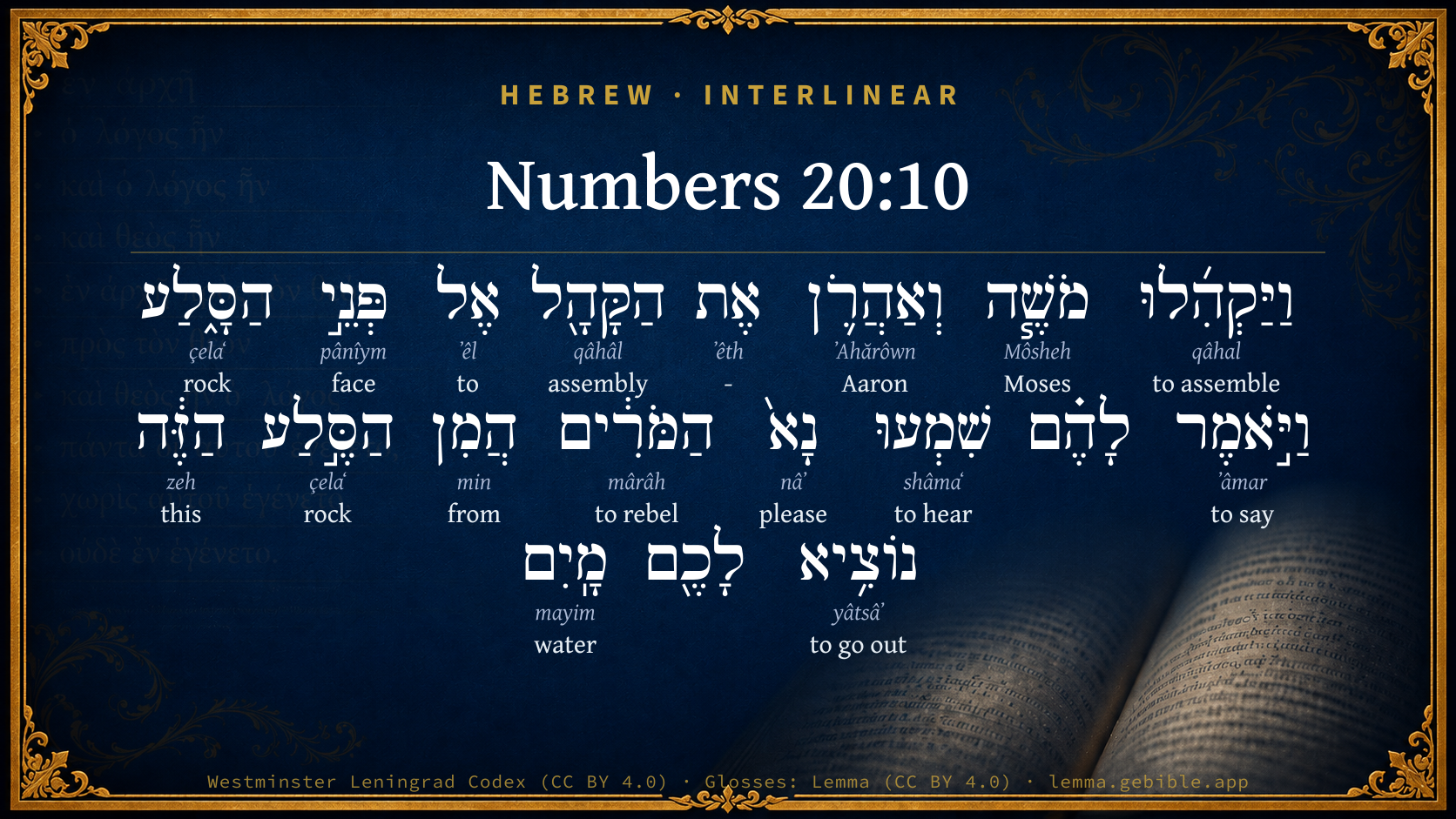
Hebrew (Westminster Leningrad Codex) Numbers 20:10 appears in the Hebrew Old Testament. The text above is from the Westminster Leningrad Codex. Each word links to its Strong’s number, a concise gloss, and parsing drawn from the Open Scriptures Hebrew Bible morphology. Click any word for its full Brown-Driver-Briggs (BDB) entry.
Download image
Cite this verse

Numbers 20:10 (World English Bible). Public Domain. Lemma interlinear Bible study tool, https://lemma.gebible.app/v/numbers/20/10.

Show BibTeX & RIS
BibTeX
RIS
English Translation
Moses and Aaron gathered the assembly together before the rock, and he said to them, Hear now, you rebels; shall we bring you forth water out of this rock?
World English Bible · Public Domain
Highlights
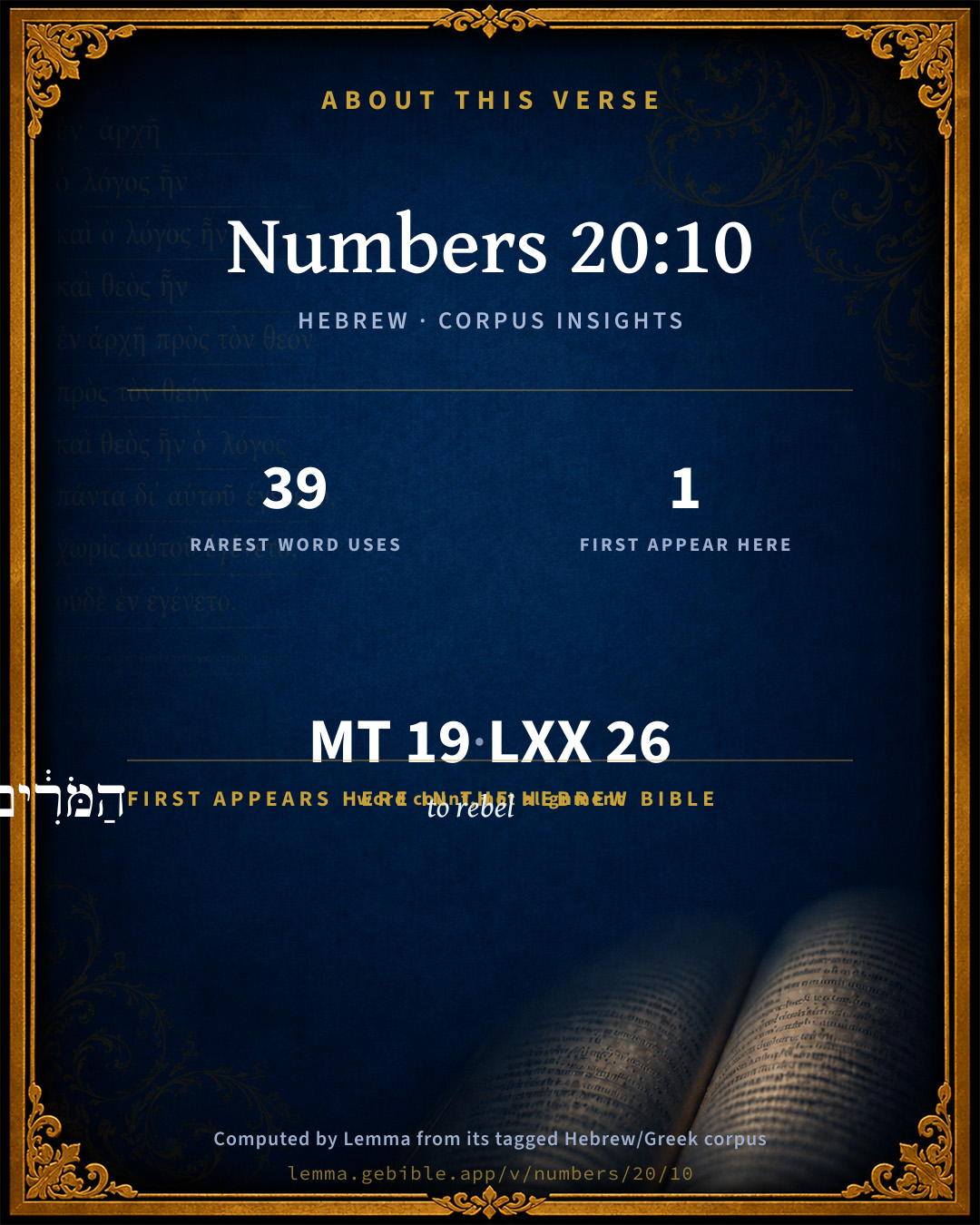
  • 1 first appearance in the Hebrew Bible
Full analysis ↓
Download a study sheet

One document with this verse’s original text, its word-by-word gloss line, the meaning frame, cross-references with their text, attributed commentary, and full source and license credits — printable, and it pastes into notes with its structure intact.

This verse Autodidact and up

Study sheet (.html) Plain text (.txt)

A passage Seminary Student

Up to 50 verses in one chapter. A passage sheet keeps up to 6 commentary sources and 12 cross-references per verse, in the order this page ranks them, and says so on the sheet whenever that leaves anything out. Ask for a single verse and you get the Autodidact verse sheet above.

Everything on this page stays free to read, with no account — the sheet is a download of what is already on screen, not access to it.

Want to remove ads? Support Godless Engineer
Compare translations 3

The same verse in 3 English versions, stacked beneath the original-language interlinear above. Click any original word for its lexicon entry.

Each is an independent rendering of the whole verse — the interlinear is not word-aligned to these translations.

Highlighted words mark where these versions differ — a whole-verse word diff, not a word-by-word alignment.

  • World English Bible Public Domain
    Moses and Aaron gathered the assembly together before the rock, and he said to them, Hear now, you rebels; shall we bring you forth water out of this rock?
  • King James Version Public Domain
    And Moses and Aaron gathered the congregation together before the rock, and he said unto them, Hear now, ye rebels; must we fetch you water out of this rock?
  • unfoldingWord Literal Text CC BY-SA 4.0
    And Moses and Aaron assembled the assembly to the face of the rock, and he said to them, “Please hear, the rebellious ones! From this rock shall we bring out water for you?”

unfoldingWord Literal Text — © unfoldingWord, licensed CC BY-SA 4.0. Word-aligned USFM3 via Door43 (git.door43.org/unfoldingWord/en_ult).

Versions to compare (up to 4)

3 of 4 selected

Show all 18 translations

Every available English version of this verse, each an independent rendering of the whole verse.

  • World English Bible Public Domain
    Moses and Aaron gathered the assembly together before the rock, and he said to them, Hear now, you rebels; shall we bring you forth water out of this rock?
  • Berean Standard Bible Public Domain
    Then Moses and Aaron gathered the assembly in front of the rock, and Moses said to them, “Listen now, you rebels, must we bring you water out of this rock?”
  • Majority Standard Bible Public Domain
    Then Moses and Aaron gathered the assembly in front of the rock, and Moses said to them, “Listen now, you rebels, must we bring you water out of this rock?”
  • King James Version Public Domain
    And Moses and Aaron gathered the congregation together before the rock, and he said unto them, Hear now, ye rebels; must we fetch you water out of this rock?
  • American Standard Version (1901) Public Domain
    And Moses and Aaron gathered the assembly together before the rock, and he said unto them, Hear now, ye rebels; shall we bring you forth water out of this rock?
  • Revised Version (1885) Public Domain
    And Moses and Aaron gathered the assembly together before the rock, and he said unto them, Hear now, ye rebels; shall we bring you forth water out of this rock?
  • Geneva Bible (1599) Public Domain
    And Moses and Aaron gathered the Congregation together before the rocke, and Moses sayd vnto them, Heare nowe, ye rebels: shall we bring you water out of this rocke?
  • Douay-Rheims (1899) Public Domain
    And having gathered together the multitude before the rock, he said to them: Hear, ye rebellious and incredulous: Can we bring you forth water out of this rock?
  • Young's Literal Translation Public Domain
    and Moses and Aaron assemble the assembly unto the front of the rock, and he saith to them, `Hear, I pray you, O rebels, from this rock do we bring out to you water?'
  • Literal Standard Version CC BY-SA 4.0
    and Moses and Aaron assemble the assembly to the front of the rock, and he says to them, “Now hear, O rebels, do we bring out water to you from this rock?”
  • Unlocked Literal Bible CC BY-SA 4.0
    Then Moses and Aaron gathered the assembly together before the rock. Moses said to them, “Listen now, you rebels. Must we bring water out of this rock for you?”
  • unfoldingWord Literal Text CC BY-SA 4.0
    And Moses and Aaron assembled the assembly to the face of the rock, and he said to them, “Please hear, the rebellious ones! From this rock shall we bring out water for you?”
  • Darby Bible Public Domain
    And Moses and Aaron gathered the congregation together before the rock, and he said to them, Hear now, ye rebels: shall we bring forth to you water out of this rock?
  • World Messianic Bible Public Domain
    Moses and Aaron gathered the assembly together before the rock, and he said to them, “Hear now, you rebels! Shall we bring water out of this rock for you?”
  • Webster's Bible Public Domain
    And Moses and Aaron assembled the congregation before the rock, and he said to them, Hear now, ye rebels; must we fetch you water out of this rock?
  • Free Bible Version CC BY-SA 4.0
    Moses and Aaron had everyone gather in front of the rock. Moses said to them, “Listen, you bunch of rebels! Do we have to bring water out of this rock for you?”
  • Bible in Basic English Public Domain
    Then Moses and Aaron made the people come together in front of the rock, and he said to them, Give ear now, you people whose hearts are turned from the Lord; are we to get water for you out of the rock?
  • JPS Tanakh (1917) Public Domain
    And Moses and Aaron gathered the assembly together before the rock, and he said unto them: 'Hear now, ye rebels; are we to bring you forth water out of this rock?'

Literal Standard Version (2020), Covenant Press — licensed CC BY-SA 4.0. Text via the HelloAO Bible API (eBible.org). Unlocked Literal Bible (unfoldingWord) — licensed CC BY-SA 4.0. Text via the HelloAO Bible API (eBible.org). unfoldingWord Literal Text — © unfoldingWord, licensed CC BY-SA 4.0. Word-aligned USFM3 via Door43 (git.door43.org/unfoldingWord/en_ult). Free Bible Version, Dr. Jonathan Gallagher — licensed CC BY-SA 4.0. Text via the HelloAO Bible API (eBible.org).

Word by word

More ways to search: Search by grammar → Find every occurrence → Compare this word →

Practice this passage: Drill this verse → Learn its vocabulary →

וַיַּקְהִ֜לוּ
qâhal
H6950
“and · to assemble”
Conjunction + Verb, Hiphil, Sequential Imperfect, 3rd Person, Masculine, Plural
Part of Speech
Conjunction + Verb
Stem
Hiphil
Form
Sequential Imperfect
Person
3rd Person
Gender
Masculine
Number
Plural
Full BDB Definition

Origin: a primitive root

TWOT: 1991

to assemble, gather - (Niphal) to assemble - for religious reasons - for political reasons - (Hiphil) to summon an assembly - for war, judgment - for religious purposes
  1. מֹשֶׁ֧ה Môsheh H4872 “Moses” Noun, Proper
  2. וְאַהֲרֹ֛ן ʼAhărôwn H175 “and · Aaron” Conjunction + Noun, Proper
  3. אֶת ʼêth H853 “-” Particle, Direct Object
  4. הַקָּהָ֖ל qâhâl H6951 “the · assembly” Particle, Definite Article + Noun, Common, Masculine, Singular, Absolute
  5. אֶל ʼêl H413 “to” Preposition
  6. פְּנֵ֣י pânîym H6440 “face(s) of” Noun, Common, Both, Plural, Construct
  7. הַסָּ֑לַע çelaʻ H5553 “the · rock” Particle, Definite Article + Noun, Common, Masculine, Singular, Absolute
  8. וַיֹּ֣אמֶר ʼâmar H559 “and · to say” Conjunction + Verb, Qal, Sequential Imperfect, 3rd Person, Masculine, Singular
  9. שִׁמְעוּ shâmaʻ H8085 “hear” Verb, Qal, Imperative, 2nd Person, Masculine, Plural
  10. נָא֙ nâʼ H4994 “please” Particle, Exhortation
  11. הַמֹּרִ֔ים mârâh H4784 “the · rebelling” Particle, Definite Article + Verb, Qal, Participle Active, Masculine, Plural, Absolute
  12. הֲמִן min H4480 “from” Particle, Interrogative + Preposition
  13. הַסֶּ֣לַע çelaʻ H5553 “the · rock” Particle, Definite Article + Noun, Common, Masculine, Singular, Absolute
  14. הַזֶּ֔ה zeh H2088 “the · this” Particle, Definite Article + Pronoun, Demonstrative, Masculine, Singular
  15. נוֹצִ֥יא yâtsâʼ H3318 “to go out” Verb, Hiphil, Imperfect, 1st Person, Common, Plural
  16. מָֽיִם mayim H4325 “water(s)” Noun, Common, Masculine, Plural, Absolute

About this verse

These counts appear in no published source. They are computed here, from the morphology-tagged text and Lemma’s own curated glosses. What Lemma adds →

19
words
16
distinct lemmas
Pentateuch
section

First appearance in Scripture

This word makes its first canonical appearance in the Hebrew Bible here:

  • הַמֹּרִ֔ים to rebel H4784

Shared distinctive vocabulary

וַיַּקְהִ֜לוּ to assemble H6950 occurs in 39 verses of the Hebrew Bible. Also found in:

Grammatical profile

  • 5 verbs
  • 7 nouns
  • 1 pronoun
  • 4 prepositions
  • 2 particles

Verb forms

  • וַיַּקְהִ֜לוּ Hiphil · Sequential Imperfect
  • וַיֹּ֣אמֶר Qal · Sequential Imperfect
  • שִׁמְעוּ Qal · Imperative
  • הַמֹּרִ֔ים Qal · Participle Active
  • נוֹצִ֥יא Hiphil · Imperfect

Repetition

A word recurs within this verse — often emphatic in Hebrew:

  • הַסָּ֑לַע rock H5553 ×2

Hebrew & Septuagint length

In English translation the verse runs 29 words from the Hebrew and 28 from the Septuagint (LXX English) — closely comparable.

A rough comparison of the two English renderings, which tokenize alike — not a word-level alignment.

Word counts can differ between the Hebrew and the Greek without any difference in meaning — e.g. the Hebrew direct-object marker אֵת has no separate Greek word, and Greek often adds the article ὁ.

In the original languages it is 19 Hebrew tokens and 26 Greek tokens — but the two are counted differently (Hebrew bundles its prefixes and suffixes into one token; the Greek is in lemma form), so that isn’t a like-for-like length.

Cross-references

15

Topical passages linked to Numbers 20:10 in the Treasury of Scripture Knowledge — connected by theme and wording, ordered by reader-vote popularity; previews shown in the World English Bible.

  • Psalms 106:32–33 They angered him also at the waters of Meribah, So that Moses was troubled for their sakes;
  • Genesis 40:8 They said to him, "We have dreamed a dream, and there is no one who can interpret it." Joseph said to them, "Don't interpretations belong to God? Please tell it to me."
  • Genesis 41:16 Joseph answered Pharaoh, saying, "It isn't in me. God will give Pharaoh an answer of peace."
  • Numbers 11:22–23 Shall flocks and herds be slain for them, to suffice them? or shall all the fish of the sea be gathered together for them, to suffice them?
  • Deuteronomy 9:24 You have been rebellious against Yahweh from the day that I knew you.
  • Daniel 2:28–30 but there is a God in heaven who reveals secrets, and he has made known to the king Nebuchadnezzar what shall be in the latter days. Your dream, and the visions of your head on your bed, are these:
  • Matthew 5:22 But I tell you, that everyone who is angry with his brother without a cause shall be in danger of the judgment; and whoever shall say to his brother, 'Raca!' shall be in danger of the council; and whoever shall say, 'You fool!' shall be in danger of the fire of Gehenna.
  • Luke 9:54–55 When his disciples, James and John, saw this, they said, "Lord, do you want us to command fire to come down from the sky, and destroy them, just as Elijah did?"
  • Acts 3:12–16 When Peter saw it, he responded to the people, "You men of Israel, why do you marvel at this man? Why do you fasten your eyes on us, as though by our own power or godliness we had made him walk?
  • Acts 14:9–15 He was listening to Paul speaking, who, fastening eyes on him, and seeing that he had faith to be made whole,
  • Acts 23:3–5 Then Paul said to him, "God will strike you, you whitewashed wall! Do you sit to judge me according to the law, and command me to be struck contrary to the law?"
  • Romans 15:17–19 I have therefore my boasting in Christ Jesus in things pertaining to God.
  • Ephesians 4:26 "Be angry, and don't sin." Don't let the sun go down on your wrath,
  • James 3:2 For in many things we all stumble. If anyone doesn't stumble in word, the same is a perfect man, able to bridle the whole body also.
  • 1 Corinthians 3:7 So then neither he who plants is anything, nor he who waters, but God who gives the increase.

Cross-references courtesy of OpenBible.info (CC BY 4.0).

Hebrew and Greek witnesses Masoretic Hebrew ↔ Greek Septuagint

The same verse in the two great witnesses to the Old Testament, shown verse-for-verse.

These are two independent witnesses, not word-aligned to each other, and the Septuagint is shown in lemma (dictionary) form.

Hebrew Numbers 20:10 Masoretic · Westminster Leningrad Codex

וַיַּקְהִ֜לוּ מֹשֶׁ֧ה וְאַהֲרֹ֛ן אֶת הַקָּהָ֖ל אֶל פְּנֵ֣י הַסָּ֑לַע וַיֹּ֣אמֶר לָהֶ֗ם שִׁמְעוּ נָא֙ הַמֹּרִ֔ים הֲמִן הַסֶּ֣לַע הַזֶּ֔ה נוֹצִ֥יא לָכֶ֖ם מָֽיִם

Moses and Aaron gathered the assembly together before the rock, and he said to them, Hear now, you rebels; shall we bring you forth water out of this rock?

World English Bible · Public Domain

Greek LXX Numbers 20:10 Septuagint · lemma form

καί ἐκἐκκλησιάζω μωυσῆς καί ἀαρών ὁ συναγωγή ἀπέναντι ὁ πέτρα καί εἶπον πρός αὐτός ἀκούω ἐγώ ὁ ἀπειθής μή ἐκ ὁ πέτρα οὗτος ἐκἄγω σύ ὕδωρ

And Moses and Aaron assembled the congregation before the rock, and said to them, Hear me, you⌃ disobedient ones; must we bring you water out of this rock?

LXX2012 (modern English Septuagint) · Public Domain

On this verse, The Pulpit Commentary discusses the Septuagint’s reading. Read the note in Commentary ↓

Hebrew: Westminster Leningrad Codex (CC BY 4.0). Greek: Septuagint (public domain); English from LXX2012 (modern English Septuagint) (Public Domain). How the Septuagint differs from the Hebrew →

Targum (Aramaic paraphrase)

2

The Targum is the ancient Jewish Aramaic paraphrase of the Hebrew Scriptures — an interpretive translation, not the Hebrew text itself. Onkelos (literal) and Pseudo-Jonathan (expansive) render the Torah, and Jonathan the Prophets. Coverage is partial: where no permissively-licensed English translation exists for a verse, only the Aramaic is shown. This is verse-level text, not a word-by-word alignment to the Hebrew.

  1. Targum Onkelos Torah (Genesis–Deuteronomy)
    וְאַכְנִישׁוּ משֶׁה וְאַהֲרֹן יָת קְהָלָא לְקֳדָם כֵּיפָא וַאֲמַר לְהוֹן שְׁמָעוּ כְעַן סַרְבָנַיָא הֲמִן כֵּיפָא הָדֵין נַפֵּיק לְכוֹן מַיָא

    (no public-domain English translation for this verse)

    Targum Onkelos — Aramaic: “Onkelos Genesis” (public domain); “Onkelos Exodus” (public domain); “Onkelos Leviticus” (public domain); “Onkelos Numbers” (public domain); “Onkelos Deuteronomy” (public domain). English: “Sefaria Community Translation” (CC0 1.0 (public-domain dedication)); “J.W. Etheridge. The Targums of Onkelos and Jonathan Ben Uzziel on the Pentateuch. London: Longmans, Green, 1862” (public domain). Text via Sefaria.

  2. Targum Pseudo-Jonathan Torah (Genesis–Deuteronomy)
    וּכְנִישׁוּ משֶׁה וְאַהֲרן יַת קְהָלָא לִקְדָם כֵּיפָא וַאֲמַר לְהוֹן משֶׁה שְׁמָעוּ כְדוֹן סוּרְבָנַיָא הֲמִן כֵּיפָא הָדֵין אֶפְשַׁר לָן לְהַנְפָּקָא לְכוֹן מַיָא

    And Mosheh and Aharon gathered the congregation together before the rock. And Mosheh said to them, Hear now, rebels: is it possible for us to bring forth water for you from this rock?

    Targum Pseudo-Jonathan — Aramaic: “Targum Jonathan on Genesis” (public domain); “Targum Jonathan on Exodus” (public domain); “Targum Jonathan on Leviticus” (public domain); “Targum Jonathan on Numbers” (public domain); “Targum Jonathan on Deuteronomy” (public domain). English: “The Targum of Jonathan ben Uzziel, trans. J. W. Etheridge, London, 1862” (public domain). Text via Sefaria.

Commentary

Notes on Numbers 20:10 from classic Christian and Jewish commentators (each source and its license shown beneath its notes). The classic Christian expositions comment on the surrounding passage and are grouped to its opening verse, so a note may address several verses; the Jewish commentaries on the Tanakh (Rashi and others) are per-verse, so they appear only where the commentator wrote on this verse.

Lemma curates 59 commentaries, every one of them public domain or Creative Commons licensed, each selected and text-cleaned for this edition rather than reprinted as found. About our sources →

The Cambridge Bible for Schools and Colleges

gen. ed. J. J. S. Perowne

10, 11. As in Num_20:8, part of the narrative seems to have been lost. The sin which Moses and Aaron committed is not clearly defined. In Num_20:10 they appear to shew anger; and that is alluded to in Psa_106:32 f. In Num_20:11 Moses is said to have struck the rock twice. He may have been commanded to strike only once, or to raise the staff (cf. Exo_8:5) and speak to the rock without striking. Whatever his sin was, the action of Moses and Aaron in these verses hardly corresponds to the expression ‘rebelled against my word’ in Num_20:24 (cf. Num_27:14), and still less to unbelief (Num_20:12). The obscurity is increased by Deu_1:37 (cf. Num_3:26, Num_4:21), where we read that Moses was forbidden to enter Canaan on account of the people’s sin at the return of the spies, which occurred (like the present incident) at Kadesh, but 37 years earlier.

The Cambridge Bible for Schools and Colleges (gen. ed. J. J. S. Perowne; Cambridge University Press, 1878–1918) — public domain. Text from a community e-Sword module.

Trapp's Complete Commentary

John Trapp

Num 20:10 And Moses and Aaron gathered the congregation together before the rock, and he said unto them, Hear now, ye rebels; must we fetch you water out of this rock?

Ver. 10. Hear now, ye rebels.] They could hardly hear, for the belly hath no ears, and their tongues scarce knew to utter any language but that of Samson, "Give me water, or I die." {Jdg 15:18} But why did Moses speak to them, when he should have spoken to the rock only? {Num 20:8} This was ill; but worse to speak so unadvisedly. He struck at the rock, and as ready almost to split against it, he makes two arguments against it. (1.) Hear now, ye rebels, q.d., Will the Lord ever give water to such rebels? (2.) Shall we give you water out of the rock? Will that ever be done To fetch fire out of a flinty rock is far more likely; but to distil water out of it, how can that be done? Lo, Moses is staggered, and now at a stand. Adeo nihil est in nobis magnum, quod non queat minui: {a} the strongest faith much assailed, may flag and hang the wing. The best carry their treasure but in earthen vessels, which, dashing against the rock of unbelief, miseras rimas ducunt, &c., leak pitifully.

{a} Bucolch.

John Trapp, A Commentary or Exposition upon All the Books of the Old and New Testament (1647–1656) — public domain. Text from a community e-Sword module.

Tyndale Open Study Notes

Tyndale Open Resources

20:10-12 Instead of reverently obeying God’s instructions, Moses rebuked the people (Must we bring you water from this rock?) and angrily struck the rock twice with the staff (20:11). God regarded Moses’ words and actions as a serious breach of faith; Moses “spoke foolishly” (Ps 106:32-33; cp. Jas 1:20) and did not trust God enough to demonstrate his holiness. By not doing exactly as he was told, Moses demonstrated a lack of faith in God to provide for his people. This lack of faith is also apparent in Moses’ words to the people. The Lord requires obedience and faith; anything less is an affront to his holy character (Num 20:24; 27:14). Such serious lack of obedience and faith had the same result as it had earlier (14:20-23; see also 1 Cor 10:4-12).

Tyndale Open Study Notes — © Tyndale Open Resources, licensed CC BY-SA 4.0. Text via the HelloAO Bible API.

Geneva Bible (1599)

Geneva Bible translators

The punishment which followed hereof, declared that Moses and Aaron believed not the Lord’s promise, as appeareth, verse 12.

Geneva Bible (1599) marginal notes — public domain. Text via Bolls.life.

Jamieson, Fausset & Brown

Robert Jamieson, A. R. Fausset & David Brown

[Moses] said unto them, Hear now, ye rebels; must we fetch you water out of this rock?--The conduct of the great leader on this occasion was hasty and passionate (Psa 106:33). He had been directed to speak to the rock [Num 20:8], but he smote it twice [Num 20:11] in his impetuosity, thus endangering the blossoms of the rod, and, instead of speaking to the rock, he spoke to the people in a fury.

Jamieson, Fausset & Brown — Commentary Critical and Explanatory on the Whole Bible (1871) — public domain (CC PDM 1.0). Text via the HelloAO Bible API.

Ellicott's Commentary for English Readers

(10) Must we fetch you water out of this rock?—In the case of the former miracle at Rephidim the rock is spoken of only under the Hebrew word zur (Exo_17:6). Throughout the present narration the rock is invariably spoken of under the word sela. In Psa_78:15-16, where reference appears to be made to both miracles, both words are used.

A Bible Commentary for English Readers, edited by Charles John Ellicott (1878–1897) — public domain. Text from a community e-Sword module.

John Gill's Exposition

And Moses lifted up his hand, and with his rod he smote the rock twice,.... At first it only brought out some drops, as Jarchi conjectures, and therefore Moses smote again, when it brought forth water plentifully: the Targum of Jonathan says,"at the first time it dropped blood, at the second time came out much water.''Could this be credited, it would make the agreement between this rock and Christ appear very manifest, from whom, when his side was pierced with a spear, there came out blood and water, Joh 19:34 for justification and sanctification. In what respect this rock was a type of Christ, as the other at Horeb, and the smiting of it an emblem of Christ being smitten with the rod of justice, according to the law of God, and of the abundance of water flowing from it, as typical of the abundance of grace, and the blessings of it, as coming through a smitten wounded Saviour; see Gill on Exo 17:6, where the same things are said of another rock as of this, and both types of Christ:

and the water came out abundantly, and the congregation drank, and their beasts also; there was enough for them and their cattle; for it came out in great quantities, in large streams, so that it ran down like a river, and which gave them drink as out of the great depths, Psa 78:15, where the Psalmist makes mention of rocks in the plural number, for there were two that were smitten in two different places, and at two different times; the one was at Rephidim, the other, as here, in Kadesh; the one was in the first year of Israel's coming out of Egypt, this in the fortieth year of it; that was struck but once, this twice; of this second stone no mention is made by any traveller but one (a), who coming from Mount Sinai, says,"we passed by a large rock on our left hand, in which, as in the other rock which Moses struck with his rod, appear, from the bottom to the top, openings where water hath gushed out.''

(a) See a Journal from Cairo to Mount Sinai, 1722. p. 42, 43. Ed. 2.

John Gill's Exposition of the Whole Bible (1746–1763) — public domain (CC PDM 1.0). Text via the HelloAO Bible API.

Haydock's Catholic Bible Commentary

Rock. Your frequent murmurs will stop the course of God’s bounty. If God had not condemned the conduct of his ministers on this occasion, we could hardly find any reason to blame them. But the Fathers observe, that they betrayed a want of resolution, and intended to throw the blame upon the incredulity of the people, in case they failed of success. Because they exasperated his spirit, and he distinguished with his lips, Psalm cv. 33. See St. Chrysostom and St. Augustine on this psalm. They were not commanded to strike the rock at all; and when the water did not come at first, they struck again, (Calmet) being afraid lest they should now be taken for impostors. (Haydock) --- They speak as if the work was their own. --- Can we, &c. They exasperate the people, instead of promoting their conversion. In a word, they did not glorify God, (Calmet) by representing him as the sovereign holiness and mercy; and the God of unbounded power. (Haydock)

George Leo Haydock (1774–1849), Haydock's Catholic Family Bible and Commentary, 1859 edition — public domain. Excludes Psalms (Douay-Rheims chapter numbering differs from Protestant) and Deuterocanonical books (Catholic canon only).

Whedon's Commentary on the Bible

Daniel D. Whedon

10. Hear now, ye rebels — Moses, as a legislator, had a right to address the seditious as rebels, and to suppress and punish them. In a proclamation made to this effect, this style of address would be admissible: “Disperse, ye rebels.” But on this occasion the execution of law is not contemplated, hence the epithet “rebels” seems to be a violation of the law of love. “Charity suffereth long and is kind.”

Must we fetch you water — The word must is not Hebrew, nor is the we emphatic: “Shall we bring water for you?” The strain of uncharitable depreciation is still kept up. Kennicott translates it, “Can we,” etc. This is admissible, since the future tense is often used for the potential mood, which is wanting in the Hebrew. (See Nord., Gram., § 993.) This shows the unbelief in the heart of Moses, with which Jehovah charges him in Num_20:12.

Daniel D. Whedon (gen. ed.), Commentary on the Old and New Testaments (1874–1909) — public domain. Text from a community e-Sword module.

The Pulpit Commentary

Hear now, ye rebels. Septuagint, oi apeiyeiv . The verb is used in a similar sense of Moses and Aaron themselves in verse 24. It has been suggested that this was the word really used by our Lord in Mat_5:22, and translated mwrov . This, however, is extremely precarious, and is indeed to accuse the Evangelist of a blunder, for there is no real correspondence between the words. Must we fetch you water.

Septuagint, mh exaxomen umin udwr . And this is no doubt the sense. It has been rendered by some "Can we fetch you water," on the supposition that Moses really doubted the possibility of such a miracle, but this seems to be an entire mistake (see next note).

The Pulpit Commentary (1880–1919), ed. H.D.M. Spence-Jones & Joseph S. Exell — public domain. Text from a community e-Sword module.

unfoldingWord translationNotes

Door43 World Missions Community

Must we bring water out of this rock for you?

Moses asks this question out of frustration to rebuke the people for complaining. It can be translated as a statement. AT: "You complain that there is no water. Well, we will make water come out of this rock." or "You would not be happy even if we caused water to come out of this rock. But I will do it anyway." (See: Rhetorical Question)

Must we bring

Here "we" refers to Moses and Aaron and may include Yahweh, but does not include the people. (See: Exclusive and Inclusive "We")

translationWords

rebel

unfoldingWord translationNotes — © Distant Shores Media and the Door43 World Missions Community, licensed CC BY-SA 4.0. Source: git.door43.org/Door43/en_tn.

Rashi

Rabbi Shlomo Yitzchaki (Rashi)

ויקהלו וגו׳ [AND MOSES AND AARON] ASSEMBLED [THE WHOLE CONGREGATION BEFORE THE ROCK] — This was one of the places where the smaller contained the greater, (the entire congregation being assembled in front of one rock) (Leviticus Rabbah 10:9).

המן הסלע הזה נוציא MUST WE BRING [WATER] OUT OF THIS ROCK? — They said this because they could not distinguish it (the rock intended by God), for the rock from which the water had hitherto flowed during these forty years had vanished and taken a place amongst the other rocks when the “well” disappeared after Miriam’s death, and Israel said to them, “What difference is it to you from which rock you bring forth water for us?” — It was on this account that he (Moses) said unto them (called them) המרים — which may mean “refractory”, or, as a Greek expression, “foolish people” (µώροι), or, “such as would teach (מורים) their teachers” — from this rock about which we have received no Divine Command can we bring forth water for you?! (cf. Midrash Tanchuma, Chukat 9).

Rashi on the Tanakh — English translations: “The Judaica Press complete Tanach with Rashi, translated by A. J. Rosenberg” (CC BY 4.0); “Pentateuch with Rashi's commentary by M. Rosenbaum and A.M. Silbermann, 1929-1934” (public domain); “The Metsudah Tanach series, Lakewood, N.J” (CC BY 4.0); and “The Book of Joshua, Metsudah Publications, 1997” (CC BY 4.0). Text via Sefaria.

Ramban (Nachmanides)

Rabbi Moshe ben Nachman (Ramban / Nachmanides)

ARE WE TO BRING YOU FORTH WATER OUT OF THIS ROCK? Far be it and [G-d] forbid that [we should explain this] as a question indicating impossibility! For Moses our teacher, who was trusted in all G-d’s house, [knew] that nothing is too hard for Him; and he together with all Israel had seen greater and more wondrous miracles than this, and especially since this [miracle of providing water from a rock] had already been done once before through him at the rock in Horeb! Now the commentators have said that there are certain questions which [by apparently doubting that which cannot be denied], have the force of an [impassioned or indignant] affirmation. Thus we find: Did I reveal Myself to the house of thy father?; The sense is: “Did I not reveal Myself, although your sons, by their actions appear to belie it!” The king said also unto Zadok the priest: ‘Seest thou?’; Wilt thou judge?; Hast thou eaten of the tree, whereof I commanded thee that thou shouldest not eat? But Rabbi Abraham ibn Ezra wrote [that the meaning of the verse is]: “Do we indeed have power to bring you forth water out of the rock?” He means thereby to explain that Moses said to them: “Hear now, ye rebels against G-d, who say, ‘and why have ye brought the assembly of the Eternal unto this evil place?’, Verse 5. Do we have the power by natural means to bring you forth water out of this flint? You should therefore recognize that this is all from G-d, for it is He Who took you out of Egypt, and brought you to this place, and it is He Who will feed you here.” This is similar to what he [Moses] told the people in the case of the manna, and ye shall know that the Eternal hath brought you out from the land of Egypt. In my opinion this letter hei [in the word hamin — “out of”] indicates a [real] query, [and the meaning thereof is as follows]: “Are we to bring you forth water out of this rock or not?” For sometimes Scripture explains a question in its positive and negative aspects, such as: whether there are trees therein or not? whether thou wouldest keep His commandments, or not? — and at other times it mentions only the positive aspect, [such as in the following verses]: Is this your youngest brother?; Know ye Laban the son of Nachor?;, 29:5. Should I weep in the fifth month, separating myself? But this question here that Moses asked of them was a probing question [to test their true intention]. He said to them: “Hear now, ye rebels. — What do ye devise against the Eternal? — Are we to bring you forth water out of this strong rock? Will this event happen or not?” [i.e., “Do you believe that it is within His power to do it, or not?”] He thus stressed that their [behaviour was a serious] rebellion, telling them they were wanting in faith, and that the reason for their quarrelling with him was because they thought that G-d would not act wondrously for them, in a similar manner to that which it says, And they tried G-d in their heart … ‘Can G-d prepare a table in the wilderness … Can He give bread also?’ Similarly the Rabbis have said: “Ten times our ancestors in the wilderness tried the Holy One, blessed be He.” [Moses’ question was thus] like a query as to the belief of the person addressed, [of which we find examples] in many places in Scripture: Must I then bring thy son back? which means: “Is that your wish?” Shall we go to Ramoth-gilead to battle, or shall I forbear? which means, “If that is your advice.” Here too, [the meaning of Moses’ question is]: “Do you think that we shall bring you forth water out of this rock?” The same is also my opinion with regard to [the following verses]: Did I reveal Myself?; The sense is: “Did I not reveal Myself, although your sons, by their actions appear to belie it!” Seest thou how Ahab humbleth himself before Me? Hast thou eaten of the tree, whereof I commanded thee that thou shouldest not eat?; Wilt thou judge? For all these are questions, but their purpose is to ask about [the truth of] something well-known, so that the person who is asked is compelled to admit [the truth of the fact] against his will. Thus [Did I reveal Myself? The sense is: “Did I not reveal Myself, although your sons, by their actions appear to belie it!” means]: “Have I revealed Myself to your father’s house and chosen you? Since you know this, then Wherefore kick ye at My sacrifice and at Mine offering?” Do ye thus requite the Eternal with such a requital! Similarly, “Hast thou eaten of the tree, about which I commanded you [not to eat], and you are ashamed [and therefore you hid yourself], or [if you did not eat of the tree], why then did you hide?” And in the same way the other [verses are to be explained]. However, the expression Seest thou? is a genuine inquiry about a matter [as to which the questioner is] in doubt, [David saying to Zadok the priest]: “If you ‘advise’ it, then return to the city,” [and the usage of the term ‘seest’ thou? means “do you see fit?”] as in the expression: “I see the words of Admon” [which means: “I find the opinion of Admon correct”]. I have already explained this in Seder Bereshith.

Ramban (Nachmanides) on the Tanakh — English translation: “Commentary on the Torah by Ramban (Nachmanides). Translated and annotated by Charles B. Chavel. New York, Shilo Pub. House, 1971-1976” (CC BY 4.0). Text via Sefaria.

Lesson kit

Teaching starters — assembled from the data on this page, not authored interpretation. Every prompt links to the verse data it draws on. Edit before teaching.

Numbers, in the Pentateuch, opens this verse with 19 words (16 distinct Hebrew lemmas). Its most distinctive word is qâhal (“to assemble”). A historical commentator’s framing appears above. Read the whole chapter for the surrounding context.

Discussion questions

  1. What does “to assemble” (qâhal) contribute to the verse as a whole?
  2. This is the first place “to rebel” appears in Scripture (first appears here). What does its debut here establish?
  3. How does Exodus 32:1, which shares the word «to assemble», read alongside this verse?
  4. What does the repetition of “rock” (2× in this one verse) do in this verse?
  5. These translations render this verse differently. What is at stake in choosing one wording over another?
  6. «וַיַּקְהִ֜לוּ» is a Hiphil Sequential Imperfect verb. How does that grammatical form shape the action described?
  7. Compare how The Cambridge Bible for Schools and Colleges and Trapp's Complete Commentary read this verse. Where do they agree or differ?

Things to notice

Reading settings

Reading text

Shown beneath each verse's original-language words.

Old Testament
Old Testament edition

Read the OT as the Masoretic Hebrew (MT) or the Greek Septuagint (LXX).

English shown for the Greek Septuagint (in the Hebrew ↔ Greek comparison).

Comparing translations? Open the Compare panel on any verse page to stack up to four side by side.