
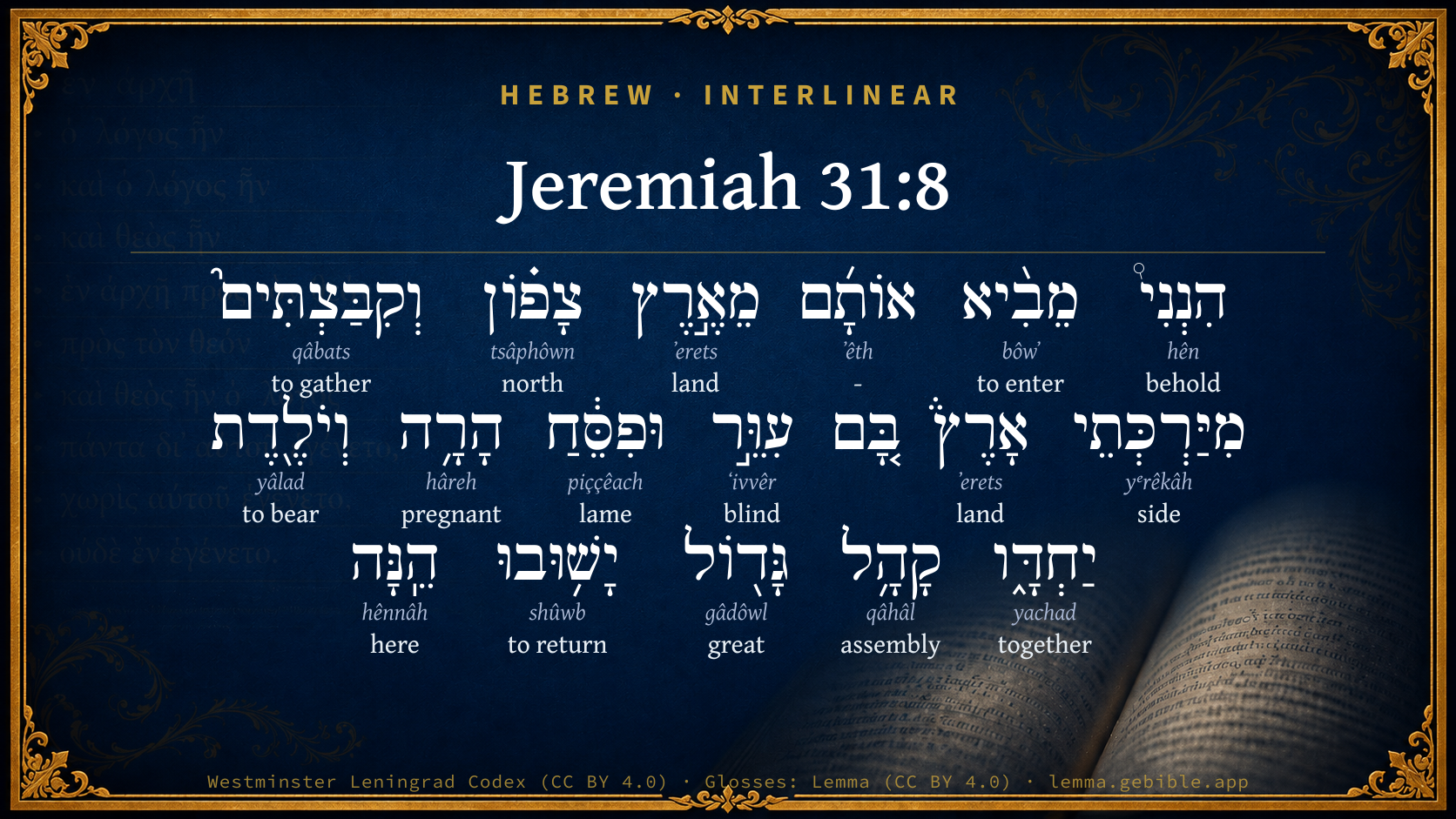
Jeremiah 31:8

Hebrew (Westminster Leningrad Codex) Jeremiah 31:8 appears in the Hebrew Old Testament. The text above is from the Westminster Leningrad Codex. Each word links to its Strong’s number, a concise gloss, and parsing drawn from the Open Scriptures Hebrew Bible morphology. Click any word for its full Brown-Driver-Briggs (BDB) entry.
Download image
Cite this verse

Jeremiah 31:8 (World English Bible). Public Domain. Lemma interlinear Bible study tool, https://lemma.gebible.app/v/jeremiah/31/8.

Show BibTeX & RIS
BibTeX
RIS
English Translation
Behold, I will bring them from the north country, and gather them from the uttermost parts of the earth, [and] with them the blind and the lame, the woman with child and her who travails with child together: a great company shall they return here.
World English Bible · Public Domain
Download a study sheet

One document with this verse’s original text, its word-by-word gloss line, the meaning frame, cross-references with their text, attributed commentary, and full source and license credits — printable, and it pastes into notes with its structure intact.

This verse Autodidact and up

Study sheet (.html) Plain text (.txt)

A passage Seminary Student

Up to 50 verses in one chapter. A passage sheet keeps up to 6 commentary sources and 12 cross-references per verse, in the order this page ranks them, and says so on the sheet whenever that leaves anything out. Ask for a single verse and you get the Autodidact verse sheet above.

Everything on this page stays free to read, with no account — the sheet is a download of what is already on screen, not access to it.

Want to remove ads? Support Godless Engineer
Compare translations 3

The same verse in 3 English versions, stacked beneath the original-language interlinear above. Click any original word for its lexicon entry.

Each is an independent rendering of the whole verse — the interlinear is not word-aligned to these translations.

Highlighted words mark where these versions differ — a whole-verse word diff, not a word-by-word alignment.

  • World English Bible Public Domain
    Behold, I will bring them from the north country, and gather them from the uttermost parts of the earth, [and] with them the blind and the lame, the woman with child and her who travails with child together: a great company shall they return here.
  • King James Version Public Domain
    Behold, I will bring them from the north country, and gather them from the coasts of the earth, and with them the blind and the lame, the woman with child and her that travaileth with child together: a great company shall return thither.
  • unfoldingWord Literal Text CC BY-SA 4.0
    See, I am about to bring them from the northern lands. I will gather them from the farthest parts of the earth. The blind and lame will be among them; pregnant women and those who are about to give birth will be with them. A great assembly will return here.

unfoldingWord Literal Text — © unfoldingWord, licensed CC BY-SA 4.0. Word-aligned USFM3 via Door43 (git.door43.org/unfoldingWord/en_ult).

Versions to compare (up to 4)

3 of 4 selected

Show all 18 translations

Every available English version of this verse, each an independent rendering of the whole verse.

  • World English Bible Public Domain
    Behold, I will bring them from the north country, and gather them from the uttermost parts of the earth, [and] with them the blind and the lame, the woman with child and her who travails with child together: a great company shall they return here.
  • Berean Standard Bible Public Domain
    Behold, I will bring them from the land of the north and gather them from the farthest parts of the earth, including the blind and the lame, expectant mothers and women in labor. They will return as a great assembly!
  • Majority Standard Bible Public Domain
    Behold, I will bring them from the land of the north and gather them from the farthest parts of the earth, including the blind and the lame, expectant mothers and women in labor. They will return as a great assembly!
  • King James Version Public Domain
    Behold, I will bring them from the north country, and gather them from the coasts of the earth, and with them the blind and the lame, the woman with child and her that travaileth with child together: a great company shall return thither.
  • American Standard Version (1901) Public Domain
    Behold, I will bring them from the north country, and gather them from the uttermost parts of the earth, `and' with them the blind and the lame, the woman with child and her that travaileth with child together: a great company shall they return hither.
  • Revised Version (1885) Public Domain
    Behold, I will bring them from the north country, and gather them from the uttermost parts of the earth, and with them the blind and the lame, the woman with child and her that travaileth with child together: a great company shall they return hither.
  • Geneva Bible (1599) Public Domain
    Beholde, I will bring them from the North countrey, and gather them from the coastes of the world, with the blinde and the lame among them, with the woman with childe, and her that is deliuered also: a great companie shall returne hither.
  • Douay-Rheims (1899) Public Domain
    Behold I will bring them from the north country, and will gather them from the ends of the earth: and among them shall be the blind, and the lame, the woman with child, and she that is bringing forth, together, a great company of them returning hither.
  • Young's Literal Translation Public Domain
    Lo, I am bringing them in from the north country, And have gathered them from the sides of the earth, Among them `are' blind and lame, Conceiving and travailing one -- together, A great assembly -- they turn back hither.
  • Literal Standard Version CC BY-SA 4.0
    Behold, I am bringing them in from the north country, || And have gathered them from the sides of the earth, || Blind and lame [are] among them, || Conceiving and travailing one—together, || A great assembly—they return here.
  • Unlocked Literal Bible CC BY-SA 4.0
    See, I am about to bring them from the northern lands. I will gather them from the farthest parts of the earth. The blind and lame will be among them; pregnant women and those who are about to give birth will be with them. A great assembly will return here.
  • unfoldingWord Literal Text CC BY-SA 4.0
    See, I am about to bring them from the northern lands. I will gather them from the farthest parts of the earth. The blind and lame will be among them; pregnant women and those who are about to give birth will be with them. A great assembly will return here.
  • Darby Bible Public Domain
    Behold, I bring them from the north country, and gather them from the uttermost parts of the earth; [and] among them the blind and the lame, the woman with child and her that travaileth with child together: a great assemblage shall they return hither.
  • World Messianic Bible Public Domain
    Behold, I will bring them from the north country, and gather them from the uttermost parts of the earth, along with the blind and the lame, the woman with child and her who travails with child together. They will return as a great company.
  • Webster's Bible Public Domain
    Behold, I will bring them from the north country, and gather them from the borders of the earth, and with them the blind and the lame, the woman with child and her that travaileth with child together: a great company shall return thither.
  • Free Bible Version CC BY-SA 4.0
    Watch, because I will bring them back from the land of the north and gather them from the ends of the earth. Everyone will return, even the blind and the lame, pregnant women, even mothers giving birth—a great gathering coming home,
  • Bible in Basic English Public Domain
    See, I will take them from the north country, and get them from the inmost parts of the earth, and with them the blind and the feeble-footed, the woman with child and her who is in birth-pains together: a very great army, they will come back here.
  • JPS Tanakh (1917) Public Domain
    Behold, I will bring them from the north country, and gather them from the uttermost parts of the earth, and with them the blind and the lame, the woman with child and her that travaileth with child together; a great company shall they return hither.

Literal Standard Version (2020), Covenant Press — licensed CC BY-SA 4.0. Text via the HelloAO Bible API (eBible.org). Unlocked Literal Bible (unfoldingWord) — licensed CC BY-SA 4.0. Text via the HelloAO Bible API (eBible.org). unfoldingWord Literal Text — © unfoldingWord, licensed CC BY-SA 4.0. Word-aligned USFM3 via Door43 (git.door43.org/unfoldingWord/en_ult). Free Bible Version, Dr. Jonathan Gallagher — licensed CC BY-SA 4.0. Text via the HelloAO Bible API (eBible.org).

Word by word

More ways to search: Search by grammar → Find every occurrence → Compare this word →

Practice this passage: Drill this verse → Learn its vocabulary →

וּפִסֵּ֔חַ
piççêach
H6455
“and · lame”
Conjunction + Adjective, Adjective, Masculine, Singular, Absolute
Part of Speech
Conjunction + Adjective
Type
Adjective
Gender
Masculine
Number
Singular
State
Absolute
Full BDB Definition

Origin: from H6452

TWOT: 1787a

lame
  1. הִנְנִי֩ hên H2005 “behold · me” Particle, Demonstrative + Suffix, Personal, 1st Person, Common, Singular
  2. מֵבִ֨יא bôwʼ H935 “entering” Verb, Hiphil, Participle Active, Masculine, Singular, Absolute
  3. אוֹתָ֜ם ʼêth H853 “- · them” Particle, Direct Object + Suffix, Personal, 3rd Person, Masculine, Plural
  4. מֵאֶ֣רֶץ ʼerets H776 “from · land of” Preposition + Noun, Common, Both, Singular, Construct
  5. צָפ֗וֹן tsâphôwn H6828 “north” Noun, Common, Feminine, Singular, Absolute
  6. וְקִבַּצְתִּים֮ qâbats H6908 “and · to gather · them” Conjunction + Verb, Piel, Sequential Perfect, 1st Person, Common, Singular + Suffix, Personal, 3rd Person, Masculine, Plural
  7. מִיַּרְכְּתֵי yᵉrêkâh H3411 “from · sides of” Preposition + Noun, Common, Feminine, Dual, Construct
  8. אָרֶץ֒ ʼerets H776 “land” Noun, Common, Both, Singular, Absolute
  9. עִוֵּ֣ר ʻivvêr H5787 “blind” Adjective, Adjective, Masculine, Singular, Absolute
  10. הָרָ֥ה hâreh H2030 “pregnant” Adjective, Adjective, Feminine, Singular, Absolute
  11. וְיֹלֶ֖דֶת yâlad H3205 “and · bearing” Conjunction + Verb, Qal, Participle Active, Feminine, Singular, Absolute
  12. יַחְדָּ֑ו yachad H3162 “together” Adverb
  13. קָהָ֥ל qâhâl H6951 “assembly” Noun, Common, Masculine, Singular, Absolute
  14. גָּד֖וֹל gâdôwl H1419 “great” Adjective, Adjective, Masculine, Singular, Absolute
  15. יָשׁ֥וּבוּ shûwb H7725 “to return” Verb, Qal, Imperfect, 3rd Person, Masculine, Plural
  16. הֵֽנָּה hênnâh H2008 “here” Adverb

About this verse

These counts appear in no published source. They are computed here, from the morphology-tagged text and Lemma’s own curated glosses. What Lemma adds →

18
words
16
distinct lemmas
Prophets
section

Notable vocabulary

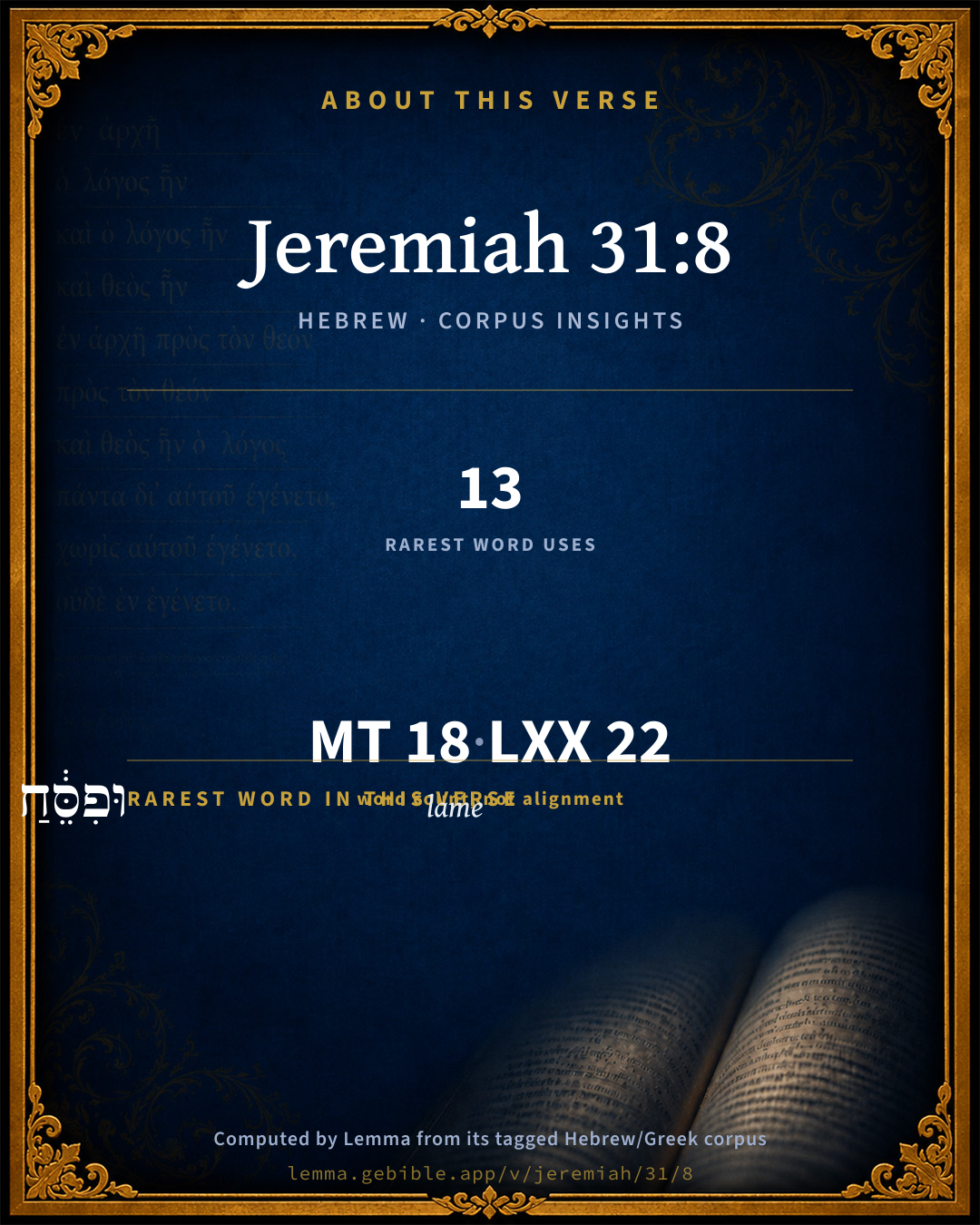
The rarest word here is וּפִסֵּ֔חַ lame H6455 — appearing just 13 times in the whole Hebrew Bible.

Shared distinctive vocabulary

וּפִסֵּ֔חַ lame H6455 occurs in 12 verses of the Hebrew Bible. Also found in:

Grammatical profile

  • 4 verbs
  • 5 nouns
  • 4 adjectives
  • 1 preposition
  • 2 adverbs
  • 2 particles

Verb forms

  • מֵבִ֨יא Hiphil · Participle Active
  • וְקִבַּצְתִּים֮ Piel · Sequential Perfect
  • וְיֹלֶ֖דֶת Qal · Participle Active
  • יָשׁ֥וּבוּ Qal · Imperfect

Repetition

A word recurs within this verse — often emphatic in Hebrew:

  • מֵאֶ֣רֶץ land H776 ×2

Hebrew & Septuagint length

In the original languages it is 18 Hebrew tokens and 22 Greek tokens — but the two are counted differently (Hebrew bundles its prefixes and suffixes into one token; the Greek is in lemma form), so that isn’t a like-for-like length.

Cross-references

26

Topical passages linked to Jeremiah 31:8 in the Treasury of Scripture Knowledge — connected by theme and wording, ordered by reader-vote popularity; previews shown in the World English Bible.

  • Ezekiel 34:16 I will seek that which was lost, and will bring back that which was driven away, and will bind up that which was broken, and will strengthen that which was sick: but the fat and the strong I will destroy; I will feed them in justice.
  • Isaiah 42:16 I will bring the blind by a way that they don't know; in paths that they don't know will I lead them; I will make darkness light before them, and crooked places straight. These things will I do, and I will not forsake them.
  • Jeremiah 23:8 but, As Yahweh lives, who brought up and who led the seed of the house of Israel out of the north country, and from all the countries where I had driven them. They shall dwell in their own land.
  • Micah 4:6 "In that day," says Yahweh, "I will assemble that which is lame, And I will gather that which is driven away, And that which I have afflicted;
  • Isaiah 40:11 He will feed his flock like a shepherd, he will gather the lambs in his arm, and carry them in his bosom, [and] will gently lead those who have their young.
  • Jeremiah 3:18 In those days the house of Judah shall walk with the house of Israel, and they shall come together out of the land of the north to the land that I gave for an inheritance to your fathers.
  • Ezekiel 34:13 I will bring them out from the peoples, and gather them from the countries, and will bring them into their own land; and I will feed them on the mountains of Israel, by the watercourses, and in all the inhabited places of the country.
  • Hebrews 12:12 Therefore, lift up the hands that hang down and the feeble knees,
  • Deuteronomy 30:4 If [any of] your outcasts are in the uttermost parts of the heavens, from there will Yahweh your God gather you, and from there will he bring you back:
  • Isaiah 43:6 I will tell the north, Give up; and to the south, Don't keep back; bring my sons from far, and my daughters from the end of the earth;
  • Isaiah 52:10 Yahweh has made bare his holy arm in the eyes of all the nations; and all the ends of the earth have seen the salvation of our God.
  • 1 Thessalonians 5:14 We exhort you, brothers, admonish the disorderly, encourage the fainthearted, support the weak, be patient toward all.
  • Matthew 12:20 He won't break a bruised reed. He won't quench a smoking flax, Until he leads justice to victory.
  • Hebrews 4:15 For we don't have a high priest who can't be touched with the feeling of our infirmities, but one who has been in all points tempted like we are, yet without sin.
  • Psalms 65:5 By awesome deeds of righteousness, you answer us, God of our salvation. You who are the hope of all the ends of the earth, Of those who are far away on the sea;
  • Psalms 98:3 He has remembered his loving kindness and his faithfulness toward the house of Israel. All the ends of the earth have seen the salvation of our God.
  • Psalms 107:3 And gathered out of the lands, From the east and from the west, From the north and from the south.
  • Isaiah 45:22 Look to me, and be you saved, all the ends of the earth; for I am God, and there is none else.
  • Jeremiah 3:12 Go, and proclaim these words toward the north, and say, Return, you backsliding Israel, says Yahweh; I will not look in anger on you; for I am merciful, says Yahweh, I will not keep [anger] forever.
  • Jeremiah 29:14 I will be found by you, says Yahweh, and I will turn again your captivity, and I will gather you from all the nations, and from all the places where I have driven you, says Yahweh; and I will bring you again to the place from where I caused you to be carried away captive.
  • Ezekiel 20:34 and I will bring you out from the peoples, and will gather you out of the countries in which you are scattered, with a mighty hand, and with an outstretched arm, and with wrath poured out;
  • Ezekiel 20:41 As a sweet savor will I accept you, when I bring you out from the peoples, and gather you out of the countries in which you have been scattered; and I will be sanctified in you in the sight of the nations.
  • Zephaniah 3:19 Behold, at that time I will deal with all those who afflict you, and I will save those who are lame, and gather those who were driven away. I will give them praise and honor, whose shame has been in all the earth.
  • Zechariah 2:6 Come! Come! Flee from the land of the north,' says Yahweh; 'for I have spread you abroad as the four winds of the sky,' says Yahweh.
  • 1 Corinthians 8:10 For if a man sees you who have knowledge sitting in an idol's temple, won't his conscience, if he is weak, be emboldened to eat things sacrificed to idols?
  • John 21:15 So when they had eaten their breakfast, Jesus said to Simon Peter, "Simon, son of Jonah, do you love me more than these?" He said to him, "Yes, Lord; you know that I have affection for you." He said to him, "Feed my lambs."

Cross-references courtesy of OpenBible.info (CC BY 4.0).

Hebrew and Greek witnesses Masoretic Hebrew ↔ Greek Septuagint

The same verse in the two great witnesses to the Old Testament, shown verse-for-verse.

These are two independent witnesses, not word-aligned to each other, and the Septuagint is shown in lemma (dictionary) form.

Hebrew Jeremiah 31:8 Masoretic · Westminster Leningrad Codex

הִנְנִי֩ מֵבִ֨יא אוֹתָ֜ם מֵאֶ֣רֶץ צָפ֗וֹן וְקִבַּצְתִּים֮ מִיַּרְכְּתֵי אָרֶץ֒ בָּ֚ם עִוֵּ֣ר וּפִסֵּ֔חַ הָרָ֥ה וְיֹלֶ֖דֶת יַחְדָּ֑ו קָהָ֥ל גָּד֖וֹל יָשׁ֥וּבוּ הֵֽנָּה

Behold, I will bring them from the north country, and gather them from the uttermost parts of the earth, [and] with them the blind and the lame, the woman with child and her who travails with child together: a great company shall they return here.

World English Bible · Public Domain

Greek LXX Structure differs

In the Septuagint, Jeremiah is about an eighth shorter than the Hebrew and arranges its material differently — the Oracles Against the Nations (Hebrew chapters 46–51) appear in the middle of the Greek book, after 25:13. Because the chapter and verse boundaries do not line up, a verse-for-verse comparison with the Hebrew is not shown.

A verse-for-verse comparison isn’t shown here because the chapters and verses don’t line up. Switch to the LXX edition with the MT / LXX toggle above to read the Greek directly.

On this verse, Joseph Benson's Commentary discusses the Septuagint’s reading. Read the note in Commentary ↓

Hebrew: Westminster Leningrad Codex (CC BY 4.0). Greek: Septuagint (public domain); English from a public-domain English Septuagint. How the Septuagint differs from the Hebrew →

Targum (Aramaic paraphrase)

1

The Targum is the ancient Jewish Aramaic paraphrase of the Hebrew Scriptures — an interpretive translation, not the Hebrew text itself. Onkelos (literal) and Pseudo-Jonathan (expansive) render the Torah, and Jonathan the Prophets. Coverage is partial: where no permissively-licensed English translation exists for a verse, only the Aramaic is shown. This is verse-level text, not a word-by-word alignment to the Hebrew.

  1. Targum Jonathan Prophets (Joshua–Malachi)
    הָאֲנָא מַיְתֵי לְהוֹן מֵאַרַע צִפּוּנָא וַאֲכַנְשִׁינוּן מִסְיָפֵי אַרְעָא דַהֲווֹ בְהוֹן עִוְרִין וְחִגְרִין יִסְגְיָן בְּהוֹן מְעִדְיָן וְיָלְדָן כַחֲדָא בְּמַשִׁרְיָן סַגִיאָן יְתוּבוּן הַלְכָא:

    I will give them from the land of the north and gather them from the ends of the earth. Among them will be the blind and the lame, the expectant mothers and women in labor. In great throngs they will return.

    Targum Jonathan — Aramaic: “Mikraot Gedolot” (public domain). English: “Sefaria Community Translation” (CC0 1.0 (public-domain dedication)); “London "Chaldee Paraphrase," 1871” (public domain). Text via Sefaria.

Commentary

Notes on Jeremiah 31:8 from classic Christian and Jewish commentators (each source and its license shown beneath its notes). The classic Christian expositions comment on the surrounding passage and are grouped to its opening verse, so a note may address several verses; the Jewish commentaries on the Tanakh (Rashi and others) are per-verse, so they appear only where the commentator wrote on this verse.

Lemma curates 59 commentaries, every one of them public domain or Creative Commons licensed, each selected and text-cleaned for this edition rather than reprinted as found. About our sources →

Trapp's Complete Commentary

John Trapp

Jer 31:8 Behold, I will bring them from the north country, and gather them from the coasts of the earth, [and] with them the blind and the lame, the woman with child and her that travaileth with child together: a great company shall return thither.

Ver. 8. Behold, I will bring them.] Here is a present answer to such a prayer; and this promise hath its performance chiefly in the kingdom of Christ, who will not suffer the least or the weakest of his to miscarry. See Isa 35:5-6.

John Trapp, A Commentary or Exposition upon All the Books of the Old and New Testament (1647–1656) — public domain. Text from a community e-Sword module.

Joseph Benson's Commentary

Jer 31:8-9. Behold, I will bring them from the north country — Here God himself undertakes to conduct home the remnant of his people from the countries through which they had been scattered; and the promise relates to the ten tribes, as well as to those of Judah and Benjamin; for Assyria and Media, whither they were removed, lay north of Judea as well as Babylon. And the following words speak of a general restoration of this people from their several dispersions; and with them the blind and the lame, &c. —

God will compassionate their infirmities, and will conduct them with all imaginable care and tenderness, and furnish the feeble and indigent of them with suitable accommodations. The prophet alludes to the care and compassion which God manifested in conducting his people, of all ages and conditions, through the wilderness, compared to the care with which a parent or nurse carries a tender child, Deu 1:31. See also Isa 40:11; Isa 49:10. They shall come with weeping — The LXX. translate the words, Εν κλαυθμω εξηλθον, και εν παρακλησει αναξω αυτους, they went forth with weeping, but with comfort will I bring them back; which sense agrees exactly with the words of Psa 136:5-6, which was composed upon occasion of the return from captivity, He that sows in tears shall reap in joy: he that goeth forth weeping, shall come again with rejoicing. Our translation, however, is much more agreeable to the original words, and is also confirmed by Jer 3:21, where we read, A voice was heard, weeping and supplications of the children of Israel; the prophet speaking upon the same subject, and in the same words here used. See also chap. Jer 50:4, where it is said, The children of Israel and Judah shall come together, going and weeping, and seek the Lord their God. All which words imply, that the Jews and Israelites, at the time of their general restoration, shall have their joy tempered with tears of repentance for their former miscarriages; which is more fully expressed Zec 12:10, where God promises to pour upon them the spirit of grace and supplication. I will cause them to walk by the rivers of waters — So that they shall not be afflicted with thirst, or the want of any accommodation in their journey. The words allude to God’s miraculously supplying the Israelites with water in the wilderness. See notes on Isa 35:6-7; Isa 41:17-18; Isa 49:10. In a straight way wherein they shall not stumble — This phrase is an allusion to God’s leading the Israelites through the Red sea, and afterward in the wilderness. See Isa 63:13; Isa 42:16. For I am a father to Israel — The remembrance of former connections is here mentioned as the motive of God’s returning favour to Israel. And Ephraim is my firstborn — Ephraim is often, as here, equivalent to Israel, especially when Israel denotes the ten tribes as distinct from Judah. He is termed the firstborn among the tribes of Israel; because the birthright which Reuben had forfeited was conferred upon the two sons of Joseph, of whom Ephraim had the precedence. “The reader will observe, that all this was but imperfectly verified in the return of the Jews from Babylon, but was fully made good in those who were made partakers of the gospel of Christ, in the miracles, in the preaching of the apostles, in the free grace and pardoning mercy of the Redeemer.”

Joseph Benson's Commentary on the Old and New Testaments (1811–1818) — public domain. Text from a community e-Sword module.

Tyndale Open Study Notes

Tyndale Open Resources

31:8 The Lord promised to gather the surviving exiles from wherever they were scattered without overlooking the weak and helpless. • The great company of exiles who returned in 538–536 BC numbered 49,697 (Ezra 2:64).

Tyndale Open Study Notes — © Tyndale Open Resources, licensed CC BY-SA 4.0. Text via the HelloAO Bible API.

Geneva Bible (1599)

Geneva Bible translators

He showeth what shall be the concord and love of all under the Gospel, when none shall be refused for their infirmities: and everyone shall exhort one another to embrace it.

Geneva Bible (1599) marginal notes — public domain. Text via Bolls.life.

Jamieson, Fausset & Brown

Robert Jamieson, A. R. Fausset & David Brown

north--Assyria, Media, &c. (see on Jer 3:12; Jer 3:18; Jer 23:8).

gather from . . . coasts of . . . earth-- (Eze 20:34, Eze 20:41; Eze 34:13).

blind . . . lame, &c.--Not even the most infirm and unfit persons for a journey shall be left behind, so universal shall be the restoration.

a great company--or, they shall return "in a great company" [MAURER].

Jamieson, Fausset & Brown — Commentary Critical and Explanatory on the Whole Bible (1871) — public domain (CC PDM 1.0). Text via the HelloAO Bible API.

Adam Clarke's Commentary

Verse 8. I will bring them from the north country] From Babylon.

From the coasts of the earth] The ten tribes were carried away partly into Assyria by Tiglath-pileser, and partly into Mesopotamia and Media by Shalmaneser, 2Kg 15:29; 2Kg 17:6. Assyria and Media, being very distant from Palestine, might have been called, in prophetic language, the coasts of the earth.

The blind and the lame] I will so effectually remove all difficulties out of the way, so provide for them on the journey, so supernaturally support their bodies and minds, that the veriest invalids shall safely proceed to, and happily arrive at, the end of their journey.

Adam Clarke's Commentary on the Bible (1810–1826) — public domain. Text from a community e-Sword/MySword module.

John Calvin's Commentaries

The Prophet again confirms the same truth, but with amplification. For this oracle is not only prefaced as having proceeded from God, but that the address might be more forcible, he introduces God himself as the speaker, Behold me restoring them from, the land of the north; for Babylon, as it is well known, was northward from Judea. And whenever the Prophets speak of the deliverance of the people, they ever name the north; as, also, when they threaten the people, they say that an army or a calamity was to come from the north. They had before been delivered from the south, for such was the situation of Egypt. The Prophet now intimates that God was furnished with power to liberate them again from the land of the north.

Then he says, and I will collect them from the sides of the earth: by sides, he means the extremities or the corners, so to speak, of the earth; as though he had said, that their dispersion would not prevent God from collecting his people.

Nearly the same promise was announced by Moses, though in other words, —

“Though thou wert dispersed through the four quarters of the world, I will yet from thence collect thee.” (Deuteronomy 30:4)

God there means that distance of places would be no obstacle to him, but that as soon as the fit time arrived, he would again collect his Church from its dispersion. We hence see what the Prophet understands by the sides of the earth. And he intended to obviate a doubt which might have depressed the minds of the people on seeing the body torn and deformed: “Eh! how can it be, that we can again come together?” In order then to remove this doubt, the Prophet says that God would come to collect his people again, not only from one corner, but also from the extreme regions of the earth.

He then adopts another mode of speaking, in order to shew that no impediment would be so strong as to exceed God’s power, when his purpose was to deliver his people: The blind, he says, and the lame, the pregnant, and the one in travail, shall come The blind cannot move a step without stumbling or falling; then the blind are by no means fit to undertake a journey, for there is no way which they can see as open for them; and the lame, when there is a way for them, cannot make any progress. But God promises that such would be their deliverance, that both the lame and the blind would participate of it. He then mentions the pregnant and women in childbed The pregnant, owing to the burden she carries, cannot undertake a long journey, and she that is recently confined, can hardly dare to leave her bed, being so debilitated by parturition; but God promises that the pregnant and the lately confined shall return with the rest; as though he had said, that there was no fear but that God would restore his Church, because his power was superior to all the impediments of the world, so that he could confirm the feeble, guide the blind, sustain the lame, and strengthen the pregnant and those lying in childbed.

Now, though the Prophet addressed this discourse to the ancient people, it yet contains a doctrine perpetually useful. We hence gather, that they act preposterously who estimate God’s favor according to present appearances. But this is a mistake almost inbred in us by nature, and engrosses all our thoughts and feelings. Hence arises want of confidence in God, and hence it also happens, that all God’s promises become frigid to us, or at least lose their just value. For when God promises anything, we look around us and inquire how it can be fulfilled; and if our minds cannot comprehend the way and manner, we reject what has proceeded from the mouth of God. Let us then attend to this prophetic doctrine; and when God seems to promise what surpasses our faith, nay, what appears to us by no means possible, let this doctrine come to our minds, and let it serve as a corrective to check our false thoughts, lest we, having our minds preoccupied by a false and preposterous opinion, should do wrong to the power of God. If, then, the deliverance which God promises seems incredible, as to our perceptions, let us remember that it is in his power to make the blind to see, the lame to walk, the pregnant and those lying in childbed, to undertake a journey; for he can by his power surmount all obstacles, so that we shall find our faith victorious, provided we learn to rely on God’s promises, and firmly rest on them. We now understand what use we ought to make of this prophecy. It follows afterwards —

John Calvin's Commentaries (1540-1563) — public domain. Text from the Calvin Translation Society English edition (1840s-50s) via the Christian Classics Ethereal Library (ccel.org). Calvin's coverage is partial (roughly two-thirds of the Bible); uncommented books and verses are honest gaps, never fabricated. The 19th-century editor's footnotes and remarks are omitted so the notes are faithfully Calvin's own voice.

Ellicott's Commentary for English Readers

(8) And with them the blind and the lame . . .—The vision of restoration continues, and the prophet sees in the spirit the great company of those that return. Even those who are commonly left behind in such an expedition, as incumbrances hindering its march, the blind, the lame, the women with child or in the very pangs of childbirth, will be seen in that company. None shall remain behind. They are to come from the land of the North, the wide range of the term covering the exiles both of Judah in Babylon and of Israel in the cities of the Medes. For “the coasts of the earth” see Note on Jer_25:32.

Shall return thither—i.e., to the land of Israel, as the goal of the company of travellers.

A Bible Commentary for English Readers, edited by Charles John Ellicott (1878–1897) — public domain. Text from a community e-Sword module.

The Cambridge Bible for Schools and Colleges

gen. ed. J. J. S. Perowne

8. The Lord’s reply to the joyous acclamation. Cp. Isa_42:16; Isa_40:11.

the blind and the lame, etc.] None shall be omitted. Even those who would naturally have most difficulty in travelling shall return.

hither] to Palestine, where the prophet is now writing.

The Cambridge Bible for Schools and Colleges (gen. ed. J. J. S. Perowne; Cambridge University Press, 1878–1918) — public domain. Text from a community e-Sword module.

John Gill's Exposition

Behold, I will bring them from the north country,.... As from Babylon, at the end of the seventy years' captivity, which lay north of Judea; so, in the latter day, from those northern countries, as ours, where they now are in great numbers:

and gather them from the coasts of the earth; or "sides" of it; from all the parts of the world where they are:

and with them the blind and the lame, the woman with child and her that travaileth with child together; signifying that no difficulties whatsoever should hinder them in their return to their own land; provision should be made for persons under these circumstances, so unfit to travel. All this may be understood, in a figurative sense, of those who are spiritually "blind"; who are made to see their lost estate, and need of Christ; and are brought to him, and to his church, in a way they had not known, and in paths they knew not before: and of the lame and impotent, unable to do any good thing in a spiritual sense, and will not come to Christ, unless drawn; these are made to leap as a hart, and to flee to Christ for refuge, and run the ways of his commandments: and of such who are laden and burdened, as "women with child"; and who are encouraged and enabled as such to come to Christ, and cast their burdens on him, and find rest for their souls: and of such who are in pain and distress, as one "that travaileth with child": in the pangs of the new birth, under a sense of wrath, and as ready to perish; who also are enabled to come and venture their souls on Christ, receive his Gospel, and submit to his ordinances, where they find peace and comfort:

a great company shall return thither; three thousand were converted under one sermon, in the first times of the Gospel; and, in the latter day, the nation of the Jews shall be born again at once; the number of the children of Israel shall then be as the sand of the sea, and great shall be the day of Jezreel, Isa 66:8.

John Gill's Exposition of the Whole Bible (1746–1763) — public domain (CC PDM 1.0). Text via the HelloAO Bible API.

Albert Barnes' Notes on the Bible

The coasts of the earth - See Jer 6:22 note.

Thither - Really, here. Not to the north country, but to Palestine, where Jeremiah wrote. A company is the word constantly used of Israel at the Exodus Exo 16:3 as an organized community.

Albert Barnes' Notes on the Bible (1834–1885) — public domain. Text from a community e-Sword/MySword module.

Haydock's Catholic Bible Commentary

Together. All shall hasten, and there shall be no impediment, Isaias xxxv. 5.

George Leo Haydock (1774–1849), Haydock's Catholic Family Bible and Commentary, 1859 edition — public domain. Excludes Psalms (Douay-Rheims chapter numbering differs from Protestant) and Deuterocanonical books (Catholic canon only).

Matthew Poole's English Annotations

By the north country, is unquestionably meant Babylon, and the land of the Chaldeans, and those places which were northward of Jerusalem; and by the

coasts of the earth, all other parts into which any of the Jews had been driven. The meaning of this is, that nothing should hinder such from returning as had a mind to return; blind men that could not see their way, and lame persons, who had no strength to walk in it, though they saw it, and women with child, in regard of their heaviness, and women travailing, in regard of their pain, are persons more unfit to travel long journeys than any others; but saith God, I will make such provision, that some under those circumstances shall come. That these phrases must be interpreted only into this general sense appears, because such persons in a literal sense could not come. And though some worthy interpreters understand it in a spiritual sense, of ignorant and impotent persons, and such as are laden with the burden of their sins, and of coming to Christ, it seems not to be the primary sense of the text.

Matthew Poole's English Annotations on the Holy Bible (1683–1685) — public domain. Text from a community e-Sword/MySword module.

Whedon's Commentary on the Bible

Daniel D. Whedon

8. The blind and the lame, the woman with child, etc. — Are mentioned as illustrating the completeness of the deliverance. Thither, should be hither.

Daniel D. Whedon (gen. ed.), Commentary on the Old and New Testaments (1874–1909) — public domain. Text from a community e-Sword module.

The Pulpit Commentary

The weakest among the Israelites will share the blessings with the strongest, even the blind and the lame. (comp. Isa_33:23, "The lame take the prey Elsewhere we are told that, in the Messianic age, "the eyes of the blind shall see," and "the lame man shall leap as a hart". (Isa_35:5, Isa_35:6) Shall return thither; rather, hither; i.e. to Palestine, where Jeremiah writes this prophecy. The word for company is hahal, the proper word in the Pentateuch for the Israelitish national "congregation.

Vers. 8, 9. God the Gatherer of his people.

I WHENCE HE GATHERS THEM. The place is spoken of very indefinitely, not from any doubt as to its reality, but because it was largely a terra incognita. It was the land away in the northward direction, but what its extent or what its power for mischief there were but few who could guess. One thing, however, was possible to consider in the days of exile, when the north country had become a sad actual experience, namely, how Jeremiah had been sent to speak joyful tidings as well as mournful ones with respect to the power of this north country. True, he had spoken again and again concerning the evil and the great destruction coming out of the north; but here is a word from the same man and under the same authority to say that the power of the north country is not to continue. God uses even great nations for his own purposes. There is indication that these powers of the north were astonished at their own success. "The kings of the earth, and all the inhabitants of the world, would not have believed that the adversary and the enemy should have entered into the gates of Jerusalem". (Lam_4:12) They were only the agents of God, and God could take his people out of their midst again when once the Exile had done its work. Distance is no difficulty. God can hinder or facilitate in a journey just as seems him best. Once he kept his people forty years in a journey from one land to another that, if he had chosen, might have been accomplished in a very short time.

II THOSE WHOM HE GATHERS. The Lord"s compassions fail not. To the young, the strong, the healthy, those perfect in body, nothing was needed but to say, "The time is come for return. Make your start." But then all were not so placed. The weaklings have ever to be considered, and God considers them, as it were, first of all. There are the blind God will keep them in the way; there are the lame God will provide that they be conveyed and sufficiently helped; there are women, with all their peculiar anxieties, who need to be dealt with very tenderly, and all grounds for alarm taken out of their way as far as possible. Well, God specifies these cases as representative of the provision he makes for every sort of weakness. It is the mark of God"s way for men that it is a way for the weak, a way in which provision is made for every sort of infirmity. There are ways in the world which are only for the strong; the weak soon get pushed aside. And God can bring all these weak people along, because the right spirit is in them. They come in weeping and in prayer. You can be eyes to a blind man, if he admits his blindness and is willing to be guided; but if he insists upon it that he can see, what are you to do with him? This is the only means by which God"s true people can be gathered into one way, moving with one purpose towards one place, namely, that they be each one of them from the very heart submitted to the Divine will and control.

III THE SPIRIT IN WHICH GOD GATHERS. The spirit of a father. Israel must needs go into exile and chastisement for a while; but the place left vacant is the child"s place, and none but the child can fill it. It is the evidence of a father"s tenderness that he cares for the blind and the lame and the weak. The house of Israel had said to a stock, "Thou art my father; and to a stone, Thou hast brought me forth." And their delusion had borne fruit in banishment and captivity. But the true Father remembered them all the time; and with the power of the true God and in the spirit of the true Father, he gathered them and guided them home. Y.

The Pulpit Commentary (1880–1919), ed. H.D.M. Spence-Jones & Joseph S. Exell — public domain. Text from a community e-Sword module.

unfoldingWord translationNotes

Door43 World Missions Community

General Information:

Yahweh continues speaking about how he will bring the Israelite people back from being captives in Babylon.

See

"Look" or "Listen" or "Pay attention to what I am about to tell you"

to bring them

"to bring the Israelite people"

I will lead them as they make their pleas

Yahweh will lead them and they will be praying to Yahweh. Some ancient versions read, "Yahweh will lead them and will comfort them."

I will be a father to Israel, and Ephraim will be my firstborn

Here "Ephraim" is another name for "Israel." AT: "I will be like a father to the people of Israel, and they will be like my firstborn child" (See: Metaphor and Metonymy)

my firstborn

The firstborn had special honor and responsibility.

translationWords

earth

assembly

ancestor

Ephraim

firstborn

unfoldingWord translationNotes — © Distant Shores Media and the Door43 World Missions Community, licensed CC BY-SA 4.0. Source: git.door43.org/Door43/en_tn.

Rashi

Rabbi Shlomo Yitzchaki (Rashi)

the blind and the lame amongst them Even the staggering ones among them I will not reject.

Rashi on the Tanakh — English translations: “The Judaica Press complete Tanach with Rashi, translated by A. J. Rosenberg” (CC BY 4.0); “Pentateuch with Rashi's commentary by M. Rosenbaum and A.M. Silbermann, 1929-1934” (public domain); “The Metsudah Tanach series, Lakewood, N.J” (CC BY 4.0); and “The Book of Joshua, Metsudah Publications, 1997” (CC BY 4.0). Text via Sefaria.

Lesson kit

Teaching starters — assembled from the data on this page, not authored interpretation. Every prompt links to the verse data it draws on. Edit before teaching.

Jeremiah, in the Prophets, opens this verse with 18 words (16 distinct Hebrew lemmas). Its most distinctive word is piççêach (“lame”). A historical commentator’s framing appears above. Read the whole chapter for the surrounding context.

Discussion questions

  1. How does “lame” (piççêach) shape what this verse is saying?
  2. How does Leviticus 21:18, which shares the word «lame», read alongside this verse?
  3. What does the repetition of “land” (2× in this one verse) do in this verse?
  4. These translations render this verse differently. What is at stake in choosing one wording over another?
  5. «מֵבִ֨יא» is a Hiphil Participle Active verb. How does that grammatical form shape the action described?
  6. Compare how Trapp's Complete Commentary and Joseph Benson's Commentary read this verse. Where do they agree or differ?

Things to notice

Reading settings

Reading text

Shown beneath each verse's original-language words.

Old Testament
Old Testament edition

Read the OT as the Masoretic Hebrew (MT) or the Greek Septuagint (LXX).

English shown for the Greek Septuagint (in the Hebrew ↔ Greek comparison).

Comparing translations? Open the Compare panel on any verse page to stack up to four side by side.