
Numbers 20:12

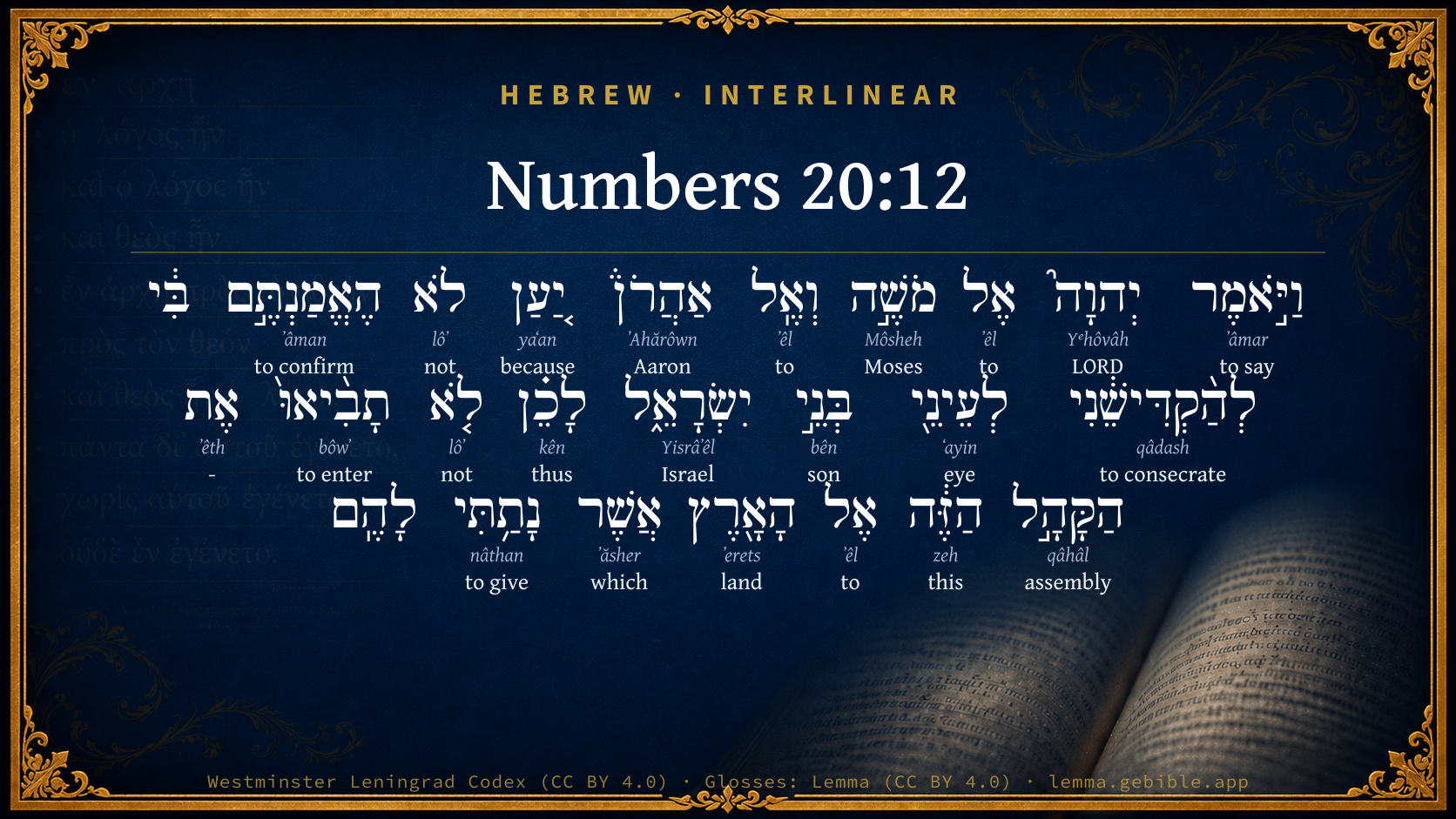
Hebrew (Westminster Leningrad Codex) Numbers 20:12 appears in the Hebrew Old Testament. The text above is from the Westminster Leningrad Codex. Each word links to its Strong’s number, a concise gloss, and parsing drawn from the Open Scriptures Hebrew Bible morphology. Click any word for its full Brown-Driver-Briggs (BDB) entry.
Download image
Cite this verse

Numbers 20:12 (World English Bible). Public Domain. Lemma interlinear Bible study tool, https://lemma.gebible.app/v/numbers/20/12.

Show BibTeX & RIS
BibTeX
RIS
English Translation
Yahweh said to Moses and Aaron, Because you didn't believe in me, to sanctify me in the eyes of the children of Israel, therefore you shall not bring this assembly into the land which I have given them.
World English Bible · Public Domain
Download a study sheet

One document with this verse’s original text, its word-by-word gloss line, the meaning frame, cross-references with their text, attributed commentary, and full source and license credits — printable, and it pastes into notes with its structure intact.

This verse Autodidact and up

Study sheet (.html) Plain text (.txt)

A passage Seminary Student

Up to 50 verses in one chapter. A passage sheet keeps up to 6 commentary sources and 12 cross-references per verse, in the order this page ranks them, and says so on the sheet whenever that leaves anything out. Ask for a single verse and you get the Autodidact verse sheet above.

Everything on this page stays free to read, with no account — the sheet is a download of what is already on screen, not access to it.

Want to remove ads? Support Godless Engineer
Compare translations 3

The same verse in 3 English versions, stacked beneath the original-language interlinear above. Click any original word for its lexicon entry.

Each is an independent rendering of the whole verse — the interlinear is not word-aligned to these translations.

Highlighted words mark where these versions differ — a whole-verse word diff, not a word-by-word alignment.

  • World English Bible Public Domain
    Yahweh said to Moses and Aaron, Because you didn't believe in me, to sanctify me in the eyes of the children of Israel, therefore you shall not bring this assembly into the land which I have given them.
  • King James Version Public Domain
    And the LORD spake unto Moses and Aaron, Because ye believed me not, to sanctify me in the eyes of the children of Israel, therefore ye shall not bring this congregation into the land which I have given them.
  • unfoldingWord Literal Text CC BY-SA 4.0
    And Yahweh said to Moses and to Aaron, “Because you did not believe in me to consecrate me to the eyes of the sons of Israel, therefore you will not bring this assembly to the land that I have given to them.”

unfoldingWord Literal Text — © unfoldingWord, licensed CC BY-SA 4.0. Word-aligned USFM3 via Door43 (git.door43.org/unfoldingWord/en_ult).

Versions to compare (up to 4)

3 of 4 selected

Show all 18 translations

Every available English version of this verse, each an independent rendering of the whole verse.

  • World English Bible Public Domain
    Yahweh said to Moses and Aaron, Because you didn't believe in me, to sanctify me in the eyes of the children of Israel, therefore you shall not bring this assembly into the land which I have given them.
  • Berean Standard Bible Public Domain
    But the LORD said to Moses and Aaron, “Because you did not trust Me to show My holiness in the sight of the Israelites, you will not bring this assembly into the land that I have given them.”
  • Majority Standard Bible Public Domain
    But the LORD said to Moses and Aaron, “Because you did not trust Me to show My holiness in the sight of the Israelites, you will not bring this assembly into the land that I have given them.”
  • King James Version Public Domain
    And the LORD spake unto Moses and Aaron, Because ye believed me not, to sanctify me in the eyes of the children of Israel, therefore ye shall not bring this congregation into the land which I have given them.
  • American Standard Version (1901) Public Domain
    And Jehovah said unto Moses and Aaron, Because ye believed not in me, to sanctify me in the eyes of the children of Israel, therefore ye shall not bring this assembly into the land which I have given them.
  • Revised Version (1885) Public Domain
    And the LORD said unto Moses and Aaron, Because ye believed not in me, to sanctify me in the eyes of the children of Israel, therefore ye shall not bring this assembly into the land which I have given them.
  • Geneva Bible (1599) Public Domain
    Againe the Lord spake vnto Moses, and to Aaron, Because ye beleeued me not, to sanctifie mee in the presence of the children of Israel, therefore ye shall not bring this Congregation into the land which I haue giuen them.
  • Douay-Rheims (1899) Public Domain
    And the Lord said to Moses and Aaron: Because you have not believed me, to sanctify me before the children of Israel, you shall not bring these people into the land, which I will give them.
  • Young's Literal Translation Public Domain
    And Jehovah saith unto Moses, and unto Aaron, `Because ye have not believed in Me to sanctify Me before the eyes of the sons of Israel, therefore ye do not bring in this assembly unto the land which I have given to them.'
  • Literal Standard Version CC BY-SA 4.0
    And YHWH says to Moses and to Aaron, “Because you have not believed in Me to sanctify Me before the eyes of the sons of Israel, therefore you do not bring in this assembly to the land which I have given to them.”
  • Unlocked Literal Bible CC BY-SA 4.0
    Then Yahweh said to Moses and Aaron, “Because you did not trust me or honor me as holy in the eyes of the people of Israel, you will not bring this assembly into the land I have given them.”
  • unfoldingWord Literal Text CC BY-SA 4.0
    And Yahweh said to Moses and to Aaron, “Because you did not believe in me to consecrate me to the eyes of the sons of Israel, therefore you will not bring this assembly to the land that I have given to them.”
  • Darby Bible Public Domain
    And Jehovah said to Moses and to Aaron, Because ye believed me not, to hallow me before the eyes of the children of Israel, therefore ye shall not bring this congregation into the land that I have given them.
  • World Messianic Bible Public Domain
    The LORD said to Moses and Aaron, “Because you didn’t believe in me, to sanctify me in the eyes of the children of Israel, therefore you shall not bring this assembly into the land which I have given them.”
  • Webster's Bible Public Domain
    And the LORD spoke to Moses and Aaron, Because ye believed me not, to sanctify me in the eyes of the children of Israel, therefore ye shall not bring this congregation into the land which I have given them.
  • Free Bible Version CC BY-SA 4.0
    But the Lord told Moses and Aaron, “Because you didn't trust me enough to demonstrate how holy I am to the Israelites, you will not be the ones to lead them into the country I've given them.”
  • Bible in Basic English Public Domain
    Then the Lord said to Moses and Aaron, Because you had not enough faith in me to keep my name holy before the children of Israel, you will not take this people into the land which I have given them.
  • JPS Tanakh (1917) Public Domain
    And the LORD said unto Moses and Aaron: 'Because ye believed not in Me, to sanctify Me in the eyes of the children of Israel, therefore ye shall not bring this assembly into the land which I have given them.'

Literal Standard Version (2020), Covenant Press — licensed CC BY-SA 4.0. Text via the HelloAO Bible API (eBible.org). Unlocked Literal Bible (unfoldingWord) — licensed CC BY-SA 4.0. Text via the HelloAO Bible API (eBible.org). unfoldingWord Literal Text — © unfoldingWord, licensed CC BY-SA 4.0. Word-aligned USFM3 via Door43 (git.door43.org/unfoldingWord/en_ult). Free Bible Version, Dr. Jonathan Gallagher — licensed CC BY-SA 4.0. Text via the HelloAO Bible API (eBible.org).

Word by word

More ways to search: Search by grammar → Find every occurrence → Compare this word →

Practice this passage: Drill this verse → Learn its vocabulary →

יַ֚עַן
yaʻan
H3282
“because”
Conjunction
Part of Speech
Conjunction
Full BDB Definition

Origin: from an unused root meaning to pay attention

TWOT: 1650e

because, therefore, because that, on account of (conjunction) - because of, on account of (preposition) - why (with interrogative pronoun) (preposition)
  1. וַיֹּ֣אמֶר ʼâmar H559 “and · to say” Conjunction + Verb, Qal, Sequential Imperfect, 3rd Person, Masculine, Singular
  2. יְהוָה֮ Yᵉhôvâh H3068 “LORD” Noun, Proper
  3. אֶל ʼêl H413 “to” Preposition
  4. מֹשֶׁ֣ה Môsheh H4872 “Moses” Noun, Proper
  5. וְאֶֽל ʼêl H413 “and · to” Conjunction + Preposition
  6. אַהֲרֹן֒ ʼAhărôwn H175 “Aaron” Noun, Proper
  7. לֹא lôʼ H3808 “not” Particle, Negative
  8. הֶאֱמַנְתֶּ֣ם ʼâman H539 “to confirm” Verb, Hiphil, Perfect, 2nd Person, Masculine, Plural
  9. לְהַ֨קְדִּישֵׁ֔נִי qâdash H6942 “to consecrate · me” Preposition + Verb, Hiphil, Infinitive Construct + Suffix, Personal, 1st Person, Common, Singular
  10. לְעֵינֵ֖י ʻayin H5869 “to/for · eyes of” Preposition + Noun, Common, Both, Dual, Construct
  11. בְּנֵ֣י bên H1121 “sons of” Noun, Common, Masculine, Plural, Construct
  12. יִשְׂרָאֵ֑ל Yisrâʼêl H3478 “Israel” Noun, Proper
  13. לָכֵ֗ן kên H3651 “to/for · thus” Preposition + Adverb
  14. לֹ֤א lôʼ H3808 “not” Particle, Negative
  15. תָבִ֨יאוּ֙ bôwʼ H935 “to enter” Verb, Hiphil, Imperfect, 2nd Person, Masculine, Plural
  16. אֶת ʼêth H853 “-” Particle, Direct Object
  17. הַקָּהָ֣ל qâhâl H6951 “the · assembly” Particle, Definite Article + Noun, Common, Masculine, Singular, Absolute
  18. הַזֶּ֔ה zeh H2088 “the · this” Particle, Definite Article + Pronoun, Demonstrative, Masculine, Singular
  19. אֶל ʼêl H413 “to” Preposition
  20. הָאָ֖רֶץ ʼerets H776 “the · land” Particle, Definite Article + Noun, Common, Both, Singular, Absolute
  21. אֲשֶׁר ʼăsher H834 “which” Particle, Relative
  22. נָתַ֥תִּי nâthan H5414 “to give” Verb, Qal, Perfect, 1st Person, Common, Singular

About this verse

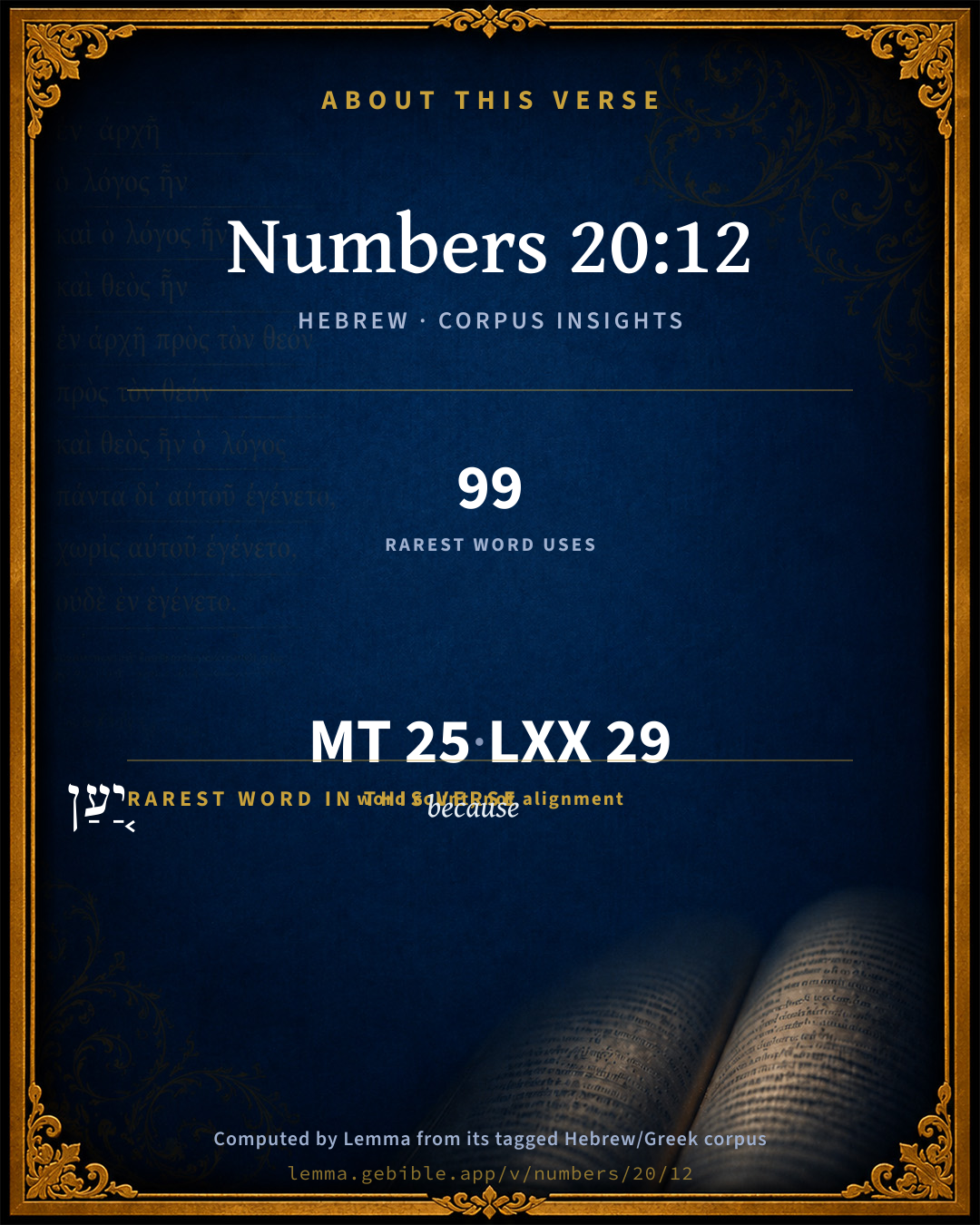
These counts appear in no published source. They are computed here, from the morphology-tagged text and Lemma’s own curated glosses. What Lemma adds →

25
words
20
distinct lemmas
Pentateuch
section

Grammatical profile

  • 5 verbs
  • 8 nouns
  • 1 pronoun
  • 5 prepositions
  • 1 conjunction
  • 1 adverb
  • 4 particles

Verb forms

  • וַיֹּ֣אמֶר Qal · Sequential Imperfect
  • הֶאֱמַנְתֶּ֣ם Hiphil · Perfect
  • לְהַ֨קְדִּישֵׁ֔נִי Hiphil · Infinitive Construct
  • תָבִ֨יאוּ֙ Hiphil · Imperfect
  • נָתַ֥תִּי Qal · Perfect

Repetition

Words recur within this verse — often emphatic in Hebrew:

Hebrew & Septuagint length

In English translation the verse runs 38 words from the Hebrew and 37 from the Septuagint (LXX English) — closely comparable.

A rough comparison of the two English renderings, which tokenize alike — not a word-level alignment.

Word counts can differ between the Hebrew and the Greek without any difference in meaning — e.g. the Hebrew direct-object marker אֵת has no separate Greek word, and Greek often adds the article ὁ.

In the original languages it is 25 Hebrew tokens and 29 Greek tokens — but the two are counted differently (Hebrew bundles its prefixes and suffixes into one token; the Greek is in lemma form), so that isn’t a like-for-like length.

Cross-references

22

Topical passages linked to Numbers 20:12 in the Treasury of Scripture Knowledge — connected by theme and wording, ordered by reader-vote popularity; previews shown in the World English Bible.

  • Deuteronomy 1:37 Also Yahweh was angry with me for your sakes, saying, You also shall not go in there:
  • Numbers 27:14 because you rebelled against my word in the wilderness of Zin, in the strife of the congregation, to sanctify me at the waters before their eyes. (These are the waters of Meribah of Kadesh in the wilderness of Zin.)
  • Ezekiel 36:23 I will sanctify my great name, which has been profaned among the nations, which you have profaned in the midst of them; and the nations shall know that I am Yahweh, says the Lord Yahweh, when I shall be sanctified in you before their eyes.
  • Numbers 20:24 Aaron shall be gathered to his people; for he shall not enter into the land which I have given to the children of Israel, because you rebelled against my word at the waters of Meribah.
  • Deuteronomy 3:23–27 I begged Yahweh at that time, saying,
  • Deuteronomy 32:49–51 Go up into this mountain of Abarim, to Mount Nebo, which is in the land of Moab, that is over against Jericho; and see the land of Canaan, which I give to the children of Israel for a possession;
  • Deuteronomy 34:4 Yahweh said to him, This is the land which I swore to Abraham, to Isaac, and to Jacob, saying, I will give it to your seed: I have caused you to see it with your eyes, but you shall not go over there.
  • Joshua 1:2 Moses my servant is dead; now therefore arise, go over this Jordan, you, and all this people, to the land which I do give to them, even to the children of Israel.
  • Isaiah 8:13 Yahweh of hosts, him shall you sanctify; and let him be your fear, and let him be your dread.
  • Matthew 17:20 He said to them, "Because of your unbelief. For most assuredly I tell you, if you have faith as a grain of mustard seed, you will tell this mountain, 'Move from here to there,' and it will move; and nothing will be impossible for you.
  • Luke 1:20 Behold, you will be silent and not able to speak, until the day that these things will happen, because you didn't believe my words, which will be fulfilled in their proper time."
  • Luke 1:45 Blessed is she who believed, for there will be a fulfillment of the things which have been spoken to her from the Lord!"
  • Romans 4:20 Yet, looking to the promise of God, he didn't waver through unbelief, but grew strong through faith, giving glory to God,
  • Leviticus 10:3 Then Moses said to Aaron, "This is what Yahweh spoke of, saying, "'I will show myself holy to those who come near me, And before all the people I will be glorified.'" Aaron held his peace.
  • Numbers 11:15 If you deal thus with me, please kill me out of hand, if I have found favor in your sight; and let me not see my wretchedness.
  • Numbers 11:21–22 Moses said, The people, among whom I am, are six hundred thousand footmen; and you have said, I will give them flesh, that they may eat a whole month.
  • 2 Chronicles 20:20 They rose early in the morning, and went forth into the wilderness of Tekoa: and as they went forth, Jehoshaphat stood and said, Hear me, Judah, and you inhabitants of Jerusalem: believe in Yahweh your God, so shall you be established; believe his prophets, so shall you prosper.
  • Isaiah 7:9 and the head of Ephraim is Samaria, and the head of Samaria is Remaliah's son. If you will not believe, surely you shall not be established.'"
  • Ezekiel 20:41 As a sweet savor will I accept you, when I bring you out from the peoples, and gather you out of the countries in which you have been scattered; and I will be sanctified in you in the sight of the nations.
  • Matthew 17:17 Jesus answered, "Faithless and perverse generation! How long will I be with you? How long will I bear with you? Bring him here to me."
  • John 1:17 For the law was given through Moses. Grace and truth came through Jesus Christ.
  • 1 Peter 3:15 But sanctify the Lord God in your hearts; and always be ready to give an answer to everyone who asks you a reason concerning the hope that is in you, with humility and fear:

Cross-references courtesy of OpenBible.info (CC BY 4.0).

Hebrew and Greek witnesses Masoretic Hebrew ↔ Greek Septuagint

The same verse in the two great witnesses to the Old Testament, shown verse-for-verse.

These are two independent witnesses, not word-aligned to each other, and the Septuagint is shown in lemma (dictionary) form.

Hebrew Numbers 20:12 Masoretic · Westminster Leningrad Codex

וַיֹּ֣אמֶר יְהוָה֮ אֶל מֹשֶׁ֣ה וְאֶֽל אַהֲרֹן֒ יַ֚עַן לֹא הֶאֱמַנְתֶּ֣ם בִּ֔י לְהַ֨קְדִּישֵׁ֔נִי לְעֵינֵ֖י בְּנֵ֣י יִשְׂרָאֵ֑ל לָכֵ֗ן לֹ֤א תָבִ֨יאוּ֙ אֶת הַקָּהָ֣ל הַזֶּ֔ה אֶל הָאָ֖רֶץ אֲשֶׁר נָתַ֥תִּי לָהֶֽם

Yahweh said to Moses and Aaron, Because you didn't believe in me, to sanctify me in the eyes of the children of Israel, therefore you shall not bring this assembly into the land which I have given them.

World English Bible · Public Domain

Greek LXX Numbers 20:12 Septuagint · lemma form

καί εἶπον κύριος πρός μωυσῆς καί ἀαρών ὅτι οὐ πιστεύω ἁγιάζω ἐγώ ἐναντίον υἱός ἰσραήλ διά οὗτος οὐ εἰςἄγω σύ ὁ συναγωγή οὗτος εἰς ὁ γῆ ὅς δίδωμι αὐτός

And the Lord said to Moses and Aaron, Because you⌃ have not believed me to sanctify me before the children of Israel, therefore you⌃ shall not bring this congregation into the land which I have given them.

LXX2012 (modern English Septuagint) · Public Domain

Hebrew: Westminster Leningrad Codex (CC BY 4.0). Greek: Septuagint (public domain); English from LXX2012 (modern English Septuagint) (Public Domain). How the Septuagint differs from the Hebrew →

Targum (Aramaic paraphrase)

2

The Targum is the ancient Jewish Aramaic paraphrase of the Hebrew Scriptures — an interpretive translation, not the Hebrew text itself. Onkelos (literal) and Pseudo-Jonathan (expansive) render the Torah, and Jonathan the Prophets. Coverage is partial: where no permissively-licensed English translation exists for a verse, only the Aramaic is shown. This is verse-level text, not a word-by-word alignment to the Hebrew.

  1. Targum Onkelos Torah (Genesis–Deuteronomy)
    וַאֲמַר יְיָ לְמשֶׁה וּלְאַהֲרֹן חֲלַף דִי לָא הֵימַנְתּוּן בְּמֵימְרִי לְקַדָשׁוּתִי לְעֵינֵי בְּנֵי יִשְׂרָאֵל בְּכֵן לָא תֵעֲלוּן יָת קְהָלָא הָדֵין לְאַרְעָא דִי יְהָבִית לְהוֹן

    (no public-domain English translation for this verse)

    Targum Onkelos — Aramaic: “Onkelos Genesis” (public domain); “Onkelos Exodus” (public domain); “Onkelos Leviticus” (public domain); “Onkelos Numbers” (public domain); “Onkelos Deuteronomy” (public domain). English: “Sefaria Community Translation” (CC0 1.0 (public-domain dedication)); “J.W. Etheridge. The Targums of Onkelos and Jonathan Ben Uzziel on the Pentateuch. London: Longmans, Green, 1862” (public domain). Text via Sefaria.

  2. Targum Pseudo-Jonathan Torah (Genesis–Deuteronomy)
    וַאֲמַר יְיָ לְמשֶׁה וּלְאַהֲרן בִּשְׁבוּעֲתָא חוּלַף דְלָא הֵימַנְתּוּן בְּמֵימְרִי לְקַדָשׁוּתִי לְמֶחֱמֵיהוֹן בִּבְנֵי יִשְרָאֵל בְּגִין כֵּן לָא תְהַנְעֲלוּן יַת קְהָלָא הָדֵין לְאַרְעָא דִי אֶתֵּן לְהוֹן

    But the Lord spake to Mosheh and Aharon with the oath, Because ye have not believed in My Word, to sanctify Me in the sight of the children of Israel, therefore you shall not bring this congregation into the land that I will give them.

    Targum Pseudo-Jonathan — Aramaic: “Targum Jonathan on Genesis” (public domain); “Targum Jonathan on Exodus” (public domain); “Targum Jonathan on Leviticus” (public domain); “Targum Jonathan on Numbers” (public domain); “Targum Jonathan on Deuteronomy” (public domain). English: “The Targum of Jonathan ben Uzziel, trans. J. W. Etheridge, London, 1862” (public domain). Text via Sefaria.

Commentary

Notes on Numbers 20:12 from classic Christian and Jewish commentators (each source and its license shown beneath its notes). The classic Christian expositions comment on the surrounding passage and are grouped to its opening verse, so a note may address several verses; the Jewish commentaries on the Tanakh (Rashi and others) are per-verse, so they appear only where the commentator wrote on this verse.

Lemma curates 59 commentaries, every one of them public domain or Creative Commons licensed, each selected and text-cleaned for this edition rather than reprinted as found. About our sources →

Ellicott's Commentary for English Readers

(12) And the Lord spake unto Moses and Aaron.—We read in Psa_106:33 that the Israelites “provoked (literally, made to rebel) his spirit, so that he spake unadvisedly with his lips.” Whatever was the nature of the sin thus committed, it is clear that Aaron was a participator in it with Moses. Some have thought that the sin of Moses consisted in addressing the people as rebels (or as rebellious ones); but this is the charge repeatedly brought against them in the book of Deuteronomy (see Num_1:26; Num_1:43; Num_9:23; Num_31:27), under circumstances in which it is impossible to suppose that Moses committed the same sin. It has also been thought that the sin of Moses and Aaron consisted in arrogating to themselves the honour which was due only to God. “Must we fetch you water?” but the personal pronoun does not occur in the Hebrew, as it might, and probably would, have occurred, if intended to be emphatic. The more probable explanation appears to be that, notwithstanding the miraculous supply of water which had begun at Rephidim, and which had been subsequently continued, Moses and Aaron distrusted the word and power (Num_20:12) of God, and that they yielded to the impulse of impatience and anger, as betrayed both by the language which they used and by the double smiting of the rock, to which Moses had been commanded only to speak. To what degree Aaron was concerned in these sins can be inferred only from the facts that he, as well as Moses, was charged with the sin of unbelief, and that the punishment of exclusion from the land of Canaan was inflicted upon both.

(12) Therefore ye shall not bring this congregation . . . —In Num_14:30 Caleb and Joshua are mentioned as the only exceptions to the general sentence of exclusion pronounced against the generation which had come out of Egypt, and which consisted of those who were above twenty years of age. It does not appear, however, from that passage whether the sentence pronounced against Moses and Aaron had, or had not, been delivered at that time, inasmuch as they were the speakers on that occasion, and they belonged to the tribe of Levi, which was not included in the numbering to which reference is made in Num_20:29.

A Bible Commentary for English Readers, edited by Charles John Ellicott (1878–1897) — public domain. Text from a community e-Sword module.

Trapp's Complete Commentary

John Trapp

Num 20:12 And the LORD spake unto Moses and Aaron, Because ye believed me not, to sanctify me in the eyes of the children of Israel, therefore ye shall not bring this congregation into the land which I have given them.

Ver. 12. Because ye believed me not.] Ye could not conceive, and were not very willing, that I should show such favour to so undeserving a people: so measuring my thoughts by your thoughts, and my ways by your ways; {Isa 55:8} casting me into a dishonourable mould, as it were; and this publicly, before all the people.

Therefore ye shall not bring.] So God was unto them "a God that forgiveth, and taketh vengeance of their practices," as the psalmist saith. {Psa 99:8} Repentance may come too late in regard of temporal chastisement, as here it did. {Deu 3:24-26}

John Trapp, A Commentary or Exposition upon All the Books of the Old and New Testament (1647–1656) — public domain. Text from a community e-Sword module.

Joseph Benson's Commentary

Num 20:12. Ye believed me not — But showed your infidelity; which they did, either by smiting the rock, and that twice, which is emphatically noted, as if they doubted whether once smiting would have done it; whereas, they were not commanded to smite so much as once, but only to speak to it: or, by the doubtfulness of these words, (Num 20:10,) Must we fetch water out of the rock? which implied a suspicion of it; whereas they should have spoken positively and confidently to the rock to give forth water. And yet they did not doubt of the power of God, but of his will, whether he would gratify these rebels with this further miracle, after so many of the like kind. To sanctify me — To give me the glory of my power in doing this miracle, and of my truth in punctually fulfilling my promise, and of my goodness in doing it, notwithstanding the people’s perverseness. In the eyes of Israel — This made their sin a cause of stumbling to the Israelites, who of themselves were too prone to infidelity; and, to prevent the contagion, God leaves a monument of his displeasure upon them, and inflicts a punishment as public as their sin.

Joseph Benson's Commentary on the Old and New Testaments (1811–1818) — public domain. Text from a community e-Sword module.

Geneva Bible (1599)

Geneva Bible translators

That the children of Israel should believe, and acknowledge my power, and so honor me.

Geneva Bible (1599) marginal notes — public domain. Text via Bolls.life.

Jamieson, Fausset & Brown

Robert Jamieson, A. R. Fausset & David Brown

The Lord spake unto Moses and Aaron, Because ye believed me not, &c.--The act of Moses in smiting twice betrayed a doubt, not of the power, but of the will of God to gratify such a rebellious people, and his exclamation seems to have emanated from a spirit of incredulity akin to Sarai's (Gen 18:13). These circumstances indicate the influence of unbelief, and there might have been others unrecorded which led to so severe a chastisement.

Jamieson, Fausset & Brown — Commentary Critical and Explanatory on the Whole Bible (1871) — public domain (CC PDM 1.0). Text via the HelloAO Bible API.

Adam Clarke's Commentary

Verse 12. Because ye believed me not] What was the offence for which Moses was excluded from the promised land? It appears to have consisted in some or all of the following particulars:

1. God had commanded him (Nu 20:8) to take the rod in his hand, and go and SPEAK TO THE ROCK, and it should give forth water. It seems Moses did not think speaking would be sufficient, therefore he smote the rock without any command so to do.

2. He did this twice, which certainly in this case indicated a great perturbation of spirit, and want of attention to the presence of God.

3. He permitted his spirit to be carried away by a sense of the people's disobedience, and thus, being provoked, he was led to speak unadvisedly with his lips: Hear now, ye REBELS, Nu 20:10.

4. He did not acknowledge GOD in the miracle which was about to be wrought, but took the honour to himself and Aaron: "Must WE fetch you water out of this rock?"

Thus it plainly appears that they did not properly believe in God, and did not honour him in the sight of the people; for in their presence they seem to express a doubt whether the thing could be possibly done. As Aaron appears to have been consenting in the above particulars, therefore he is also excluded from the promised land.

Adam Clarke's Commentary on the Bible (1810–1826) — public domain. Text from a community e-Sword/MySword module.

The Cambridge Bible for Schools and Colleges

gen. ed. J. J. S. Perowne

12. Had Moses and Aaron shewn a true faith they would have been the means of exhibiting God’s holiness before the eyes of the people. By their unbelief they detracted from it.

The Cambridge Bible for Schools and Colleges (gen. ed. J. J. S. Perowne; Cambridge University Press, 1878–1918) — public domain. Text from a community e-Sword module.

John Gill's Exposition

This is the water of Meribah,.... Or "strife": this is the name by which the water had in this place, and from this rock, was called; and which is the same name given to the place at Horeb, where a rock had been smitten, and water had flowed, as now, the first year they came out of Egypt; and to distinguish this from that, this is sometimes called Meribah-Kadesh, Deu 32:51, this being at Kadesh, as that was at Rephidim:

because the children of Israel strove with the Lord: for their chiding and striving with Moses was interpretatively striving with the Lord himself, whose ministers and servants they were:

and he was sanctified in them; that is, the glory of his divine perfections was displayed in them; either in the waters fetched out of the rock, which was a proof of the almighty power of God, and of his truth and faithfulness to his promises; or in the children of Israel, in whose sight, and for whose sake this miracle was wrought: the Targum of Jonathan expressly says, in Moses and Aaron, in not sparing these his saints, but expressing severity towards them for their sin; so Jarchi and Aben Ezra interpret it.

John Gill's Exposition of the Whole Bible (1746–1763) — public domain (CC PDM 1.0). Text via the HelloAO Bible API.

Haydock's Catholic Bible Commentary

You have not believed, &c. The fault of Moses and Aaron, on this occasion, was a certain diffidence and weakness of faith: not doubting of God’s power or veracity; but apprehending the unworthiness of that rebellious and incredulous people, and therefore speaking with some ambiguity. (Challoner) --- St. Augustine (contra Faust. xvi. 16,) does not think them guilty of any grievous crime. (Menochius) --- But this must be left undetermined. (Calmet) --- Land, beyond the Jordan, which is described (chap. xxxiv. 2,) as the land of promise, though the east side of the Jordan was so too. (Haydock)

George Leo Haydock (1774–1849), Haydock's Catholic Family Bible and Commentary, 1859 edition — public domain. Excludes Psalms (Douay-Rheims chapter numbering differs from Protestant) and Deuterocanonical books (Catholic canon only).

Matthew Poole's English Annotations

Ye believed me not, but showed your infidelity; which they did either by their looks and gestures, or rather by the matter and manner of their expressions and actions; either,

1. By smiting the rock, and that twice, which is emphatically noted, as if he doubted whether once smiting would have done it, whereas he was not commanded to smite so much as once, but only to speak to it; or,

2. By the doubtfulness of these words, Num 20:10,

Must we fetch water out of the rock? which implies a suspicion of it, as the like words do, Gen 18:13, whereas they should have spoken positively and confidently to the rock to give forth waters. And yet they did not doubt of the power of God, but of his will, whether he would gratify these rebels with this further miracle, after so many of the like kind. And besides the words themselves, it is considerable, both with what mind they were spoken, which God saw to be distrustful, and in what manner they were delivered, which the people might discern to come from misbelief or doubt. And there might be divers other unbelieving words used by them at this time and place, though they be not here recorded, it being usual in Scripture to give only the sum or principal heads of discourses or events, leaving the rest to be gathered out of them. See Psa 106:32,33.

To sanctify me, i.e. to give me glory of my power in doing this miracle, and of my truth in punctually fulfilling my promise so to do, and of my goodness in doing it notwithstanding the people’s perverseness.

In the eyes of the children of Israel: this made their sin scandalous to the Israelites, who of themselves were too prone to infidelity, and little needed such an ill example; to prevent the contagion whereof God leaves a monument of his great displeasure upon them, and inflicts a punishment as public and manifest as their sin was.

Matthew Poole's English Annotations on the Holy Bible (1683–1685) — public domain. Text from a community e-Sword/MySword module.

Whedon's Commentary on the Bible

Daniel D. Whedon

12. Because ye believed me not — Or, rather, trusted not in me. Belief relates to the intellectual assent to the truth, while trust signifies reliance on a person. Self-confidence was in excess, and humble reliance on Jehovah was deficient. These, usually, are present in an inverse ratio, so that God is greatest when self is least in our esteem. As trust in God is the root of all the virtues, its absence is the source of all evil qualities in human character; hence the following complaint against Moses:

To sanctify me in the eyes of the children of Israel — Jehovah had not been magnified as the source of all power. Self-trust had robbed him of his glory before Israel. The absence of trust in God caused the removal of that imperturbable repose, that tranquillity, which neither wind nor wave can disturb; hence the impatience of Moses, his angry spirit and hasty words. As a leader he represented Jehovah to the Hebrews. Their conceptions of God’s moral character would be derived from the conduct of the man who was so intimate with him. Thus a wrong temper, an unadvised word, reflects on God’s honour in the eyes of men. This is true not only of Moses and Aaron, but of all who profess to be godly, (godlike,) especially ministers of the Gospel of Christ.

Ye shall not bring this congregation into the land — They had not forfeited heaven, but Canaan. Jehovah still loved them, while he set the mark of his displeasure upon this fault, so great in his eyes, and yet so trifling in men’s esteem that they are not agreed respecting the nature of the offence. The punishment was grievous. For many years had they looked with longing eyes toward the Land of Promise. Thirty-eight years they had uncomplainingly endured the hardships of the wilderness, cheered by the hope of eventually enjoying its rest. But now the finger of hope no longer beckons them on. They must die in the wilderness. We can give no explanation of this sin of distrust. All sin is inexplicable and causeless. To give a good reason for sin is to justify it. There is no reasonable ground for unbelief. The Saviour’s question, Wherefore do ye doubt? is still unanswered. It is possible that there was a more grave defect than a momentary wavering of faith. There may have been a slow decay of Moses’s confidence during the term of the penal wanderings, and of great apostasy from Jehovah. It is very difficult to maintain a degree of faith far above the average of those around us. Lesson: No Christian, however eminent in usefulness and piety, can ever in this life become impeccable. He may talk face to face with God on the mountain top, and come down with a shining countenance, and then forget his might and doubt his truth.

“What I say unto you, I say unto all, Watch.” Thus Moses and Aaron knew Jehovah’s “breach of promise.” Num_14:34. In all God’s promises of good to individuals there is a tacit condition of continued fidelity. This decree was irrevocable. Moses prayed that it might be recalled, and that he might “go over and see the good land.” “Speak no more unto me of this matter, for thou shalt not go over this Jordan,” is the reply. Deu_3:25-27.

Daniel D. Whedon (gen. ed.), Commentary on the Old and New Testaments (1874–1909) — public domain. Text from a community e-Sword module.

The Pulpit Commentary

Because ye believed me not, to sanctify me in the eyes of the children of Israel. It is very important, and at the same time very difficult, to understand what the precise sin of Moses and Aaron was upon this occasion. That it was very serious is manifest from the punishment which is entailed. Aaron, indeed, does not appear in the narrative, save in his usual subordinate position as associated with his brother by the Divine mandate. It has been said that he might have checked the unadvised words of Moses, but that is wholly beside the mark. Aaron had obviously no control whatever over his far more able and energetic brother, and therefore could have no responsibility in that respect. We can only suppose that he inwardly assented to the language and conduct with which he was outwardly associated, and therefore shared the guilt. A less degree of sin was (so to speak) necessary in his cause, because he had on former occasions so greatly dishonoured his office; and the anger of God against the sin of his ministers, although laid to sleep, is ever ready to awake upon the recurrence of a similar provocation. We may therefore dismiss him, and consider only the case of Moses. It is impossible to suppose that Moses actually doubted the power of God to supply the present need, for he held in his hand the very rod with which he had struck the rock in Rephidim, nor is there anything in his words or acts upon this occasion to imply any such disbelief. The language of Num_11:21, 22 may be cited on the other side, but that was spoken in passion, and spoken to God, and cannot be held as expressing an actual failure of faith. Nor do subsequent references point to unbelief as having been the sin of Moses. (cf. Num_27:14 Deu_32:51 Psa_106:33) Rather, they point to disobedience and indiscretion; to such disloyal conduct and language as produced a bad impression upon the people, and did not place the Divine character before them in its true light. We must understand, therefore, that the want of belief with which Moses stood charged was not a want of faith in the power of God, but a want of obedience to the will of God, bearing in mind that the two faults of disbelief and disobedience are but two sides of one inward fact, and are perpetually confounded in the language of Scripture (compare the use of apeiyein in the New Testament). What then was the disobedience of Moses? Here, again, the more obvious answer is insufficient. It is true that Moses struck the rock twice instead of (or perhaps in addition to) speaking to it; but God had bid him take the rod, and he might naturally think he was meant to use it as before; moreover, the people could not have known anything of the exact terms of the command, and would have thought no more of his striking the rock at Kadesh than at Rephidim; but it was the fact of the bad impression made upon the people which was the ground of the Divine rebuke. We come back, therefore, to the simple conclusion expressed by the Psalmist, (Psa_106:32, Psa_106:33) that Moses lost his temper, and in the irritation of the moment spoke and acted in such a way and in such a spirit as to dishonour his Master and to impair the good effect of the Divine beneficence. It is quite likely that the repeated striking of the rock was one sign of the anger to which Moses gave way, but we could hardly have attached any serious character to the act if it had stood alone. It is in the words of Moses, words in which he associated Aaron with himself, that we must find the explanation of the displeasure he incurred. That he called the people "rebels" was unseemly, not because it was untrue, or because it was an uncalled-for term of reproach, but because he himself was at that very moment a rebel, and disloyal in heart to his Master (cf. verse 24). That he should say, "Must we fetch you water out of this rock?" showed how completely he was carried away. It is true that God had said to him, "Thou shalt bring forth to them water," and, "Thou shalt give the congregation...drink", (compare this with Exo_17:6) and it is probable that his own words were more or less consciously dictated by this remembrance; but he knew very well that the Divine mandate afforded him no real justification; that he and Aaron were the merest instruments in the hand of God; that it was peculiarly necessary to keep this fact before the minds of the people; nevertheless, his vexation and anger betrayed him into putting himself a mere man, and a man too in a very bad temper into the place of God before the eyes of the whole congregation. Moses had fallen at least once before (see on Num_11:11-15) into a similar error, one so natural to an angry mind; but this was the first time that he had made his error public, and thereby dishonoured the Master whom it was his special duty to uphold and glorify. This was the sin, and if the punishment seem disproportionate, it must be remembered that the heinousness of a sin depends quite as much on the position of the sinner as upon its intrinsic enormity. Ye shall not bring this congregation into the land. That they should die in the wilderness was implied in this sentence, but was not strictly a part of the sentence itself. Moses, indeed, although he did not enter the land of promise in its narrower sense, yet he died within the inheritance of Israel. Since they had behaved unworthily of their high office as leaders of the people, therefore that office should be taken from them before the glorious end.

The Pulpit Commentary (1880–1919), ed. H.D.M. Spence-Jones & Joseph S. Exell — public domain. Text from a community e-Sword module.

John Wesley's Explanatory Notes

Ye believed me not - But shewed your infidelity: which they did, either by smiting the rock, and that twice, which is emphatically noted, as if he doubted whether once smiting would have done it, whereas he was not commanded to smite so much as once, but only to speak to it: or by the doubtfulness of these words, chap. xx, 10. Must we fetch water out of the rock? which implies a suspicion of it, whereas they should have spoken positively and confidently to the rock to give forth water. And yet they did not doubt of the power of God, but of his will, whether he would gratify these rebels with this farther miracle, after so many of the like kind. To sanctify me - To give me the glory of my power in doing this miracle, and of my truth in punctually fulfilling my promise, and of my goodness in doing it notwithstanding the peoples perverseness. In the eyes of Israel - This made their sin scandalous to the Israelites, who of themselves were too prone to infidelity; to prevent the contagion, God leaves a monument of his displeasure upon them, and inflicts a punishment as publick as their sin.

John Wesley, Explanatory Notes Upon the Whole Bible (1754–1765) — public domain. Text via the GEBible commentary corpus.

Keil & Delitzsch

C. F. Keil & F. Delitzsch

The Lord then said to both of them, both Moses and Aaron, "Because ye have not trusted firmly in Me, to sanctify Me before the eyes of the children of Israel, therefore ye shall not bring this congregation into the land which I have given them." The want of belief or firm confidence in the Lord, through which both of them had sinned, was not actual unbelief or distrust in the omnipotence and grace of God, as if God could not relieve the want of water or extend His help to the murmuring people; for the Lord had promised His help to Moses, and Moses did what the Lord had commanded him. It was simply the want of full believing confidence, a momentary wavering of that immovable assurance, which the two heads of the nation ought to have shown to the congregation, but did not show. Moses did even more than God had commanded him. Instead of speaking to the rock with the rod of God in his hand, as God directed him, he spoke to the congregation, and in these inconsiderate words, "Shall we fetch you water out of the rock?" words which, if they did not express any doubt in the help of the Lord, were certainly fitted to strengthen the people in their unbelief, and are therefore described in Psa 106:33 as prating (speaking unadvisedly) with the lips (cf. Lev 5:4). He then struck the rock twice with the rod, "as if it depended upon human exertion, and not upon the power of God alone," or as if the promise of God "would not have been fulfilled without all the smiting on his part" (Knobel). In the ill-will expressed in these words the weakness of faith was manifested, by which the faithful servant of God, worn out with the numerous temptations, allowed himself to be overcome, so that he stumbled, and did not sanctify the Lord before the eyes of the people, as he ought to have done. Aaron also wavered along with Moses, inasmuch as he did nothing to prevent Moses' fall. But their sin became a grievous one, from the fact that they acted unworthily of their office. God punished them, therefore, by withdrawing their office from them before they had finished the work entrusted to them. They were not to conduct the congregation into the promised land, and therefore were not to enter in themselves (cf. Num 27:12-13; Deu 32:48.). The rock, from which water issued, is distinguished by the article הסּלע, not as being already known, or mentioned before, but simply as a particular rock in that neighbourhood; though the situation is not described, so as to render it possible to search for it now.

(Note: Moses Nachmanides has given a correct interpretation of the words, "Speak to the rock before their eyes" (Num 20:8): viz., "to the first rock in front of them, and standing in their sight." The fable attributed to the Rabbins, viz., that the rock of Rephidim followed the Israelites all about in the desert, and supplied them with water, cannot be proved from the talmudical and rabbinical passages given by Buxtorf (historia Petrae in deserto) in his exercitatt. c. v., but is simply founded upon a literal interpretation of certain rabbinical statements concerning the identity of the well at Rephidim with that at Kadesh, which were evidently intended to be figurative, as Abarbanel expressly affirms (Buxtorf, l. c. pp. 422ff.). "Their true meaning," he says, "was, that those waters which flowed out in Horeb were the gift of God granted to the Israelites, and continued all through the desert, just like the manna. For wherever they went, fountains of living waters were opened to them as the occasion required. And for this reason, the rock in Kadesh was the same rock as that in Horeb. Still less ground is there for supposing that the Apostle Paul alluded to any such rabbinical fable when he said, "They drank of that spiritual rock that followed them" (Co1 10:4), and gave it a spiritual interpretation in the words, "and that rock was Christ.")

Keil & Delitzsch — Biblical Commentary on the Old Testament (1861–1891) — public domain (CC PDM 1.0). Text via the HelloAO Bible API. (Old Testament only.)

unfoldingWord translationNotes

Door43 World Missions Community

Because you did not trust me or honor me as holy in the eyes of the people of Israel

How Moses showed that he did not trust and honor God can be stated clearly. AT: "Because you did not trust me or honor me as holy in the eyes of the people of Israel, but struck the rock instead of speaking to it as I told you" (See: Assumed Knowledge and Implicit Information)

in the eyes of the people of Israel

Here the people are represented by their "eyes" to emphasize what they see. AT: "while the people of Israel were watching you" (See: Synecdoche)

This place was called

This can be stated in active form. AT: "People called this place" (See: Active or Passive)

translationWords

trust

holy

people group

Israel

assembly

call

water

unfoldingWord translationNotes — © Distant Shores Media and the Door43 World Missions Community, licensed CC BY-SA 4.0. Source: git.door43.org/Door43/en_tn.

Rashi

Rabbi Shlomo Yitzchaki (Rashi)

יען לא האמנתם בי BECAUSE YE BELIEVED ME NOT — Scripture discloses the fact that but for this sin alone, they would have entered the land of Canaan, in order that people should not say of them, “Even as the sin of the generation of the Wilderness (a term used of those who left Egypt) on whom it was decreed that they should not enter the Land was the sin of Moses and Aaron” (cf. Rashi on Numbers 27:13). But was not the doubting question (cf. Rashi on Numbers 11:22), “shall the sheep and oxen be slaughtered for them?” a more grievous lack of faith in God than this? But because that had been said in private (no Israelites being present and therefore it could have no evil influence upon them), Scripture (God) spared him (and did not make his lack of faith public by pronouncing punishment for it), but here, where all Israel were standing by, Scripture does not spare him because of the Hallowing of the Divine Name (cf. Midrash Tanchuma, Chukat 10).

להקדישני TO SANCTIFY ME — For had you spoken to the rock and it had brought forth water I would have been sanctified before the whole congregation, for they would have said: What is the case with this rock which cannot speak and cannot hear and needs no maintenance? It fulfils the bidding of the Omnipresent God! How much more should we do so?

לכן לא תביאו THEREFORE YE SHALL NOT BRING — This expression (“therefore”) is used by way of an oath, just as (I Samuel 3:14), “Therefore I have sworn to the house of Eli”. Here He was quick to take an oath in order that they should not pray at length about it (that He should withdraw the decree) (Midrash Tanchuma, Vaera 2).

Rashi on the Tanakh — English translations: “The Judaica Press complete Tanach with Rashi, translated by A. J. Rosenberg” (CC BY 4.0); “Pentateuch with Rashi's commentary by M. Rosenbaum and A.M. Silbermann, 1929-1934” (public domain); “The Metsudah Tanach series, Lakewood, N.J” (CC BY 4.0); and “The Book of Joshua, Metsudah Publications, 1997” (CC BY 4.0). Text via Sefaria.

Lesson kit

Teaching starters — assembled from the data on this page, not authored interpretation. Every prompt links to the verse data it draws on. Edit before teaching.

Numbers, in the Pentateuch, opens this verse with 25 words (20 distinct Hebrew lemmas). Its most distinctive word is yaʻan (“because”). A historical commentator’s framing appears above. Read the whole chapter for the surrounding context.

Discussion questions

  1. The word yaʻan carries the sense “because.” How does it shape the verse?
  2. How does Deuteronomy 1:37, which shares this passage’s theme, read alongside this verse?
  3. What does the repetition of “to” (3× in this one verse) do in this verse?
  4. These translations render this verse differently; the difference is in the English rendering, not the original. What questions does that raise?
  5. «וַיֹּ֣אמֶר» is a Qal Sequential Imperfect verb. How does that grammatical form shape the action described?
  6. Compare how Ellicott's Commentary for English Readers and Trapp's Complete Commentary read this verse. Where do they agree or differ?

Things to notice

Reading settings

Reading text

Shown beneath each verse's original-language words.

Old Testament
Old Testament edition

Read the OT as the Masoretic Hebrew (MT) or the Greek Septuagint (LXX).

English shown for the Greek Septuagint (in the Hebrew ↔ Greek comparison).

Comparing translations? Open the Compare panel on any verse page to stack up to four side by side.