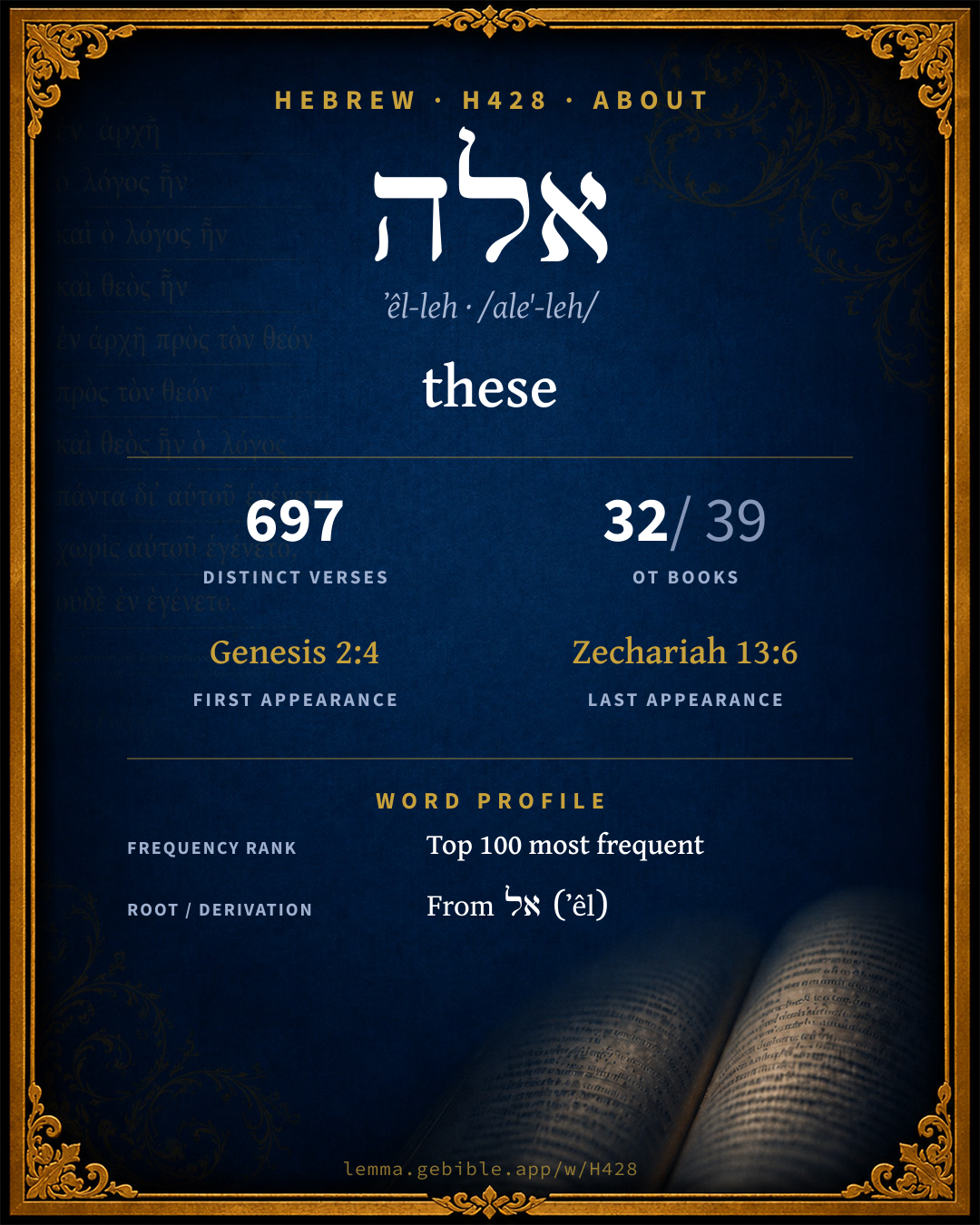
אֵ֫לֶּה
these
‘these’ is one of 3 main senses fuller range ↓
Full lexicon entry — Brown-Driver-Briggs (BDB)
From Brown-Driver-Briggs (BDB)
Where this word appears
Grammar key — what these labels mean
Part of speech
- Pronoun
- A word standing in for a noun (“he,” “this,” “who”).
Gender
- Common
- Either gender — not distinguished for this form.
Number
- Plural
- More than one (in Hebrew, generally three or more).
Every verse where H428 appears in the Book of Numbers — 71 distinct verses. Click any verse to open its interlinear word-by-word view. Verse text shown in the World English Bible for context — . Each verse’s Hebrew form is shown with its reference; the English is not keyword-highlighted, since the data carries no word-level English alignment. Use “Compare translations” on any verse to read it across multiple English versions. This concordance covers the Hebrew Bible; Septuagint (Greek Old Testament) occurrences are not indexed here.
Numbers
- Numbers 1:5 וְ/אֵ֨לֶּה֙ conj + pron dem cp These are the names of the men who shall stand with you: Of Reuben: Elizur the son of Shedeur.
- Numbers 1:16 אֵ֚לֶּה pron dem cp These are those who were called of the congregation, the princes of the tribes of their fathers; they were the heads of the thousands of Israel.
- Numbers 1:17 הָ/אֵ֔לֶּה ptcl def.art + pron dem cp Moses and Aaron took these men who are mentioned by name.
- Numbers 1:44 אֵ֣לֶּה pron dem cp These are those who were numbered, whom Moses and Aaron numbered, and the princes of Israel, being twelve men: they were each one for his fathers' house.
- Numbers 2:32 אֵ֛לֶּה pron dem cp These are those who were numbered of the children of Israel by their fathers' houses. All who were numbered of the camps according to their hosts were six hundred three thousand five hundred fifty.
- Numbers 3:1 וְ/אֵ֛לֶּה conj + pron dem cp Now this is the history of the generations of Aaron and Moses in the day that Yahweh spoke with Moses in Mount Sinai.
- Numbers 3:2 וְ/אֵ֛לֶּה conj + pron dem cp These are the names of the sons of Aaron: Nadab the firstborn, and Abihu, Eleazar, and Ithamar.
- Numbers 3:3 אֵ֗לֶּה pron dem cp These are the names of the sons of Aaron, the priests who were anointed, whom he consecrated to minister in the priest's office.
- Numbers 3:17 אֵ֥לֶּה pron dem cp These were the sons of Levi by their names: Gershon, and Kohath, and Merari.
- Numbers 3:18 וְ/אֵ֛לֶּה conj + pron dem cp These are the names of the sons of Gershon by their families: Libni and Shimei.
- Numbers 3:20 אֵ֥לֶּה pron dem cp The sons of Merari by their families: Mahli and Mushi. These are the families of the Levites according to their fathers' houses.
- Numbers 3:21 אֵ֣לֶּה pron dem cp Of Gershon was the family of the Libnites, and the family of the Shimeites: these are the families of the Gershonites.
- Numbers 3:27 אֵ֥לֶּה pron dem cp Of Kohath was the family of the Amramites, and the family of the Izharites, and the family of the Hebronites, and the family of the Uzzielites: these are the families of the Kohathites.
- Numbers 3:33 אֵ֥לֶּה pron dem cp Of Merari was the family of the Mahlites, and the family of the Mushites. These are the families of Merari.
- Numbers 4:15 אֵ֛לֶּה pron dem cp "When Aaron and his sons have finished covering the sanctuary, and all the furniture of the sanctuary, as the camp moves forward; after that, the sons of Kohath shall come to carry it: but they shall not touch the sanctuary, lest they die. These things are the burden of the sons of Kohath in the Tent of Meeting.
- Numbers 4:37 אֵ֤לֶּה pron dem cp These are those who were numbered of the families of the Kohathites, all who served in the Tent of Meeting, whom Moses and Aaron numbered according to the commandment of Yahweh by Moses.
- Numbers 4:41 אֵ֣לֶּה pron dem cp These are those who were numbered of the families of the sons of Gershon, all who served in the Tent of Meeting, whom Moses and Aaron numbered according to the commandment of Yahweh.
- Numbers 4:45 אֵ֣לֶּה pron dem cp These are those who were numbered of the families of the sons of Merari, whom Moses and Aaron numbered according to the commandment of Yahweh by Moses.
- Numbers 5:19 הָ/אֵֽלֶּה ptcl def.art + pron dem cp The priest shall cause her to swear, and shall tell the woman, 'If no man has lain with you, and if you haven't gone aside to uncleanness, being under your husband, be free from this water of bitterness that brings a curse.
- Numbers 5:22 הָ/אֵ֨לֶּה֙ ptcl def.art + pron dem cp and this water that brings a curse will go into your bowels, and make your body swell, and your thigh fall away.' The woman shall say, 'Amen, Amen.'
- Numbers 5:23 הָ/אֵ֛לֶּה ptcl def.art + pron dem cp "The priest shall write these curses in a book, and he shall blot them out into the water of bitterness.
- Numbers 10:28 אֵ֛לֶּה pron dem cp Thus were the travels of the children of Israel according to their hosts; and they set forward.
- Numbers 13:4 וְ/אֵ֖לֶּה conj + pron dem cp These were their names: Of the tribe of Reuben, Shammua the son of Zaccur.
- Numbers 13:16 אֵ֚לֶּה pron dem cp These are the names of the men who Moses sent to spy out the land. Moses called Hoshea the son of Nun Joshua.
- Numbers 14:39 הָ/אֵ֔לֶּה ptcl def.art + pron dem cp Moses told these words to all the children of Israel: and the people mourned greatly.
- Numbers 15:13 אֵ֑לֶּה pron dem cp All who are home-born shall do these things after this manner, in offering an offering made by fire, of a sweet savor to Yahweh.
- Numbers 15:22 הָ/אֵ֑לֶּה ptcl def.art + pron dem cp When you shall err, and not observe all these commandments, which Yahweh has spoken to Moses,
- Numbers 16:26 הָ/אֵ֔לֶּה ptcl def.art + pron dem cp He spoke to the congregation, saying, Depart, I pray you, from the tents of these wicked men, and touch nothing of theirs, lest you be consumed in all their sins.
- Numbers 16:28 הָ/אֵ֑לֶּה ptcl def.art + pron dem cp Moses said, Hereby you shall know that Yahweh has sent me to do all these works; for [I have] not [done them] of my own mind.
- Numbers 16:29 אֵ֔לֶּה pron dem cp If these men die the common death of all men, or if they be visited after the visitation of all men; then Yahweh hasn't sent me.
- Numbers 16:30 הָ/אֵ֖לֶּה ptcl def.art + pron dem cp But if Yahweh make a new thing, and the ground open its mouth, and swallow them up, with all that appertain to them, and they go down alive into Sheol; then you shall understand that these men have despised Yahweh.
- Numbers 16:31 הָ/אֵ֑לֶּה ptcl def.art + pron dem cp It happened, as he made an end of speaking all these words, that the ground split apart that was under them;
- Numbers 16:38 הָ/אֵ֜לֶּה ptcl def.art + pron dem cp even the censers of these sinners against their own lives; and let them be made beaten plates for a covering of the altar: for they offered them before Yahweh; therefore they are holy; and they shall be a sign to the children of Israel.
- Numbers 21:25 הָ/אֵ֑לֶּה ptcl def.art + pron dem cp Israel took all these cities: and Israel lived in all the cities of the Amorites, in Heshbon, and in all the towns of it.
- Numbers 22:9 הָ/אֵ֖לֶּה ptcl def.art + pron dem cp God came to Balaam, and said, What men are these with you?
- Numbers 22:15 מֵ/אֵֽלֶּה prep + pron dem cp Balak sent yet again princes, more, and more honorable than they.
- Numbers 26:7 אֵ֖לֶּה pron dem cp These are the families of the Reubenites; and those who were numbered of them were forty-three thousand seven hundred thirty.
- Numbers 26:14 אֵ֖לֶּה pron dem cp These are the families of the Simeonites, twenty-two thousand two hundred.
- Numbers 26:18 אֵ֛לֶּה pron dem cp These are the families of the sons of Gad according to those who were numbered of them, forty thousand and five hundred.
- Numbers 26:22 אֵ֛לֶּה pron dem cp These are the families of Judah according to those who were numbered of them, seventy-six thousand five hundred.
- Numbers 26:25 אֵ֛לֶּה pron dem cp These are the families of Issachar according to those who were numbered of them, sixty-four thousand three hundred.
- Numbers 26:27 אֵ֛לֶּה pron dem cp These are the families of the Zebulunites according to those who were numbered of them, sixty thousand five hundred.
- Numbers 26:30 אֵ֚לֶּה pron dem cp These are the sons of Gilead: [of] Iezer, the family of the Iezerites; of Helek, the family of the Helekites;
- Numbers 26:34 אֵ֖לֶּה pron dem cp These are the families of Manasseh; and those who were numbered of them were fifty-two thousand seven hundred.
- Numbers 26:35 אֵ֣לֶּה pron dem cp These are the sons of Ephraim after their families: of Shuthelah, the family of the Shuthelahites; of Becher, the family of the Becherites; of Tahan, the family of the Tahanites.
- Numbers 26:36 וְ/אֵ֖לֶּה conj + pron dem cp These are the sons of Shuthelah: of Eran, the family of the Eranites.
- Numbers 26:37 אֵ֣לֶּה אֵ֥לֶּה pron dem cp pron dem cp These are the families of the sons of Ephraim according to those who were numbered of them, thirty-two thousand five hundred. These are the sons of Joseph after their families.
- Numbers 26:41 אֵ֥לֶּה pron dem cp These are the sons of Benjamin after their families; and those who were numbered of them were forty-five thousand six hundred.
- Numbers 26:42 אֵ֤לֶּה אֵ֛לֶּה pron dem cp pron dem cp These are the sons of Dan after their families: of Shuham, the family of the Shuhamites. These are the families of Dan after their families.
- Numbers 26:47 אֵ֛לֶּה pron dem cp These are the families of the sons of Asher according to those who were numbered of them, fifty-three thousand and four hundred.
- Numbers 26:50 אֵ֛לֶּה pron dem cp These are the families of Naphtali according to their families; and those who were numbered of them were forty-five thousand four hundred.
- Numbers 26:51 אֵ֗לֶּה pron dem cp These are those who were numbered of the children of Israel, six hundred one thousand seven hundred thirty.
- Numbers 26:53 לָ/אֵ֗לֶּה prep + pron dem cp To these the land shall be divided for an inheritance according to the number of names.
- Numbers 26:57 וְ/אֵ֨לֶּה conj + pron dem cp These are those who were numbered of the Levites after their families: of Gershon, the family of the Gershonites; of Kohath, the family of the Kohathites; of Merari, the family of the Merarites.
- Numbers 26:58 אֵ֣לֶּה pron dem cp These are the families of Levi: the family of the Libnites, the family of the Hebronites, the family of the Mahlites, the family of the Mushites, the family of the Korahites. Kohath became the father of Amram.
- Numbers 26:63 אֵ֚לֶּה pron dem cp These are those who were numbered by Moses and Eleazar the priest, who numbered the children of Israel in the plains of Moab by the Jordan at Jericho.
- Numbers 26:64 וּ/בְ/אֵ֨לֶּה֙ conj + prep + pron dem cp But among these there was not a man of them who were numbered by Moses and Aaron the priest, who numbered the children of Israel in the wilderness of Sinai.
- Numbers 27:1 וְ/אֵ֨לֶּה֙ conj + pron dem cp Then drew near the daughters of Zelophehad, the son of Hepher, the son of Gilead, the son of Machir, the son of Manasseh, of the families of Manasseh the son of Joseph; and these are the names of his daughters: Mahlah, Noah, and Hoglah, and Milcah, and Tirzah.
- Numbers 28:23 אֵֽלֶּה pron dem cp You shall offer these besides the burnt offering of the morning, which is for a continual burnt offering.
- Numbers 28:24 כָּ/אֵ֜לֶּה prep + pron dem cp After this manner you shall offer daily, for seven days, the food of the offering made by fire, of a sweet savor to Yahweh: it shall be offered besides the continual burnt offering, and the drink-offering of it.
- Numbers 29:39 אֵ֛לֶּה pron dem cp These you shall offer to Yahweh in your set feasts, besides your vows, and your freewill-offerings, for your burnt offerings, and for your meal-offerings, and for your drink-offerings, and for your peace-offerings.
- Numbers 30:16 אֵ֣לֶּה pron dem cp These are the statutes, which Yahweh commanded Moses, between a man and his wife, between a father and his daughter, being in her youth, in her father's house.
- Numbers 33:1 אֵ֜לֶּה pron dem cp These are the journeys of the children of Israel, when they went forth out of the land of Egypt by their hosts under the hand of Moses and Aaron.
- Numbers 33:2 וְ/אֵ֥לֶּה conj + pron dem cp Moses wrote their goings out according to their journeys by the commandment of Yahweh: and these are their journeys according to their goings out.
- Numbers 34:17 אֵ֚לֶּה pron dem cp These are the names of the men who shall divide the land to you for inheritance: Eleazar the priest, and Joshua the son of Nun.
- Numbers 34:19 וְ/אֵ֖לֶּה conj + pron dem cp These are the names of the men: Of the tribe of Judah, Caleb the son of Jephunneh.
- Numbers 34:29 אֵ֕לֶּה pron dem cp These are they whom Yahweh commanded to divide the inheritance to the children of Israel in the land of Canaan.
- Numbers 35:15 הָ/אֵ֖לֶּה ptcl def.art + pron dem cp For the children of Israel, and for the stranger and for the foreigner living among them, shall these six cities be for refuge; that everyone who kills any person unwittingly may flee there.
- Numbers 35:24 הָ/אֵֽלֶּה ptcl def.art + pron dem cp then the congregation shall judge between the striker and the avenger of blood according to these ordinances;
- Numbers 35:29 אֵ֧לֶּה pron dem cp These things shall be for a statute [and] ordinance to you throughout your generations in all your dwellings.
- Numbers 36:13 אֵ֣לֶּה pron dem cp These are the commandments and the ordinances which Yahweh commanded by Moses to the children of Israel in the plains of Moab by the Jordan at Jericho.
About this entry
At a glance — auto-summarized from this page’s data, not written by a person. Every figure links to its source below. This summary describes the numbers; it doesn’t interpret them.
“these” is the headline sense of the Hebrew word אלה (ʼêl-leh). First canonically at Genesis 2:4, it enters the text early. It appears 697 verses across 32 books of the Hebrew Bible, among its most common vocabulary. Its meaning spans more than one sense — see its full sense range. Related forms include אל, אל and אלה. See the sense tree, 697-verse concordance, and the renderings breakdown below.
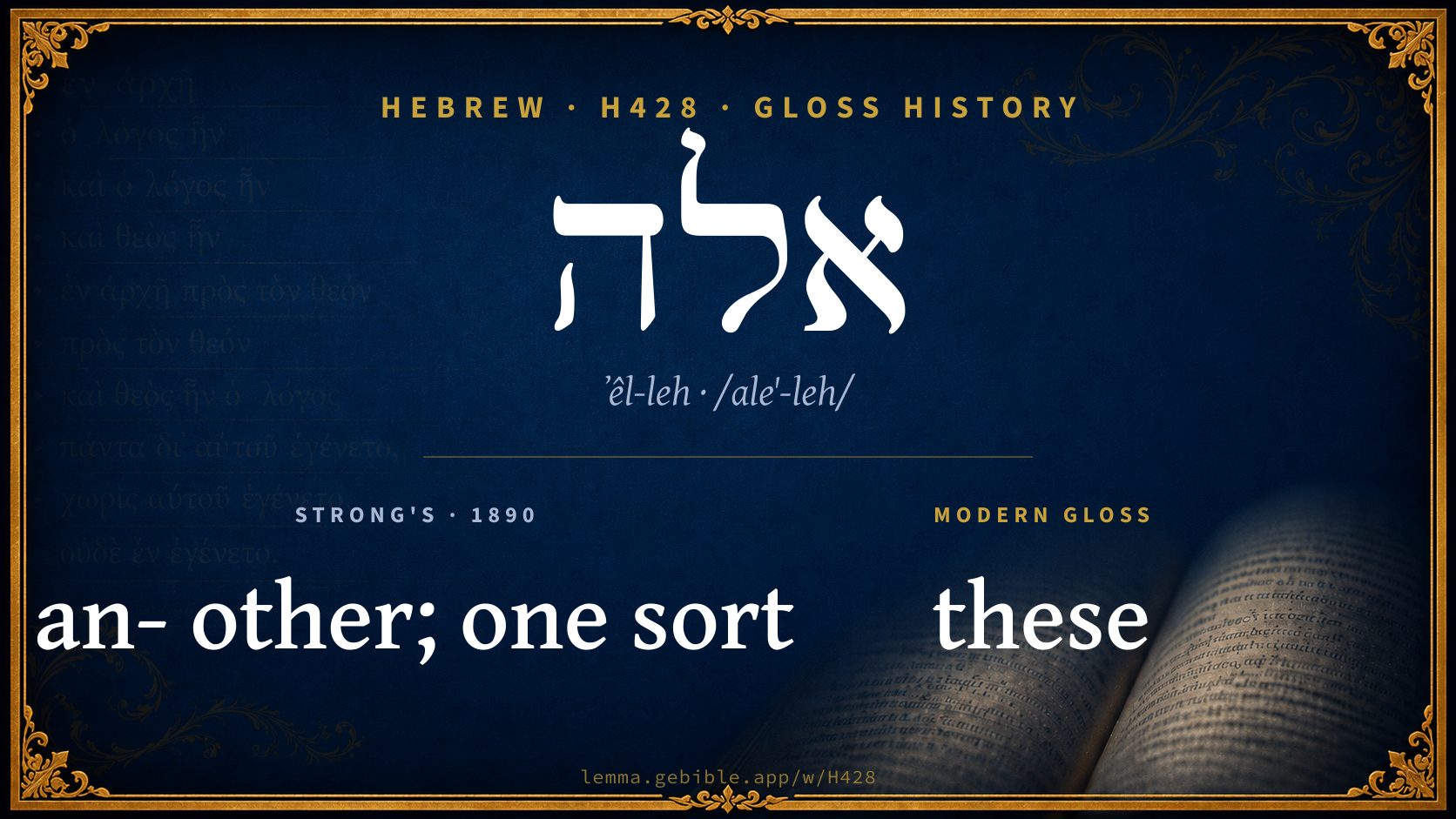
Gloss history
Strong's 1890 vs modern scholarship
About this word
Strong's H428 catalogs a Hebrew word from the Hebrew Old Testament.
These counts are not copied from any lexicon or concordance. They are computed here, from the morphology-tagged Hebrew Old Testament. What Lemma adds →
- 697
- distinct verses
- The word appears in 697 distinct verses.
- 32 / 39
- OT books
- The word appears in 32 of 39 Old Testament books.
- #68
- by frequency
- Top 100 most frequent Hebrew words (rank 68 of 8,640 Hebrew words by occurrence).
View all 697 occurrences in the concordance →
Most concentrated in
- Genesis 78 verses 11%
- 1 Chronicles 77 verses 11%
- Numbers 71 verses 10%
By section of the Old Testament
By traditional corpus
Conventional, traditional groupings — biblical authorship is debated, so this is a traditional corpus grouping, not an authorship claim. Each share is this word’s portion of its verses in that division of the Hebrew canon. Each figure is a share of the word’s 697 distinct verses.
- Prophets (Nevi'im) 283 verses · 41%
- Torah (Pentateuch) 246 verses · 35%
- Writings (Ketuvim) 168 verses · 24%
How translations render this word
Counts come from each version’s own published word-to-Strong’s tagging or interlinear alignment — an approximate guide to how each version renders this word, not a word-level alignment the data otherwise carries. Because each total is that version’s own tagged count, the per-version totals vary from one another and need not match the appearance or distinct-verse counts above. These counts may also differ from a printed concordance because Lemma counts each distinctly tagged rendering and does not collapse phrase taggings into a single head-word total. This is a fixed set of word-tagged versions (KJV, ASV, BSB, ULT) and does not change with the reading translation you choose elsewhere. Each version’s license is shown beside its name below (and on Sources).
BDB lists this Strong’s number as 4 distinct words (homographs). Each count above pools all of them and is not split by sense — see the Senses section below. A low-frequency rendering may belong to a different one of those words, not the primary meaning.
- King James Version†: Other 2×, Were 2×
- American Standard Version†: These 4×, Others 2×, Things 2×
- Berean Standard Bible†: These 445×, Things 34×, This 27×
- unfoldingWord Literal Text†: These 523×, Are 62×, Were 57×
King James Version Public Domain
Renders H428 across 20† tagged occurrences — most commonly:
Plus 16 renderings that appear only once — usually multi-word phrases or single function words the recovered tagging swept in, not distinct renderings.
American Standard Version Public Domain
Renders H428 across 19† tagged occurrences — most commonly:
Plus 11 renderings that appear only once — usually multi-word phrases or single function words the recovered tagging swept in, not distinct renderings.
Berean Standard Bible Public Domain
Renders H428 across 690† tagged occurrences — most commonly:
Plus other, less common renderings. Plus 60 renderings that appear only once — usually multi-word phrases or single function words the recovered tagging swept in, not distinct renderings. Not rendered by a distinct English word in 54 further occurrences.
unfoldingWord Literal Text CC BY-SA 4.0
Renders H428 across 830† tagged occurrences — most commonly:
Plus other, less common renderings. Plus 30 renderings that appear only once — usually multi-word phrases or single function words the recovered tagging swept in, not distinct renderings.
13 senses and sub-senses in the full BDB
Hebrew verbs can shift meaning by stem (binyan): Qal is the basic action, Niphal is often passive or reflexive, Piel often intensifies or makes it factitive, and Hiphil is typically causative. The senses below are grouped under the stem BDB assigns to each.
What do BDB’s symbols mean?
BDB uses these scholarly abbreviations:
| Symbol | Meaning |
|---|---|
| 𝔊 | the Septuagint (the ancient Greek translation, LXX) |
| 𝔙 | the Vulgate (the Latin translation) |
| 𝔖 | the Syriac version (the Peshitta) |
| 𝔗 | the Targum (the Aramaic translation) |
| ψ | the Psalms |
| √ | root (the underlying root or stem) |
| ‖ | parallel passage (a synonymous or contrasted parallel) |
| † | the dagger: every passage where the word occurs is cited |
The 13 senses and sub-senses the full Brown-Driver-Briggs lexicon distinguishes for this word, in lexicon order (not ranked by frequency), with BDB’s own verbatim wording and sub-sense lettering. Shown in Hebrew script with BDB’s own scholarly abbreviations. The condensed entry is in the Lexicon Entry tab. See also the Forms in the corpus table below.
אלה I
- a. Gn 2:4 & often: in appos. to a subst. with a pron. suff. (always without the art.) Ex 9:14 (read with Hi. אֵלֶּה בְּךָ for אֶל־לִבֵּךָ) 10:1 אֹתֹתַי אֵלֶּה these my signs, 11:8 Dt 11:18 1 K 8:59; 10:8; 22:23 2 K 1:13 Je 31:21 Ezr 2:65 Ne 6:14; in the genit. 2 K 6:20 Is 47:9 Dt 18:12 ψ 15:5; and after כל Gn 14:3 + often Standing alone in a neuter sense, these things (rare in best prose, & not very common in poetry), with עָשָׂה Dt 18:12; 22:5; 25:16 2 S 23:17, 22 ψ 15:5 +; with other vbs. Ezr 9:1 Is 44:21; 47:7 Je 13:22 Ho 14:10 ψ 42:5; 50:21; 107:43 Jb 8:2; with אֶת־ Nu 15:13 Is 48:14; with כָּל־ Ju 13:23 Is 66:2 +; v. also some of the cases with preps. sub d. אלה may point indifferently to what follows, Gn 6:9; 10:1; 25:7, 12, 13 ψ 42:5; or to what has preceded, Gn 9:19; 10:20, 31, 32; 25:4 Lv 21:14; 22:22 ψ 15:5; = such as these (τοιαῦτα), ψ 73:12 Jb 18:21. e.g. Genesis 2:4
- b. repeated, אלה … ואלה, these … those Dt 27:12, 13 Jos 8:22 Is 49:12 (3 times) ψ 20:8 +. e.g. Deuteronomy 27:12
- c. with art. (only after a subst. determined by art. (except Gn 21:29 Jos 17:9 עָרִים הָאֵלֶּה read הֶעָרִים, cf. 17:12; 19:8, 16, 31, 48, etc. Ez 42:9)) הָאֵלֶּה Gn 15:1 +. e.g. Genesis 21:29
- d. with preps.: בְּאֵלָּה Lv 25:54; 26:23 1 K 22:11 (7 times), בָּאֵלֶּה †1 S 16:10; 17:39; לְאֵלֶּה Lv 11:24 (4 times), לָאֵלֶּה 1 K 22:17 (5 times); מֵאֵלֶּה Gn 9:19 (16 times); עַד אֵלֶּה Lv 26:18; עַל־אֵלָּה on account of these things Is 57:6; 64:11 Je 5:9 al.; כְּאֵלֶּה †Jb 16:2 Je 10:16 = 51:19, כָּאֵלֶּה †Gn 27:46 Lv 10:19 (things like these, so Is 66:8 Je 18:13) Nu 28:24 P (cf. Ez 45:25) 2 K 25:17 = Je 52:22, כְּמוֹ־אֵלֶּה †Jb 12:3. e.g. Leviticus 25:54
אלה II swear, curse (cf. I. אלה? so Thes LagOr ii. 3)
Qal
- Pf. 1 K 8:31 (= 2 Ch 6:22 all Vrss Th Bö Bä Kp reading וְאָלָה); אָלִית Ju 17:2; Inf. abs. אָלֹה Ho 4:2; אָלוֹת Ho 10:4. e.g. 1 Kings 8:31
- 1. swear, take oath before God 1 K 8:31 (= 2 Ch 6:22); in covenants Ho 4:2; 10:4 (falsely). e.g. 1 Kings 8:31
- 2. curse Ju 17:2. e.g. Judges 17:2
Hiphil
- Impf. וַיֹּ֫אֶ֗ל 1 S 14:24; Inf. לְהַאֲלֹתוֹ 1 K 8:31 = 2 Ch 6:22 adjure, put under oath. e.g. 1 Samuel 14:24
אלה III oath Gn 26
- 1. oath in testimony Lv 5:1 Nu 5:21(×2) (P) Pr 29:24; בא באלה come into an oath Ne 10:30; הביא באלה bring into an oath Ez 17:13; נשׂא אלה 1 K 8:31 (= 2 Ch 6:22). e.g. Leviticus 5:1
- 2. oath of covenant Gn 24:41(×2); 26:28 (J) Dt 29:11, 13; בזה אלה despise an oath Ez 16:59; 17:16, 18, 19. e.g. Genesis 24:41
- 3. curse (a) from God Nu 5:23 (P) Dt 29:18, 19, 20; 30:7 2 Ch 34:24 Is 24:6 Je 23:10 Dn 9:11 Zc 5:3; (b) from men Jb 31:30 ψ 10:7; 59:13. e.g. Numbers 5:23
- 4. execration in the phrase היה לאלה become an execration Nu 5:27 (P) Je 29:18; 42:18; 44:12. e.g. Numbers 5:27
אלה IV wail (Aramaic אֲלָא, ܐܶܠܴܐ ) only
Qal
- Imv. fs. אֱלִי Jo 1:8 (v. אַלְלַי). e.g. Joel 1:8
Senses from the full Brown-Driver-Briggs lexicon (Brown, Driver, Briggs; Oxford 1906 — public domain), digitized via Sefaria, supplemented by the OpenScriptures HebrewLexicon (CC BY 4.0). Full attribution on Sources.
Word origin
I. (أُولَى, እሉ: እላ: Rabb. אֵלּוּ, Aramaic אִלֵּין, & compd. with ܗܳܐ and ܐܰܝ in ܗܳܠܶܝܢ, ܐܰܝܠܶܝܢ ) pr.pl.m. & f. these, in usage the pl. of זֶה.
I. vb. swear, curse (cf. I. אלה? so Thes LagOr ii. 3)—
II. n.f. oath Gn 26:28 +; sf. אָלָתִי, אָלָתוֹ Gn 24:41 + (4 times); pl. אָלוֹת Dt 29:20 + (4 times)
III. vb. wail (Aramaic אֲלָא, ܐܶܠܴܐ ) only
— Brown-Driver-Briggs (Oxford 1906, public domain), digitized via Sefaria, supplemented by the OpenScriptures HebrewLexicon (CC BY 4.0). See Sources.
Derived from אל (ʼêl) (H411) — these.
Jastrow Dictionary
A second Hebrew/Aramaic lexicon for comparison, covering Aramaic and post-biblical (Talmudic, Targumic, Midrashic) usage that the biblical-Hebrew BDB does not. Matched by lemma rather than by Strong’s number, so a lemma may carry more than one Jastrow headword (shown separately below), and the entries cover usage well beyond the Bible.
אָלָה
- to curse, v. אלי.
אָלָה ²
- imprecation, curse. Sot. II, 5 (17ᵃ); a. fr.—Pl. אָלוֹת. Ib. a. e.
אֵלֶּה
- c. pl. (b. h.; v. preced.) these, those (cmp. הרי). Ex. R. s. 30 v’elleh (and this) adds to the preceding (continues), elleh (these) restricts. V. אֵלּוּ.
אֵלָה
- v. preced. ws.) terebinth. Shebi. VII, 5.
אלה
- Sabb. 90ᵃ Ar., v. אֵילָא 3.
אַלָּה
- Josh. XXIV, 26; v. אַלָּתָא) [pointed, prominent] e.g. Joshua 24:26
- 1. lance, fork. Kel. XVI, 8 חפוי הא׳, v. חִפּוּי. Pes. 57ᵃ אוי לי מֵאַלָּתָן woe to me (I am afraid) of their fork (weapon). Sabb. VI, 3 (63ᵃ) ed. (Ms. אלא); Y. ibid. 8ᵇ (expl. דייקרן).
- 2. sign-pole, used in the barn as a mark. Ib.; Y. Maasr. I, 49ᵃ bot.; Tosef. Ter. III, 11 משתיעקר הא׳ (ed. Zuck. משיתעשר, corr. acc.) as soon as the sign-pole (fork) is removed (indicating that the grain is ready for use and priestly gifts).
אֱלָהּ
- (= h. אֱלוֹהַּ) God. Dan. III, 28; a. fr.—Targ. O. Deut. XXXIII, 26; a. fr.—Lev. R. s. 5, end את אלה רב Ar. (ed. אלוה). Y. B. Mets. II, 8ᶜ אלההון דיהודאי the God of the Jews. Y. Snh. X, 28ᵇ.—Pl. (also plur. majest.) אֱלָהִין. Dan. II, 11; a. e.—אֱלָהַיָּא. Jer. X, 11. Targ. Ps. CXXXVI, 2 אלהי אלהיא the God of gods. [Gen. R. s. 26 כומריא גנבו א׳ וכ׳ (read אלהון) when priests rob—who would swear by their god?] Ib. (ref. to Gen. VI, 2).—Lev. R. s. 33 תמן קריין … אֱלָהַיָּיא there (in Rome) they call their kings gods. e.g. Daniel 3:28
אלי I
- to curse. Sifré Num. 18 (ref. to Num. XVIII, 21) לאלה שיהו אָלִין בה וכ׳ ‘as a curse’ means that people shall curse by her (pointing to her), ‘may happen unto thee what happened to …’. e.g. Numbers 18:21
A Dictionary of the Targumim, the Talmud Babli and Yerushalmi, and the Midrashic Literature (Marcus Jastrow; London, Luzac, 1903) — Public Domain. Digitized via Sefaria. Digitized via Sefaria. Full attribution on Sources.
Forms in the corpus
The 78 distinct written forms H428 takes in the Hebrew Bible, most frequent first — each parse links to that state’s occurrences in the concordance. Hebrew forms include their vowel points and cantillation, so a single lemma takes many written forms.
| Form | Parsing | Example | Uses |
|---|---|---|---|
| הָ/אֵ֔לֶּה | Pronoun, Demonstrative, Common, Plural | Amos 6:2 | 68 |
| אֵ֖לֶּה | Pronoun, Demonstrative, Common, Plural | Ecclesiastes 7:28 | 58 |
| אֵ֣לֶּה | Pronoun, Demonstrative, Common, Plural | Deuteronomy 1:1 | 57 |
| הָ/אֵ֑לֶּה | Pronoun, Demonstrative, Common, Plural | Daniel 10:15 | 50 |
| הָ/אֵ֖לֶּה | Pronoun, Demonstrative, Common, Plural | Deuteronomy 7:17 | 50 |
| הָ/אֵֽלֶּה | Pronoun, Demonstrative, Common, Plural | Deuteronomy 16:12 | 41 |
| אֵ֥לֶּה | Pronoun, Demonstrative, Common, Plural | Deuteronomy 5:3 | 28 |
| אֵ֑לֶּה | Pronoun, Demonstrative, Common, Plural | Deuteronomy 18:12 | 26 |
| אֵ֚לֶּה | Pronoun, Demonstrative, Common, Plural | Daniel 12:2 | 25 |
| אֵ֛לֶּה | Pronoun, Demonstrative, Common, Plural | Ecclesiastes 11:9 | 24 |
| וְ/אֵ֨לֶּה֙ | Pronoun, Demonstrative, Common, Plural | Daniel 11:41 | 22 |
| הָ/אֵ֗לֶּה | Pronoun, Demonstrative, Common, Plural | Deuteronomy 6:6 | 21 |
| אֵֽלֶּה | Pronoun, Demonstrative, Common, Plural | Daniel 11:4 | 18 |
| הָ/אֵ֨לֶּה֙ | Pronoun, Demonstrative, Common, Plural | Daniel 1:17 | 18 |
| וְ/אֵ֣לֶּה | Pronoun, Demonstrative, Common, Plural | Ezra 2:1 | 15 |
| אֵ֔לֶּה | Pronoun, Demonstrative, Common, Plural | Daniel 10:21 | 14 |
| וְ/אֵ֖לֶּה | Pronoun, Demonstrative, Common, Plural | Deuteronomy 22:17 | 14 |
| וְ/אֵ֛לֶּה | Pronoun, Demonstrative, Common, Plural | Deuteronomy 27:13 | 14 |
| אֵ֤לֶּה | Pronoun, Demonstrative, Common, Plural | Exodus 32:4 | 13 |
| אֵ֨לֶּה֙ | Pronoun, Demonstrative, Common, Plural | Deuteronomy 25:3 | 13 |
| וְ/אֵ֗לֶּה | Pronoun, Demonstrative, Common, Plural | Exodus 1:1 | 13 |
| וְ/אֵ֥לֶּה | Pronoun, Demonstrative, Common, Plural | Daniel 12:2 | 12 |
| אֵ֗לֶּה | Pronoun, Demonstrative, Common, Plural | Exodus 6:25 | 11 |
| אֵ֕לֶּה | Pronoun, Demonstrative, Common, Plural | Ezra 10:44 | 10 |
| וְ/אֵ֨לֶּה | Pronoun, Demonstrative, Common, Plural | Exodus 6:16 | 9 |
| הָ/אֵ֜לֶּה | Pronoun, Demonstrative, Common, Plural | Esther 9:31 | 7 |
| אֵ֜לֶּה | Pronoun, Demonstrative, Common, Plural | Deuteronomy 3:5 | 6 |
| הָ/אֵ֛לֶּה | Pronoun, Demonstrative, Common, Plural | Deuteronomy 31:3 | 6 |
| אֵ֠לֶּה | Pronoun, Demonstrative, Common, Plural | Deuteronomy 12:1 | 4 |
| מֵ/אֵ֖לֶּה | Pronoun, Demonstrative, Common, Plural | Ezekiel 16:5 | 4 |
| מֵ/אֵֽלֶּה | Pronoun, Demonstrative, Common, Plural | Ezekiel 8:15 | 4 |
| אֵ֧לֶּה | Pronoun, Demonstrative, Common, Plural | Genesis 36:19 | 3 |
| אֵ֭לֶּה | Pronoun, Demonstrative, Common, Plural | Job 18:21 | 3 |
| אֵלֶּה֩ | Pronoun, Demonstrative, Common, Plural | Deuteronomy 29:1 | 3 |
| הָ/אֵ֤לֶּה | Pronoun, Demonstrative, Common, Plural | Esther 9:26 | 3 |
| הָ/אֵלֶּה֮ | Pronoun, Demonstrative, Common, Plural | Ezekiel 14:16 | 3 |
| וְ/אֵ֤לֶּה | Pronoun, Demonstrative, Common, Plural | 1 Chronicles 3:1 | 3 |
| לָ/אֵ֔לֶּה | Pronoun, Demonstrative, Common, Plural | 1 Kings 22:17 | 3 |
| אֵ֨לֶּה | Pronoun, Demonstrative, Common, Plural | Exodus 11:8 | 2 |
| בְּ/אֵ֛לֶּה | Pronoun, Demonstrative, Common, Plural | 1 Kings 22:11 | 2 |
| הָ/אֵ֡לֶּה | Pronoun, Demonstrative, Common, Plural | Deuteronomy 5:22 | 2 |
| הָ֠/אֵלֶּה | Pronoun, Demonstrative, Common, Plural | Esther 9:28 | 2 |
| וְ/כָ/אֵ֛לֶּה | Pronoun, Demonstrative, Common, Plural | 2 Kings 25:17 | 2 |
| וְ֠/אֵלֶּה | Pronoun, Demonstrative, Common, Plural | Genesis 36:40 | 2 |
| וּ/מֵ/אֵ֖לֶּה | Pronoun, Demonstrative, Common, Plural | Genesis 9:19 | 2 |
| כְ/אֵ֜לֶּה | Pronoun, Demonstrative, Common, Plural | Jeremiah 10:16 | 2 |
| כָּ/אֵ֑לֶּה | Pronoun, Demonstrative, Common, Plural | Jeremiah 18:13 | 2 |
| מֵ/אֵ֑לֶּה | Pronoun, Demonstrative, Common, Plural | Ecclesiastes 7:10 | 2 |
| מֵ/אֵ֗לֶּה | Pronoun, Demonstrative, Common, Plural | 1 Chronicles 2:53 | 2 |
| אֵ֣לֶּ֣ה | Pronoun, Demonstrative, Common, Plural | Genesis 36:13 | 1 |
| אֵ֦לֶּה | Pronoun, Demonstrative, Common, Plural | 1 Kings 20:29 | 1 |
| בְ/אֵ֥לֶּה | Pronoun, Demonstrative, Common, Plural | Jeremiah 9:24 | 1 |
| בְּ/אֵ֑לֶּה | Pronoun, Demonstrative, Common, Plural | Leviticus 25:54 | 1 |
| בְּ/אֵ֔לֶּה | Pronoun, Demonstrative, Common, Plural | Leviticus 26:23 | 1 |
| בְּ/אֵ֨לֶּה֙ | Pronoun, Demonstrative, Common, Plural | 1 Chronicles 7:29 | 1 |
| בָּ/אֵ֖לֶּה | Pronoun, Demonstrative, Common, Plural | 1 Samuel 17:39 | 1 |
| בָּ/אֵֽלֶּה | Pronoun, Demonstrative, Common, Plural | 1 Samuel 16:10 | 1 |
| ה/אהל | Pronoun, Demonstrative, Common, Plural | 1 Kings 7:45 | 1 |
| הָ/אֵ֔לֶה | Pronoun, Demonstrative, Common, Plural | Zechariah 4:11 | 1 |
| הָ/אֵ֧לֶּה | Pronoun, Demonstrative, Common, Plural | Joshua 4:7 | 1 |
The 60 most common forms are shown; 18 rarer forms follow in the full concordance.
Same root — word family
Other BDB entries built from the same root as H428, grouped by Strong’s listed origin. These share a root / origin per the lexicon — not necessarily a shared meaning. Each links to that word’s own entry.
Derives from
Shares the same root
Derived from this word
Compare all same-root words → They share a root, not necessarily a meaning.
Septuagint verse parallels
This word appears in 661 verses that also exist in the Greek Old Testament (Septuagint), out of the 697 Hebrew verses it occurs in. You can read those verses in Greek by switching the Old Testament edition to the Septuagint.
Read these verses in the Septuagint
- Genesis 2:4
- Exodus 1:1
- Leviticus 2:8
- Numbers 1:5
- Deuteronomy 1:1
- Joshua 4:6
- Judges 2:4
- Ruth 3:17
- 1 Samuel 2:23
- 2 Samuel 2:13
- 1 Kings 4:2
- 2 Kings 1:7
This is a verse-level parallel only — the same verses exist in both the Hebrew and Greek Old Testaments. No word-level Hebrew↔Greek correspondence is claimed: the data carries no such alignment, so no Greek word is shown as this Hebrew word’s translation. Coverage is not total — the Septuagint omits the deuterocanon and renumbers the Psalms, so some Hebrew verses have no direct Greek parallel.