
Numbers 14:39

Hebrew (Westminster Leningrad Codex) Numbers 14:39 appears in the Hebrew Old Testament. The text above is from the Westminster Leningrad Codex. Each word links to its Strong’s number, a concise gloss, and parsing drawn from the Open Scriptures Hebrew Bible morphology. Click any word for its full Brown-Driver-Briggs (BDB) entry.
Download image
Cite this verse

Numbers 14:39 (World English Bible). Public Domain. Lemma interlinear Bible study tool, https://lemma.gebible.app/v/numbers/14/39.

Show BibTeX & RIS
BibTeX
RIS
English Translation
Moses told these words to all the children of Israel: and the people mourned greatly.
World English Bible · Public Domain
Download a study sheet

One document with this verse’s original text, its word-by-word gloss line, the meaning frame, cross-references with their text, attributed commentary, and full source and license credits — printable, and it pastes into notes with its structure intact.

This verse Autodidact and up

Study sheet (.html) Plain text (.txt)

A passage Seminary Student

Up to 50 verses in one chapter. A passage sheet keeps up to 6 commentary sources and 12 cross-references per verse, in the order this page ranks them, and says so on the sheet whenever that leaves anything out. Ask for a single verse and you get the Autodidact verse sheet above.

Everything on this page stays free to read, with no account — the sheet is a download of what is already on screen, not access to it.

Want to remove ads? Support Godless Engineer
Compare translations 3

The same verse in 3 English versions, stacked beneath the original-language interlinear above. Click any original word for its lexicon entry.

Each is an independent rendering of the whole verse — the interlinear is not word-aligned to these translations.

Highlighted words mark where these versions differ — a whole-verse word diff, not a word-by-word alignment.

  • World English Bible Public Domain
    Moses told these words to all the children of Israel: and the people mourned greatly.
  • King James Version Public Domain
    And Moses told these sayings unto all the children of Israel: and the people mourned greatly.
  • unfoldingWord Literal Text CC BY-SA 4.0
    And Moses spoke these words to all the sons of Israel, and the people mourned exceedingly,

unfoldingWord Literal Text — © unfoldingWord, licensed CC BY-SA 4.0. Word-aligned USFM3 via Door43 (git.door43.org/unfoldingWord/en_ult).

Versions to compare (up to 4)

3 of 4 selected

Show all 18 translations

Every available English version of this verse, each an independent rendering of the whole verse.

  • World English Bible Public Domain
    Moses told these words to all the children of Israel: and the people mourned greatly.
  • Berean Standard Bible Public Domain
    And when Moses relayed these words to all the Israelites, the people mourned bitterly.
  • Majority Standard Bible Public Domain
    And when Moses relayed these words to all the Israelites, the people mourned bitterly.
  • King James Version Public Domain
    And Moses told these sayings unto all the children of Israel: and the people mourned greatly.
  • American Standard Version (1901) Public Domain
    And Moses told these words unto all the children of Israel: and the people mourned greatly.
  • Revised Version (1885) Public Domain
    And Moses told these words unto all the children of Israel: and the people mourned greatly.
  • Geneva Bible (1599) Public Domain
    Then Moses tolde these sayings vnto all the children of Israel, and the people sorowed greatly.
  • Douay-Rheims (1899) Public Domain
    And Moses spoke all these words to all the children of Israel, and the people mourned exceedingly.
  • Young's Literal Translation Public Domain
    And Moses speaketh these words unto all the sons of Israel, and the people mourn exceedingly,
  • Literal Standard Version CC BY-SA 4.0
    And Moses speaks these words to all the sons of Israel, and the people mourn exceedingly,
  • Unlocked Literal Bible CC BY-SA 4.0
    When Moses reported these words to all the people of Israel, they mourned very deeply.
  • unfoldingWord Literal Text CC BY-SA 4.0
    And Moses spoke these words to all the sons of Israel, and the people mourned exceedingly,
  • Darby Bible Public Domain
    And Moses told all these sayings to all the children of Israel; then the people mourned greatly.
  • World Messianic Bible Public Domain
    Moses told these words to all the children of Israel, and the people mourned greatly.
  • Webster's Bible Public Domain
    And Moses told these sayings to all the children of Israel: and the people mourned greatly.
  • Free Bible Version CC BY-SA 4.0
    When Moses told the Israelites what the Lord had said they were very, very sad.
  • Bible in Basic English Public Domain
    And when Moses put these words before the children of Israel, the people were full of grief.
  • JPS Tanakh (1917) Public Domain
    And Moses told these words unto all the children of Israel; and the people mourned greatly.

Literal Standard Version (2020), Covenant Press — licensed CC BY-SA 4.0. Text via the HelloAO Bible API (eBible.org). Unlocked Literal Bible (unfoldingWord) — licensed CC BY-SA 4.0. Text via the HelloAO Bible API (eBible.org). unfoldingWord Literal Text — © unfoldingWord, licensed CC BY-SA 4.0. Word-aligned USFM3 via Door43 (git.door43.org/unfoldingWord/en_ult). Free Bible Version, Dr. Jonathan Gallagher — licensed CC BY-SA 4.0. Text via the HelloAO Bible API (eBible.org).

Word by word

More ways to search: Search by grammar → Find every occurrence → Compare this word →

Practice this passage: Drill this verse → Learn its vocabulary →

וַיִּֽתְאַבְּל֥וּ
ʼâbal
H56
“and · to mourn”
Conjunction + Verb, Hithpael, Sequential Imperfect, 3rd Person, Masculine, Plural
Part of Speech
Conjunction + Verb
Stem
Hithpael
Form
Sequential Imperfect
Person
3rd Person
Gender
Masculine
Number
Plural
Full BDB Definition

Origin: a primitive root

TWOT: 6

to mourn, lament - (Qal) to mourn, lament - of humans - of inanimate objects (figuratively) - of gates - of land - (Hiphil) - to mourn, cause to mourn (figuratively) - (Hithpael) - to mourn - play the mourner
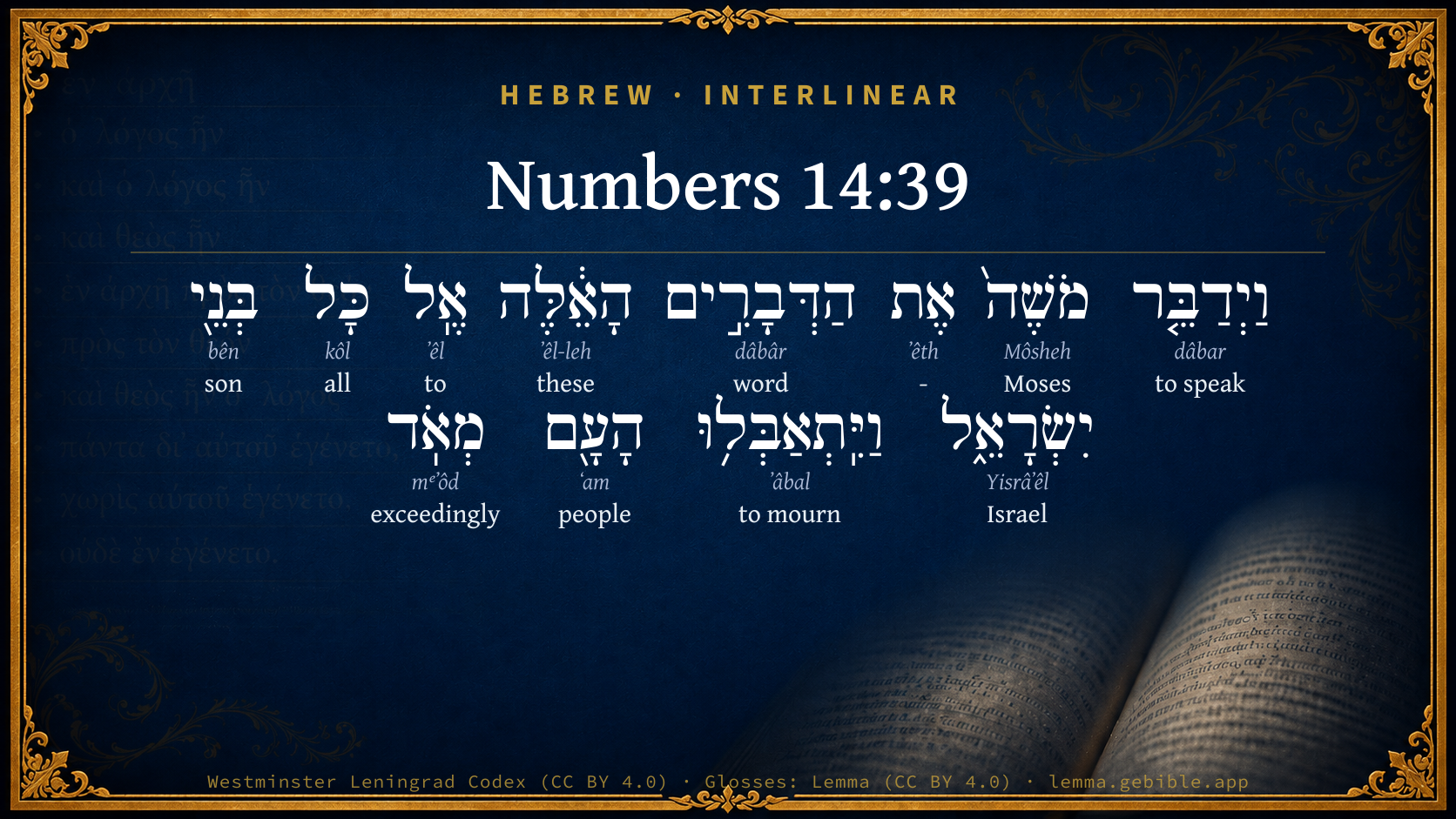
  1. וַיְדַבֵּ֤ר dâbar H1696 “and · to speak” Conjunction + Verb, Piel, Sequential Imperfect, 3rd Person, Masculine, Singular
  2. מֹשֶׁה֙ Môsheh H4872 “Moses” Noun, Proper
  3. אֶת ʼêth H853 “-” Particle, Direct Object
  4. הַדְּבָרִ֣ים dâbâr H1697 “the · words” Particle, Definite Article + Noun, Common, Masculine, Plural, Absolute
  5. הָאֵ֔לֶּה ʼêl-leh H428 “the · these” Particle, Definite Article + Pronoun, Demonstrative, Common, Plural
  6. אֶֽל ʼêl H413 “to” Preposition
  7. כָּל kôl H3605 “all of” Noun, Common, Masculine, Singular, Construct
  8. בְּנֵ֖י bên H1121 “sons of” Noun, Common, Masculine, Plural, Construct
  9. יִשְׂרָאֵ֑ל Yisrâʼêl H3478 “Israel” Noun, Proper
  10. הָעָ֖ם ʻam H5971 “the · people” Particle, Definite Article + Noun, Common, Masculine, Singular, Absolute
  11. מְאֹֽד mᵉʼôd H3966 “exceedingly” Adverb

About this verse

These counts appear in no published source. They are computed here, from the morphology-tagged text and Lemma’s own curated glosses. What Lemma adds →

12
words
12
distinct lemmas
Pentateuch
section

Shared distinctive vocabulary

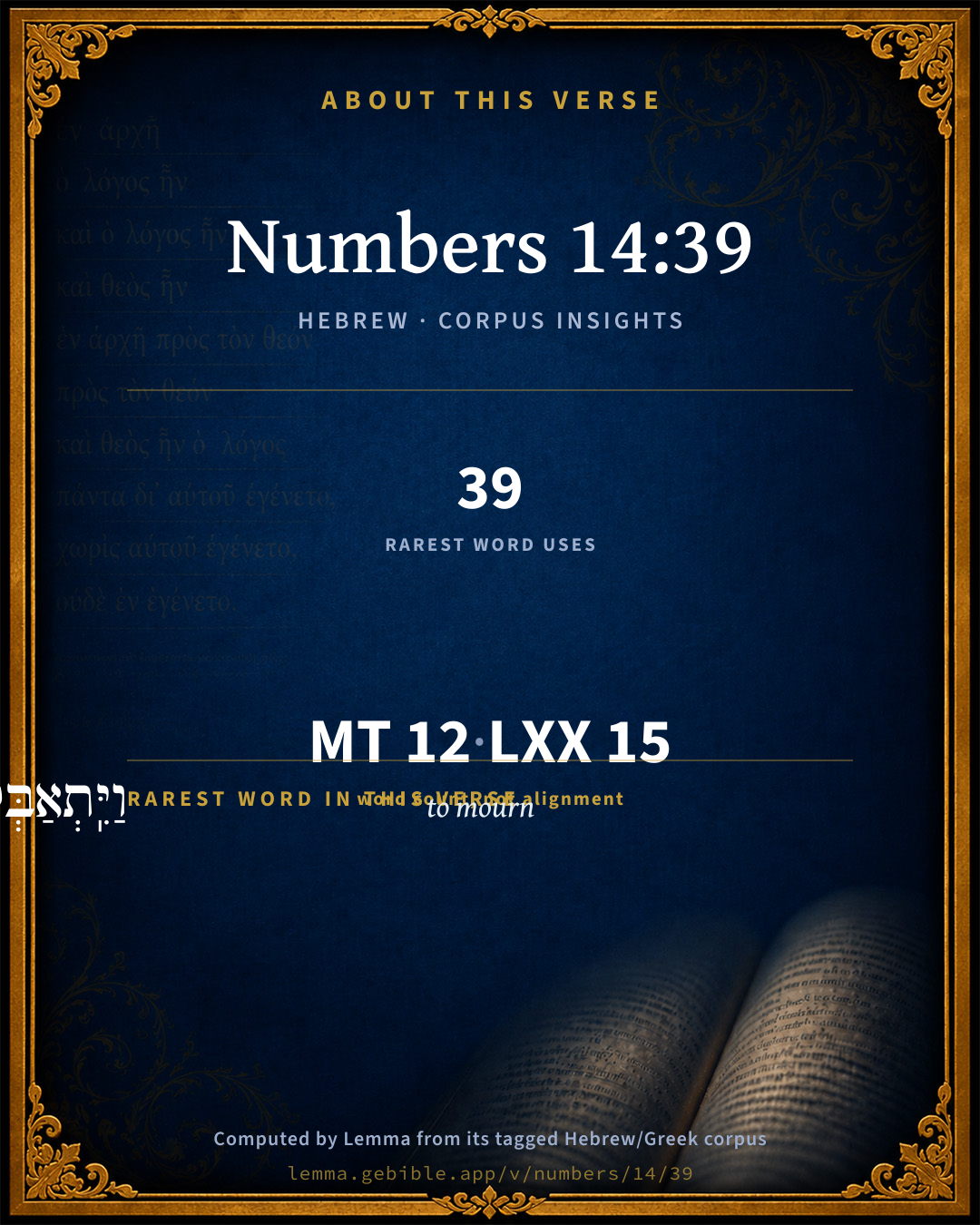
וַיִּֽתְאַבְּל֥וּ to mourn H56 occurs in 38 verses of the Hebrew Bible. Also found in:

Grammatical profile

  • 2 verbs
  • 6 nouns
  • 1 pronoun
  • 1 preposition
  • 1 adverb
  • 1 particle

Verb forms

  • וַיְדַבֵּ֤ר Piel · Sequential Imperfect
  • וַיִּֽתְאַבְּל֥וּ Hithpael · Sequential Imperfect

Hebrew & Septuagint length

In English translation the verse runs 15 words from the Hebrew and 16 from the Septuagint (LXX English) — closely comparable.

A rough comparison of the two English renderings, which tokenize alike — not a word-level alignment.

Word counts can differ between the Hebrew and the Greek without any difference in meaning — e.g. the Hebrew direct-object marker אֵת has no separate Greek word, and Greek often adds the article ὁ.

In the original languages it is 12 Hebrew tokens and 15 Greek tokens — but the two are counted differently (Hebrew bundles its prefixes and suffixes into one token; the Greek is in lemma form), so that isn’t a like-for-like length.

Cross-references

5

Topical passages linked to Numbers 14:39 in the Treasury of Scripture Knowledge — connected by theme and wording, ordered by reader-vote popularity; previews shown in the World English Bible.

  • Exodus 33:4 When the people heard this evil news, they mourned: and no one put on his jewelry.
  • Proverbs 19:3 The foolishness of man subverts his way; His heart rages against Yahweh.
  • Matthew 8:12 but the children of the Kingdom will be thrown out into the outer darkness. There will be weeping and the gnashing of teeth."
  • Hebrews 12:17 For you know that even when he afterward desired to inherit the blessing, he was rejected, for he found no place for a change of mind though he sought it diligently with tears.
  • Isaiah 26:16 Yahweh, in trouble have they visited you; they poured out a prayer [when] your chastening was on them.

Cross-references courtesy of OpenBible.info (CC BY 4.0).

Hebrew and Greek witnesses Masoretic Hebrew ↔ Greek Septuagint

The same verse in the two great witnesses to the Old Testament, shown verse-for-verse.

These are two independent witnesses, not word-aligned to each other, and the Septuagint is shown in lemma (dictionary) form.

Hebrew Numbers 14:39 Masoretic · Westminster Leningrad Codex

וַיְדַבֵּ֤ר מֹשֶׁה֙ אֶת הַדְּבָרִ֣ים הָאֵ֔לֶּה אֶֽל כָּל בְּנֵ֖י יִשְׂרָאֵ֑ל וַיִּֽתְאַבְּל֥וּ הָעָ֖ם מְאֹֽד

Moses told these words to all the children of Israel: and the people mourned greatly.

World English Bible · Public Domain

Greek LXX Numbers 14:39 Septuagint · lemma form

καί λαλέω μωυσῆς ὁ ῥῆμα οὗτος πρός πᾶς υἱός ἰσραήλ καί πενθέω ὁ λαός σφόδρα

And Moses spoke these words to all the children of Israel; and the people mourned exceedingly.

LXX2012 (modern English Septuagint) · Public Domain

On this verse, Keil & Delitzsch discusses the Septuagint’s reading. Read the note in Commentary ↓

Hebrew: Westminster Leningrad Codex (CC BY 4.0). Greek: Septuagint (public domain); English from LXX2012 (modern English Septuagint) (Public Domain). How the Septuagint differs from the Hebrew →

Targum (Aramaic paraphrase)

2

The Targum is the ancient Jewish Aramaic paraphrase of the Hebrew Scriptures — an interpretive translation, not the Hebrew text itself. Onkelos (literal) and Pseudo-Jonathan (expansive) render the Torah, and Jonathan the Prophets. Coverage is partial: where no permissively-licensed English translation exists for a verse, only the Aramaic is shown. This is verse-level text, not a word-by-word alignment to the Hebrew.

  1. Targum Onkelos Torah (Genesis–Deuteronomy)
    וּמַלִיל משֶׁה יָת פִּתְגָמַיָא הָאִלֵין לְכָל בְּנֵי יִשְׂרָאֵל וְאִתְאַבָּלוּ עַמָא לַחֲדָא

    (no public-domain English translation for this verse)

    Targum Onkelos — Aramaic: “Onkelos Genesis” (public domain); “Onkelos Exodus” (public domain); “Onkelos Leviticus” (public domain); “Onkelos Numbers” (public domain); “Onkelos Deuteronomy” (public domain). English: “Sefaria Community Translation” (CC0 1.0 (public-domain dedication)); “J.W. Etheridge. The Targums of Onkelos and Jonathan Ben Uzziel on the Pentateuch. London: Longmans, Green, 1862” (public domain). Text via Sefaria.

  2. Targum Pseudo-Jonathan Torah (Genesis–Deuteronomy)
    וּמַלֵיל משֶׁה יַת פִּתְגָמַיָא הָאִילֵן עִם כָּל בְּנֵי יִשְרָאֵל וְאִתְאַבְּלוּ עַמָא לַחֲדָא

    And Mosheh spake these words with all the sons of Israel, and the people mourned greatly.

    Targum Pseudo-Jonathan — Aramaic: “Targum Jonathan on Genesis” (public domain); “Targum Jonathan on Exodus” (public domain); “Targum Jonathan on Leviticus” (public domain); “Targum Jonathan on Numbers” (public domain); “Targum Jonathan on Deuteronomy” (public domain). English: “The Targum of Jonathan ben Uzziel, trans. J. W. Etheridge, London, 1862” (public domain). Text via Sefaria.

Commentary

Notes on Numbers 14:39 from classic Christian and Jewish commentators (each source and its license shown beneath its notes). The classic Christian expositions comment on the surrounding passage and are grouped to its opening verse, so a note may address several verses; the Jewish commentaries on the Tanakh (Rashi and others) are per-verse, so they appear only where the commentator wrote on this verse.

Lemma curates 59 commentaries, every one of them public domain or Creative Commons licensed, each selected and text-cleaned for this edition rather than reprinted as found. About our sources →

Trapp's Complete Commentary

John Trapp

Num 14:39 And Moses told these sayings unto all the children of Israel: and the people mourned greatly.

Ver. 39. Mourned greatly.] God gave them somewhat to cry for.

John Trapp, A Commentary or Exposition upon All the Books of the Old and New Testament (1647–1656) — public domain. Text from a community e-Sword module.

Joseph Benson's Commentary

Num 14:39-40. And the people mourned greatly — But it was now too late. There was now no place for repentance. Such mourning as this there is in hell; but the tears will not quench the flames. Gat them up — Designed or prepared themselves to go up.

Joseph Benson's Commentary on the Old and New Testaments (1811–1818) — public domain. Text from a community e-Sword module.

Tyndale Open Study Notes

Tyndale Open Resources

14:39-45 The threat of divine punishment for their sins brought grief to the people of Israel, but their hearts were still rebellious and they again disobeyed the Lord’s command (14:25). The promise of God’s presence had been the basis for Caleb and Joshua’s initial confidence (14:9), but God would not fight alongside the Israelites until all the rebels had died.

Tyndale Open Study Notes — © Tyndale Open Resources, licensed CC BY-SA 4.0. Text via the HelloAO Bible API.

Ellicott's Commentary for English Readers

(39) And the people mourned greatly.—It appears from what follows that the sorrow which the Israelites felt was sorrow for the punishment which their sin had entailed, not godly sorrow for the sin itself.

A Bible Commentary for English Readers, edited by Charles John Ellicott (1878–1897) — public domain. Text from a community e-Sword module.

The Cambridge Bible for Schools and Colleges

gen. ed. J. J. S. Perowne

39. Moses told these words] i.e. those contained in Num_14:27-35.

39b–45. Having heard their sentence (in Num_14:21-25), the people made an attempt to gain Jehovah’s favour by marching up to the hills in the Negeb, disregarding Moses’ warning that Jehovah would not help them. They received a severe defeat from the Amalekites and Canaanites.

The Cambridge Bible for Schools and Colleges (gen. ed. J. J. S. Perowne; Cambridge University Press, 1878–1918) — public domain. Text from a community e-Sword module.

John Gill's Exposition

And they rose up early in the morning,.... The next morning after they had heard the bad news of their consumption in the wilderness; not being able, perhaps, to sleep that night with the thoughts of it, and being now in a great haste to go up and possess the land of Canaan, as they were before to return to Egypt:

and gat them up into the top of the mountain; which was the way the spies went into the land of Canaan, Num 13:17; this they did not actually ascend, as appears from Num 14:44; but they determined upon it, and got themselves ready for it:

saying, lo, we be here; this they said either to one another, animating each other to engage in the enterprise; or to Moses and Joshua, signifying that they were ready to go up and possess the land, if they would put themselves at the head of them, and take the command and direction of them:

and will go up unto the place which the Lord hath promised: the land of Canaan:

for we have sinned; in not going up to possess it, when they were bid to go, and in listening to the spies that brought an ill report of it, and by murmuring against Moses and Aaron, and the Lord himself, and proposing to make them a captain and return to Egypt, Num 14:2, but this acknowledgment and repentance were not very sincere, by what follows.

John Gill's Exposition of the Whole Bible (1746–1763) — public domain (CC PDM 1.0). Text via the HelloAO Bible API.

The Pulpit Commentary

Vers. 39-45. A confession contradicted in action.

The way of Israel seems now closed up. The way to Egypt is closed, and also the way to the promised land, where of late was fixed up the clear intimation, "This is the way, walk ye in it." There is now but one way open to wander in this wilderness for forty years till all the rebels have passed away. The full measure of their doom is now before them, and as it appears in all its naked severity, it fills them with grief and consternation. Everything corroborates the word of Moses. The ten spies who brought up the slanderous report are lying plague-stricken corpses, while Caleb and Joshua stand among the living confessed by God himself as faithful and true witnesses. Nevertheless, in the midst of this utter collapse the people were not unprovided for as to their course of action (verse 25). God had told Moses the direction into which to take them. But they cannot learn even so much obedience as this without being taught it in a terrible lesson.

I WE HAVE A CONFESSION CONTRADICTED EVEN WHILE IT WAS BEING MADE. The confession is, "We have sinned." It is very easy to say this, and to say it meaning something by it, but in a great multitude of cases it is said with very little understanding of what sin really is. Pharaoh said at last, when he had been visited with seven plagues, "I have sinned this time: the Lord is righteous, and I and my people are wicked"; (Exo_9:27) but as soon as the rain, hail, and thunders ceased at the intercession of Moses, he sinned yet more and hardened his heart So with the Israelites here; it was not sin they felt, but suffering. If they had truly felt sin, they would have submitted at once to the decision of God and his direction for their present need (verse 25). A mind filled with the sense of sin is filled also with the sense of God"s authority. It is so impressed with its own sin and God"s righteousness, that its first thought is how to end the dreadful alienation from God by reason of wicked works. It will at once attempt to bring disobedience to an end by prompt obedience in the nearest duties. But here the confession of sin is not even put first. They are occupied with self, its aims and disappointments, even while professing themselves humbled before God. What a proof that God judged them truly when he said that any further trial of their obedience was useless I They had forgotten that wisdom has to do with times and seasons. What was obedience yesterday may be disobedience today. They tried to open a door closed by him who shuts so that none can open. They said "We have sinned" in the same breath with the most audacious purpose of sin they could form. Learn from them how hard it is to have, not simply an adequate sense of sin, but a sense of sin at all. It is a dreadful filing to sin, and yet persistently deny it through failing to feel it; (1Jn_1:8, 1Jn_1:10) it is also a dreadful thing to confess sin while the felt trouble is not sin, but mere fleshly vexation and pain. Read carefully Da 9 for a becoming confession of sin really felt.

II A CONFESSION STILL FURTHER CONTRADICTED IN ACTION, EVEN AFTER THE CONTRADICTION HAS BEEN POINTED OUT. We have seen how the resolution to advance into Canaan made the confession of sin worthless. How worthless it was is made more evident by the action of the people. Notice that Moses takes not the slightest heed of their confession of sin, but aims direct at their wild resolution. What can be more urgent and more strongly fortified with reasons than his dissuasive words? He puts in the front, as the most proper thing to be put, that they are about to transgress the commandment of the Lord. Fresh from one transgression, and with its penalty pronounced, they yet rushed headlong into another. They are foolish enough to suppose that by an energetic effort they can release themselves from the penalty. Such a rebellious purpose must assuredly be frustrated. By so much as the presence of God would have been felt if they had gone onward at the right time, by just as much would his absence be felt now. As formerly they would have had a force far above nature against their enemies, now they have a force far below. But all that Moses can say is in vain. All their notion of sin was that they had not advanced into Canaan. They had such poor thoughts of God as to think that they could wipe the sin out by advancing with all energy now, forgetting that the sin lay in unbelief and disobedience. If by any chance they had got into Canaan, they would not have found it a promised land. God could and would have made it just as hard and unattractive as the wilderness they had left.

III THE CONTRADICTION IS STILL FURTHER AGGRAVATED BY BREAKING AWAY FROM MOSES AND THE ARK. One can imagine that in their impetuosity all tribal order and discipline was lost. Possibly they had some commander; there may have been just enough cohesion to agree so far. But though a crowd may choose a commander, a commander cannot at will make a crowd into an army. The peculiarity of Israel was that its army was fixed and disciplined by Jehovah himself, and to break away from the ark, where his honour dwelt, was openly to despise it, as if it were nothing but common furniture. There was not only a rebellion of the people against its governor, but a mutiny of the army against its commander. Does it not almost seem as if a host of demons had gone into these men, carrying them headlong to destruction, even as they carried the swine down the steep place? Only a little while before, no argument, no appeal would have dragged them an inch against the Amalekites and the Canaanites, and now there is nothing can keep them back. Surely this crowns the illustrations of Israel"s perversity, and makes it very wonderful that out of them, as concerning the flesh, the Christ should have sprung.

IV THEIR DISCOMFITURE CAME AS A CERTAIN CONSEQUENCE. The enemy, we may conjecture, had been preparing for some time. Probably, as the Israelites sent spies into Canaan, so the Canaanites may have had spies in the wilderness. And so as Israel in this battle was at its very weakest, Canaan may have been at its strongest. Yet Israel would appear strong, advancing with furious onset, and bent on canceling these dreadful forty years. Hence the enemy would exult in a great victory gained by their own powers, being ignorant that they owed it rather to the disobedience of Israel. The world is not strong in itself, as against those who truly confide in God, but its strength is enough and to spare when God"s people fight against it with fleshly weapons. The best allies of God"s enemies are oftentimes found among his professed friends. Y.

The Pulpit Commentary (1880–1919), ed. H.D.M. Spence-Jones & Joseph S. Exell — public domain. Text from a community e-Sword module.

John Wesley's Explanatory Notes

And the people mourned greatly - But it was now too late. There was now no place for repentance. Such mourning as this there is in hell; but the tears will not quench the flames.

John Wesley, Explanatory Notes Upon the Whole Bible (1754–1765) — public domain. Text via the GEBible commentary corpus.

Keil & Delitzsch

C. F. Keil & F. Delitzsch

(cf. Deu 1:41-44). The announcement of the sentence plunged the people into deep mourning. But instead of bending penitentially under the judgment of God, they resolved to atone for their error, by preparing the next morning to go to the top of the mountain and press forward into Canaan. And they would not even suffer themselves to be dissuaded from their enterprise by the entreaties of Moses, who denounced it as a transgression of the word of God which could not succeed, and predicted their overthrow before their enemies, but went presumptuously (לעלות יעפּלוּ) up without the ark of the covenant and without Moses, who did not depart out of the midst of the camp, and were smitten by the Amalekites and Canaanites, who drove them back as far as Hormah. Whereas at first they had refused to enter upon the conflict with the Canaanites, through their unbelief in the might of the promise of God, now, through unbelief in the severity of the judgment of God, they resolved to engage in this conflict by their own power, and without the help of God, and to cancel the old sin of unbelieving despair through the new sin of presumptuous self-confidence, - an attempt which could never succeed, but was sure to plunge deeper and deeper into misery. Where "the top (or height) of the mountain" to which the Israelites advanced was, cannot be precisely determined, as we have no minute information concerning the nature of the ground in the neighbourhood of Kadesh. No doubt the allusion is to some plateau on the northern border of the valley mentioned in Num 14:25, viz., the Wady Murreh, which formed the southernmost spur of the mountains of the Amorites, from which the Canaanites and Amalekites came against them, and drove them back. In Deu 1:44, Moses mentions the Amorites instead of the Amalekites and Canaanites, using the name in a broader sense for all the Canaanites, and contenting himself with naming the leading foes with whom the Amalekites who wandered about in the Negeb had allied themselves, as Bedouins thirsting for booty. These tribes came down (Num 14:45) from the height of the mountain to the lower plateau or saddle, which the Israelites had ascended, and smote them and יכּתוּם (from כּתת, with the reduplication of the second radical anticipated in the first: see Ewald, 193, c.), "discomfited them, as far as Hormah," or as Moses expressed it in Deu 1:44, They "chased you, as bees do" (which pursue with great ferocity any one who attacks or disturbs them), "and destroyed you in Seir, even unto Hormah." There is not sufficient ground for altering "in Seir" into "from Seir," as the lxx, Syriac, and Vulgate have done. But בּשׂעיר might signify "into Seir, as far as Hormah." As the Edomites had extended their territory at that time across the Arabah towards the west, and taken possession of a portion of the mountainous country which bounded the desert of Paran towards the north (see at Num 34:3), the Israelites, when driven back by them, might easily be chased into the territory of the Edomites. Hormah (i.e., the ban-place) is used here proleptically (see at Num 21:3).

Keil & Delitzsch — Biblical Commentary on the Old Testament (1861–1891) — public domain (CC PDM 1.0). Text via the HelloAO Bible API. (Old Testament only.)

Kretzmann's Popular Commentary

Paul E. Kretzmann

The Disobedience of the People Punished

v. 39. And Moses told these sayings unto all the children of Israel, he announced to them in what manner the Lord intended to punish them; and the people mourned greatly. Although they were now standing on the threshold of Canaan, they were denied entrance into the Land of Promise, and all by their own fault. But the measure of their trespass was not yet full, for their repentance now turned them to presumption, since it was not connected with true humility.

v. 40. And they rose up early in the morning, and gat them up into the top of the mountain, with the object of forcing their way through the pass to the opposite side of the mountain range and beginning the conquest of Canaan on their own responsibility; it was a reaction from the extremities of despair which plunged the people into foolhardiness, saying, Lo, we be here, and will go up unto the place which the Lord hath promised; for we have sinned. That simple statement was to undo the happenings of the past two days.

v. 41. And Moses said, Wherefore now do ye transgress the commandment of the Lord? But it shall not prosper. He predicted certain defeat to the self-willed people, who presumed to set aside the word of the Lord. True repentance bows in humility under the will of the Lord, no matter in what manner He chooses to make it known.

v. 42. Go not up, for the Lord is not among you; that ye be not smitten before your enemies.

v. 43. For the Amalekites and the Canaanites are there before you, their armies having probably been mobilized to resist the threatened invasion, and ye shall fall by the sword; because ye are turned away from the Lord, therefore the Lord will not be with you. Two days before, in unbelief, they had refused to take up arms against the inhabitants of Canaan, and now again, in unbelief, because they refused to accept the word of Moses concerning the seriousness of God’s judgment, they intend to undertake the conquest; to the old sin of unbelieving despair came the new sin of presumptuous self-confidence.

v. 44. But they presumed to go up unto the hilltop; nevertheless the Ark of the Covenant of the Lord and Moses departed not out of the camp.

v. 45. Then the Amalekites came down, and the Canaanites which dwelt in that hill, eager to meet the invaders, and smote them and discomfited them, even unto Hormah. Having put them to flight, they pursued them with relentless fury, Deu 1:44, attacking the individual bands again and again, until parts of the Israelitish army were scattered far into the land of the Edomites. The behavior of the Israelites is a picture of the despair and the deceit of man’s natural heart, which insists upon going its own ways. But God resisteth the proud, and giveth grace unto the humble. This is true both in spiritual and in temporal matters.

Paul E. Kretzmann, Popular Commentary of the Bible (1921–1924) — public domain. Text from a community e-Sword module.

unfoldingWord translationNotes

Door43 World Missions Community

Look, we are here

They use these words to emphasize that they have changed their minds and now want to do what they should have done the day before. Your language may have a different way of showing this.

translationWords

word

Israel

mourn

raise

promise

unfoldingWord translationNotes — © Distant Shores Media and the Door43 World Missions Community, licensed CC BY-SA 4.0. Source: git.door43.org/Door43/en_tn.

Lesson kit

Teaching starters — assembled from the data on this page, not authored interpretation. Every prompt links to the verse data it draws on. Edit before teaching.

Numbers, in the Pentateuch, opens this verse with 12 words (12 distinct Hebrew lemmas). Its most distinctive word is ʼâbal (“to mourn”). A historical commentator’s framing appears above. Read the whole chapter for the surrounding context.

Discussion questions

  1. How does “to mourn” (ʼâbal) shape what this verse is saying?
  2. How does Genesis 37:34, which shares the word «to mourn», read alongside this verse?
  3. These translations render this verse differently; the difference is in the English rendering, not the original. What questions does that raise?
  4. «וַיְדַבֵּ֤ר» is a Piel Sequential Imperfect verb. How does that grammatical form shape the action described?
  5. Compare how Trapp's Complete Commentary and Joseph Benson's Commentary read this verse. Where do they agree or differ?

Things to notice

Reading settings

Reading text

Shown beneath each verse's original-language words.

Old Testament
Old Testament edition

Read the OT as the Masoretic Hebrew (MT) or the Greek Septuagint (LXX).

English shown for the Greek Septuagint (in the Hebrew ↔ Greek comparison).

Comparing translations? Open the Compare panel on any verse page to stack up to four side by side.