Deuteronomy 27:13

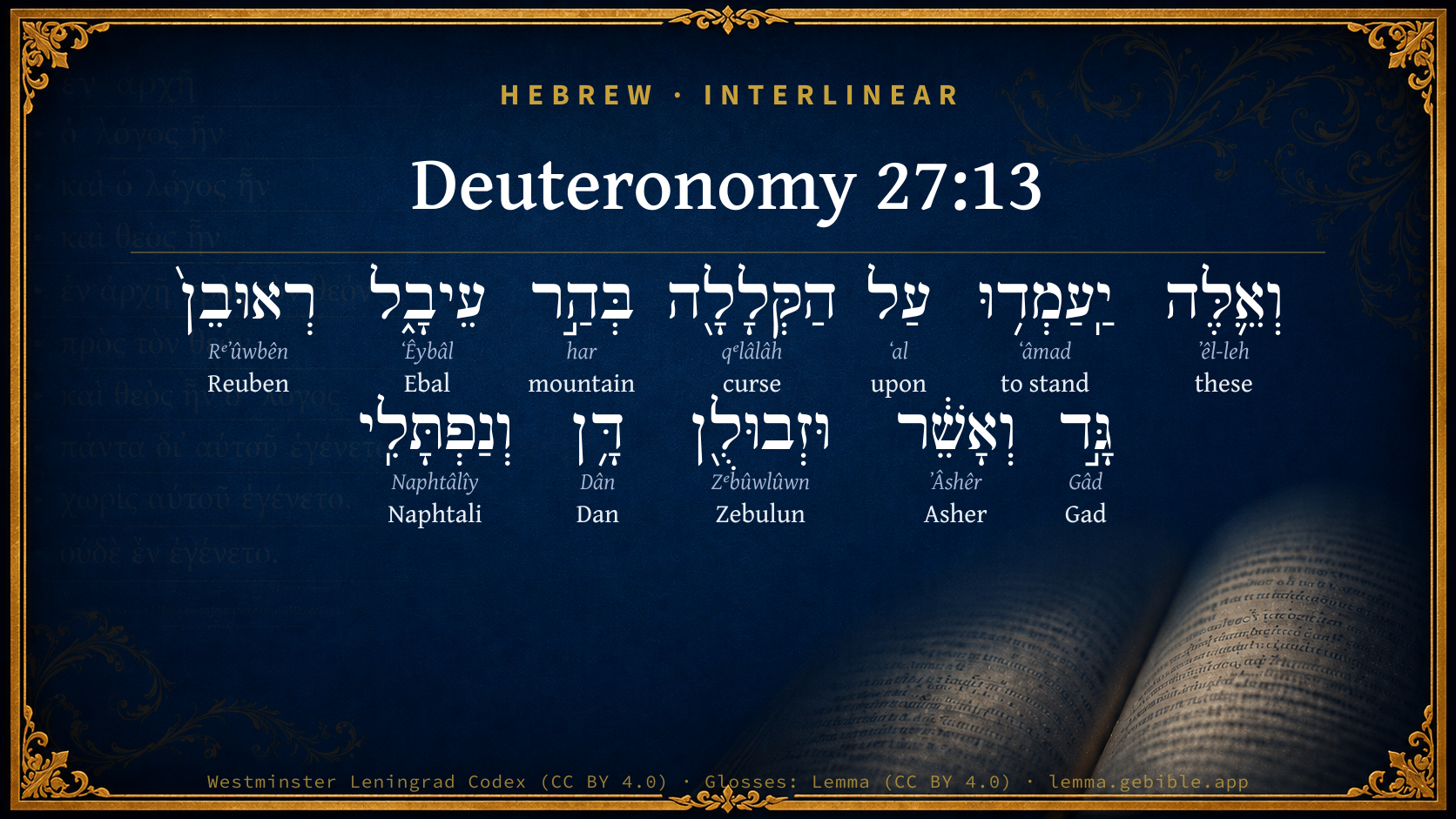
Hebrew (Westminster Leningrad Codex) Deuteronomy 27:13 appears in the Hebrew Old Testament. The text above is from the Westminster Leningrad Codex. Each word links to its Strong’s number, a concise gloss, and parsing drawn from the Open Scriptures Hebrew Bible morphology. Click any word for its full Brown-Driver-Briggs (BDB) entry.
Download image
Cite this verse

Deuteronomy 27:13 (World English Bible). Public Domain. Lemma interlinear Bible study tool, https://lemma.gebible.app/v/deuteronomy/27/13.

Show BibTeX & RIS
BibTeX
RIS
English Translation
These shall stand on Mount Ebal for the curse: Reuben, Gad, and Asher, and Zebulun, Dan, and Naphtali.
World English Bible · Public Domain
Download a study sheet

One document with this verse’s original text, its word-by-word gloss line, the meaning frame, cross-references with their text, attributed commentary, and full source and license credits — printable, and it pastes into notes with its structure intact.

This verse Autodidact and up

Study sheet (.html) Plain text (.txt)

A passage Seminary Student

Up to 50 verses in one chapter. A passage sheet keeps up to 6 commentary sources and 12 cross-references per verse, in the order this page ranks them, and says so on the sheet whenever that leaves anything out. Ask for a single verse and you get the Autodidact verse sheet above.

Everything on this page stays free to read, with no account — the sheet is a download of what is already on screen, not access to it.

Want to remove ads? Support Godless Engineer
Compare translations 3

The same verse in 3 English versions, stacked beneath the original-language interlinear above. Click any original word for its lexicon entry.

Each is an independent rendering of the whole verse — the interlinear is not word-aligned to these translations.

Highlighted words mark where these versions differ — a whole-verse word diff, not a word-by-word alignment.

  • World English Bible Public Domain
    These shall stand on Mount Ebal for the curse: Reuben, Gad, and Asher, and Zebulun, Dan, and Naphtali.
  • King James Version Public Domain
    And these shall stand upon mount Ebal to curse; Reuben, Gad, and Asher, and Zebulun, Dan, and Naphtali.
  • unfoldingWord Literal Text CC BY-SA 4.0
    And these shall stand for the curse on Mount Ebal: Reuben, Gad and Asher and Zebulun, Dan, and Naphtali.

unfoldingWord Literal Text — © unfoldingWord, licensed CC BY-SA 4.0. Word-aligned USFM3 via Door43 (git.door43.org/unfoldingWord/en_ult).

Versions to compare (up to 4)

3 of 4 selected

Show all 18 translations

Every available English version of this verse, each an independent rendering of the whole verse.

  • World English Bible Public Domain
    These shall stand on Mount Ebal for the curse: Reuben, Gad, and Asher, and Zebulun, Dan, and Naphtali.
  • Berean Standard Bible Public Domain
    And these tribes shall stand on Mount Ebal to deliver the curse: Reuben, Gad, Asher, Zebulun, Dan, and Naphtali.
  • Majority Standard Bible Public Domain
    And these tribes shall stand on Mount Ebal to deliver the curse: Reuben, Gad, Asher, Zebulun, Dan, and Naphtali.
  • King James Version Public Domain
    And these shall stand upon mount Ebal to curse; Reuben, Gad, and Asher, and Zebulun, Dan, and Naphtali.
  • American Standard Version (1901) Public Domain
    And these shall stand upon mount Ebal for the curse: Reuben, Gad, and Asher, and Zebulun, Dan, and Naphtali.
  • Revised Version (1885) Public Domain
    and these shall stand upon mount Ebal for the curse; Reuben, Gad, and Asher, and Zebulun, Dan, and Naphtali.
  • Geneva Bible (1599) Public Domain
    And these shall stand vpon mount Ebal to curse: Reuben, Gad, and Asher, and Zebulun, Dan, and Naphtali.
  • Douay-Rheims (1899) Public Domain
    And over against them shall stand on mount Hebal to curse: Ruben, Gad, and Aser, and Zabulon, Dan, and Nephtali.
  • Young's Literal Translation Public Domain
    And these do stand, for the reviling, on mount Ebal: Reuben, Gad, and Asher, and Zebulun, Dan, and Naphtali.
  • Literal Standard Version CC BY-SA 4.0
    And these stand, for the reviling, on Mount Ebal: Reuben, Gad, and Asher, and Zebulun, Dan, and Naphtali.”
  • Unlocked Literal Bible CC BY-SA 4.0
    These are the tribes that must stand on Mount Ebal to pronounce curses: Reuben, Gad, Asher, Zebulun, Dan, and Naphtali.
  • unfoldingWord Literal Text CC BY-SA 4.0
    And these shall stand for the curse on Mount Ebal: Reuben, Gad and Asher and Zebulun, Dan, and Naphtali.
  • Darby Bible Public Domain
    And these shall stand upon mount Ebal to curse: Reuben, Gad, and Asher, and Zebulun, Dan, and Naphtali.
  • World Messianic Bible Public Domain
    These shall stand on Mount Ebal for the curse: Reuben, Gad, Asher, Zebulun, Dan, and Naphtali.
  • Webster's Bible Public Domain
    And these shall stand upon mount Ebal to curse; Reuben, Gad, and Asher, and Zebulun, Dan, and Naphtali.
  • Free Bible Version CC BY-SA 4.0
    The following tribes are to stand on Mount Ebal for the curse: Reuben, Gad, Asher, Zebulun, Dan, and Naphtali.
  • Bible in Basic English Public Domain
    And these are to be on Mount Ebal for the curse: Reuben, Gad, and Asher, and Zebulun, Dan, and Naphtali.
  • JPS Tanakh (1917) Public Domain
    and these shall stand upon mount Ebal for the curse: Reuben, Gad, and Asher, and Zebulun, Dan, and Naphtali.

Literal Standard Version (2020), Covenant Press — licensed CC BY-SA 4.0. Text via the HelloAO Bible API (eBible.org). Unlocked Literal Bible (unfoldingWord) — licensed CC BY-SA 4.0. Text via the HelloAO Bible API (eBible.org). unfoldingWord Literal Text — © unfoldingWord, licensed CC BY-SA 4.0. Word-aligned USFM3 via Door43 (git.door43.org/unfoldingWord/en_ult). Free Bible Version, Dr. Jonathan Gallagher — licensed CC BY-SA 4.0. Text via the HelloAO Bible API (eBible.org).

Word by word

More ways to search: Search by grammar → Find every occurrence → Compare this word →

Practice this passage: Drill this verse → Learn its vocabulary →

עֵיבָ֑ל
ʻÊybâl
H5858
“Ebal”
Noun, Proper
Part of Speech
Noun
Type
Proper
Full BDB Definition

Origin: perhaps from an unused root probably meaning to be bald

TWOT: None

Ebal = "stone" or " bare mountain" - a son of Shobal (noun proper masculine) - mountain of cursing, north of Shechem and opposite Mount Gerizim (noun proper locative)
  1. וְאֵ֛לֶּה ʼêl-leh H428 “and · these” Conjunction + Pronoun, Demonstrative, Common, Plural
  2. יַֽעַמְד֥וּ ʻâmad H5975 “to stand” Verb, Qal, Imperfect, 3rd Person, Masculine, Plural
  3. עַל ʻal H5921 “upon” Preposition
  4. הַקְּלָלָ֖ה qᵉlâlâh H7045 “the · curse” Particle, Definite Article + Noun, Common, Feminine, Singular, Absolute
  5. בְּהַ֣ר har H2022 “in/at · mountain of” Preposition + Noun, Common, Masculine, Singular, Construct
  6. רְאוּבֵן֙ Rᵉʼûwbên H7205 “Reuben” Noun, Proper
  7. גָּ֣ד Gâd H1410 “Gad” Noun, Proper
  8. וְאָשֵׁ֔ר ʼÂshêr H836 “and · Asher” Conjunction + Noun, Proper
  9. וּזְבוּלֻ֖ן Zᵉbûwlûwn H2074 “and · Zebulun” Conjunction + Noun, Proper
  10. דָּ֥ן Dân H1835 “Dan” Noun, Proper
  11. וְנַפְתָּלִֽי Naphtâlîy H5321 “and · Naphtali” Conjunction + Noun, Proper

About this verse

These counts appear in no published source. They are computed here, from the morphology-tagged text and Lemma’s own curated glosses. What Lemma adds →

12
words
12
distinct lemmas
Pentateuch
section

Notable vocabulary

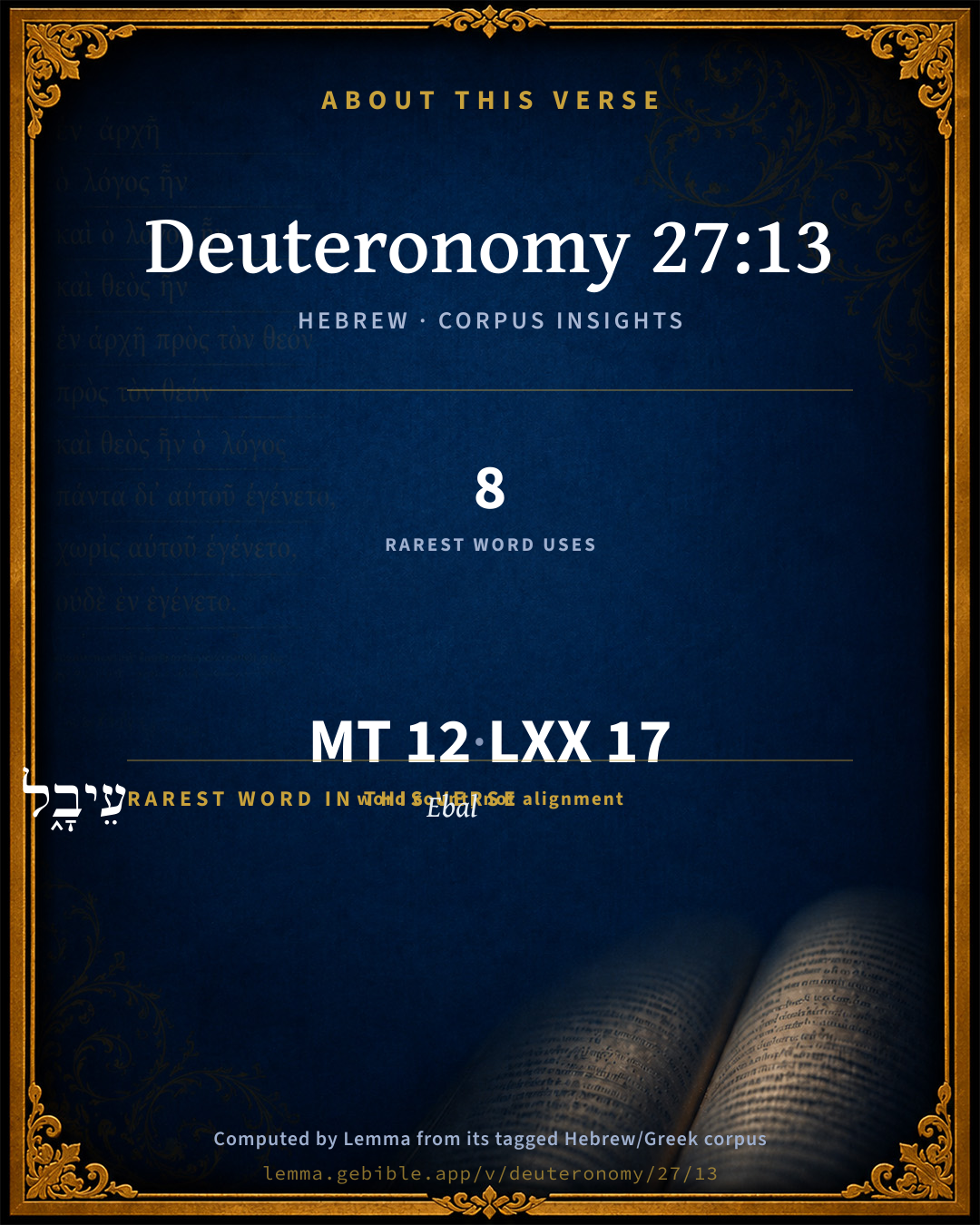
The rarest word here is עֵיבָ֑ל Ebal H5858 — appearing just 8 times in the whole Hebrew Bible.

Shared distinctive vocabulary

עֵיבָ֑ל Ebal H5858 occurs in 8 verses of the Hebrew Bible. Also found in:

Grammatical profile

  • 1 verb
  • 9 nouns
  • 1 pronoun
  • 1 preposition

Verb forms

  • יַֽעַמְד֥וּ Qal · Imperfect

Hebrew & Septuagint length

In English translation the verse runs 18 words from the Hebrew and 17 from the Septuagint (LXX English) — closely comparable.

A rough comparison of the two English renderings, which tokenize alike — not a word-level alignment.

Word counts can differ between the Hebrew and the Greek without any difference in meaning — e.g. the Hebrew direct-object marker אֵת has no separate Greek word, and Greek often adds the article ὁ.

In the original languages it is 12 Hebrew tokens and 17 Greek tokens — but the two are counted differently (Hebrew bundles its prefixes and suffixes into one token; the Greek is in lemma form), so that isn’t a like-for-like length.

Cross-references

7

Topical passages linked to Deuteronomy 27:13 in the Treasury of Scripture Knowledge — connected by theme and wording, ordered by reader-vote popularity; previews shown in the World English Bible.

  • Deuteronomy 27:4 It shall be, when you are passed over the Jordan, that you shall set up these stones, which I command you this day, in Mount Ebal, and you shall plaster them with plaster.
  • Genesis 29:32 Leah conceived, and bore a son, and she named him Reuben. For she said, "Because Yahweh has looked at my affliction. For now my husband will love me."
  • Genesis 30:6–13 Rachel said, "God has judged me, and has also heard my voice, and has given me a son." Therefore called she his name Dan.
  • Genesis 30:20 Leah said, "God has endowed me with a good dowry. Now my husband will live with me, because I have borne him six sons." She named him Zebulun.
  • Genesis 49:3–4 "Reuben, you are my firstborn, my might, and the beginning of my strength; The pre-eminence of dignity, and the pre-eminence of power.
  • Deuteronomy 11:29 It shall happen, when Yahweh your God shall bring you into the land where you go to possess it, that you shall set the blessing on Mount Gerizim, and the curse on Mount Ebal.
  • Joshua 8:33 All Israel, and their elders and officers, and their judges, stood on this side of the ark and on that side before the priests the Levites, who bore the ark of the covenant of Yahweh, as well the foreigner as the native; half of them in front of Mount Gerizim, and half of them in front of Mount Ebal; as Moses the servant of Yahweh had commanded at the first, that they should bless the people of Israel.

Cross-references courtesy of OpenBible.info (CC BY 4.0).

Hebrew and Greek witnesses Masoretic Hebrew ↔ Greek Septuagint

The same verse in the two great witnesses to the Old Testament, shown verse-for-verse.

These are two independent witnesses, not word-aligned to each other, and the Septuagint is shown in lemma (dictionary) form.

Hebrew Deuteronomy 27:13 Masoretic · Westminster Leningrad Codex

וְאֵ֛לֶּה יַֽעַמְד֥וּ עַל הַקְּלָלָ֖ה בְּהַ֣ר עֵיבָ֑ל רְאוּבֵן֙ גָּ֣ד וְאָשֵׁ֔ר וּזְבוּלֻ֖ן דָּ֥ן וְנַפְתָּלִֽי

These shall stand on Mount Ebal for the curse: Reuben, Gad, and Asher, and Zebulun, Dan, and Naphtali.

World English Bible · Public Domain

Greek LXX Deuteronomy 27:13 Septuagint · lemma form

καί οὗτος ἵστημι ἐπί ὁ κατάρα ἐν ὄρος γαιβαλ ρουβην γαδ καί ασηρ ζαβουλων δαν καί νεφθαλι

And these shall stand for cursing on mount Gaebal; Ruben, Gad, and Aser, Zabulon, Dan, and Nephthali.

LXX2012 (modern English Septuagint) · Public Domain

Hebrew: Westminster Leningrad Codex (CC BY 4.0). Greek: Septuagint (public domain); English from LXX2012 (modern English Septuagint) (Public Domain). How the Septuagint differs from the Hebrew →

Targum (Aramaic paraphrase)

2

The Targum is the ancient Jewish Aramaic paraphrase of the Hebrew Scriptures — an interpretive translation, not the Hebrew text itself. Onkelos (literal) and Pseudo-Jonathan (expansive) render the Torah, and Jonathan the Prophets. Coverage is partial: where no permissively-licensed English translation exists for a verse, only the Aramaic is shown. This is verse-level text, not a word-by-word alignment to the Hebrew.

  1. Targum Onkelos Torah (Genesis–Deuteronomy)
    וְאִלֵין יְקוּמוּן עַל לְוָטַיָא בְּטוּרָא דְעֵיבָל רְאוּבֵן גָד וְאָשֵׁר וּזְבוּלֻן דָן וְנַפְתָּלִי

    (no public-domain English translation for this verse)

    Targum Onkelos — Aramaic: “Onkelos Genesis” (public domain); “Onkelos Exodus” (public domain); “Onkelos Leviticus” (public domain); “Onkelos Numbers” (public domain); “Onkelos Deuteronomy” (public domain). English: “Sefaria Community Translation” (CC0 1.0 (public-domain dedication)); “J.W. Etheridge. The Targums of Onkelos and Jonathan Ben Uzziel on the Pentateuch. London: Longmans, Green, 1862” (public domain). Text via Sefaria.

  2. Targum Pseudo-Jonathan Torah (Genesis–Deuteronomy)
    וְאִלֵין שִׁבְטַיָא יְקוּמוּן עַל לְוָטַיָא בְּטַוְורָא דְעֵיבָל רְאוּבֵן גָד וְאָשֵׁר וּזְבוּלֻן דָן וְנַפְתָּלִי

    and these tribes shall stand (to pronounce) the curses on the mountain of Ebal, - Reuben, Gad, Asher, Zebulon, Dan, and Naphtali.

    Targum Pseudo-Jonathan — Aramaic: “Targum Jonathan on Genesis” (public domain); “Targum Jonathan on Exodus” (public domain); “Targum Jonathan on Leviticus” (public domain); “Targum Jonathan on Numbers” (public domain); “Targum Jonathan on Deuteronomy” (public domain). English: “The Targum of Jonathan ben Uzziel, trans. J. W. Etheridge, London, 1862” (public domain). Text via Sefaria.

Commentary

Notes on Deuteronomy 27:13 from classic Christian and Jewish commentators (each source and its license shown beneath its notes). The classic Christian expositions comment on the surrounding passage and are grouped to its opening verse, so a note may address several verses; the Jewish commentaries on the Tanakh (Rashi and others) are per-verse, so they appear only where the commentator wrote on this verse.

Lemma curates 59 commentaries, every one of them public domain or Creative Commons licensed, each selected and text-cleaned for this edition rather than reprinted as found. About our sources →

Joseph Benson's Commentary

Deu 27:13. To curse — Of the former tribes, it is said, they stood to bless the people: of these, that they stood to curse. Perhaps the different way of speaking intimates, that Israel in general were a happy people, and should ever be so, if they were obedient. And to that blessing, they on mount Gerizim said, Amen! But the curses come in only as exceptions to the general rule: “Israel is a blessed people: but if there be any even among them that do such and such things, they have no part or lot in this matter, but are under a curse.” This shows how ready God is to bestow the blessing: if any fall under the curse, they bring it on their own heads. Four of these are children of the bond-women, to show that the curse belongs to those of servile and disingenuous spirits. With these are joined Reuben, who by his shameful sin fell from his dignity, and Zebulun, the youngest of Leah’s children, that the numbers might be equal.

Joseph Benson's Commentary on the Old and New Testaments (1811–1818) — public domain. Text from a community e-Sword module.

Tyndale Open Study Notes

Tyndale Open Resources

27:13 proclaim a curse: By invoking curses on themselves if they disobeyed the terms of the covenant, these tribes served as witnesses and judges of their own future disobedience.

Tyndale Open Study Notes — © Tyndale Open Resources, licensed CC BY-SA 4.0. Text via the HelloAO Bible API.

Geneva Bible (1599)

Geneva Bible translators

Signifying, that if they would not obey God for love, they should be made to obey for fear.

Geneva Bible (1599) marginal notes — public domain. Text via Bolls.life.

John Gill's Exposition

And these shall stand upon Mount Ebal curse,.... Which was dry and rocky, barren and fruitful, and like the earth, that bears briers and thorns, is rejected and nigh unto cursing, and so a proper place to curse, and a fit emblem of those to be cursed; see Heb 6:8,

Reuben, Gad, and Asher, and Zebulun, Dan, and Naphtali; four of these appointed for cursing were the children of the handmaids, Gad, Asher, Dan, and Naphtali; and since two were wanting, as Aben Ezra observes, and the sons of Leah were many, the oldest and the youngest were taken; Reuben, who had defiled his father's bed, and exposed himself to the curse of the law, and Zebulun, the last and youngest of Leah's sons; see Gal 3:10.

John Gill's Exposition of the Whole Bible (1746–1763) — public domain (CC PDM 1.0). Text via the HelloAO Bible API.

Matthew Poole's English Annotations

To curse; he saith to bless the people, Deu 27:12, but here only to curse, not expressing whom, either because he was loth to mention the people as objects of the curse; or because he presumed and hoped that though some particular persons might deserve the curse, yet the generality of the people would keep out of the reach of it; or to intimate, that though the blessing was peculiar to the people of Israel, yet the curse was indefinite and common to all nations, as may appear from the particular sins here numbered, which are such as made the Gentiles guilty and abominable to God, as is elsewhere affirmed. See Lev 18:28.

Gad and Asher, Dan and Naphtali, are the children of the bond-women, to show that the curse belongs to those of servile and disingenuous spirits and carriages to God. With these are joined

Reuben, who by his shameful sin fell from his dignity, Gen 49:4, and

Zebulun, as the youngest of Leah’s children, who was necessary to be joined with those, that the numbers might be equal.

Matthew Poole's English Annotations on the Holy Bible (1683–1685) — public domain. Text from a community e-Sword/MySword module.

The Pulpit Commentary

These shall stand upon mount Ebal to curse; literally, These shall stand upon the curse on Mount Ebal; i.e. it shall belong to them to utter the curse.

The Pulpit Commentary (1880–1919), ed. H.D.M. Spence-Jones & Joseph S. Exell — public domain. Text from a community e-Sword module.

John Wesley's Explanatory Notes

To curse - Of the former tribes, 'tis said, they stood to bless the people: of these, that they stood to curse. Perhaps the different way of speaking intimates, That Israel in general were an happy people, and should ever be so, if they were obedient. And to that blessing, they on mount Gerizzim said, Amen! But the curses come in, only as exceptions to the general rule: "Israel is a blessed people: but if there be any even among them, that do such and such things, they have no part or lot in this matter, but are under a curse." This shews how ready God is to bestow the blessing: if any fall under the curse, they bring it on their own head. Four of these are children of the bond-woman, to shew that the curse belongs to those of servile and disingenuous spirits. With these are joined Reuben, who by his shameful sin fell from his dignity, and Zebulun, the youngest of Leah's children, that the numbers might be equal.

John Wesley, Explanatory Notes Upon the Whole Bible (1754–1765) — public domain. Text via the GEBible commentary corpus.

unfoldingWord translationNotes

Door43 World Missions Community

Mount Ebal

See how you translated this in Deuteronomy 11:29.

pronounce curses

"say in a loud voice how Yahweh will curse Israel"

translationWords

curse

Reuben

Gad

Asher

Zebulun

Dan

Naphtali

Levi

Israel

voice

unfoldingWord translationNotes — © Distant Shores Media and the Door43 World Missions Community, licensed CC BY-SA 4.0. Source: git.door43.org/Door43/en_tn.

Lesson kit

Teaching starters — assembled from the data on this page, not authored interpretation. Every prompt links to the verse data it draws on. Edit before teaching.

Deuteronomy, in the Pentateuch, opens this verse with 12 words (12 distinct Hebrew lemmas). Its most distinctive word is ʻÊybâl (“Ebal”). A historical commentator’s framing appears above. Read the whole chapter for the surrounding context.

Discussion questions

  1. The word ʻÊybâl carries the sense “Ebal.” How does it shape the verse?
  2. Genesis 36:23 shares the word «Ebal» with this verse. How do the two illuminate each other?
  3. These translations render this verse differently; the difference is in the English rendering, not the original. What questions does that raise?
  4. The verb «יַֽעַמְד֥וּ» is Qal Imperfect. How does its form color the action?
  5. Reading how Joseph Benson's Commentary and Tyndale Open Study Notes read this verse, where do the two commentators agree and where do they part?

Things to notice

Reading settings

Reading text

Shown beneath each verse's original-language words.

Old Testament
Old Testament edition

Read the OT as the Masoretic Hebrew (MT) or the Greek Septuagint (LXX).

English shown for the Greek Septuagint (in the Hebrew ↔ Greek comparison).

Comparing translations? Open the Compare panel on any verse page to stack up to four side by side.