
Numbers 26:57

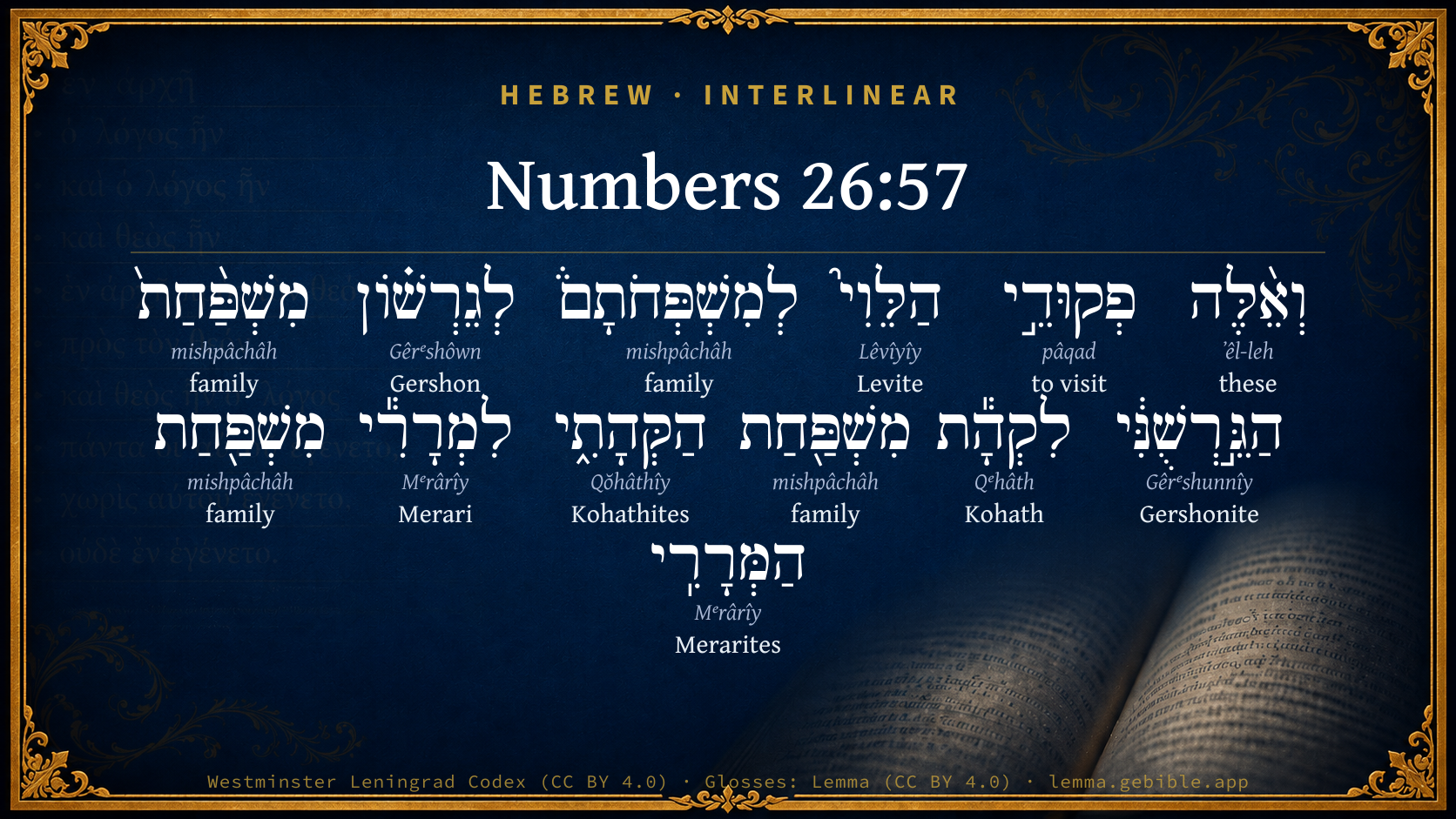
Hebrew (Westminster Leningrad Codex) Numbers 26:57 appears in the Hebrew Old Testament. The text above is from the Westminster Leningrad Codex. Each word links to its Strong’s number, a concise gloss, and parsing drawn from the Open Scriptures Hebrew Bible morphology. Click any word for its full Brown-Driver-Briggs (BDB) entry.
Download image
Cite this verse

Numbers 26:57 (World English Bible). Public Domain. Lemma interlinear Bible study tool, https://lemma.gebible.app/v/numbers/26/57.

Show BibTeX & RIS
BibTeX
RIS
English Translation
These are those who were numbered of the Levites after their families: of Gershon, the family of the Gershonites; of Kohath, the family of the Kohathites; of Merari, the family of the Merarites.
World English Bible · Public Domain
Highlights
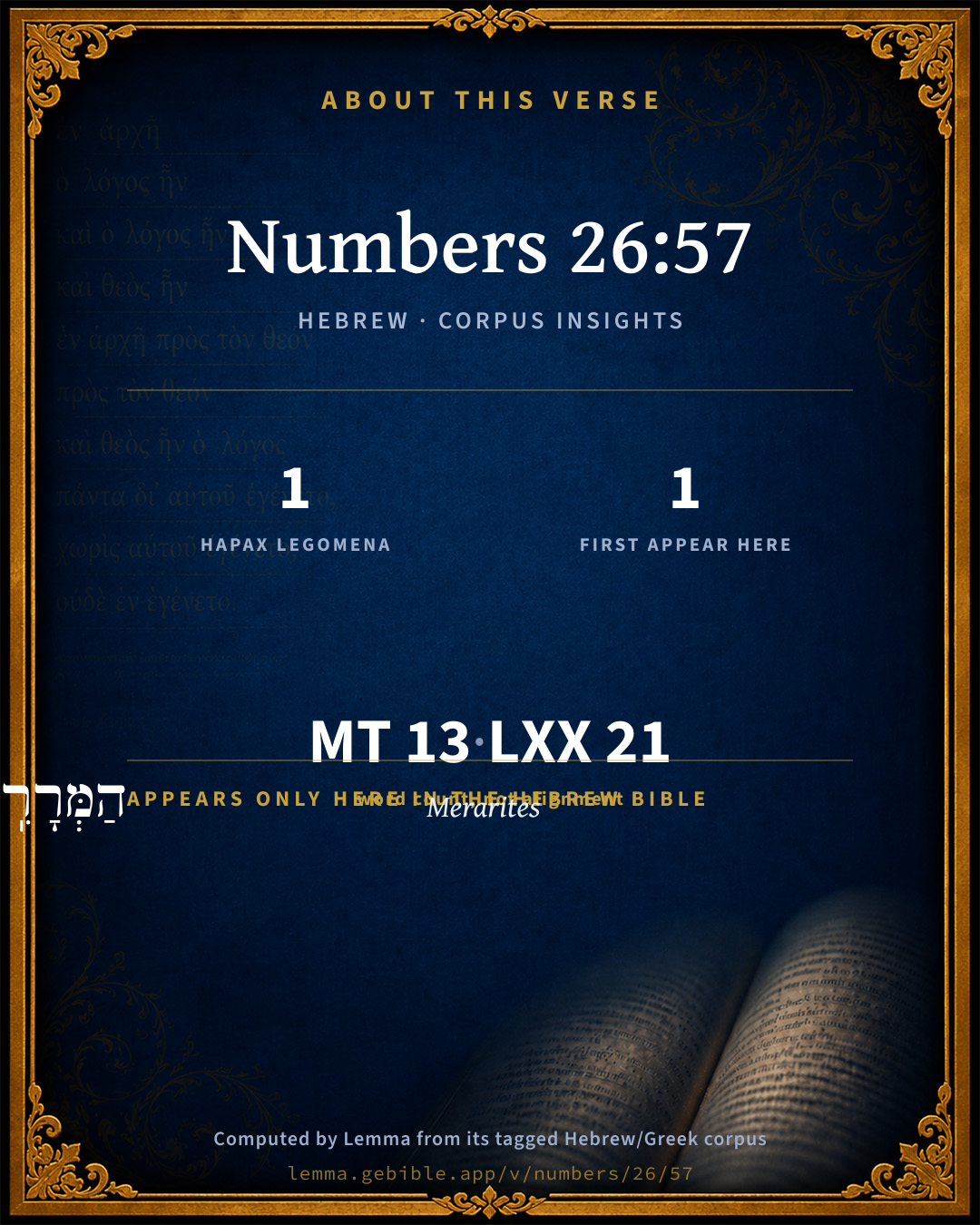
  • 1 hapax legomenon — only here in the Hebrew Bible
  • 1 first appearance in the Hebrew Bible
Full analysis ↓
Download a study sheet

One document with this verse’s original text, its word-by-word gloss line, the meaning frame, cross-references with their text, attributed commentary, and full source and license credits — printable, and it pastes into notes with its structure intact.

This verse Autodidact and up

Study sheet (.html) Plain text (.txt)

A passage Seminary Student

Up to 50 verses in one chapter. A passage sheet keeps up to 6 commentary sources and 12 cross-references per verse, in the order this page ranks them, and says so on the sheet whenever that leaves anything out. Ask for a single verse and you get the Autodidact verse sheet above.

Everything on this page stays free to read, with no account — the sheet is a download of what is already on screen, not access to it.

Want to remove ads? Support Godless Engineer
Compare translations 3

The same verse in 3 English versions, stacked beneath the original-language interlinear above. Click any original word for its lexicon entry.

Each is an independent rendering of the whole verse — the interlinear is not word-aligned to these translations.

Highlighted words mark where these versions differ — a whole-verse word diff, not a word-by-word alignment.

  • World English Bible Public Domain
    These are those who were numbered of the Levites after their families: of Gershon, the family of the Gershonites; of Kohath, the family of the Kohathites; of Merari, the family of the Merarites.
  • King James Version Public Domain
    And these are they that were numbered of the Levites after their families: of Gershon, the family of the Gershonites: of Kohath, the family of the Kohathites: of Merari, the family of the Merarites.
  • unfoldingWord Literal Text CC BY-SA 4.0
    And these were the counted ones of the Levite according to their clans: of Gershon, the clan of the Gershonite; of Kohath, the clan of the Kohathite; of Merari, the clan of the Merarite.

unfoldingWord Literal Text — © unfoldingWord, licensed CC BY-SA 4.0. Word-aligned USFM3 via Door43 (git.door43.org/unfoldingWord/en_ult).

Versions to compare (up to 4)

3 of 4 selected

Show all 18 translations

Every available English version of this verse, each an independent rendering of the whole verse.

  • World English Bible Public Domain
    These are those who were numbered of the Levites after their families: of Gershon, the family of the Gershonites; of Kohath, the family of the Kohathites; of Merari, the family of the Merarites.
  • Berean Standard Bible Public Domain
    Now these were the Levites numbered by their clans: The Gershonite clan from Gershon, the Kohathite clan from Kohath, and the Merarite clan from Merari.
  • Majority Standard Bible Public Domain
    Now these were the Levites numbered by their clans: The Gershonite clan from Gershon, the Kohathite clan from Kohath, and the Merarite clan from Merari.
  • King James Version Public Domain
    And these are they that were numbered of the Levites after their families: of Gershon, the family of the Gershonites: of Kohath, the family of the Kohathites: of Merari, the family of the Merarites.
  • American Standard Version (1901) Public Domain
    And these are they that were numbered of the Levites after their families: of Gershon, the family of the Gershonites; of Kohath, the family of the Kohathites; of Merari, the family of the Merarites.
  • Revised Version (1885) Public Domain
    And these are they that were numbered of the Levites after their families: of Gershon, the family of the Gershonites: of Kohath, the family of the Kohathites: of Merari, the family of the Merarites.
  • Geneva Bible (1599) Public Domain
    These also are the nobers of ye Leuites, after their families: of Gershon came ye familie of the Gershonites: of Kohath, ye familie of the Kohathites: of Merari, the familie of the Merarites.
  • Douay-Rheims (1899) Public Domain
    This also is the number of the sons of Levi by their families: Gerson, of whom is the family of the Gersonites: Caath, of whom is the family of the Caathites: Merari, of whom is the family of the Merarites.
  • Young's Literal Translation Public Domain
    And these `are' numbered ones of the Levite by their families: of Gershon `is' the family of the Gershonite; of Kohath the family of the Kohathite; of Merari the family of the Merarite.
  • Literal Standard Version CC BY-SA 4.0
    And these [are] numbered ones of the Levite by their families: of Gershon [is] the family of the Gershonite; of Kohath the family of the Kohathite; of Merari the family of the Merarite.
  • Unlocked Literal Bible CC BY-SA 4.0
    The Levite clans, counted clan by clan, were these: Through Gershon, the clan of the Gershonites, through Kohath, the clan of the Kohathites, through Merari, the clan of the Merarites.
  • unfoldingWord Literal Text CC BY-SA 4.0
    And these were the counted ones of the Levite according to their clans: of Gershon, the clan of the Gershonite; of Kohath, the clan of the Kohathite; of Merari, the clan of the Merarite.
  • Darby Bible Public Domain
    And these are the numbered of the Levites, after their families: of Gershon, the family of the Gershonites; of Kohath, the family of the Kohathites; of Merari, the family of the Merarites.
  • World Messianic Bible Public Domain
    These are those who were counted of the Levites after their families: of Gershon, the family of the Gershonites; of Kohath, the family of the Kohathites; of Merari, the family of the Merarites.
  • Webster's Bible Public Domain
    And these are they that were numbered of the Levites after their families: of Gershon, the family of the Gershonites: of Kohath, the family of the Kohathites: of Merari, the family of the Merarites.
  • Free Bible Version CC BY-SA 4.0
    These were the Levites censused by family: Gershon, ancestor of the Gershonite family; Kohath, ancestor of the Kohathite family; and Merari, ancestor of the Merarite family.
  • Bible in Basic English Public Domain
    These were those of the Levites who were numbered by their families: of Gershon, the family of the Gershonites: of Kohath, the family of the Kohathites: of Merari, the family of the Merarites.
  • JPS Tanakh (1917) Public Domain
    And these are they that were numbered of the Levites after their families: of Gershon, the family of the Gershonites; of Kohath, the family of the Kohathites; of Merari, the family of the Merarites.

Literal Standard Version (2020), Covenant Press — licensed CC BY-SA 4.0. Text via the HelloAO Bible API (eBible.org). Unlocked Literal Bible (unfoldingWord) — licensed CC BY-SA 4.0. Text via the HelloAO Bible API (eBible.org). unfoldingWord Literal Text — © unfoldingWord, licensed CC BY-SA 4.0. Word-aligned USFM3 via Door43 (git.door43.org/unfoldingWord/en_ult). Free Bible Version, Dr. Jonathan Gallagher — licensed CC BY-SA 4.0. Text via the HelloAO Bible API (eBible.org).

Word by word

More ways to search: Search by grammar → Find every occurrence → Compare this word →

Practice this passage: Drill this verse → Learn its vocabulary →

הַמְּרָרִֽי
Mᵉrârîy
H4848
“the · Merarites”
Particle, Definite Article + Noun, Gentilic, Masculine, Singular, Absolute
Part of Speech
Particle + Noun
Type
Gentilic
Gender
Masculine
Number
Singular
State
Absolute
Full BDB Definition

Origin: from H4847

TWOT: None

Merarites = see Marari " bitter" - descendants of Merari, the son of Levi, and members of a Levitical family
  1. וְאֵ֨לֶּה ʼêl-leh H428 “and · these” Conjunction + Pronoun, Demonstrative, Common, Plural
  2. פְקוּדֵ֣י pâqad H6485 “visited” Verb, Qal, Participle Passive, Masculine, Plural, Construct
  3. הַלֵּוִי֮ Lêvîyîy H3881 “the · Levite” Particle, Definite Article + Noun, Gentilic, Masculine, Singular, Absolute
  4. לְמִשְׁפְּחֹתָם֒ mishpâchâh H4940 “to/for · families · their” Preposition + Noun, Common, Feminine, Plural, Construct + Suffix, Personal, 3rd Person, Masculine, Plural
  5. לְגֵרְשׁ֗וֹן Gêrᵉshôwn H1648 “to/for · Gershon” Preposition + Noun, Proper
  6. מִשְׁפַּ֨חַת֙ mishpâchâh H4940 “family of” Noun, Common, Feminine, Singular, Construct
  7. הַגֵּ֣רְשֻׁנִּ֔י Gêrᵉshunnîy H1649 “the · Gershonite” Particle, Definite Article + Noun, Gentilic, Masculine, Singular, Absolute
  8. לִקְהָ֕ת Qᵉhâth H6955 “to/for · Kohath” Preposition + Noun, Proper
  9. מִשְׁפַּ֖חַת mishpâchâh H4940 “family of” Noun, Common, Feminine, Singular, Construct
  10. הַקְּהָתִ֑י Qŏhâthîy H6956 “the · Kohathites” Particle, Definite Article + Noun, Gentilic, Masculine, Singular, Absolute
  11. לִמְרָרִ֕י Mᵉrârîy H4847 “to/for · Merari” Preposition + Noun, Proper
  12. מִשְׁפַּ֖חַת mishpâchâh H4940 “family of” Noun, Common, Feminine, Singular, Construct

About this verse

These counts appear in no published source. They are computed here, from the morphology-tagged text and Lemma’s own curated glosses. What Lemma adds →

13
words
10
distinct lemmas
Pentateuch
section

Notable vocabulary

1 hapax legomenon — a word that appears only here in the entire Hebrew Bible:

  • הַמְּרָרִֽי Merarites H4848

First appearance in Scripture

This word makes its first canonical appearance in the Hebrew Bible here:

  • הַמְּרָרִֽי Merarites H4848

Shared distinctive vocabulary

הַגֵּ֣רְשֻׁנִּ֔י Gershonite H1649 occurs in 12 verses of the Hebrew Bible. Also found in:

Grammatical profile

  • 1 verb
  • 11 nouns
  • 1 pronoun

Verb forms

  • פְקוּדֵ֣י Qal · Participle Passive

Repetition

A word recurs within this verse — often emphatic in Hebrew:

  • לְמִשְׁפְּחֹתָם֒ family H4940 ×4

Hebrew & Septuagint length

In English translation the verse runs 33 words from the Hebrew and 30 from the Septuagint (LXX English) — closely comparable.

A rough comparison of the two English renderings, which tokenize alike — not a word-level alignment.

Word counts can differ between the Hebrew and the Greek without any difference in meaning — e.g. the Hebrew direct-object marker אֵת has no separate Greek word, and Greek often adds the article ὁ.

In the original languages it is 13 Hebrew tokens and 21 Greek tokens — but the two are counted differently (Hebrew bundles its prefixes and suffixes into one token; the Greek is in lemma form), so that isn’t a like-for-like length.

Cross-references

6

Topical passages linked to Numbers 26:57 in the Treasury of Scripture Knowledge — connected by theme and wording, ordered by reader-vote popularity; previews shown in the World English Bible.

  • Genesis 46:11 The sons of Levi: Gershon, Kohath, and Merari.
  • Exodus 6:16–19 These are the names of the sons of Levi according to their generations: Gershon, and Kohath, and Merari; and the years of the life of Levi were one hundred thirty-seven years.
  • 1 Chronicles 6:1 The sons of Levi: Gershon, Kohath, and Merari.
  • 1 Chronicles 6:16–30 The sons of Levi: Gershom, Kohath, and Merari.
  • Numbers 3:1–4 Now this is the history of the generations of Aaron and Moses in the day that Yahweh spoke with Moses in Mount Sinai.
  • Numbers 35:2–3 Command the children of Israel that they give to the Levites of the inheritance of their possession cities to dwell in; and suburbs for the cities round about them shall you give to the Levites.

Cross-references courtesy of OpenBible.info (CC BY 4.0).

Hebrew and Greek witnesses Masoretic Hebrew ↔ Greek Septuagint

The same verse in the two great witnesses to the Old Testament, shown verse-for-verse.

These are two independent witnesses, not word-aligned to each other, and the Septuagint is shown in lemma (dictionary) form.

Hebrew Numbers 26:57 Masoretic · Westminster Leningrad Codex

וְאֵ֨לֶּה פְקוּדֵ֣י הַלֵּוִי֮ לְמִשְׁפְּחֹתָם֒ לְגֵרְשׁ֗וֹן מִשְׁפַּ֨חַת֙ הַגֵּ֣רְשֻׁנִּ֔י לִקְהָ֕ת מִשְׁפַּ֖חַת הַקְּהָתִ֑י לִמְרָרִ֕י מִשְׁפַּ֖חַת הַמְּרָרִֽי

These are those who were numbered of the Levites after their families: of Gershon, the family of the Gershonites; of Kohath, the family of the Kohathites; of Merari, the family of the Merarites.

World English Bible · Public Domain

Greek LXX Numbers 26:57 Septuagint · lemma form

καί υἱός λευί κατά δῆμος αὐτός ὁ γεδσων δῆμος ὁ γεδσωνι ὁ κααθ δῆμος ὁ κααθι ὁ μεραρι δῆμος ὁ μεραρι

And the sons of Levi according to their families; to Gedson, the family of the Gedsonites; to Caath, the family of the Caathites; to Merari, the family of the Merarites.

LXX2012 (modern English Septuagint) · Public Domain

Hebrew: Westminster Leningrad Codex (CC BY 4.0). Greek: Septuagint (public domain); English from LXX2012 (modern English Septuagint) (Public Domain). How the Septuagint differs from the Hebrew →

Targum (Aramaic paraphrase)

2

The Targum is the ancient Jewish Aramaic paraphrase of the Hebrew Scriptures — an interpretive translation, not the Hebrew text itself. Onkelos (literal) and Pseudo-Jonathan (expansive) render the Torah, and Jonathan the Prophets. Coverage is partial: where no permissively-licensed English translation exists for a verse, only the Aramaic is shown. This is verse-level text, not a word-by-word alignment to the Hebrew.

  1. Targum Onkelos Torah (Genesis–Deuteronomy)
    וְאִלֵין מִנְיָנֵי לֵוָאֵי לְזַרְעֲיַתְהוֹן לְגֵרְשׁוֹן זַרְעִית גֵרְשׁוֹן לִּקְהָת זַרְעִית קְהָת לִמְרָרִי זַרְעִית מְרָרִי

    (no public-domain English translation for this verse)

    Targum Onkelos — Aramaic: “Onkelos Genesis” (public domain); “Onkelos Exodus” (public domain); “Onkelos Leviticus” (public domain); “Onkelos Numbers” (public domain); “Onkelos Deuteronomy” (public domain). English: “Sefaria Community Translation” (CC0 1.0 (public-domain dedication)); “J.W. Etheridge. The Targums of Onkelos and Jonathan Ben Uzziel on the Pentateuch. London: Longmans, Green, 1862” (public domain). Text via Sefaria.

  2. Targum Pseudo-Jonathan Torah (Genesis–Deuteronomy)
    וְאִלֵין סְכוּמֵי לֵיוָאֵי לִגְנִיסַתְהוֹן לְגֵרְשׁוֹן גְנִיסַת גֵרְשׁוֹן לִקְהָת גְנִיסַת קְהָת לִמְרָרִי גְנִיסַת מְרָרִי

    But these are the names of the Levites after their families, the families of Gershon, Kehath, Merari. _

    Targum Pseudo-Jonathan — Aramaic: “Targum Jonathan on Genesis” (public domain); “Targum Jonathan on Exodus” (public domain); “Targum Jonathan on Leviticus” (public domain); “Targum Jonathan on Numbers” (public domain); “Targum Jonathan on Deuteronomy” (public domain). English: “The Targum of Jonathan ben Uzziel, trans. J. W. Etheridge, London, 1862” (public domain). Text via Sefaria.

Commentary

Notes on Numbers 26:57 from classic Christian and Jewish commentators (each source and its license shown beneath its notes). The classic Christian expositions comment on the surrounding passage and are grouped to its opening verse, so a note may address several verses; the Jewish commentaries on the Tanakh (Rashi and others) are per-verse, so they appear only where the commentator wrote on this verse.

Lemma curates 59 commentaries, every one of them public domain or Creative Commons licensed, each selected and text-cleaned for this edition rather than reprinted as found. About our sources →

Whedon's Commentary on the Bible

Daniel D. Whedon

CENSUS OF THE LEVITES, Num_26:57-62.

As in the Sinaitic enumeration, the census of the Levites was taken separately, thereby showing their non-military, non-secular, and semi-priestly character; The enumeration of the three families of the Levites proceeds regularly till Num_26:58, where the writer turns aside to trace the descent of Moses and Aaron, and to name the sons of the latter and the judicial death of two of them. Instead of the completion of the census of the Levite families their sum total is given.

57. The Levites — For their character, see Num_1:49, note. For their service, see Num_3:14-39; Num_7:3-9, notes.

The Gershonites — Num_4:21-28, note.

The Kohathites — Num_4:4-20, notes.

The Merarites — Num_3:35-37; Num_4:29-33, notes.

Daniel D. Whedon (gen. ed.), Commentary on the Old and New Testaments (1874–1909) — public domain. Text from a community e-Sword module.

Tyndale Open Study Notes

Tyndale Open Resources

26:57-61 The family of Kohath received special attention as the clan of Aaron, Moses, and Miriam.

Tyndale Open Study Notes — © Tyndale Open Resources, licensed CC BY-SA 4.0. Text via the HelloAO Bible API.

Matthew Henry's Commentary

Levi was God's tribe, a tribe that was to have no inheritance with the rest in the land of Canaan, and therefore was not numbered with the rest, but by itself; so it had been numbered in the beginning of this book at Mount Sinai, and therefore came not under the sentence passed upon all that were then numbered, that none of them should enter Canaan but Caleb and Joshua; for of the Levites that were not numbered with them, nor were to go forth to war, Eleazar and Ithamar, and perhaps others who were above twenty years old then (as appears, Jos 4:16, 28), entered Canaan; and yet this tribe, now at its second numbering, had increased but 1000, and was still one of the smallest tribes. Mention is made here of the death of Nadab and Abihu for offering strange fire, as before of the sin and punishment of Korah, because these things happened to them for ensamples.

Matthew Henry's Commentary on the Whole Bible (1708–1710) — public domain (CC PDM 1.0). Text via the HelloAO Bible API.

The Cambridge Bible for Schools and Colleges

gen. ed. J. J. S. Perowne

57–62. The census of the Levites. They were numbered separately from the secular tribes, because they were not, as a tribe, to possess any land.

The Cambridge Bible for Schools and Colleges (gen. ed. J. J. S. Perowne; Cambridge University Press, 1878–1918) — public domain. Text from a community e-Sword module.

Keil & Delitzsch

C. F. Keil & F. Delitzsch

Mustering of the Levites. - The enumeration of the different Levitical families into which the three leading families of Levi, that were founded by his three sons Gershon, Kohath, and Merari, were divided, is not complete, but is broken off in Num 26:58 after the notice of five different families, for the purpose of tracing once more the descent of Moses and Aaron, the heads not of this tribe only, but of the whole nation, and also of giving the names of the sons of the latter (Num 26:59-61). And after this the whole is concluded with a notice of the total number of those who were mustered of the tribe of Levi (Num 26:62). - Of the different families mentioned, Libni belonged to Gershon (cf. Num 3:21), Hebroni to Kohath (Num 3:27), Machli and Mushi to Merari (Num 3:33), and Korchi, i.e., the family of Korah (according to ch. Num 16:1; cf. Exo 6:21 and Exo 6:24), to Kohath. Moses and Aaron were descendants of Kohath (see at Exo 6:20 and Exo 2:1). Some difficulty is caused by the relative clause, "whom (one) had born to Levi in Egypt" (Num 26:59), on account of the subject being left indefinite. It cannot be Levi's wife, as Jarchi, Abenezra, and others suppose; for Jochebed, the mother of Moses, was not a daughter of Levi in the strict sense of the word, but only a Levitess or descendant of Levi, who lived about 300 years after Levi; just as her husband Amram was not actually the son of Amram, who bore that name (Exo 6:18), but a later descendant of this older Amram. The missing subject must be derived from the verb itself, viz., either היּלדת or אמּהּ (her mother), as in Kg1 1:6, another passage in which "his mother" is to be supplied (cf. Ewald, 294, b.).

Keil & Delitzsch — Biblical Commentary on the Old Testament (1861–1891) — public domain (CC PDM 1.0). Text via the HelloAO Bible API. (Old Testament only.)

unfoldingWord translationNotes

Door43 World Missions Community

General Information:

This is a list of the Levite clans. Moses counts the Levites separately from the other tribes because they did not receive any land. (See: How to Translate Names)

counted clan by clan

This can be stated in active form. AT: "that the leaders also counted clan by clan" (See: Active or Passive)

Gershon ... Kohath ... Merari ... Amram

See how you translated these men's names you did in Numbers 3:17-19.

She bore to Amram their children

"She and Amram had children"

translationWords

Levi

descend

Egypt

Aaron

Miriam

unfoldingWord translationNotes — © Distant Shores Media and the Door43 World Missions Community, licensed CC BY-SA 4.0. Source: git.door43.org/Door43/en_tn.

Ramban (Nachmanides)

Rabbi Moshe ben Nachman (Ramban / Nachmanides)

AND THESE ARE THEY THAT WERE NUMBERED OF THE LEVITES. I do not know why He [commanded] that the Levites should be counted [here], and what purpose [is served] now by counting them [since they did not receive any portion in the Land]. Perhaps [they were counted because] it was only to these [Levites] that they gave the [forty-eight] cities to dwell in and their open land for their cattle, and not to those who were born afterwards. Or [it may be that this census] was done as an expression of honor for them before G-d, so that “the legion of the King” should not be treated as less important [than the other people], by not bothering to count them like the rest of the people. Scripture mentions Amram and his wife [Jochebed, with the children she bore — Aaron, Moses and Miriam their sister, although it does not do so in connection with any other Levite families], because the sons of [that] Levite [Amram] were counted as two [groups], as priests and as Levites, and it was fitting that Aaron and his sons [who were originally Levites but later on became priests] should be counted separately [therefore Scripture mentions especially the names of the parents and of their children].

Ramban (Nachmanides) on the Tanakh — English translation: “Commentary on the Torah by Ramban (Nachmanides). Translated and annotated by Charles B. Chavel. New York, Shilo Pub. House, 1971-1976” (CC BY 4.0). Text via Sefaria.

Lesson kit

Teaching starters — assembled from the data on this page, not authored interpretation. Every prompt links to the verse data it draws on. Edit before teaching.

Numbers, in the Pentateuch, opens this verse with 13 words (10 distinct Hebrew lemmas). Its most distinctive word is Mᵉrârîy (“Merarites”). A historical commentator’s framing appears above. Read the whole chapter for the surrounding context.

Discussion questions

  1. How does “Merarites” (Mᵉrârîy) shape what this verse is saying?
  2. This verse holds 1 word here found nowhere else in the Hebrew Bible. What might the rare word draw attention to?
  3. The word “Merarites” first appears here in Scripture. What is being introduced at this debut?
  4. Numbers 3:21 shares the word «Gershonite» with this verse. How do the two illuminate each other?
  5. “family” occurs 4× in this one verse. What is the effect of the repetition?
  6. These translations render this verse differently; the difference is in the English rendering, not the original. What questions does that raise?
  7. The verb «פְקוּדֵ֣י» is Qal Participle Passive. How does its form color the action?
  8. Reading how Whedon's Commentary on the Bible and Tyndale Open Study Notes read this verse, where do the two commentators agree and where do they part?

Things to notice

  • 1 word in this verse appears nowhere else in the Hebrew Bible.
  • 1 word makes its first canonical appearance in Scripture here.
  • This verse counts 13 Hebrew ↔ 21 Greek words.
  • These translations choose different wording for 18 words in this verse.
  • “family” occurs 4× in this single verse.

Reading settings

Reading text

Shown beneath each verse's original-language words.

Old Testament
Old Testament edition

Read the OT as the Masoretic Hebrew (MT) or the Greek Septuagint (LXX).

English shown for the Greek Septuagint (in the Hebrew ↔ Greek comparison).

Comparing translations? Open the Compare panel on any verse page to stack up to four side by side.