
Job 18:21

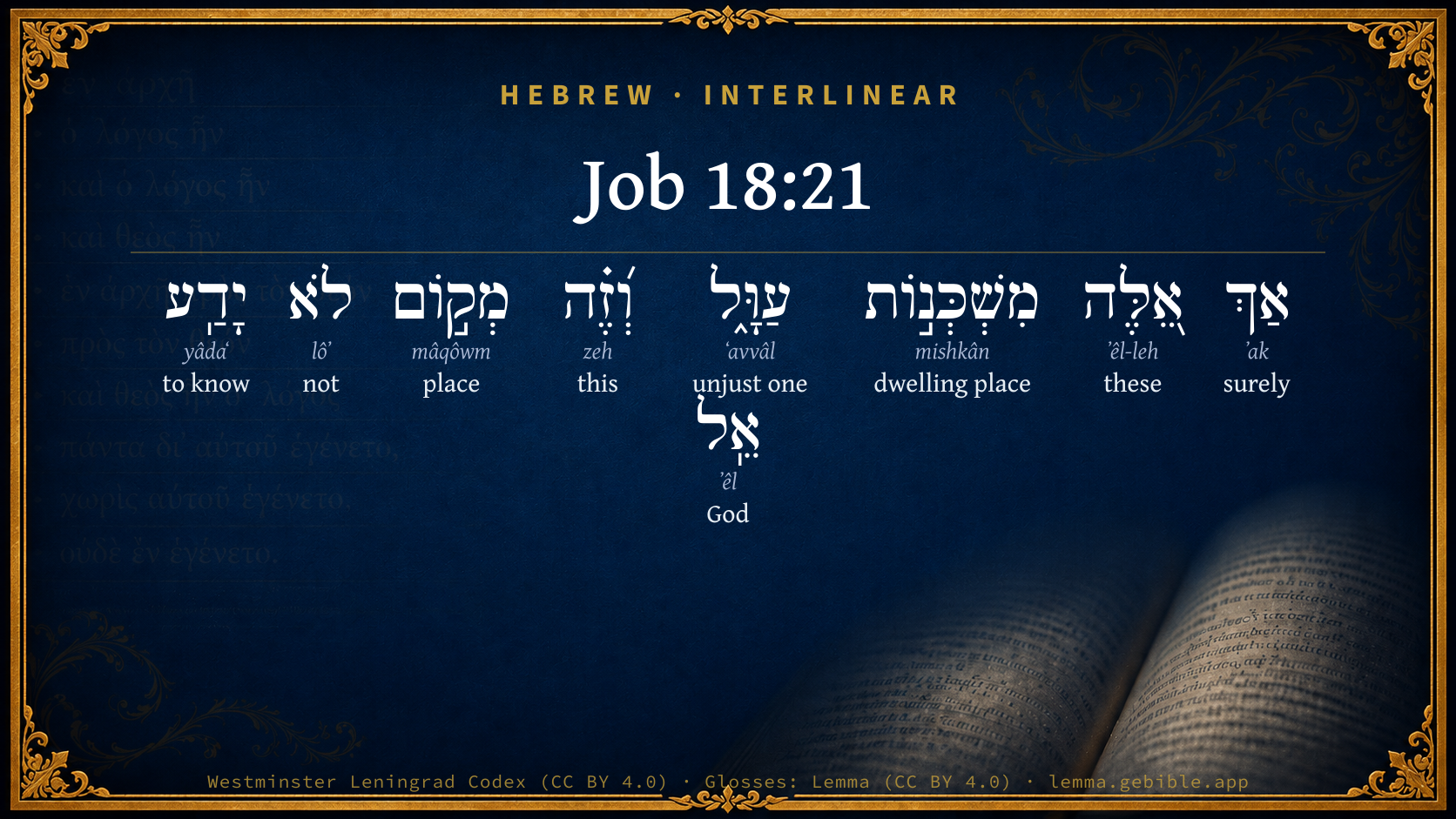
Hebrew (Westminster Leningrad Codex) Job 18:21 appears in the Hebrew Old Testament. The text above is from the Westminster Leningrad Codex. Each word links to its Strong’s number, a concise gloss, and parsing drawn from the Open Scriptures Hebrew Bible morphology. Click any word for its full Brown-Driver-Briggs (BDB) entry.
Download image
Cite this verse

Job 18:21 (World English Bible). Public Domain. Lemma interlinear Bible study tool, https://lemma.gebible.app/v/job/18/21.

Show BibTeX & RIS
BibTeX
RIS
English Translation
Surely such are the dwellings of the unrighteous, This is the place of him who doesn't know God."
World English Bible · Public Domain
Highlights
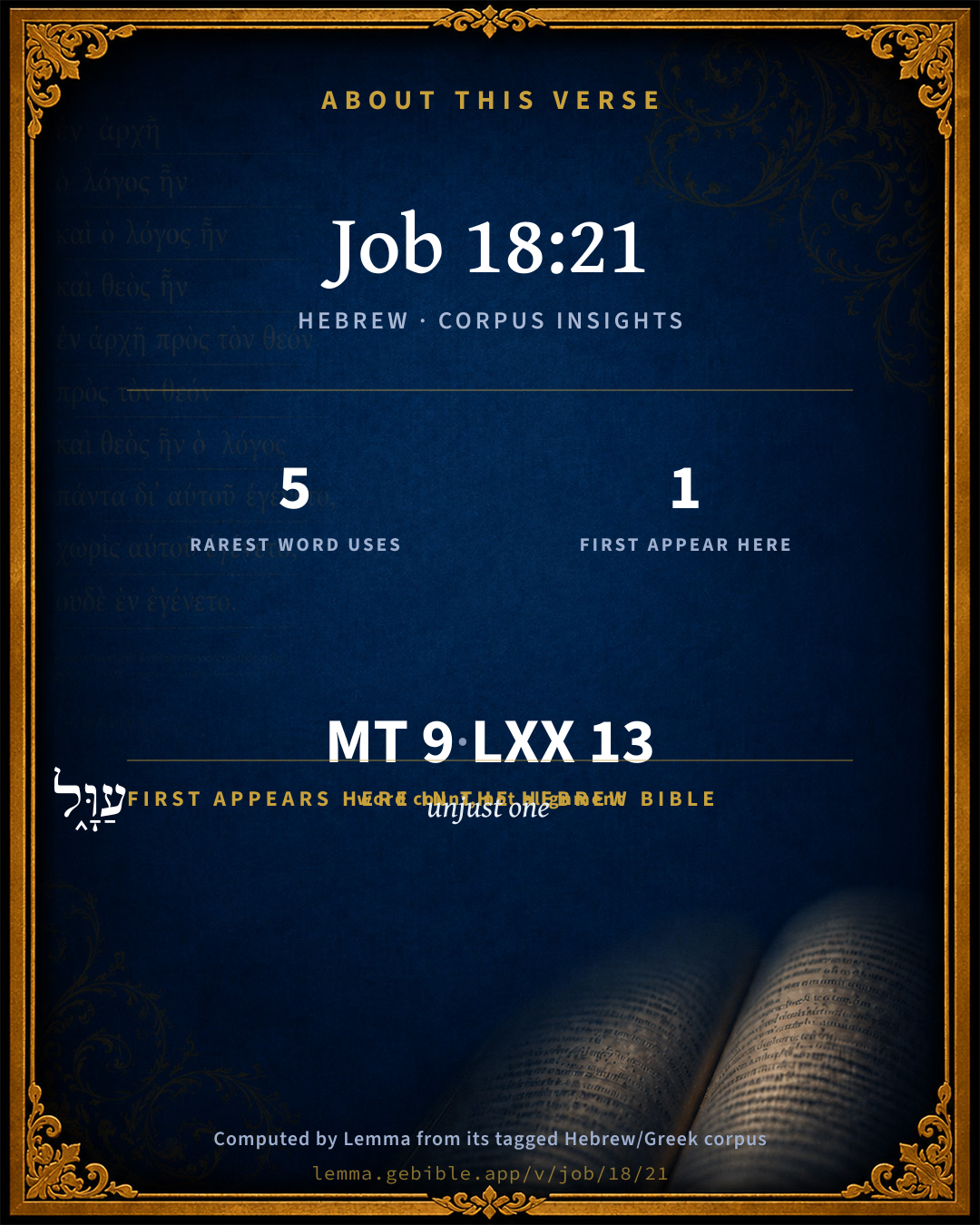
  • 1 first appearance in the Hebrew Bible
Full analysis ↓
Download a study sheet

One document with this verse’s original text, its word-by-word gloss line, the meaning frame, cross-references with their text, attributed commentary, and full source and license credits — printable, and it pastes into notes with its structure intact.

This verse Autodidact and up

Study sheet (.html) Plain text (.txt)

A passage Seminary Student

Up to 50 verses in one chapter. A passage sheet keeps up to 6 commentary sources and 12 cross-references per verse, in the order this page ranks them, and says so on the sheet whenever that leaves anything out. Ask for a single verse and you get the Autodidact verse sheet above.

Everything on this page stays free to read, with no account — the sheet is a download of what is already on screen, not access to it.

Want to remove ads? Support Godless Engineer
Compare translations 3

The same verse in 3 English versions, stacked beneath the original-language interlinear above. Click any original word for its lexicon entry.

Each is an independent rendering of the whole verse — the interlinear is not word-aligned to these translations.

Highlighted words mark where these versions differ — a whole-verse word diff, not a word-by-word alignment.

  • World English Bible Public Domain
    Surely such are the dwellings of the unrighteous, This is the place of him who doesn't know God."
  • King James Version Public Domain
    Surely such are the dwellings of the wicked, and this is the place of him that knoweth not God.
  • unfoldingWord Literal Text CC BY-SA 4.0
    Surely these the dwellings of the wicked, and this the place of one does not know God.”

unfoldingWord Literal Text — © unfoldingWord, licensed CC BY-SA 4.0. Word-aligned USFM3 via Door43 (git.door43.org/unfoldingWord/en_ult).

Versions to compare (up to 4)

3 of 4 selected

Show all 18 translations

Every available English version of this verse, each an independent rendering of the whole verse.

  • World English Bible Public Domain
    Surely such are the dwellings of the unrighteous, This is the place of him who doesn't know God."
  • Berean Standard Bible Public Domain
    Surely such is the dwelling of the wicked and the place of one who does not know God.”
  • Majority Standard Bible Public Domain
    Surely such is the dwelling of the wicked and the place of one who does not know God.”
  • King James Version Public Domain
    Surely such are the dwellings of the wicked, and this is the place of him that knoweth not God.
  • American Standard Version (1901) Public Domain
    Surely such are the dwellings of the unrighteous, And this is the place of him that knoweth not God.
  • Revised Version (1885) Public Domain
    Surely such are the dwellings of the unrighteous, and this is the place of him that knoweth not God.
  • Geneva Bible (1599) Public Domain
    Surely such are the habitations of the wicked, and this is the place of him that knoweth not God.
  • Douay-Rheims (1899) Public Domain
    These men are the tabernacles of the wicked, and this the place of him that knoweth not God.
  • Young's Literal Translation Public Domain
    Only these `are' tabernacles of the perverse, And this the place God hath not known.
  • Literal Standard Version CC BY-SA 4.0
    Only these [are] dwelling places of the perverse, || And this [is] the place God has not known.”
  • Unlocked Literal Bible CC BY-SA 4.0
    Surely such are the homes of unrighteous people, the places of those who do not know God.”
  • unfoldingWord Literal Text CC BY-SA 4.0
    Surely these the dwellings of the wicked, and this the place of one does not know God.”
  • Darby Bible Public Domain
    Surely, such are the dwellings of the unrighteous man, and such the place of him that knoweth not ùGod.
  • World Messianic Bible Public Domain
    Surely such are the dwellings of the unrighteous. This is the place of him who doesn’t know God.”
  • Webster's Bible Public Domain
    Surely such are the dwellings of the wicked, and this is the place of him that knoweth not God.
  • Free Bible Version CC BY-SA 4.0
    This is what happens to the homes of the wicked, to the places of those who reject God.”
  • Bible in Basic English Public Domain
    Truly, these are the houses of the sinner, and this is the place of him who has no knowledge of God.
  • JPS Tanakh (1917) Public Domain
    Surely such are the dwellings of the wicked, and this is the place of him that knoweth not God.

Literal Standard Version (2020), Covenant Press — licensed CC BY-SA 4.0. Text via the HelloAO Bible API (eBible.org). Unlocked Literal Bible (unfoldingWord) — licensed CC BY-SA 4.0. Text via the HelloAO Bible API (eBible.org). unfoldingWord Literal Text — © unfoldingWord, licensed CC BY-SA 4.0. Word-aligned USFM3 via Door43 (git.door43.org/unfoldingWord/en_ult). Free Bible Version, Dr. Jonathan Gallagher — licensed CC BY-SA 4.0. Text via the HelloAO Bible API (eBible.org).

Word by word

More ways to search: Search by grammar → Find every occurrence → Compare this word →

Practice this passage: Drill this verse → Learn its vocabulary →

About this verse

These counts appear in no published source. They are computed here, from the morphology-tagged text and Lemma’s own curated glosses. What Lemma adds →

9
words
9
distinct lemmas
Wisdom
section

Notable vocabulary

The rarest word here is עַוָּ֑ל unjust one H5767 — appearing just 5 times in the whole Hebrew Bible.

First appearance in Scripture

This word makes its first canonical appearance in the Hebrew Bible here:

  • עַוָּ֑ל unjust one H5767

Shared distinctive vocabulary

עַוָּ֑ל unjust one H5767 occurs in 5 verses of the Hebrew Bible. Also found in:

Grammatical profile

  • 1 verb
  • 4 nouns
  • 2 pronouns
  • 2 particles

Verb forms

  • יָדַֽע Qal · Perfect

Hebrew & Septuagint length

In English translation the verse runs 18 words from the Hebrew and 19 from the Septuagint (LXX English) — closely comparable.

A rough comparison of the two English renderings, which tokenize alike — not a word-level alignment.

Word counts can differ between the Hebrew and the Greek without any difference in meaning — e.g. the Hebrew direct-object marker אֵת has no separate Greek word, and Greek often adds the article ὁ.

In the original languages it is 9 Hebrew tokens and 13 Greek tokens — but the two are counted differently (Hebrew bundles its prefixes and suffixes into one token; the Greek is in lemma form), so that isn’t a like-for-like length.

Cross-references

13

Topical passages linked to Job 18:21 in the Treasury of Scripture Knowledge — connected by theme and wording, ordered by reader-vote popularity; previews shown in the World English Bible.

  • Jeremiah 9:3 They bend their tongue, [as it were] their bow, for falsehood; and they are grown strong in the land, but not for truth: for they proceed from evil to evil, and they don't know me, says Yahweh.
  • Titus 1:16 They profess that they know God, but by their works they deny him, being abominable, disobedient, and unfit for any good work.
  • Judges 2:10 Also all that generation were gathered to their fathers: and there arose another generation after them, who didn't know Yahweh, nor yet the work which he had worked for Israel.
  • Jeremiah 10:25 Pour out your wrath on the nations that don't know you, and on the families that don't call on your name: for they have devoured Jacob, yes, they have devoured him and consumed him, and have laid waste his habitation.
  • 1 Thessalonians 4:5 not in the passion of lust, even as the Gentiles who don't know God;
  • 2 Thessalonians 1:8 giving vengeance to those who don't know God, and to those who don't obey the Gospel of our Lord Jesus,
  • Exodus 5:2 Pharaoh said, "Who is Yahweh, that I should listen to his voice to let Israel go? I don't know Yahweh, and moreover I will not let Israel go."
  • 1 Samuel 2:12 Now the sons of Eli were base men; they didn't know Yahweh.
  • Job 21:14 They tell God, 'Depart from us, For we don't want to know about your ways.
  • Job 21:28 For you say, 'Where is the house of the prince? Where is the tent in which the wicked lived?'
  • Psalms 79:6 Pour out your wrath on the nations that don't know you; On the kingdoms that don't call on your name;
  • 1 Chronicles 28:9 You, Solomon my son, know the God of your father, and serve him with a perfect heart and with a willing mind; for Yahweh searches all hearts, and understands all the imaginations of the thoughts: if you seek him, he will be found of you; but if you forsake him, he will cast you off forever.
  • Romans 1:28 Even as they refused to have God in their knowledge, God gave them up to a reprobate mind, to do those things which are not fitting;

Cross-references courtesy of OpenBible.info (CC BY 4.0).

Hebrew and Greek witnesses Masoretic Hebrew ↔ Greek Septuagint

The same verse in the two great witnesses to the Old Testament, shown verse-for-verse.

These are two independent witnesses, not word-aligned to each other, and the Septuagint is shown in lemma (dictionary) form.

Hebrew Job 18:21 Masoretic · Westminster Leningrad Codex

אַךְ אֵ֭לֶּה מִשְׁכְּנ֣וֹת עַוָּ֑ל וְ֝זֶ֗ה מְק֣וֹם לֹא יָדַֽע אֵֽל

Surely such are the dwellings of the unrighteous, This is the place of him who doesn't know God."

World English Bible · Public Domain

Greek LXX Job 18:21 Septuagint · lemma form

οὗτος εἰμί οἶκος ἄδικος οὗτος δέ ὁ τόπος ὁ μή οἶδα ὁ κύριος

These are the houses of the unrighteous, and this is the place of them that know not the Lord.

LXX2012 (modern English Septuagint) · Public Domain

Hebrew: Westminster Leningrad Codex (CC BY 4.0). Greek: Septuagint (public domain); English from LXX2012 (modern English Septuagint) (Public Domain). How the Septuagint differs from the Hebrew →

Commentary

Notes on Job 18:21 from classic Christian and Jewish commentators (each source and its license shown beneath its notes). The classic Christian expositions comment on the surrounding passage and are grouped to its opening verse, so a note may address several verses; the Jewish commentaries on the Tanakh (Rashi and others) are per-verse, so they appear only where the commentator wrote on this verse.

Lemma curates 59 commentaries, every one of them public domain or Creative Commons licensed, each selected and text-cleaned for this edition rather than reprinted as found. About our sources →

Trapp's Complete Commentary

John Trapp

Job 18:21 Surely such [are] the dwellings of the wicked, and this [is] the place [of him that] knoweth not God.

Ver. 21. Surely such are the dwellings of the wicked] As sure as death it is so; and this is oft inculcated, because hardly believed. Bildad hints at Job in all this, and therefore speaks of the wicked here in the singular number; as who should say, Thou art the man. But Job’s innocence served him for a Heptaboean buckler.

And this is the place] That is, the state.

Of him that knoweth not God] Periphrasis impii, saith Drusius; this is the character of a graceless man. "Have the workers of iniquity no knowledge?" Psa 14:4. No, none that they were a button the better for.

John Trapp, A Commentary or Exposition upon All the Books of the Old and New Testament (1647–1656) — public domain. Text from a community e-Sword module.

Tyndale Open Study Notes

Tyndale Open Resources

18:21 Bildad kept implying that Job had rejected God (15:4, 13, 25).

Tyndale Open Study Notes — © Tyndale Open Resources, licensed CC BY-SA 4.0. Text via the HelloAO Bible API.

Jamieson, Fausset & Brown

Robert Jamieson, A. R. Fausset & David Brown

(Job 8:22, Margin).

Next: Job Chapter 19

Jamieson, Fausset & Brown — Commentary Critical and Explanatory on the Whole Bible (1871) — public domain (CC PDM 1.0). Text via the HelloAO Bible API.

Adam Clarke's Commentary

Verse 21. Such are the dwellings] This is the common lot of the wicked; and it shall be particularly the case with him who knoweth not God, that is Job, for it is evident he alludes to him. Poor Job! hard was thy lot, severe were thy sufferings.

ON the elephant hunt to which I have referred, Job 18:13, I shall borrow the following account extracted from Mr. Cordiner's History of Ceylon, by Mr. Good: -

"We have a curious description of the elephant hunt, which is pursued in a manner not essentially different from the preceding, except that the snares are pallisadoed with the strongest possible stakes, instead of being netted, and still farther fortified by interlacings. They are numerous, but connected together; every snare or inclosure growing gradually narrower, and opening into each other by a gate or two that will only admit the entrance of a single animal at a time.

"The wood in which elephants are known to abound is first surrounded, excepting at the end where the foremost and widest inclosure is situated, with fires placed on moveable pedestals, which in every direction are drawn closer and closer, and, aided by loud and perpetual shouts, drive the animals forward till they enter into the outer snare. After which the same process is continued, and they are driven by fear into a second, into a third, and into a fourth; till at length the elephants become so much sub-divided, that by the aid of cordage fastened carefully round their limbs, and the management of decoy elephants, they are easily capable of being led away one by one, and tamed. A single hunt thus conducted will sometimes occupy not less than two months of unremitting labour; and the entrance of the elephants into the snares is regarded as an amusement or sport of the highest character, and as such is attended by all the principal families of the country." Account of Ceylon, p. 218-226.

Adam Clarke's Commentary on the Bible (1810–1826) — public domain. Text from a community e-Sword/MySword module.

Ellicott's Commentary for English Readers

(21) Dwellings of the wicked.—That is to say, of the wicked man. As Bildad designedly uses the singular here, there can be little doubt that he as designedly intended this terrible and cruel picture to represent Job himself.

A Bible Commentary for English Readers, edited by Charles John Ellicott (1878–1897) — public domain. Text from a community e-Sword module.

Albert Barnes' Notes on the Bible

Surely such are the dwellings of the wicked - The conclusion or sum of the whole matter. The meaning is, that the habitations of all that knew not God would be desolate - a declaration which Job could not but regard as aimed at himself; compare Job 20:29. This is the close of this harsh and severe speech. It is no wonder that Job should feel it keenly, and that he “did” feel it is apparent from the following chapter. A string of proverbs has been presented, having the appearance of proof, and as the result of the long observation of the course of events, evidently bearing on his circumstances, and so much in point that he could not well deny their pertinency to his condition. He was stung to the quick, and and gave vent to his agonized feelings in the following chapter.

Albert Barnes' Notes on the Bible (1834–1885) — public domain. Text from a community e-Sword/MySword module.

Matthew Poole's English Annotations

i.e. Who doth not acknowledge, nor fear, nor serve God, as this phrase is used, 1Sa 2:12; Psa 79:6; 2Th 1:8.

Matthew Poole's English Annotations on the Holy Bible (1683–1685) — public domain. Text from a community e-Sword/MySword module.

Whedon's Commentary on the Bible

Daniel D. Whedon

21. That knoweth not God — These words, last in the Hebrew also, furnish a climax — a sneer at Job’s most solemn protestations. (Job_16:19.)

Daniel D. Whedon (gen. ed.), Commentary on the Old and New Testaments (1874–1909) — public domain. Text from a community e-Sword module.

The Pulpit Commentary

Surely such are the dwellings of the wicked. "Such as I have described is the general condition and manner of life of the man who is wicked." and this is the place (or, position) of him that knoweth not God . The singular number used both in this clause and the preceding indicates that the whole series of denunciations (vers. 5-21) is leveled against an individual viz. Job.

The Pulpit Commentary (1880–1919), ed. H.D.M. Spence-Jones & Joseph S. Exell — public domain. Text from a community e-Sword module.

John Wesley's Explanatory Notes

The place - The condition.

John Wesley, Explanatory Notes Upon the Whole Bible (1754–1765) — public domain. Text via the GEBible commentary corpus.

unfoldingWord translationNotes

Door43 World Missions Community

General Information:

Bildad continues to describe the wicked person.

the homes of unrighteous people, the places of those who do not know God

These two phrases have the same meaning and refer to the same people. Here these people are referred to by the places where they live. AT: "unrighteous people, those who do not know God" (See: Parallelism and Metonymy)

translationWords

righteous

know

God

unfoldingWord translationNotes — © Distant Shores Media and the Door43 World Missions Community, licensed CC BY-SA 4.0. Source: git.door43.org/Door43/en_tn.

Rashi

Rabbi Shlomo Yitzchaki (Rashi)

These are only the dwellings of the unrighteous This is their fate.

Rashi on the Tanakh — English translations: “The Judaica Press complete Tanach with Rashi, translated by A. J. Rosenberg” (CC BY 4.0); “Pentateuch with Rashi's commentary by M. Rosenbaum and A.M. Silbermann, 1929-1934” (public domain); “The Metsudah Tanach series, Lakewood, N.J” (CC BY 4.0); and “The Book of Joshua, Metsudah Publications, 1997” (CC BY 4.0). Text via Sefaria.

Lesson kit

Teaching starters — assembled from the data on this page, not authored interpretation. Every prompt links to the verse data it draws on. Edit before teaching.

Job, in the Wisdom, opens this verse with 9 words (9 distinct Hebrew lemmas). Its most distinctive word is ʻavvâl (“unjust one”). A historical commentator’s framing appears above. Read the whole chapter for the surrounding context.

Discussion questions

  1. The word ʻavvâl carries the sense “unjust one.” How does it shape the verse?
  2. This is the first place “unjust one” appears in Scripture (first appears here). What does its debut here establish?
  3. How does Job 27:7, which shares the word «unjust one», read alongside this verse?
  4. These translations render this verse differently; the difference is in the English rendering, not the original. What questions does that raise?
  5. «יָדַֽע» is a Qal Perfect verb. How does that grammatical form shape the action described?
  6. Compare how Trapp's Complete Commentary and Tyndale Open Study Notes read this verse. Where do they agree or differ?

Things to notice

Reading settings

Reading text

Shown beneath each verse's original-language words.

Old Testament
Old Testament edition

Read the OT as the Masoretic Hebrew (MT) or the Greek Septuagint (LXX).

English shown for the Greek Septuagint (in the Hebrew ↔ Greek comparison).

Comparing translations? Open the Compare panel on any verse page to stack up to four side by side.