
Esther 9:28

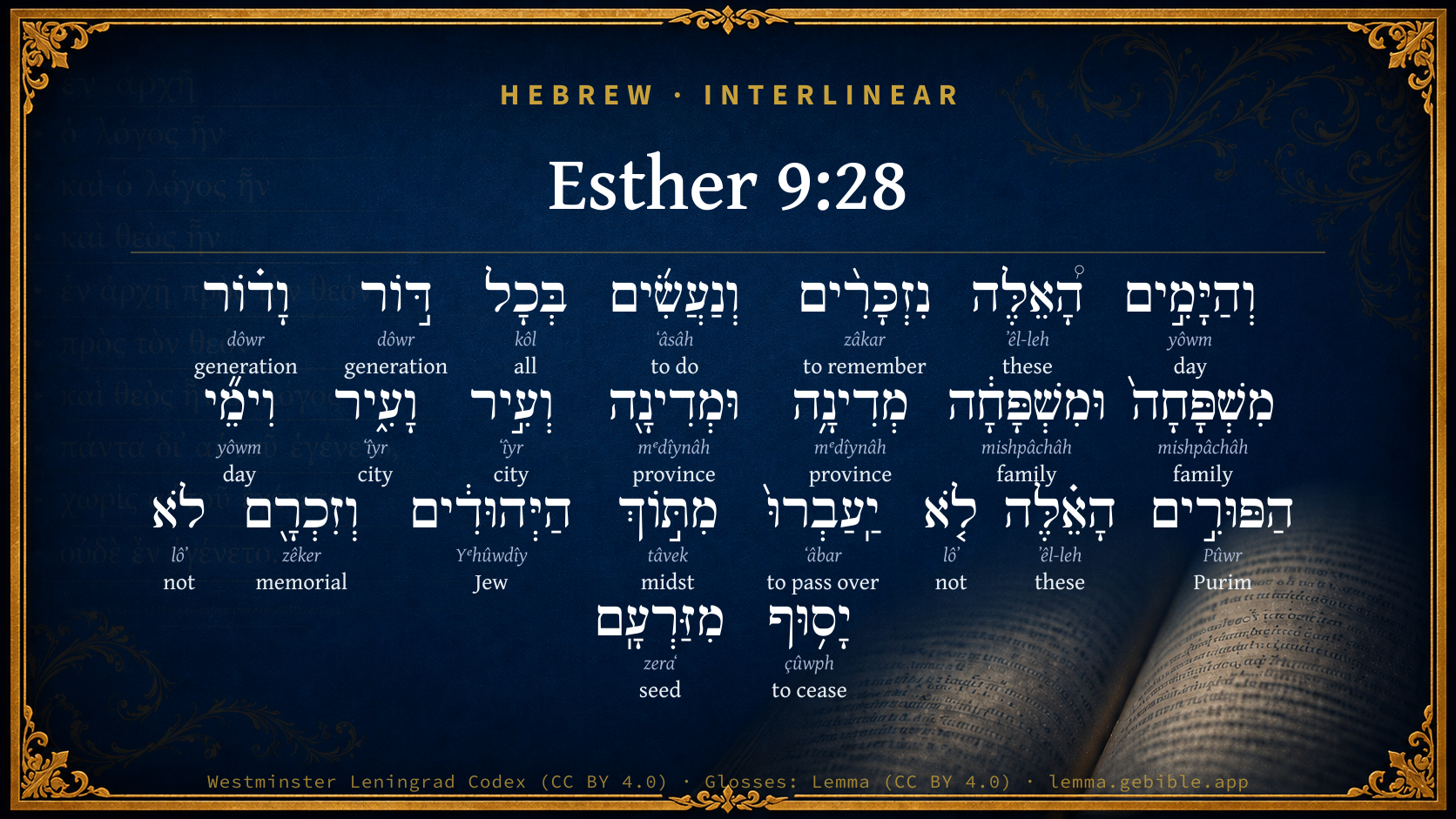
Hebrew (Westminster Leningrad Codex) Esther 9:28 appears in the Hebrew Old Testament. The text above is from the Westminster Leningrad Codex. Each word links to its Strong’s number, a concise gloss, and parsing drawn from the Open Scriptures Hebrew Bible morphology. Click any word for its full Brown-Driver-Briggs (BDB) entry.
Download image
Cite this verse

Esther 9:28 (World English Bible). Public Domain. Lemma interlinear Bible study tool, https://lemma.gebible.app/v/esther/9/28.

Show BibTeX & RIS
BibTeX
RIS
English Translation
and that these days should be remembered and kept throughout every generation, every family, every province, and every city; and that these days of Purim should not fail from among the Jews, nor the memory of them perish from their seed.
World English Bible · Public Domain
Highlights Full analysis ↓
Download a study sheet

One document with this verse’s original text, its word-by-word gloss line, the meaning frame, cross-references with their text, attributed commentary, and full source and license credits — printable, and it pastes into notes with its structure intact.

This verse Autodidact and up

Study sheet (.html) Plain text (.txt)

A passage Seminary Student

Up to 50 verses in one chapter. A passage sheet keeps up to 6 commentary sources and 12 cross-references per verse, in the order this page ranks them, and says so on the sheet whenever that leaves anything out. Ask for a single verse and you get the Autodidact verse sheet above.

Everything on this page stays free to read, with no account — the sheet is a download of what is already on screen, not access to it.

Want to remove ads? Support Godless Engineer
Compare translations 3

The same verse in 3 English versions, stacked beneath the original-language interlinear above. Click any original word for its lexicon entry.

Each is an independent rendering of the whole verse — the interlinear is not word-aligned to these translations.

Highlighted words mark where these versions differ — a whole-verse word diff, not a word-by-word alignment.

  • World English Bible Public Domain
    and that these days should be remembered and kept throughout every generation, every family, every province, and every city; and that these days of Purim should not fail from among the Jews, nor the memory of them perish from their seed.
  • King James Version Public Domain
    And that these days should be remembered and kept throughout every generation, every family, every province, and every city; and that these days of Purim should not fail from among the Jews, nor the memorial of them perish from their seed.
  • unfoldingWord Literal Text CC BY-SA 4.0
    And these days are remembered and are made in every generation by generation, family by family, province by province, and city by city. And these days of Purim will not pass away from the midst of the Jews, and their remembrance will not come to an end from their seed.

unfoldingWord Literal Text — © unfoldingWord, licensed CC BY-SA 4.0. Word-aligned USFM3 via Door43 (git.door43.org/unfoldingWord/en_ult).

Versions to compare (up to 4)

3 of 4 selected

Show all 18 translations

Every available English version of this verse, each an independent rendering of the whole verse.

  • World English Bible Public Domain
    and that these days should be remembered and kept throughout every generation, every family, every province, and every city; and that these days of Purim should not fail from among the Jews, nor the memory of them perish from their seed.
  • Berean Standard Bible Public Domain
    These days should be remembered and celebrated by every generation, family, province, and city, so that these days of Purim should not fail to be observed among the Jews, nor should the memory of them fade from their descendants.
  • Majority Standard Bible Public Domain
    These days should be remembered and celebrated by every generation, family, province, and city, so that these days of Purim should not fail to be observed among the Jews, nor should the memory of them fade from their descendants.
  • King James Version Public Domain
    And that these days should be remembered and kept throughout every generation, every family, every province, and every city; and that these days of Purim should not fail from among the Jews, nor the memorial of them perish from their seed.
  • American Standard Version (1901) Public Domain
    and that these days should be remembered and kept throughout every generation, every family, every province, and every city; and that these days of Purim should not fail from among the Jews, nor the remembrance of them perish from their seed.
  • Revised Version (1885) Public Domain
    and that these days should be remembered and kept throughout every generation, every family, every province, and every city; and that these days of Purim should not fail from among the Jews, nor the memorial of them perish from their seed.
  • Geneva Bible (1599) Public Domain
    And that these dayes shoulde be remembred, and kept throughout euery generation and euery familie, and euery prouince, and euery citie: euen these daies of Purim should not faile among the Iewes, and the memoriall of them should not perish from their seede.
  • Douay-Rheims (1899) Public Domain
    These are the days which shall never be forgot: and which all provinces in the whole world shall celebrate throughout all generations: neither is there any city wherein the days of Phurim, that is, of lots, must not be observed by the Jews, and by their posterity, which is bound to these ceremonies.
  • Young's Literal Translation Public Domain
    and these days are remembered and kept in every generation and generation, family and family, province and province, and city and city, and these days of Purim do not pass away from the midst of the Jews, and their memorial is not ended from their seed.
  • Literal Standard Version CC BY-SA 4.0
    and these days are remembered and kept in every generation and generation, family and family, province and province, and city and city, and these days of Purim do not pass away from the midst of the Jews, and their memorial is not ended from their seed.
  • Unlocked Literal Bible CC BY-SA 4.0
    These days were to be celebrated and observed in every generation, every family, every province, and every city. These Jews and their descendants would never cease to faithfully observe these days of Purim, so that they should never forget them.
  • unfoldingWord Literal Text CC BY-SA 4.0
    And these days are remembered and are made in every generation by generation, family by family, province by province, and city by city. And these days of Purim will not pass away from the midst of the Jews, and their remembrance will not come to an end from their seed.
  • Darby Bible Public Domain
    and that these days should be remembered and observed throughout every generation, in every family, every province, and every city, and that these days of Purim should not fail from among the Jews, nor the memorial of them cease from among their seed.
  • World Messianic Bible Public Domain
    and that these days should be remembered and kept throughout every generation, every family, every province, and every city; and that these days of Purim should not fail from among the Jews, nor their memory perish from their offspring.
  • Webster's Bible Public Domain
    And that these days should be remembered and kept throughout every generation, every family, every province, and every city; and that these days of Purim should not fail from among the Jews, nor the memorial of them perish from their seed.
  • Free Bible Version CC BY-SA 4.0
    These days were to be remembered and celebrated by every generation, family, province, and city, so that these days of Purim would always be observed among the Jews, and they would not be forgotten by their descendants.
  • Bible in Basic English Public Domain
    And that those days were to be kept in memory through every generation and every family, in every division of the kingdom and every town, that there might never be a time when these days of Purim would not be kept among the Jews, or when the memory of them would go from the minds of their seed.
  • JPS Tanakh (1917) Public Domain
    and that these days should be remembered and kept throughout every generation, every family, every province, and every city; and that these days of Purim should not fail from among the Jews, nor the memorial of them perish from their seed.

Literal Standard Version (2020), Covenant Press — licensed CC BY-SA 4.0. Text via the HelloAO Bible API (eBible.org). Unlocked Literal Bible (unfoldingWord) — licensed CC BY-SA 4.0. Text via the HelloAO Bible API (eBible.org). unfoldingWord Literal Text — © unfoldingWord, licensed CC BY-SA 4.0. Word-aligned USFM3 via Door43 (git.door43.org/unfoldingWord/en_ult). Free Bible Version, Dr. Jonathan Gallagher — licensed CC BY-SA 4.0. Text via the HelloAO Bible API (eBible.org).

Word by word

More ways to search: Search by grammar → Find every occurrence → Compare this word →

Practice this passage: Drill this verse → Learn its vocabulary →

יָס֥וּף
çûwph
H5486
“to cease”
Verb, Qal, Imperfect, 3rd Person, Masculine, Singular
Part of Speech
Verb
Stem
Qal
Form
Imperfect
Person
3rd Person
Gender
Masculine
Number
Singular
Full BDB Definition

Origin: a primitive root

TWOT: 1478

to cease, come to an end - (Qal) to come to an end - (Hiphil) to make an end
  1. וְהַיָּמִ֣ים yôwm H3117 “and · the · days” Conjunction + Particle, Definite Article + Noun, Common, Masculine, Plural, Absolute
  2. הָ֠אֵלֶּה ʼêl-leh H428 “the · these” Particle, Definite Article + Pronoun, Demonstrative, Common, Plural
  3. נִזְכָּרִ֨ים zâkar H2142 “remembered” Verb, Niphal, Participle Passive, Masculine, Plural, Absolute
  4. וְנַעֲשִׂ֜ים ʻâsâh H6213 “and · done” Conjunction + Verb, Niphal, Participle Passive, Masculine, Plural, Absolute
  5. בְּכָל kôl H3605 “in/at · all of” Preposition + Noun, Common, Masculine, Singular, Construct
  6. דּ֣וֹר dôwr H1755 “generation” Noun, Common, Masculine, Singular, Absolute
  7. וָד֗וֹר dôwr H1755 “and · generation” Conjunction + Noun, Common, Masculine, Singular, Absolute
  8. מִשְׁפָּחָה֙ mishpâchâh H4940 “family” Noun, Common, Feminine, Singular, Absolute
  9. וּמִשְׁפָּחָ֔ה mishpâchâh H4940 “and · family” Conjunction + Noun, Common, Feminine, Singular, Absolute
  10. מְדִינָ֥ה mᵉdîynâh H4082 “province” Noun, Common, Feminine, Singular, Absolute
  11. וּמְדִינָ֖ה mᵉdîynâh H4082 “and · province” Conjunction + Noun, Common, Feminine, Singular, Absolute
  12. וְעִ֣יר ʻîyr H5892 “and · city” Conjunction + Noun, Common, Feminine, Singular, Absolute
  13. וָעִ֑יר ʻîyr H5892 “and · city” Conjunction + Noun, Common, Feminine, Singular, Absolute
  14. וִימֵ֞י yôwm H3117 “and · days of” Conjunction + Noun, Common, Masculine, Plural, Construct
  15. הַפּוּרִ֣ים Pûwr H6332 “the · Purim” Particle, Definite Article + Noun, Proper
  16. הָאֵ֗לֶּה ʼêl-leh H428 “the · these” Particle, Definite Article + Pronoun, Demonstrative, Common, Plural
  17. לֹ֤א lôʼ H3808 “not” Particle, Negative
  18. יַֽעַבְרוּ֙ ʻâbar H5674 “to pass over” Verb, Qal, Imperfect, 3rd Person, Masculine, Plural
  19. מִתּ֣וֹךְ tâvek H8432 “from · midst of” Preposition + Noun, Common, Masculine, Singular, Construct
  20. הַיְּהוּדִ֔ים Yᵉhûwdîy H3064 “the · Jews” Particle, Definite Article + Noun, Gentilic, Masculine, Plural, Absolute
  21. וְזִכְרָ֖ם zêker H2143 “and · memorial · their” Conjunction + Noun, Common, Masculine, Singular, Construct + Suffix, Personal, 3rd Person, Masculine, Plural
  22. לֹא lôʼ H3808 “not” Particle, Negative
  23. מִזַּרְעָֽם zeraʻ H2233 “from · seed · their” Preposition + Noun, Common, Masculine, Singular, Construct + Suffix, Personal, 3rd Person, Masculine, Plural

About this verse

These counts appear in no published source. They are computed here, from the morphology-tagged text and Lemma’s own curated glosses. What Lemma adds →

24
words
17
distinct lemmas
Historical
section

Notable vocabulary

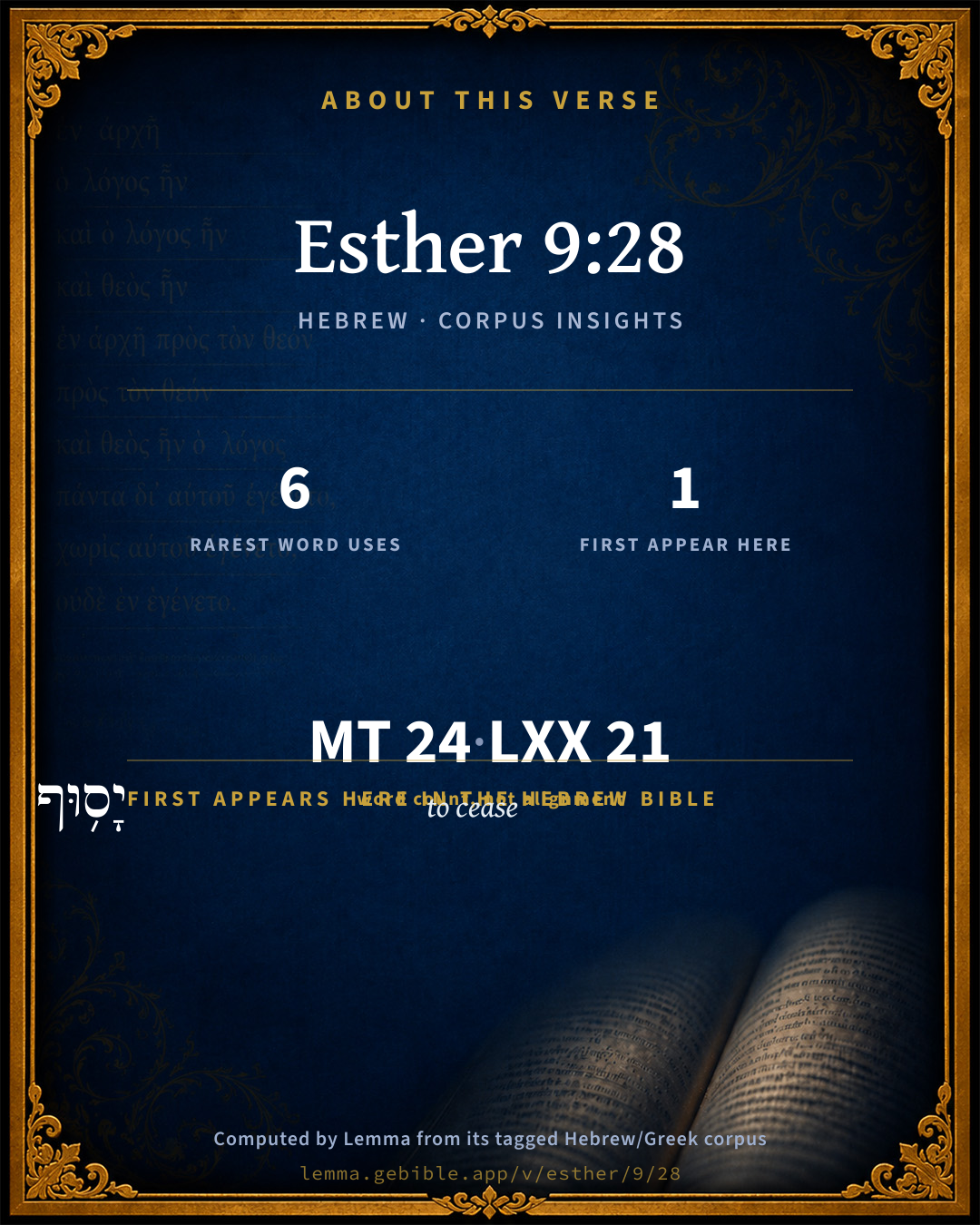
The rarest word here is יָס֥וּף to cease H5486 — appearing just 6 times in the whole Hebrew Bible.

First appearance in Scripture

This word makes its first canonical appearance in the Hebrew Bible here:

  • יָס֥וּף to cease H5486

Shared distinctive vocabulary

יָס֥וּף to cease H5486 occurs in 6 verses of the Hebrew Bible. Also found in:

Grammatical profile

  • 4 verbs
  • 16 nouns
  • 2 pronouns
  • 2 particles

Verb forms

  • נִזְכָּרִ֨ים Niphal · Participle Passive
  • וְנַעֲשִׂ֜ים Niphal · Participle Passive
  • יַֽעַבְרוּ֙ Qal · Imperfect
  • יָס֥וּף Qal · Imperfect

Repetition

Words recur within this verse — often emphatic in Hebrew:

  • וְהַיָּמִ֣ים day H3117 ×2
  • דּ֣וֹר generation H1755 ×2
  • מִשְׁפָּחָה֙ family H4940 ×2
  • מְדִינָ֥ה province H4082 ×2
  • וְעִ֣יר city H5892 ×2
  • הָ֠אֵלֶּה these H428 ×2
  • לֹ֤א not H3808 ×2

Hebrew & Septuagint length

In English translation the verse runs 41 words from the Hebrew and 22 from the Septuagint (LXX English) — the Septuagint runs noticeably shorter here. See the side-by-side →

A rough comparison of the two English renderings, which tokenize alike — not a word-level alignment.

Word counts can differ between the Hebrew and the Greek without any difference in meaning — e.g. the Hebrew direct-object marker אֵת has no separate Greek word, and Greek often adds the article ὁ.

In the original languages it is 24 Hebrew tokens and 21 Greek tokens — but the two are counted differently (Hebrew bundles its prefixes and suffixes into one token; the Greek is in lemma form), so that isn’t a like-for-like length.

Cross-references

6

Topical passages linked to Esther 9:28 in the Treasury of Scripture Knowledge — connected by theme and wording, ordered by reader-vote popularity; previews shown in the World English Bible.

  • Exodus 13:8–9 You shall tell your son in that day, saying, 'It is because of that which Yahweh did for me when I came forth out of Egypt.'
  • Joshua 4:7 then you shall tell them, Because the waters of the Jordan were cut off before the ark of the covenant of Yahweh; when it passed over the Jordan, the waters of the Jordan were cut off: and these stones shall be for a memorial to the children of Israel forever.
  • Psalms 78:5–7 For he established a testimony in Jacob, And appointed a law in Israel, Which he commanded our fathers, That they should make them known to their children;
  • Psalms 103:2 Praise Yahweh, my soul, And don't forget all his benefits;
  • Exodus 12:17 You shall observe the feast of unleavened bread; for in this same day have I brought your hosts out of the land of Egypt: therefore shall you observe this day throughout your generations by an ordinance forever.
  • Zechariah 6:14 The crowns shall be to Helem, and to Tobijah, and to Jedaiah, and to Hen the son of Zephaniah, for a memorial in the temple of Yahweh.

Cross-references courtesy of OpenBible.info (CC BY 4.0).

Hebrew and Greek witnesses Masoretic Hebrew ↔ Greek Septuagint

The same verse in the two great witnesses to the Old Testament, shown verse-for-verse.

Here the Septuagint runs noticeably shorter than the Hebrew — LXX2012 (modern English Septuagint) 22 words vs World English Bible 41. A rough length comparison of the two English translations, not a word-level alignment — read both below.

These are two independent witnesses, not word-aligned to each other, and the Septuagint is shown in lemma (dictionary) form.

Hebrew Esther 9:28 Masoretic · Westminster Leningrad Codex

וְהַיָּמִ֣ים הָ֠אֵלֶּה נִזְכָּרִ֨ים וְנַעֲשִׂ֜ים בְּכָל דּ֣וֹר וָד֗וֹר מִשְׁפָּחָה֙ וּמִשְׁפָּחָ֔ה מְדִינָ֥ה וּמְדִינָ֖ה וְעִ֣יר וָעִ֑יר וִימֵ֞י הַפּוּרִ֣ים הָאֵ֗לֶּה לֹ֤א יַֽעַבְרוּ֙ מִתּ֣וֹךְ הַיְּהוּדִ֔ים וְזִכְרָ֖ם לֹא יָס֥וּף מִזַּרְעָֽם

and that these days should be remembered and kept throughout every generation, every family, every province, and every city; and that these days of Purim should not fail from among the Jews, nor the memory of them perish from their seed.

World English Bible · Public Domain

Greek LXX Esther 9:28 Septuagint · lemma form

ὁ δέ ἡμέρα ἑαυτοῦ ὁ φρουραι ἄγω εἰς ὁ ἅπας χρόνος καί ὁ μνημόσυνον αὐτός οὐ μή ἐκλείπω ἐκ ὁ γενεά

And these days of the Phrurae, said they, shall be kept for ever, and their memorial shall not fail in any generation.

LXX2012 (modern English Septuagint) · Public Domain

Hebrew: Westminster Leningrad Codex (CC BY 4.0). Greek: Septuagint (public domain); English from LXX2012 (modern English Septuagint) (Public Domain). How the Septuagint differs from the Hebrew →

Commentary

Notes on Esther 9:28 from classic Christian and Jewish commentators (each source and its license shown beneath its notes). The classic Christian expositions comment on the surrounding passage and are grouped to its opening verse, so a note may address several verses; the Jewish commentaries on the Tanakh (Rashi and others) are per-verse, so they appear only where the commentator wrote on this verse.

Lemma curates 59 commentaries, every one of them public domain or Creative Commons licensed, each selected and text-cleaned for this edition rather than reprinted as found. About our sources →

Trapp's Complete Commentary

John Trapp

Est 9:28 And [that] these days [should be] remembered and kept throughout every generation, every family, every province, and every city; and [that] these days of Purim should not fail from among the Jews, nor the memorial of them perish from their seed.

Ver. 28. And that these days should be remembered] That the memory of them might be kept afoot in the Church to all perpetuity. Nothing is sooner forgotten than a good turn received. David found himself faulty this way, and, therefore, sets the thorn to the breast, Psa 103:2. Other holy men kept catalogues (see one of God’s own making, Jdg 10:11-12). They also had their μνημοσυνα, or memorials, as is before noted. The very heathens had their triumphal arches, pillars, trophies, tables, histories, annals, ephemerides, &c. A foul shame for us to fall short of them, and not to wish, as Job in another case, Oh that God’s works of wonder for us were now written. "Oh that they were printed in a book! that they were graven with an iron pen and lead in the rock for ever!" Job 19:23-24. That famous fifth of November especially, which drowns in a manner the memory of all former deliverances; as the return out of Babylon did the departure out of Egypt, Jer 23:7. This happy day, too much slighted, alas, in many places already, should never be put out of the English calendar while the sun courseth about the earth; but be registered for the generation to come, that the people which shall be created may praise the Lord, Psa 102:8. (This was written Nov. 5, 1653.)

Every family, every province, and every city] They should all recognize their late danger, and thereby the better relish their deliverance, as Samson did his honeycomb, which he found by turning aside to see the lion he had escaped. Every man was to consider his own share in the public safety, as the people did at Solomon’s coronation, and to be particularly thankful. This would fortify his faith, feed his hope, nourish his joy, further his obedience.

John Trapp, A Commentary or Exposition upon All the Books of the Old and New Testament (1647–1656) — public domain. Text from a community e-Sword module.

Joseph Benson's Commentary

Est 9:28. That these days should be remembered and kept — That the memorial of these great things, which God had done for his church, might never perish. For if God work wonders for a day, it is that they may be had in everlasting remembrance. Every family, every province, every city — Accordingly, even the women and little children, nay, such as were base- born and servants, were bound to keep this feast.

Joseph Benson's Commentary on the Old and New Testaments (1811–1818) — public domain. Text from a community e-Sword module.

John Gill's Exposition

And he sent letters unto all the Jews,.... That is, Mordecai did, signed in the queen's name, and his own:

to the hundred twenty and seven provinces of the kingdom of Ahasuerus; among which was Judea, that was become a province, first of the Chaldean, now of the Persian empire, see Ezr 5:8 to whom also these letters were sent, directing and ordering the Jews there to observe these days, who were also concerned in the deliverance wrought:

with words of peace and truth exhorting them to live in peace with one another, and their neighbours, and to constancy in the true religion; or wishing them all peace and prosperity in the most loving and sincere manner.

John Gill's Exposition of the Whole Bible (1746–1763) — public domain (CC PDM 1.0). Text via the HelloAO Bible API.

Haydock's Catholic Bible Commentary

Ceremonies. The king also enjoined (chap. xvi. 22.) all his subjects (Tirinus) to keep a day of rejoicing, (Haydock) as the death of Aman was deemed a public benefit. (Calmet)

George Leo Haydock (1774–1849), Haydock's Catholic Family Bible and Commentary, 1859 edition — public domain. Excludes Psalms (Douay-Rheims chapter numbering differs from Protestant) and Deuterocanonical books (Catholic canon only).

Whedon's Commentary on the Bible

Daniel D. Whedon

28. Nor the memorial of them perish — Great events are appropriately commemorated by significant monuments or institutions. Such memorials were the monumental stones and great altar at Jordan. Jos_4:7-8; Jos_22:10. But memorials of wood and stone will sooner or later perish, and those erected by the Jordan have long since disappeared. More permanent are such memorials as the Jewish Passover and Purim, and the Christian Eucharist. The continued observance of Purim to this day is a monumental proof of the truth of this history.

Daniel D. Whedon (gen. ed.), Commentary on the Old and New Testaments (1874–1909) — public domain. Text from a community e-Sword module.

The Pulpit Commentary

That these days should be remembered and kept throughout every generation, every family, etc. The universal adoption of the Purina feast by the Jewish nation, originating as it did at Susa, among the Persian Jews, never a very important part of the nation, is a curious fact, and is certainly not satisfactorily accounted for by the beauty and popularity of the Book of Esther (Ewald), nor by the dignity and power of Mordecai. Mordecai had no ecclesiastical authority; and it might have been expected that the Jews of Jerusalem would have demurred to the imposition of a fresh religious obligation upon them by a Jew of the Dispersion, who was neither a prophet, nor a priest, nor even a Levite. The Jews of Jerusalem, in their strongly-situated city, which was wholly theirs, and with their temple-fortress complete, (Ezr_6:15) can scarcely have felt themselves in much danger from an attack which was to have begun and ended in a day. But Joiakim, the high priest of the time, (Neh_12:10-12) to whom, as we have seen ("Introduction," the Book of Esther was attributed by some, must have given his approval to the feast from the first, and have adopted it into the ceremonial of the nation, or it would scarcely have become universal. Hooker ("Eccl. Pol.," 5:71, rightly makes the establishment of the feast an argument in favour of the Church"s power to prescribe festival days; and it must certainly have been by ecclesiastical, and not by civil, command that it became obligatory. That these days should not fail, nor the memorial of them perish. As a commemoration of human, and not of Divine, appointment, the feast of Purim was liable to abrogation or discontinuance. The Jews of the time resolved that the observance should be perpetual; and in point of fact the feast has continued up to the present date, and is likely to continue, though they could not bind their successors.

A holy memorial.

Memory is a Divine gift, to be used for the glory of the Giver. Every individual has his memories; for his past life has been marked by events important to himself, and worthy of being now and again recalled to awaken gratitude, humility, confidence. Every family has its memories; and domestic anniversaries may be observed with advantage, especially to the young. Every nation has its memories of great reigns, great deliverances, great conquests, etc. Every religion has its memories of its founder, its fundamental facts, its triumphs. The Jews had reason to remember Purim.

I WHAT IS SPECIALLY WORTHY TO BE REMEMBERED? Our deliverances. God"s mercies.

II WHY SHOULD SUCH THINGS BE REMEMBERED? To encourage us to the exercise of devout gratitude. To foster our trust and faith in him whose mercies we call to mind. To honour God. "Forget not all his benefits.

III How SHOULD HOLY MEMORIALS BE OBSERVED?

1. With sacrifices of praise. "Let us exalt his name together." "The Lordbath done great things for us, whereof we are glad.

2. With gatherings of fellowship. Where mercies have been experienced incommon they should be acknowledged in common. There is something inspiring and elevating in the celebration, by a multitude, of a great event, a signal mercy. So with the observance of the Lord"s Supper.

3. With tokens of practical kindness. Festivals are holy in proportion asthose who take part in them are unselfish, disinterested, and kind.

4. With especial reference to the young. In youth public observancesimpress themselves upon the memory. The Jews took pains to instruct their children in the meaning of the passover and the other national festivals. Thus the perpetuity of the memorial is secured. We should celebrate God"s loving-kindness, and "tell it to the generation following."

The Pulpit Commentary (1880–1919), ed. H.D.M. Spence-Jones & Joseph S. Exell — public domain. Text from a community e-Sword module.

Keil & Delitzsch

C. F. Keil & F. Delitzsch

And that these days should be remembered and kept throughout every generation, every family, every province, and every city; and these days of Purim are not to pass away among the Jews, nor their remembrance to cease among their seed. The participles ונעשׂים נזכּרים still depend on להיות, Est 9:27. Not till the last clause does the construction change in להיות לא to the temp. finit. יעבור ולא is a periphrasis of the adverb: imperishably, inviolably. כּכתבם, secundum scriptum eorum, i.e., as Mordochai had written concerning them (Est 9:23). כּזמנּם, as he had appointed their time. מן סוּף, to come to an end from, i.e., to cease among their descendants.

Keil & Delitzsch — Biblical Commentary on the Old Testament (1861–1891) — public domain (CC PDM 1.0). Text via the HelloAO Bible API. (Old Testament only.)

Rashi

Rabbi Shlomo Yitzchaki (Rashi)

remembered with the reading of the Scroll [of Esther].

and celebrated feasting and rejoicing and a festive day, to give portions [of food to friends] and gifts [to the poor].

every family gather together and feast and drink together, and so they took upon themselves that the Purim days would not be revoked.

shall not cease Heb. לֹא יָסוּף. This is the Aramaic translation of יִתֹּם, will end, for the Targum of (Deut. 2:14) “עַד תֹּם” is עַד דְסַף, until it finished, and it is impossible to say that it is derived from the same root as (Gen. 19:15): “lest you perish (תִּסָפֶה),” or from the same root as (I Sam. 27:1): “Now I shall perish (אֶסָפֶה) one day,” for if that were so, Scripture should have written: לֹא יִסָפֶה מִזַרְעָם.

Rashi on the Tanakh — English translations: “The Judaica Press complete Tanach with Rashi, translated by A. J. Rosenberg” (CC BY 4.0); “Pentateuch with Rashi's commentary by M. Rosenbaum and A.M. Silbermann, 1929-1934” (public domain); “The Metsudah Tanach series, Lakewood, N.J” (CC BY 4.0); and “The Book of Joshua, Metsudah Publications, 1997” (CC BY 4.0). Text via Sefaria.

Lesson kit

Teaching starters — assembled from the data on this page, not authored interpretation. Every prompt links to the verse data it draws on. Edit before teaching.

Esther, in the Historical, opens this verse with 24 words (17 distinct Hebrew lemmas). Its most distinctive word is çûwph (“to cease”). The Greek Septuagint runs shorter here. A historical commentator’s framing appears above. Read the whole chapter for the surrounding context.

Discussion questions

  1. How does “to cease” (çûwph) shape what this verse is saying?
  2. The word “to cease” first appears here in Scripture. What is being introduced at this debut?
  3. Psalms 73:19 shares the word «to cease» with this verse. How do the two illuminate each other?
  4. “day” occurs 2× in this one verse. What is the effect of the repetition?
  5. Compared with the Hebrew, the Septuagint runs shorter here. What questions does that raise?
  6. The translations on this page render this verse differently — a whole-verse word diff, not a word-by-word alignment. What might account for the different wordings?
  7. The verb «נִזְכָּרִ֨ים» is Niphal Participle Passive. How does its form color the action?
  8. Reading how Trapp's Complete Commentary and Joseph Benson's Commentary read this verse, where do the two commentators agree and where do they part?

Things to notice

Reading settings

Reading text

Shown beneath each verse's original-language words.

Old Testament
Old Testament edition

Read the OT as the Masoretic Hebrew (MT) or the Greek Septuagint (LXX).

English shown for the Greek Septuagint (in the Hebrew ↔ Greek comparison).

Comparing translations? Open the Compare panel on any verse page to stack up to four side by side.